
Sponsored

0W-40 in PUG 3.6

ShadowsPapa

Well-Known Member
First Name
Bill
Joined
Oct 12, 2019
Threads
247
Messages
40,442
Reaction score
53,860
Location
Runnells, Iowa
Vehicle(s)
'25 JTMX, '23 JLU 4xe, '82 SX4, '73 Javelin
Occupation
Retired auto mechanic, frmr gov't ntwrk security admin
Vehicle Showcase
3
maybe higher oil pressure. But, I do not know the clearances, or if they would matter for the 3.6 PUG.
Oil pressure is regulated, so will top out at least under 3,000 RPM, regardless. It will result in lower volume of oil and added heat.
Will it eventually impact the phasers and VVL system? Only time will tell, FCA says yes in their documents.

I really wish the sump temperatures could be monitored on these. People may be surprised..........to find much higher temps with heavier oil.
The oil life monitor and recommended change intervals are made for 0w20 so anything heavier I'd absolutely change a lot more frequently.
Sponsored
 

ShadowsPapa

Well-Known Member
First Name
Bill
Joined
Oct 12, 2019
Threads
247
Messages
40,442
Reaction score
53,860
Location
Runnells, Iowa
Vehicle(s)
'25 JTMX, '23 JLU 4xe, '82 SX4, '73 Javelin
Occupation
Retired auto mechanic, frmr gov't ntwrk security admin
Vehicle Showcase
3
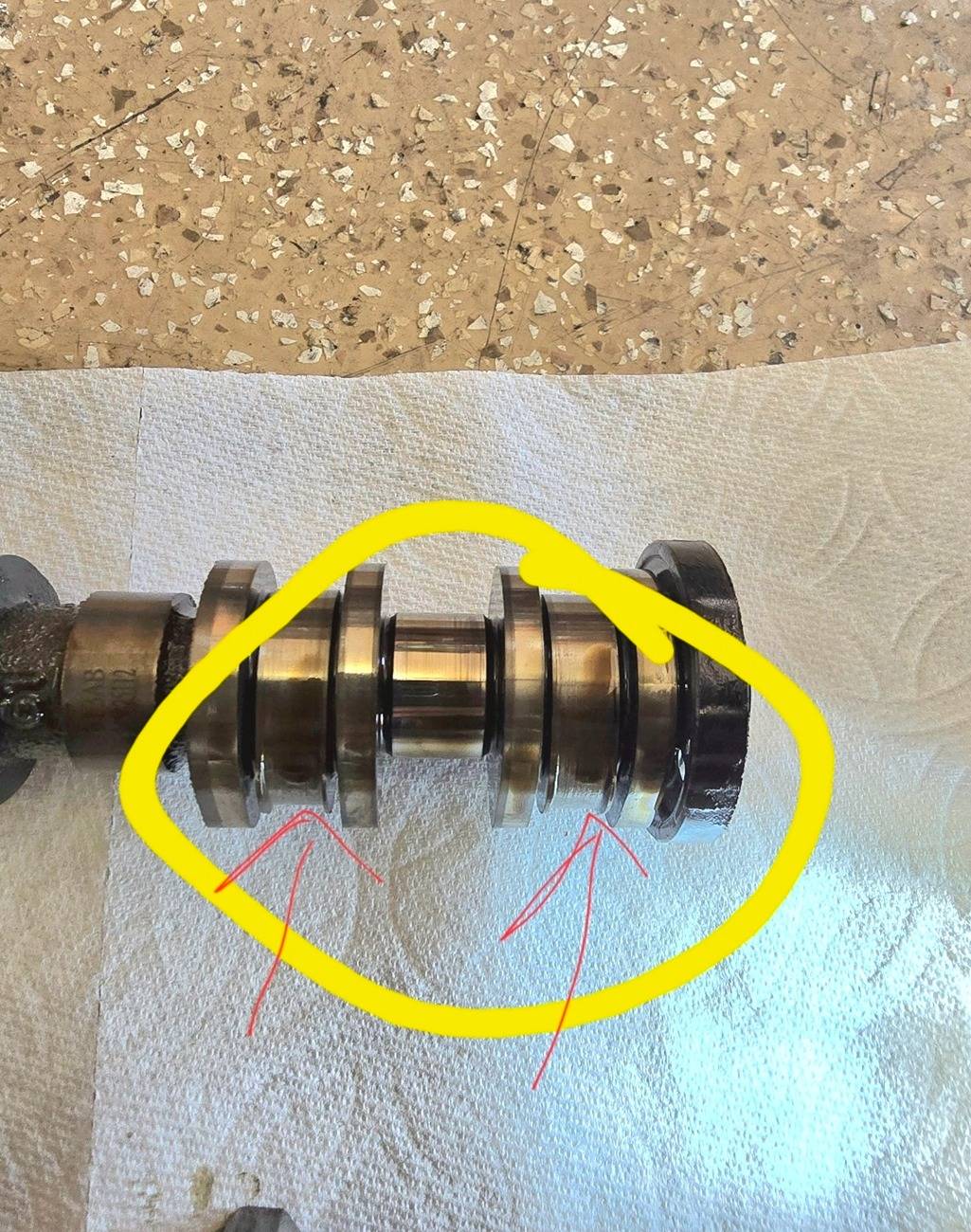
Would this be the high lift portion?
I thought this was caused by the rocker.
1000030331.jpg
The center is the high lift portion.
It's supposedly a CAM issue - according to FCA. And that's how I lean on it following the issue for several years now and talking to others about it.

The outer two/pair of lobes is the low lift and the rollers run on those areas.
(and notice the rollers do not fail on these)
 

Biff Happy

Well-Known Member
Joined
May 3, 2021
Threads
7
Messages
116
Reaction score
199
Location
Around the corner
Vehicle(s)
Jeep Truck
I’m thinking about trying 40w70 oil. Do you agree that thicker is better? The way I figure is if the oil industry produces this oil, then it’s out there for reason, and the reason is it’s better.
you can probably get better viscosity and really lube those cams and probably even skip a few oil changes.
I can’t wait for those oil analyses to prove my point, then I’m looking forward to using YT to get some likes. I’ll send a link to follow me.
 

ShadowsPapa

Well-Known Member
First Name
Bill
Joined
Oct 12, 2019
Threads
247
Messages
40,442
Reaction score
53,860
Location
Runnells, Iowa
Vehicle(s)
'25 JTMX, '23 JLU 4xe, '82 SX4, '73 Javelin
Occupation
Retired auto mechanic, frmr gov't ntwrk security admin
Vehicle Showcase
3
I’m thinking about trying 40w70 oil. Do you agree that thicker is better? The way I figure is if the oil industry produces this oil, then it’s out there for reason, and the reason is it’s better.
you can probably get better viscosity and really lube those cams and probably even skip a few oil changes.
I can’t wait for those oil analyses to prove my point, then I’m looking forward to using YT to get some likes. I’ll send a link to follow me.
Jeep Gladiator 0W-40 in PUG 3.6 1753757806670-1h
 

MT1

Well-Known Member
First Name
Matthew
Joined
Apr 10, 2024
Threads
1
Messages
133
Reaction score
140
Location
So Cal
Vehicle(s)
2023 JTR
Occupation
Software
I’m thinking about trying 40w70 oil. Do you agree that thicker is better? The way I figure is if the oil industry produces this oil, then it’s out there for reason, and the reason is it’s better.
you can probably get better viscosity and really lube those cams and probably even skip a few oil changes.
I can’t wait for those oil analyses to prove my point, then I’m looking forward to using YT to get some likes. I’ll send a link to follow me.
Nah, for total overkill protection, step up to at least 75W90.

Kidding aside, yes, there too much of a good thing

The dividing point on these discussions seem to be trusting the manufacturer to do what is right for the manufacturer, or what is right for the customer. But, there is also which customer?

Most Jeeps, according to Jeep, never go off road, "Mark Allen, head of design at Jeep, told ABC News in September 2019 that approximately 10% to 15% of Wrangler owners will take them off-roading."

If 85-90% of the vehicles will be driven on road in light conditions, the manufacturer would aim for getting the +1 MPG to make the EPA or whoever happier. So we get 0W20 recommended. This is also why we have ESS.

The other 10-15% are looking to keep their engines alive longer, while also really working them.

Then some supplier gets metallurgy/manufacturing incorrect resulting in failures, and another manufacturer gets a design incorrect with a temporary fix of changing from 0W20 to 0W40. And the result is that the simple "which grade should I use for my usage?" becomes a mess.

It should be simple, from the manufacturer, if normal usage 0W20 (or whatever), if fleet/towing/offloading +50%, use 0W30/40(whatever). Else, admit you built for the for the street and light usage, and fleet/towing/offloading +50% should change the oil at 3k miles.
 

Sponsored

OP
OP

Gladiator007

Member
Joined
Jul 27, 2025
Threads
1
Messages
21
Reaction score
35
Location
OR
Vehicle(s)
2025 Gladiator
5w30 AMSOIL - signature.
Mobil 1 and Amsoil are supposedly less prone to viscosity breakdown over time than others. (to do with the base oils and chemistry from there)
Unless you see temps below 40 or so the 5w is likely fine.
If where you live in AZ gets colder when you start it up cold start, then 0W but my experiences in AZ suggest it's usually not that cold even at night in the areas I was in
There are other great oils, but AMSOIL is right up there and since YOU mentioned it - yeah.
The 3.6 is not known to mechanically shear(break down) oil except in one case, and that is if one is a chronic short tripper specially in the winter. Fuel is what thins out the oil. Other than that no shearing happens. You should know better. Or you are just used to Blackstone reports that 99% of the times report incorrect viscosity value and folks mistake that for viscosity loss due to mechanical shearing. Blackstone is a waste of money. Oil Analyzers are better and they also do an accurate test for fuel dilution.
 

Lost1wing

Well-Known Member
First Name
Tim
Joined
Dec 22, 2020
Threads
24
Messages
2,608
Reaction score
2,852
Location
West Georgia
Vehicle(s)
2020 Jeep Gladiator Rubicon
Occupation
Retired AMT
I have been using 5w30 in my Ford 4.6l since it was new. At 250k it experienced an overheat from a major coolant leak. The engine survived but the overheat cooked the seals and created leaks. I did end up with some tensioner wear but that is very common even with the proper oil. That engine is relatively basic compared to our 3.6l. With no real answer as to what is causing the rocker/cam failures on the 3.6l, I'll just stick to the proper (hydraulic fluid). I would like to buy just 1 oil for my gas engines and 1 oil for the diesels.​
I don’t know about trolling. I think it is easy to only look for reasons to support your claims and ignore the facts that don’t support your claim. One thing for sure, the OP is being informed. I'll bet he will be just fine.​
I did read an article supporting the claim that the heavier weight oil can carry a​
way more contaminants due to the thicker film. The lighter weight oils require sooner oil changes for this reason. This was from a machinery article and not the automotive industry.​
 

PuddleJumper

Well-Known Member
First Name
Cortlund
Joined
Jan 17, 2024
Threads
68
Messages
2,540
Reaction score
3,373
Location
Alexandria, Virginia
Vehicle(s)
23' JTM, 22' JTR, 22' F56S,
Build Thread
Link
Occupation
STACK Infrastructure Critical Operations Technician
Vehicle Showcase
1
Why would you? No gain.
I laugh when people say "oil is oil" - funny stuff. They are negating all of the engineering that goes into the oil and the engines and the fact that the oil companies work with the engine designers to come up with the best oil for a given engine design.
Funny - all of the arm-chair engineers. They also can't say at all what's happening to the engine over time and ignore the testing that has proven thicker oil runs hotter at critical points in the engine, and that means - the oil should be changed SOONER than if you run the correct oil.
And then there's the response times of the phasers, multi-mode intake followers (high and low lift mode), the oil control solenoids that are made to hold specific oil in the intake follower systems based on the viscosity recommended, the fact that heavier oil won't spray as well at the parts it's supposed to cool and lubricate. Thus - you run certain parts HOTTER, likely shortening engine life.
There's also higher bearing temperatures due to the shear forces of the heavier oil, how it balls up going into bearings and between surfaces it's supposed to protect (there's videos out there on this topic)

Funny shit here.

What is up with the obsession with 40 weight oils when back in the 70s and 80s, 30 weights were recommended. Why would we run oil heavier than 45 years ago? These are very different engines with very different bearings, and different clearances, FLOW needs and more. Thicker oil flows more slowly, so you figure it out.

Amusing.

Do what you want (it's YOUR Jeep!), but don't think for a minute you are doing anything smarter or better or helping anything at all.
I change oil every 3500-4000 miles. 0w-20 is usually what ends up in there. But everytime i sent in oil to blackstone. Regardless of weight it always had the same amount of wear metal present. As long as it meets or beats the required MS-6395 rating. Its been negligible in difference. Now at say a 10k interval, i wouldn't know and can't say. oil temp and pressure at the sensor have stayed the same. Now at the bearings and whatnot that you've mentioned, idk. All I know is that wear didn't increase, that tells me the engine has quite a range of tolerance. Time will tell. I'm under no delusion that changing oil weight improves anything. My only rule is don't run thinner than the manufacturer recommendation. I just had a random assortment of oil bottles lying around for vehicles I no longer had, and took a gamble. I could see higher viscosity oil increasing the amount of varnish and deposits. The oil test did prove that the higher weight oils degraded marginally quicker, but that could also be attributed to what i was doing with the truck during that 3500-4000 miles. Was I towing? Snow wheeling. I don't remember but it changes oil degradation rate nonetheless right? I have 5w-20 with a bottle of mystery oil tossed in rn. After that I only have non synthetic oil lying around. I won't run those, so back to 0w-20 she'll go. Ultimately, its a Jeep. We'd like to think that if you did everything right and to the book it'll all work out. But there are guys who do that and their Jeep lives at the dealer more than not. Then there are guys who neglect everything and sometimes do the bare min. Somehow their truck is at 120k and still pushing with no issues. Yes there is science, and its wise to understand it like yourself. But dumb luck and ignorance has gotten people just as far. Whats the saying?
“According to all known laws of aviation, there is no way that a bee should be able to fly. Its wings are too small to get its fat little body off the ground. The bee, of course, flies anyways. Because bees don't care what humans think is impossible.”
 

ShadowsPapa

Well-Known Member
First Name
Bill
Joined
Oct 12, 2019
Threads
247
Messages
40,442
Reaction score
53,860
Location
Runnells, Iowa
Vehicle(s)
'25 JTMX, '23 JLU 4xe, '82 SX4, '73 Javelin
Occupation
Retired auto mechanic, frmr gov't ntwrk security admin
Vehicle Showcase
3
I have been using 5w30 in my Ford 4.6l since it was new. At 250k it experienced an overheat from a major coolant leak. The engine survived but the overheat cooked the seals and created leaks. I did end up with some tensioner wear but that is very common even with the proper oil. That engine is relatively basic compared to our 3.6l. With no real answer as to what is causing the rocker/cam failures on the 3.6l, I'll just stick to the proper (hydraulic fluid). I would like to buy just 1 oil for my gas engines and 1 oil for the diesels.​
I don’t know about trolling. I think it is easy to only look for reasons to support your claims and ignore the facts that don’t support your claim. One thing for sure, the OP is being informed. I'll bet he will be just fine.​
I did read an article supporting the claim that the heavier weight oil can carry a​
way more contaminants due to the thicker film. The lighter weight oils require sooner oil changes for this reason. This was from a machinery article and not the automotive industry.​
Automotive oil and the operating conditions are different. The anti-oxidants break down with heat and thicker oil will run hotter at some areas, leading to faster breakdown of the oil. So changes should be done more frequently with thicker oil if it's more than 1 grade higher, especially.
I probably shouldn't have used the word "shear" as these don't do what some Porsche engines do - shear the oil to death, but it's still that same effect in a way, the friction generated by the thicker oil increases the temperature of the oil in that area - bearings, for example, will run hotter because of the added friction and the inability of the oil to carry away the heat fast enough.

From AMSOIL themselves -
Jeep Gladiator 0W-40 in PUG 3.6 1753795526252-7


You can reach the threshold of thermal breakdown faster with a thicker oil (when I say "thicker", I mean jumping 2 grades up, from a 20 to a 40, for example. 20 to 30 should be of little issue)

From BITOG - (some funny stuff there, too. It's just ordinary people responding in most cases, so be careful what you take from there. )
Jeep Gladiator 0W-40 in PUG 3.6 1753795971170-l8


Jeep Gladiator 0W-40 in PUG 3.6 Screenshot 2025-07-29 081714


Jeep Gladiator 0W-40 in PUG 3.6 Screenshot 2025-07-29 081929


Little problem if any at all with the move from 0w20 to 0w30 or even 5w30 in the heat of AZ but going 2 grades according to real experts can be problematic in both short term oil life and long term engine life.

But....but....but my engine doesn't run hotter!
No, because the cooling system is keeping up or head of the BTUs of heat being generated.

But...but...but my oil temp gauge isn't reading higher!
No, because of where it's being sensed, and because we have an oil cooler.
We risk running certain parts of the engine hotter - not the heat measured at a single location at the thermostat or the back of the head, but localized heat, due to the thicker oil not carrying it away, or even causing that heat.
You may see only 240 degrees oil temperature, but localized conditions can take it to closer to 280 or higher, so bits of that oil reach thermal breakdown, impacting anti-oxidizing chemicals, etc.
 

Sponsored

FrankFrqnkFrank

Well-Known Member
First Name
John
Joined
Dec 20, 2020
Threads
30
Messages
339
Reaction score
356
Location
NW IN
Vehicle(s)
2021 Willys Gladiator
I think we’ve all operated out vehicles outside of the engineers’ specs without precipitating calamity. Expeditors in Promasters using the pre-PUG Pentastars easily get 600k miles out of their engines. I suspect few of them change oil before the monitor tells them to and many of them exceed the use recommendation

and at least one groups of oil engineers for the GM 6.2 liter V8 wasn’t infallible
 

Sandman 4x4

Well-Known Member
First Name
Kevin
Joined
Jul 23, 2024
Threads
0
Messages
687
Reaction score
560
Location
Kissimmee, Florida
Vehicle(s)
2024 Gladiator Sport S
Occupation
Retired. Beach bum.
I believe them on the parasitic loss and the eddy/nip build up at the entry point between the 2 rolling surfaces . Makes total sense . I got 130k I will stay with 0W-20 . I aint claiming anything or promoting Amsoil . But I habe been using it since the very forst oil change works for me.
And dont believe that crap about use conventional for X-amount of miles before switching or the rings won't seal thats more silliness.
I would appreciate if corrected, but a knowledgeable person told me the oil that comes with the new engines do have some differences that will allow rings to seat properly, without over lubrication. That’s it’s a good idea to go at least 1,000 miles before the first change.
 

ShadowsPapa

Well-Known Member
First Name
Bill
Joined
Oct 12, 2019
Threads
247
Messages
40,442
Reaction score
53,860
Location
Runnells, Iowa
Vehicle(s)
'25 JTMX, '23 JLU 4xe, '82 SX4, '73 Javelin
Occupation
Retired auto mechanic, frmr gov't ntwrk security admin
Vehicle Showcase
3
I would appreciate if corrected, but a knowledgeable person told me the oil that comes with the new engines do have some differences that will allow rings to seat properly, without over lubrication. That’s it’s a good idea to go at least 1,000 miles before the first change.
They aren't really all that knowledgeable if they still believe that.
It's the same oil.
The rings are seated by the time you get it. (or should be). And factory machined surfaces in the cylinders are not like they were 70 years ago, neither are the low tension rings used today.

Any oil that will "allow ring seating" is also going to allow excessive wear everywhere.
Break-in oil is a myth. Yes, you can buy it, but it's only sold because some still believe in it. It's an oxymoron - if you have an oil that allows for more wear, then you are allowing for more wear everywhere, and what exactly is the limit? When do you say enough is enough? Miles? Can't do that because you can drive easy miles with little load and cause less wear - or you can drive the same miles with heavy throttle and heavy loads and cause a whole lot of wear.

People who have built engines (me, included) run the same oil we're going to run.
If the engine calls for 10w30 (like my 73 360 or my 4.0 and so on), then it gets the same 10w30 I'll run in it forever.

it's not a bad idea to change that first fill earlier than normal, but there's nothing about the factory fill that will break rings in. Some people take that first fill out to the oil life monitor warning - and if that factory fill was different, the rings would be pretty well worn down.
The reason to change it a bit sooner is because it will have more of the worn off material than later oils will have. I never take the first oil out to the end of oil life monitor.

That myth of break-in oils was disproven in our college classes, and in our college books, and in the fact that engine builders use the same oil you will run with it later.
The process for ring seating or break-in is only minutes long and I've posted it around here somewhere before - it includes heavy throttle acceleration up to about 50 mph several times, not letting it downshift, but not lugging it, either, to force high combustion pressures to force the rings outward against the cylinder walls.

I also have a snippet from a Ford owners manual stating that "no further break-in is necessary", drive as usual, change oil as usual.

But those break-in myths persist, holding over from the 50s, I guess. Modern methods and modern rings just don't require anything special.

and at least one groups of oil engineers for the GM 6.2 liter V8 wasn’t infallible
LOL - sorry, no. That was a manufacturing defect from the word go. It was never about oil. Watch the Motor Oil Geek talk about that topic, and find the facts. The machined surfaces were wrong. They tossed out a BAND AID solution of thicker oil to mask the issue. Once the issue is resolved, guess what - they go right back to the same specified oil as before. The engineers made no mistakes, the original oil spec wasn't a mistake - the people in charge of the crankshaft machining were making mistakes.
So, GM hid the problem using thicker oil like people used to toss STP in to hide a bit of rod knock.
If the engine was replaced or repaired, the instructions were to put the original oil cap with the original oil spec back on the new engine. The thicker oil was basically putting motor honey in to kick the can down the road so they weren't flooded with thousands of repairs all at once.
There's big discussions here on that topic I suspect you missed.
It was never about the oil, it was about GM fucking up the crankshaft finish, masking the issue with thicker oil, then if the engine finally did fail and get replaced, go back to the correct oil.
It was a bandaid, nothing more.
Sponsored


Top