mike921921
Well-Known Member
I drive a 2020, came from a WK2, and am pleasantly surprised - I read a bit of negatives (prior to purchase) about handling/noise/drive ability and found it's really not that bad.
Sponsored

The nitrogen thing is a myth. Google Boyle's Ideal Gas law. Pressure goes up with temperature. The pressure change with Nitrogen vs with air is because bottled nitrogen is dry. 0% humidity, which does increase the pressure change marginally. So rather than getting a 6 psi rise, you get a 5.8 psi rise.I set my own air after getting the Jeep home... but, long drives in the heat push that PSI up. Maybe I need to air up with nitrogen so there isn't a 3-6 psi difference based on temperature. Man, I hate that my tires creep up to 40 in the middle of a long drive. )c:
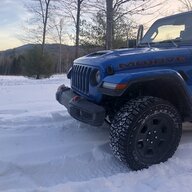
Hank, just curious what size tires you have and how much lift. ThanksJust completed a trip from Michigan to Minot North Dakota, to Deadwood South Dakota and back to Michigan. I loved the ride of my jeep. I have 0 wandering issues. The wind noise gets a bit much with the soft top at 83 mph but being able to have the top down at Custer State Park and Spearfish canyon were well worth it. Very happy with the Mojave.
Hank

I have 35's with no lift.Hank, just curious what size tires you have and how much lift. Thanks
Don
Thank you. The truck looks great with that combination. Itseems like a good compromise.A couple pics from the trip.
I have 35's with no lift.
Hank

Just google "air vs nitrogen tires" and you'll see some real world numbers that dispel the myth. The difference is miniscule - not worth the money and hassle.The nitrogen thing is a myth. Google Boyle's Ideal Gas law. Pressure goes up with temperature. The pressure change with Nitrogen vs with air is because bottled nitrogen is dry. 0% humidity, which does increase the pressure change marginally. So rather than getting a 6 psi rise, you get a 5.8 psi rise.
Tire temps are meant to be taken cold. That's just how it is. You don't need to compensate for anything. Tires don't get firmer on a long drive. If anything they get more compliant. The carcas of the tire is very stiff at ambient temps and becomes much more supple when its warmed up.
Again, this system is all engineered to be optimized at running temp, not ambient.

The nitrogen thing is a myth. Google Boyle's Ideal Gas law. Pressure goes up with temperature. The pressure change with Nitrogen vs with air is because bottled nitrogen is dry. 0% humidity, which does increase the pressure change marginally. So rather than getting a 6 psi rise, you get a 5.8 psi rise.
Tire temps are meant to be taken cold. That's just how it is. You don't need to compensate for anything. Tires don't get firmer on a long drive. If anything they get more compliant. The carcas of the tire is very stiff at ambient temps and becomes much more supple when its warmed up.
Again, this system is all engineered to be optimized at running temp, not ambient.
For non-competitive activities, there's really no need for nitrogen-filled tires. N2 comes from racing, where moisture definitely negatively affects tires.Just google "air vs nitrogen tires" and you'll see some real world numbers that dispel the myth. The difference is miniscule - not worth the money and hassle.
My Silverado came to me with nitrogen filled tires. There was a sticker on the driver side of the windshield. I don't know if that was factory or dealer, but the sticker sure "looked" factory.For non-competitive activities, there's really no need for nitrogen-filled tires. N2 comes from racing, where moisture definitely negatively affects tires.
But the main reason we use N2 in tires is to mitigate pressure build up from tire temps. Street cars on the roads aren't hitting the temperature race cars hit. Off-road tires aren't either.
For example, our race tires (10" wide on 15" rims, bias-ply) will hit 180-220* on a hot day by the time the driver gets back to the pits. On track, it's probably 230-250*. With N2, we start the cold pressures at 10-12* on the left, 18-20* on the rights... all depends on what you want your hot pressures to be.
Why do we care about pressures? For one, the rule of thumb is +2psi adds 25# of spring rate. Secondly, tire circumference changes with tire pressure. That dramatically changes how the car handles in racing. We've lost races because my tires were .25" too big on one side.
Atmospheric air (from a compressor) contains tons of water vapor. Atmospheric air expands greater than nitrogen. How much? On that rare occasion our N2 ran out and we had to run atmospheric... 6-10 pounds. In racing, that's a 75# stiffer car at each corner, with tires 1/4"-1/2" bigger. Which meant roughly .5% more swaybar preload and more stagger. Tight in, loose middle, loose off.
And to put things in comparison, just sitting in the sun the tires would gain 3-4psi. Mistakes are made if you set your pressures on tires that had been sitting in the sun.
I also owned a FJ55 for a while. Loved it!There is something to be said when the Gladiator is compared to one of the quirkiest cool vehicles out there, the VW van or bus 60's-70's. I can think of one other vehicle that holds that crown, the Toyota Land Cruiser FJ40 70's. the quirkiness is what gives them personality. So we deal with cross winds
30k miles later I still love it! I’d buy another without hesitation.I have to ask, being that your profile says you have a 2020 now - how do you like it? PLEASE forgive me if that's answered later in this thread, i'm going to go through it now and look LOL


