Sponsored

Regearing, where does the power come from?

kb5zcr

Well-Known Member
First Name
Tim
Joined
Sep 24, 2021
Threads
25
Messages
393
Reaction score
558
Location
Texas
Vehicle(s)
2023 Diesel Rubi Gladiator
Occupation
Retired
Ok, I've heard many say they regeared after getting bigger tires to get its drive ability back and are very happy with the results.
They say that the power is back and is similar to stock.

Ok, now to my questions for all the engineers and high thinkers out there.

A stock gladiator can run a 0-60 time of approx 8 seconds (https://www.zeroto60times.com/vehicle-make/jeep-0-60-mph-times/).
Has anyone found out what their larger tired, regeared, glad's 0-60 time is?

When one regears and says that they feel their lost power is back, where does this lost power come from?
I understand that the rolling mass with bigger tires has some effect and takes more power to get going.
It seems that regearing only puts you in a higher rpm for any given speed, and I get the engine makes more power as the rpm rises (within reason), is this where the lost power comes from?

I'd love to see 0-60 times from some users here to see the change from stock to regeared with larger tires.
I know these jeeps arnt speedsters, I just don't know any other way to compare before VS after a tire change and regear.
I'd like to get an idea of how much a regear with larger tires will change the drivability from stock.

Thanks,
Sponsored
 

Badunit

Well-Known Member
Joined
Jan 31, 2023
Threads
20
Messages
817
Reaction score
1,346
Location
USA
Vehicle(s)
2023 JT Rubicon, 1997 TJ
As you alluded to, regearing doesn't magically give the engine more hp, it is all in the increased rpms. For those with larger tires it also means making 1st low enough again and getting an extra gear because high gear had been so high it was rarely, if ever, used. However, regearing may also end up trading top speed mph for low speed "power". If geared too low (numerically high ratio), it will feel like a rocket (relatively speaking) but you'll be winding out the engine at highway speeds. You might be able to put on 37's and heavily regear and be able to beat a stocker from 0-60 but the stocker will be able to do 70-90 all day long while you cannot. It is conjecture on my part about who would actually win this race but the heavily regeared truck would have been able to shift through more gears, keeping the rpms more optimal.

The proper gearing for a given tire size is based on opinion. But if you regear so the rpms are the same as stock at each mph in the same gears, the stock truck will still be quicker. Larger, wider, and more aggressive tires require more power and lifted trucks have more drag.

I am planning on regearing my stock Rubicon from 4.10 to 4.56. My goal is not increased 0-60 time, it is to help it hold 8th at highways speeds and downshift less often.
 
Last edited:

Fly-by

Active Member
First Name
Jason
Joined
Oct 19, 2023
Threads
4
Messages
40
Reaction score
37
Location
Snoqualmie, WA
Vehicle(s)
2023 Jeep Gladiator Mojave 6MT
Occupation
Finance
Vehicle Showcase
1
Does anyone know if there a mathematical way to equate torque based on gear ratio? I have 5.38s scheduled for installation later this month in my 6 speed Mojave. Plan to keep stock 33s. I am really curious how this will compare to say a 5.7 with 3.21s in a Ram 1500.
 

ShadowsPapa

Well-Known Member
First Name
Bill
Joined
Oct 12, 2019
Threads
247
Messages
40,442
Reaction score
53,860
Location
Runnells, Iowa
Vehicle(s)
'25 JTMX, '23 JLU 4xe, '82 SX4, '73 Javelin
Occupation
Retired auto mechanic, frmr gov't ntwrk security admin
Vehicle Showcase
3
Ok, I've heard many say they regeared after getting bigger tires to get its drive ability back and are very happy with the results.
They say that the power is back and is similar to stock.

Ok, now to my questions for all the engineers and high thinkers out there.

A stock gladiator can run a 0-60 time of approx 8 seconds (https://www.zeroto60times.com/vehicle-make/jeep-0-60-mph-times/).
Has anyone found out what their larger tired, regeared, glad's 0-60 time is?

When one regears and says that they feel their lost power is back, where does this lost power come from?
I understand that the rolling mass with bigger tires has some effect and takes more power to get going.
It seems that regearing only puts you in a higher rpm for any given speed, and I get the engine makes more power as the rpm rises (within reason), is this where the lost power comes from?

I'd love to see 0-60 times from some users here to see the change from stock to regeared with larger tires.
I know these jeeps arnt speedsters, I just don't know any other way to compare before VS after a tire change and regear.
I'd like to get an idea of how much a regear with larger tires will change the drivability from stock.

Thanks,
It's the final ratio - the engine revolutions for a given number of feet forward.

If you start out with xx engine revolutions moving the truck 100 feet, then add larger tires, now the engine revolutions are reduced for the forward motion.
Regearing puts the engine speed back to where it belongs for a given road speed.

It's all math. No power is lost, no power is gained.
Think of the big tires as being like putting 2.73 gears in your truck - ugh.
It drops the engine speed for a given road speed. It's like shifting into high gear way too soon.
Swapping the gears puts the RPM back.
 

Sponsored

Rahkmalla

Well-Known Member
First Name
Jim
Joined
Oct 20, 2021
Threads
38
Messages
2,036
Reaction score
4,714
Location
NJ
Vehicle(s)
22 Gobi Manual Mojave
Build Thread
Link
gearing is a torque multiplier. You can directly multiply the input shaft times the gear ratio to get the output torque.

If you've ever dynoed a manual, you'll know that you're supposed to use direct drive (3rd on 4spds, 4th on 5spds, 4th on dual overdrive 6spds, and 5th on close ratio 6 spds) to avoid the gearing effect of the transmission affecting your results.

So what you're asking "where does the power come from" is nowhere. but where does the force come from? the answer is mechanical advantage.

BESIDES THAT, being able to use higher RPMs at lower speeds is helpful. But the mechanical advantage is a bigger piece of that in my eyes.

All you need to know about mechanical advantage can be learned from riding a 21 speed bike up and down hills. You're trading top speed for grunt. in 1-1 you can climb the mightiest of hills, but it's going to take you an hour. try to ride in 1-1 on flat land and you'll soon exceed your legs' ability to keep up with the speed of the pedals to create substantive force. pop it into 3-7 up a hill and you might as well be pedaling through a pool of mercury. You can stand on the pedal and maybe not move. Go down a hill and gravity will pull you faster than your legs can pedal 1-1, but get into 3-7 and you can fly.

The only difference between transmission ratios or cycling ratios and final drive ratios is how easily they can be changed.
 
Last edited:

Zachanadandy

Well-Known Member
First Name
Zach
Joined
Oct 17, 2023
Threads
4
Messages
2,997
Reaction score
4,742
Location
Patterson, ca
Vehicle(s)
2023 gladiator Mojave
Occupation
Electrical foreman
Went down this road in our 2019 JLUR. With the 2.0t, the superchips td3 93 octane tune, factory 4.10s, and 38s the best 0-60 I managed was 6.7s. Regeared to 5.38s and....7.0s. It was actually slower. The only great you gain any torque in is 1st gear, and it's already very low for an automatic. Early model jks had a 2.86-1 1st Gear. The 8 speed has a 4.7-1 1st Gear. You'd have to Gear a JK axle to 7.5-1 just to get it to match our 1st Gear with 4.10s. Crawl ratio was never an issue with the 4.10s either as the 4-1 transfer case gives it plenty. People say you gain a gear as you "rarely" see 8th with large tires. Conversely if you gear too low like I did, you're in 8th gear by 45mph. It defeats the purpose of having an 8 speed with 2 overdrive gears. Even coming down a long grade at 85 where you would have been at 2300rpms in 8th gear you're pushing near 3k as there's no upshift to be had. Whatever load you have will require a certain output from the engine, that output is determined by the rpms. The engine doesn't know if you're on 7th gear with 4.10s or 8th gear with 5.13s (approximately mathematically equal ratios). You gain in 1st Gear only, anywhere else it can downshift accordingly. Our 2022 xr JL is on 39s with the factory 4.56s and I have 0 desire to regear. My mojave isn't a crawler and will likely never see larger than 35s so I'll stick with the 4.10s.
 

MPMB

Well-Known Member
First Name
Michael
Joined
Apr 30, 2021
Threads
12
Messages
1,820
Reaction score
2,716
Location
Utah
Vehicle(s)
'21 JTR - SG
Occupation
Check your inbox.
Most people don't understand how changing gears works and where the power comes from. It's a secret, because most people don't *want* to know.

When gears are swapped out, they put in shorter gears. And tiny gnomes that assist the rotation of the gear. Special gnomes from the Baltic that can live in high temperature areas with little oxygen and massive amounts of petroleum products. Sometimes the gnomes go bad and become gremlins, and travel to other parts of vehicles and cause problems. We don't know what makes gnomes go bad. We do know that they love the sound of frustrated, clanking wrenches, busted knuckles, and people swearing.
 

Fly-by

Active Member
First Name
Jason
Joined
Oct 19, 2023
Threads
4
Messages
40
Reaction score
37
Location
Snoqualmie, WA
Vehicle(s)
2023 Jeep Gladiator Mojave 6MT
Occupation
Finance
Vehicle Showcase
1
Don’t do that unless you plan on 37’s or 40’s.
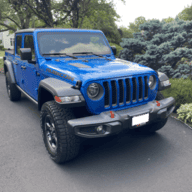
I've gone through the math and it should be ideal for my 75% off pavement (FS and logging roads), 15% in town, 10% highway, and 0% crawling use for the vehicle. I want good torque from 0-50 mph and 3k rpm max at about 75mph in 6th. It only looks like a radical change because these things are geared so wrong from the factory.

Jeep Gladiator Regearing, where does the power come from? 1698936846553
 

Sponsored

bleda2002

Well-Known Member
Joined
May 11, 2021
Threads
24
Messages
2,750
Reaction score
4,492
Location
34655
Vehicle(s)
2021 JTR Firecracker Red
This right here.

When you go to a lower ratio (numerically higher), you increase the torque multiplication.
Exactly, its not "higher engine rpm" its the mechanical advantage multiplying the torque. Gears multiply torque by using the mechanical advantage of the gear ratio. The torque at the output gear is equal to the torque at the input gear multiplied by the gear ratio.

An extra that can happen is that you can get the engine in a better RPM range so the input torque is higher (such as the pentastar that prefers high RPMS) but it can also be detrimental (such as the diesel that likes low RPM range).

This is similar to why its easier to torque to 250 ftlbs with a 3 foot torque wrench than a 12 inch torque wrench. I can only pull so hard, but the mechanical advantage of the longer lever means more force is applied at the output end.

Edit for Some Math about bigger tires reducing effective gear ratio:
33/37 = 0.891891891891892 AKA it reduces effective gear ratio by .892 so going to 37 means your effective gear ratio in the diff is more like 3.6572 instead of 4.10

Now if you go to 5.13's on 37's thats like having a 4.58 on 33's so you effectively have 12% more torque at the wheels than stock for a given torque input.
 
Last edited:

Zachanadandy

Well-Known Member
First Name
Zach
Joined
Oct 17, 2023
Threads
4
Messages
2,997
Reaction score
4,742
Location
Patterson, ca
Vehicle(s)
2023 gladiator Mojave
Occupation
Electrical foreman
Exactly, its not "higher engine rpm" its the mechanical advantage multiplying the torque. Gears multiply torque by using the mechanical advantage of the gear ratio. The torque at the output gear is equal to the torque at the input gear multiplied by the gear ratio.

An extra that can happen is that you can get the engine in a better RPM range so the input torque is higher (such as the pentastar that prefers high RPMS) but it can also be detrimental (such as the diesel that likes low RPM range).

This is similar to why its easier to torque to 250 ftlbs with a 3 foot torque wrench than a 12 inch torque wrench. I can only pull so hard, but the mechanical advantage of the longer lever means more force is applied at the output end.

Edit for Some Math about bigger tires reducing effective gear ratio:
33/37 = 0.891891891891892 AKA it reduces effective gear ratio by .892 so going to 37 means your effective gear ratio in the diff is more like 3.6572 instead of 4.10

Now if you go to 5.13's on 37's thats like having a 4.58 on 33's so you effectively have 12% more torque at the wheels than stock for a given torque input.
Technically true, but it takes the transmissions torque multiplication completely out of the equation. The 3.6L makes about 200ft-lbs through its usable range of 1500-6500rpm, so why does it downshift? Horsepower is not at all a flat curve and peaks at about 6400rpm. If the vehicle needs the power to move it is going to push that rpm regardless of gearing in the axles. Gear down to 5.38s even on 38s and you are always in 8th gear making your final drive ratio 3.6-1 at about any speed above 45mph. Geared stock with 4.10s, your probably still in 5th gear at that point for a final drive ratio of 4.1-1, so much for that mechanical advantage? No get in to a low load situation where both gearsets would be cruising along in 8th, the over geared jeep is just spinning extra rpms and burning extra fuel for nothing. Of course there's a limit, but it exists on both ends of the spectrum. With the low 1st Gear in the 8 speed I find under geared much more liveable than over geared, but I do love our west where a lot of freeway speed limits start with an 8 and everyone drives 5-10mph over the limit. Hated 5.38s with 38s on the freeway, don't even want to imagine rolling on 33s with that deep a gear. With this transmission I see no reason to gear in to the 5s ever.
 

bleda2002

Well-Known Member
Joined
May 11, 2021
Threads
24
Messages
2,750
Reaction score
4,492
Location
34655
Vehicle(s)
2021 JTR Firecracker Red
Technically true, but it takes the transmissions torque multiplication completely out of the equation. The 3.6L makes about 200ft-lbs through its usable range of 1500-6500rpm, so why does it downshift? Horsepower is not at all a flat curve and peaks at about 6400rpm. If the vehicle needs the power to move it is going to push that rpm regardless of gearing in the axles. Gear down to 5.38s even on 38s and you are always in 8th gear making your final drive ratio 3.6-1 at about any speed above 45mph. Geared stock with 4.10s, your probably still in 5th gear at that point for a final drive ratio of 4.1-1, so much for that mechanical advantage? No get in to a low load situation where both gearsets would be cruising along in 8th, the over geared jeep is just spinning extra rpms and burning extra fuel for nothing. Of course there's a limit, but it exists on both ends of the spectrum. With the low 1st Gear in the 8 speed I find under geared much more liveable than over geared, but I do love our west where a lot of freeway speed limits start with an 8 and everyone drives 5-10mph over the limit. Hated 5.38s with 38s on the freeway, don't even want to imagine rolling on 33s with that deep a gear. With this transmission I see no reason to gear in to the 5s ever.
The transmission torque input doesn't really matter since it's fairly equal as the pentastar torque curve is flat from 2500 to 6k. So the torque going in to the diff is basically the same geared vs stock as the rpms are only 12% off on 37s and even less on 38s or 39s. Same tire size and regearing will kill efficiency because you are greatly increasing rpm, bigger tires regeared to offer same or slightly better mechanical advantage will restore efficiency.

Your assumption is that tranny can't drop to 2nd or 3rd at 45 mph in both scenarios, it can because the final drive ratio is only slightly higher so engine rpm at a given speed is only a 250 -300 rpm or less higher. In super low load situations you are again correct but on 38s or 39s you basically never see 8th, instead you are in 6th or lower, which is equivalent to 8th in 5.13s.

Have you ever tried the JT with 5.13s on the freeway on big tires? It makes it near stock again in driveability where as the 4.10s couldn't get out of their own way. The 8 speed ratios are magic for 5.13s and 37-39s
 
Last edited:

sharpsicle

Well-Known Member
Joined
Apr 29, 2021
Threads
22
Messages
2,765
Reaction score
6,255
Location
Tampa, FL / Milwaukee, WI
Vehicle(s)
2020 Gladiator Overland, 2002 VTX1800
Ever heard the quote "Give me a lever big enough and I'll move the Earth"? That's this. But the lever is the gear.

Think of bicycle gears on the pedals. The big ones let you take off by giving you more torque to the wheel, but at the expense of speed. To get up to speed, you go to the smaller gears but at the expense of torque. So you do this gradually over many gears over time, making sure to balance the tradeoff. Modern gearboxes take this concept and multiply it a lot over many gears.

You aren't adding or removing any power from the equation. You're just redistributing it over a distance, in this case the gear circumference.

Yes, this is a really big simplification, but it illustrates the idea.
Sponsored


Top