
Sponsored

Buying a Level 2 charger showed me a panel problem.....

ShadowsPapa

Well-Known Member
First Name
Bill
Joined
Oct 12, 2019
Threads
247
Messages
40,440
Reaction score
53,853
Location
Runnells, Iowa
Vehicle(s)
'25 JTMX, '23 JLU 4xe, '82 SX4, '73 Javelin
Occupation
Retired auto mechanic, frmr gov't ntwrk security admin
Vehicle Showcase
3
......with the panel in our garage.
Place built in 1980 when rules and laws were a bit different. There were 2 ways sub-panels could be wired. And unfortunately, the panel in our garage was wired the bad way.

The garage is fed via a 60 amp breaker in the main box in the house.
the 2 hots and a "neutral". That's fine - but............ what about ground?
All of the neutrals and ground wires for everything in the garage are tied together in one bus.
Not cool.
So now I have to find a way to run an 8' ground rod into the ground just outside our garage. One problem - the garage is surrounded by concrete on two sides - where the panel is (where the new panel with both neutral and ground bus will be)
So I am scratching my head - how the heck will I drive this long rod into ground when there's no open earth to drive it into any closer than about 30 feet.
I'd have to run the GEC up to the rafters, across the front of the garage, back down, and then out and sink that ground rod outside the opposite wall where the panel is and have a very long gec to get from the panel to the ground rod.
The whole area between house and garage is concrete. Good thick concrete.
Sponsored


 

Gatorized

Well-Known Member
Joined
Sep 13, 2019
Threads
8
Messages
1,872
Reaction score
1,759
Location
ME/NH
Vehicle(s)
ā€˜14 Mazda3, ā€˜20 JTR (Gator), ā€˜25 RAV4 PHEV
Sounds like a lot of work - would it be simpler to drill a hole in the garage floor inside near the panel and just drive it in there?
 
OP
OP
ShadowsPapa

ShadowsPapa

Well-Known Member
First Name
Bill
Joined
Oct 12, 2019
Threads
247
Messages
40,440
Reaction score
53,853
Location
Runnells, Iowa
Vehicle(s)
'25 JTMX, '23 JLU 4xe, '82 SX4, '73 Javelin
Occupation
Retired auto mechanic, frmr gov't ntwrk security admin
Vehicle Showcase
3
Sounds like a lot of work - would it be simpler to drill a hole in the garage floor inside near the panel and just drive it in there?
I had actually considered that for about 0.013 seconds. May still end up that way, but thought I'd see if the electricians here knew of something. I was only licensed for maintenance, not new installs, when I worked for O.W.L.
I know ideally you exit the building, straight line to a rod away from footings or foundation so you don't hit concrete.
And if you go through concrete, you are supposed to sleeve the hole so the rod can't contact rebar in the concrete.
The concrete floor in this garage is likely just like that in our house. We had a guy burn up half a dozen bits and fry a drill trying to get simple lag holes in the basement concrete. They said they'd never seen such a thing. It was like some industrial stuff. And I know the guy who built it (for himself, he was a contractor) didn't just pour a slab - he later sent me complex drawings of the trenches he dug around the perimeter (rodent barrier, a spade deep at least) and he put rebar all over the place and tied it into the concrete in the trench.
So if I'm correct, I have to drill a few inches in from the edge of the floor or go through 2 feet of concrete.
ugh.
 

Jaxmax

Well-Known Member
First Name
Jack
Joined
Jun 28, 2020
Threads
54
Messages
2,856
Reaction score
4,637
Location
Bally, Pa.
Vehicle(s)
Jeeps....... 2021 Mojave , 2019 Wrangler
Occupation
Electrical Manager
Bill the best thing is to take the ground wire back to the source or utility. Any chance that panel in garage is fed in conduit and if so how big?
I am a Master Electrician and just spent last Saturday in a code seminar to keep my license and a good portion of it was on EV chargers, learned a lot ,also how they could spend three hours on it was mind numbing. There are exceptions in the code, but main reason for separate grounds to sub panels is to allow least restrictive current path back to Utility to clear faults and trip breakers fast, including the sub panel main. Not sure what your level two charger current rating is but assume it is somewhere around 30 amps/ 240V, on a sixty amp panel rated for continuous load of about 48-50 amps, a fault on line side of charger could flow pretty high current…..Jack

PS: Yes there is talk of changing the Electrical Code requirements for new home construction to require car charger circuit or empty conduits be run to suitable locations.
 

Gatorized

Well-Known Member
Joined
Sep 13, 2019
Threads
8
Messages
1,872
Reaction score
1,759
Location
ME/NH
Vehicle(s)
ā€˜14 Mazda3, ā€˜20 JTR (Gator), ā€˜25 RAV4 PHEV
I know ideally you exit the building, straight line to a rod away from footings or foundation so you don't hit concrete.
And if you go through concrete, you are supposed to sleeve the hole so the rod can't contact rebar in the concrete.

ugh.
learn something new every day… sadly- so much to learn and so little time!
 

Sponsored

OP
OP
ShadowsPapa

ShadowsPapa

Well-Known Member
First Name
Bill
Joined
Oct 12, 2019
Threads
247
Messages
40,440
Reaction score
53,853
Location
Runnells, Iowa
Vehicle(s)
'25 JTMX, '23 JLU 4xe, '82 SX4, '73 Javelin
Occupation
Retired auto mechanic, frmr gov't ntwrk security admin
Vehicle Showcase
3
learn something new every day… sadly- so much to learn and so little time!
You said it all right there.
Bill the best thing is to take the ground wire back to the source or utility. Any chance that panel in garage is fed in conduit and if so how big?
I am a Master Electrician and just spent last Saturday in a code seminar to keep my license and a good portion of it was on EV chargers, learned a lot ,also how they could spend three hours on it was mind numbing. There are exceptions in the code, but main reason for separate grounds to sub panels is to allow least restrictive current path back to Utility to clear faults and trip breakers fast, including the sub panel main. Not sure what your level two charger current rating is but assume it is somewhere around 30 amps/ 240V, on a sixty amp panel rated for continuous load of about 48-50 amps, a fault on line side of charger could flow pretty high current…..Jack

PS: Yes there is talk of changing the Electrical Code requirements for new home construction to require car charger circuit or empty conduits be run to suitable locations.
Yeah, it's fed through conduit. The conduit exits the sill plate on the south side of the house near the east end. It drops down a couple of feet then makes a 90 to the east and goes under ground and concrete (about 10 feet or more) to the garage where it makes another 90 to go up through the slab and the 2 courses of concrete block that make up the lower part of the walls.
The conduit is 3/4" PVC and no way to get another conductor in that. I have a feeling the cable was put in the conduit as the conduit was put together. It's PVC.

HOWEVER, there is a white wire that's likely a 10 gauge ? that also runs through the conduit besides the 3 wires that I believe are 6 gauge.
I believe that white wire is connected to the neutral bar in the main panel in the house.

I installed the new larger panel in the garage today (what a pain!)
I duplicated the old panel by tying neutral and ground together in the panel exactly like the old one was but that's not how it should be.

Everything I have seen says a subpanel in a disconnected building should have a ground rod.
However, some say tie ground back to the main panel with another wire. They say 4 wires is the only accepted method today.

2 black wires, one black that was marked with green tape on the ends (all 3 are 6 gauge I believe, it's hard to read) and then that white wire. The one with green tape ran from the neutral in the house to the neutral in the garage panel.

I don't know if that white wire is enough.
I know by code the neutral and ground can't be bonded by code since 2008. This was built before 2008 however, adding breakers and replacing the panel I'm sure it can't be grandfathered in. At least I'd expect as much.

https://structuretech.com/subpanels-when-the-grounds-and-neutrals-should-be-separated/

https://waypointinspection.com/neutrals-grounds-subpanels/


PS - mega-thanks for the response.
 
Last edited:

Jaxmax

Well-Known Member
First Name
Jack
Joined
Jun 28, 2020
Threads
54
Messages
2,856
Reaction score
4,637
Location
Bally, Pa.
Vehicle(s)
Jeeps....... 2021 Mojave , 2019 Wrangler
Occupation
Electrical Manager
Bill, you might not have a problem, can't check now but I think 10AWG is minimum ground size for a sixty amp panel, which means you get a ground bar kit for your panel mark that white wire with green tape, leave the white wire marked green on the neutral bar in main panel, mark the black wire that has green tape on it with white tape, at both ends, and you should be good. I assume we are talking copper wire.....Jack
 
OP
OP
ShadowsPapa

ShadowsPapa

Well-Known Member
First Name
Bill
Joined
Oct 12, 2019
Threads
247
Messages
40,440
Reaction score
53,853
Location
Runnells, Iowa
Vehicle(s)
'25 JTMX, '23 JLU 4xe, '82 SX4, '73 Javelin
Occupation
Retired auto mechanic, frmr gov't ntwrk security admin
Vehicle Showcase
3
Bill, you might not have a problem, can't check now but I think 10AWG is minimum ground size for a sixty amp panel, which means you get a ground bar kit for your panel mark that white wire with green tape, leave the white wire marked green on the neutral bar in main panel, mark the black wire that has green tape on it with white tape, at both ends, and you should be good. I assume we are talking copper wire.....Jack
Yes, all copper.

The panel came with a ground bar kit. I installed it and ran ground wires to the ground bars which are screwed to the panel.
For now, I have the neutral bonded to the panel exactly how the old one was.
I figured that way, I could simply remove that green screw to "disconnect" the neutral from the panel once the ground side was figured out. I'd not have to move any wires.
You are making total sense - sounds like I might be ok.
 
OP
OP
ShadowsPapa

ShadowsPapa

Well-Known Member
First Name
Bill
Joined
Oct 12, 2019
Threads
247
Messages
40,440
Reaction score
53,853
Location
Runnells, Iowa
Vehicle(s)
'25 JTMX, '23 JLU 4xe, '82 SX4, '73 Javelin
Occupation
Retired auto mechanic, frmr gov't ntwrk security admin
Vehicle Showcase
3
OK, panel itself done. Not bad. Not as perfect as I'd like, but not bad either.
I am going to have to mount the charger below the electric panel because -
There's precious little wall space in this messy garage, just so much stuff on the walls
and
It would take a lot to run 3 number 6s through 1.25" conduit up to the rafters, over to another wall, then back down.

So this is the plan.
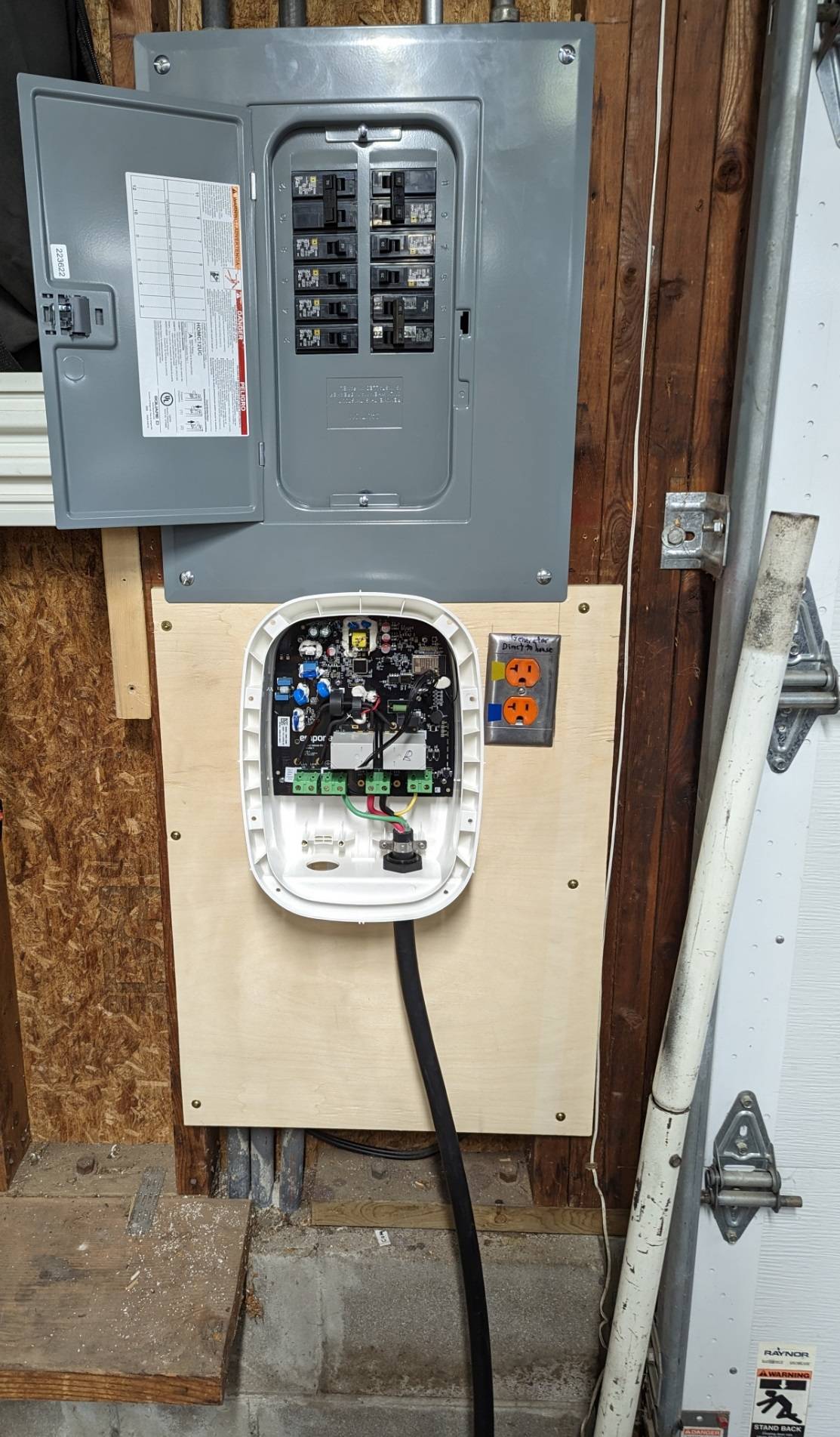
But, with the recessed panel between the studs and the charger going below the panel, I've got to figure out how to go out the bottom of the panel, down, out through plywood, then up into the bottom of the charger itself.

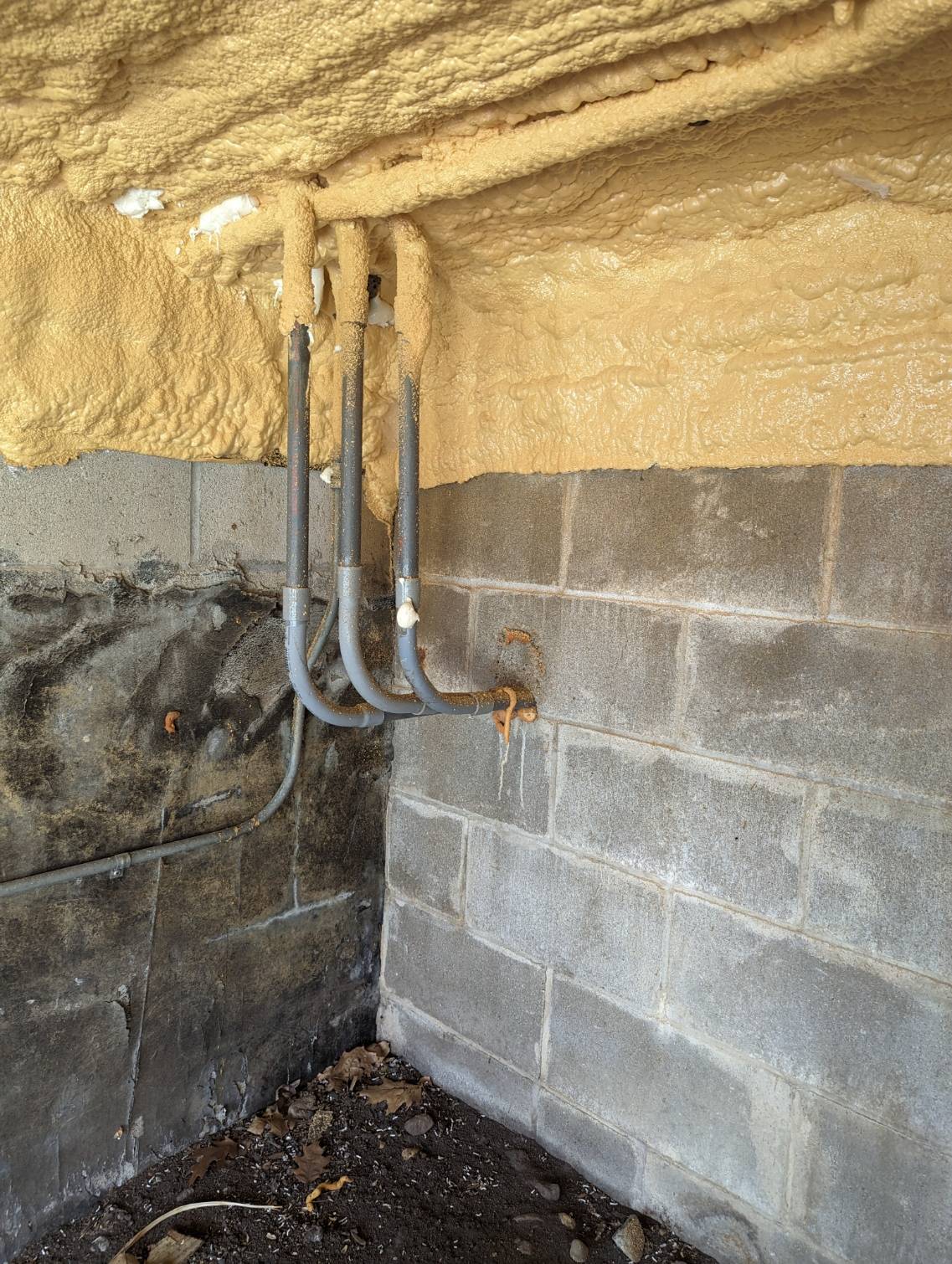
BTW - this is how the electric comes out of the house and goes to the garage. The much larger pipe running across under the sun room eventually goes down into the ground and then about 200 feet south to the NW corner of my shop and up through the floor.
One of these three has 4 pair wire from house to garage to operate the garage door openers and I used to have a phone out there before the days of cell phones.

Jeep Gladiator Buying a Level 2 charger showed me a panel problem..... PXL_20230419_162413935


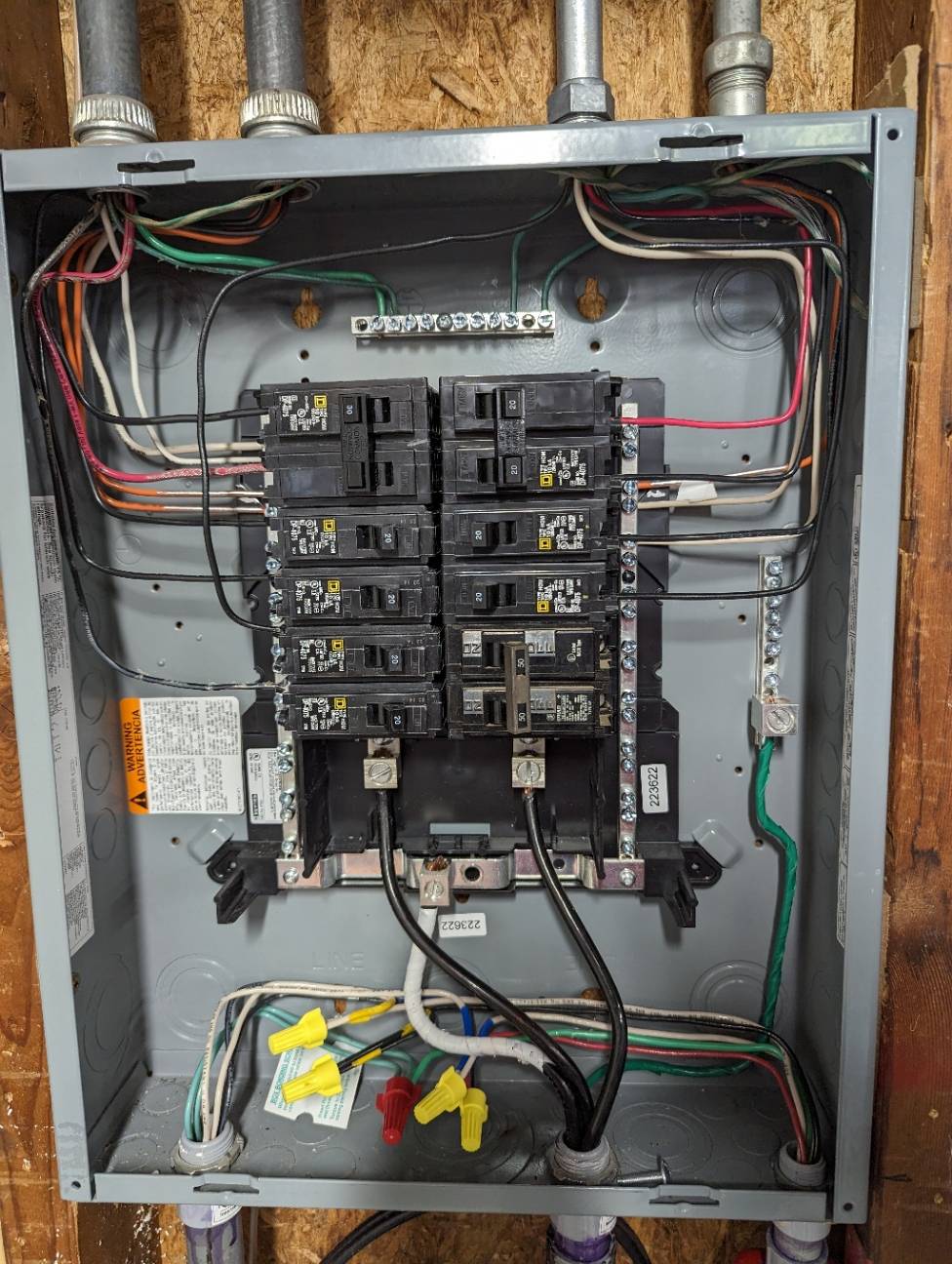
OK, here is the new panel. Not very neat but it works.......... and is a ton better than the old one!
The one wrapped in green tape is a white wire that comes from the neutral bar in the house/main panel and goes to the ground bus on this garage panel.
I used one of the 3 conduits to run wires directly into a couple of outlets in the house that can be powered directly from a generator. 20 amp outlet in the garage directly wired to 20 amp outlet in the house.
The guy who built this house and garage for himself in 1980 used orange wire from two places back to neutral, so I used a silver paint pen on them. It was just too complex to dig into the boxes in the rafters and replace them with white. At least he was consistent - he never used orange for hot.

Jeep Gladiator Buying a Level 2 charger showed me a panel problem..... PXL_20230419_205141729.MP


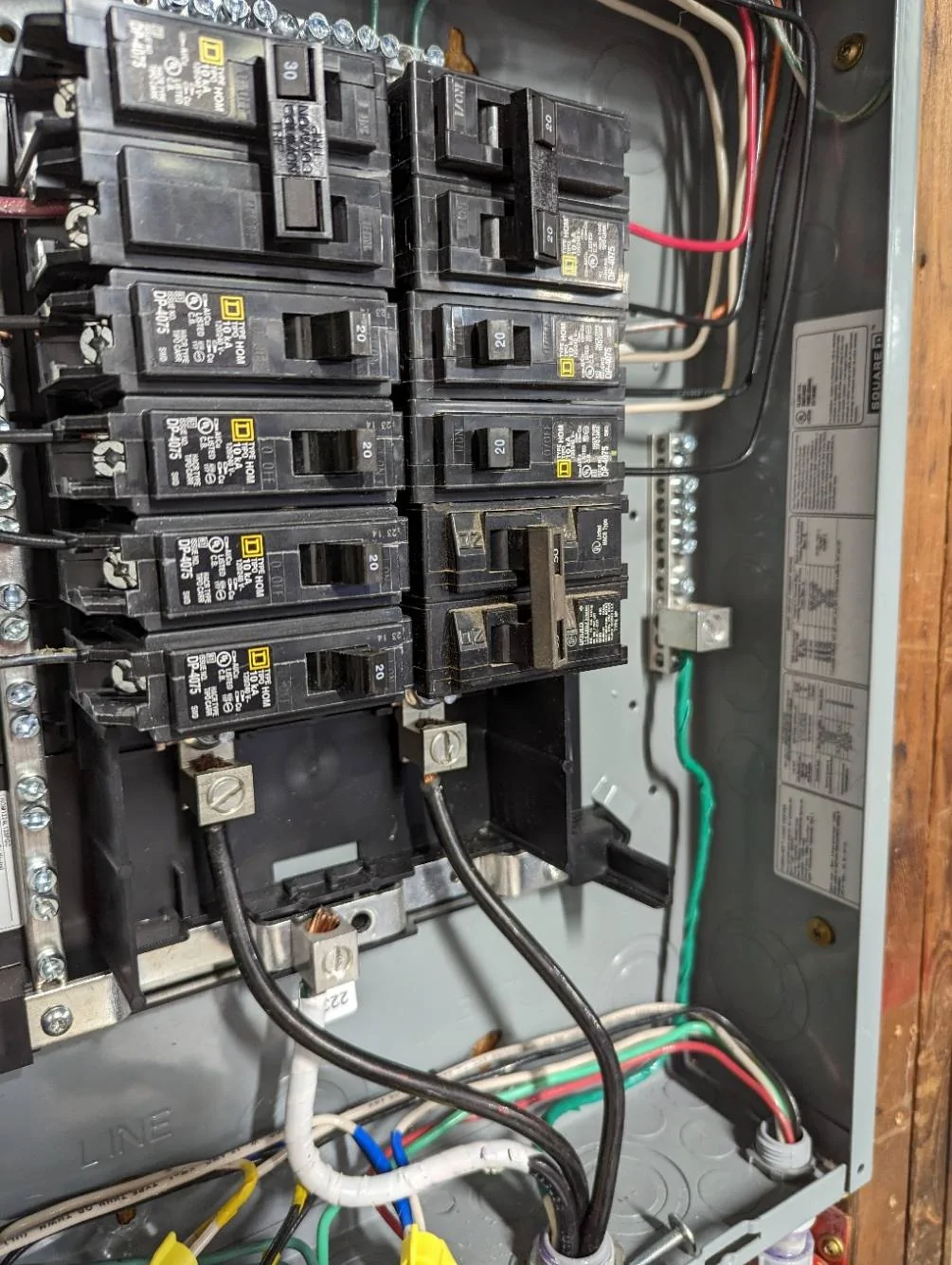
I hope jaxmax doesn't sic the NEC people on me.........

Jeep Gladiator Buying a Level 2 charger showed me a panel problem..... PXL_20230419_205157066.MP


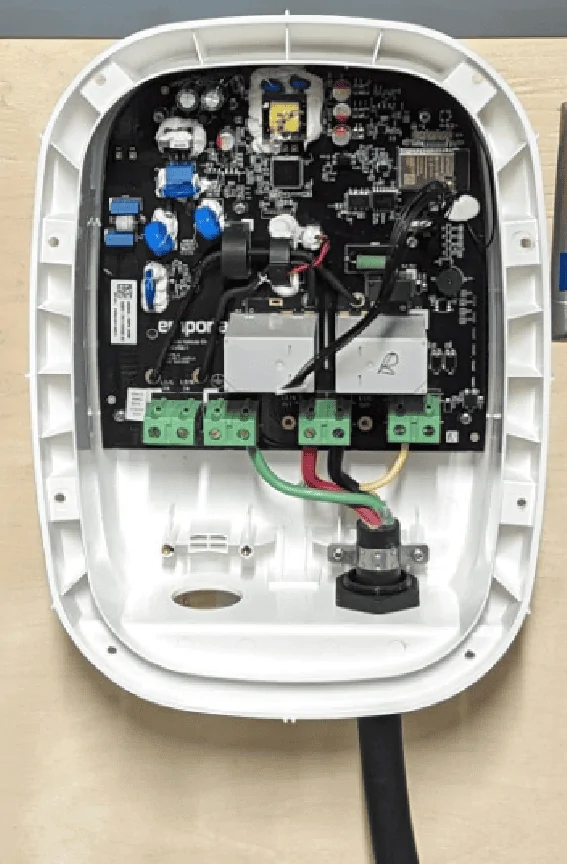
So now my chore is running 3 6 gauge wires from the box for the 220 volt level 2 charger. You can see the hole it's got to come up into. I have to figure out how to get there - going out the bottom of the panel, down behind the plywood, then back out and up into the charger.
I'll use the bottom right breaker.

Jeep Gladiator Buying a Level 2 charger showed me a panel problem..... PXL_20230419_223547511


Luckily, the wires enter from the bottom and go straight up to the green terminals.

Jeep Gladiator Buying a Level 2 charger showed me a panel problem..... 1681951478068
 

Jaxmax

Well-Known Member
First Name
Jack
Joined
Jun 28, 2020
Threads
54
Messages
2,856
Reaction score
4,637
Location
Bally, Pa.
Vehicle(s)
Jeeps....... 2021 Mojave , 2019 Wrangler
Occupation
Electrical Manager
Looks good Bill, the 10awg wire for ground is good, what does your charger draw, and how quick is your charger time?….Jack
 

Sponsored

OP
OP
ShadowsPapa

ShadowsPapa

Well-Known Member
First Name
Bill
Joined
Oct 12, 2019
Threads
247
Messages
40,440
Reaction score
53,853
Location
Runnells, Iowa
Vehicle(s)
'25 JTMX, '23 JLU 4xe, '82 SX4, '73 Javelin
Occupation
Retired auto mechanic, frmr gov't ntwrk security admin
Vehicle Showcase
3
Looks good Bill, the 10awg wire for ground is good, what does your charger draw, and how quick is your charger time?….Jack
Thanks. Relieved to find this is also legal and according to code. I triple checked and it's indeed 10 gauge.

48 amp max. It comes set to 40 amp. The 4xe can only take 32 amps.
So I'll run it with the default of 40 amps.
For using with a 50 amp outlet, they suggest a 50 amp breaker.
For hard-wired installs, they say use a 60 amp breaker.
I could technically use either with it set at 40 amps max.
They say use 6 gauge, 2 hots and a ground. No need for neutral (and there's no neutral connection inside it anyway)

For the 4xe I believe they say 2.5 hours from empty to full.
Her Jeep has a 17.3 kWh battery set.

Any suggestions on getting the wire from the bottom of the panel to the bottom of the charger?
It's got to make a sharp turn to come out behind the plywood from the bottom of the panel and then up into the bottom of the charger.
I've been looking online at Menards, Lowe's and HD and can't find any good ways.


HARDWIRED OR PLUGGED INSTALLATION -
11.5kW (240V/48A) / 9.6kW (240V/40A) / 10kW (208V/48A) / 8.3kW (208V/40A) (up to 48A hardwired or up to 40A NEMA Type 14-50P with 22" cable compliant with 2017 NEC Section 625.17(A)(3)).
Requires a dual-pole, dedicated breaker at 60A+ for a 48A charge or 50A+ for a 40A charge.

https://www.amazon.com/dp/B09ZNN3JB7
 
Last edited:

Jaxmax

Well-Known Member
First Name
Jack
Joined
Jun 28, 2020
Threads
54
Messages
2,856
Reaction score
4,637
Location
Bally, Pa.
Vehicle(s)
Jeeps....... 2021 Mojave , 2019 Wrangler
Occupation
Electrical Manager
Bill, Home Depot and others look up AC Whip should give you what you want. Do not get the metal connectors get plastic PVC setup as you are going into a plastic box and chance of wires rubbing through on connector is a thing. They come with a straight and ninety degree connector, use a hole saw perhaps an inch and a half hole under charger bring ninety out right there , you can knock out the panel from above and fish the seal tight right into Hole and put locknut on. Run the shortest path you can ,the whips come premade six feet long but you can shorten easily
? BOOM ?…Jack
 
OP
OP
ShadowsPapa

ShadowsPapa

Well-Known Member
First Name
Bill
Joined
Oct 12, 2019
Threads
247
Messages
40,440
Reaction score
53,853
Location
Runnells, Iowa
Vehicle(s)
'25 JTMX, '23 JLU 4xe, '82 SX4, '73 Javelin
Occupation
Retired auto mechanic, frmr gov't ntwrk security admin
Vehicle Showcase
3
Bill, Home Depot and others look up AC Whip should give you what you want. Do not get the metal connectors get plastic PVC setup as you are going into a plastic box and chance of wires rubbing through on connector is a thing. They come with a straight and ninety degree connector, use a hole saw perhaps an inch and a half hole under charger bring ninety out right there , you can knock out the panel from above and fish the seal tight right into Hole and put locknut on. Run the shortest path you can ,the whips come premade six feet long but you can shorten easily
? BOOM ?…Jack
Thanks again. Yes, for this one I was absolutely going all PVC as it's a plastic housing for the charger and not that thick or stout anyway, and was concerned about using metal. Besides, 0 benefit, only negatives. PVC is so much easier to work with in tight spots.
I assume I can run 3 6 gauge wires through such a thing. Direct wired is more future-proof as who knows, if Jeep comes out all electric in the future.........
Using an outlet means limited to 50 amp breaker and 40 amp charge current. Going hard-wired means 60 amp breaker and up to 48 amp charging current. Even 40 is overkill for a 4xe but why limit myself?
Besides, if my son visits, we could crank it up to the max and charge is EV (Audi) in short order.
 
OP
OP
ShadowsPapa

ShadowsPapa

Well-Known Member
First Name
Bill
Joined
Oct 12, 2019
Threads
247
Messages
40,440
Reaction score
53,853
Location
Runnells, Iowa
Vehicle(s)
'25 JTMX, '23 JLU 4xe, '82 SX4, '73 Javelin
Occupation
Retired auto mechanic, frmr gov't ntwrk security admin
Vehicle Showcase
3
Bill, Home Depot and others look up AC Whip should give you what you want. Do not get the metal connectors get plastic PVC setup as you are going into a plastic box and chance of wires rubbing through on connector is a thing. They come with a straight and ninety degree connector, use a hole saw perhaps an inch and a half hole under charger bring ninety out right there , you can knock out the panel from above and fish the seal tight right into Hole and put locknut on. Run the shortest path you can ,the whips come premade six feet long but you can shorten easily
? BOOM ?…Jack
PS - I owe you at least some liquid refreshments for sure.
 

Jaxmax

Well-Known Member
First Name
Jack
Joined
Jun 28, 2020
Threads
54
Messages
2,856
Reaction score
4,637
Location
Bally, Pa.
Vehicle(s)
Jeeps....... 2021 Mojave , 2019 Wrangler
Occupation
Electrical Manager
Ok on my way for the drink Bill, leaving now see you perhaps by Saturday!
Bill , Memory is the second thing to go, I forget what the first was! Remember what size ground wire you would need ?? Not a number six but ten or eight at most, might fit better and probably is what they ran for the AC whip unless you can get a #6 gauge whip……Jack
Sponsored


Top