Flanders
Well-Known Member
- Thread starter
- #1
You know nothing if you haven’t measured it.
So I did. About 300mAh per day for my 2023 with power nuthin. At that rate it would take 3 and a half weeks to discharge 10%, and well over 4 months to discharge to 50%.
The average draw is around 13mA but it varies quite a bit over short and long periods. This trace is taken across a 1-ohm resistor inserted in series with the main ground connection (so 1mV = 1mA):

There’s a regular 20Hz component, and a much larger and highly variable component at around 0.775Hz. Here are a couple of 10-second traces illustrating the variability.
Note the difference in the means. Some of the big spikes actually exceed 250mA. There’s a lot of variation in the average over 100 second traces as well.
Also, the Jeep wakes up every 12 hours (for telemetry maybe) and draws a great deal more current for about 150 seconds.
One could take 24-hour measurements with a good multimeter or scope but I didn't want to mess with it and the Jeep already has a perfectly good current integrator: The battery.
So I let it sit for a few days from a fully charged state, and then measured the charge required to bring it back up to full charge. I used a bench power supply that can accurately report current and charged delivered.
I did this several times, with up to 8 days of quiescent draw. It's always the same thing, right about 320mAh per day of sitting.
Most recently yesterday, after 48 hours of sitting the Jeep took 681 mAh in 4.52 hours of charging, which works out to 311mAh / day and 13mA average.
This is a slight overestimate because coulombic efficiency is less than 100% - some of the current passed during charging goes to secondary reactions. It also includes self-discharge of the batteries.
So I did. About 300mAh per day for my 2023 with power nuthin. At that rate it would take 3 and a half weeks to discharge 10%, and well over 4 months to discharge to 50%.
The average draw is around 13mA but it varies quite a bit over short and long periods. This trace is taken across a 1-ohm resistor inserted in series with the main ground connection (so 1mV = 1mA):
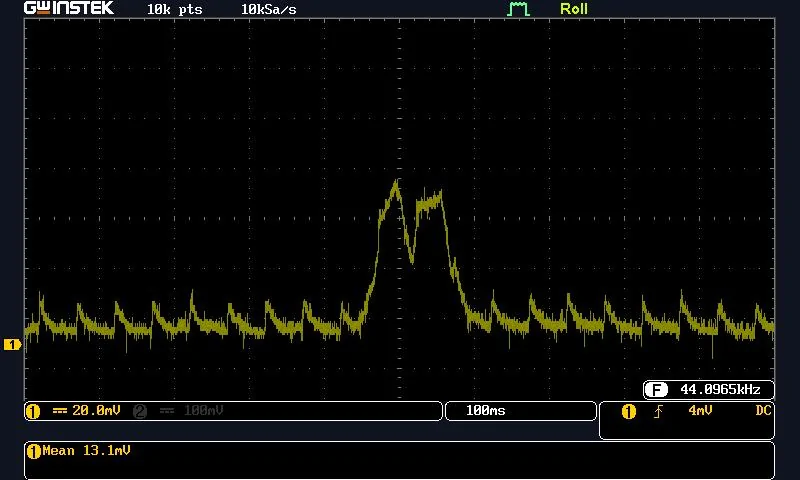
There’s a regular 20Hz component, and a much larger and highly variable component at around 0.775Hz. Here are a couple of 10-second traces illustrating the variability.
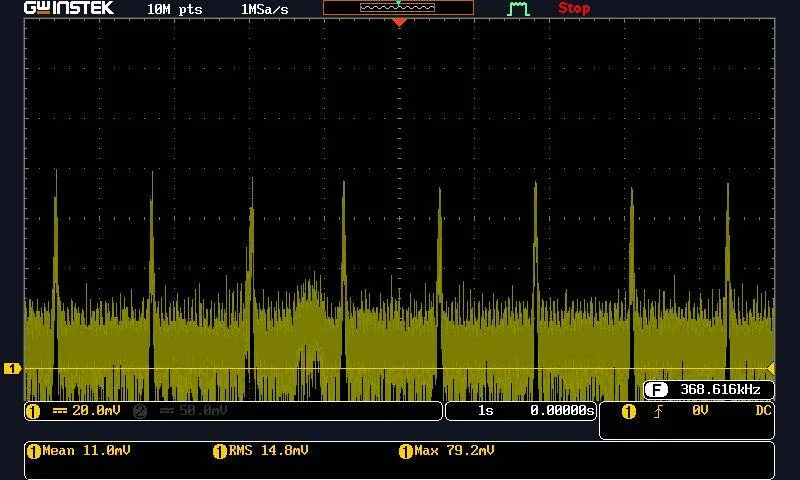
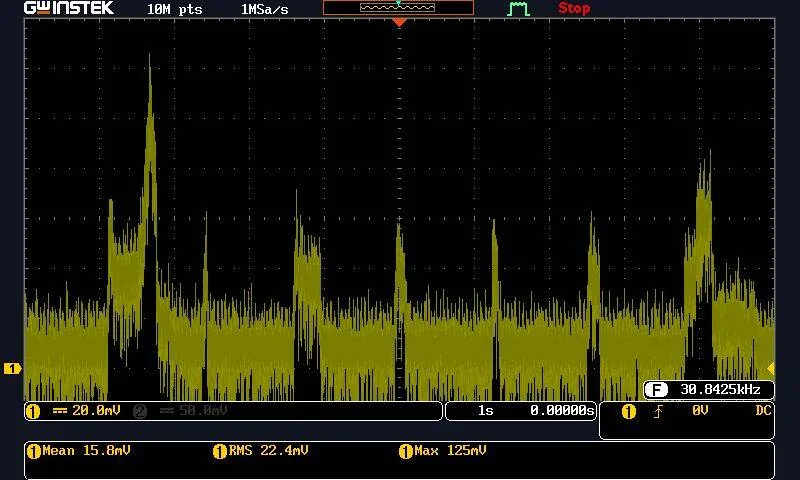
Note the difference in the means. Some of the big spikes actually exceed 250mA. There’s a lot of variation in the average over 100 second traces as well.
Also, the Jeep wakes up every 12 hours (for telemetry maybe) and draws a great deal more current for about 150 seconds.
One could take 24-hour measurements with a good multimeter or scope but I didn't want to mess with it and the Jeep already has a perfectly good current integrator: The battery.
So I let it sit for a few days from a fully charged state, and then measured the charge required to bring it back up to full charge. I used a bench power supply that can accurately report current and charged delivered.
I did this several times, with up to 8 days of quiescent draw. It's always the same thing, right about 320mAh per day of sitting.
Most recently yesterday, after 48 hours of sitting the Jeep took 681 mAh in 4.52 hours of charging, which works out to 311mAh / day and 13mA average.
This is a slight overestimate because coulombic efficiency is less than 100% - some of the current passed during charging goes to secondary reactions. It also includes self-discharge of the batteries.
Sponsored