
Sponsored

Misfire investigation (in part)

OP
OP
Maximus Gladius

Maximus Gladius

Well-Known Member
First Name
Kevin
Joined
Jan 30, 2021
Threads
75
Messages
2,910
Reaction score
3,713
Location
Calgary, AB, Canada
Vehicle(s)
2021 JTR, 2023 JTR
UPDATE:
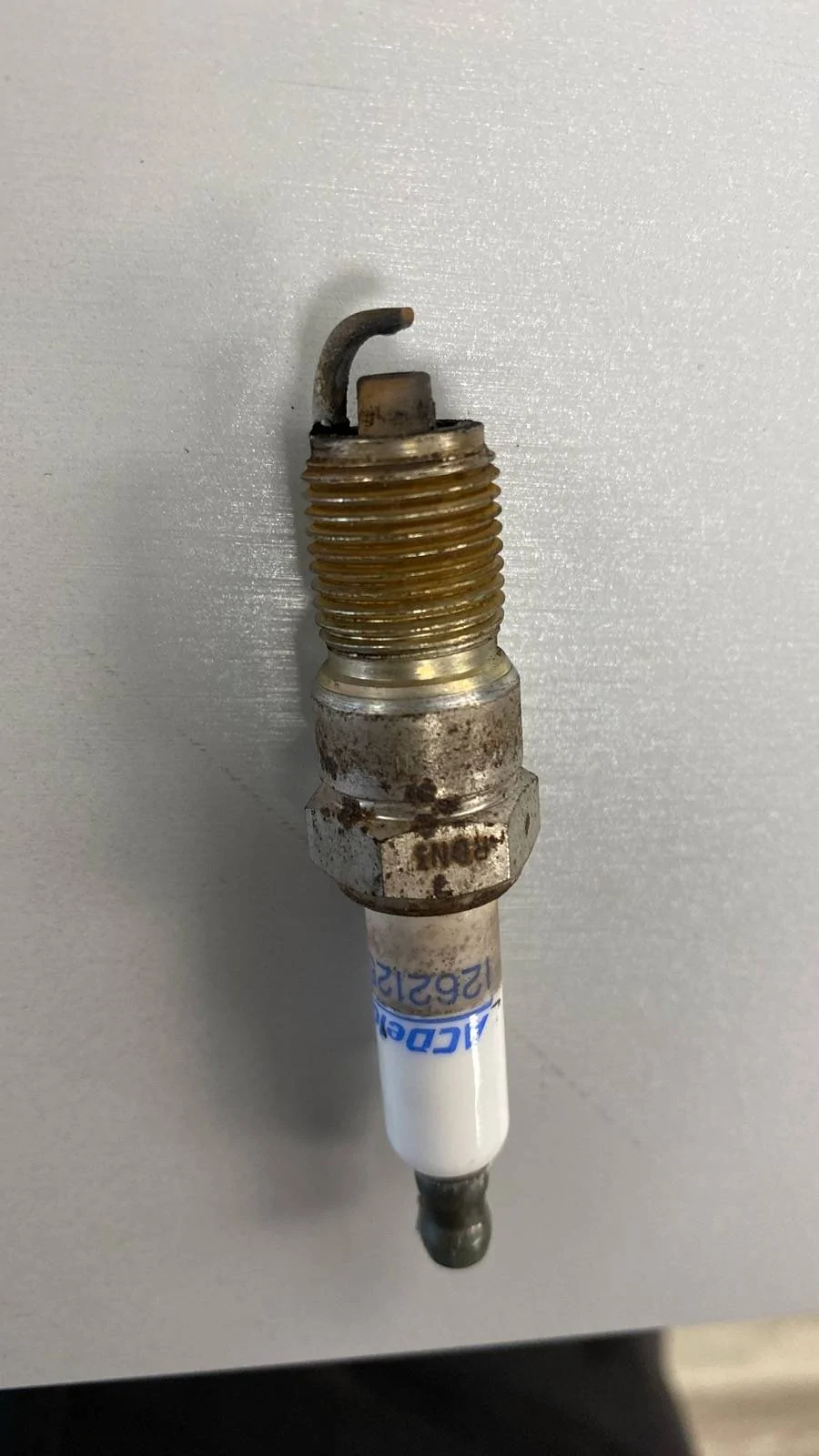
I took into the dealership the spark plug (50k km) from the P0305, 5th cylinder misfire that we all agreed was toast from the photo I posted, and sat down with the service manager and had him look it over and provide his opinion.

He carefully looked it over and said I want to bring in the Shop Forman to give his opinion, he sees spark plugs every day, so he called him in, gave it to him and asked what is the condition of this plug at 50k kms? The Forman looked it over and said “the burn is even, looks very normal to what they see here, tip is good, there’s no burn deposits on the ceramic, no white deposits on the tip ….its not ready to be changed, lots of life left.” I asked him about the oil smell on the plug and said since I changed it, I can not reproduce the misfire.

He said the pentastar engine is notorious for blowby which sends oil up into the intake via to PCV valve and they often see a cup of oil sitting in the intake manifold regularly which needs cleaning out all the time (catch can grabs this first). So the oil is from blowby.

I told him I don’t have blowby so the oil smell is from having found 12L installed when the second engine was installed and the top end was saturated.

Long story short the intake valves get cleaned with the gas so is not a concern with oil that makes it down into the top of the cylinder, this is why oil burned residue is expected on plugs. My guess is, we all have plugs that look like mine.

I don’t have blowby so oil burned plugs, I shouldn’t have. I ran a can of Sea Foam intake manifold cleaner last summer and I’ll be doing it again soon.

The Forman also mentioned he’s seen plugs that were changed that were missing the iridium tip, like the photo sent to me by @sep. This plug came out of a GM van with nearly 300k kms on it. Plugs were never changed, all the plugs were missing the tips but the vehicle still ran.!!😳

Take it for what it’s worth, I’m glad my misfire is gone (knock on wood) I changed #5 plug and when I’m done with my trip to BC this weekend, I’ll change run another can of sea foam in the intake and change them all out.

Photos again is my #5 plug and the photo of the 300k km plug (x8) the GM van still ran with.

Jeep Gladiator Misfire investigation (in part) IMG_8172


Jeep Gladiator Misfire investigation (in part) IMG_2468
 

ShadowsPapa

Well-Known Member
First Name
Bill
Joined
Oct 12, 2019
Threads
247
Messages
40,483
Reaction score
53,970
Location
Runnells, Iowa
Vehicle(s)
'25 JTMX, '23 JLU 4xe, '82 SX4, '73 Javelin
Occupation
Retired auto mechanic, frmr gov't ntwrk security admin
Vehicle Showcase
3
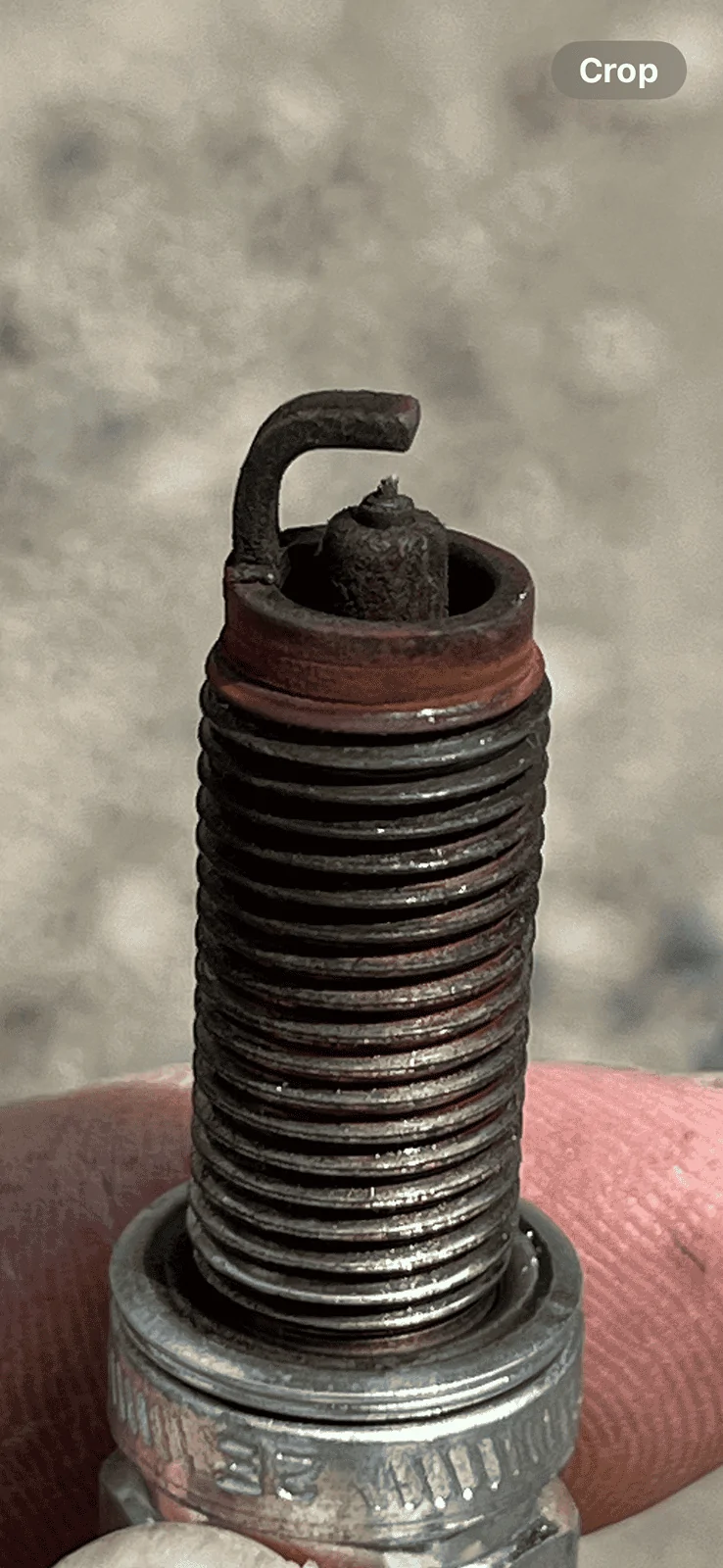
My jaw dropped in disbelief at that post telling of that that guy told you.

Look again at the center electrode - that's anything but normal.

QUESTION - Did the NEW plug you put in have an electrode that looked just like this one?

Jeep Gladiator Misfire investigation (in part) 1716040249959-km


Long story short the intake valves get cleaned with the gas so is not a concern with oil that makes it down into the top of the cylinder, this is why oil burned residue is expected on plugs. My guess is, we all have plugs that look like mine.
WTH.............. sure, the intake valves get cleaned, but then that oil is flushed into the cylinder and burned. So it's STILL oil consumption. It's still technically burning oil. The only positive is that it's not direct injection so the INTAKE valves get washed. It's still in the chamber, being burned.

So - please explain the part about your engine not having blow-by? Based on................?
In what I'd call 3,000 miles, how far down is the oil on the stick?
How far down is it at 5,000 miles, or when you change oil?
Since these aren't vented to the atmosphere - the crankcase makeup air comes from the intake air tube near the air filter, you can't see if there's anything blowing back when it's running.

He said the pentastar engine is notorious for blowby which sends oil up into the intake via to PCV valve and they often see a cup of oil sitting in the intake manifold regularly which needs cleaning out all the time (catch can grabs this first). So the oil is from blowby.
Only if there's a problem, like the PCV issue mentioned in the TSB.

He's trying to get you to ignore what's going on.
That plug is not normal. Doesn't matter "what he's seen" - he sees the PROBLEM engines, not normal engines.
Your plug is not normal - it's physically damaged.
There's a reason, and that reason is possibly detonation.
And gee, what causes detonation? Oil in the mixture.
It's damaged, and I'd sure want to keep a very close eye on it and turn up the hearing aids.
The bad bit is that if you have one cylinder that's consuming oil, perhaps ring issues or whatever, that combined with the fact that detonation isn't always audible, you can't always hear it, I'd keep an eye on that one.

In short, I don't buy his "go away, it's fine, they all consume oil and burn electrodes like that" explanation.
 
OP
OP
Maximus Gladius

Maximus Gladius

Well-Known Member
First Name
Kevin
Joined
Jan 30, 2021
Threads
75
Messages
2,910
Reaction score
3,713
Location
Calgary, AB, Canada
Vehicle(s)
2021 JTR, 2023 JTR
My jaw dropped in disbelief at that post telling of that that guy told you.

Look again at the center electrode - that's anything but normal.

QUESTION - Did the NEW plug you put in have an electrode that looked just like this one?

1716040249959-km.png


WTH.............. sure, the intake valves get cleaned, but then that oil is flushed into the cylinder and burned. So it's STILL oil consumption. It's still technically burning oil. The only positive is that it's not direct injection so the INTAKE valves get washed. It's still in the chamber, being burned.

So - please explain the part about your engine not having blow-by? Based on................?
In what I'd call 3,000 miles, how far down is the oil on the stick?
How far down is it at 5,000 miles, or when you change oil?
Since these aren't vented to the atmosphere - the crankcase makeup air comes from the intake air tube near the air filter, you can't see if there's anything blowing back when it's running.


Only if there's a problem, like the PCV issue mentioned in the TSB.

He's trying to get you to ignore what's going on.
That plug is not normal. Doesn't matter "what he's seen" - he sees the PROBLEM engines, not normal engines.
Your plug is not normal - it's physically damaged.
There's a reason, and that reason is possibly detonation.
And gee, what causes detonation? Oil in the mixture.
It's damaged, and I'd sure want to keep a very close eye on it and turn up the hearing aids.
The bad bit is that if you have one cylinder that's consuming oil, perhaps ring issues or whatever, that combined with the fact that detonation isn't always audible, you can't always hear it, I'd keep an eye on that one.

In short, I don't buy his "go away, it's fine, they all consume oil and burn electrodes like that" explanation.
Blowby is engine running, pull off the oil fill cap. Is there air shooting out the hole? YES (Blowby) - intake air bypassing poorly seated piston rings or weak compression. Intake air bypassing rings into the crankcase thereby (ideally) picked up by the PCV valve and sent back to the intake or is the PCV valve is all gummed up (not ideal) positive air pressure in the crankcase then blows out seals.
If NO air blows out the oil fill hole, then there’s no Blowby. I don’t have blowby.
 

Sponsored

OP
OP
Maximus Gladius

Maximus Gladius

Well-Known Member
First Name
Kevin
Joined
Jan 30, 2021
Threads
75
Messages
2,910
Reaction score
3,713
Location
Calgary, AB, Canada
Vehicle(s)
2021 JTR, 2023 JTR
Us three guys in the office talked about oil consumption which led to how much am I using (burning) and what does Chrysler deem “ACCEPTABLE” burn and you all will be shocked!

I go through 1/2 L in 7000 kms. The acceptable burn amount or consumption CHRYSLER deems “NORMAL” is 1.5 L/ 1000 kms. !!!!!! You do the math.
 
OP
OP
Maximus Gladius

Maximus Gladius

Well-Known Member
First Name
Kevin
Joined
Jan 30, 2021
Threads
75
Messages
2,910
Reaction score
3,713
Location
Calgary, AB, Canada
Vehicle(s)
2021 JTR, 2023 JTR
QUESTION - Did the NEW plug you put in have an electrode that looked just like this one?
No, new plug was not like this one and I have one guess as to what happened. The shop Forman told me that the gap on these plugs come pre gapped. I told him the gap in the old plug is wider than the new plug. He said “really”?! He said you don’t even want to put a feeler gauge or regap these plugs or you’ll reck the plug. I thing this plug, or all of them were regapped or a feeler gauge was used and bent the tip or damaged the tip. Just speculation here
 

ShadowsPapa

Well-Known Member
First Name
Bill
Joined
Oct 12, 2019
Threads
247
Messages
40,483
Reaction score
53,970
Location
Runnells, Iowa
Vehicle(s)
'25 JTMX, '23 JLU 4xe, '82 SX4, '73 Javelin
Occupation
Retired auto mechanic, frmr gov't ntwrk security admin
Vehicle Showcase
3
Blowby is engine running, pull off the oil fill cap. Is there air shooting out the hole? YES (Blowby) - intake air bypassing poorly seated piston rings or weak compression. Intake air bypassing rings into the crankcase thereby (ideally) picked up by the PCV valve and sent back to the intake or is the PCV valve is all gummed up (not ideal) positive air pressure in the crankcase then blows out seals.
If NO air blows out the oil fill hole, then there’s no Blowby. I don’t have blowby.
Not 100% true - blowby exists in all engines, the idea is - how severe is it. If it's just simply not "blowing out" the oil fill - and there's no vacuum, then you have enough blowby at idle it may be overwhelming the PCV in other conditions.
Just because nothing blows out the tube doesn't mean no blowby. There's also that tube leading into the air intake tube just inches from the air filter where there can be positive pressure.

You should be able to put your hand over the oil fill tube, if the air makeup line was plugged, and feel a decent vacuum.
For testing, you plug the crankcase air makeup line and check vacuum at the oil fill tube. There should be a good vacuum. Neutral pressure means there's blowby enough to overwhelm the PCV.

Air shooting out the oil fill is not the definition of blowby (maybe time to pull out the engine building books again??)
That's excessive blowby - and quite excessive if it's that bloody bad.

So in short, ALL engines produce combustion gases getting past the rings (well, all consumer automotive engines)
The idea is that the PCV system functions sufficiently well to overcome that and then some - meaning it takes care of that AND can produce a vacuum in the crankcase.

Leave the oil fill cap in place, pull the air intake line away from the filter box cover, check the line going from the crankcase to the air intake tube for vacuum. If there's no vacuum, or there's positive pressure there instead, you have excessive blowby that the PCV can't handle at idle.

I've got a set of instructions for testing for crankcase vacuum somewhere - and there must be a vacuum. If there's not, your PCV is defective, or, you have sufficient blowby to overcome the PCV system.

No, new plug was not like this one and I have one guess as to what happened. The shop Forman told me that the gap on these plugs come pre gapped. I told him the gap in the old plug is wider than the new plug. He said “really”?! He said you don’t even want to put a feeler gauge or regap these plugs or you’ll reck the plug. I thing this plug, or all of them were regapped or a feeler gauge was used and bent the tip or damaged the tip. Just speculation here
Yes, these special plugs come pre-gapped. Anyone working in a modern shop should know this.
But then, anyone old-timer who didn't know that and attempted to regap would never mess up the center electrode because gapping involves bending the OUTER, or ground electrode, never the center electrode. Any good plug gapping tool has a part with a notch that you slip over that ground electrode to bend it. You never apply pressure to the center electrode EVER, even in the 1960s and 1970s, you never put pressure on the center electrode. It only ever involved bending the outer electrode, making sure it was perfectly parallel to the center electrode top, not at any angle.
There's no harm in checking with a feeler gauge. A feeler gauge wouldn't be strong enough to damage an electrode. You can absolutely use a feeler gauge (does he even know what a REAL feeler gauge is? It's thin strips of metal that are quite flexible and would bend pretty easily with any real force)
If he says using a feeler gauge to check the gap would damage the plug, he's worse than I thought. Or maybe he's the type that checks a crankshaft with a micrometer and uses pliers to tighten the mic against the shaft? No one using a feeler gauge to "check" would use any force at all. No one I'd want working in my shop. it's really that simple.

So either an idiot tried to gap those plugs - or the foreman is just making stuff up
I vote for the latter because that center is not damaged in a way anyone would cause by trying to set the gap. It's got a blob on one side and appears eaten away on the other - ONLY a closer picture with better focus would tell for sure.
A better explanation for that gap being wider than a new plug - that electrode was melted or beaten away.

Sorry, I just don't have any faith in him.
 
OP
OP
Maximus Gladius

Maximus Gladius

Well-Known Member
First Name
Kevin
Joined
Jan 30, 2021
Threads
75
Messages
2,910
Reaction score
3,713
Location
Calgary, AB, Canada
Vehicle(s)
2021 JTR, 2023 JTR
Not 100% true - blowby exists in all engines, the idea is - how severe is it. If it's just simply not "blowing out" the oil fill - and there's no vacuum, then you have enough blowby at idle it may be overwhelming the PCV in other conditions.
Just because nothing blows out the tube doesn't mean no blowby. There's also that tube leading into the air intake tube just inches from the air filter where there can be positive pressure.

You should be able to put your hand over the oil fill tube, if the air makeup line was plugged, and feel a decent vacuum.
For testing, you plug the crankcase air makeup line and check vacuum at the oil fill tube. There should be a good vacuum. Neutral pressure means there's blowby enough to overwhelm the PCV.

Air shooting out the oil fill is not the definition of blowby (maybe time to pull out the engine building books again??)
That's excessive blowby - and quite excessive if it's that bloody bad.

So in short, ALL engines produce combustion gases getting past the rings (well, all consumer automotive engines)
The idea is that the PCV system functions sufficiently well to overcome that and then some - meaning it takes care of that AND can produce a vacuum in the crankcase.

Leave the oil fill cap in place, pull the air intake line away from the filter box cover, check the line going from the crankcase to the air intake tube for vacuum. If there's no vacuum, or there's positive pressure there instead, you have excessive blowby that the PCV can't handle at idle.

I've got a set of instructions for testing for crankcase vacuum somewhere - and there must be a vacuum. If there's not, your PCV is defective, or, you have sufficient blowby to overcome the PCV system.


Yes, these special plugs come pre-gapped. Anyone working in a modern shop should know this.
But then, anyone old-timer who didn't know that and attempted to regap would never mess up the center electrode because gapping involves bending the OUTER, or ground electrode, never the center electrode. Any good plug gapping tool has a part with a notch that you slip over that ground electrode to bend it. You never apply pressure to the center electrode EVER, even in the 1960s and 1970s, you never put pressure on the center electrode. It only ever involved bending the outer electrode, making sure it was perfectly parallel to the center electrode top, not at any angle.
There's no harm in checking with a feeler gauge. A feeler gauge wouldn't be strong enough to damage an electrode. You can absolutely use a feeler gauge (does he even know what a REAL feeler gauge is? It's thin strips of metal that are quite flexible and would bend pretty easily with any real force)
If he says using a feeler gauge to check the gap would damage the plug, he's worse than I thought. Or maybe he's the type that checks a crankshaft with a micrometer and uses pliers to tighten the mic against the shaft? No one using a feeler gauge to "check" would use any force at all. No one I'd want working in my shop. it's really that simple.

So either an idiot tried to gap those plugs - or the foreman is just making stuff up
I vote for the latter because that center is not damaged in a way anyone would cause by trying to set the gap. It's got a blob on one side and appears eaten away on the other - ONLY a closer picture with better focus would tell for sure.
A better explanation for that gap being wider than a new plug - that electrode was melted or beaten away.

Sorry, I just don't have any faith in him.
I hear ya. Thanks for all that. I’ll be doing the other test to check blowby
 

Sponsored

ShadowsPapa

Well-Known Member
First Name
Bill
Joined
Oct 12, 2019
Threads
247
Messages
40,483
Reaction score
53,970
Location
Runnells, Iowa
Vehicle(s)
'25 JTMX, '23 JLU 4xe, '82 SX4, '73 Javelin
Occupation
Retired auto mechanic, frmr gov't ntwrk security admin
Vehicle Showcase
3
Feeler gauge below. If you need to check something more than 0.030" for example, maybe 0.045, you slip the 30 and 15 together and see if it slides into the gap. No forcing allowed. If it doesn't slip in, then you try a smaller stack until it just slides in.
No damage to anything.

Why is one brass? For checking the gap on things like the pickup coil in certain electronic ignition systems of decades past. A steel feeler gauge would stick to the magnet and mess up your feel for the right gap.
Those are typically .010" gap - thus, the brass blade here.

A feeler gauge isn't going to mess up a plug - not by anyone who knows even the most basic crap.

Jeep Gladiator Misfire investigation (in part) 1716047008525-oa
 

ShadowsPapa

Well-Known Member
First Name
Bill
Joined
Oct 12, 2019
Threads
247
Messages
40,483
Reaction score
53,970
Location
Runnells, Iowa
Vehicle(s)
'25 JTMX, '23 JLU 4xe, '82 SX4, '73 Javelin
Occupation
Retired auto mechanic, frmr gov't ntwrk security admin
Vehicle Showcase
3
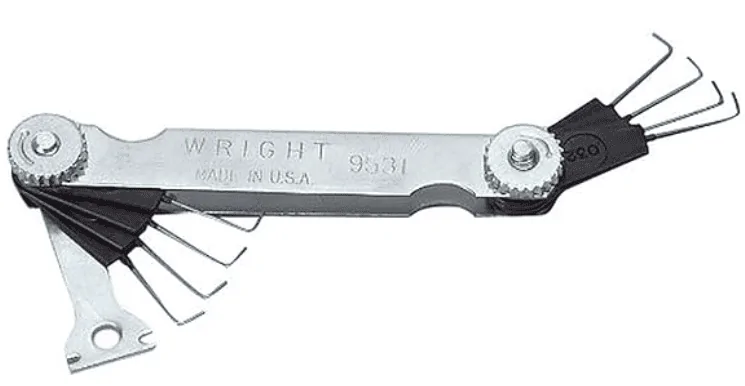
For those wondering what's all the hubbub about - who have not been familiar with all of the types of spark plugs over the years, and feeler gauge types and how to properly or correctly set the gap - when needed, on plugs where you are supposed to set the gap - here's more -

I was trying to hurry and get out and mow before it got too bloody hot................. and forgot about a totally different type of feeler gauge used for spark plugs - the wire type feeler gauge.
I have several of each type.
The round wire allows for checking a gap on spark plugs that don't use flat, parallel surfaces. It can check concave or convex situations where a flat type would be totally inaccurate.

Instead of tossing Tovak off my lap and going way out to the shop and getting a picture, I grabbed one from Amazon. Different brand (mine dates back into the 1970s) but same thing. Note the "tool" most included to bend the ground electrode to set the gap. You never wedged or pressed or pried against the center electrode. In fact, when setting a spark plug, you just don't touch the center electrode other than to check the gap. You use a tool to move the ground electrode, and in legacy types, strive to keep the ground electrode parallel to the flat end of that type of spark plug.


The bit lower left in this pic is to put on the ground electrode to bend it to adjust gap.

Jeep Gladiator Misfire investigation (in part) 1716055018407-48


I'd like to have a word with the devs about their microtransaction model
I think you have to contact help desk and put in a work order on that.
 

swtrailboss

Well-Known Member
First Name
Travis
Joined
Mar 9, 2024
Threads
1
Messages
173
Reaction score
290
Location
Florida
Vehicle(s)
21 Gladiator Mojave
Occupation
Auto tech
He's trying to get you to ignore what's going on.
That plug is not normal. Doesn't matter "what he's seen" - he sees the PROBLEM engines, not normal engines.
I’m sure he as programmed as most in his position (for job security) in a “call out” situation that you presented and caught off guard to say “normal “ to spray water on the flames! He obviously knows (if he actually knows) this plug is not a normal worn plug!
 

ShadowsPapa

Well-Known Member
First Name
Bill
Joined
Oct 12, 2019
Threads
247
Messages
40,483
Reaction score
53,970
Location
Runnells, Iowa
Vehicle(s)
'25 JTMX, '23 JLU 4xe, '82 SX4, '73 Javelin
Occupation
Retired auto mechanic, frmr gov't ntwrk security admin
Vehicle Showcase
3
I’m sure he as programmed as most in his position (for job security) in a “call out” situation that you presented and caught off guard to say “normal “ to spray water on the flames! He obviously knows (if he actually knows) this plug is not a normal worn plug!
Sad, because in a shop where I worked, if the boss had been made aware of such a thing - he'd say "ok, which if you clowns screwed this up, get it in here now and take care of it" (he might actually have used the words "horse's ass" but he'd say that out of earshot of the customer)
Sponsored

 
Last edited:


Top