Sponsored

Auto Start/Stop to be removed says EPA chief

Gvsukids

Well-Known Member
First Name
Justin
Joined
Mar 7, 2020
Threads
26
Messages
7,282
Reaction score
6,913
Location
Grand Rapids
Website
www.youtube.com
Vehicle(s)
2020 Gladiator Sport S Max Tow
Occupation
Delivery Driver
Jeep did. It’s my 7th and one irritating feature isn't enough to make me tolerate a freaking Bronco
Especially if it has a bed. Also, with the lack of dealership visits we have had with her Bronco Sport, I can conclude that Ford builds a better vehicle.
 

Great Offender

Well-Known Member
Joined
Aug 8, 2023
Threads
19
Messages
582
Reaction score
725
Location
Texas
Vehicle(s)
2021 Gladiator Sport S - MT
The simple fact it saves very little gas and just adds to the price the vehicle.
It saves "you" very little gas but collectively, with ALL drivers, it saves a lot. I have read several conflicting figures on how much so I won't throw numbers around. I personally don't like ti so I shut it off, but that's me. Just do you!
 

Ding gus

Well-Known Member
First Name
Ding
Joined
May 29, 2022
Threads
6
Messages
68
Reaction score
110
Location
Florida
Vehicle(s)
Jt
It saves "you" very little gas but collectively, with ALL drivers, it saves a lot. I have read several conflicting figures on how much so I won't throw numbers around. I personally don't like ti so I shut it off, but that's me. Just do you!
Cost analysis on these systems are eye opening. On average the net cost savings over 5 years is $25-$125. Thats it, and that assumes a 5% fuel savings. Much of the savings is offset by significant increase in part cost due to added complexity. I can say first hand due to cost of battery replacement i will not see any net gains from this system.
 

ShadowsPapa

Well-Known Member
First Name
Bill
Joined
Oct 12, 2019
Threads
247
Messages
40,445
Reaction score
53,872
Location
Runnells, Iowa
Vehicle(s)
'25 JTMX, '23 JLU 4xe, '82 SX4, '73 Javelin
Occupation
Retired auto mechanic, frmr gov't ntwrk security admin
Vehicle Showcase
3
It saves "you" very little gas but collectively, with ALL drivers, it saves a lot. I have read several conflicting figures on how much so I won't throw numbers around. I personally don't like ti so I shut it off, but that's me. Just do you!
Jeep Gladiator Auto Start/Stop to be removed says EPA chief 1747317394980-p7


I can point to others by automotive magazines that showed roughly 7% and more, DEPENDING on the vehicle and driving conditions.
To say it doesn't save individuals anything or very little is just hatred talking, not facts.

Jeep Gladiator Auto Start/Stop to be removed says EPA chief 1747317539929-zl


Jeep Gladiator Auto Start/Stop to be removed says EPA chief 1747317619693-d7


SAE's comments -
Jeep Gladiator Auto Start/Stop to be removed says EPA chief 1747317708370-ya


This is a great and easily doable request.
Yeah, right.

Don't look for any "download" or "update" from companies making running changes to this. It would cost them in real dollars not to mention the risks as it would require flashes to modules.
It's already in place, it's only a COST to them to make a change that will be of zero benefit and many owners simply don't give a rip about - no matter how much hate you project into it. It's a done deal on sold units. They don't care and won't be spending the real money on it. It would require time in a shop, risks as it's a flash and not a "radio update". You don't get BCM and PCM updates over the air for good reason. First time one of those is bricked over it - then who gripes about that damned FCA and their updates? You.

Does anyone really believe a company that's trying hard to come back from the brink financially, trouble selling models from the last model year or two, is going to spend money to make a change to a vehicle that will have no impact on them as a company, and will lead to zip as far as performance, etc.?

I'll say it again - get real.
There's no incentive, no savings to Stellantis, only COSTS to the company, and risks modules as it's an update to systems that really have no impact on the company. They have no reason to bother.
You can buy an electronic circuit for a few bucks to disable it vs. the cost of flashing major modules of a vehicle. If they said "we can disable it, the flash/time will cost you $250 - I'd be all over the cheap circuits sold on eBay and so on before I'd let them flash anything for it at that cost. I've seen people - if I can find the link again, that created a simple electronic timer for under 20 bucks that literally sent the button press signal about 5 seconds after a start cycle. It was home-built. I really wish I had taken screen shots or saved the link as it was so damned simple - an IC timer circuit! That was it. Digikey or Mouser parts.
If, and it's a stretch, if it ever did happen, you know it won't be free.


Support forum sponsors and vendors -
Go buy the auto stop/start eliminator if it angers you so very much. Then you can relax and concentrate on actual real important stuff that truly matters.
 

Sponsored

ShadowsPapa

Well-Known Member
First Name
Bill
Joined
Oct 12, 2019
Threads
247
Messages
40,445
Reaction score
53,872
Location
Runnells, Iowa
Vehicle(s)
'25 JTMX, '23 JLU 4xe, '82 SX4, '73 Javelin
Occupation
Retired auto mechanic, frmr gov't ntwrk security admin
Vehicle Showcase
3
Cost analysis on these systems are eye opening. On average the net cost savings over 5 years is $25-$125. Thats it, and that assumes a 5% fuel savings. Much of the savings is offset by significant increase in part cost due to added complexity. I can say first hand due to cost of battery replacement i will not see any net gains from this system.
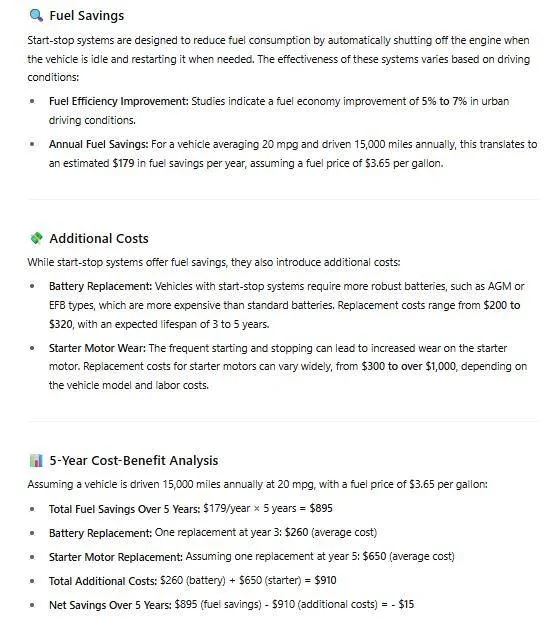
Don't know where you get that - most come up with an average of $179 ANNUALLY - see my prior posts.
Maybe if your drives are almost all highway, yeah, but for rural or city drivers with a lot of long lights (2 minutes waiting to get onto a highway), it's massive savings.

Jeep Gladiator Auto Start/Stop to be removed says EPA chief 1747318606586-sx


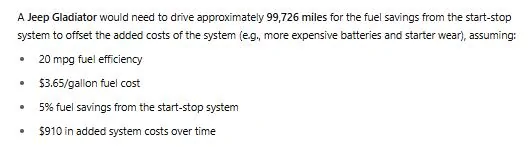
Those figures pretty much match many Jeep vehicles on average - taking JL/JLU, JT, Grand Cherokee and such into account, 20 mpg. And if you pay $3.65/gallon, the figures end up between 150 and 200 ANNUALLY.
 

Ding gus

Well-Known Member
First Name
Ding
Joined
May 29, 2022
Threads
6
Messages
68
Reaction score
110
Location
Florida
Vehicle(s)
Jt

ShadowsPapa

Well-Known Member
First Name
Bill
Joined
Oct 12, 2019
Threads
247
Messages
40,445
Reaction score
53,872
Location
Runnells, Iowa
Vehicle(s)
'25 JTMX, '23 JLU 4xe, '82 SX4, '73 Javelin
Occupation
Retired auto mechanic, frmr gov't ntwrk security admin
Vehicle Showcase
3
Starter wear is a non-issue these days. No one is going through a starter a year or even every 4 years. That's bogus. I've posted the data and comments from engineers to show it's bogus. people are ASSUMING that these are the same starters as used in the 1990s. They are not. It's a very different animal. Gone are carbon brushes, gone are bronze bushings for bearings, gone are copper commutators. There's zero reason for any starter to not go as far, if not farther than, starters of the past.
Would be nice to see Charles, a real tech, comment on just how many starters he's replaced.
We've had ESS vehicles since 2016 - no starters ever went bad. We've only had one instance of battery failures.
The battery bit is also very misleading because frankly, people in general are seeing more battery problems and failures - unrelated to ESS.
Why? Because of the short drives and because of the parasitic draw of modern vehicles.
Most of our Jeeps don't get driven often enough or far enough to keep the batteries topped off. So you start at 100%, drive to work and back, it gets back up to 98%. It sits a while, the parasitic draw of the electronics drops it down to 90%. You drive it and maybe it gets up to 93%.

Week after week this happens and suddenly you have a battery that's sitting at 50% charge, 12.0-12.3 volts, and start to get some errors or warnings.
People without ESS vehicles, or who disable it, are still seeing short battery life.


I've seen errors on our JLU - auxiliary switches unavailable, battery charging.
It goes away after 40 minutes of driving. Next day it's back again.
That JLU doesn't even HAVE ESS! And there's no aux battery! It's the fact that it's a cheap Jeep battery, the parasitic draw of the systems in the vehicle, and it doesn't get driven enough. I put a REAL battery charger on it and the issue went away.

Sorry, the bit about starters, battery, meh, bogus. No one here replaces starters every couple of years. Batteries are an issue anyway - as per discussions with customers a while back at a parts store where a guy said "I can't get a battery to last 4 years in any car these days".
Those "sources" for starters simply have not done their homework. It's a non-issue.
9 years of owning ESS vehicles - not a starter issue in the lot. And as a person who repairs and restores starters, I'd bet I know more than those assuming starters need to be replaced.

Be careful if you grab info from AI in the browser - it gleans a lot of stuff from FORUMS and non-engineers speculating.
 

ourjeeps

Well-Known Member
First Name
Dennis
Joined
Jan 22, 2025
Threads
3
Messages
60
Reaction score
56
Location
Traveling the USA
Vehicle(s)
2024 JT RubiconX 2017 JKU Rubicon RECON 1974 CJ-5 AMC304 T18A
Occupation
MILVET Aviation PrgmMgr Prof Vintner Retired
Lots of vehicles out there that don't have it. Who forced you to buy one with it?
Maybe not "Lots... ...don't"

"Re ASS “The EPA does not require stop-start technology, but automakers that adopt it are given extra fuel economy credits.

The technology was included in 65% of vehicles in 2023, a jump from 45% in 2021, 9% in 2016 and 1% in 2012, according to the Battery Council International.”
 

Figmo

Well-Known Member
First Name
Figmo
Joined
Jun 28, 2021
Threads
6
Messages
285
Reaction score
618
Location
Missoula, MT
Vehicle(s)
22 Gladiator Rubicon, 23 Bronco, Samurai
Occupation
Renaissance Man
And I'm 100% behind your idea of a permanent on/off but I just don't sweat having to push a button. Really not throwing shade on you but the on the idea that ESS is the most important problem facing our nation today.
The most important problem facing our nation today is: ALL the "not the most important problems" facing our nation today.

In other words, the paralysis over doing nothing because nothing is "the most important problem facing our nation today"

DISCLAIMER: Not political. Each reader is free to contemplate their own ideas of what constitutes a "problem" and what does not. Just don't tell me about it.
 

Sponsored

Deleted member 57233

Maybe not "Lots... ...don't"

"Re ASS “The EPA does not require stop-start technology, but automakers that adopt it are given extra fuel economy credits.

The technology was included in 65% of vehicles in 2023, a jump from 45% in 2021, 9% in 2016 and 1% in 2012, according to the Battery Council International.”
I would call 35% (5.5 million cars) of new vehicles in the US "lots"
 

ShadowsPapa

Well-Known Member
First Name
Bill
Joined
Oct 12, 2019
Threads
247
Messages
40,445
Reaction score
53,872
Location
Runnells, Iowa
Vehicle(s)
'25 JTMX, '23 JLU 4xe, '82 SX4, '73 Javelin
Occupation
Retired auto mechanic, frmr gov't ntwrk security admin
Vehicle Showcase
3
Maybe not "Lots... ...don't"

"Re ASS “The EPA does not require stop-start technology, but automakers that adopt it are given extra fuel economy credits.

The technology was included in 65% of vehicles in 2023, a jump from 45% in 2021, 9% in 2016 and 1% in 2012, according to the Battery Council International.”
Yeah, that lots of vehicles out there without it is only about 30% today. Heck, it was only 35% 2 model years ago, so it's likely we'd find 70% have it, 30% don't.
IMO, 30% without it is not really "lots" and you know most of those are economy vehicles, small sedans with small engines, where there'd be almost no gain at all because they already get 30-40 mpg without it.

Jeep Gladiator Auto Start/Stop to be removed says EPA chief Screenshot 2025-05-15 100418


2/3 of all vehicles made TWO years ago had it. And the trend I saw was spiking upward, growing fast with each successive model year.
 

Ding gus

Well-Known Member
First Name
Ding
Joined
May 29, 2022
Threads
6
Messages
68
Reaction score
110
Location
Florida
Vehicle(s)
Jt
Starter wear is a non-issue these days. No one is going through a starter a year or even every 4 years. That's bogus. I've posted the data and comments from engineers to show it's bogus. people are ASSUMING that these are the same starters as used in the 1990s. They are not. It's a very different animal. Gone are carbon brushes, gone are bronze bushings for bearings, gone are copper commutators. There's zero reason for any starter to not go as far, if not farther than, starters of the past.
Would be nice to see Charles, a real tech, comment on just how many starters he's replaced.
We've had ESS vehicles since 2016 - no starters ever went bad. We've only had one instance of battery failures.
The battery bit is also very misleading because frankly, people in general are seeing more battery problems and failures - unrelated to ESS.
Why? Because of the short drives and because of the parasitic draw of modern vehicles.
Most of our Jeeps don't get driven often enough or far enough to keep the batteries topped off. So you start at 100%, drive to work and back, it gets back up to 98%. It sits a while, the parasitic draw of the electronics drops it down to 90%. You drive it and maybe it gets up to 93%.

Week after week this happens and suddenly you have a battery that's sitting at 50% charge, 12.0-12.3 volts, and start to get some errors or warnings.
People without ESS vehicles, or who disable it, are still seeing short battery life.


I've seen errors on our JLU - auxiliary switches unavailable, battery charging.
It goes away after 40 minutes of driving. Next day it's back again.
That JLU doesn't even HAVE ESS! And there's no aux battery! It's the fact that it's a cheap Jeep battery, the parasitic draw of the systems in the vehicle, and it doesn't get driven enough. I put a REAL battery charger on it and the issue went away.

Sorry, the bit about starters, battery, meh, bogus. No one here replaces starters every couple of years. Batteries are an issue anyway - as per discussions with customers a while back at a parts store where a guy said "I can't get a battery to last 4 years in any car these days".
Those "sources" for starters simply have not done their homework. It's a non-issue.
9 years of owning ESS vehicles - not a starter issue in the lot. And as a person who repairs and restores starters, I'd bet I know more than those assuming starters need to be replaced.

Be careful if you grab info from AI in the browser - it gleans a lot of stuff from FORUMS and non-engineers speculating.
I specifically provided the sources it used, none were forums. And starter wear and failure is still and always will be a "thing". You can't argue physics. Don't kid yourself on that, the technology is improved but look no further than any parts supplier and their sales history which absolutely refute that claim. Your personal vehicle ownership over a span of 9 years is woefully inadequate for a sample size. Significant factors such as vehicle use, climate, and driving habits vary so drastically your personal experience would be irrelevant for making blanket statements.

The global starter market is around $53 billion. Us market around $35 Billion a year with replacement starters around $15.43 billion as of 2024. With a significant increase in "modern" starters the projected growth in this market remains aggressive. Your logic would have to indicate a reduction in growth.
 
Last edited:

ShadowsPapa

Well-Known Member
First Name
Bill
Joined
Oct 12, 2019
Threads
247
Messages
40,445
Reaction score
53,872
Location
Runnells, Iowa
Vehicle(s)
'25 JTMX, '23 JLU 4xe, '82 SX4, '73 Javelin
Occupation
Retired auto mechanic, frmr gov't ntwrk security admin
Vehicle Showcase
3
I specifically provided the sources it used, none were forums. And starter wear and failure is still and always will be a "thing". You can't argue physics. Don't kid yourself on that, the technology is improved but look no further than any parts supplier and their sales history which absolutely refute that claim. Your personal vehicle ownership over a span of 9 years is woefully inadequate for a sample size. Significant factors such as vehicle use, climate, and driving habits vary so drastically your personal experience would be irrelevant for making blanket statements.
I can argue it as I have many years of experience in starters myself.
I also have watched the trends- show me the numbers as far as people talking of starter replacements. It's not a thing. There will always be the "one-offs" where a starter dies for some reason - but there's no trend showing increased starter replacements. It's just not there.

These also have temperature sensing that disables ESS if the starter temperature is too high - so you can rule out heat as a factor.
They monitor the piston position and last firing of each injector as well as the ignition system, meaning a hot restart is a fraction of the load of a cold start. They may spin the engine 1 revolution (sounds like more because of how it's driven)
You crank the engine multiple revolutions for a cold start, there's many times more drag and load on the starter. The ball bearings in these last hundreds of thousands of miles, so you can count that out. (I've dealt with starters with over 200,000 miles on them)

These are high-torque starters - permanent magnet starters. So there's actually less electrical load than with some.
One of the big changes was to the coast-down time. In other words - really short spin time at high torque (maybe one crank revolution) then it pretty much stops spinning. Coast-down time was a starter killer prior to these. It's a real thing - how much time is spent after it disengages, coasting down to 0 rpm.

Engineers have stated that these can handle 500,000 cycles compared to 50,000 of non-ESS starters.
Taking into account that these are temperature monitored where your non-ESS starters were not and often failed due to HEAT (I've repaired a lot because of melted solder!!), the fact that non-ESS starters were almost always starting cold engines, while these are starting warm engines ready to fire in a single revolution, not several revolutions and other factors - yeah, starter wear just isn't a thing.
We also have different flywheels to help handle the restarting and take the load off the starter.

There's no way you are going to be changing starters even every 2 years.
Show me where that's happening.

Starter wear/replacement for Jeeps is just not a thing. I stand behind that 100%
I"ve been involved with starters for decades, of all types, big and small, new and old, and have done some deep diving into this for years because people have so much hate they assume instead of study and find the truth. They'll latch onto the first article that say "it ruins starters!".

BTW - this technology has been around for 50 years. It's not at all new, and neither are the starting and charging system mods and designs. We have many many years, decades, even, of proof that it doesn't wear out starters, nor does it cause other issues. These were designed from the ground-up for ESS - the PUG we all own i our JTs is specifically made for this. there is no pandemic of failing starters. Jeep used existing tech from other companies. Jeep has had it in the 3.6 for 10 years.
It was around for many years prior to that. Do we see floods of burned or worn our starters sitting around in shops? If it was a thing - don't you believe that in all of these years it's been around, it would have been addressed?
If it was an issue, we'd have seen it decades ago. It's not an issue except in the heads of those who don't know better.
 
Last edited:

Ding gus

Well-Known Member
First Name
Ding
Joined
May 29, 2022
Threads
6
Messages
68
Reaction score
110
Location
Florida
Vehicle(s)
Jt
I can argue it as I have many years of experience in starters myself.
I also have watched the trends- show me the numbers as far as people talking of starter replacements. It's not a thing. There will always be the "one-offs" where a starter dies for some reason - but there's no trend showing increased starter replacements. It's just not there.

These also have temperature sensing that disables ESS if the starter temperature is too high - so you can rule out heat as a factor.
They monitor the piston position and last firing of each injector as well as the ignition system, meaning a hot restart is a fraction of the load of a cold start. They may spin the engine 1 revolution (sounds like more because of how it's driven)
You crank the engine multiple revolutions for a cold start, there's many times more drag and load on the starter. The ball bearings in these last hundreds of thousands of miles, so you can count that out. (I've dealt with starters with over 200,000 miles on them)

These are high-torque starters - permanent magnet starters. So there's actually less electrical load than with some.
One of the big changes was to the coast-down time. In other words - really short spin time at high torque (maybe one crank revolution) then it pretty much stops spinning. Coast-down time was a starter killer prior to these. It's a real thing - how much time is spent after it disengages, coasting down to 0 rpm.

Engineers have stated that these can handle 500,000 cycles compared to 50,000 of non-ESS starters.
Taking into account that these are temperature monitored where your non-ESS starters were not and often failed due to HEAT (I've repaired a lot because of melted solder!!), the fact that non-ESS starters were almost always starting cold engines, while these are starting warm engines ready to fire in a single revolution, not several revolutions and other factors - yeah, starter wear just isn't a thing.
We also have different flywheels to help handle the restarting and take the load off the starter.

There's no way you are going to be changing starters even every 2 years.
Show me where that's happening.

Starter wear/replacement for Jeeps is just not a thing. I stand behind that 100%
I"ve been involved with starters for decades, of all types, big and small, new and old, and have done some deep diving into this for years because people have so much hate they assume instead of study and find the truth. They'll latch onto the first article that say "it ruins starters!".
No matter how many times you say it, it doesn't make it truth. I've never once made a claim about someone changing a starter every two years. Again look no further than the aftermarket replacement starter sales data.

Here's some more readily available data on ESS systems (with their sources) that proves wear remains a critical concern:
1. High Cycle Fatigue and Accelerated Wear

ESS starters are subjected to a vastly increased number of start cycles compared to conventional starters. Traditional starters may operate on the order of tens of thousands of cycles over the vehicle’s life, while ESS starters can experience hundreds of thousands or even millions of cycles. According to a study by Bosch (2017) on Start-Stop systems, the increased cycle frequency exponentially accelerates wear mechanisms, particularly fatigue in the solenoid coil windings and engagement components [1].


Reference: Bosch Automotive Handbook, 10th Ed., 2017

2. Thermal Stress and Material Degradation

Although temperature sensors can disable the starter to prevent extreme overheating, thermal cycling remains a key degradation mechanism. Repeated short-duration cranking events cause rapid temperature fluctuations, resulting in thermal expansion and contraction stresses on brushes, commutators, and insulation materials. These stresses contribute to micro-cracking and accelerated aging of the starter’s electrical components, as noted by Schwab et al. (2018) in their analysis of ESS starter reliability [2].


Reference: Schwab, P. et al., “Reliability Assessment of Start-Stop System Starters under Thermal Cycling,” SAE Int. J. Passeng. Cars - Mech. Syst., 2018.

3. Mechanical Engagement Wear

Even with improved flywheel designs, the starter pinion and ring gear interface remains a high-wear zone. The engagement/disengagement mechanism undergoes mechanical shock each cycle, leading to pitting, deformation, and premature wear of the teeth profiles. According to Zhang & Lee (2020), the dynamic load during start-stop engagement is complex and sensitive to timing and engine conditions, increasing localized stresses beyond what static load ratings might predict [3].


Reference: Zhang, X. & Lee, J., “Dynamic Load Analysis of Start-Stop Starter Pinion Engagement,” Journal of Mechanical Engineering Science, 2020.

4. Real-World Failure Data

Multiple OEM service bulletins and aftermarket repair data indicate that ESS starters often fail earlier than expected in high-cycle applications. For example, Ford’s TSB 19-0451 cites starter failures on vehicles with start-stop systems around 80,000 to 100,000 miles, often linked to solenoid coil burnout or gear wear [4]. Independent repair shops report increased starter replacements correlating with ESS adoption, underscoring that longevity claims do not always translate to the field.


Reference: Ford Technical Service Bulletin 19-0451, 2019

5. Variable Operating Conditions

Start-stop starters must operate under varying ambient temperatures, battery charge states, and engine oil viscosities, all of which influence cranking torque and electrical load. A study by Müller et al. (2019) demonstrates that in cold-start conditions or low battery states, starter current draw and mechanical load increase significantly, accelerating wear despite ESS design safeguards [5].


Reference: Müller, T. et al., “Impact of Environmental Conditions on Start-Stop System Starters,” IEEE Transactions on Vehicular Technology, 2019.
Sponsored


Top