Sponsored

First Tow coming up looking for thoughts or opinions

BDPJR

Member
First Name
Bruce
Joined
Nov 6, 2024
Threads
2
Messages
22
Reaction score
23
Location
Georgia
Vehicle(s)
Gladiator RubiconX
Good morning,

I have my first trip coming up with a 2024 gladiator Rubicon X. I’ll be leaving Atlanta Georgia and headed down to Perdido Key Florida. We bring the boat down twice a year. This will be my first trip doing it with the gladiator. Specs say I’m good for 7000 pounds. The boat is a 20 foot cobia center console weighing 2745, the motor weighs 500 the trailer around 1200 lbs for a total of approximately 4445lbs. Plan on running the fuel down to next to nothing before we take it other than that it’ll just be luggage and fishing gear.

i’m pretty sure we’ll be fine. Just wanted to post here for any real world experience, tips, tricks or advice. Thanks in advance for any input!
Sponsored
 

Verne

Well-Known Member
Joined
Oct 25, 2021
Threads
10
Messages
203
Reaction score
297
Location
Ohio
Vehicle(s)
2021 Jeep Gladiator Mojave
In all of my years of pulling it has never been about pulling the weight (yes, you should be fine) but all about stopping the weight. The Glady isn't the most optimal towing rig but it does just fine especially if you have some experience and a level head. Enjoy the vacation!
 

NC_Overland

Well-Known Member
First Name
John
Joined
Feb 21, 2020
Threads
18
Messages
3,379
Reaction score
4,146
Location
Raleigh, NC
Vehicle(s)
2020 JT Overland
In all of my years of pulling it has never been about pulling the weight (yes, you should be fine) but all about stopping the weight. The Glady isn't the most optimal towing rig but it does just fine especially if you have some experience and a level head. Enjoy the vacation!
It should have trailer or at least surge brakes. Have you ever looked at the size of gladiator brakes? They’re massive. They’re bigger than most full size not too long ago. They also weigh more than most F-150s And have a very long wheel base for a mid sized truck. Mine is remarkably stable and has excellent braking when towing. I’ve been had some emergency maneuver situations, which is inevitable if you tow enough, and it did admirably. If I can keep control when going 65 downhill in the rain on a curve on I-77 in the VA mtns while towing almost 5k when I got run off the road in that situation then I’d say it’s a pretty good tow rig.

I know I was going too fast… I was towing a lot then, all over the SE, and got too comfortable.
 

Verne

Well-Known Member
Joined
Oct 25, 2021
Threads
10
Messages
203
Reaction score
297
Location
Ohio
Vehicle(s)
2021 Jeep Gladiator Mojave
It should have trailer or at least surge brakes. Have you ever looked at the size of gladiator brakes? They’re massive. They’re bigger than most full size not too long ago. They also weigh more than most F-150s And have a very long wheel base for a mid sized truck. Mine is remarkably stable and has excellent braking when towing. I’ve been had some emergency maneuver situations, which is inevitable if you tow enough, and it did admirably. If I can keep control when going 65 downhill in the rain on a curve on I-77 in the VA mtns while towing almost 5k when I got run off the road in that situation then I’d say it’s a pretty good tow rig.

I know I was going too fast… I was towing a lot then, all over the SE, and got too comfortable.
I agree! I'm just saying that I care more about stopping than being able to pull.
 

Deleted member 52902

Verne hits the nail on the head.

Bruce - You didn't indicate you have towed before. I'll post this just in case you haven't. Or maybe food for thought with other forum readers.

So far, your indicated towed weight Bruce, falls well within the 7k max so of course, thats a good thing. Let's just say after some gear and fluids, etc. are added into the boat, the weight on its trailer comes to 5,000 pounds when measured on a scale . The tongue weight with a totally balanced boat on the trailer needs to be about 10% of this hypothetical 5,000 pound weight. Thats well within the 7,000 pound towing maximum of the Gladiators spec. BUT - occupant and gear weight in the cabin and in the truck bed matters.

Assuming your occupants and gear that is loaded into the cabin and bed are within good limits, then your tow if balanced well ,sounds like it would be ok. You can calculate the weight of fuel easily to see if that still is within good weight and trailer balance limits. My thing is to always insure my absolute total weight that is at least 20% less than 7k max and that the tongue weight has definitely not been exceeded. Or too lightly loaded on the tongue matters too. Combine that with a well balanced and not overloaded "payload" in the truck and you're good in this manner.

Bear in mind the 7k maximum tow rating is with everything in the tow vehicle, hitch and trailer axles/brakes/TIRES/hitch are in like new, optimal condition. Tires and brakes/braking especially. Both in air pressure levels and age & wear.

Weight transfer hitch best. They cost a bunch. Totally worth it.

All hitched up and loaded for a trip.... Does the Gladiators front-end looking like it's ready to launch to the moon when the boat on trailer tongue weight is connected? Stop right there.

Lightly loaded front tires provide some of the most dangerous mid to higher road speed towing situations. Gets worse if the driving surface has any water or other fluids on it. Situations that if you panic and nail the brakes, can make for a worse result than if just letting off the gas pedal to let the vehicle-train slow itself if no immediate obstacles ahead of you need to be quickly dealt with. Some pressure or pumping of the brakes envoked of course but panic-nailing the pedal can really make a bad situation, worse.

Big jerks of steering wheel direction also bad bad. Of course in a panic situation it's all well and good to arm chair talk about acting calm with decisive actions. Reality isn't going to be the same. But we all have to try to process what's going on with firm and controlled actions. Regain control of your recently guided cruise missile.

I personally won't tow notably heavy loads behind my Gladiator. Around town ok but high speed highway runs, no. Full size trucks with their extra width and in particular, longer than a Gladiator, can make a tremendous difference. Even one foot longer than a Gladiator can make a tremendous difference. Tail wagging the dog for whatever reason, is easier to recover when the two vehicle is brawnier, heavier, longer and even wider axle than any of these factors in what your towing. I don't trust big donut tires and especially don't run with particularly lifted suspensions with big trailer towing.

It's not that the Gladiator can't be used. Longer tow vehicle plus width and more forward weight bias, all good. I think of my Gladiator as a Swiss Army knife in that it can do many things, but in some functions, not the best go-to tool.

Hitch it up, load it up like your trip will be expected to carry and do some low speed driving., gradually increasing to say, 45 mph runs and stopping with plenty of room ahead of you. Brakes should have been used enough to get them to a very warm state or even hot. Feel confident with the brakes so far.

Surely this boat is a size that requires electric brakes on the trailer. Then testing the trailer's electric brakes come sin to play where you have a brake controller that you can adjust when the trailer brakes come into affect on your very first test drive stop. Not locking up or not working at all. It can take a few test stops at different speeds to find just the right setting on a controller to apply the trailer brakes without skidding locked wheels. Or still not applying the electric brakes in time to help with simple stops you expect to make before sliding right through an intersection ro and, or playing into the back of a vehicle in front of you. Brakes that are finally heated up and higher speed stops have to be considered to really get the controller set to a balance for slower simple stops and higher speed, potential panic time stops.

If truly comfortable with how things are going on a pre-trip test run, then higher speed runs on your test drive while still maintaining alertness to issues can now be tried. Just stay out of heavy traffic if you can All of these tests are best done on a day and time that in-town and then on-highway testing with all of the weight and balance expected during the least amount of especially non-bunched up traffic. Your tow vehicle and trailer tire are pressures are spot on, right? Aired cold, not just driven on and not expanded by any heating yet. Decent tread? Not OLD tires? Probably more important on the trailer that these haven't been sitting parked a lot and within about 5+ years of mostly dormant tire-sitting to boot. Especially when suddenly asked too rotate with a load, on a hit day, at high speeds. Ideally of course, no traffic to contend with at all on your test drives. That might not be possible but pick your test drive times to not be during rush hours for sure.

Safety is paramount.

Misc: Hitch "stinger" secured by proper size pin? The ball is truly tight on the stinger with its large lock washer? The ball is of course, the right diameter that matches the trailer tongue? Which has a truly good working fork & latch to secure itself to the ball?

Good chains and hooks crossed, and attached to the tow vehicles tow chain rings? NOT dragging ever in straight or turns?

Your 7-pin wired plug securely plugged in with no evidence of bad wire issues? And a test of the running lights, turn and brake lights all working? Before and after the test drive? Seriously; sometimes a drive can expose intermittent connections by vibration or turns. Clean male and female contacts are your friend.

Do you cable-attach to the two vehicle, the emergency brake switch on the tongue? Battery mounted on the trailer tongue has a charge? And know that it is is actually capable of working?

Testing the function of this switch can sometimes require a helper with really good hearing to stoop near the trailer wheels to hear hear the electric brakes activate. when the safety cable is jerked out of its switch-box on the trailer tongue. Depending on the weathered age of this switch, I'd advise wearing a not-thin glove on the hand doing the jerk-pull, on the cable.

A sort of hard to hear click or clunk when that trailers auxiliary battery activates the electric brakes should be heard. Might need a quiet day for that helper to hear that action. Maybe insert the cable end-in into the switch and do this test two or more times to be sure the switch contacts are working well. You DO want to know that safety is functional if/when what you towing might come disconnected. It won't stop a real mess from happening when you're moving at speed down the road. But, it also won't let your trailer & boat continue to slide a greater distance than if this brake didn't deploy at all.

Have fun boating!
 

Sponsored

ShadowsPapa

Well-Known Member
First Name
Bill
Joined
Oct 12, 2019
Threads
247
Messages
40,465
Reaction score
53,916
Location
Runnells, Iowa
Vehicle(s)
'25 JTMX, '23 JLU 4xe, '82 SX4, '73 Javelin
Occupation
Retired auto mechanic, frmr gov't ntwrk security admin
Vehicle Showcase
3
Specs say I’m good for 7000 pounds. The boat is a 20 foot cobia center console weighing 2745, the motor weighs 500 the trailer around 1200 lbs for a total of approximately 4445lbs.
I tow a 5,000 pound car hauler with car on it - no issues.
However, I have dual axles under the trailer, brakes on both axles.

Does that rig have trailer brakes? Most states say trailer brakes are required at something like 2,000 pounds or more - can be surge or electric and so on, but must have them.
As long as it's properly equipped, I see no issues.

I prefer electric brakes because I can apply trailer brakes only if necessary for sway, but have never had a sway condition with the JT - it detects and applies brakes as needed to control it.

Many boat trailers haven't used electric brakes due to the water issues with electric, but that's been changing due to improvements in the brake systems, wiring and so on . As long as it HAS brakes, that's all the law requires.

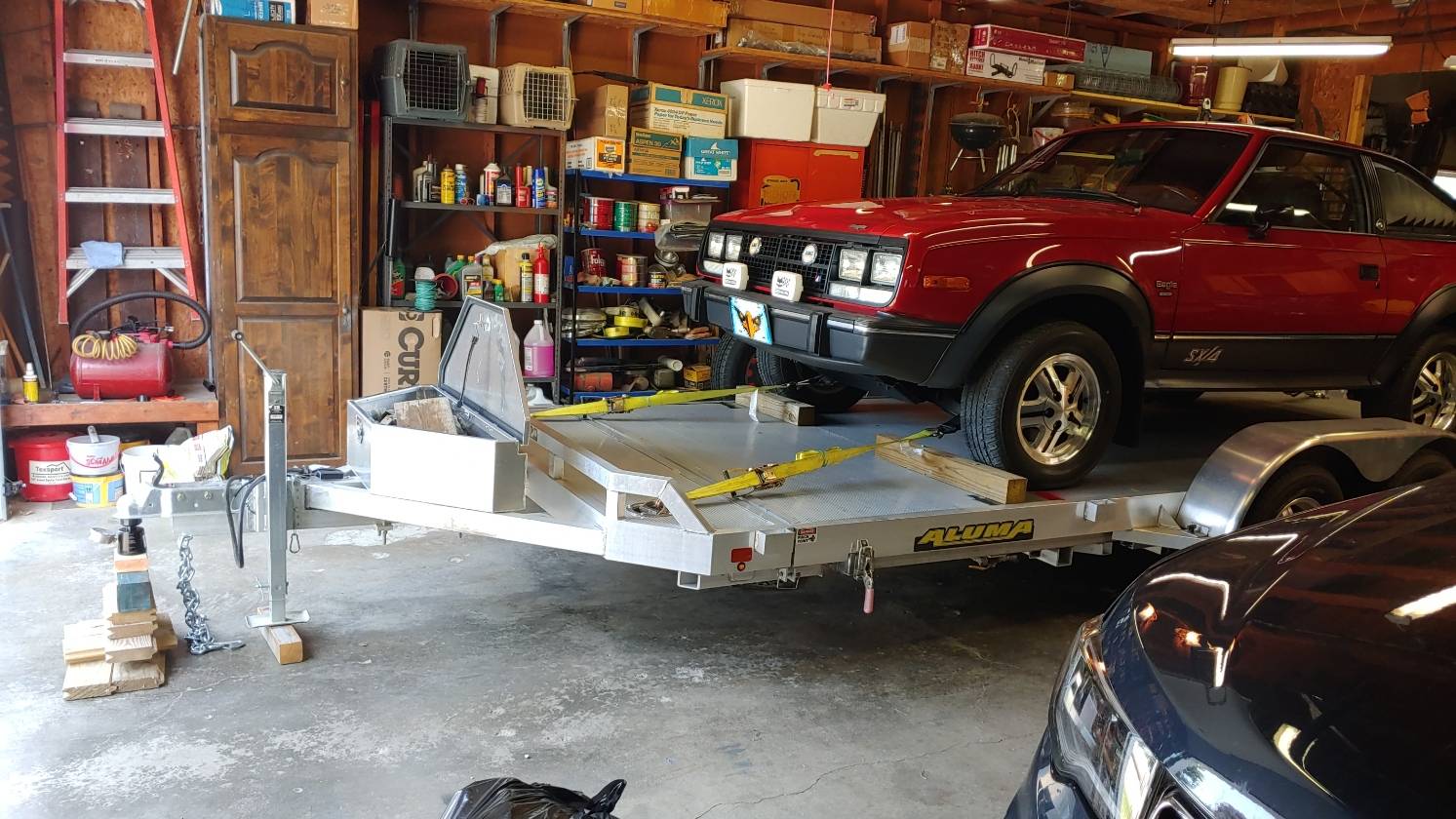
Here, I'm testing the tongue weight (using a hydraulic scale) and making sure of where trailer level is for the correct ball mount height to keep things level - 5,000 pounds when loaded, 525 pounds tongue weight. Tows great.

Jeep Gladiator First Tow coming up looking for thoughts or opinions 20210909_134253
 
OP
OP
BDPJR

BDPJR

Member
First Name
Bruce
Joined
Nov 6, 2024
Threads
2
Messages
22
Reaction score
23
Location
Georgia
Vehicle(s)
Gladiator RubiconX
that’s why I love this Jeep community! Thank you all for the replies. I’m grabbing the trailer today and I’m gonna do a test run.
 

ShadowsPapa

Well-Known Member
First Name
Bill
Joined
Oct 12, 2019
Threads
247
Messages
40,465
Reaction score
53,916
Location
Runnells, Iowa
Vehicle(s)
'25 JTMX, '23 JLU 4xe, '82 SX4, '73 Javelin
Occupation
Retired auto mechanic, frmr gov't ntwrk security admin
Vehicle Showcase
3
that’s why I love this Jeep community! Thank you all for the replies. I’m grabbing the trailer today and I’m gonna do a test run.
I love the Redarc and Jeep brake controllers as I can adjust the braking on the fly as needed. I use one setting for pavement, and when I hit gravel or rock, I back it off or I slide the tires in the gravel/rock/dirt.
It also varies slightly for the weight I have on the trailer - I might run a 4 with one car and load, and a 4 1/2 setting for another.
Like already said - I test, I watch for the wheels to lock on my gravel area between garage and shop, and listen for the brakes when hooking things up.
I keep the tires covered to protect them from the hidden damage of UV when it's not in use.
I also pull into a rest area or a parking lot and quadruple check everything. I have seen some really GROSS, deadly crap from trailers being improperly towed or hitched up, lack of proper safety chains, not locking the hitch onto the ball properly and so on. In one case - a trailer dropped and stopped instantly on the interstate - killing the elderly couple behind it. Boss towed that car in and I still almost get sick thinking of that thing.
So I get a bit crazy about trailer towing safety.
 
OP
OP
BDPJR

BDPJR

Member
First Name
Bruce
Joined
Nov 6, 2024
Threads
2
Messages
22
Reaction score
23
Location
Georgia
Vehicle(s)
Gladiator RubiconX
I love the Redarc and Jeep brake controllers as I can adjust the braking on the fly as needed. I use one setting for pavement, and when I hit gravel or rock, I back it off or I slide the tires in the gravel/rock/dirt.
It also varies slightly for the weight I have on the trailer - I might run a 4 with one car and load, and a 4 1/2 setting for another.
Like already said - I test, I watch for the wheels to lock on my gravel area between garage and shop, and listen for the brakes when hooking things up.
I keep the tires covered to protect them from the hidden damage of UV when it's not in use.
I also pull into a rest area or a parking lot and quadruple check everything. I have seen some really GROSS, deadly crap from trailers being improperly towed or hitched up, lack of proper safety chains, not locking the hitch onto the ball properly and so on. In one case - a trailer dropped and stopped instantly on the interstate - killing the elderly couple behind it. Boss towed that car in and I still almost get sick thinking of that thing.
So I get a bit crazy about trailer towing safety.
I was just looking and wanted to confirm, the Redarc’s are plug and play? I just picked up the trailer and noticed that my safety chains are not chains, but in fact cable, I should probably switch that out!
 

Sponsored

ShadowsPapa

Well-Known Member
First Name
Bill
Joined
Oct 12, 2019
Threads
247
Messages
40,465
Reaction score
53,916
Location
Runnells, Iowa
Vehicle(s)
'25 JTMX, '23 JLU 4xe, '82 SX4, '73 Javelin
Occupation
Retired auto mechanic, frmr gov't ntwrk security admin
Vehicle Showcase
3
I was just looking and wanted to confirm, the Redarc’s are plug and play? I just picked up the trailer and noticed that my safety chains are not chains, but in fact cable, I should probably switch that out!
The safety chains are supposed to cross under the trailer tongue.
The Redarc controller plugs in to the existing Jeep harness at the left kick panel area - where your left foot would rest, but up high at the top of that left panel.
Pretty easy install an excellent company support. They respond - and quickly, in my experience.
 
OP
OP
BDPJR

BDPJR

Member
First Name
Bruce
Joined
Nov 6, 2024
Threads
2
Messages
22
Reaction score
23
Location
Georgia
Vehicle(s)
Gladiator RubiconX
The safety chains are supposed to cross under the trailer tongue.
The Redarc controller plugs in to the existing Jeep harness at the left kick panel area - where your left foot would rest, but up high at the top of that left panel.
Pretty easy install an excellent company support. They respond - and quickly, in my experience.
thanks so much gonna go ahead and order it
 

Verne

Well-Known Member
Joined
Oct 25, 2021
Threads
10
Messages
203
Reaction score
297
Location
Ohio
Vehicle(s)
2021 Jeep Gladiator Mojave
Verne hits the nail on the head.

Bruce - You didn't indicate you have towed before. I'll post this just in case you haven't. Or maybe food for thought with other forum readers.

So far, your indicated towed weight Bruce, falls well within the 7k max so of course, thats a good thing. Let's just say after some gear and fluids, etc. are added into the boat, the weight on its trailer comes to 5,000 pounds when measured on a scale . The tongue weight with a totally balanced boat on the trailer needs to be about 10% of this hypothetical 5,000 pound weight. Thats well within the 7,000 pound towing maximum of the Gladiators spec. BUT - occupant and gear weight in the cabin and in the truck bed matters.

Assuming your occupants and gear that is loaded into the cabin and bed are within good limits, then your tow if balanced well ,sounds like it would be ok. You can calculate the weight of fuel easily to see if that still is within good weight and trailer balance limits. My thing is to always insure my absolute total weight that is at least 20% less than 7k max and that the tongue weight has definitely not been exceeded. Or too lightly loaded on the tongue matters too. Combine that with a well balanced and not overloaded "payload" in the truck and you're good in this manner.

Bear in mind the 7k maximum tow rating is with everything in the tow vehicle, hitch and trailer axles/brakes/TIRES/hitch are in like new, optimal condition. Tires and brakes/braking especially. Both in air pressure levels and age & wear.

Weight transfer hitch best. They cost a bunch. Totally worth it.

All hitched up and loaded for a trip.... Does the Gladiators front-end looking like it's ready to launch to the moon when the boat on trailer tongue weight is connected? Stop right there.

Lightly loaded front tires provide some of the most dangerous mid to higher road speed towing situations. Gets worse if the driving surface has any water or other fluids on it. Situations that if you panic and nail the brakes, can make for a worse result than if just letting off the gas pedal to let the vehicle-train slow itself if no immediate obstacles ahead of you need to be quickly dealt with. Some pressure or pumping of the brakes envoked of course but panic-nailing the pedal can really make a bad situation, worse.

Big jerks of steering wheel direction also bad bad. Of course in a panic situation it's all well and good to arm chair talk about acting calm with decisive actions. Reality isn't going to be the same. But we all have to try to process what's going on with firm and controlled actions. Regain control of your recently guided cruise missile.

I personally won't tow notably heavy loads behind my Gladiator. Around town ok but high speed highway runs, no. Full size trucks with their extra width and in particular, longer than a Gladiator, can make a tremendous difference. Even one foot longer than a Gladiator can make a tremendous difference. Tail wagging the dog for whatever reason, is easier to recover when the two vehicle is brawnier, heavier, longer and even wider axle than any of these factors in what your towing. I don't trust big donut tires and especially don't run with particularly lifted suspensions with big trailer towing.

It's not that the Gladiator can't be used. Longer tow vehicle plus width and more forward weight bias, all good. I think of my Gladiator as a Swiss Army knife in that it can do many things, but in some functions, not the best go-to tool.

Hitch it up, load it up like your trip will be expected to carry and do some low speed driving., gradually increasing to say, 45 mph runs and stopping with plenty of room ahead of you. Brakes should have been used enough to get them to a very warm state or even hot. Feel confident with the brakes so far.

Surely this boat is a size that requires electric brakes on the trailer. Then testing the trailer's electric brakes come sin to play where you have a brake controller that you can adjust when the trailer brakes come into affect on your very first test drive stop. Not locking up or not working at all. It can take a few test stops at different speeds to find just the right setting on a controller to apply the trailer brakes without skidding locked wheels. Or still not applying the electric brakes in time to help with simple stops you expect to make before sliding right through an intersection ro and, or playing into the back of a vehicle in front of you. Brakes that are finally heated up and higher speed stops have to be considered to really get the controller set to a balance for slower simple stops and higher speed, potential panic time stops.

If truly comfortable with how things are going on a pre-trip test run, then higher speed runs on your test drive while still maintaining alertness to issues can now be tried. Just stay out of heavy traffic if you can All of these tests are best done on a day and time that in-town and then on-highway testing with all of the weight and balance expected during the least amount of especially non-bunched up traffic. Your tow vehicle and trailer tire are pressures are spot on, right? Aired cold, not just driven on and not expanded by any heating yet. Decent tread? Not OLD tires? Probably more important on the trailer that these haven't been sitting parked a lot and within about 5+ years of mostly dormant tire-sitting to boot. Especially when suddenly asked too rotate with a load, on a hit day, at high speeds. Ideally of course, no traffic to contend with at all on your test drives. That might not be possible but pick your test drive times to not be during rush hours for sure.

Safety is paramount.

Misc: Hitch "stinger" secured by proper size pin? The ball is truly tight on the stinger with its large lock washer? The ball is of course, the right diameter that matches the trailer tongue? Which has a truly good working fork & latch to secure itself to the ball?

Good chains and hooks crossed, and attached to the tow vehicles tow chain rings? NOT dragging ever in straight or turns?

Your 7-pin wired plug securely plugged in with no evidence of bad wire issues? And a test of the running lights, turn and brake lights all working? Before and after the test drive? Seriously; sometimes a drive can expose intermittent connections by vibration or turns. Clean male and female contacts are your friend.

Do you cable-attach to the two vehicle, the emergency brake switch on the tongue? Battery mounted on the trailer tongue has a charge? And know that it is is actually capable of working?

Testing the function of this switch can sometimes require a helper with really good hearing to stoop near the trailer wheels to hear hear the electric brakes activate. when the safety cable is jerked out of its switch-box on the trailer tongue. Depending on the weathered age of this switch, I'd advise wearing a not-thin glove on the hand doing the jerk-pull, on the cable.

A sort of hard to hear click or clunk when that trailers auxiliary battery activates the electric brakes should be heard. Might need a quiet day for that helper to hear that action. Maybe insert the cable end-in into the switch and do this test two or more times to be sure the switch contacts are working well. You DO want to know that safety is functional if/when what you towing might come disconnected. It won't stop a real mess from happening when you're moving at speed down the road. But, it also won't let your trailer & boat continue to slide a greater distance than if this brake didn't deploy at all.

Have fun boating!
Awesome reply! 💯
 

Texbaz

Well-Known Member
Joined
Mar 31, 2024
Threads
9
Messages
204
Reaction score
295
Location
Texas
Vehicle(s)
2023 Jeep Gladiator Mojave, Zynith Silver
Occupation
Retired
Since we are giving tips, I carry a simple, cheap, infrared thermometer with me when I tow.
When I stop for fuel, or rest I take a temp reading just to keep a trend on what the wheel/bearing temps are.
Good luck.
 

ShadowsPapa

Well-Known Member
First Name
Bill
Joined
Oct 12, 2019
Threads
247
Messages
40,465
Reaction score
53,916
Location
Runnells, Iowa
Vehicle(s)
'25 JTMX, '23 JLU 4xe, '82 SX4, '73 Javelin
Occupation
Retired auto mechanic, frmr gov't ntwrk security admin
Vehicle Showcase
3
Since we are giving tips, I carry a simple, cheap, infrared thermometer with me when I tow.
When I stop for fuel, or rest I take a temp reading just to keep a trend on what the wheel/bearing temps are.
Good luck.
Hmm, I have one of those, but have always just gone by using my hand against the sidewalls of the tires and the bearing cap areas. Never thought of tossing that device in the truck, too.
Sponsored


Top