jywolfe
Active Member
- First Name
- Jon
- Joined
- Nov 10, 2023
- Threads
- 11
- Messages
- 36
- Reaction score
- 63
- Location
- Western North Carolina
- Vehicle(s)
- 2023 Mojave/2021 JLUR
- Occupation
- Self
- Thread starter
- #1
For the good of the community, I'm logging some notes with no specific objective other than the sharing of information and my experiences.
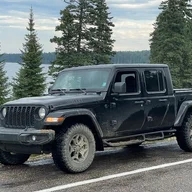
I purchased a MY23 Gladiator Willys in November of last year and now how 9500 miles. It's been all stock with the exception of a decked system, RokBlokz flaps, and Outlander topper. At the time of purchase, the fuel pump recall had been performed. I installed the Mopar 2" diesel specific lift with Bilstein shocks over the weekend. The vehicle has an additional 250 pounds over empty weight without me and I add 160 when driving so 410 pounds total average weight.
I purchased a MY21 Wrangler JL 80th edition in August of this year with 680 miles. It's 100% stock and now has 2800 miles. I had the fuel pump recall done at 1807 miles.
General Observations and Comments for Gladiator:
1. I've changed oil/filter at 682 miles, 1700 miles, 3208 miles, 4789 miles (Jeep Wave), 5886 miles and 7949 miles (Jeep Wave).
2. I replaced the fuel filter at 5886 miles.
3. The tires were rotated at 4789 and 7949 miles.
4. I've been using Quaker State, Castrol and Pennzoil Oils that are all approved for Gen3 Ecodiesel. No oil usage and none to be expected with short OCIs.
5. It has had 15 regens since new and I primarily drive 4 hour trips (216 miles) twice a week when I drive this vehicle, but once at my destination I do 12 miles trips twice daily. Mileage is 90% long-tripping.
6. I fuel up without turning off the engine and usually use DEF at local station to fill up.
7. Fuel mileage started out up to ~5000 miles at 29 MPG highway and 26 in mixed driving.
8. DEF usage is minimal and it uses about 1 gal every 1000 miles.
9. Fuel mileage started to slip this summer dropping to 25 highway and 22.8 mixed, no change in driving habits and tire pressure unchanged and nitrogen filled. It could be I going over 75 MPH more frequently and not paying close attention, as fuel mileage dips pretty significantly at a certain point beyond 72 to 75 MPH.
10. In September, power and torque started to feel constrained and not as responsive as it did when new. I really noticed this after I bought my wife the Wrangler JL 80th edition noted above with the Ecodiesel. Her vehicle is lighter, but the JL diesel engine is significantly more responsive than mine. So it could be the power and torque are unchanged and it's my perception between the two.
11. Oil leak started to show up at the oil filter cooler bottom (no leak confirmed by dealer, they acknowledged they spilled some oil on last oil change) bolt last month and was dripping onto the right side of differential and then onto the carport. I figured the dealership spilled some oil during the last oil change, and cleaned it completely and checked it again this month after a 40 mile trip; it's still present and noticeably black oil so I have an appointment Friday for the dealer to investigate as it's still under warranty.
12. Other than the stock BF Goodrich 255/75/17 mud-terrain tires, the truck has been incredible to drive and operate. They are loud and feel like they have significant rolling resistance; I like their performance, but I usually wear noise cancelling Apple Air pods on long trips. It's the best truck I've owned other than a 2004 Chevrolet 2500 diesel with Allison transmission, which I bought new as well. That's a different class of vehicle, but it's my all-time favorite.
13. I have no noticeable premature wear components or issues, no leaking diffs or coolant loss.
14. I have no interior water leaks from hard top or rear glass.
15. I use Mopar filters exclusively.
16. I've never used the ESS and it is disabled as soon as I crank the vehicle.
17. On long uninterrupted trips, my soot percentage has dropped as much as 15 percent without a passive regen kicking in. This was at highway speeds with cruise control enabled and hot ambient temps 90 degrees plus. Otherwise, it drops a few percentage points on long interstate trips greater than 30 minutes.
18. Soot mass percentage seems to increase non-linearly with multiple start stop events; such as making multiple stops in town and turning the engine off for 10 to 20 minutes and then restarting, but it does increase significantly during these routine events. On the other hand, it increases almost linearly on the days I do short commutes of 12 miles, park at the office and then restart for a 12-mile commute back home. Under these conditions I see a 5-percentage point increase in soot mass for each day on average.
19. I use JScan with bypass cables to monitor this data, but have not done a forced regen to date.
20. The transmission and Ecodiesel pair are excellent. I've owned other JLs with the US made ZF 8 speed and the German made transmission is noticeably more refined and shifts are almost imperceptible.
22. Shock and spring combination when stock was very good and I don't recall ever bottoming out and I drive a lot of poorly maintained dirt and gravel fire roads in a local national forest. I had significant travel on the front and rear when stock and even more now with the Mopar lift.
23. Climbing one of our biggest mountain grades locally with 1000 feet of elevation in ~2 miles I can easily maintain 65-80 MPH without leaving 8th gear.
24. My average oil temp is 218/221 (winter/summer) degrees f when highway driving at a moderate pace, and it's been as high as 233 on hot days at highway speeds in excess of 75 MPH with increasing elevation. Never any concerns over coolant or transmission temps. I don't tow anything regularly, but towed 2500 # trailer locally without issue.
25. As the weather is turning cooler, the notable difference between the Gladiator and the Wrangler is the JL's heat comes on almost instantly whereas my Gladiator is slow to warm up with ambient temps in the 40s recently.
26. I will be adding a front track bar and carrier housing spacer this week. I'll have an alignment done shortly thereafter.
27. On the highway, the Gladiator drives straight and has excellent road manners at highway speeds. The longer wheelbase makes the comfort side of things much better than past Jeeps/Wranglers I've owned.
General Observations and Comments Wrangler JL:
1. We bought the 2021 with 680 miles in August of this year. It was a lease that got caught up in the recall and for some reason the lease owner didn't want to drive it. It also looked like it was stored inside as there was no contaminants or dirt anywhere on the undercarriage. It looked better than my Gladiator did when it was brand new. It also has what appears to be 3M protectant film on all forward-facing surfaces. I should have done the same on my Gladiator.
2. I immediately changed the oil at 702 miles and then again at 1932 miles.
3. I have not yet changed or drained the fuel filter.
4. The JL easily gets 32 MPG on the highway and we've recorded as high as 33.2 on a five-hour trip to the coast and mixed driving we see 28 MPG.
5. The engine is noticeably more responsive in what could be described as pep. It revs on acceleration noticeably more freely than the Gladiator.
6. On the last oil change I also noted oil leaking from the bottom bolt(no oil leaking, it was from last oil change) of the oil cooler and then onto the differential. I cleaned it and will check it again at the next oil change.
7. No notable oil usage and no coolant loss in the short time we've owned it.
8. The tires on the JL are Bridgestone Ascent on 18" wheels and are excellent for what my wife does with the Jeep and for our family travel.
9. Not enough data for DEF fluid use, but I filled it up at 702 miles and it's now at slighly less than 4/5ths.
10. The Wrangler heat comes on almost instantly at cold start when ambient temps are low. It was blowing warm to hot air within 20 seconds of starting it yesterday. This does not happen on my Gladiator. It could be I don't have something configured correctly too. I assume this is the electric option, but haven't really investigated.
11. For comparison, we had a 2021 JLRU with the 2.0L before this one with the Ecodiesel. I thought the world of that Jeep and the little 2.0L was a real pleasure to drive. However, after now driving a Wrangler with the Ecodiesel, the whole Wrangler experience has significantly changed. It's easily the best engine/transmission combination I've ever experienced in a Jeep Wrangler. This is currently our 5th Wrangler in 10 years, and so far, it's the best.
12. The Wrangler has only had two Regens in 2800 miles. It is at 68% right now, so one is forthcoming. (after driving a 216 mile road trip, soot mass percentage dropped to 49%, no third regen)
13. The auxiliary battery failed at 2460 miles and load test showed it was nearly depleted.
Conclusion:
1. High, low-end torque is ideal in a Jeep Wrangler/Gladiator and enhances the driving experience, both on and off pavement.
2. Turbo spool has not been an issue with either of the two Ecodiesels.
3. If you plan on keeping the vehicles long-term as I do, the maintenance costs will likely be higher for the Diesel even if you do your own.
4. One of the two low mileage Ecodiesels I own already has a confirmed oil leak and the other has a potential oil leak. This may be a chronic issue in the engineering or an initial quality control from the engine builder.
5. DPF Regens alter the long-term average fuel economy and there is potential for fuel economy to gradually decline with increased mileage as the residual DPF soot mass increases from non-combustible particulate.
6. While I don't like the adverse effects of the new emission regulations and the aftertreatment systems that cause premature wear of Diesel engine components, I do appreciate that my exhaust gas is transparent and smells like dryer sheets.
7. The transmission on both our Jeep diesels is excellent.
8. Both our Jeeps drive with good torque and strong smooth acceleration, but the Wrangler revs more freely and it is distinctly more enjoyable to drive. It could be weight, or it could be programming, but it's definitely different.
9. Both Jeeps have an odd sound when coming to a stop and only occasionally. It's more prevalent on the Gladiator, but it has happened on both. It almost sounds like a low growl from a junk yard dog and there is a very slight corresponding vibration.
10. I have noticed no perceptible difference with diesel additives. I did a trial with both Hotshots EDT and Archoil 6400-D, but I will continue to use for the Cetane and lubricity. The Archoil showed some correlation with a reduction in soot mass and potentially increased the duration between regens, but I did not fully log all start/stops and drive durations so it was not scientific. Also, there are many variables that are not controlled.
11. The anti-spin rear differentials on both Jeeps is a net positive.
12. The Wrangler's with Ecodiesel on lower models get an upgraded front axle as part of the package. This increases the future potential for upgrading.
13. The Gladiator has cast iron knuckles and the Wrangler has aluminum, even though both are diesels.
14. The Wrangler has half the amount down travel on the front suspension versus the Gladiator when stock, while both share the same front axle and geometry. Ther Wrangler visibly has more rake.
15. The Wrangler Ecodiesel gets significantly better fuel economy and so far, has only done three Regens even though it sees more short trips on average than the Gladiator.
16. Both have excellent road manners and rarely downshift from 8th gear to 7th at highway speeds at or above 65 MPH even when climbing.
17. When using cruise control on both, it has a higher tendancy to downshift even on slight inclines, but manually holding speed on inclines without slowing down it will not downshift. (Programming?)
18. The Wrangler has maintained cleaner looking oil after the first and second oil change compared to the Gladiator. This is likely the difference in mileage between the two, but the Gladiator started showing black oil within a few hundred miles after an oil change as early as the second oil change at 1700 miles. The Wrangler has about 1000 miles on the most recent oil change and it's still brown, not black. On both, I drain for 25-30 minutes and remove all of the residual oil in the oil filter housing. I also plan my oil changes after longer drives, usually an hour or more.
19. The engineering and design of the oil filtration and oil cooling could have been better executed. The one-piece element oil filter is unusual to me. BMW has been using top mounted separate oil filter element/housing for more than two decades and it simply works. However, I think a dual-filtration system could have significant positive benefits for the Ecodiesel.
20. I have had no issues with the SCR, DPF, EGR for either vehicle yet.
21. The recommended oil for the Ecodiesel Gen3 is an excellent standard for wear protection, but poor for after-treatment systems long term. This is a disappointment, and given the high standards of the 5w40 Euro Specs and the usual certs it carries (BMW, MB and Porshe), there seems to be a significant oil sheering and high wear metals (Iron and Aluminum) problem with the exception of one or two boutique oils. I wish I understood which physical properties of the engine and potentially operating conditions/temperatures that is causing this significant sheering and degradation of the oils as blended properties. Until something shakes loose with respect to this anomaly, I'm going to be only extending my OCIs out to 3500 to 4000 miles once I hit 10000 miles. Until then, I'm trying to keep my average OCI to ~1500 miles until 10000 miles on both. Likely overkill and acknowledge my OCD.
22. Long term plan is to purchase the extended warranty on the Gladiator when due and have already done so on the Wrangler. I'll likely drive them up until then, 8 years or 100k and then move on. As much as I love the drivability and performance of both, I'm not confident in the long-term prospects of owning them beyond warranty.
I purchased a MY23 Gladiator Willys in November of last year and now how 9500 miles. It's been all stock with the exception of a decked system, RokBlokz flaps, and Outlander topper. At the time of purchase, the fuel pump recall had been performed. I installed the Mopar 2" diesel specific lift with Bilstein shocks over the weekend. The vehicle has an additional 250 pounds over empty weight without me and I add 160 when driving so 410 pounds total average weight.
I purchased a MY21 Wrangler JL 80th edition in August of this year with 680 miles. It's 100% stock and now has 2800 miles. I had the fuel pump recall done at 1807 miles.
General Observations and Comments for Gladiator:
1. I've changed oil/filter at 682 miles, 1700 miles, 3208 miles, 4789 miles (Jeep Wave), 5886 miles and 7949 miles (Jeep Wave).
2. I replaced the fuel filter at 5886 miles.
3. The tires were rotated at 4789 and 7949 miles.
4. I've been using Quaker State, Castrol and Pennzoil Oils that are all approved for Gen3 Ecodiesel. No oil usage and none to be expected with short OCIs.
5. It has had 15 regens since new and I primarily drive 4 hour trips (216 miles) twice a week when I drive this vehicle, but once at my destination I do 12 miles trips twice daily. Mileage is 90% long-tripping.
6. I fuel up without turning off the engine and usually use DEF at local station to fill up.
7. Fuel mileage started out up to ~5000 miles at 29 MPG highway and 26 in mixed driving.
8. DEF usage is minimal and it uses about 1 gal every 1000 miles.
9. Fuel mileage started to slip this summer dropping to 25 highway and 22.8 mixed, no change in driving habits and tire pressure unchanged and nitrogen filled. It could be I going over 75 MPH more frequently and not paying close attention, as fuel mileage dips pretty significantly at a certain point beyond 72 to 75 MPH.
10. In September, power and torque started to feel constrained and not as responsive as it did when new. I really noticed this after I bought my wife the Wrangler JL 80th edition noted above with the Ecodiesel. Her vehicle is lighter, but the JL diesel engine is significantly more responsive than mine. So it could be the power and torque are unchanged and it's my perception between the two.
11. Oil leak started to show up at the oil filter cooler bottom (no leak confirmed by dealer, they acknowledged they spilled some oil on last oil change) bolt last month and was dripping onto the right side of differential and then onto the carport. I figured the dealership spilled some oil during the last oil change, and cleaned it completely and checked it again this month after a 40 mile trip; it's still present and noticeably black oil so I have an appointment Friday for the dealer to investigate as it's still under warranty.
12. Other than the stock BF Goodrich 255/75/17 mud-terrain tires, the truck has been incredible to drive and operate. They are loud and feel like they have significant rolling resistance; I like their performance, but I usually wear noise cancelling Apple Air pods on long trips. It's the best truck I've owned other than a 2004 Chevrolet 2500 diesel with Allison transmission, which I bought new as well. That's a different class of vehicle, but it's my all-time favorite.
13. I have no noticeable premature wear components or issues, no leaking diffs or coolant loss.
14. I have no interior water leaks from hard top or rear glass.
15. I use Mopar filters exclusively.
16. I've never used the ESS and it is disabled as soon as I crank the vehicle.
17. On long uninterrupted trips, my soot percentage has dropped as much as 15 percent without a passive regen kicking in. This was at highway speeds with cruise control enabled and hot ambient temps 90 degrees plus. Otherwise, it drops a few percentage points on long interstate trips greater than 30 minutes.
18. Soot mass percentage seems to increase non-linearly with multiple start stop events; such as making multiple stops in town and turning the engine off for 10 to 20 minutes and then restarting, but it does increase significantly during these routine events. On the other hand, it increases almost linearly on the days I do short commutes of 12 miles, park at the office and then restart for a 12-mile commute back home. Under these conditions I see a 5-percentage point increase in soot mass for each day on average.
19. I use JScan with bypass cables to monitor this data, but have not done a forced regen to date.
20. The transmission and Ecodiesel pair are excellent. I've owned other JLs with the US made ZF 8 speed and the German made transmission is noticeably more refined and shifts are almost imperceptible.
22. Shock and spring combination when stock was very good and I don't recall ever bottoming out and I drive a lot of poorly maintained dirt and gravel fire roads in a local national forest. I had significant travel on the front and rear when stock and even more now with the Mopar lift.
23. Climbing one of our biggest mountain grades locally with 1000 feet of elevation in ~2 miles I can easily maintain 65-80 MPH without leaving 8th gear.
24. My average oil temp is 218/221 (winter/summer) degrees f when highway driving at a moderate pace, and it's been as high as 233 on hot days at highway speeds in excess of 75 MPH with increasing elevation. Never any concerns over coolant or transmission temps. I don't tow anything regularly, but towed 2500 # trailer locally without issue.
25. As the weather is turning cooler, the notable difference between the Gladiator and the Wrangler is the JL's heat comes on almost instantly whereas my Gladiator is slow to warm up with ambient temps in the 40s recently.
26. I will be adding a front track bar and carrier housing spacer this week. I'll have an alignment done shortly thereafter.
27. On the highway, the Gladiator drives straight and has excellent road manners at highway speeds. The longer wheelbase makes the comfort side of things much better than past Jeeps/Wranglers I've owned.
General Observations and Comments Wrangler JL:
1. We bought the 2021 with 680 miles in August of this year. It was a lease that got caught up in the recall and for some reason the lease owner didn't want to drive it. It also looked like it was stored inside as there was no contaminants or dirt anywhere on the undercarriage. It looked better than my Gladiator did when it was brand new. It also has what appears to be 3M protectant film on all forward-facing surfaces. I should have done the same on my Gladiator.
2. I immediately changed the oil at 702 miles and then again at 1932 miles.
3. I have not yet changed or drained the fuel filter.
4. The JL easily gets 32 MPG on the highway and we've recorded as high as 33.2 on a five-hour trip to the coast and mixed driving we see 28 MPG.
5. The engine is noticeably more responsive in what could be described as pep. It revs on acceleration noticeably more freely than the Gladiator.
6. On the last oil change I also noted oil leaking from the bottom bolt(no oil leaking, it was from last oil change) of the oil cooler and then onto the differential. I cleaned it and will check it again at the next oil change.
7. No notable oil usage and no coolant loss in the short time we've owned it.
8. The tires on the JL are Bridgestone Ascent on 18" wheels and are excellent for what my wife does with the Jeep and for our family travel.
9. Not enough data for DEF fluid use, but I filled it up at 702 miles and it's now at slighly less than 4/5ths.
10. The Wrangler heat comes on almost instantly at cold start when ambient temps are low. It was blowing warm to hot air within 20 seconds of starting it yesterday. This does not happen on my Gladiator. It could be I don't have something configured correctly too. I assume this is the electric option, but haven't really investigated.
11. For comparison, we had a 2021 JLRU with the 2.0L before this one with the Ecodiesel. I thought the world of that Jeep and the little 2.0L was a real pleasure to drive. However, after now driving a Wrangler with the Ecodiesel, the whole Wrangler experience has significantly changed. It's easily the best engine/transmission combination I've ever experienced in a Jeep Wrangler. This is currently our 5th Wrangler in 10 years, and so far, it's the best.
12. The Wrangler has only had two Regens in 2800 miles. It is at 68% right now, so one is forthcoming. (after driving a 216 mile road trip, soot mass percentage dropped to 49%, no third regen)
13. The auxiliary battery failed at 2460 miles and load test showed it was nearly depleted.
Conclusion:
1. High, low-end torque is ideal in a Jeep Wrangler/Gladiator and enhances the driving experience, both on and off pavement.
2. Turbo spool has not been an issue with either of the two Ecodiesels.
3. If you plan on keeping the vehicles long-term as I do, the maintenance costs will likely be higher for the Diesel even if you do your own.
4. One of the two low mileage Ecodiesels I own already has a confirmed oil leak and the other has a potential oil leak. This may be a chronic issue in the engineering or an initial quality control from the engine builder.
5. DPF Regens alter the long-term average fuel economy and there is potential for fuel economy to gradually decline with increased mileage as the residual DPF soot mass increases from non-combustible particulate.
6. While I don't like the adverse effects of the new emission regulations and the aftertreatment systems that cause premature wear of Diesel engine components, I do appreciate that my exhaust gas is transparent and smells like dryer sheets.
7. The transmission on both our Jeep diesels is excellent.
8. Both our Jeeps drive with good torque and strong smooth acceleration, but the Wrangler revs more freely and it is distinctly more enjoyable to drive. It could be weight, or it could be programming, but it's definitely different.
9. Both Jeeps have an odd sound when coming to a stop and only occasionally. It's more prevalent on the Gladiator, but it has happened on both. It almost sounds like a low growl from a junk yard dog and there is a very slight corresponding vibration.
10. I have noticed no perceptible difference with diesel additives. I did a trial with both Hotshots EDT and Archoil 6400-D, but I will continue to use for the Cetane and lubricity. The Archoil showed some correlation with a reduction in soot mass and potentially increased the duration between regens, but I did not fully log all start/stops and drive durations so it was not scientific. Also, there are many variables that are not controlled.
11. The anti-spin rear differentials on both Jeeps is a net positive.
12. The Wrangler's with Ecodiesel on lower models get an upgraded front axle as part of the package. This increases the future potential for upgrading.
13. The Gladiator has cast iron knuckles and the Wrangler has aluminum, even though both are diesels.
14. The Wrangler has half the amount down travel on the front suspension versus the Gladiator when stock, while both share the same front axle and geometry. Ther Wrangler visibly has more rake.
15. The Wrangler Ecodiesel gets significantly better fuel economy and so far, has only done three Regens even though it sees more short trips on average than the Gladiator.
16. Both have excellent road manners and rarely downshift from 8th gear to 7th at highway speeds at or above 65 MPH even when climbing.
17. When using cruise control on both, it has a higher tendancy to downshift even on slight inclines, but manually holding speed on inclines without slowing down it will not downshift. (Programming?)
18. The Wrangler has maintained cleaner looking oil after the first and second oil change compared to the Gladiator. This is likely the difference in mileage between the two, but the Gladiator started showing black oil within a few hundred miles after an oil change as early as the second oil change at 1700 miles. The Wrangler has about 1000 miles on the most recent oil change and it's still brown, not black. On both, I drain for 25-30 minutes and remove all of the residual oil in the oil filter housing. I also plan my oil changes after longer drives, usually an hour or more.
19. The engineering and design of the oil filtration and oil cooling could have been better executed. The one-piece element oil filter is unusual to me. BMW has been using top mounted separate oil filter element/housing for more than two decades and it simply works. However, I think a dual-filtration system could have significant positive benefits for the Ecodiesel.
20. I have had no issues with the SCR, DPF, EGR for either vehicle yet.
21. The recommended oil for the Ecodiesel Gen3 is an excellent standard for wear protection, but poor for after-treatment systems long term. This is a disappointment, and given the high standards of the 5w40 Euro Specs and the usual certs it carries (BMW, MB and Porshe), there seems to be a significant oil sheering and high wear metals (Iron and Aluminum) problem with the exception of one or two boutique oils. I wish I understood which physical properties of the engine and potentially operating conditions/temperatures that is causing this significant sheering and degradation of the oils as blended properties. Until something shakes loose with respect to this anomaly, I'm going to be only extending my OCIs out to 3500 to 4000 miles once I hit 10000 miles. Until then, I'm trying to keep my average OCI to ~1500 miles until 10000 miles on both. Likely overkill and acknowledge my OCD.
22. Long term plan is to purchase the extended warranty on the Gladiator when due and have already done so on the Wrangler. I'll likely drive them up until then, 8 years or 100k and then move on. As much as I love the drivability and performance of both, I'm not confident in the long-term prospects of owning them beyond warranty.
Sponsored
Last edited: