Sponsored

JT/JL Clutch and Flywheel explained by ACT

ACTman

Rock Sponsor (Level 1)
First Name
Dirk
Joined
Apr 23, 2019
Threads
1
Messages
111
Reaction score
259
Location
Lancaster, CA
Website
www.advancedclutch.com
Vehicle(s)
2015 Jeep JKUR, 2003 Jeep Wrangler
Occupation
President and head cheerleader at ACT
Gladiator Clutch and Flywheel Explained

If you really want to know all about the JL/JT clutch, this is your bet place to start. This is actually a repost from the JL forum since they share the same clutch.

I have been working on performance/racing automobile clutches since 1979 and started Advanced Clutch Technology (ACT) in 1994. Being a Jeep enthusiast and owner of two Jeeps with three pedals, I was anxious to see what clutch the new generation of Jeeps had in store as the JL was first released. What we found with the JL/JT clutch at ACT was shocking and unexpected.

In the following posts and makeshift iPhone videos, we will describe the design and function of the JL clutch components, compare with it’s predecessor (JK clutch), share some of ACT’s testing, and summarize the development if the ACT clutch and flywheel for the Jeep JL/JT. Bear with me since video editing is a totally new experience for me. It’s not perfect, but it will do. Let me start with a corny intro video:


After seeing what information is floating around, I knew we had to share our experience, but I struggled with how to structure this thread. I wanted to complete the information before posting, so you wouldn’t have to scroll through a bunch of pages to find information. Then I found myself getting too granular and having to go back and simplify it over again. Hopefully, it will provide enough for you to better understand the clutch system on your Jeep. We will start off with an evaluation of the stock parts, some clutch tech, then how ACT developed our clutch.

Disclaimer: ACT is not offering opinions on specific failures or warranty claims presented to FCA Jeep since we are not privy to the discussions and decisions made by FCA Jeep related to the design, testing, failures, warranty, or recalls.
Sponsored

 
OP
OP
ACTman

ACTman

Rock Sponsor (Level 1)
First Name
Dirk
Joined
Apr 23, 2019
Threads
1
Messages
111
Reaction score
259
Location
Lancaster, CA
Website
www.advancedclutch.com
Vehicle(s)
2015 Jeep JKUR, 2003 Jeep Wrangler
Occupation
President and head cheerleader at ACT
Stock JL/JT clutch, behind the wheel:

ACT’s first Impressions: What we first noticed driving a new JL, was how light and vague the pedal feels. We had no idea how much worse it gets over time, until we had a used JL in the shop. More on that to follow. Here is what automotive journalists had to say about their first impressions with the JL/JT clutch.

“…the clutch engaged with an abruptness that saw many experienced drivers stall the thing.” Car and Driver Dec 12, 2017

“…the clutch on our preproduction Jeep felt artificial and difficult to modulate the friction zone.” Motor Trend Dec 12/2017

“… the clutch take-up on the six-speed manual transmission is so vague even our officemates at JP and 4-Wheel and Off-Road were stalling. …Were it not for the funky clutch pedal, I'd have nothing to complain about.” Motor Trend Dec 13, 2017

“Jeep HQ advised the dealer to replace the six-speed and inspect the clutch assembly. That inspection revealed multiple overheated sections on the clutch's pressure plate and excessive play in the dual-mass flywheel, both of which necessitated the replacement of the full assembly.” Car and Driver Nov 5, 2021, with less than 9k miles into a long-term test of the Gladiator
 
OP
OP
ACTman

ACTman

Rock Sponsor (Level 1)
First Name
Dirk
Joined
Apr 23, 2019
Threads
1
Messages
111
Reaction score
259
Location
Lancaster, CA
Website
www.advancedclutch.com
Vehicle(s)
2015 Jeep JKUR, 2003 Jeep Wrangler
Occupation
President and head cheerleader at ACT
JL clutch design and components:

The next video shows how different the design is from the JK but similar it looks to a couple other applications that have little in common to the JL. The details will be useful later in our conversation.


Let’s start with a couple videos that describe a little of what we see with the parts:
Dual mass damping:


Disassembled parts:


Later I will share some photos of the parts as needed.
 
OP
OP
ACTman

ACTman

Rock Sponsor (Level 1)
First Name
Dirk
Joined
Apr 23, 2019
Threads
1
Messages
111
Reaction score
259
Location
Lancaster, CA
Website
www.advancedclutch.com
Vehicle(s)
2015 Jeep JKUR, 2003 Jeep Wrangler
Occupation
President and head cheerleader at ACT
General Opinions:
If everything is working properly, the stock parts should sufficiently handle the standard torque of the Pentastar and withstand normal driving. In my opinion the failures that have occurred are probably not directly caused by the internal clutch parts. Of course, that is still speculation since I don’t have firsthand knowledge of failed parts.

Flywheel:
The stock flywheel is typical of other dual-mass flywheels with great torsional damping to reduce transmission noise and only adequate heat capacity. Since the damping is in the flywheel, the discs can be solid center which puts less load on the synchronizers.

In my opinion, the dual-mass design of the flywheel is unnecessary. With every clutch change, it is an expensive throw away wear item. The Pentastar 3.6 doesn’t produce violent torsional vibrations, so we don’t see the benefit to Jeep owners. The new Aisin transmission is quiet and shifts very well without it and the added driveline slop in low range can be annoying.

Pressure plate/floater assembly:
Having about 1200lbs of clamp load, the twin disc has adequate torque capacity for the stock JL/JT engine. The JL/JT twin disc clutch has a very light diaphragm spring which results in light pedal effort and very short release travel to operate. Because the Pentastar engine is neither what I would describe as high torque nor high performance, the usual benefits of the self-adjusting twin disc design are negligible. In fact, these same characteristics can be harmful when it comes to feel and operation as it reduces feedback to the driver. I would describe the performance and materials of the stock clutch as adequate. We see similar clutch designs on other applications that don’t share the same complaints as the Jeep JL/JT.

Clutch discs:
We don’t find anything particularly troublesome with the clutch discs. The friction materials and surface area are adequate. The solid center design is reliable and offers very low moment of inertia (MOI) for a twin disc.

JL Operating system:
There are four ratios that help you overcome the 1200lbs of clamp load to operate the stock clutch with such a soft pedal. The pedal effort is further reduced by the pedal assembly assist spring. This video explains differences between the JK and JL operating system.


The reduced travel requirement of the clutch explains why the operating system has a higher pedal to pressure plate ratio to help modulate clutch engagement. Unfortunately, the higher ratio and assist spring on the pedal assembly further reduces the already very light clutch pedal effort.

Later we decided to take a closer look at the pedal assembly which you will see in the next video. In addition to the video, we discovered the ratio of pedal travel to master cylinder travel remained unchanded between the JK and JL/JT.

 
OP
OP
ACTman

ACTman

Rock Sponsor (Level 1)
First Name
Dirk
Joined
Apr 23, 2019
Threads
1
Messages
111
Reaction score
259
Location
Lancaster, CA
Website
www.advancedclutch.com
Vehicle(s)
2015 Jeep JKUR, 2003 Jeep Wrangler
Occupation
President and head cheerleader at ACT
General Opinions:
If everything is working properly, the stock parts should sufficiently handle the standard torque of the Pentastar and withstand normal driving. In my opinion the failures that have occurred are probably not directly caused by the internal clutch parts. Of course, that is still speculation since I don’t have firsthand knowledge of failed parts.

Flywheel:
The stock flywheel is typical of other dual-mass flywheels with great torsional damping to reduce transmission noise and only adequate heat capacity. Since the damping is in the flywheel, the discs can be solid center which puts less load on the synchronizers.

In my opinion, the dual-mass design of the flywheel is unnecessary. With every clutch change, it is an expensive throw away wear item. The Pentastar 3.6 doesn’t produce violent torsional vibrations, so we don’t see the benefit to Jeep owners. The new Aisin transmission is quiet and shifts very well without it and the added driveline slop in low range can be annoying.

Pressure plate/floater assembly:
Having about 1200lbs of clamp load, the twin disc has adequate torque capacity for the stock JL/JT engine. The JL/JT twin disc clutch has a very light diaphragm spring which results in light pedal effort and very short release travel to operate. Because the Pentastar engine is neither what I would describe as high torque nor high performance, the usual benefits of the self-adjusting twin disc design are negligible. In fact, these same characteristics can be harmful when it comes to feel and operation as it reduces feedback to the driver. I would describe the performance and materials of the stock clutch as adequate. We see similar clutch designs on other applications that don’t share the same complaints as the Jeep JL/JT.

Clutch discs:
We don’t find anything particularly troublesome with the clutch discs. The friction materials and surface area are adequate. The solid center design is reliable and offers very low moment of inertia (MOI) for a twin disc.

JL Operating system:
There are four ratios that help you overcome the 1200lbs of clamp load to operate the stock clutch with such a soft pedal. The pedal effort is further reduced by the pedal assembly assist spring. This video explains differences between the JK and JL operating system.


The reduced travel requirement of the clutch explains why the operating system has a higher pedal to pressure plate ratio to help modulate clutch engagement. Unfortunately, the higher ratio and assist spring on the pedal assembly further reduces the already very light clutch pedal effort.

Later we decided to take a closer look at the pedal assembly which you will see in the next video. In addition to the video, we discovered the ratio of pedal travel to master cylinder travel remained unchanded between the JK and JL/JT.


Later I will share some photos of the parts as needed.
 

Sponsored

OP
OP
ACTman

ACTman

Rock Sponsor (Level 1)
First Name
Dirk
Joined
Apr 23, 2019
Threads
1
Messages
111
Reaction score
259
Location
Lancaster, CA
Website
www.advancedclutch.com
Vehicle(s)
2015 Jeep JKUR, 2003 Jeep Wrangler
Occupation
President and head cheerleader at ACT
Clutch Capacity:
Let’s look at some characteristics that determine the performance of a clutch:

Torque capacity:
The most fundamental calculation to determine clutch performance is for torque capacity. The formula used to calculate torque capacity of a clutch can be depicted as N x R x F x P = T, where N = number of friction surfaces (single disc is 2, etc), R = mean radius of the friction area (ft.), F = coefficient of friction, P = lbs. of clamping force, and T = torque capacity in ft. lbs.


As you can tell by the formula, each factor influences the torque capacity equally. Each factor also has benefits and tradeoffs, some of which we only touched on in the video. We usually recommend at least 20% more clutch torque capacity over engine torque at the flywheel.

For our purposes:
Stock JL/JT = 1200 x .303 x 4 x .25 = 363 ftlbs. This is quite adequate for the Pentastart engine that makes 260ftlbs of torque.

EDIT: See post 19 about more recent testing!

Clutch life (wear)

Simply put, how many miles will the clutch last? In many cases that is up to the driver and driving habits. Identify weak links that are prone to failure. For instance, I had the original release bearing beginning to fail on my JK at only 20K miles. The rest of the stock clutch still looked good but the OEM release bearing quality was terrible.

Heat capacity (two types)
Heat stress – The ability for the clutch to withstand the heat of the clutch slipping without breaking down the friction material. Basically, this is surface heat. How effectively does the clutch pull the heat away from the surfaces? This it largely determined by the clutch surface area and quality of the friction material in relation to the torque and weight of the vehicle which is why heavy diesel trucks have big clutches.

Heat soak – The ability of the clutch to soak up the heat of the clutch and recover from clutch slippage. This is mainly determined by the mass behind the mating surfaces of the flywheel/pressure plate/floater as well as the quality of the friction material. More mass = better heat soak.

Reliability, Durability
Determine if the clutch can adequately withstand typical abuse, heat, mileage, or other influences without failure.

What are the possible failure modes of the design? For instance, if a clutch disc has the linings blow off, it usually stays within the bellhousing, but if the flywheel fails, it can be disastrous.

What materials are the parts constructed of?
Here is how to simply compare casting materials:
 
Last edited:
OP
OP
ACTman

ACTman

Rock Sponsor (Level 1)
First Name
Dirk
Joined
Apr 23, 2019
Threads
1
Messages
111
Reaction score
259
Location
Lancaster, CA
Website
www.advancedclutch.com
Vehicle(s)
2015 Jeep JKUR, 2003 Jeep Wrangler
Occupation
President and head cheerleader at ACT
Testing:

Once we determine the platform we want to use for an application, to properly design a clutch there are several tests and evaluations we routinely perform. The most basic data points are clamping force, working range, bearing load, release travel and drivability (in-car feel).

Clamping force (or clamp load). The short video shows our computerized tester, but we also perform manual tests when there is no need to record the results.


Working range testing is similar to the clamp load test, except the pressure plate is mounted to the flywheel on test blocks. The details can be confusing with a self-adjusting clutch so I will save everyone the headache.

Bearing load is tested in a very similar manner except pushing on the fingers of the diaphragm spring.

Release Travel – This video shows how the clutch operates and how we test for release travel:


Engineering and prototyping – Next, we run the numbers on the diaphragm spring design and geometry (fulcrum points) to determine the best balance of diaphragm spring load and leverage ratio of the fulcrum points. We go on from there into engineering the diaphragm spring to deliver the right feel, since the bearing load required from the diaphragm spring is mostly what you feel through the clutch pedal. For the clutch disc, we have several common configurations we like to use depending on the test results. We can save that for another discussion.
 

ShadowsPapa

Well-Known Member
First Name
Bill
Joined
Oct 12, 2019
Threads
247
Messages
40,440
Reaction score
53,853
Location
Runnells, Iowa
Vehicle(s)
'25 JTMX, '23 JLU 4xe, '82 SX4, '73 Javelin
Occupation
Retired auto mechanic, frmr gov't ntwrk security admin
Vehicle Showcase
3
Bravo - glad to see someone coming out with some real information, details on these stock clutches.
There's no reason for a vague clutch feel. Heck, even the hydraulic clutch in my Eagle can be modulated and you know exactly when it's engaging and disengaging. It's not even a performance clutch by any stretch.
I could not understand how one can make a clutch that isn't easy to determine exactly where it's at as far as being engaged or not. Hydraulics are no excuse. That's old technology.
 
OP
OP
ACTman

ACTman

Rock Sponsor (Level 1)
First Name
Dirk
Joined
Apr 23, 2019
Threads
1
Messages
111
Reaction score
259
Location
Lancaster, CA
Website
www.advancedclutch.com
Vehicle(s)
2015 Jeep JKUR, 2003 Jeep Wrangler
Occupation
President and head cheerleader at ACT
Test Results and Comparison:

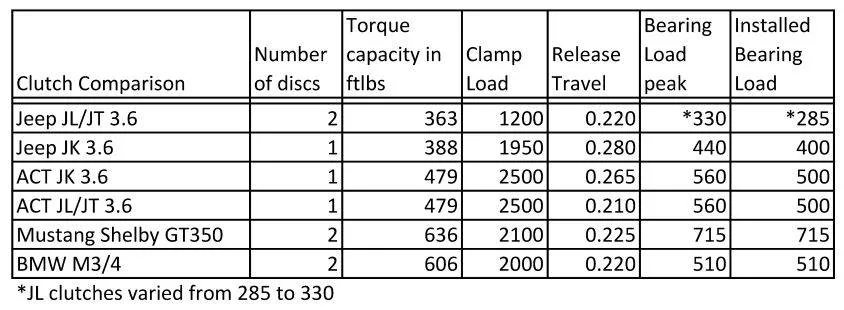
The following chart shows data from several clutches in our discussion. The reason I chose the Ford and BMW clutches is because they share similar or identical components to the JL/JT. For instance, the floater plate, drive plate and rivets look the same.
Jeep Gladiator JT/JL Clutch and Flywheel explained by ACT Clutch Comparison data small

Since they are self-adjusting, the clamping force and torque capacity of the twin-disc clutches were tested/calculated at installed position. The others show results at peak clamping force, which is roughly 10% higher than installed position. Peak clamping force for a self-adjusting clutch is irrelevant since it never reached peak, while installed position for a conventional clutch is a moving target.

EDIT: See post 19 about more recent testing!

From the chart we see:

- The Jeep JL/JT clutch has a very low bearing load because the required clamp load is very low.
- Being a much larger clutch with a stronger diaphragm spring, the stock JK requires 27% and the ACT JK requires 20% more travel to release than the stock JL.
- The ACT JL clutch has identical performance to the ACT JK except travel is reduces dramatically.
- Although the Mustang and BMW have similar clamp loads and release travel, the bearing loads are quite different, which makes sense. You expect the modern muscle car to have a more manly pedal, while the more refined reputation of the BMW might demand a moderate pedal feel.

Note: I didn’t do deep research on it but there are reported clutch failures of both the Mustang and BMW clutches we are comparing to related to the drive straps or rivets failing. Unlike the JL/JT clutch failures, this looks to be related to the higher engine output or how it is driven, not overheating. Here are a couple links you can check into:

BMW M3: https://www.m3post.com/forums/showthread.php?t=1342757

Mustang clutch failure TSB: https://www.mustang6g.com/forums/th...ailure-related-to-excessive-wheel-hop.186777/
 
Last edited:
OP
OP
ACTman

ACTman

Rock Sponsor (Level 1)
First Name
Dirk
Joined
Apr 23, 2019
Threads
1
Messages
111
Reaction score
259
Location
Lancaster, CA
Website
www.advancedclutch.com
Vehicle(s)
2015 Jeep JKUR, 2003 Jeep Wrangler
Occupation
President and head cheerleader at ACT
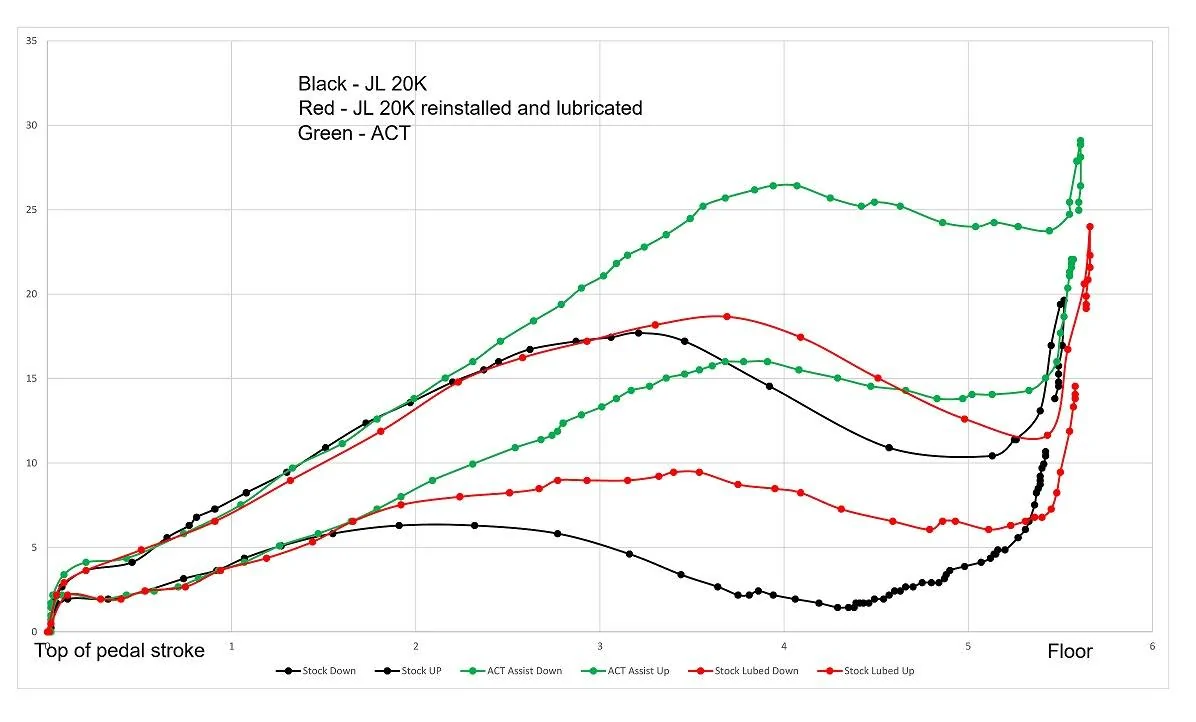
JL Pedal load test results:
Jeep Gladiator JT/JL Clutch and Flywheel explained by ACT JL Pedal graphs

The pedal load graph explains why the pedal felt so terrible on the used JL we had in the shop at only 20,000 miles. The pedal was showing less than 2 pounds of force on the return stroke at one point. Incidentally this is the same clutch shown in the earlier videos, which you can see was in pretty good shape. We repeated the test a few times because we couldn’t believe it. For comparison, we were interested to find out how much improvement we would get if we lubricated everything and of course compare with the ACT clutch installed.
 
Last edited:

Sponsored

OP
OP
ACTman

ACTman

Rock Sponsor (Level 1)
First Name
Dirk
Joined
Apr 23, 2019
Threads
1
Messages
111
Reaction score
259
Location
Lancaster, CA
Website
www.advancedclutch.com
Vehicle(s)
2015 Jeep JKUR, 2003 Jeep Wrangler
Occupation
President and head cheerleader at ACT
ACT Clutch Development:

Here is an informal video explaining how we developed the JL/JT clutch.


Hopefully after reviewing this thread, you will have a better understanding about JL clutches. I think our product will speak for itself. For product information, install videos and more, go to www.advancedclutch.com.

If you have any questions, feel free to contact me and I will do my best to respond.
 

ericnewcom

Well-Known Member
First Name
Eric
Joined
Nov 14, 2022
Threads
1
Messages
47
Reaction score
50
Location
US
Vehicle(s)
2023 JTR MT
ACT Clutch Development:

Here is an informal video explaining how we developed the JL/JT clutch.


Hopefully after reviewing this thread, you will have a better understanding about JL clutches. I think our product will speak for itself. For product information, install videos and more, go to www.advancedclutch.com.

If you have any questions, feel free to contact me and I will do my best to respond.
Thank you for all the valuable information. My truck only has 1,400 miles on it but with the recall and poor behavior of the clutch I plan to replace soon. It feels wrong to replace a clutch that isn't worn out but I've done it once before and it was in a ram. With the tall only option 3.42 gears the ram had the clutch slipped under rated max tow loads. So I replaced it with a southbend. No more issues for over 180k miles. Prior to that I put 210k on a factory clutch in a 2002 superduty 7.3. The clutch was still good the pressure plate springs failed on one side.

So I look forward to seeing how many miles I can put on an ACT clutch.
 

be77solo

Well-Known Member
First Name
Al
Joined
May 7, 2021
Threads
10
Messages
384
Reaction score
571
Location
NC
Vehicle(s)
'21 Gladiator Willys Sport 6-MT, '05 TJ Rubicon
Very good info, great post, thanks for taking the time to put it all together. Sounds like your clutch will fix the issues/feel and is a simpler install than the CF since no hydraulic components are changed.

Look forward to reading more reviews and thoughts once more people have your clutch!
 
OP
OP
ACTman

ACTman

Rock Sponsor (Level 1)
First Name
Dirk
Joined
Apr 23, 2019
Threads
1
Messages
111
Reaction score
259
Location
Lancaster, CA
Website
www.advancedclutch.com
Vehicle(s)
2015 Jeep JKUR, 2003 Jeep Wrangler
Occupation
President and head cheerleader at ACT
Very good info, great post, thanks for taking the time to put it all together. Sounds like your clutch will fix the issues/feel and is a simpler install than the CF since no hydraulic components are changed.

Look forward to reading more reviews and thoughts once more people have your clutch!
Here are a couple:
Wrangler JL: https://www.jlwranglerforums.com/fo...-clutch-technology.111416/page-7#post-2331384
Gladiator: https://www.jeepgladiatorforum.com/...romass-flywheel-installed.68582/#post-1123697. Be sure to see his later feedback on posts #11-13.
Sponsored


Top