Sponsored

Just got the Death Wobble on my JT....grrrr. Any advice?

CerOf

Well-Known Member
Joined
Jan 1, 2021
Threads
18
Messages
1,375
Reaction score
1,625
Location
Dallas
Vehicle(s)
‘21 JTRD
Steering stabilizer is a band aid.
If true death wobble, a steering stabilizer will not fix it. It will mask the underlying problem. At some point, what ever is loose or worn out, will become so bad a stabilizer will no longer mask the problem.

Ball joints or track bar are the usual suspects.
Sponsored

 

ShadowsPapa

Well-Known Member
First Name
Bill
Joined
Oct 12, 2019
Threads
247
Messages
40,514
Reaction score
54,044
Location
Runnells, Iowa
Vehicle(s)
'25 JTMX, '23 JLU 4xe, '82 SX4, '73 Javelin
Occupation
Retired auto mechanic, frmr gov't ntwrk security admin
Vehicle Showcase
3
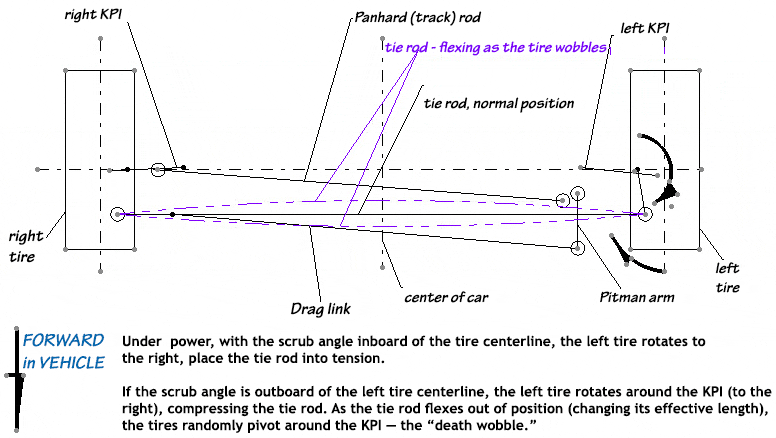
Make sure the track bar isn't damaged and that the ends are TORQUED and not the slightest bit loose. A suspension expert stated that most death wobble experiences were due to track bar flex, etc. I really need to find that link..............
The engineers hit on something I keep harping on - scrub radius and toe......... nuff said or I'll piss someone off.

This comes from suspension engineers who have studied this in depth -

Norm Layton wrote that the "Jeep death wobble" is basically a shimmy, and can affect any suspension with a continuous tie rod (which nearly all solid axles have) to connect the front wheels. He noted, "Shimmy is normally cause by aftermarket application of larger tires, lifts that change the front axle setting for toe, or caster and camber, or worn or damaged parts. An out of balance tire, a broken tire cord, a bent wheel, or worn shocks can be the cause."
Shimmy can be caused by wear or damage to the tie-rod ends, steering box, steering arm ends, or steering stabilizer; even an improper alignment can do it. A major cause is improper toe-in or toe-out, with oversized tires.

Most shimmys come in certain speed ranges, and some are severe enough to require coming to a complete stop. They can be scary to the first timer who is not expecting such violent behavior after hitting a pot hole or railroad track, or just hitting a certain speed.

These shimmies have little to do with design flaws, until design parameters are tampered with, or damaged. It's been around since at least the 1950s, and is not limited to Jeeps.

"CherokeeVision" wrote, "Do not mistake an unbalanced tire or bump steer for death wobble. A steering stabilizer may help dampen the effects of an unbalanced tire or bump steer but does nothing to fix those conditions. With 'death wobble,' it's like the vehicle is hooked up to a paint-can shaker. If it ever happens to you, you will know it. ... aftermarket products such as suspension lifts are designed to flex at slow speeds off road. This is not the same as engineering a suspension to function properly on road."

Suspension engineer Bob Sheaves wrote,
In the 1984 Jeep XJ, a Haltenberger linkage modified this arrangement somewhat. Now, it was a single rod from the pitman arm to the right hand knuckle with tie rod ends at both ends for the draglink; and a single rod from the left hand knuckle to the drag link with ball joints at both ends.

These parts are sized in compression strength and torsional strength for the original maximum size tires and no larger. In stock form, flexing out of plane for these pieces is minimized.

Once you change to a larger overall diameter tire, you do two things - both bad. You increase the rotating mass, increasing the gyroscopic effect of the tire on handling; and you change the theoretical length of the arm resisting the toe change from ground induced inputs.

This is the cause of the steering induced effects. Other issues arise from the changes in the geometry when a panhard rod is added to the system, which causes an over-constraint of the suspension geometry (which is why the proper name of the Jeep "Quadracoil" suspension is "5 link, over constrained, link-coil" suspension.)

In a properly designed XJ suspension, the motion of the draglink (of the Haltenberger type) and the panhard rod is supposed to be a parallelogram...but in stock form, it is not, so raising the vehicle even 1 inch worsens the "fight" between the track bar (panhard rod) and the draglink, causing the tires to steer instead of the driver.

In stock form, these effects are minimized. Lift it and you will have a problem, the only change is when and under what conditions. Idiots that simply bolt on a 4" lift kit will be selected by Darwin...the only question is when. In general, people designing these lift kits do not know what they are doing. There was one exception, Nth Degree, but they went out of business - from what I heard because their kits, which minimized these problems, were too expensive.

The Rubicon is at the ragged edge of acceptable street and offroad suspension geometry motion. Given the GD&T variance of the production design, it could (I am not saying "will") occur, but it will not be to the amount of a 36" tire equipped vehicle.

Jeep Gladiator Just got the Death Wobble on my JT....grrrr.  Any advice? death-wobble


And on steering dampeners - exactly as some members have said - it's not a fix and wobble or wander aren't even the purpose for them at all! Not even close -
More quotes -

A steering damper is not a fix, it's a band-aid used to mask issues with either worn components or poor design. Dampers did not start appearing on stock vehicles until the late 70s, mostly associated with the trend to larger (wider thus heavier) tires on older designs. Rather than redesign the entire front-end geometry, AMC found it less expensive to add the damper.

On a properly designed and well maintained system, a damper's purpose is to mitigate the effects of bump steer and the sudden encounter of unexpected objects, such as hitting a rock in a trail at 50 miles per hour. On an improperly designed and/or poorly maintained system, a damper is used as a crutch to mask issues with suspension and tire errors.
 
Last edited:


Top