Mercer
Member
- First Name
- Michael
- Joined
- Sep 23, 2019
- Threads
- 1
- Messages
- 5
- Reaction score
- 26
- Location
- Huntsville, Alabama
- Vehicle(s)
- 2020 Jeep Gladiator
- Occupation
- Engineering Executive
- Thread starter
- #1
I recently completed building a power system for my Jeep Gladiator, and I thought I'd share my experience.
Last year I purchased a Goal Zero Yeti 1400 and after my first camping trip, I realized that it wasn't nearly as capable as I had hoped, running out of power to run my Dometic fridge/freezer much faster than I had anticipated. After that experience, I bought a Boulder 100 solar panel, Yeti Link and 100 AH Yeti Tank. That increased my capacity, but battery recovery was dependant on sunny weather, and the Boulder 100 wasn't really cutting it. I decided to build a system that could fit inside of a waterproof truck box, with a quick disconnect to my Jeep's 220 amp alternator via the starter battery (AGM, 75 Ah, 70 CCA).
It took me a while to identify the right equipment, particularly a quick disconnect that would be waterproof and safely support up to 100 amps. I considered a large Anderson plug, but I wanted a waterproof plug receptacle I could mount to my truck box. Eventually, I discovered a 100 amp trolling motor plug from Battery Tender which ended up working perfectly. I ran a 4 AWG cable from a relay-based battery isolator in my engine compartment to my truck bed, using a magnetic cable clip to keep it "docked" when my battery system is removed.
With the truck box in place, I decided to base my key system components around Victron, due to their excellent Bluetooth powered apps -- getting the SmartSolar 100/50 charge controller and the BMV-712 battery monitor. At the center of my system is a Blue Sea Safety Hub 150, which supports circuits up to 200A and handily supplies a central negative bus. Originally I was looking at a DC to DC charger to put between my starter battery and house battery, but because the Gladiator’s alternator already works to charge its AGM starter battery, I decided to give it a try without one. So far, the results are good. After discharging my house battery to 75%, I was able to charge it at 400 watts, eventually leveling off to 60 watts. I may still look into a DC to DC charger eventually, but for now, this system seems to be working well. I'll be hooking up two 110-watt flexible solar panels next, and seeing how they perform.
One unusual aspect of my system is the Yeti 1400. Rather than get a new inverter, I connected the Yeti to the Safety Hub 150 fuse block via its Yeti Link charge controller (which supports charging at 60 amps).
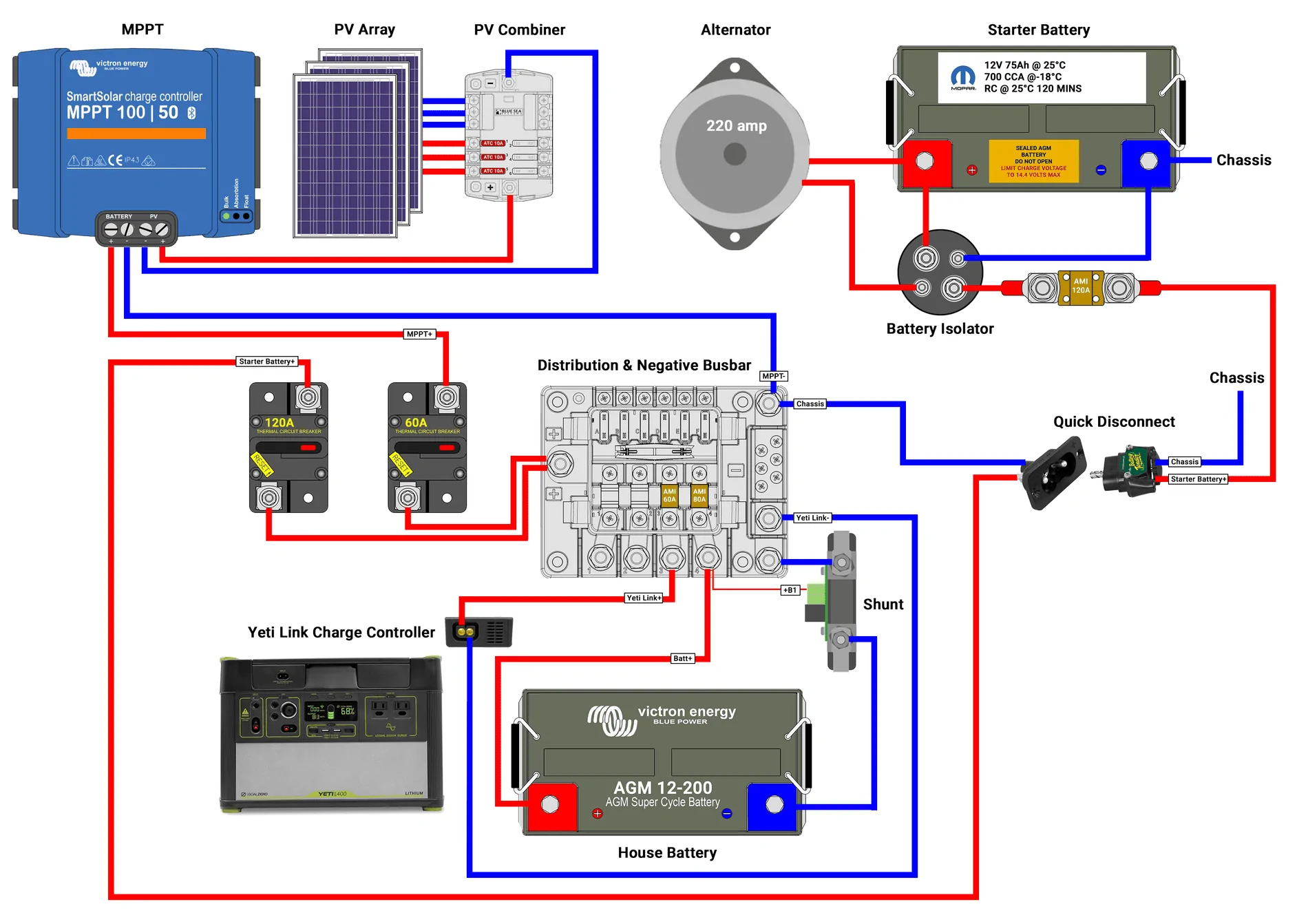
Here's a schematic of my build -- would love to hear thoughts and feedback.

Last year I purchased a Goal Zero Yeti 1400 and after my first camping trip, I realized that it wasn't nearly as capable as I had hoped, running out of power to run my Dometic fridge/freezer much faster than I had anticipated. After that experience, I bought a Boulder 100 solar panel, Yeti Link and 100 AH Yeti Tank. That increased my capacity, but battery recovery was dependant on sunny weather, and the Boulder 100 wasn't really cutting it. I decided to build a system that could fit inside of a waterproof truck box, with a quick disconnect to my Jeep's 220 amp alternator via the starter battery (AGM, 75 Ah, 70 CCA).
It took me a while to identify the right equipment, particularly a quick disconnect that would be waterproof and safely support up to 100 amps. I considered a large Anderson plug, but I wanted a waterproof plug receptacle I could mount to my truck box. Eventually, I discovered a 100 amp trolling motor plug from Battery Tender which ended up working perfectly. I ran a 4 AWG cable from a relay-based battery isolator in my engine compartment to my truck bed, using a magnetic cable clip to keep it "docked" when my battery system is removed.
With the truck box in place, I decided to base my key system components around Victron, due to their excellent Bluetooth powered apps -- getting the SmartSolar 100/50 charge controller and the BMV-712 battery monitor. At the center of my system is a Blue Sea Safety Hub 150, which supports circuits up to 200A and handily supplies a central negative bus. Originally I was looking at a DC to DC charger to put between my starter battery and house battery, but because the Gladiator’s alternator already works to charge its AGM starter battery, I decided to give it a try without one. So far, the results are good. After discharging my house battery to 75%, I was able to charge it at 400 watts, eventually leveling off to 60 watts. I may still look into a DC to DC charger eventually, but for now, this system seems to be working well. I'll be hooking up two 110-watt flexible solar panels next, and seeing how they perform.
One unusual aspect of my system is the Yeti 1400. Rather than get a new inverter, I connected the Yeti to the Safety Hub 150 fuse block via its Yeti Link charge controller (which supports charging at 60 amps).
Here's a schematic of my build -- would love to hear thoughts and feedback.
Sponsored