
Sponsored

Odd Horizon on Oracle Lighting

hermit-krab

Member
First Name
Brian
Joined
Jan 24, 2025
Threads
3
Messages
17
Reaction score
7
Location
Colorado
Vehicle(s)
22 JTRD
Occupation
Engineering
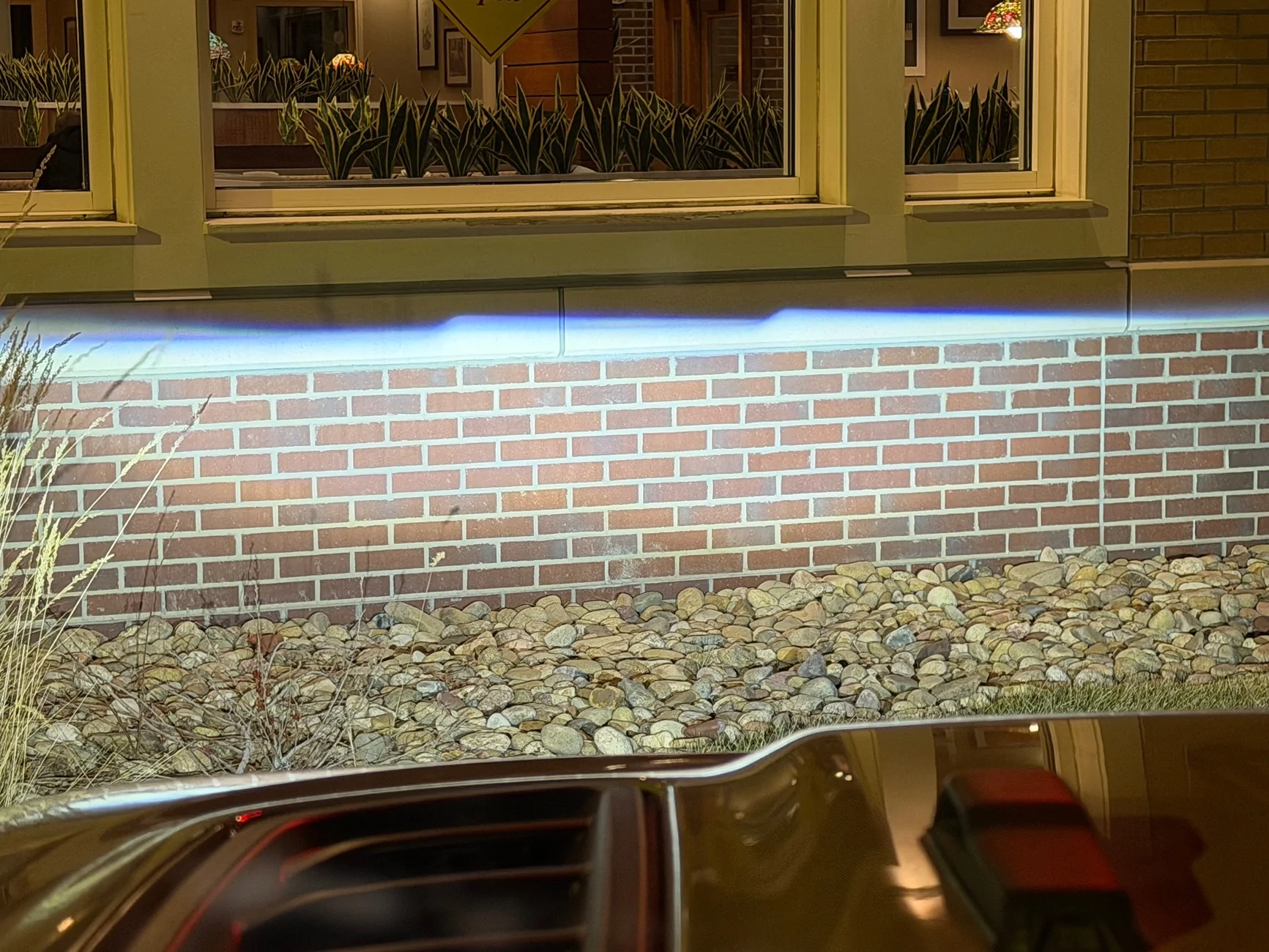
Jeep Gladiator Odd Horizon on Oracle Lighting IMG_5506


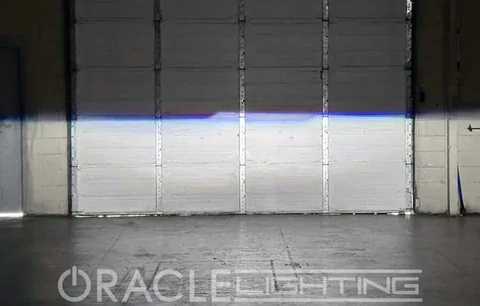
I picked up the heated Oracle LED Headlights over the holiday sale and it seems they incorporated a 'mountain range' horizon into the design. Or maybe I'm just making up some marketing mumbo jumbo but I wanted to ask if anyone else has seen this oddity as it is quite annoying and is visible everywhere I go because of how definitive that cut off is.

Is this normal?
Sponsored
 

Sandman 4x4

Well-Known Member
First Name
Kevin
Joined
Jul 23, 2024
Threads
0
Messages
687
Reaction score
560
Location
Kissimmee, Florida
Vehicle(s)
2024 Gladiator Sport S
Occupation
Retired. Beach bum.
It’s kinda hard to tell in this picture, exactly how far from the wall are you? The two individual beams should meet in one notch at 25’. If not then block each one off at a time to see exactly where each has its peak in the cutoff. Do those light assemblies have a side to side adjustment? You should be alright as far as oncoming traffic is concerned, if the lights are set at 2” or more below the center hight of the headlights at a distance of 25’. Good luck. I’m sure you paid some serious $$$$ even on sale.
 

AmosMoses

Well-Known Member
First Name
Amos
Joined
Jun 25, 2022
Threads
41
Messages
938
Reaction score
1,846
Location
Ohio
Vehicle(s)
2020 jeep gladiator sport
Occupation
Manufacturing
Its one of the features they list on their website with pictures of the "cut off line" just like you've showed in your picture.

I think softer transitions on headlights improve visibility. A sharp cutoff line makes what is beyond it, harder to see, especially with bright LEDs. At least that is how my eyes work. I had a set of oracles and mine were just like yours and just like their website shows.
 
OP
OP
hermit-krab

hermit-krab

Member
First Name
Brian
Joined
Jan 24, 2025
Threads
3
Messages
17
Reaction score
7
Location
Colorado
Vehicle(s)
22 JTRD
Occupation
Engineering
I don't mind the well defined line so much as I do the fact that it looks like an EKG. The inconsistent dispersement of the light to the sides make them look... not well engineered.
 

Sponsored

Vtur

Well-Known Member
First Name
Le
Joined
Mar 6, 2021
Threads
11
Messages
1,914
Reaction score
2,263
Location
Norcal
Vehicle(s)
JTOD
Occupation
Electrical Foreman
That call D.O.T cutoff line. It helps with not blinding opposite traffic for LHD. The cutoff flip other way for RHD countries.

Please don't attempt pointing any headlamps to the side. Lights intensity will looks cockeye to the drivers in front. Both headlight beams should aways be pointing straight forward and parallel with each other. Same with taillights.
 
Last edited:

ORACLElights

Peak Sponsor (Level 2)
Joined
Dec 29, 2019
Threads
400
Messages
1,901
Reaction score
2,411
Location
Metairie, LA
Website
www.oraclelights.com
Vehicle(s)
Jeep Gladiator
Occupation
Automotive LED Manufacturer
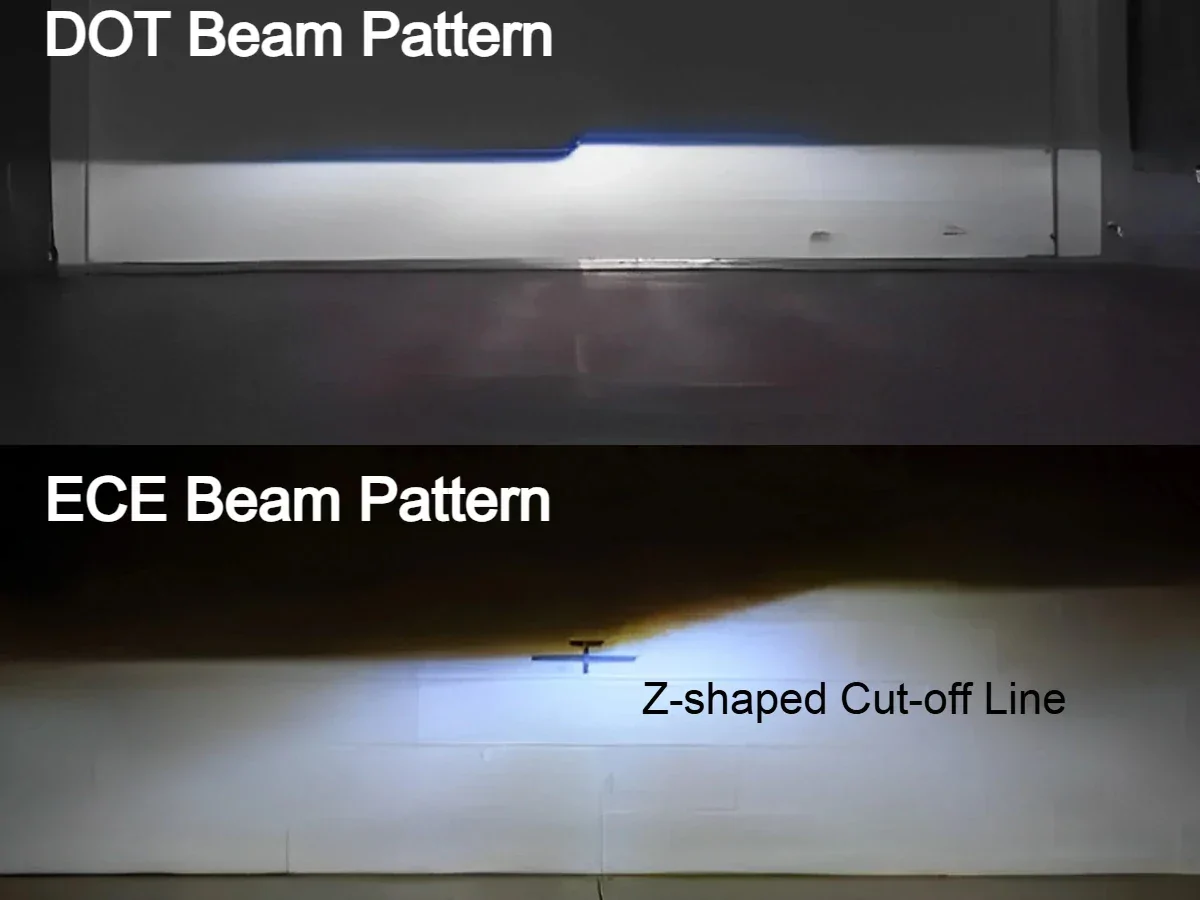
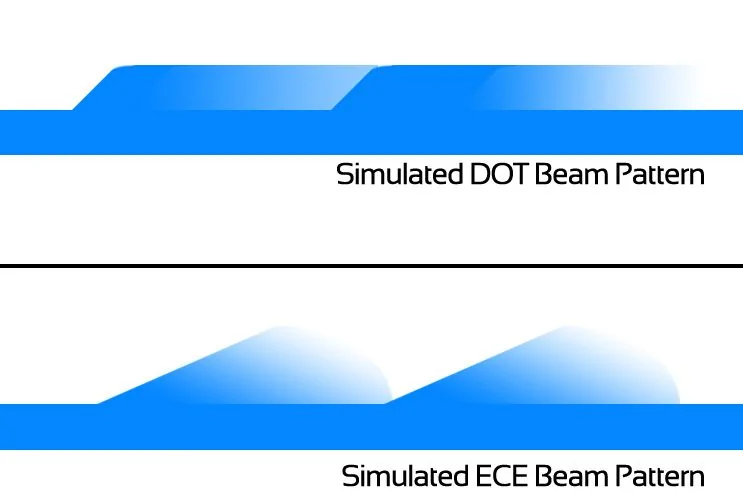
What you’re seeing is the DOT beam cutoff pattern, and that “mountain range” look is essentially the way the two projector beams overlap and meet. On DOT-approved headlights (like these), the cutoff is designed to be very defined so light stays below oncoming drivers’ eye level. That sharp line is actually what keeps them legal and glare-controlled for LHD vehicles.

Jeep Gladiator Odd Horizon on Oracle Lighting 1768851889855-0k


A couple folks already gave good advice above, and I’ll build on that:
  • At 25 ft, the two individual beams should meet cleanly at a single point in the cutoff.
  • The cutoff should land ~2 inches or more below headlight center height at that distance.
  • If it looks uneven, blocking one projector at a time is the best way to see where each beam is landing.
  • These housings do have vertical adjustment (under the rubber cap), but side-to-side aiming is not recommended — both beams should remain straight and parallel.

If it helps, here’s the basic aiming process we recommend:
  1. Park on level ground, 25 ft from a wall
  2. Measure from ground to headlight center
  3. Mark that height on the wall
  4. Adjust vertically so the cutoff meets just below that mark

As for DOT vs ECE, this is where preference comes in:
  • DOT patterns (what you have):
    • Symmetrical, very sharp cutoff
    • Excellent glare control
    • Designed to meet US regulations
    • Can appear more “defined” or noticeable, especially on flat roads or walls
  • ECE patterns (common on older halogen / Euro lights):
    • Asymmetrical step-up on one side
    • Smoother-looking cutoff
    • Better sign illumination, but not DOT certified here

So yes... what you’re seeing is normal behavior for a DOT-certified projector (these are certified under DOT / SAE standards). Once properly aimed, most people stop noticing it during real-world driving, but if the cutoff is landing too high or the two beams aren’t meeting cleanly, a small vertical adjustment usually fixes that quickly. Happy to help if you have any other questions!
 
OP
OP
hermit-krab

hermit-krab

Member
First Name
Brian
Joined
Jan 24, 2025
Threads
3
Messages
17
Reaction score
7
Location
Colorado
Vehicle(s)
22 JTRD
Occupation
Engineering
What you’re seeing is the DOT beam cutoff pattern, and that “mountain range” look is essentially the way the two projector beams overlap and meet. On DOT-approved headlights (like these), the cutoff is designed to be very defined so light stays below oncoming drivers’ eye level. That sharp line is actually what keeps them legal and glare-controlled for LHD vehicles.

1768851889855-0k.webp


A couple folks already gave good advice above, and I’ll build on that:
  • At 25 ft, the two individual beams should meet cleanly at a single point in the cutoff.
  • The cutoff should land ~2 inches or more below headlight center height at that distance.
  • If it looks uneven, blocking one projector at a time is the best way to see where each beam is landing.
  • These housings do have vertical adjustment (under the rubber cap), but side-to-side aiming is not recommended — both beams should remain straight and parallel.

If it helps, here’s the basic aiming process we recommend:
  1. Park on level ground, 25 ft from a wall
  2. Measure from ground to headlight center
  3. Mark that height on the wall
  4. Adjust vertically so the cutoff meets just below that mark

As for DOT vs ECE, this is where preference comes in:
  • DOT patterns (what you have):
    • Symmetrical, very sharp cutoff
    • Excellent glare control
    • Designed to meet US regulations
    • Can appear more “defined” or noticeable, especially on flat roads or walls
  • ECE patterns (common on older halogen / Euro lights):
    • Asymmetrical step-up on one side
    • Smoother-looking cutoff
    • Better sign illumination, but not DOT certified here

So yes... what you’re seeing is normal behavior for a DOT-certified projector (these are certified under DOT / SAE standards). Once properly aimed, most people stop noticing it during real-world driving, but if the cutoff is landing too high or the two beams aren’t meeting cleanly, a small vertical adjustment usually fixes that quickly. Happy to help if you have any other questions!

In both the DOT and The ECE, I see a single step. Is this captured from a single beam? On my image there are dual steps. I would think that because they are manufactured as left and right that there would be a synergy between the lenses which would add some to the manufacturing cost rather than just different mounting bases and having a step in both. Designing the beams to 'meet' at the step I feel would produce a much cleaner looking light pattern and also be a nice cue to ensuring both beams are in alignment. Perhaps it has to do with the distance to the wall? These were already height adjusted at the time of the photo.
 

sharpsicle

Well-Known Member
Joined
Apr 29, 2021
Threads
22
Messages
2,762
Reaction score
6,255
Location
Tampa, FL / Milwaukee, WI
Vehicle(s)
2020 Gladiator Overland, 2002 VTX1800
In both the DOT and The ECE, I see a single step. Is this captured from a single beam? On my image there are dual steps. I would think that because they are manufactured as left and right that there would be a synergy between the lenses which would add some to the manufacturing cost rather than just different mounting bases and having a step in both. Designing the beams to 'meet' at the step I feel would produce a much cleaner looking light pattern and also be a nice cue to ensuring both beams are in alignment. Perhaps it has to do with the distance to the wall? These were already height adjusted at the time of the photo.
Your picture looks too close for them to merge. Try going back to 30 feet.

As I pull up to my garage at night, I can watch the steps separate as I get closer.
 
OP
OP
hermit-krab

hermit-krab

Member
First Name
Brian
Joined
Jan 24, 2025
Threads
3
Messages
17
Reaction score
7
Location
Colorado
Vehicle(s)
22 JTRD
Occupation
Engineering
Your picture looks too close for them to merge. Try going back to 30 feet.

As I pull up to my garage at night, I can watch the steps separate as I get closer.

I will try to get these adjusted in the parking garage at work. There isn't much flat ground around where I am at.
 

Sponsored

ORACLElights

Peak Sponsor (Level 2)
Joined
Dec 29, 2019
Threads
400
Messages
1,901
Reaction score
2,411
Location
Metairie, LA
Website
www.oraclelights.com
Vehicle(s)
Jeep Gladiator
Occupation
Automotive LED Manufacturer
In both the DOT and The ECE, I see a single step. Is this captured from a single beam? On my image there are dual steps. I would think that because they are manufactured as left and right that there would be a synergy between the lenses which would add some to the manufacturing cost rather than just different mounting bases and having a step in both. Designing the beams to 'meet' at the step I feel would produce a much cleaner looking light pattern and also be a nice cue to ensuring both beams are in alignment. Perhaps it has to do with the distance to the wall? These were already height adjusted at the time of the photo.
Jeep Gladiator Odd Horizon on Oracle Lighting 1771435656941-rt


The graphic we shared is showing a single beam pattern for illustration purposes, not both headlights projected together.

When you project both left and right lamps onto a wall, you’ll naturally see two distinct step points. That’s completely normal and expected. Each headlight is engineered as a dedicated left and right unit, and they’re designed to work together on the road — but not to visually “merge” into one single step on a wall.

In both DOT and ECE patterns, the step is intentional:
  • The horizontal cutoff prevents glare to oncoming drivers.
  • The upward step (on the right side for LHD markets) provides additional illumination for road signs and shoulder visibility.

They are not designed to “meet” perfectly in the center. In fact, if they did, that could create excessive intensity directly in front of oncoming traffic. Proper aim will show two defined step transitions, not one continuous merged line.

Distance to the wall can slightly affect how exaggerated the steps appear, but the presence of two step points is correct when both lamps are operating.

Jeep Gladiator Odd Horizon on Oracle Lighting 1771435740701-40


We have a blog with even more information here: https://www.oraclelights.com/blogs/news/how-to-aim-the-headlights-on-your-jeep
 
OP
OP
hermit-krab

hermit-krab

Member
First Name
Brian
Joined
Jan 24, 2025
Threads
3
Messages
17
Reaction score
7
Location
Colorado
Vehicle(s)
22 JTRD
Occupation
Engineering
thank you for sharing this information
Sponsored


Top