Knightindullarmor
Well-Known Member
- Thread starter
- #1
So... I've been through many posts on this site and watched many YouTube videos regarding different lift options.
One thing stands out. Supposedly the "best" way to maintain factory ride with a suspension lift is to use brackets that relocate your front & rear upper & lower control arms to a horizontal position after the lift.
Seems like a good idea, but help me understand this: after running Rausch Creek last weekend and finally having a chance to figure out exactly what my point(s) of contact were when I had "thunks" or scrapes, the only thing that scraped on rock were my LCA-to-frame mounting brackets. Now, if I do the lift using the best possible method to keep factory ride, I use the extended (downward) brackets to maintain a horizontal LCA angle.
The one thing that actually scrapes on the trail would be lowered using this method.
The whole point of the lift is to put more ground clearance between the ground/rocks and the point of the vehicle that scrapes on those rocks. But if I use LCA relocation brackets, the exact part of the Jeep that I want further from the ground now becomes lowered and I net 0" ground clearance gain between the LCA bracket & the ground. Which makes the whole point of the lift (getting the parts that actually scrape on trails further from the ground) null & void.
I'm basing this on real-world testing. The only part of my JT that whacks rocks is the only part of my JT that would gain 0" ground clearance with a 100% proper lift.
Am I missing something?
(Yes I know lift = bigger tires = the only way to put more clearance between pumpkins & obstacles)
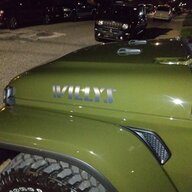
But I plan on running these great 32" MT that came factory with my Willys until they need replaced. Even then, when I go to 285x70r17 version of same tire, I only gain 3/4" to 1" additional ground clearance and I don't even need a lift to clear 33.5/34" tires.
What am I missing?
One thing stands out. Supposedly the "best" way to maintain factory ride with a suspension lift is to use brackets that relocate your front & rear upper & lower control arms to a horizontal position after the lift.
Seems like a good idea, but help me understand this: after running Rausch Creek last weekend and finally having a chance to figure out exactly what my point(s) of contact were when I had "thunks" or scrapes, the only thing that scraped on rock were my LCA-to-frame mounting brackets. Now, if I do the lift using the best possible method to keep factory ride, I use the extended (downward) brackets to maintain a horizontal LCA angle.
The one thing that actually scrapes on the trail would be lowered using this method.
The whole point of the lift is to put more ground clearance between the ground/rocks and the point of the vehicle that scrapes on those rocks. But if I use LCA relocation brackets, the exact part of the Jeep that I want further from the ground now becomes lowered and I net 0" ground clearance gain between the LCA bracket & the ground. Which makes the whole point of the lift (getting the parts that actually scrape on trails further from the ground) null & void.
I'm basing this on real-world testing. The only part of my JT that whacks rocks is the only part of my JT that would gain 0" ground clearance with a 100% proper lift.
Am I missing something?
(Yes I know lift = bigger tires = the only way to put more clearance between pumpkins & obstacles)
But I plan on running these great 32" MT that came factory with my Willys until they need replaced. Even then, when I go to 285x70r17 version of same tire, I only gain 3/4" to 1" additional ground clearance and I don't even need a lift to clear 33.5/34" tires.
What am I missing?
Sponsored