
Sponsored

Jeep Gladiators Burn to Death During Battery Jump

ShadowsPapa

Well-Known Member
First Name
Bill
Joined
Oct 12, 2019
Threads
247
Messages
40,504
Reaction score
54,031
Location
Runnells, Iowa
Vehicle(s)
'25 JTMX, '23 JLU 4xe, '82 SX4, '73 Javelin
Occupation
Retired auto mechanic, frmr gov't ntwrk security admin
Vehicle Showcase
3
Many years ago I bought a set of jumper cables that are in two pieces, with a polarized (by way of orientation of the male and female prongs), and have LEDs on each connector. The prongs are recessed on each connector. You hook each half to a car with the alligator clamps, and if both LEDs are lit, you are good to stick the connectors together.

It is a good system. Tried to find similar product recently, came up empty. Still have the original one, though, in my wife's trunk.
Sounds cool.
But my experience with auto electric and charging systems is that when they invent something idiot proof, someone else comes up with a better idiot.

That's the sort of jumper cable I should buy to put in my wife's Jeep as you never know when one of her friends will say "my son can jump that for you".......... scary words.
Sponsored


 

Delhux

Well-Known Member
Joined
Aug 23, 2019
Threads
44
Messages
578
Reaction score
893
Location
Boston, MA
Vehicle(s)
2020 Gladiator - Overland - Gator
Every time I am jump starting a car with someone else, I get the sense that I may be the only person in the world that actual connects the negative end to a ground point on the dead-battery vehicle.

I have had so many people I know try to move the negative cable off the ground point and attach it to the battery. Then, like clockwork, they look at me like I’m an idiot from planet Dipshit when I try to explain the “chance” of a spark/battery explosion.

“I always do it this way and it never explodes...”

Until it does.
 

AggieJeep

Well-Known Member
First Name
Mark
Joined
Apr 3, 2019
Threads
6
Messages
469
Reaction score
770
Location
Houston, TX
Vehicle(s)
2020 Gladiator Firecracker Red LE, 2012 JKUR Call of Duty, 1967 M715 (military Gladiator)
Vehicle Showcase
1
Do you have the 8.4” radio by any chance? I had a 2019 Challenger with that radio & it was the source of the intermittent draw. I pulled the radio fuse & the car could then sit for weeks without killing the battery. Dealer of course was no help in fixing the car.
Thanks for the tip. I do have the 8.4. I didn’t mean to hijack this thread with my battery issue. I just wanted to provide some evidence that the Gladiator doesn’t necessarily spontaneously combust when a jump start is performed.
 
Joined
Mar 5, 2020
Threads
4
Messages
1,954
Reaction score
2,421
Location
Lake Martin, Alabama
Vehicle(s)
2020 Jeep Gladiator Rubicon
Vehicle Showcase
1
Many years ago I bought a set of jumper cables that are in two pieces, with a polarized (by way of orientation of the male and female prongs), and have LEDs on each connector. The prongs are recessed on each connector. You hook each half to a car with the alligator clamps, and if both LEDs are lit, you are good to stick the connectors together.

It is a good system. Tried to find similar product recently, came up empty. Still have the original one, though, in my wife's trunk.
Warn makes a connector for the winch like that. They used to offer other accessories that connected to it, as well. Not sure if they still do. It was a great idea. You could run the cables with the connector to your battery, and hang the connector end behind your bumper or out of your grill, and then you can hook things and power 12v electrical things without ever having to open your hood. Might be worth looking into.
 
Joined
Mar 5, 2020
Threads
4
Messages
1,954
Reaction score
2,421
Location
Lake Martin, Alabama
Vehicle(s)
2020 Jeep Gladiator Rubicon
Vehicle Showcase
1
Every time I am jump starting a car with someone else, I get the sense that I may be the only person in the world that actual connects the negative end to a ground point on the dead-battery vehicle.

I have had so many people I know try to move the negative cable off the ground point and attach it to the battery. Then, like clockwork, they look at me like I’m an idiot from planet Dipshit when I try to explain the “chance” of a spark/battery explosion.

“I always do it this way and it never explodes...”

Until it does.
Also, another way of doing that, if you're going to hook it up to both battery terminals, hook up the good vehicle battery first (assuring that the cable ends are nowhere near touching each other), then hook the negative onto the dead battery, THEN the positive onto the dead battery. Remove in the exact reverse manner (pos, neg on bad battery, then remove from jump vehicle), avoid touching cables together. Simple as that. I've jumped off hundreds of cars, trucks, SUV's, motorcycles, 4-wheelers, dirt bikes, sea-doo's, boats, etc.., Never had an issue doing it that way.
 

Sponsored

ShadowsPapa

Well-Known Member
First Name
Bill
Joined
Oct 12, 2019
Threads
247
Messages
40,504
Reaction score
54,031
Location
Runnells, Iowa
Vehicle(s)
'25 JTMX, '23 JLU 4xe, '82 SX4, '73 Javelin
Occupation
Retired auto mechanic, frmr gov't ntwrk security admin
Vehicle Showcase
3
Also, another way of doing that, if you're going to hook it up to both battery terminals, hook up the good vehicle battery first (assuring that the cable ends are nowhere near touching each other), then hook the negative onto the dead battery, THEN the positive onto the dead battery. Remove in the exact reverse manner (pos, neg on bad battery, then remove from jump vehicle), avoid touching cables together. Simple as that. I've jumped off hundreds of cars, trucks, SUV's, motorcycles, 4-wheelers, dirt bikes, sea-doo's, boats, etc.., Never had an issue doing it that way.
LOL - sorry, but it makes no difference whether you hook the positive or negative up last.
Why would hooking the positive to the dead battery last matter? It won't. There is no electrical difference at that point - electrons still flow, a spark is STILL very possible. It's worked because of luck, that's it.
There is the EXACT SAME RISK at either terminal - why? Because there's the exact same electron flow - exactly. For there to be 1 amp moving at one terminal there has to be 1 amp moving at the other terminal.

Haven't you ever wondered why experts, instructions, battery makers, car makers, colleges and high schools always teach connect ground last - to GROUND, not the battery?
There's still gases, still chance of a spark. It can't possibly matter which is done last.
If your way was safe, that would be part of the instructions.
You are exactly the same as far as chances of a spark connecting negative OR positive last. Exactly, no difference. In fact your way isn't quite as safe as now you have a positive cable clamp that could slip and fall against some ground under the hood.

Chances of an explosion are small - that's why you've had no issue. If the battery had been down or dead for a while, then simple air exchange has removed the hydrogen gases.
I can demonstrate the sparks either way as I use electrolysis for rust removal - it involves a battery, or charger, or charger AND battery.
Doesn't matter which lead I connect last, I get minor sparking at the electrolysis tank.
Why not? Electrons still flow.
 

AggieJeep

Well-Known Member
First Name
Mark
Joined
Apr 3, 2019
Threads
6
Messages
469
Reaction score
770
Location
Houston, TX
Vehicle(s)
2020 Gladiator Firecracker Red LE, 2012 JKUR Call of Duty, 1967 M715 (military Gladiator)
Vehicle Showcase
1
Also, another way of doing that, if you're going to hook it up to both battery terminals, hook up the good vehicle battery first (assuring that the cable ends are nowhere near touching each other), then hook the negative onto the dead battery, THEN the positive onto the dead battery. Remove in the exact reverse manner (pos, neg on bad battery, then remove from jump vehicle), avoid touching cables together. Simple as that. I've jumped off hundreds of cars, trucks, SUV's, motorcycles, 4-wheelers, dirt bikes, sea-doo's, boats, etc.., Never had an issue doing it that way.
This does go against the normal recommend approach. This can generate a spark right at the dead battery. That is the primary danger. Two key things to consider, a freshly depleted battery or one that has developed an internal fault.

A freshly depleted battery can have a high concentration of hydrogen gas that can be ignited with the spark. It also may be hot and unable to dissipate the added heat from the fast charge that will be delivered when the cables are connected. These don’t usually apply to a farm tractor, boat or such that just sat too long. The hydrogen has ample time to dissipate. The battery will also be at ambient temp.

A battery can also fail internally, like cell(s) shorting. In this specific case, the battery is no longer a true 12v unit. So connecting 12v boost to anything other than 12v = bad things.

I do my setup so that I am not near the dead battery for the final circuit-making connection.

keep something with your jumper cables to secure the loose end while you work the other. I have some 12” Velcro strips that are handy if I can’t find a good way to hang / drape the loose ends well enough.
 
Joined
Mar 5, 2020
Threads
4
Messages
1,954
Reaction score
2,421
Location
Lake Martin, Alabama
Vehicle(s)
2020 Jeep Gladiator Rubicon
Vehicle Showcase
1
LOL - sorry, but it makes no difference whether you hook the positive or negative up last.
Why would hooking the positive to the dead battery last matter? It won't. There is no electrical difference at that point - electrons still flow, a spark is STILL very possible. It's worked because of luck, that's it.
There is the EXACT SAME RISK at either terminal - why? Because there's the exact same electron flow - exactly. For there to be 1 amp moving at one terminal there has to be 1 amp moving at the other terminal.

Haven't you ever wondered why experts, instructions, battery makers, car makers, colleges and high schools always teach connect ground last - to GROUND, not the battery?
There's still gases, still chance of a spark. It can't possibly matter which is done last.
If your way was safe, that would be part of the instructions.
You are exactly the same as far as chances of a spark connecting negative OR positive last. Exactly, no difference. In fact your way isn't quite as safe as now you have a positive cable clamp that could slip and fall against some ground under the hood.

Chances of an explosion are small - that's why you've had no issue. If the battery had been down or dead for a while, then simple air exchange has removed the hydrogen gases.
I can demonstrate the sparks either way as I use electrolysis for rust removal - it involves a battery, or charger, or charger AND battery.
Doesn't matter which lead I connect last, I get minor sparking at the electrolysis tank.
Why not? Electrons still flow.
I never said said my way was anymore "right" than anyone else's, or claimed to know shit about electicity...That's why I hire electricians to do electrical work. I just said I'd never had any issues...But congratulations on your condescension.
 

ShadowsPapa

Well-Known Member
First Name
Bill
Joined
Oct 12, 2019
Threads
247
Messages
40,504
Reaction score
54,031
Location
Runnells, Iowa
Vehicle(s)
'25 JTMX, '23 JLU 4xe, '82 SX4, '73 Javelin
Occupation
Retired auto mechanic, frmr gov't ntwrk security admin
Vehicle Showcase
3
This does go against the normal recommend approach. This can generate a spark right at the dead battery. That is the primary danger. Two key things to consider, a freshly depleted battery or one that has developed an internal fault.

A freshly depleted battery can have a high concentration of hydrogen gas that can be ignited with the spark. It also may be hot and unable to dissipate the added heat from the fast charge that will be delivered when the cables are connected. These don’t usually apply to a farm tractor, boat or such that just sat too long. The hydrogen has ample time to dissipate. The battery will also be at ambient temp.

A battery can also fail internally, like cell(s) shorting. In this specific case, the battery is no longer a true 12v unit. So connecting 12v boost to anything other than 12v = bad things.

I do my setup so that I am not near the dead battery for the final circuit-making connection.

keep something with your jumper cables to secure the loose end while you work the other. I have some 12” Velcro strips that are handy if I can’t find a good way to hang / drape the loose ends well enough.
My points exactly. If the battery has not RECENTLY been drained, then the gases have likely dissipated.
If someone left their headlights on and you arrive to jump them fairly soon after, then there's possibly still gases present. Timing, winds, reason for the dead or low battery, all makes a difference. I've seen more than one explode - I just described the worst in my other post.
Never make that last connection AT the battery that has been depleted or is down.
Final connection should be negative to a ground point not at the battery - that's the only truly safe way.
Current flows any time there's a difference in potential (voltage is potential) just like water seeking its own level, electrons do as well. If one battery is 12 volts and the other is a properly charged, full battery, it will be 12.6 volts. you have over half a volt potential between them and 12 volts isn't even really dead. Imagine one at 10 volts. And with these big cables, there's no real resistance to current, so you get some healthy amps flowing, and a spark.
 

ShadowsPapa

Well-Known Member
First Name
Bill
Joined
Oct 12, 2019
Threads
247
Messages
40,504
Reaction score
54,031
Location
Runnells, Iowa
Vehicle(s)
'25 JTMX, '23 JLU 4xe, '82 SX4, '73 Javelin
Occupation
Retired auto mechanic, frmr gov't ntwrk security admin
Vehicle Showcase
3
I never said said my way was anymore "right" than anyone else's, I just said I'd never had any issues...But congratulations on your condescension.
You are giving advice that isn't safe. You are suggesting it's ok for that and others could follow and not have problems because you haven't.
It's akin to saying you could support the Jeep on a cinder block as you've done so for years with no issues.
That's all.
You were giving alternative advice that could get someone into trouble. I don't want to see someone getting hurt doing it that way.
 

Sponsored

Joined
Mar 5, 2020
Threads
4
Messages
1,954
Reaction score
2,421
Location
Lake Martin, Alabama
Vehicle(s)
2020 Jeep Gladiator Rubicon
Vehicle Showcase
1
You are giving advice that isn't safe. You are suggesting it's ok for that and others could follow and not have problems because you haven't.
It's akin to saying you could support the Jeep on a cinder block as you've done so for years with no issues.
That's all.
You were giving alternative advice that could get someone into trouble. I don't want to see someone getting hurt doing it that way.
Maybe my verbiage was wrong, but I wasn't recommending or telling anyone to do it that way...I was simply stating how I do it. Take it or leave it. I'm tired of having to make disclaimers on the internet for other people's problems. Part of the reason why I stopped giving advice on the diesel performance stuff. And why I got burned-out on giving reloading ammo advice, because I always had to leave a legal disclaimer at the beginning or end of each post. :mad::mad::mad: Too many idiots taking things online as the gospel truth, and then getting all butthurt when they didn't get matching results, and then trying to blame you for their shortcomings. That's a lot of what's wrong with the world today. People need to learn to accept personal responsibility for their own failures. If I accidentally burn my truck to the ground because I did something stupid, it's my fault. If someone read something online, and did the same thing, and then burned their trucks to the ground, it's still THEIR own fault for doing it. No one made them do it...They chose to. As human beings, we have free-will.

So, if I'm doing it wrong, and they're doing it wrong, and everyone else has been doing it wrong for 150 years, when what is the correct way to jump-off a vehicle if hooking a positive to a positive and a negative to a negative is incorrect? Seriously, I'm asking... And don't give me some overly-complicated BS scientific answer. Not that I can't comprehend it, but it's just unnecessary in a practical-application discussion.
 

Delhux

Well-Known Member
Joined
Aug 23, 2019
Threads
44
Messages
578
Reaction score
893
Location
Boston, MA
Vehicle(s)
2020 Gladiator - Overland - Gator
So, if I'm doing it wrong, and they're doing it wrong, and everyone else has been doing it wrong for 150 years, when what is the correct way to jump-off a vehicle if hooking a positive to a positive and a negative to a negative is incorrect? Seriously, I'm asking... And don't give me some overly-complicated BS scientific answer. Not that I can't comprehend it, but it's just unnecessary in a practical-application discussion.
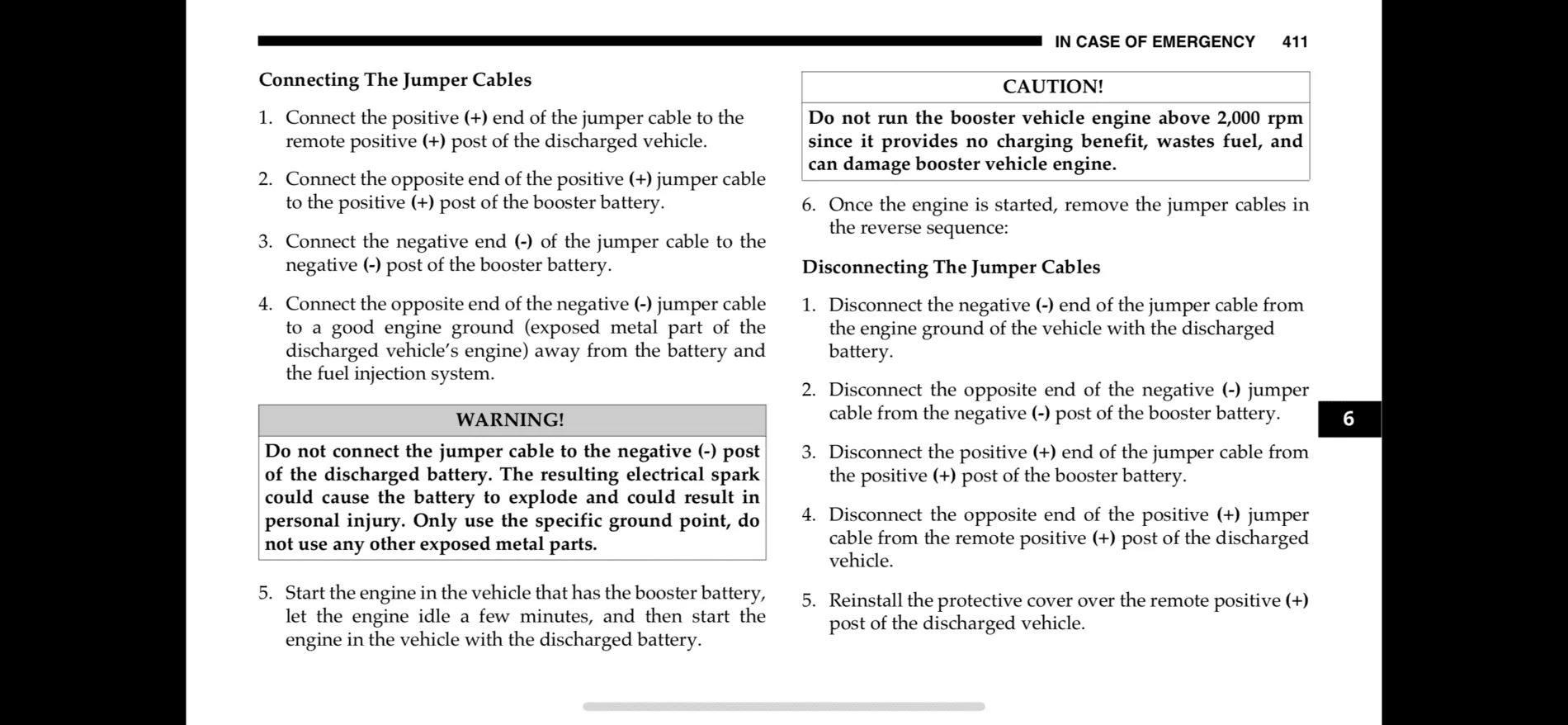
Jeep Gladiator Jeep Gladiators Burn to Death During Battery Jump 15397393-7C2A-4CFF-8253-8D6A987A286E
 
Joined
Mar 5, 2020
Threads
4
Messages
1,954
Reaction score
2,421
Location
Lake Martin, Alabama
Vehicle(s)
2020 Jeep Gladiator Rubicon
Vehicle Showcase
1
Well, according to that, I hook the negative up after the positive (but above, they said that order of polarity didn't matter which got hooked up first or last), and the only thing I didn't do the same as that, was hook to an engine ground, instead of the negative terminal of the dead vehicle...

So, even though it will still spark if you touch something under the hood (while connecting it to an engine ground, and you happen to touch something ferrous under there), since it's telling you to do that step LAST, that it will make THAT much difference going directly to a grounding strap, than it will connecting it to the negative terminal of the battery?

I'm seriously asking these questions, I'm not being a smartass... I want to know WHY this is suddenly incorrect in the last 10 years, than it was the previous 120+ that we've had batteries?
 

ShadowsPapa

Well-Known Member
First Name
Bill
Joined
Oct 12, 2019
Threads
247
Messages
40,504
Reaction score
54,031
Location
Runnells, Iowa
Vehicle(s)
'25 JTMX, '23 JLU 4xe, '82 SX4, '73 Javelin
Occupation
Retired auto mechanic, frmr gov't ntwrk security admin
Vehicle Showcase
3
Maybe my verbiage was wrong, but I wasn't recommending or telling anyone to do it that way...I was simply stating how I do it. Take it or leave it. I'm tired of having to make disclaimers on the internet for other people's problems. Part of the reason why I stopped giving advice on the diesel performance stuff. And why I got burned-out on giving reloading ammo advice, because I always had to leave a legal disclaimer at the beginning or end of each post. :mad::mad::mad: Too many idiots taking things online as the gospel truth, and then getting all butthurt when they didn't get matching results, and then trying to blame you for their shortcomings. That's a lot of what's wrong with the world today. People need to learn to accept personal responsibility for their own failures. If I accidentally burn my truck to the ground because I did something stupid, it's my fault. If someone read something online, and did the same thing, and then burned their trucks to the ground, it's still THEIR own fault for doing it. No one made them do it...They chose to. As human beings, we have free-will.

So, if I'm doing it wrong, and they're doing it wrong, and everyone else has been doing it wrong for 150 years, when what is the correct way to jump-off a vehicle if hooking a positive to a positive and a negative to a negative is incorrect? Seriously, I'm asking... And don't give me some overly-complicated BS scientific answer. Not that I can't comprehend it, but it's just unnecessary in a practical-application discussion.
Well, I was in a hurry and I know I come off cold, abrupt. I literally have no filter.
I'll try to be more careful. Just when I see risk or danger lurking, I jump even higher.
I've got to make a call to a fellow in Texas about converting his car back to the original charging system, get him set up with a correct regulator, and see if I can't talk him through the wiring. His pics show the dope mechanic that converted it at least didn't cut wires and he strapped them to the side - but the owner - actually his WIFE owns the car, but I think he's a bit confused on why not all the wires he sees at the fender make it to where the alternator goes. Nice guy but very electrically challenged and picky on this - his wife has owned the car since buying it new in 1974.
So I'll get him fixed up hopefully, and put on my try to be nice hat............ and be back soon.

Yes, my bad - your calling me out on my cold, abrupt smack was warranted. I know about it because I know it's a trait of my ADHD - so that makes it worse. KNOWING a tendency and not watching for it is worse than not knowing and having it happen.
 

Delhux

Well-Known Member
Joined
Aug 23, 2019
Threads
44
Messages
578
Reaction score
893
Location
Boston, MA
Vehicle(s)
2020 Gladiator - Overland - Gator
Well, according to that, I hook the negative up after the positive (but above, they said that order of polarity didn't matter which got hooked up first or last), and the only thing I didn't do the same as that, was hook to an engine ground, instead of the negative terminal of the dead vehicle...

So, even though it will still spark if you touch something under the hood (while connecting it to an engine ground, and you happen to touch something ferrous under there), since it's telling you to do that step LAST, that it will make THAT much difference going directly to a grounding strap, than it will connecting it to the negative terminal of the battery?

I'm seriously asking these questions, I'm not being a smartass... I want to know WHY this is suddenly incorrect in the last 10 years, than it was the previous 120+ that we've had batteries?
I can’t speak to history or perceived history of battery technology.

However, the main risk with a discharged battery is the possibility of hydrogen gas amassing near the dead battery.

You want to make sure you don’t generate a spark near a source of hydrogen gas. So, assuming you are connecting jumper cables to charge the dead battery, you start with the positive terminal on the dead battery first, so there is no circuit to generate a spark at the dead battery (potential source of explosive gasses).
You then make both terminal connections (positive, then negative) in the booster or “good” battery, then you connect the negative cable on the dead-battery vehicle side to a ground point (not the battery) away from the battery (and in Jeep’s instructions) and fuel injection system.

It’s all about avoiding generating a spark near hydrogen.

Again, I can’t speak to battery technology history, but I think as long as we’ve been using lead acid batteries, I would only have to assume this has been true. In terms of life experience, I’m willing to bet “tribal knowledge” passes from generation to generation is more likely to be a learning source for a lot of people than a page in a manual about jump starting cars—since we’ve probably all had a dad/cousin/whoever “teach” us how to do it.
Sponsored


Top