
Sponsored

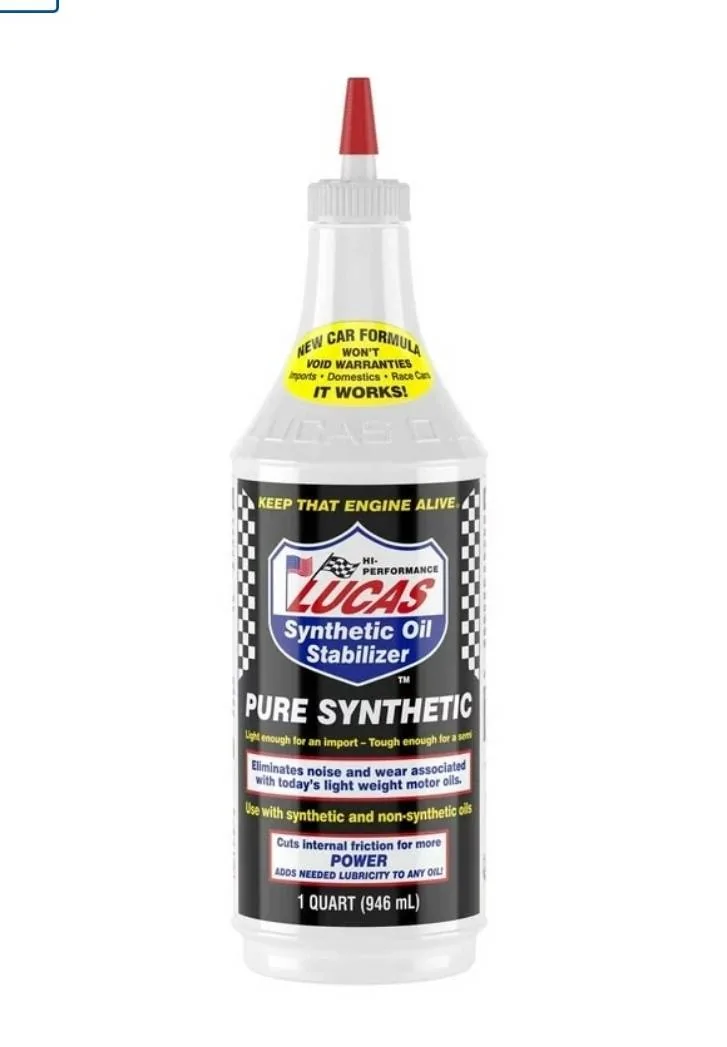
Lucas pure synthetic oil additive

Whisperingjim

Well-Known Member
First Name
Jim
Joined
Dec 9, 2022
Threads
3
Messages
45
Reaction score
20
Location
Illinois
Vehicle(s)
2020 gladiator
Occupation
Teamster
Anyone using Lucas pure synthetic oil additive with the 3.6?
I'm a freight relocation engineer ?. (Truck driver 30+ yrs)
I have used it for 2 oil changes and what a difference it makes with dry start ups. Quiet as a church mouse now. I have 80th on my motor.

Jeep Gladiator Lucas pure synthetic oil additive Screenshot_20231115_213913_Chrom
Sponsored


ShadowsPapa

Well-Known Member
First Name
Bill
Joined
Oct 12, 2019
Threads
247
Messages
40,440
Reaction score
53,853
Location
Runnells, Iowa
Vehicle(s)
'25 JTMX, '23 JLU 4xe, '82 SX4, '73 Javelin
Occupation
Retired auto mechanic, frmr gov't ntwrk security admin
Vehicle Showcase
3
I don't put crap in oil.
These have gone many years, hundreds of thousands of miles without additives.
In fact, scientific tests have shown that most additives actually oil's film strength and that's what keeps the moving parts apart. That film strength.
I also never hear any noise on startup on any of my Jeep engines- quiet as a church mouse on every startup with the stock recommended oil.
I've had a number of 3.6 engines over the years. Never any engine troubles. Never any clicking or tapping, and all have been quiet on startups.
 

katsrdking

Active Member
First Name
Brian
Joined
Oct 16, 2023
Threads
4
Messages
38
Reaction score
19
Location
Kansas
Vehicle(s)
2022 Jeep Gladiator Overland
Occupation
Retired
I agree with ShadowsPapa, you buy a full synthetic oil for an ungodly price already so the lucus oil additive is a waste of money.
 

Hootbro

Well-Known Member
First Name
Don
Joined
Apr 13, 2019
Threads
57
Messages
10,172
Reaction score
19,936
Location
Delaware
Vehicle(s)
2025 Gladiator Sport
Lucas Oil Stabilizer primarily works as a viscosity modifier that basically thickens the oil. That is why it "quiets" things down. There is evidence over the long term it causes more wear due to the thickening and messing with the base oil additive package thereby degrading the overall engine oil effectiveness.

It really is in the same category as STP oil treatment. But in STP's case, it actually had value back in the 1980's and prior when most engine oils had much weaker additive packs and were more susceptible to viscosity grade shearing.

There is no place for products like this in modern passenger vehicle using modern oil.
 

howeitsdone

Well-Known Member
First Name
Phillip
Joined
Nov 7, 2023
Threads
2
Messages
55
Reaction score
123
Location
UT-CO-WY
Vehicle(s)
'22 Mojave 6-spd, '00 XJ, '88 MJ
It should primarily be used on a worn engine with lower oil pressure. The viscosity will give you a few PSI. Jeep 4.0 guys run it all the time as did I before rebuilding my motors. I see no need in the 3.6. But happy it's working for you.
 

Sponsored

ShadowsPapa

Well-Known Member
First Name
Bill
Joined
Oct 12, 2019
Threads
247
Messages
40,440
Reaction score
53,853
Location
Runnells, Iowa
Vehicle(s)
'25 JTMX, '23 JLU 4xe, '82 SX4, '73 Javelin
Occupation
Retired auto mechanic, frmr gov't ntwrk security admin
Vehicle Showcase
3
Lucas Oil Stabilizer primarily works as a viscosity modifier that basically thickens the oil. That is why it "quiets" things down. There is evidence over the long term it causes more wear due to the thickening and messing with the base oil additive package thereby degrading the overall engine oil effectiveness.

It really is in the same category as STP oil treatment. But in STP's case, it actually had value back in the 1980's and prior when most engine oils had much weaker additive packs and were more susceptible to viscosity grade shearing.

There is no place for products like this in modern passenger vehicle using modern oil.
I know some "old-timers" who still build some engines and use STP on the lobes and lifters during a build - it's sort of like chain saw bar oil - it'll stick to the lobes for a very long time.
Me - i use modern assembly lube and normal oil.

It should primarily be used on a worn engine with lower oil pressure. The viscosity will give you a few PSI. Jeep 4.0 guys run it all the time as did I before rebuilding my motors. I see no need in the 3.6. But happy it's working for you.
You can run a heavier oil in a worn engine and get the same - with no additives.
I've never had an issue with the 4.0........... i did have a 258 in a car that had been abused - the oil rarely changed. The prior owner really didn't take any care of it at all. When i hit about 160,000 miles on that 258 the oil pressure dropped to 8 or below at stop lights once warmed up. I upped the viscosity for a while to get by - knowing some work was in its future, and ended up building a 4.0 to put in it instead of the 258 rebuild.
I sold an 80 Eagle wagon (Limited, very plush and fully loaded car) as a project to a guy in Ohio and included that 1982 worn 258 with the car. He didn't really have to do much other than a basic rebuild, bearings, oil pump, etc. and it's now running strong as a fully restored car.

I've had 4.0s over the years, never had a problem with oil pressure but then, never took one to over 160,000 miles - like that 258 went. Most of mine I sold or traded in the 120,000 mile range. So I never experienced any oil pressure drop in my engines.
You don't need 80 psi anyway, if she runs 10-15 at idle and in the 30s or above on the highway at 2,000-2500 RPM, you are good.
Pressure is only an indication that the supply volume exceeds the leakage along the path.
High pressure only stresses the oil pump drive system, gears and shaft that drive the pump.
 

Hootbro

Well-Known Member
First Name
Don
Joined
Apr 13, 2019
Threads
57
Messages
10,172
Reaction score
19,936
Location
Delaware
Vehicle(s)
2025 Gladiator Sport
I know some "old-timers" who still build some engines and use STP on the lobes and lifters during a build - it's sort of like chain saw bar oil - it'll stick to the lobes for a very long time.
Me - i use modern assembly lube and normal oil.
I have been nursing the same bottle of STP for the last 20+ years in my Garage as thick GP spot lubricant. I can see using it as an assembly lube as that is what my Grandfather used when rebuilding OPE small engines over the years back in the day.

I think RIchard Petty having it as his main sponsor in NASCAR for so many years sold it on my Grandfather more than the actual product itself being useful.
 

howeitsdone

Well-Known Member
First Name
Phillip
Joined
Nov 7, 2023
Threads
2
Messages
55
Reaction score
123
Location
UT-CO-WY
Vehicle(s)
'22 Mojave 6-spd, '00 XJ, '88 MJ
Yep, it's when you double that. My MJ went to 307k before I rebuilt and the XJ went to 344k. Your cam bearings start to really become thin at that point. Before I rebuilt the MJ, I laid underneath and changed all the main and rod bearings. While that helped a ton, the pressure would never see more than 20. So upping the viscosity a bit wasn't a bad choice.
 

ShadowsPapa

Well-Known Member
First Name
Bill
Joined
Oct 12, 2019
Threads
247
Messages
40,440
Reaction score
53,853
Location
Runnells, Iowa
Vehicle(s)
'25 JTMX, '23 JLU 4xe, '82 SX4, '73 Javelin
Occupation
Retired auto mechanic, frmr gov't ntwrk security admin
Vehicle Showcase
3
I have been nursing the same bottle of STP for the last 20+ years in my Garage as thick GP spot lubricant. I can see using it as an assembly lube as that is what my Grandfather used when rebuilding OPE small engines over the years back in the day.

I think RIchard Petty having it as his main sponsor in NASCAR for so many years sold it on my Grandfather more than the actual product itself being useful.
LOL - that, too. I have an old old bottle for that same purpose. It pretty much stays where you put it, but also dissolved in oil so is safe for putting on engine parts, etc.

Then of course when I was younger, there were the stop signs that got modified a bit - STP, the other acronyms that got associated with it........ anyone around my age will remember those.
Yep, it's when you double that. My MJ went to 307k before I rebuilt and the XJ went to 344k. Your cam bearings start to really become thin at that point. Before I rebuilt the MJ, I laid underneath and changed all the main and rod bearings. While that helped a ton, the pressure would never see more than 20. So upping the viscosity a bit wasn't a bad choice.
Oh, the fun of a horizontal, on your back, bearing change, or rear main change and so on.
I still have those inserts you put in the main bearing journal oil hole, then turn the crankshaft and it would roll the top half of the bearing out for you - reverse the process to put the new top half in. They are a bit worn from use but would still do the trick.
The problem with the 4.0 in my SX4 is that if i ever get to the point of needing bearings - it's a complete removal of the steering and lower half of the front suspension and cross member to get to the pan. It's a snug fit and those cars use a special "Eagle only" oil pan. Luckily, they are a bolt-on for the 4.0. Front of the pan is really shallow to allow room for the cross member and front differential, the sump part is more skinny and deep to fit where it had to fit.

I've not taken a 4.0 to the point you have and that's why I never experienced the oil pressure loss in one. And knowing how the prior owner/owners treated the 258 that my car came with - it would have likely gone well over 200,000 without any oil pressure troubles as well. They are basically the same bottom end. I'm using AMC rod and main bearings for a 258 in my 4.0
 

HankB

Well-Known Member
First Name
Henry
Joined
May 19, 2022
Threads
5
Messages
163
Reaction score
153
Location
Massachusetts
Vehicle(s)
Jeep Gladiator Sport, Porsche Panamera 4S
Occupation
Retired
Lucas Oil Stabilizer primarily works as a viscosity modifier that basically thickens the oil. That is why it "quiets" things down. There is evidence over the long term it causes more wear due to the thickening and messing with the base oil additive package thereby degrading the overall engine oil effectiveness.

It really is in the same category as STP oil treatment. But in STP's case, it actually had value back in the 1980's and prior when most engine oils had much weaker additive packs and were more susceptible to viscosity grade shearing.

There is no place for products like this in modern passenger vehicle using modern oil.
Well said, I spent forty five years in commercial transportation, many in heavy vehicle design and maintenance & repair. Back then there was a valid place for stuff like this, no longer because engines are being designed for use with lower viscosity lubricants for a number of reasons; improved fuel economy, improved cooling, etc. Increasing the viscosity under those conditions is just undoing the benefits of the lower viscosity lubricant.

Something else to consider. Forty - fifty years ago in the days of STP, engines as machines were pretty simple. The were analog, had primitive ignition systems, and tolerance between parts was only critical in a few spots. They delivered huge amounts of horsepower through large volumes of inefficient fuel consumption, using big and heavy pieces of spinning mass. Spinning at in machine terms would be moderate levels. Today’s engines are lighter and smaller, primarily electronics and software controlled where nearly every component has tight mechanical and assembly tolerances. And they all have significantly higher redlines.

The current JT 3.6 produces 300 hp, or about 83 hp/liter. In the sixties, one of the leading production performance engines was the Chevy 396 that produced 425 hp in the corvette and SS engine versions. That works out to 65 hp/liter. To put that in a more equal context, the engine in my car produces 440 hp out of just under 3 liters, or about 155hp/liter. It’s pretty clear todays engines are pretty complicated finely tuned machines, where lots small things contribute better overall output. Pouring unplanned stuff into the crankcase will most likely literally gum up the works. Save your money, and get an extra oil & filter change.
 

Sponsored

ShadowsPapa

Well-Known Member
First Name
Bill
Joined
Oct 12, 2019
Threads
247
Messages
40,440
Reaction score
53,853
Location
Runnells, Iowa
Vehicle(s)
'25 JTMX, '23 JLU 4xe, '82 SX4, '73 Javelin
Occupation
Retired auto mechanic, frmr gov't ntwrk security admin
Vehicle Showcase
3
Well said, I spent forty five years in commercial transportation, many in heavy vehicle design and maintenance & repair. Back then there was a valid place for stuff like this, no longer because engines are being designed for use with lower viscosity lubricants for a number of reasons; improved fuel economy, improved cooling, etc. Increasing the viscosity under those conditions is just undoing the benefits of the lower viscosity lubricant.

Something else to consider. Forty - fifty years ago in the days of STP, engines as machines were pretty simple. The were analog, had primitive ignition systems, and tolerance between parts was only critical in a few spots. They delivered huge amounts of horsepower through large volumes of inefficient fuel consumption, using big and heavy pieces of spinning mass. Spinning at in machine terms would be moderate levels. Today’s engines are lighter and smaller, primarily electronics and software controlled where nearly every component has tight mechanical and assembly tolerances. And they all have significantly higher redlines.

The current JT 3.6 produces 300 hp, or about 83 hp/liter. In the sixties, one of the leading production performance engines was the Chevy 396 that produced 425 hp in the corvette and SS engine versions. That works out to 65 hp/liter. To put that in a more equal context, the engine in my car produces 440 hp out of just under 3 liters, or about 155hp/liter. It’s pretty clear todays engines are pretty complicated finely tuned machines, where lots small things contribute better overall output. Pouring unplanned stuff into the crankcase will most likely literally gum up the works. Save your money, and get an extra oil & filter change.
Valid points.

Glad to see you mentioned improved cooling and other factors.
The last sentence is a perfect wrap-up.

I feel good getting about 377-380 HP out of a 360 - but it takes some gas to do it.
As far as oil - I run off-the-shelf stuff with no additives - even in that flat tappet cam engine. Same for my 4.0 with a Comp Xtreme 4x4 cam and MOPAR performance valve springs. No additives, no extra anything, off-the-shelf oil.
 

Fastwake

Well-Known Member
First Name
Mike
Joined
Jun 8, 2021
Threads
3
Messages
197
Reaction score
225
Location
Rocklin ca.
Vehicle(s)
2020 Gladiator Sport S
Occupation
Retired
Vehicle Showcase
1
I don't put crap in oil.
These have gone many years, hundreds of thousands of miles without additives.
In fact, scientific tests have shown that most additives actually oil's film strength and that's what keeps the moving parts apart. That film strength.
I also never hear any noise on startup on any of my Jeep engines- quiet as a church mouse on every startup with the stock recommended oil.
I've had a number of 3.6 engines over the years. Never any engine troubles. Never any clicking or tapping, and all have been quiet on startups.
I am right with you PaPa no problems with any of my Jeep motors when using the correct oil
 

Outback_Joe

Well-Known Member
First Name
Joe
Joined
Feb 17, 2023
Threads
5
Messages
185
Reaction score
163
Location
Oregon Outback
Vehicle(s)
2022 Jeep Gladiator
Occupation
Retired Civil Engineer
I hope you think about the hundreds of hours engineers spend on these motors and the lubricant's they use in them before you pour that snake oil in your motor. Plus the amount of time the engineers spend on the oils they make and certify.

Way back when I was in school we had a teacher explain oils very simply. He started out by saying, think of a room full of beachballs, this is the base stock used in oils back in the 60's. Then we try and make smaller and smaller balls to fill those gaps between the balls to further protect oiled surfaces. I know its not exactly that way but it was a great illustration of how oils work and it's stuck with me for all this time. So, are you, sure you want to insert your balls into that mix? And from a certain standpoint is your BALLS that are on the line with that sweet little 3.6L that makes all that power in such a small package. Just some advice from a old wrench for your consideration.

Sorry if this seems rash but for me the risk is not worth the so-called reward. Your mileage WILL vary!
 

ShadowsPapa

Well-Known Member
First Name
Bill
Joined
Oct 12, 2019
Threads
247
Messages
40,440
Reaction score
53,853
Location
Runnells, Iowa
Vehicle(s)
'25 JTMX, '23 JLU 4xe, '82 SX4, '73 Javelin
Occupation
Retired auto mechanic, frmr gov't ntwrk security admin
Vehicle Showcase
3
I hope you think about the hundreds of hours engineers spend on these motors and the lubricant's they use in them before you pour that snake oil in your motor. Plus the amount of time the engineers spend on the oils they make and certify.

Way back when I was in school we had a teacher explain oils very simply. He started out by saying, think of a room full of beachballs, this is the base stock used in oils back in the 60's. Then we try and make smaller and smaller balls to fill those gaps between the balls to further protect oiled surfaces. I know its not exactly that way but it was a great illustration of how oils work and it's stuck with me for all this time. So, are you, sure you want to insert your balls into that mix? And from a certain standpoint is your BALLS that are on the line with that sweet little 3.6L that makes all that power in such a small package. Just some advice from a old wrench for your consideration.

Sorry if this seems rash but for me the risk is not worth the so-called reward. Your mileage WILL vary!
Some oil companies even say to not add anything - their reasoning is it can upset the chemistry of the additives they create. If your friction modifiers interfere with theirs, you lose.
Wear testing has shown that additives typically actually lowers the oil's film strength which is what you need to protect cams and followers, etc.
Not unlike the plating chemicals I use - just a tiny bit of something added (or missing) can cause all sorts of problems. Once you get the ideal balance, don't mess with it.
 

biplaneguy

Well-Known Member
First Name
Dana
Joined
Oct 28, 2023
Threads
15
Messages
217
Reaction score
265
Location
CT
Vehicle(s)
2023 Gladiator Sport
Occupation
Engineer
Lycoming still recommends a mixture of STP and engine oil as assembly lube for their aircraft engines.

Of course, even modern aircraft engines are basically 1940s technology; big, slow turning air cooled engines with carburetors and magnetos. The engine in my plane produces only 125HP at 2600 rpm from 290 ci (4.75 liter)... but it'll do it all day long at WOT.

Now if you really want to get a discussion going on an aviation forum just mention Marvel Mystery Oil... ;)
Sponsored


Top