
PeterGriffin
Well-Known Member
- Thread starter
- #1
I was actually kind of surprised about the lack of posts/threads/information here about people using CO2 systems to air up/run power tools so here's my 2-cents...and then some!
With the temperatures pushing up to 110 here this time of year (and are only going to get hotter!), taking over 20 minutes to air back up after wheeling is an unpleasant experience! The air compressor I was previously using was a Superflow which is no cheap cigarette lighter deal; it clamps directly to the battery and is fused at 30A. Don't buy the "Inflates a 37 inch tire in under 2 minutes." line that Amazon is giving; airing up the 35s on my JKUR from 18 to 35 PSI took almost 5 minutes a tire at a high idle. While it did the job it would get insanely hot, which is what happens when you compress air for a prolonged period of time and run it at a near continuous duty cycle, which admittedly you shouldn't do!
While I already had tire deflators that made the airing down process too easy, I knew I could better when it came to getting air back in the tires. For the deflators I used Staun's which work perfectly and get my tires down to 18 PSI quickly, everytime. That being said there are MUCH cheaper alternatives that appear to do the same thing but I can't vouch for their quality and the Staun's were a gift anyway...
On board air isn't an option for me either, I personally think they're obsolete. A quality system, like ARB, with a tank (otherwise it's no faster than a standard compressor), installed is around $1K where I am (cheaper if you do it yourself of course) and are problematic in wet/muddy environments, which is not an issue where I live, but I do occasionally wheel in N/AZ which has both conditions in addition to snow.
Sooooo I started looking at CO2 systems. Although Smittybuilt has their own systems, Powertank appears to be the gold standard. And by gold standard I mean they price their systems like they're made of it! Their 10lb systems range from just over $500 to nearly $900 (dual tank) and after watching some YouTube videos and poking around Amazon and eBay I put together a system for under $300 that's every bit as good and leaves me more than some small change leftover for other mods!
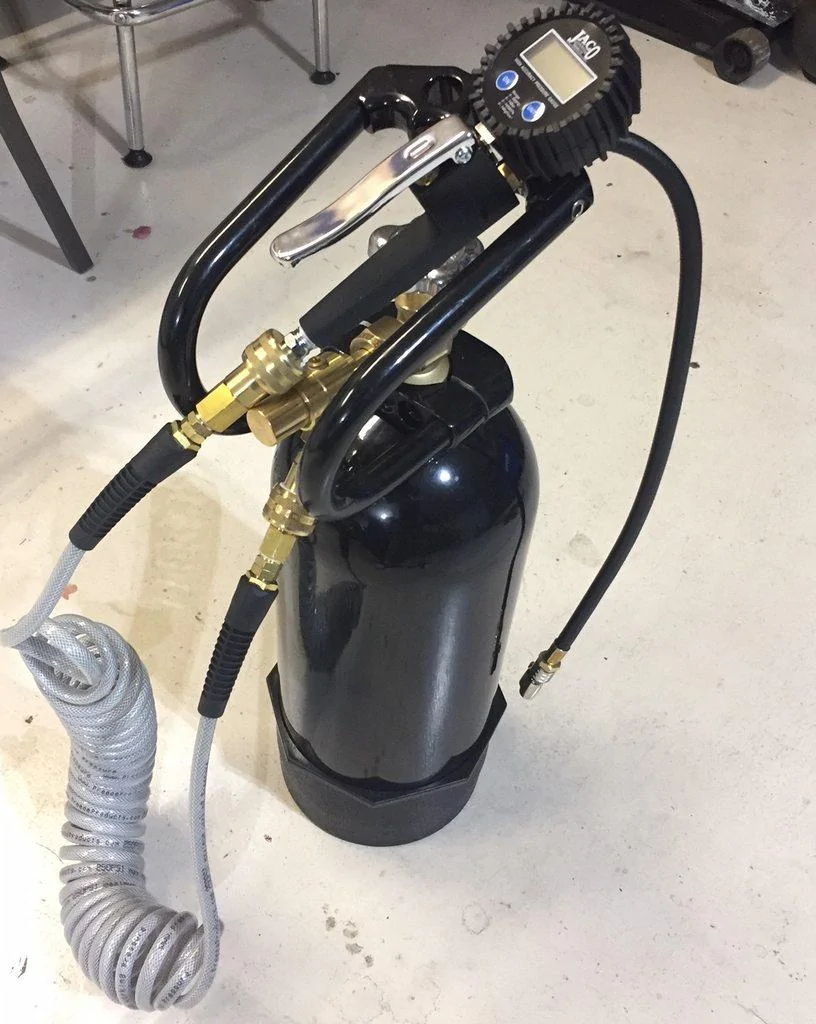
I went with a fixed 150 PSI pressure regulator because that's what you need to fill tires. If you're running air tools you may want a variable pressure regulator which costs a little bit more. I didn't buy a pressure gauge either because it's not needed; a full tank can vary in PSI tremendously depending on ambient air temperature and is no indication of how full the tank is. The tank I bought is powdercoated and came both with the fixed pressure regulator and a very nice/rugged carrying handle. I added a tank boot to protect the bottom of the tank and keep it upright when I'm using it along with a quality high pressure hose and gauge which literally matches the PSI readings I'm getting from the EVIC/Uconnect whatever it's called now display!
Tank: https://www.ebay.com/itm/223905128925
Boot: https://www.ebay.com/itm/302565732262
Hose: https://www.ebay.com/itm/193772330279
Pressure gauge: https://www.ebay.com/itm/223081881640
There's room in this setup to save some money or spend some more of course! It lays down on the rear seat passenger footwell securely resting on the tank handle. CO2 tanks like this should not be exposed to more than 125 degrees and the tank will vent around 150 degrees for safety as the PSI at that point is near what the tank is rated for. With that being said mounting the tank in my bed in SW AZ is NOT an option, at least during the summer as the temperatures under the tonneau cover could easily reach that with 115+ peak summer temps. I have a local off road shop right down the street that fills YOUR tank (not an exchange like a lot of places do) for $2/gallon, which is pretty awesome.
With the area I was wheeling in last weekend almost an hour from my house, airing down at the house wasn't an option as riding on surface streets at 18 PSI is just dangerous. When I got to the trailhead my trusty Staun's deflators had me ready to go in about 5 minutes start to finish. After finishing our ride it was the moment of truth; I pressed the air hose connection into the pressure regulator and got a reassuring click and turned the digital display of the pressure gauge on. The slide on barrel/air chock swivels so there's no hose twisting or acrobatics and once you're done you just push the button and pull it off the valve stem which results in a minimal loss of air. If you happen to over-inflate depressing the lever halfway bleeds off pressure.
I have a 2 HP/25-gallon/150 Craftsman air compressor in my garage. This CO2 tank setup was slightly, I'd go as far to say barely perceptibly, slower than that. The first tire took about a minute as I kept stopping and checking the PSI reading on the gauge and as I went on it went faster as I didn't check it as much. While the stock tires on my Mojave aren't the 35s that were on my JKUR, it took me just over 30 seconds of continuous use to get the tires from 18 to 37 PSI. The total time I spent out of my vehicle start to finish was about 5 minutes. I quite literally barely broke a sweat even though it was 106 at the trailhead.
Checking the tank when I got home, having weighed it before we left it looked like I used just under 1.5 pounds to air up all 4 tires from 18 to 37 PSI. That'd give me 6 full times before I'd need to refill the tank, which works out to about 80-cents/tire. I'll take that ALL day! Using Powertank's own chart found HERE once I go with 35s I get a solid 4 full uses (all 4 tires, 4 times) out of it which works out to $1.25/tire. That's still a HUGE win of getting me back on the road WAY faster not to mention the portability of the tank which is something you can't do with an on board air system.

With the temperatures pushing up to 110 here this time of year (and are only going to get hotter!), taking over 20 minutes to air back up after wheeling is an unpleasant experience! The air compressor I was previously using was a Superflow which is no cheap cigarette lighter deal; it clamps directly to the battery and is fused at 30A. Don't buy the "Inflates a 37 inch tire in under 2 minutes." line that Amazon is giving; airing up the 35s on my JKUR from 18 to 35 PSI took almost 5 minutes a tire at a high idle. While it did the job it would get insanely hot, which is what happens when you compress air for a prolonged period of time and run it at a near continuous duty cycle, which admittedly you shouldn't do!
While I already had tire deflators that made the airing down process too easy, I knew I could better when it came to getting air back in the tires. For the deflators I used Staun's which work perfectly and get my tires down to 18 PSI quickly, everytime. That being said there are MUCH cheaper alternatives that appear to do the same thing but I can't vouch for their quality and the Staun's were a gift anyway...
On board air isn't an option for me either, I personally think they're obsolete. A quality system, like ARB, with a tank (otherwise it's no faster than a standard compressor), installed is around $1K where I am (cheaper if you do it yourself of course) and are problematic in wet/muddy environments, which is not an issue where I live, but I do occasionally wheel in N/AZ which has both conditions in addition to snow.
Sooooo I started looking at CO2 systems. Although Smittybuilt has their own systems, Powertank appears to be the gold standard. And by gold standard I mean they price their systems like they're made of it! Their 10lb systems range from just over $500 to nearly $900 (dual tank) and after watching some YouTube videos and poking around Amazon and eBay I put together a system for under $300 that's every bit as good and leaves me more than some small change leftover for other mods!
I went with a fixed 150 PSI pressure regulator because that's what you need to fill tires. If you're running air tools you may want a variable pressure regulator which costs a little bit more. I didn't buy a pressure gauge either because it's not needed; a full tank can vary in PSI tremendously depending on ambient air temperature and is no indication of how full the tank is. The tank I bought is powdercoated and came both with the fixed pressure regulator and a very nice/rugged carrying handle. I added a tank boot to protect the bottom of the tank and keep it upright when I'm using it along with a quality high pressure hose and gauge which literally matches the PSI readings I'm getting from the EVIC/Uconnect whatever it's called now display!
Tank: https://www.ebay.com/itm/223905128925
Boot: https://www.ebay.com/itm/302565732262
Hose: https://www.ebay.com/itm/193772330279
Pressure gauge: https://www.ebay.com/itm/223081881640
There's room in this setup to save some money or spend some more of course! It lays down on the rear seat passenger footwell securely resting on the tank handle. CO2 tanks like this should not be exposed to more than 125 degrees and the tank will vent around 150 degrees for safety as the PSI at that point is near what the tank is rated for. With that being said mounting the tank in my bed in SW AZ is NOT an option, at least during the summer as the temperatures under the tonneau cover could easily reach that with 115+ peak summer temps. I have a local off road shop right down the street that fills YOUR tank (not an exchange like a lot of places do) for $2/gallon, which is pretty awesome.
With the area I was wheeling in last weekend almost an hour from my house, airing down at the house wasn't an option as riding on surface streets at 18 PSI is just dangerous. When I got to the trailhead my trusty Staun's deflators had me ready to go in about 5 minutes start to finish. After finishing our ride it was the moment of truth; I pressed the air hose connection into the pressure regulator and got a reassuring click and turned the digital display of the pressure gauge on. The slide on barrel/air chock swivels so there's no hose twisting or acrobatics and once you're done you just push the button and pull it off the valve stem which results in a minimal loss of air. If you happen to over-inflate depressing the lever halfway bleeds off pressure.
I have a 2 HP/25-gallon/150 Craftsman air compressor in my garage. This CO2 tank setup was slightly, I'd go as far to say barely perceptibly, slower than that. The first tire took about a minute as I kept stopping and checking the PSI reading on the gauge and as I went on it went faster as I didn't check it as much. While the stock tires on my Mojave aren't the 35s that were on my JKUR, it took me just over 30 seconds of continuous use to get the tires from 18 to 37 PSI. The total time I spent out of my vehicle start to finish was about 5 minutes. I quite literally barely broke a sweat even though it was 106 at the trailhead.
Checking the tank when I got home, having weighed it before we left it looked like I used just under 1.5 pounds to air up all 4 tires from 18 to 37 PSI. That'd give me 6 full times before I'd need to refill the tank, which works out to about 80-cents/tire. I'll take that ALL day! Using Powertank's own chart found HERE once I go with 35s I get a solid 4 full uses (all 4 tires, 4 times) out of it which works out to $1.25/tire. That's still a HUGE win of getting me back on the road WAY faster not to mention the portability of the tank which is something you can't do with an on board air system.
Sponsored