Sponsored

TeraFex Instructions ?? / Came From JK World

3Dirty

Member
First Name
Kenny
Joined
Dec 28, 2019
Threads
4
Messages
9
Reaction score
14
Location
Massachusetts
Vehicle(s)
2020 Gladiator - Sting Gray
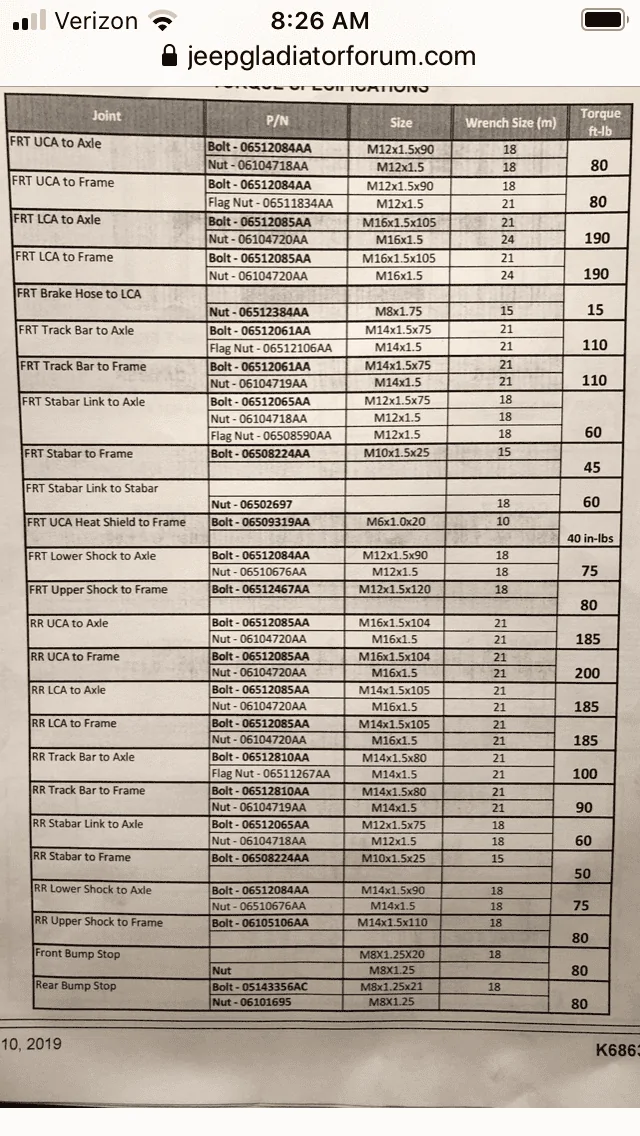
Hello.. Question.. Im coming from a JKU where trackbar, control arms were 125 ft lbs of torque on those bolts.. below are the Teraflex instructs for the 1.5" leving kit .. Do these torque numbers seem right? 37lbs on uppers, 52lbs on the track bar.. 103lbs on the lowers? And what is this +145 degress business after the torque numbers?

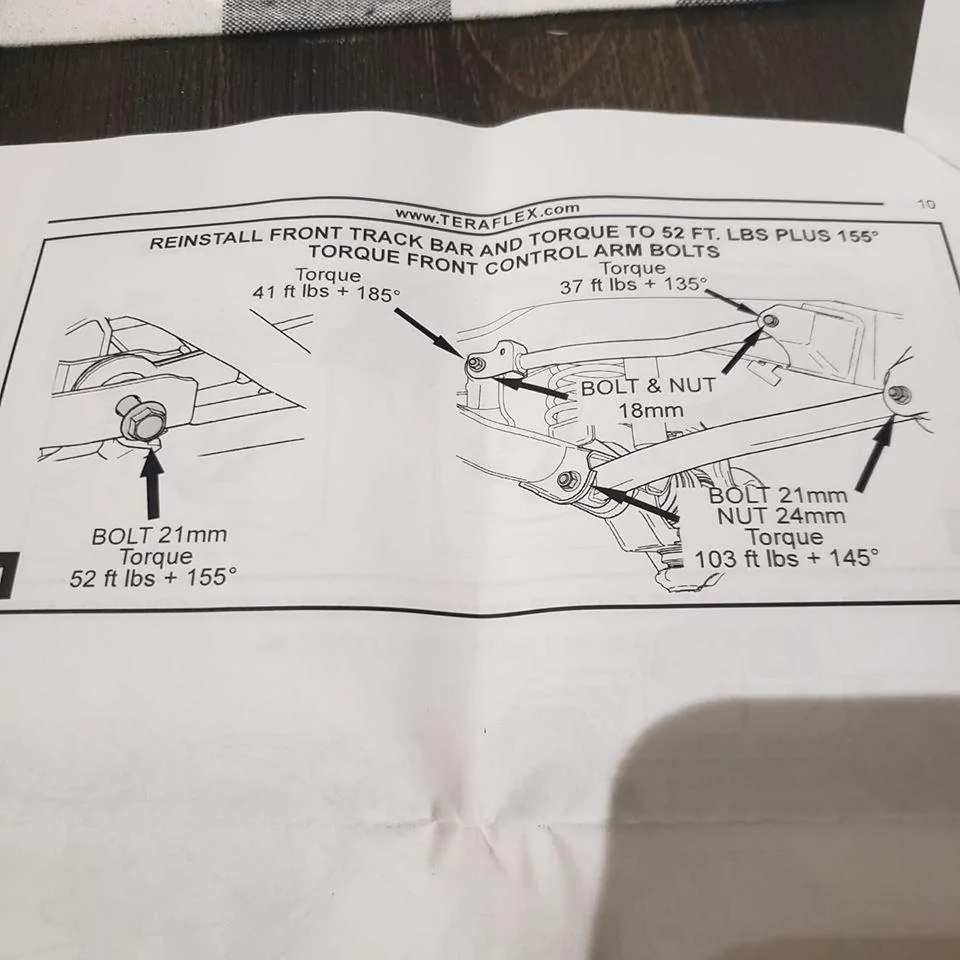
Jeep Gladiator TeraFex Instructions ?? / Came From JK World 82526260_2974881965856345_5058830197416001536_o
Sponsored


Mark Doiron

Well-Known Member
First Name
Mark
Joined
Aug 14, 2019
Threads
7
Messages
602
Reaction score
1,277
Location
Oklahoma City, OK
Vehicle(s)
2007 JKU X, 1979 Tenth Anniversary Trans Am, 2020 Gobi Gladiator Rubicon
Occupation
Retired
Hello.. Question.. Im coming from a JKU where trackbar, control arms were 125 ft lbs of torque on those bolts.. below are the Teraflex instructs for the 1.5" leving kit .. Do these torque numbers seem right? 37lbs on uppers, 52lbs on the track bar.. 103lbs on the lowers? And what is this +145 degress business after the torque numbers?

82526260_2974881965856345_5058830197416001536_o.webp
We ran into this odd way to torque bolts while installing the Ace Engineering rock rails. Those numbers mean, turn the torque wrench until you reach the specified value, then from that point, rotate the wrench the additional number of degrees to tighten. 360° is a full turn, 180° is a half turn, etc. You can use a protractor to get accurate measurements. Seemed odd to us on the rock rails, but your post suggests this is routine with the Gladiator.
 

CarolinaGladiator

Well-Known Member
First Name
Paul
Joined
Aug 31, 2019
Threads
27
Messages
343
Reaction score
653
Location
N. Carolina
Vehicle(s)
2023 High Velocity JTR
This is interesting. I wonder if there is someone here that can explain the reasoning behind this. I have never seen torque specs like that.
 

HTXGladiator

Well-Known Member
First Name
Jason
Joined
Aug 7, 2019
Threads
5
Messages
405
Reaction score
433
Location
The Woodlands, TX
Vehicle(s)
2020 Gladiator Rubicon, 2014 HD XL1200X
Vehicle Showcase
1
I've seen stuff like this on Helicopters, but usually for castellated nuts, to be used with cotter pins. (TQ to "x" ft. lbs then turn to align next castellation). I'm sure there's some kind of engineering explanation for the torque + "x" degrees. I just don't know what it is....seems much easier to assign a higher torque.
 

BlueCT

Well-Known Member
First Name
Chris
Joined
Dec 30, 2017
Threads
26
Messages
104
Reaction score
69
Location
New Jersey
Vehicle(s)
2014 JKU
Take a look at this PDF from snap on. It doesn’t do a great job but the diagram explains what to do. I believe it is saying you torque to the suggested ft lbs then turn the wrench an additional number of degrees, so 90 degrees would be an additional 1/4 turn. The above poster seems to be saying the same thing.
 

Attachments


Sponsored

Hootbro

Well-Known Member
First Name
Don
Joined
Apr 13, 2019
Threads
57
Messages
10,182
Reaction score
19,947
Location
Delaware
Vehicle(s)
2025 Gladiator Sport
I found the torque specs a little wacky also. Very similar to Torque To Yield bolts used on things like crank shaft and cylinder head bolts were they want the fastener stretched a certain distance after seating torque but usually they have a disclaimer to replace these bolts as they are one time use. I am not seeing that disclaimer in these torque instructions.

I guarantee most shops and home DIY types are just going to find a set torque higher and go there rather than fiddle with this degree measurement stuff.
 

arosen1997

Well-Known Member
First Name
Aaron
Joined
Nov 29, 2019
Threads
12
Messages
458
Reaction score
850
Location
Boise
Vehicle(s)
Jeep Gladiator Sport S
Build Thread
Link
Occupation
LAV Turret Technician
Hello.. Question.. Im coming from a JKU where trackbar, control arms were 125 ft lbs of torque on those bolts.. below are the Teraflex instructs for the 1.5" leving kit .. Do these torque numbers seem right? 37lbs on uppers, 52lbs on the track bar.. 103lbs on the lowers? And what is this +145 degress business after the torque numbers?

82526260_2974881965856345_5058830197416001536_o.webp
We ran into this odd way to torque bolts while installing the Ace Engineering rock rails. Those numbers mean, turn the torque wrench until you reach the specified value, then from that point, rotate the wrench the additional number of degrees to tighten. 360° is a full turn, 180° is a half turn, etc. You can use a protractor to get accurate measurements. Seemed odd to us on the rock rails, but your post suggests this is routine with the Gladiator.
This is interesting. I wonder if there is someone here that can explain the reasoning behind this. I have never seen torque specs like that.
I've seen stuff like this on Helicopters, but usually for castellated nuts, to be used with cotter pins. (TQ to "x" ft. lbs then turn to align next castellation). I'm sure there's some kind of engineering explanation for the torque + "x" degrees. I just don't know what it is....seems much easier to assign a higher torque.
These are called torque turns, in theory they provide a more uniform and accurate clamping and stretching force on studs/bolts compared to just using a torque wrench to tighten them.

I have limited experience with them, however my old man had been a generator tech for Caterpillar for years and the data he's seen showed that head bolts with torque turn specs have a statistically significant decrease in torque related failures compared to those with a conventional torque spec.

I myself just installed a teraflex level and did the torque turns on them.
I found the best way to do them was to secure the bolt side with a socket and breaker bar clamped to the control arm. Then mark your nut and measure out however many degrees it needs to turn. After that do your torque turn to the measured point. Mark a line across the nut and underside of the bolt that sticks out and continue down to the bracket. Also mark the bolt head on the same way.
Now after you do you 300 miles to before checking torque you'll be able to see if the bolt has moved in relation to the bracket/control arm, and more importantly if the nut has moved on the bolt.
 

RH 67

Well-Known Member
First Name
Dave
Joined
Jul 25, 2019
Threads
18
Messages
695
Reaction score
482
Location
SoCal
Vehicle(s)
2020 Black Rubicon Gladiator, Alfa Romeo Quad
Occupation
Retired DOD, Army SF, SS.
A torque angular gage is required for the + settings. Unfortunately it`s not possible to get a torque wrench and angular gage on all of the bolts. The Mopar and AEV lifts have simple torque settings.
 

arosen1997

Well-Known Member
First Name
Aaron
Joined
Nov 29, 2019
Threads
12
Messages
458
Reaction score
850
Location
Boise
Vehicle(s)
Jeep Gladiator Sport S
Build Thread
Link
Occupation
LAV Turret Technician
A torque angular gage is required for the + settings. Unfortunately it`s not possible to get a torque wrench and angular gage on all of the bolts. The Mopar and AEV lifts have simple torque settings.
Thats why I said to just measure and mark, it does the same thing as the torque angular gauge, it's just harder to be as precise
 

Sponsored

Renegade

Well-Known Member
First Name
Zac
Joined
Sep 11, 2017
Threads
38
Messages
3,615
Reaction score
4,816
Location
Signal Mountain, TN
Vehicle(s)
2020 JT
Build Thread
Link


Top