Deleted member 22728
- Thread starter
- #1
This post is intended as a (hopeful) repository of general information as related to the 3.0 litre diesel produced by Vancini Martelli, specifically found as an option in the current generation JL and JT Jeep brand vehicles. I will reference previous versions in other platforms, however this is mostly intended to be contextual.
Please note that these are my opinions and observations based on experience as an owner and service technician, not sponsored or endorsed by Stellantis, although I will credit them with certain training and technical webcasts provided free-of-charge via the National Institute for Automotive Service Excellence, for which I am very grateful.
The 3.0 VM was envisioned as a lightweight, high-output, high-efficiency automotive diesel engine utilizing what was then (late 2000's) state-of-the-art technologies. Some of these are:
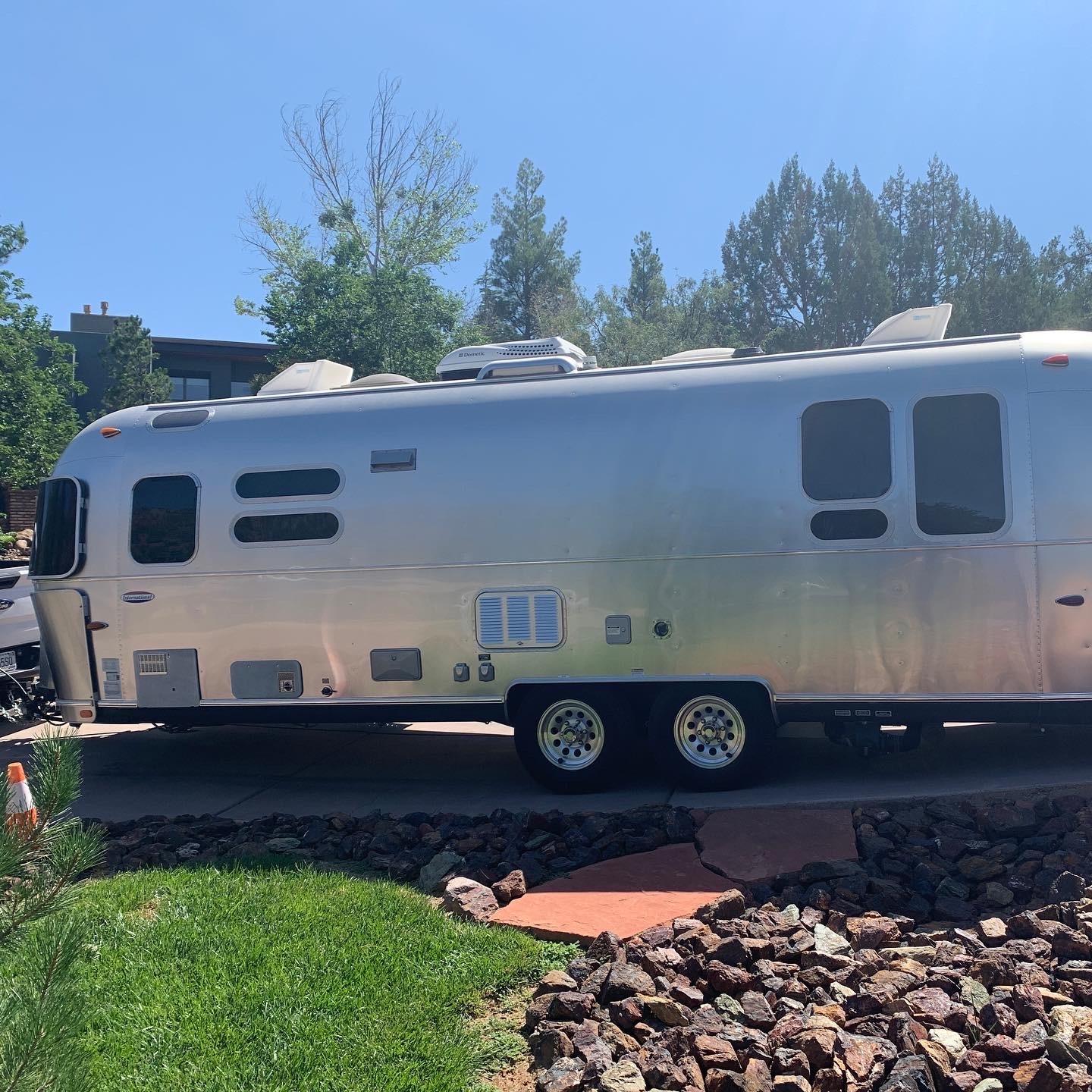
In any case, the first task on the WK2 was pulling our new 28' Airstream to the factory service center in Jackson Center, OH (Had to spend a week there as the trailer was, well, poorly assembled and basically had to literally "go back to the factory"). The trip was about 800 miles, with the only serious grade pull being the 81 out of Knoxville. It was then that the little gorilla came to life, winning even more points by delivering a 404 mile cruising range. At 70k miles, that platform has only had a single fault, which was not powertrain related - the transfer case control module (not "intelligent") failed, with that repair not requiring any sort of flash or firmware, taking about 5 minutes to R&R. The EGR cooler was replaced under an emissions campaign, but that's basically it for hardware, and a couple of firmware flashes which have decreased tip-in throttle response and fuel economy. The most extreme booty-pucker event was a pull from Barstow, CA to Needles, CA....in July. Ambient air temps hit 119f, with IAT hovering in the 145f range; oil temps approached 255f, coolant 238f, trans 210f. It never depowered, however I was being proactive by reducing ground speeds, which kept oil temps in check. Like so many heavily-boosted diesels (or naturally-aspirated ones), "P" tubes direct pressurized engine oil that targets the underside of the piston assembly. As fueling is increased, and assuming engine speed increases, the resulting exhaust stream accelerates the turbocharger turbine, which is directly connected to the compressor assembly, resulting in a charged, pressurized "slug" of air to facilitate a higher degree of combustion efficiency and power, generally speaking, along with mapped injection sequences and subsequent flame-front propagation. Whew. So all of that equals a prompt rise in piston crown temperature, which must be reconciled quickly, and that's where the oil jets come into play. This is where monitoring your EGT's is important, but in the absence of that, pulling your oil temp up will give you an idea of a comparative to the presence of climbing EGT's.
This is where we get into the "meat" of why the JL/JT is what it is when it comes to total powertrain cooling, and why it's very marginal for the EcoD. And finally, you might be asking, where we can discuss how I deal with it in the JTR. Like the WK2, we have a cooling module that is composed of multiple heat exchangers. These include the main engine coolant radiator, the HVAC refrigerant condenser, a transmission lube oil cooler, and the CAC, or charge air cooler, which serves to cool that charged air "slug" before it enters the engine (cool air is denser than hot, thus there's more potential oxygen present to support combustion). If you stand in front of your JL/JT, you'll get the picture; basically 35% of that cooling module is obscured by mainly a bumper (more if you have a winch!), horns, misc. peripherals, and essentially only 5 of the 7 famous slots are partially open for air flow. That's it. And there isn't much the owner can do about it, aside from removing the grille and bumper or replacing with a modified angry bird grille (don't do it).
When I fist took delivery of mine, I immediately lifted it to the spec. you've seen in my av, yet retained the 3.73 gearing, as the 4.56's were on perpetual back-order at the time. It was then that I wanted to experiment with how hot the engine would need to get, e.g., how far I could push it, right to the "wall", and note temperatures, any malfunction indicators, IAT, etc. My basis of comparison was the aforementioned WK2 EcoD, where 250f would be the most I would tolerate under heavy boost, or powertrain would step-in and reduce throttle potentially. The opportunity arrived last July when my fellow Jeep mad scientist asked if I would drive down to Mesa and get a GEN 4 SBC he'd bought for.....another project.
I rented a 5x10' open aluminum utility trailer, and off I went. Predictably, the 3.73/37" combo immediately let itself be known, in the form of my effectively having a 5.5 speed transmission, unless going downhill. Yes, the tire size was updated on the network, but other than ground speed being accurate, it didn't help. Upon climbing the grade out of Camp Verde, ambient air temp was 93f with a 35kt headwind, oil temp very quickly climbed to 250f...and kept going. Coolant followed closely to 235f; I reduced speed to 55mph. Oil and coolant both stopped going up, but it didn't last. About 1/2 mile from the pass, powertrain began to depower when oil reached 267f, coolant 255f, at which point I slowed to 35mph with hazard flashers on (not such a big deal at the time, as a third lane was present with a line of commercial trucks and RV's moving slowly). It was about then I got my first malfunction indicator light, which was related to basically "fuel delivery requirement greater than anticipated" - more on that later. Fast forward to the trip back, and a similar scenario played-out on the Black Canyon Grade, with a complete 20mph depower on the last little grade near the house. Upon reaching my destination, HVAC shut down, and I let it idle for about 6 minutes until oil leveled-off at 225f.
Although it might sound crazy, these results were what I was hoping for, as now, definitively, I had some hard figures to work with. I also understood what the engineers had in mind with the progressive shedding of load in order to preserve powertrain integrity. On a side note, one of the earliest examples, in a domestic platform, of this kind of shedding and depower, was the Cadillac Northstar, which had a "backup" cooling capacity using lube oil as the medium. Cool stuff. Anyway....now for some lab time, the next day.
I pulled the above code, noted the freeze-frame, and wiped the modules (there were the usual U codes that seem to afflict the JL/JT when the network brains perceive a SHTF DEFCON, what I affectionately call "it's trying to get the launch codes and fire missiles!". This is where it gets interesting; IAT was 197f (!!!!!!!) on the freeze, which means it likely spiked over 200f before the event ended, which is, most extreme, IMHO. I get 145, even 150 on a really hot day. But this was just too much, and it became apparent why: The air cleaner intake opening neatly seals-off a portion of the underhood skin that, aside from the small duct that is open to the grill. You basically draw you're fresh air from the space, formed by a stamped "channel", between the hood blanket and the hood skin. Note that the gas burners have a portion of that boot open for at least enough fresh air to enter, again outside of the little plastic tube open to the grille.
There's more. On the EcoD, not only is the engine heavier, it has a taller deck than the 2.0 or 3.6, by both basic physics of a longer-stroke compression-ignition engine, but also it has peripherals that eat-up space. It also sits a little further forward, as compared to the gassers. While, aside from reports of stock front-end jounce bumper excess contact "bottoming", this isn't all that important to this discussion, it's noteworthy that the EGR cooler is located right-bank top, turbo in the midship "VEE", and the downpipe aft the turbo, trailing down the right along the firewall, and on to aftertreatment systems. I was astonished at how hot it gets, localized largely in the right bank area...I mean, paint blister hot. Keep in mind that code I mentioned earlier, with IAT's almost 200f. It's no wonder, even given the CAC chiller, the air slug was just too hot, thus less dense, to support the metered fuel being requested at the time. With a totality of circumstance - high underhood "cells" of air, limited air heat exchange up front, improper axle ratio (the "space" between each gear is effectively "stretched-out", so you spend a lot of your engine revs not ideally matched to ground speed, which is how much of powertrain AI determines shift points, along with throttle request), high boost loads sending even more heat to the oil/coolant exchanger for the radiator to deal with, cooled EGR with...you guessed it, engine coolant, AND an engine coolant chilled turbocharger. That's a lot to ask from the cooling system, even a really oversized one. It's worth noting that the ole reliable 8HP didn't get over 210f. I like that whole series of transmissions.
About that time, the gears arrived early, so regearing was the first step in the right direction. Secondly, I wanted to reduce underhood temps, especially around the right bank. Third, getting some more fresh air into that little monster diesel was in order. In my estimation, those three correctives were the "low-hanging fruit" that I could remedy without being more invasive.
So with matched gears, I installed a pair of SB hood scoops. Keep in mind that these things replace the ones on the Rubicon hood . The right one sends a stream of ram air right over the EGR cooler, and down the right path of exhaust down pipe. The left one provides relief for what amounts to a stagnant "cell" of hot air, allowing a now discretely trimmed air intake boot to draw some much needed air.
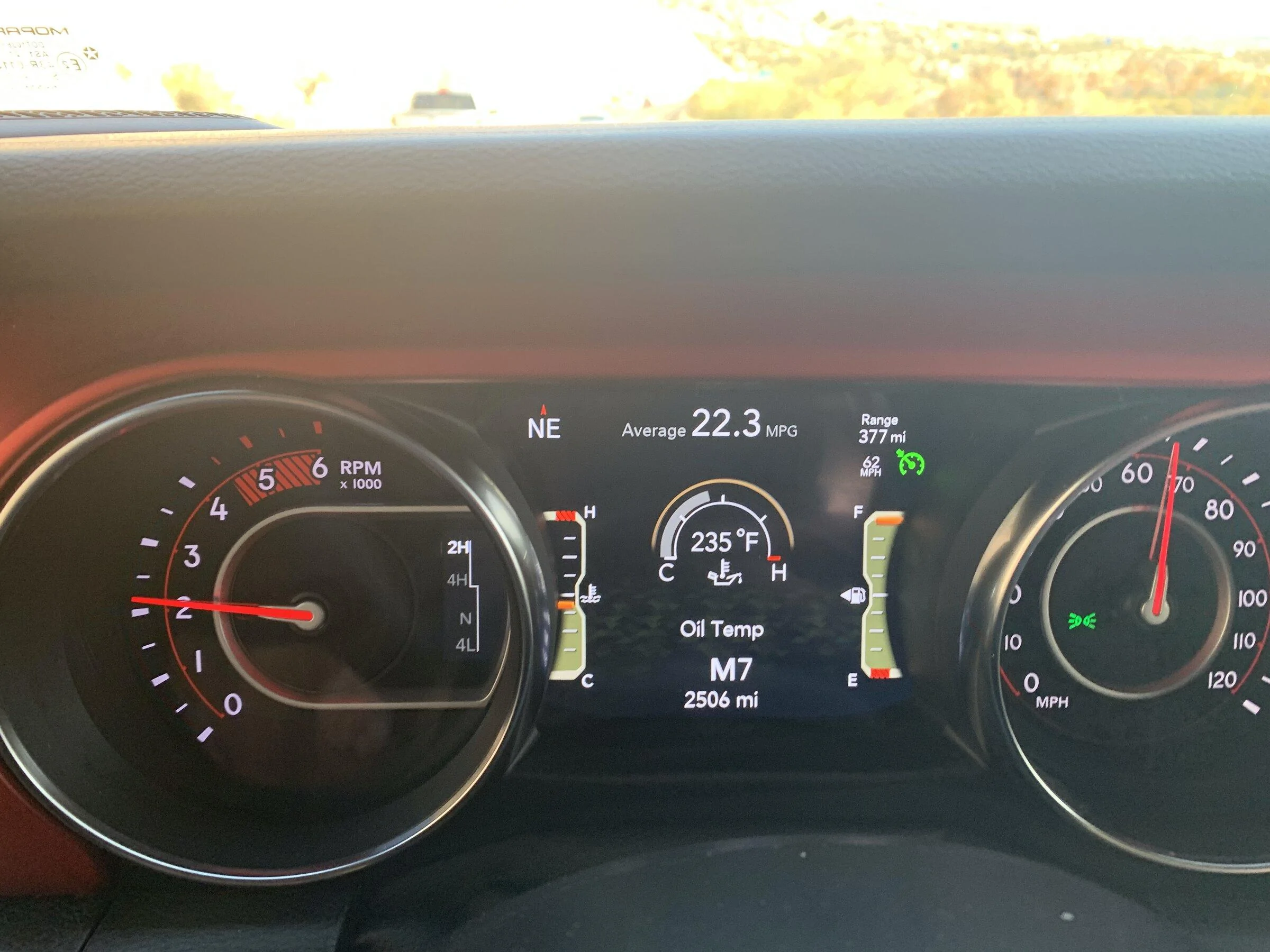
I recently posted a picture of ambient air, oil temp, gear selection, and ground speed at the instrument cluster while pulling the Airstream up the grade. Oil remained at 239f @ 62mph, until I had to pass a slower RV, thus oil climbed to 242f (IIRC), then quickly returned to 239f once I got off the throttle. So far, so good. Unladen performance is awesome, just like with 33"s again, as 7th and 8th gear have returned!
I have a few more ideas in the lab. I acquired a new oil pan, just to template a custom unit potentially, and have a PPE aluminum transmission pan in the stash, although the 8HP doesn't seem to need help at this time.
Surely I've left some things out, but if you've held-on thus far, thank you and please comment. There's additional information on aftertreatment, with the big bit being cruise control facilitates the most effective passive cook for the DPF. It's not the only advantage of it, to be sure, but that was straight from Stellantis engineering.
Thanks for your time and attention!
Please note that these are my opinions and observations based on experience as an owner and service technician, not sponsored or endorsed by Stellantis, although I will credit them with certain training and technical webcasts provided free-of-charge via the National Institute for Automotive Service Excellence, for which I am very grateful.
The 3.0 VM was envisioned as a lightweight, high-output, high-efficiency automotive diesel engine utilizing what was then (late 2000's) state-of-the-art technologies. Some of these are:
- Lightweight castings
- Forged internals
- High-pressure, full-authority direct fuel injection
- Variable nozzle, liquid-cooled compact turbocharging
- Variable camshaft timing (phasing)
- Latest Tier emissions compliance
- Design adaptable to multiple automotive global platforms
- More that I've likely forgotten
In any case, the first task on the WK2 was pulling our new 28' Airstream to the factory service center in Jackson Center, OH (Had to spend a week there as the trailer was, well, poorly assembled and basically had to literally "go back to the factory"). The trip was about 800 miles, with the only serious grade pull being the 81 out of Knoxville. It was then that the little gorilla came to life, winning even more points by delivering a 404 mile cruising range. At 70k miles, that platform has only had a single fault, which was not powertrain related - the transfer case control module (not "intelligent") failed, with that repair not requiring any sort of flash or firmware, taking about 5 minutes to R&R. The EGR cooler was replaced under an emissions campaign, but that's basically it for hardware, and a couple of firmware flashes which have decreased tip-in throttle response and fuel economy. The most extreme booty-pucker event was a pull from Barstow, CA to Needles, CA....in July. Ambient air temps hit 119f, with IAT hovering in the 145f range; oil temps approached 255f, coolant 238f, trans 210f. It never depowered, however I was being proactive by reducing ground speeds, which kept oil temps in check. Like so many heavily-boosted diesels (or naturally-aspirated ones), "P" tubes direct pressurized engine oil that targets the underside of the piston assembly. As fueling is increased, and assuming engine speed increases, the resulting exhaust stream accelerates the turbocharger turbine, which is directly connected to the compressor assembly, resulting in a charged, pressurized "slug" of air to facilitate a higher degree of combustion efficiency and power, generally speaking, along with mapped injection sequences and subsequent flame-front propagation. Whew. So all of that equals a prompt rise in piston crown temperature, which must be reconciled quickly, and that's where the oil jets come into play. This is where monitoring your EGT's is important, but in the absence of that, pulling your oil temp up will give you an idea of a comparative to the presence of climbing EGT's.
This is where we get into the "meat" of why the JL/JT is what it is when it comes to total powertrain cooling, and why it's very marginal for the EcoD. And finally, you might be asking, where we can discuss how I deal with it in the JTR. Like the WK2, we have a cooling module that is composed of multiple heat exchangers. These include the main engine coolant radiator, the HVAC refrigerant condenser, a transmission lube oil cooler, and the CAC, or charge air cooler, which serves to cool that charged air "slug" before it enters the engine (cool air is denser than hot, thus there's more potential oxygen present to support combustion). If you stand in front of your JL/JT, you'll get the picture; basically 35% of that cooling module is obscured by mainly a bumper (more if you have a winch!), horns, misc. peripherals, and essentially only 5 of the 7 famous slots are partially open for air flow. That's it. And there isn't much the owner can do about it, aside from removing the grille and bumper or replacing with a modified angry bird grille (don't do it).
When I fist took delivery of mine, I immediately lifted it to the spec. you've seen in my av, yet retained the 3.73 gearing, as the 4.56's were on perpetual back-order at the time. It was then that I wanted to experiment with how hot the engine would need to get, e.g., how far I could push it, right to the "wall", and note temperatures, any malfunction indicators, IAT, etc. My basis of comparison was the aforementioned WK2 EcoD, where 250f would be the most I would tolerate under heavy boost, or powertrain would step-in and reduce throttle potentially. The opportunity arrived last July when my fellow Jeep mad scientist asked if I would drive down to Mesa and get a GEN 4 SBC he'd bought for.....another project.
I rented a 5x10' open aluminum utility trailer, and off I went. Predictably, the 3.73/37" combo immediately let itself be known, in the form of my effectively having a 5.5 speed transmission, unless going downhill. Yes, the tire size was updated on the network, but other than ground speed being accurate, it didn't help. Upon climbing the grade out of Camp Verde, ambient air temp was 93f with a 35kt headwind, oil temp very quickly climbed to 250f...and kept going. Coolant followed closely to 235f; I reduced speed to 55mph. Oil and coolant both stopped going up, but it didn't last. About 1/2 mile from the pass, powertrain began to depower when oil reached 267f, coolant 255f, at which point I slowed to 35mph with hazard flashers on (not such a big deal at the time, as a third lane was present with a line of commercial trucks and RV's moving slowly). It was about then I got my first malfunction indicator light, which was related to basically "fuel delivery requirement greater than anticipated" - more on that later. Fast forward to the trip back, and a similar scenario played-out on the Black Canyon Grade, with a complete 20mph depower on the last little grade near the house. Upon reaching my destination, HVAC shut down, and I let it idle for about 6 minutes until oil leveled-off at 225f.
Although it might sound crazy, these results were what I was hoping for, as now, definitively, I had some hard figures to work with. I also understood what the engineers had in mind with the progressive shedding of load in order to preserve powertrain integrity. On a side note, one of the earliest examples, in a domestic platform, of this kind of shedding and depower, was the Cadillac Northstar, which had a "backup" cooling capacity using lube oil as the medium. Cool stuff. Anyway....now for some lab time, the next day.
I pulled the above code, noted the freeze-frame, and wiped the modules (there were the usual U codes that seem to afflict the JL/JT when the network brains perceive a SHTF DEFCON, what I affectionately call "it's trying to get the launch codes and fire missiles!". This is where it gets interesting; IAT was 197f (!!!!!!!) on the freeze, which means it likely spiked over 200f before the event ended, which is, most extreme, IMHO. I get 145, even 150 on a really hot day. But this was just too much, and it became apparent why: The air cleaner intake opening neatly seals-off a portion of the underhood skin that, aside from the small duct that is open to the grill. You basically draw you're fresh air from the space, formed by a stamped "channel", between the hood blanket and the hood skin. Note that the gas burners have a portion of that boot open for at least enough fresh air to enter, again outside of the little plastic tube open to the grille.
There's more. On the EcoD, not only is the engine heavier, it has a taller deck than the 2.0 or 3.6, by both basic physics of a longer-stroke compression-ignition engine, but also it has peripherals that eat-up space. It also sits a little further forward, as compared to the gassers. While, aside from reports of stock front-end jounce bumper excess contact "bottoming", this isn't all that important to this discussion, it's noteworthy that the EGR cooler is located right-bank top, turbo in the midship "VEE", and the downpipe aft the turbo, trailing down the right along the firewall, and on to aftertreatment systems. I was astonished at how hot it gets, localized largely in the right bank area...I mean, paint blister hot. Keep in mind that code I mentioned earlier, with IAT's almost 200f. It's no wonder, even given the CAC chiller, the air slug was just too hot, thus less dense, to support the metered fuel being requested at the time. With a totality of circumstance - high underhood "cells" of air, limited air heat exchange up front, improper axle ratio (the "space" between each gear is effectively "stretched-out", so you spend a lot of your engine revs not ideally matched to ground speed, which is how much of powertrain AI determines shift points, along with throttle request), high boost loads sending even more heat to the oil/coolant exchanger for the radiator to deal with, cooled EGR with...you guessed it, engine coolant, AND an engine coolant chilled turbocharger. That's a lot to ask from the cooling system, even a really oversized one. It's worth noting that the ole reliable 8HP didn't get over 210f. I like that whole series of transmissions.
About that time, the gears arrived early, so regearing was the first step in the right direction. Secondly, I wanted to reduce underhood temps, especially around the right bank. Third, getting some more fresh air into that little monster diesel was in order. In my estimation, those three correctives were the "low-hanging fruit" that I could remedy without being more invasive.
So with matched gears, I installed a pair of SB hood scoops. Keep in mind that these things replace the ones on the Rubicon hood . The right one sends a stream of ram air right over the EGR cooler, and down the right path of exhaust down pipe. The left one provides relief for what amounts to a stagnant "cell" of hot air, allowing a now discretely trimmed air intake boot to draw some much needed air.
I recently posted a picture of ambient air, oil temp, gear selection, and ground speed at the instrument cluster while pulling the Airstream up the grade. Oil remained at 239f @ 62mph, until I had to pass a slower RV, thus oil climbed to 242f (IIRC), then quickly returned to 239f once I got off the throttle. So far, so good. Unladen performance is awesome, just like with 33"s again, as 7th and 8th gear have returned!
I have a few more ideas in the lab. I acquired a new oil pan, just to template a custom unit potentially, and have a PPE aluminum transmission pan in the stash, although the 8HP doesn't seem to need help at this time.
Surely I've left some things out, but if you've held-on thus far, thank you and please comment. There's additional information on aftertreatment, with the big bit being cruise control facilitates the most effective passive cook for the DPF. It's not the only advantage of it, to be sure, but that was straight from Stellantis engineering.
Thanks for your time and attention!
Sponsored
Last edited by a moderator:
 The dash pic from the JTR EcoD as sen in my av; again, as geared and cooled appropriately, it pulls the rig much better than the gasser, with cruising range to spare.