- Thread starter
- Banned
- #1
Rear axle needs articulation too, no?
Sponsored


You're asking a lot of "what if" questions that may or may not have any practical use, or are ignoring the geometry differences of the front vs. rear suspensions. Honestly, I'd ask them if you're looking to poke holes in the explanation. That's why I linked the thread rather than just the video. There are two suspension companies in that thread backing up and explaining the claims of a third offroad company. 3 vendors all saying the same thing. They clearly know more about it than us. In my opinion they did a great job showing and explaining and I have no reason to doubt it. You asked "why not", that thread answered.I watched the video and it created more questions than it answered:
So going uphill overloads the rear but going downhill doesn't overload the front?
Why didn't he back up the flex ramp?
He didn't makes it up the ramp as far with the sway bar disconnected because the rear tires were rubbing which is attributed I would assume, to more flex in the rear axle which can be construed as a more balanced application of weight to each rear wheel which is the goal, no?
If you want to bring factors such as engine weight, steering, and direction of travel into the explanation then okay but these variables weren't brought up IIRC.

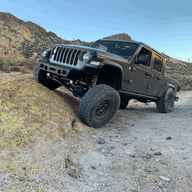
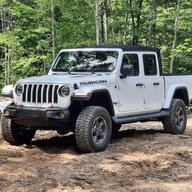
I have a friend with a 2dr JK on 40s. He has described this to me similarly. He had a front anti rock for a couple wheeling seasons. I'm not sure about the rear but I think he had a stock bar during that time. He said that the jeep works so much better and feels way more stable now that he's added the rear anti rockLike several others, I ripped out the upper sway bar link mounts on the frame. I ran no rear sway bar (with an anti-rock front) for about six months and then put a rear anti-rock on. (the rear anti-rock has a similar rate to the oem sway bar, the front anti-rock is much softer than oem).
What I learned was that in slow, rock crawling situations, the rear would articulate great - but what often happened was that the truck would lean more than needed, because the front sway bar was causing the body and frame to track with the front axle.
When I installed the rearantirock, I lost about two inchs of articulation measured at the rear wheels. But on the trails, the truck feels more stable and balanced with both sway bars. Now, the front is articulating more and the rear is articuating less - hard to explain but easy to see on the trail. I prefer the feel with the rear sway bar. It is easier to lift a tire now, but I truly believe that there would be so little weight on the drooped tire that it wouldnt make a difference to have the additional articulation.
And then, at mid and high speeds off road it is a wholly different matter. The rear sway bar makes the truck so much more controlable. It induces a perfect amount of oversteer for driving fast off road. (on road is better too)
In every situation, I prefer the truck with the rear sway bar (granted the anti-rock is much less limiting articulation-wise than the oem sway bar)
And lastly, almost everyone at king of hammers is running a rear sway bar....be like the cool kids LOL.
I think what I'm reading here is that you need the lesser of two weevils in order to give the body some stability;but what often happened was that the truck would lean more than needed, because the front sway bar was causing the body and frame to track with the front axle.
i'm with you. In that specific RTI ramp test, where you are going up an obstacle, yes, there is a benefit to running a rear bar. And of course, that is where you want the most flex for traction. But as soon as you are level and twisted up in a rut, there is probably a benefit to not having a rear bar. If you're going downhill, you don't need traction but you need wheel contact for stability, and there is likely a big benefit to not having the rear bar. I'm with you - i'd like to see him back up the RTI ramp rear connected and rear disconnectedI watched the video and it created more questions than it answered:
So going uphill overloads the rear but going downhill doesn't overload the front?
Why didn't he back up the flex ramp?
He didn't makes it up the ramp as far with the sway bar disconnected because the rear tires were rubbing which is attributed I would assume, to more flex in the rear axle which can be construed as a more balanced application of weight to each rear wheel which is the goal, no?
If you want to bring factors such as engine weight, steering, and direction of travel into the explanation then okay but these variables weren't brought up IIRC.
I was on a soft sand trail yesterday on the side of a hill with an off camber turn. The roll inclinometer hit 25° when I had to redirect focus because the front wheels started sliding.Biggest pucker moments on the trail for me have been going DOWN a technical trail and needing flex for stability