
ShadowsPapa
Well-Known Member
- First Name
- Bill
- Joined
- Oct 12, 2019
- Threads
- 247
- Messages
- 40,442
- Reaction score
- 53,859
- Location
- Runnells, Iowa
- Vehicle(s)
- '25 JTMX, '23 JLU 4xe, '82 SX4, '73 Javelin
- Occupation
- Retired auto mechanic, frmr gov't ntwrk security admin
- Vehicle Showcase
- 3
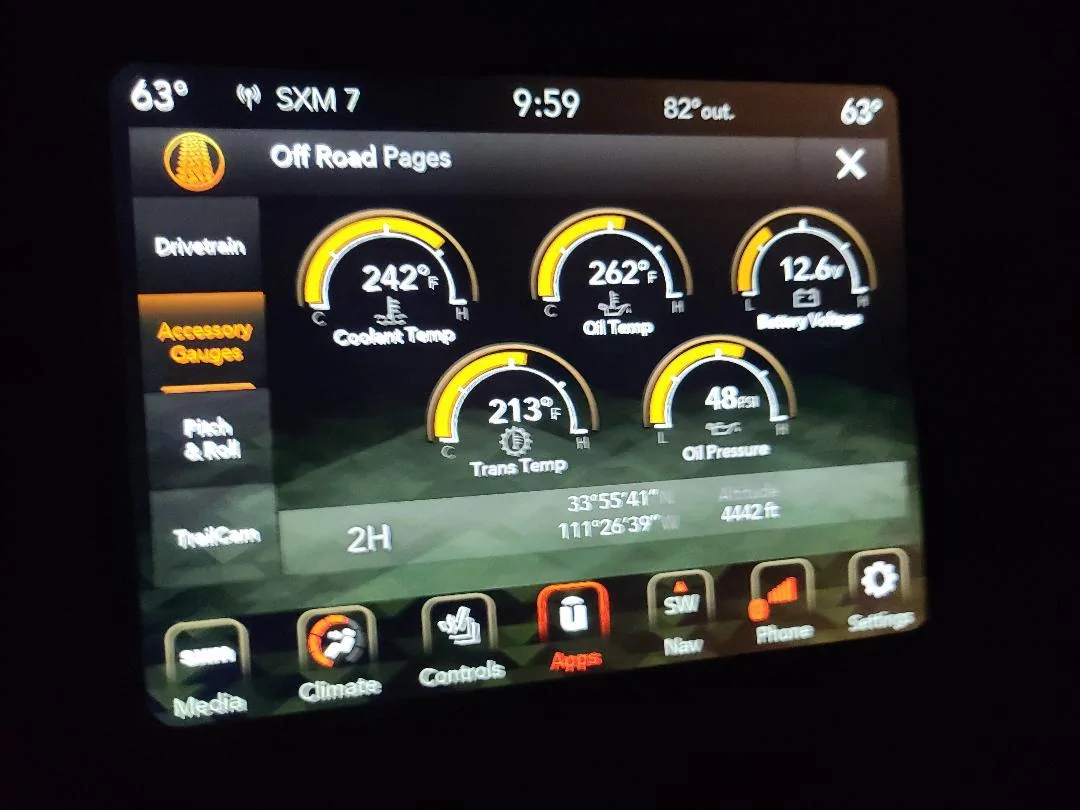
And everything I posted is from an engineer - who tests oils and has current information on current oils as of spring 2021.The ECU protecting the engine isn't necessarily a bad thing. But I understand that it frustrates people in high altitude and stressful environments.
A snippet from another thread:
" When I was a development engineer at Cummins, I used to run hot box tests at rated power for hundreds of hours on engines with 230F coolant temperatures, which drove the oil temperatures to 280F on dino 15w40. We never worried about the durability. All that my management wanted to know was the exact date that the test would be completed."
Since dino oils have much lower breakdown temperatures than synthetics, 300 degrees on a syn oil is not an issue.
You are wrong, and I have never had an issue with you. I actually respect you. But I'm kind of getting tired of you jumping on every post I make and trying to discredit me.
Everything I posted in this thread is 100% accurate. Period.
Oils have changed, tests in 2020 and 2021 show totally different numbers than you refer to.
Not sure where the "dino oils have a much lower breakdown temperature than synthetics" comes from - but it's just not true. Each oil is different - some synthetics break down at 260 and 270 while some conventional oils exceed that. There's no rule because the numbers vary with the oil.
Here's a link so you can see where I'm coming from - real numbers, real tests by an SAE engineer.
https://540ratblog.wordpress.com/
For example -
5W30 Valvoline Full Synthetic Extended Protection, GM dexos1-Gen2, ILSAC GF-6A, API SP thermal breakdown was 285 - for THAT synthetic oil.
20W50 Valvoline VR1 Racing Oil, conventional - thermal breakdown - 285. The same.
I'm passing along information is all.
Read the numbers - it's been shown that modern oils - there's very little difference and in protection over-all, some synthetics suck while others are superior, same for conventional oils.
Capability ranking at 275*F:
1. 5W30 Pennzoil Ultra, API SM = 97,955 psi (dropped 15% from its 230* value)
2. 5W30 Mobil 1, API SN = 96,323 psi (dropped 9% from its 230* value)
(2% below no. 1 here at 275*)
3. 10W30 Lucas Racing Only = 95,996 psi (dropped 10% from its 230* value)
(2% below no. 1 here at 275*)
4. 5W50 Motorcraft, API SN = 92,545 psi (dropped 11% from its 230* value)
(6% below no. 1 here at 275*)
5. 10W30 Amsoil Z-Rod Oil = 91,351 psi (dropped ONLY 4% from its 230* value)
(7% below no. 1 here at 275*)
6. 20W50 Castrol GTX, API SN = 85,815 psi (dropped 11% from its 230* value)
(12% below no. 1 here at 275*)
7. 5W20 Castrol Edge w/Titanium, API SN = 84,584 psi (dropped 15% from its 230* value)
(14% below no. 1 here at 275*)
8. 10W30 Joe Gibbs XP3 NASCAR Racing Oil = 80,957 psi (dropped 15% from its 230* value)
(17% below no. 1 here at 275*)
9. 5W30 Castrol GTX, API SN = 80,957 psi (dropped 15% from its 230* value)
(17% below no. 1 here at 275*)
NOTE: This is not a typo here, number 8 and 9 here just happened to have the same size wear scar, thus the same psi value.
10. 10W30 Valvoline VR1 Racing Oil, silver bottle = 75,116 psi (dropped 27% from its 230* value)
(23% below no. 1 here at 275*)
11. 0W30 Brad Penn, Penn Grade 1 = 68,768 psi (dropped ONLY 4% from its 230* value)
(30% below no. 1 here at 275*)
12. 5W30 Royal Purple XPR = 66,664 psi (dropped 11% from its 230* value)
(32% below no. 1 here at 275*)
As expected, the capability psi values dropped as the oils got hotter and thinner. But for most of the oils, the drop was not enormous. And the average psi drop for the whole group of 12 oils, was only about 12% from their 230* values.
Sponsored