
Sponsored

Alternator or battery?

brianinca

Well-Known Member
First Name
Brian
Joined
Jun 8, 2020
Threads
22
Messages
1,329
Reaction score
1,384
Location
USA
Vehicle(s)
2020 Gladiator Rubicon
Occupation
IT Manager
Two things:
1) Very helpful thread and your posts of course, since 13.6v on the instrument panel was worrying me I didn't change the midget battery fast enough to avoid damage to the main battery.

2) You're getting a NEW Gladiator?


When I first start mine it's in the 14s, sometimes 13s. Mine has been sitting a lot lately to save miles on it (I have it traded in for a new one) so the battery itself reads low.
Sponsored


 

B1tPirate

Member
First Name
Kevin
Joined
Apr 8, 2022
Threads
2
Messages
21
Reaction score
28
Location
Tampa, Florida
Vehicle(s)
2022 Jeep Gladiator
Build Thread
Link
Occupation
Computer Nerd
Plus the combo of the bad batches of batteries and my friend’s Gladiator charging at north of 14v had me concerned too.
Unless you have a separate isolated voltage meter you are seeing the alternator voltage while the engine is running. If you are using the dash gauges then go to "run" without starting the motor and anything above 12.1 volts is good, 11.7 - 11.9 is time to look at a new battery. With the engine running anything between 12.5 and 13.5 is normal. If you have a higher capacity alternator (max tow has a 220w alternator) you should see 14V on startup or if you have an accessory pulling extra power, the computer will kick the alternator up to 13.9 - 14.2V.

Heavy duty pickups with 260w alternators will show as high as 14.3V on startup to recharge the battery after the starter drew power, then it will drop to 12.7ish. If an inverter, compressor, etc are turned on the engine will kick the voltage back up to 14V to accommodate the draw.
 

ShadowsPapa

Well-Known Member
First Name
Bill
Joined
Oct 12, 2019
Threads
247
Messages
40,440
Reaction score
53,854
Location
Runnells, Iowa
Vehicle(s)
'25 JTMX, '23 JLU 4xe, '82 SX4, '73 Javelin
Occupation
Retired auto mechanic, frmr gov't ntwrk security admin
Vehicle Showcase
3
Unless you have a separate isolated voltage meter you are seeing the alternator voltage while the engine is running. If you are using the dash gauges then go to "run" without starting the motor and anything above 12.1 volts is good, 11.7 - 11.9 is time to look at a new battery. With the engine running anything between 12.5 and 13.5 is normal. If you have a higher capacity alternator (max tow has a 220w alternator) you should see 14V on startup or if you have an accessory pulling extra power, the computer will kick the alternator up to 13.9 - 14.2V.

Heavy duty pickups with 260w alternators will show as high as 14.3V on startup to recharge the battery after the starter drew power, then it will drop to 12.7ish. If an inverter, compressor, etc are turned on the engine will kick the voltage back up to 14V to accommodate the draw.
14.7 volts is not out of the realm of reality. In fact, I've seen 14.6-14.7 fairly regularly.
You'll see higher voltages when charging AGM batteries with a correct charger.

Sorry, your voltages are off.
No, 12.1 volts is not good. In fact if you see that real regular, eventually your battery will not fully charge if it doesn't go over a certain point.
With AGM, you want over 12.6 to be fully charged.
That's typically 12.7-12.8 volts for these.
A SoC of 12.4 or under is where sulfation starts to occur.
12.1 is under 50% charged, for many, about 40% charged at best (connect a good charger, it will tell you, but it must be AGM type charger). Even my AGM specific charger agrees with that. (see chart below)

I've laid all of this out a couple of times, once in a long thread doing some troubleshooting and testing on my own truck.


Heavy duty pickups with 260w alternators will show as high as 14.3V on startup to recharge the battery after the starter drew power, then it will drop to 12.7ish.
......... I think you mean 260 AMPS, not W for watts. Alternators are rated in Amps (A) not watts (W).
I restore/repair/rebuild alternators in my shop, as well as test them.

The system may not drop to 12.7 unless the PCM via IBS senses there's no load, and the PCM has determined certain conditions are met - lighting and other loads, battery true state of charge based on mA in and out over time and other factors. The PCM controls the charging rate - voltage, etc. based on a number of needs and criteria.

The maximum amperage output of the alternator isn't what determines the charging rate of the battery, or the voltage you see. If a 100 amp alternator wasn't handling any other load, it could charge a battery at 15.0 volts if needed.

Unless you have a separate isolated voltage meter you are seeing the alternator voltage while the engine is running.
You'll not be able to read the battery voltage itself with the engine running - can't be done since the battery voltage across the terminals is what the system voltage is, accounting for voltage drop at connections, etc.
But if you have the volt meter selected when you hit the button and go into ACC mode, you can read the battery voltage before starting it. It will be a bit off in my experience, compared to a Fluke. The cluster usually reads just a little bit lower - possibly due to the IBS.
I have not tried to isolate the difference.


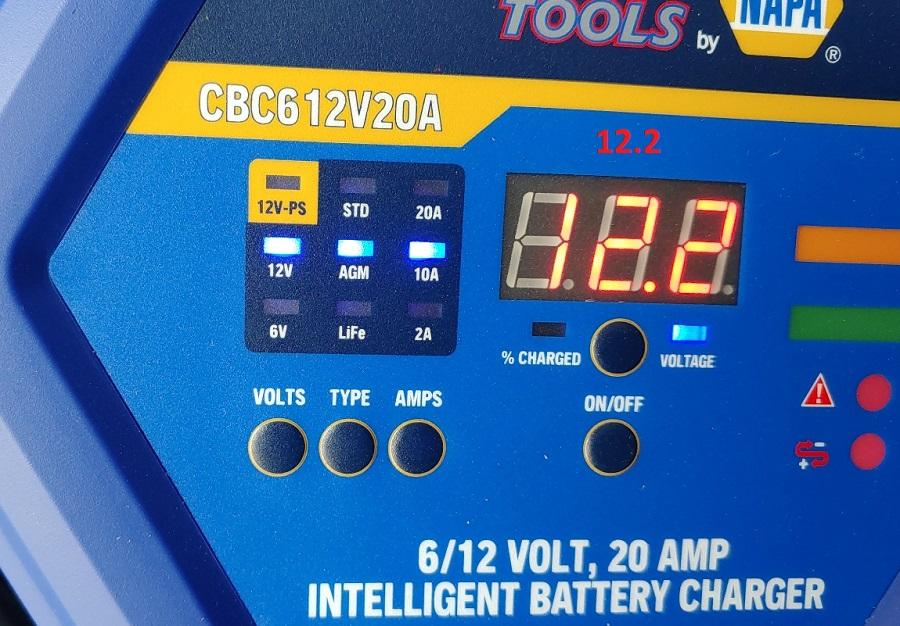
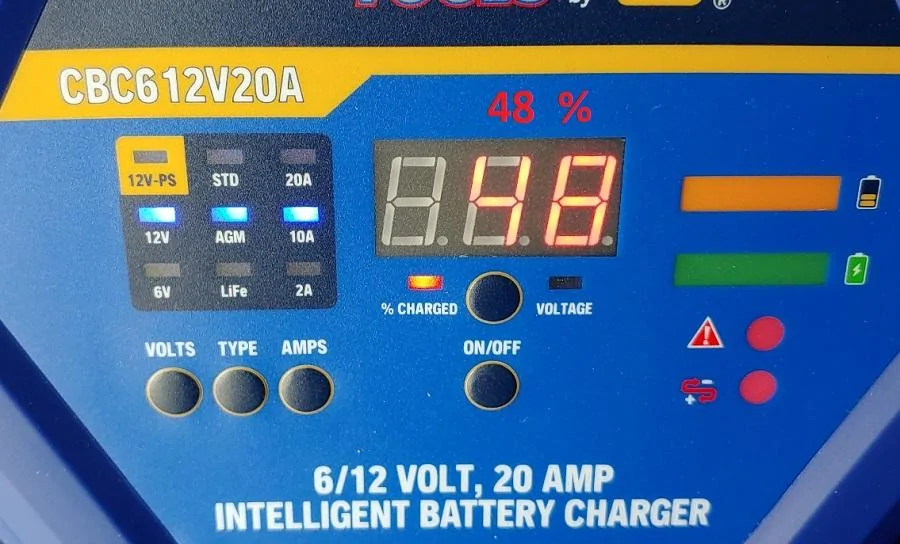
Here the charger says that 12.2 volts is 48% charged. That's pretty much in agreement with the chart below.

Jeep Gladiator Alternator or battery? 20220415_120844

Jeep Gladiator Alternator or battery? 20220415_120805


AGM battery
State of Charge
(SoC)
Open-circuit
voltage*
Notes
100%12.7…13.0 Vvaries
80%12.5…12.7 V
60%12.3…12.5 Vrecharge
recommended
40%12.0…12.2 V
20%11.8…12.0 V
10%11.7…11.9 Vstop discharge
0%11.4…11.6 Vpermanent
damage
*after 12h rest


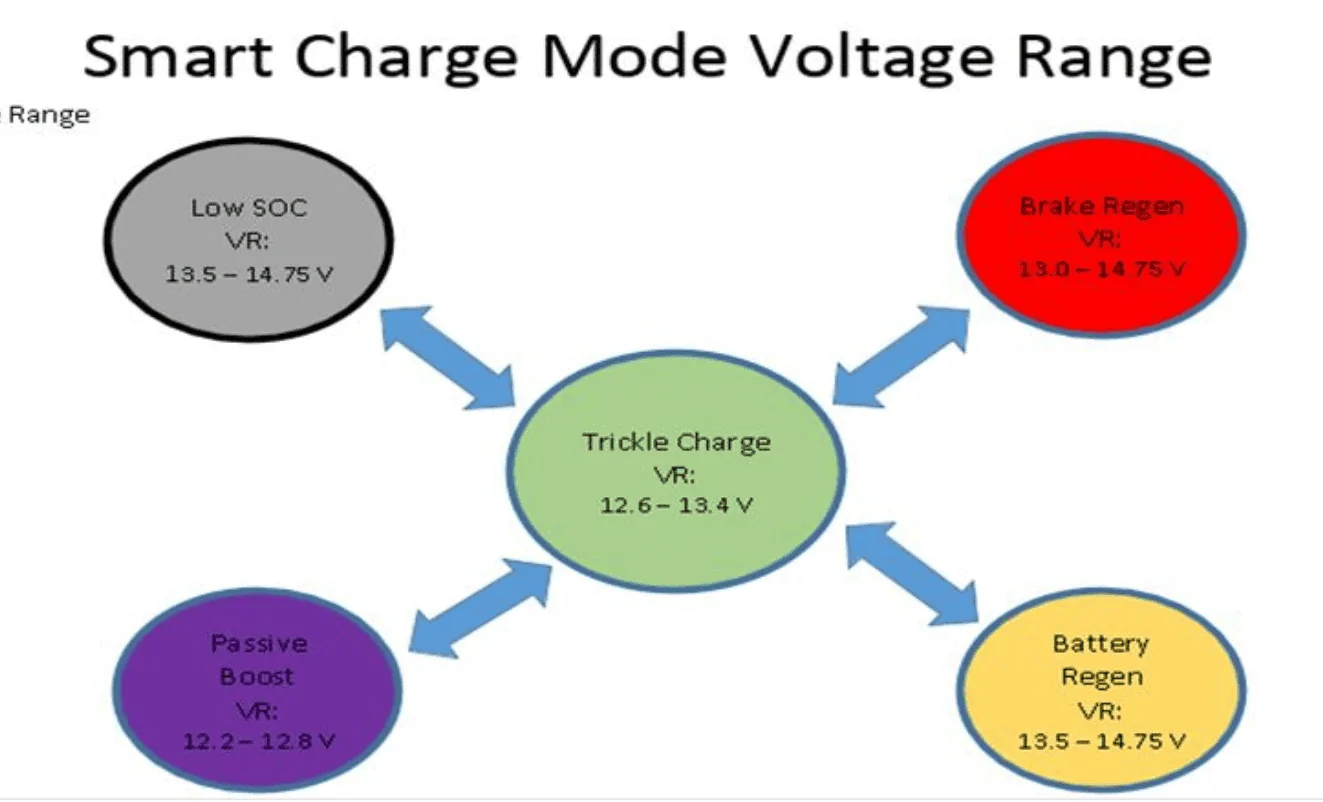
Here are some possible voltage ranges based on what the PCM has decided is needed. When you need power - the engine needs all it can muster, the field current may be cut briefly, dropping system voltage into the 12s (purple)
If the batteries are at or near 100% SoC, it may go into trickle charge mode just to maintain them.
AGM also require very different charging processes than standard flooded batteries.

This is from MOPAR tech documents -

Jeep Gladiator Alternator or battery? 1653622778266
 

B1tPirate

Member
First Name
Kevin
Joined
Apr 8, 2022
Threads
2
Messages
21
Reaction score
28
Location
Tampa, Florida
Vehicle(s)
2022 Jeep Gladiator
Build Thread
Link
Occupation
Computer Nerd
Full disclaimer - I am not a certified technician or mechanic. Everything I post is from my personal experience working with Ford/GM/Ram trucks from owning a transportation company and a truck customization company.

Battery health is something we watch closely so I install battery monitors that are isolated and communicate via Bluetooth so it is easy to see actual voltage with the trucks off. The battery monitor also helps bleed off any voltage float on a vehicle that was just turned off.

You are correct, 12.1 is not a healthy battery, but in my transportation business I have never treated it as a "drive to O'Reilly's right now" type of situation either. 11.9 has been my point where I consider it urgent on my own vehicles.

You voltage chart is great and I think very helpful for anyone that lands on this thread.

BTW - Of course I meant amps instead of watts, I knew I should have re-read before I posted...
 

ShadowsPapa

Well-Known Member
First Name
Bill
Joined
Oct 12, 2019
Threads
247
Messages
40,440
Reaction score
53,854
Location
Runnells, Iowa
Vehicle(s)
'25 JTMX, '23 JLU 4xe, '82 SX4, '73 Javelin
Occupation
Retired auto mechanic, frmr gov't ntwrk security admin
Vehicle Showcase
3
BTW - Of course I meant amps instead of watts, I knew I should have re-read before I posted...
I figured it was a simple basic error - thinking one thing, type another, somewhere the neurons missed a turn. The numbers were right for amps............

I guess I get picky on electrical things. I've done electric, mostly automotive, since about age 12 or so. Short time as a maintenance electrician, then a couple of years as electrician for PFG (man I hate those noisy core drills and fishing in stuffed floor channels) but mostly automotive.
Most of my experience is pre-year 2000 so I've had to bring myself up to speed. I may miss here and there.

Right that 12.1 isn't a "replace battery" emergency, but IMO, it's a "why is it that low, investigate" thing. (especially when battery makers say that sulfation processes can start at below 12.4, and if AGM batteries are never fully charged - if they are only ever charged to, say, 60%, after a while that's all they'll take.
 

Sponsored

ShadowsPapa

Well-Known Member
First Name
Bill
Joined
Oct 12, 2019
Threads
247
Messages
40,440
Reaction score
53,854
Location
Runnells, Iowa
Vehicle(s)
'25 JTMX, '23 JLU 4xe, '82 SX4, '73 Javelin
Occupation
Retired auto mechanic, frmr gov't ntwrk security admin
Vehicle Showcase
3
2) You're getting a NEW Gladiator?
LOL - yeah, maybe. Ordered 5/02/22, confirmed by an email from Jeep on 5/03 with order number, crickets since. Not scheduled, no word, still in D (not D1)
Will be identical (I hope, anyway) except for addition of Selec-Trac transfer case, aux switches.

Time will tell - if I get it or not, seems some are getting lost or never being built, and whether or not it will match this one in reliability, lack of major issues.
 

jrf

Well-Known Member
First Name
J.R.
Joined
Sep 17, 2019
Threads
8
Messages
387
Reaction score
327
Location
PA
Vehicle(s)
2020 Jeep Gladiator Rubicon Launch Edition (White), 2001 TJ Sahara (white)
Vehicle Showcase
2
Opening this thread back up as I've been trying to diagnose what I still think is an alternator issue. I've read about the PCM and what is needed but I'm not seeing mine get above 12.6/12.7 constantly no matter what is going on.... EXCEPT during brake regen. AKA foot off the gas the volts will climb up to about 14.0. As soon as I stop or go again and as long as I'm not coasting I never see higher than 12.6/12.7. I noticed after a few hours of driving a host of dash lights on, trac control turned off on it's own/etc. The battery charge was low (mind you this is a pretty recent new battery, few months ago maybe). I fully charged the battery at home and I'm still seeing this. Anyone know why it would only charge above a trickle during brake regen?

IBS maybe not accurate or needs to be replaced?
 

ShadowsPapa

Well-Known Member
First Name
Bill
Joined
Oct 12, 2019
Threads
247
Messages
40,440
Reaction score
53,854
Location
Runnells, Iowa
Vehicle(s)
'25 JTMX, '23 JLU 4xe, '82 SX4, '73 Javelin
Occupation
Retired auto mechanic, frmr gov't ntwrk security admin
Vehicle Showcase
3
Opening this thread back up as I've been trying to diagnose what I still think is an alternator issue. I've read about the PCM and what is needed but I'm not seeing mine get above 12.6/12.7 constantly no matter what is going on.... EXCEPT during brake regen. AKA foot off the gas the volts will climb up to about 14.0. As soon as I stop or go again and as long as I'm not coasting I never see higher than 12.6/12.7. I noticed after a few hours of driving a host of dash lights on, trac control turned off on it's own/etc. The battery charge was low (mind you this is a pretty recent new battery, few months ago maybe). I fully charged the battery at home and I'm still seeing this. Anyone know why it would only charge above a trickle during brake regen?

IBS maybe not accurate or needs to be replaced?
There is no brake regen on these - they aren't hybrids.

In any case, it won't be an alternator issue. The alternator is apparently working as the voltage does climb.

First things I'd try -
Charge each battery independently.
While doing that, disconnect the IBS, including the network connector, and lay it aside while charging the batteries (independently of each other)
Once the batteries are charged - use a decent meter and check the voltage of each.
It should settle to about 12.8 volts for each battery.
Put it all back together.

You said you charged "the" battery - you do know there are two, correct?

What do you mean by " The battery charge was low (mind you this is a pretty recent new battery, few months ago maybe)"

How was it low - how did you check? What was the voltage?
 

jrf

Well-Known Member
First Name
J.R.
Joined
Sep 17, 2019
Threads
8
Messages
387
Reaction score
327
Location
PA
Vehicle(s)
2020 Jeep Gladiator Rubicon Launch Edition (White), 2001 TJ Sahara (white)
Vehicle Showcase
2
There is no brake regen on these - they aren't hybrids.
Ahhh, that's what I thought too. However it seems when you are off throttle at speed and coasting, the PCM considers that "brake regen" and the voltage will climb. As soon as you come to a stop/and or back on the throttle it stops. I was under the assumption you were also until today.

In any case, it won't be an alternator issue. The alternator is apparently working as the voltage does climb.
That's where I'm at now....clearly it has the ability to work, something not telling it to..

First things I'd try -
Charge each battery independently.
While doing that, disconnect the IBS, including the network connector, and lay it aside while charging the batteries (independently of each other)
Once the batteries are charged - use a decent meter and check the voltage of each.
It should settle to about 12.8 volts for each battery.
Put it all back together.
Should have added...I'm battery 2 deleted a long time ago. Fuse pulled, cables wrapped, 2nd battery removed. AND yes my main(now only) battery did die before/while it was in storage this winter. Hence the new battery. The storage people complained of it not starting and having to jump start it. Who knows what could have happened during that.

But that brings me back to the PCM is not telling the jeep to do anything other than trickle charge this battery except for the brake regen. I know the battery was depleted after my last long drive because I have a battery tester. SOH was good SOC was low, I don't remember the exact numbers....now something I will be keeping an eye on.

Still think charge the main battery and disconnect the IBS as a good start?
 

ShadowsPapa

Well-Known Member
First Name
Bill
Joined
Oct 12, 2019
Threads
247
Messages
40,440
Reaction score
53,854
Location
Runnells, Iowa
Vehicle(s)
'25 JTMX, '23 JLU 4xe, '82 SX4, '73 Javelin
Occupation
Retired auto mechanic, frmr gov't ntwrk security admin
Vehicle Showcase
3
Ahhh, that's what I thought too. However it seems when you are off throttle at speed and coasting, the PCM considers that "brake regen" and the voltage will climb. As soon as you come to a stop/and or back on the throttle it stops. I was under the assumption you were also until today.
I'm under no assumptions - it's not brake regen. The PCM monitors the torque load on the engine vs. throttle position vs. road speed and other factors and when it makes sense for miles per gallon and power needs, it backs off the alternator, even to the point of stopping charging completely.
As you touch the throttle if the battery is charged or hot (per the IBS) then it backs off field current to the alternator, reducing output.
If you back off the throttle, it will increase alternator field current to make up the power taken out during the start cycle, as per the IBS.
The IBS tracks all amps in, and all amps out.
So when you start it, it tracks the power removed from the battery and works to restore that to get back to 100% SoC (State of Charge)
If the battery is hot from a long drive and charging, it will cut the alternator output even to the point of stopping charging completely and just maintaining the existing electrical load.

And I circle back to - reset the IBS, fully charge the battery with a good AGM charger, letting it go through all 4 phases. Don't use anything but an AGM charger for best results.
And reset the IBS for sure.

I don't know what you have for a battery tester, but I don't trust most consumer versions. The only testing I trust is a carbon pile, volt meter and high-current amp meter.
 

Sponsored

Mr._Bill

Well-Known Member
First Name
Bill
Joined
Jul 22, 2019
Threads
38
Messages
6,645
Reaction score
7,720
Location
North Las Vegas, NV
Vehicle(s)
2023 Gladiator High Altitude - 2013 Nissan Leaf SV
Vehicle Showcase
1
Opening this thread back up as I've been trying to diagnose what I still think is an alternator issue. I've read about the PCM and what is needed but I'm not seeing mine get above 12.6/12.7 constantly no matter what is going on.... EXCEPT during brake regen. AKA foot off the gas the volts will climb up to about 14.0. As soon as I stop or go again and as long as I'm not coasting I never see higher than 12.6/12.7. I noticed after a few hours of driving a host of dash lights on, trac control turned off on it's own/etc. The battery charge was low (mind you this is a pretty recent new battery, few months ago maybe). I fully charged the battery at home and I'm still seeing this. Anyone know why it would only charge above a trickle during brake regen?

IBS maybe not accurate or needs to be replaced?
Check the high current fuse array on the side of the fuse box. It's possible that one of those has blown. A new one is around $75.
 

ShadowsPapa

Well-Known Member
First Name
Bill
Joined
Oct 12, 2019
Threads
247
Messages
40,440
Reaction score
53,854
Location
Runnells, Iowa
Vehicle(s)
'25 JTMX, '23 JLU 4xe, '82 SX4, '73 Javelin
Occupation
Retired auto mechanic, frmr gov't ntwrk security admin
Vehicle Showcase
3
IBS maybe not accurate or needs to be replaced?
I've said a couple of times - reset it.

If it's faulty, it will throw a code - you'll find it with a code reader.

You need to get an accurate charge on that battery and then check voltage with a real meter - not a hand-held consumer battery tester.
If nothing else, at least have a parts store check it.
However, it's really hard to get an accurate test on a battery that doesn't have a decent charge to it.

Always fully charge batteries before install.
Always rest the IBS when installing a new battery.

Check the high current fuse array on the side of the fuse box. It's possible that one of those has blown. A new one is around $75.
The only one that could matter is the main alternator output fuse......N7, 300 amp.
If that blew - I'd expect the thing to always be running only off the crank battery as that fuse would isolate the alternator from the PDC unless I am reading it wrong.

N3 charges the aux, which he says he's removed.
Sponsored


Top