
Sponsored

Amber/yellow for the fog

bd100

Well-Known Member
Joined
May 31, 2022
Threads
28
Messages
757
Reaction score
744
Location
USA Midwest
Vehicle(s)
JT, WK2, ole' Ram
Random thoughts after using yellow fog lights for a while:

For now I have some Kapton tape on the halogen fogs. Gives a nice yellow glow on top of the halogen's inherent warmth. Available from computer parts places, as it may be used for 3D printing. Similar in effect to Lamin-x yellow. Off road it makes dry dirt ground seem orange, and I might prefer white for that, but in the rain and snow on pavement the close-up warmth is nice.

Drove through some fog in daytime. 20mph, several car lengths visibility, blinkers flashing, but you don't want to go too fast. Being daytime, the overall effect was a white fog, misty gray pavement, with shapes coming at you out of the fog. Many of these vehicles had white LED headlights with white LED markers, often on a white vehicle, in a white fog bank. The fog ate the white lights. Low color contrast.

Vehicles with halogen lights stood out a little better, and any amber marker lights stood out like little bits of flame. The color contrast against the gray white background really was noticeable, even if the brightness was no better. Didn't happen to see anyone with amber fogs at that time.

I know that the stock halogen fog lights are ridiculed as being low on power, but they are very nice if thought of as bright marker lights for oncoming traffic in fog, and also perform as intended for watching lane markings up close. (Those who want to throw light into the distance are really looking for driving lights.) I also used them while towing a trailer through town. Kind of a "get out of the way coming through" warning light effect.

Halogen fogs probably melt snow on the lens better, too.

We have a few other vehicles with fog lights. I find them to be too bright for use at night on dry pavement. They make the foreground noticeably brighter than the distance, almost to the point of being a glare. In this respect I actually prefer the JT's halogen fogs, as they don't overpower the ("weak") halogen headlights.

Also thinking that bright aftermarket fogs may be annoying to oncoming traffic in rain. Wet pavement reflects a lot of that stuff which was aimed at the ground back into the air again.

Also considering swapping in amber bulbs for the daytime running lights.
Sponsored
 

TheOpa

Well-Known Member
First Name
Greg
Joined
Jan 22, 2022
Threads
19
Messages
644
Reaction score
933
Location
Skippack PA
Vehicle(s)
2021 High Altitude
Build Thread
Link
Occupation
Cyber stuff
Agree with your thoughts on the amber being better. There is a lot of research into the topic and of course marketing material from people that sell lights so there is plenty of science behind the “why”. Even just driving the backroads at night I now prefer amber over white light for the eye strain relief. Less glare off of road signs, better visibility into the woods on the sides of the road.
 

WILDHOBO

Well-Known Member
First Name
Dan
Joined
Sep 24, 2021
Threads
73
Messages
11,683
Reaction score
17,785
Location
Colorado
Vehicle(s)
2021 Gladiator Rubicon
Occupation
Network Engineer
Vehicle Showcase
1
Agree with your thoughts on the amber being better. There is a lot of research into the topic and of course marketing material from people that sell lights so there is plenty of science behind the “why”. Even just driving the backroads at night I now prefer amber over white light for the eye strain relief. Less glare off of road signs, better visibility into the woods on the sides of the road.
No question. I use my amber lenses always, except when I’m off road. Only then do I use clear.
 
OP
OP
bd100

bd100

Well-Known Member
Joined
May 31, 2022
Threads
28
Messages
757
Reaction score
744
Location
USA Midwest
Vehicle(s)
JT, WK2, ole' Ram
I found the factory halogen fog lights to work a bit better when aimed higher than original. Now the top edge of the fog beam skims slightly below the horizon, whereas from the factory it was just a car length or so in front.
 

ShadowsPapa

Well-Known Member
First Name
Bill
Joined
Oct 12, 2019
Threads
247
Messages
40,456
Reaction score
53,899
Location
Runnells, Iowa
Vehicle(s)
'25 JTMX, '23 JLU 4xe, '82 SX4, '73 Javelin
Occupation
Retired auto mechanic, frmr gov't ntwrk security admin
Vehicle Showcase
3
I found the factory halogen fog lights to work a bit better when aimed higher than original. Now the top edge of the fog beam skims slightly below the horizon, whereas from the factory it was just a car length or so in front.
Then you are doing them wrong. They are only to be out a little ways from the front. Fog lights are not to go out as far as "the horizon". They aren't driving lights, they are fog lights.
Fog lights are to light the area immediately ahead of you at lower speed, nothing more.

There's too many of "those guys" out there already who aim them high to act like driving lights.

Here's some expert's text - and he blow away those dummies insisting their glaring killer blue headlights that blind everyone else are better -

What, then, explains the persistent subjective preference amongst experienced poor-weather drivers for selective yellow fog lamps (whether or not they happen to know that's the name of the colour), despite decades of white fog lamp prevalence? Selective yellow light can improve a driver's ability to see in fog or rain or snow, but not because it 'penetrates fog better' or 'reflects less off droplets'. In fact it's because of the way the human eye processes different colours of light. Blue, indigo, and violet are difficult for the human optical system to process correctly. They are the shortest visible wavelengths and tend to focus in front of our retina rather than upon it.
..................................
..........
Extremely high-performing fog lamps are quite rare, but they do exist. And under abnormal driving conditions (very thick fog, very heavy snow) they can be of some help. That's the key point: fog lamps are meant to be used in heavy fog, rain, or snow to help the driver see the edges of the road close to the car so s/he can safely make progress through foul weather at very low speeds. That is all these lamps are designed, intended, and able to do, and most of the ones available as factory or optional equipment or in the aftermarket aren't even capable of doing that.

Fog lamps of any type should not be used in dry weather. Leaving the fog lamps on at all times does not actually improve the lighting safety performance or the driver's ability to see, though many people do so in the mistaken belief that they can see better this way at normal road speeds in dry weather. In fact, a systematic study done by one of North America's preëminent traffic safety research institutes shows that in the United States more people inappropriately use their front fog lamps in dry weather than use them properly in poor weather.

Why? Because we human beings generally can't accurately tell how well or how poorly we see. We have subjective impressions, reactions, and feelings about how "good" or "bad" our headlamps are, and they feel very real to us, but they're very far out of line with the objective, measurable, real lighting performance and seeing ability. It's not that we're fooling ourselves, it's that our visual systems just aren't equipped to correctly assess how well or how poorly we can see. The primary driver for a subjective impression of "good" headlighting is foreground light—and remember, that's what fog lamps produce—but foreground light is very far down the list of factors that go into the actual, real safety performance of the car's lighting system; that is, how well it actually lets the driver see what must be seen to avoid a crash. In clear conditions, though it makes us feel (falsely) more secure, more foreground light is not a good thing, it's a bad thing. Of course, some foreground light is necessary so you can use your peripheral vision to see where you are relative to the road edges, the lane markings and that pothole 20 feet in front of your left wheels.

https://www.danielsternlighting.com/tech/lights/fog_lamps/fog_lamps.html
 

Sponsored

OP
OP
bd100

bd100

Well-Known Member
Joined
May 31, 2022
Threads
28
Messages
757
Reaction score
744
Location
USA Midwest
Vehicle(s)
JT, WK2, ole' Ram
"Slightly below the horizon" works out to about two maybe three car lengths in this case. I didn't want to throw light so far in front that it's useless. They light up close in as well.

"Fog lamps of any type should not be used in dry weather." I consider these to be more than just fog lights. They're also attention-getting yellow marker lights for bad weather, towing, and/or dense traffic. On my vehicle, they're just 25W halogens, not flame throwers. I do agree with his point that too much light up close can be a problem. In my case it just adds a mild amber glow to the low beams.

By the way, for anyone who wishes to adjust their halogen fog lamps: If there is a plastic shield over the back of the fog lamps, look for a flat round section of the plastic shield, about the size of a quarter, directly behind the fog light. Drill a 1/4" hole in the center of that round section, then you can use a #2 Phillips screw driver to adjust the light. You may have to poke around a little to get it into the adjuster, but once you do you can see the light go up or down as you turn the driver. Clockwise is down, counter-clockwise is up. Wiggle it around a little to get it to settle back down into position after poking at it. When done, you can plug the holes with 1/4" plastic fender push rivets from the auto parts store.
 

Killroy Was Here

Well-Known Member
First Name
Dave
Joined
Dec 19, 2020
Threads
8
Messages
429
Reaction score
1,030
Location
NW Ohio
Vehicle(s)
2021 Gladiator Mojave
I had sold & personally installed aftermarket driving & fog lights on all types of cars & light trucks for many years.

Both PIAA and Hella used to have a ton of really interesting info in their catalogs that explained the use & purpose of each type of light.

PIAA had done extensive studies on the use of yellow vs. white fog lenses, and came to the conclusion that from the driver's perspective, there was no real benefit in visibility of one color over the other in fog or rainy conditions.
They did however determine that a yellow lens did provide an advantage giving the driver added depth of view & contrast during heavy snowfall conditions.

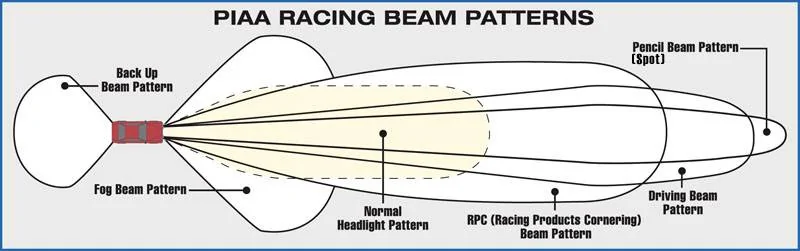
As far a the intended range of a fog vs. driving vs. pencil beam lights, the below illustration does a good job of showing them compared to factory headlight beam patterns.
Jeep Gladiator Amber/yellow for the fog PIAA_Beam_Patterns_th


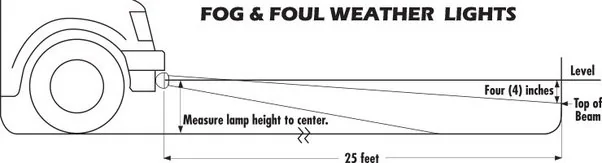
And this next image shows the proper aiming & alignment of a fog light in relation to the center of the light & the ground surface.
The intended range of the fog pattern hitting the ground is very short, and only around 25-30 ft at the most ahead of the front bumper.
Jeep Gladiator Amber/yellow for the fog main-qimg-eca9f87f3dacc15b28319554f1101202-c


Hope some of this might be helpful.

Dave
 
OP
OP
bd100

bd100

Well-Known Member
Joined
May 31, 2022
Threads
28
Messages
757
Reaction score
744
Location
USA Midwest
Vehicle(s)
JT, WK2, ole' Ram
Some of these statements are kind of contradictory:

If the top of the fog beam is only 4 inches below the bulb at 25 feet, instead of hitting the ground at 25 feet, then the top of the beam will continue on for quite a distance. I'm getting a few car lengths with this setting.

"In clear conditions, though it makes us feel (falsely) more secure, more foreground light is not a good thing, it's a bad thing." "Fog lights are to light the area immediately ahead of you at lower speed, nothing more." And yet everyone's getting brighter fog lights.

Anyhow, my halogen fogs are aimed lower than the headlights, so all seems good.
Sponsored


Top