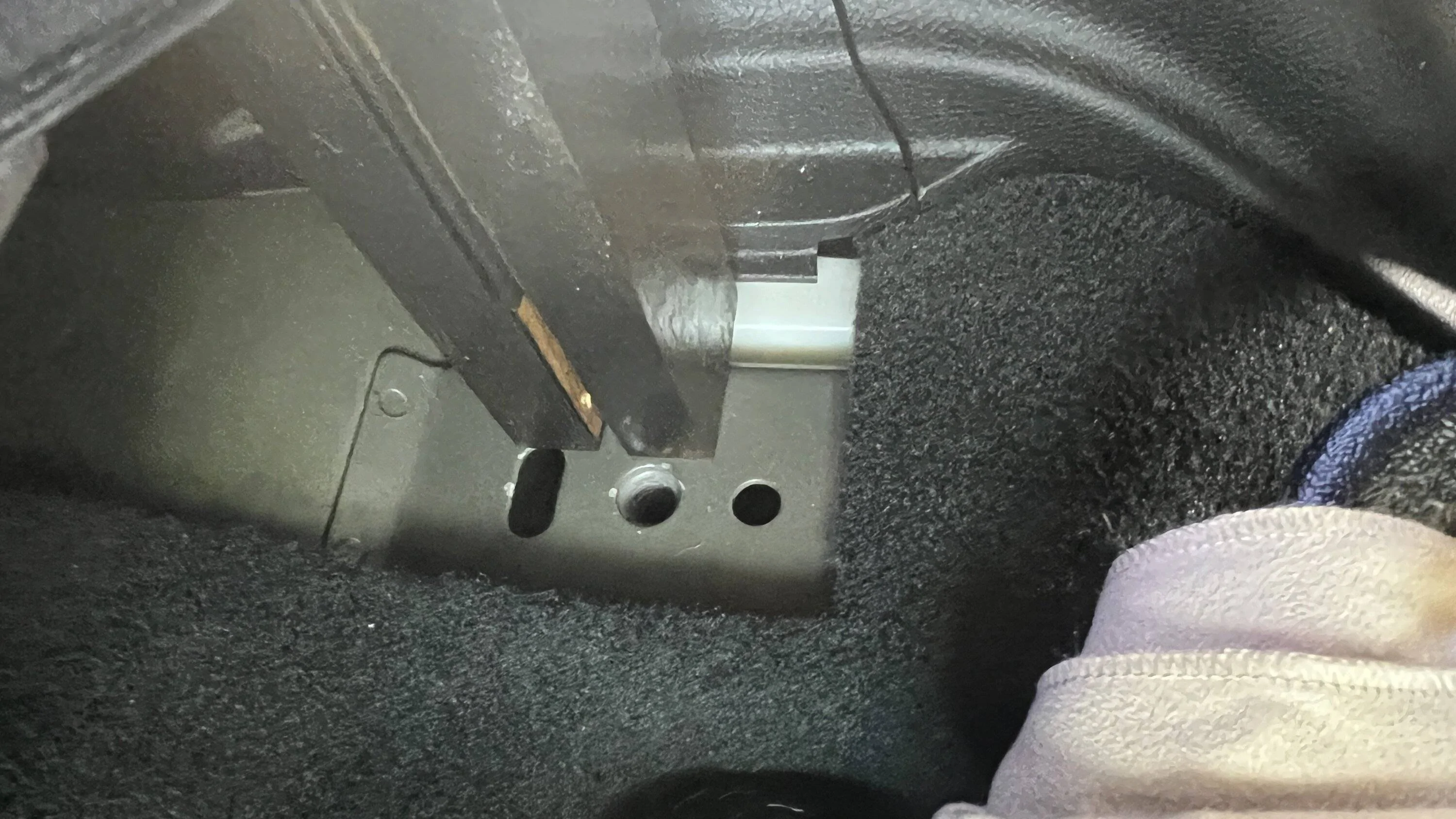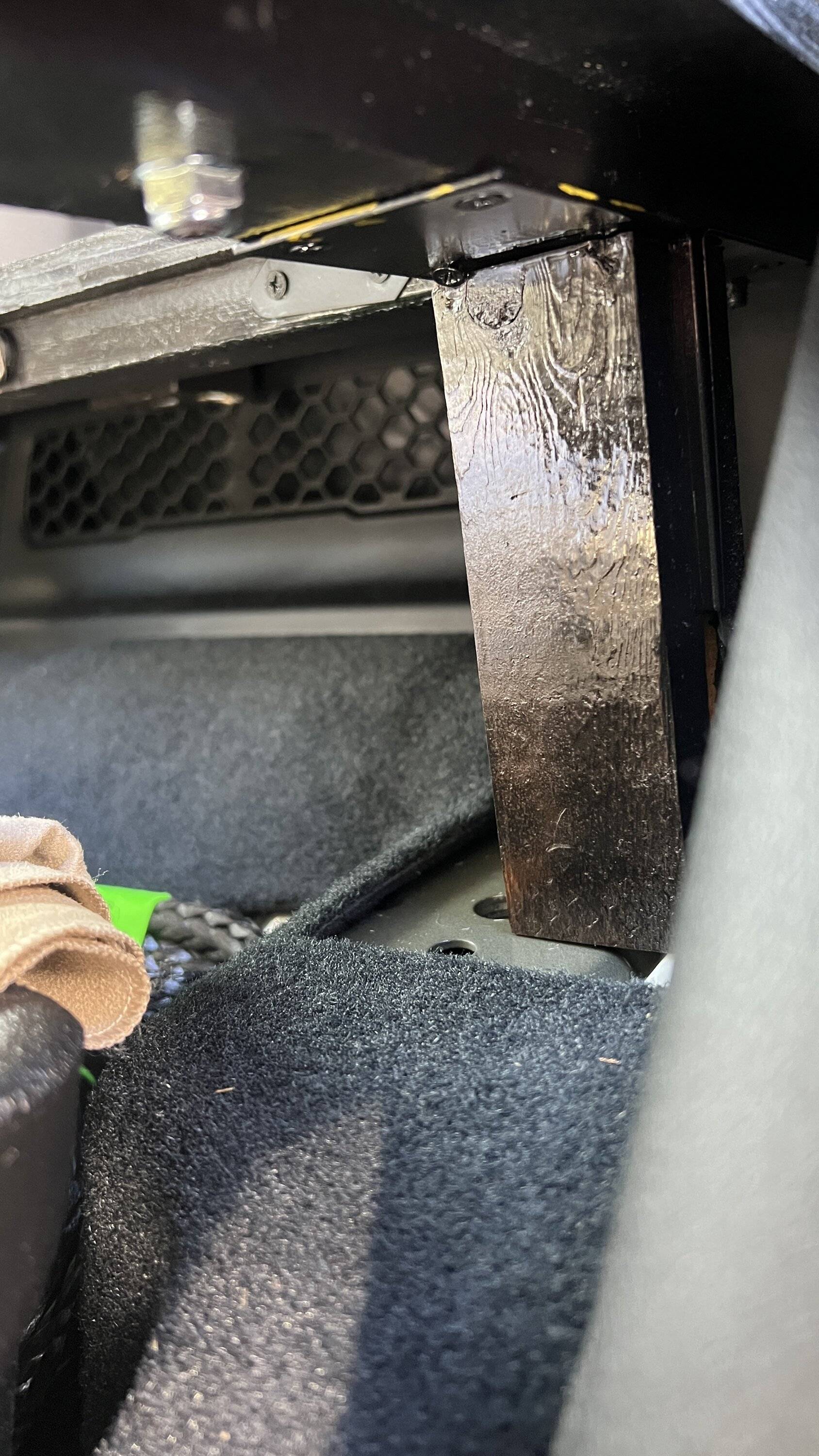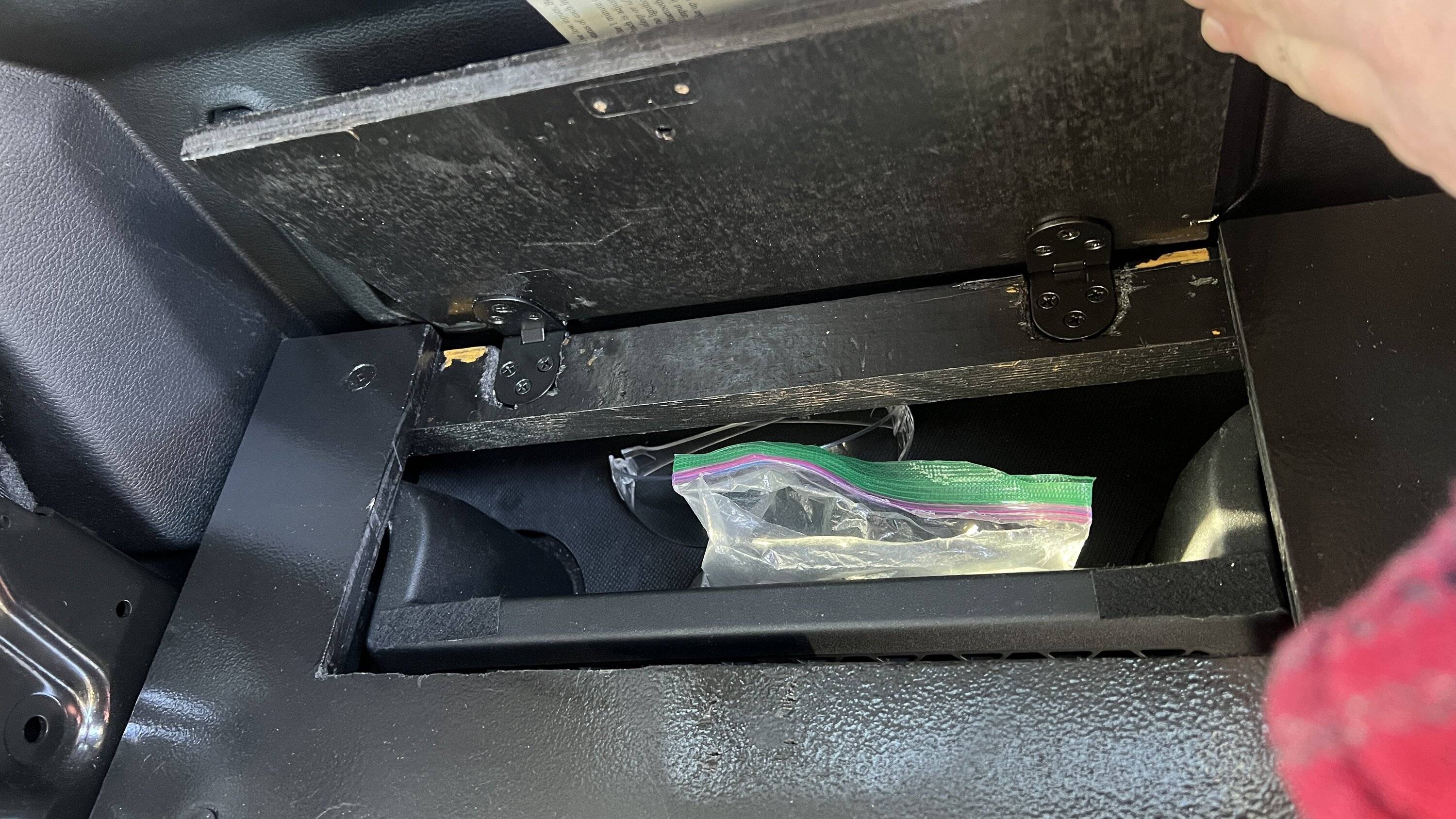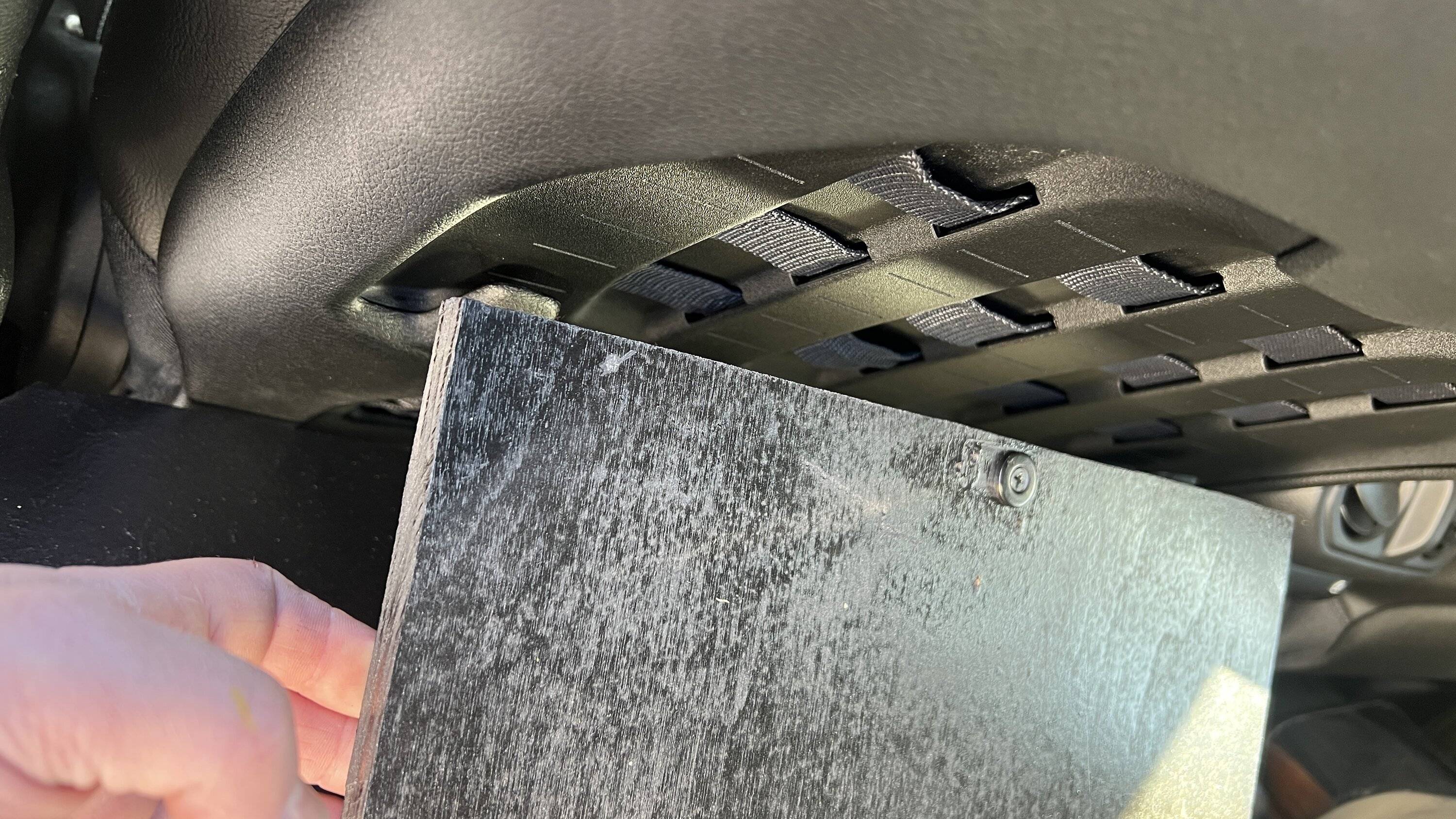

Sponsored

NeatFreq

Well-Known Member
Joined
Jan 8, 2023
Threads
6
Messages
146
Reaction score
300
Location
Lexington, South Carolina
Vehicle(s)
2021 Jeep Gladiator Sport Max Tow
Occupation
Writer, Sole Proprietor, Marketing Lead, Quality Assurance.
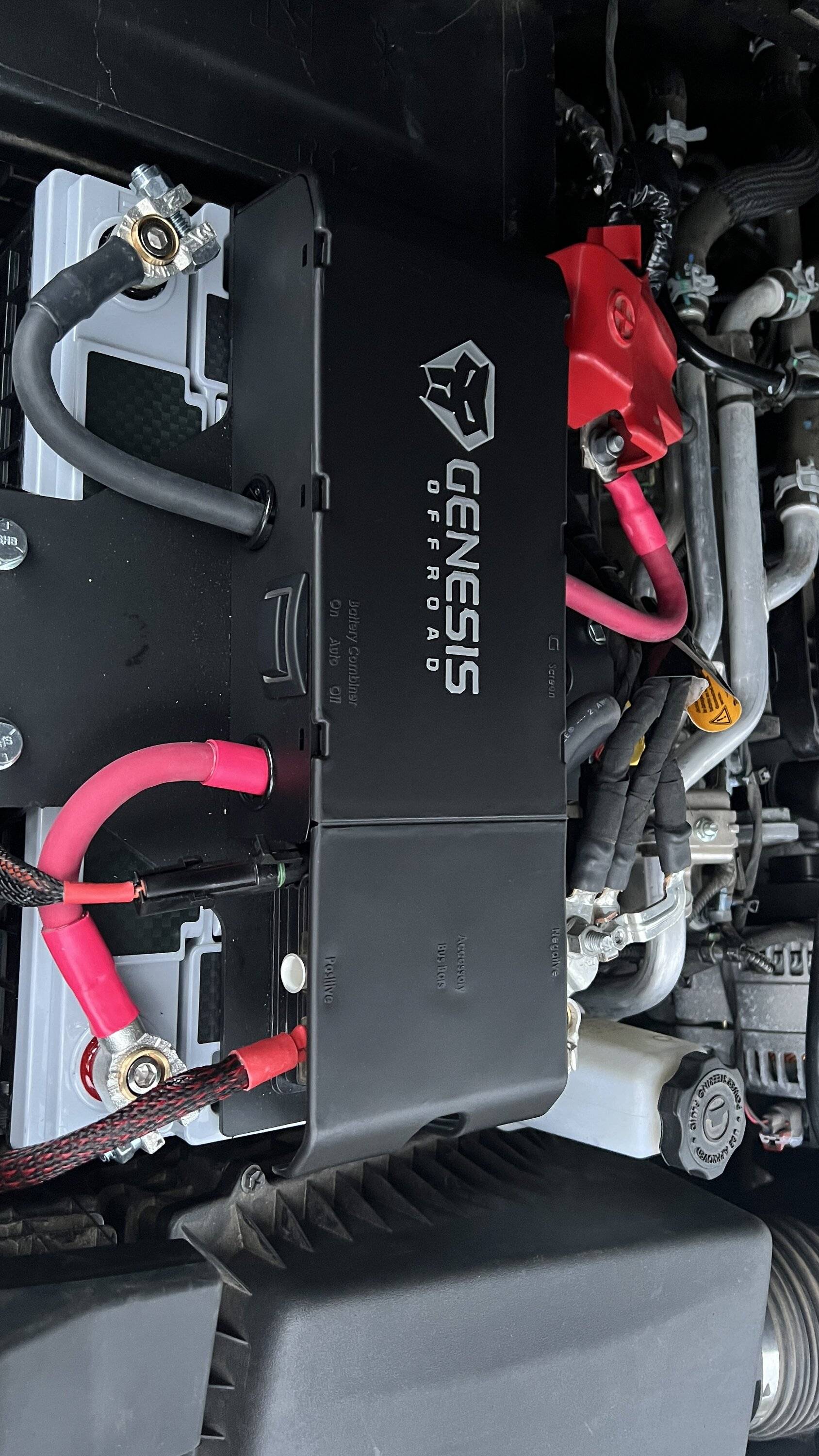
Today the G-Screen went on. As with most things it took twice as long as planned even though I planned for twice as long as expected - so I suppose that makes 4 times as long as expected.

Anyway - the most difficult part is the part I did not take pics of as it was getting dark out. Cutting parts of plastic trim.

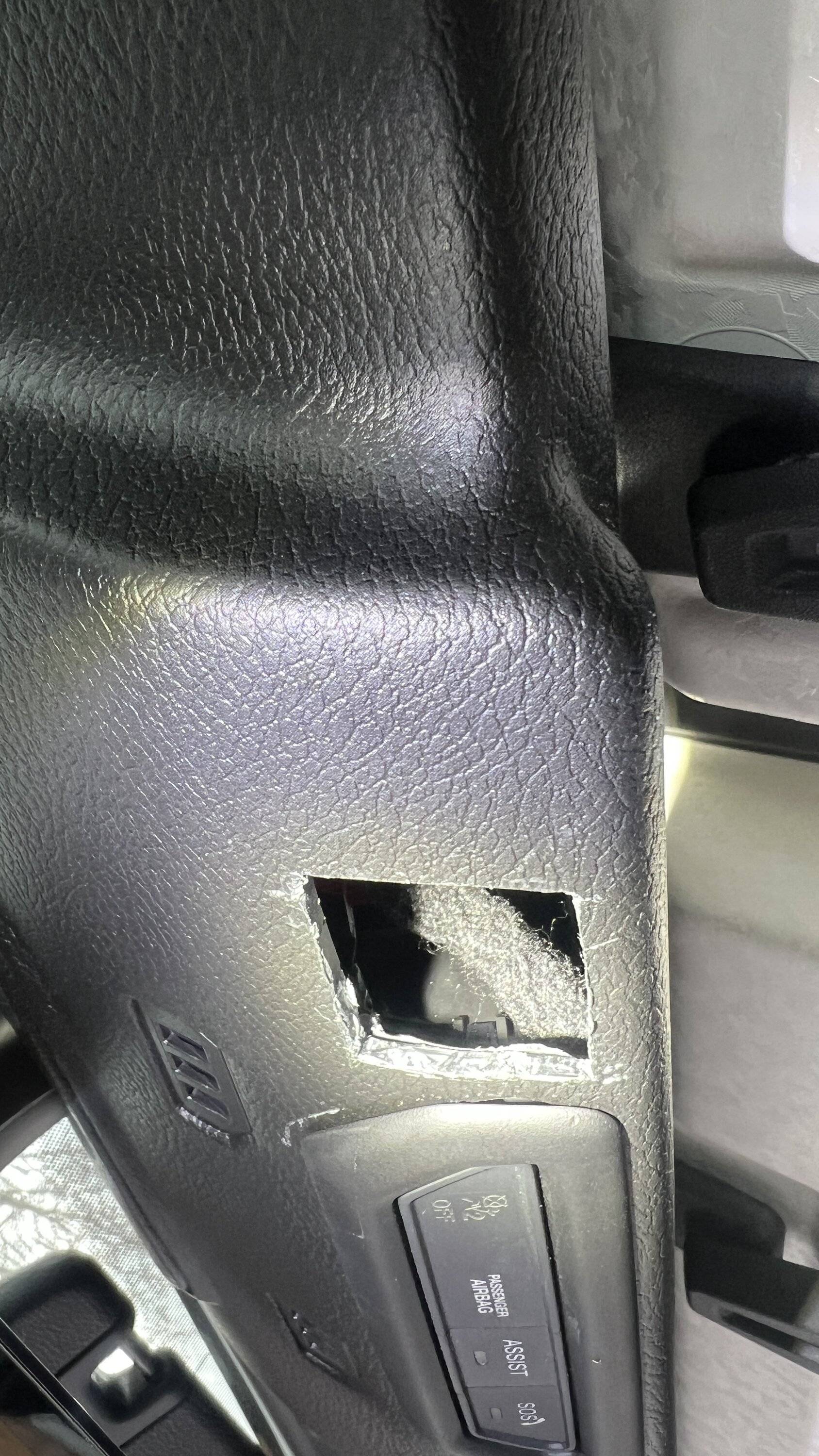
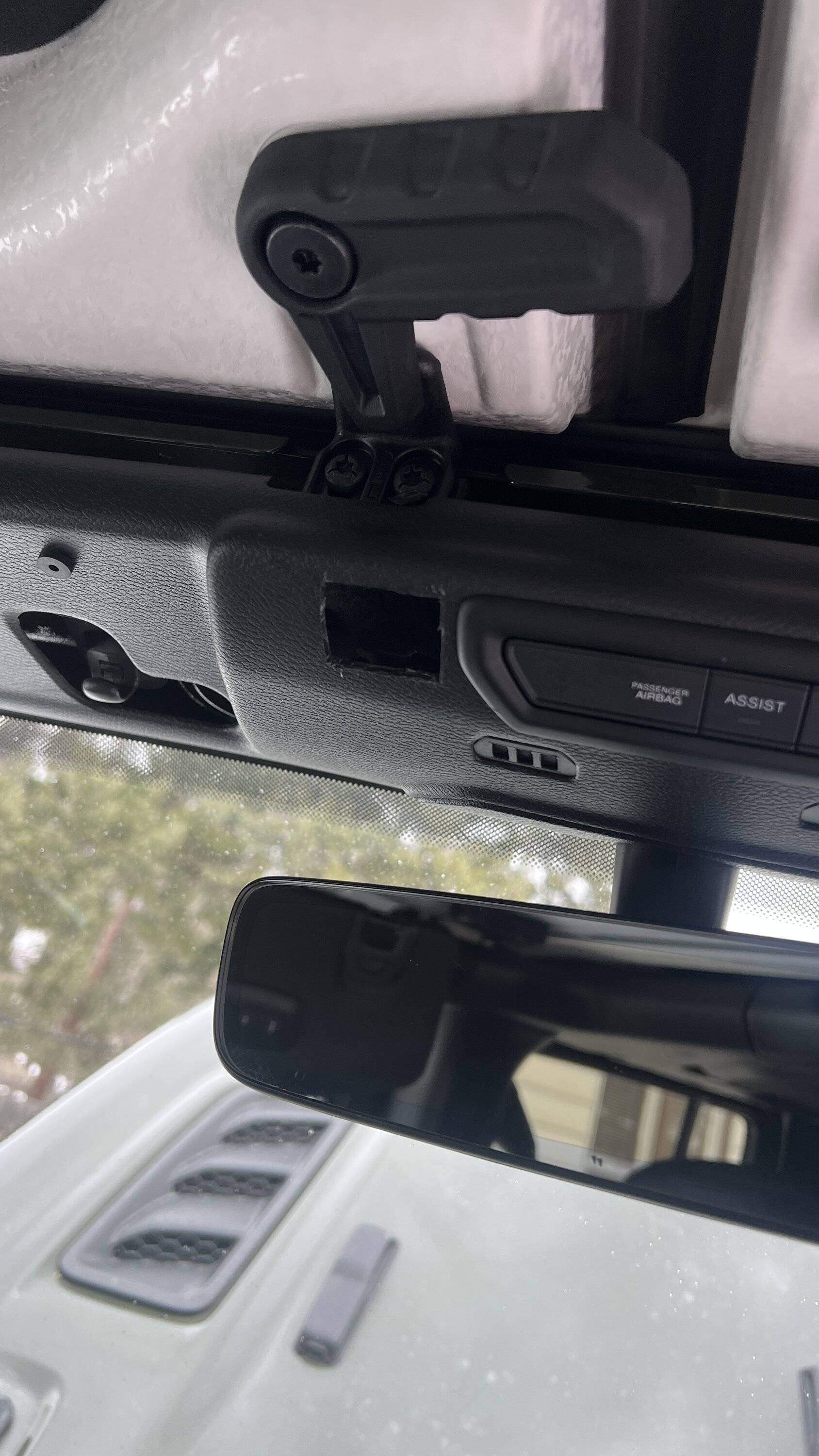
I chose to install the G-Screen in the same location as the Genesis video. Mostly because it really offers, I think, the best viewable location. And it's out of the way. The dash is cluttered enough and there really isn't a very good location there. So, preparations were made and I scored the portion that needed to be removed - reluctantly. I suppose a patch could be made later if needed. This part took quite some time. Probably an hour to be exact. I used multiple scores with a razor blade over and over again which was time consuming and slow due to taking caution to not cause any deep gashes in visible areas. I could have used a little die grinder, but in past experiences, that often leaves plastic melted and not looking so great.

IMG_9917.JPG


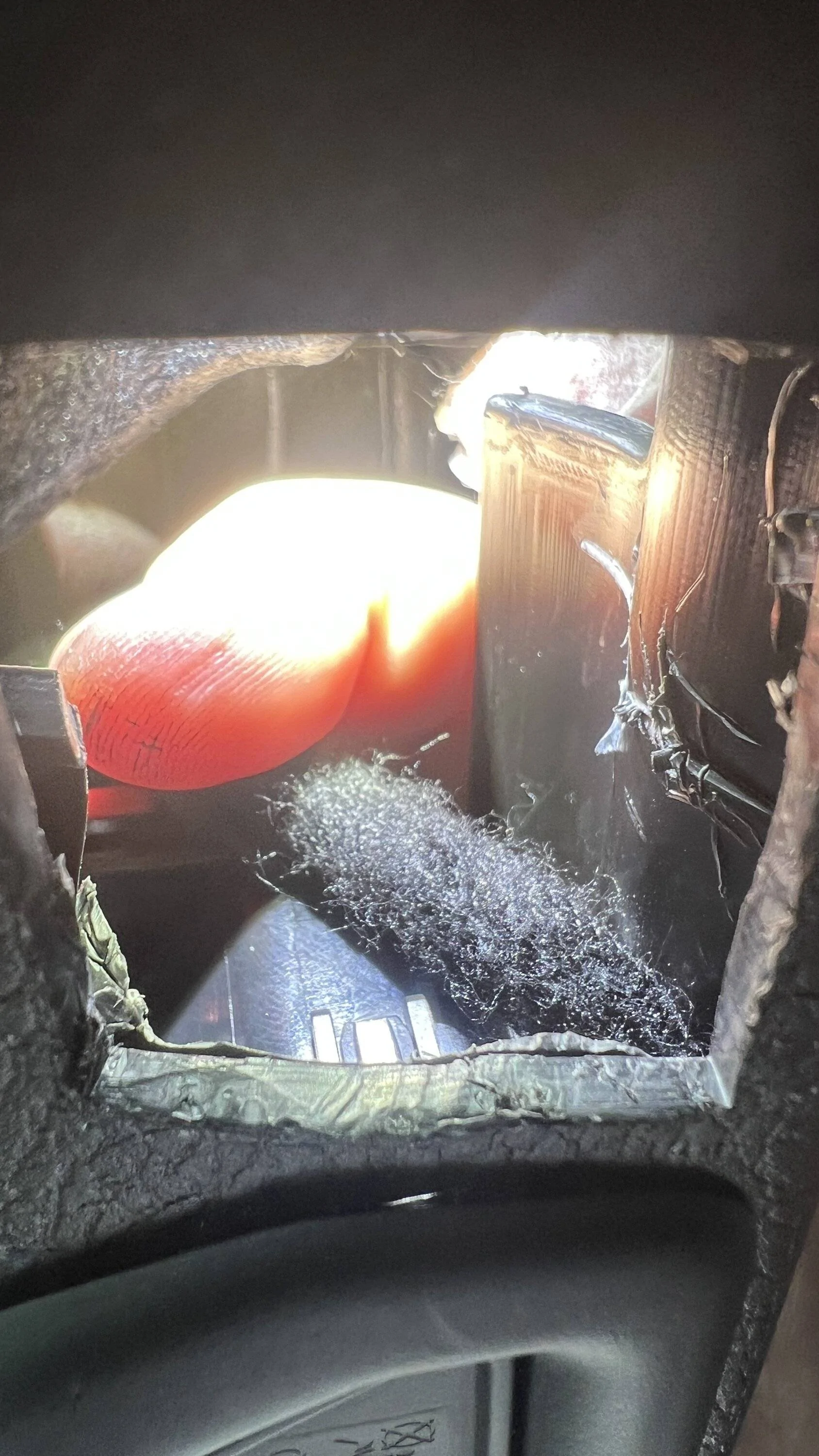
I did cut a little too far to the passenger side, making it a tight squeeze for the wiring harness. As you can see, there are also wires there that I didn't realize were so close - thankfully I didn't knick any of them!
IMG_9919.JPG

IMG_9920.JPG


Obviously I did make a couple of oopses....but from a normal sitting position, you have to be OCD like me to really know its there. The most challenging part I failed to get pics of. Finding a place to put the control box. It's not very big. Maybe 1.5" by 2.5" by 0.75". But there is hardly any space up there as it is. I had to, reluctant cringe, cut more.... There just wasn't a long enough ribbon wire to put the control box further off to the side. So it is basically right behind the SOS button. Unfortunately, even with a bunch of plastic back there cut and out of the way, it still bows out. But since it is in the middle, it is not super obvious, and again, unless you have OCD like myself, the average person would likely have NO clue. But, I did have to cut 1 retaining clip, and a bunch of 'structural' plastic. I have some worries that it might rattle and make noise now - for which if it does I will have to open it back up and put some felt tape in place.

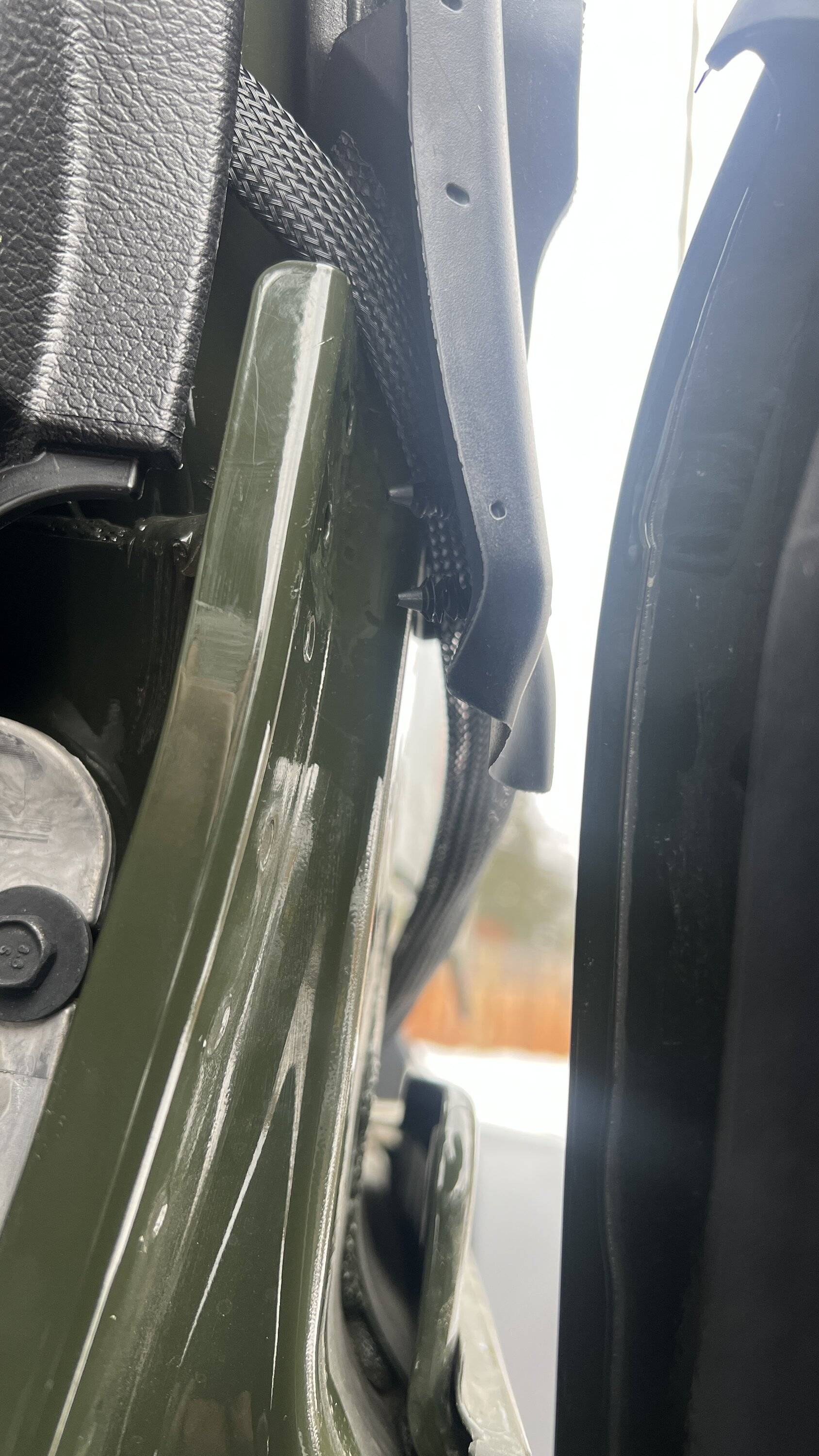
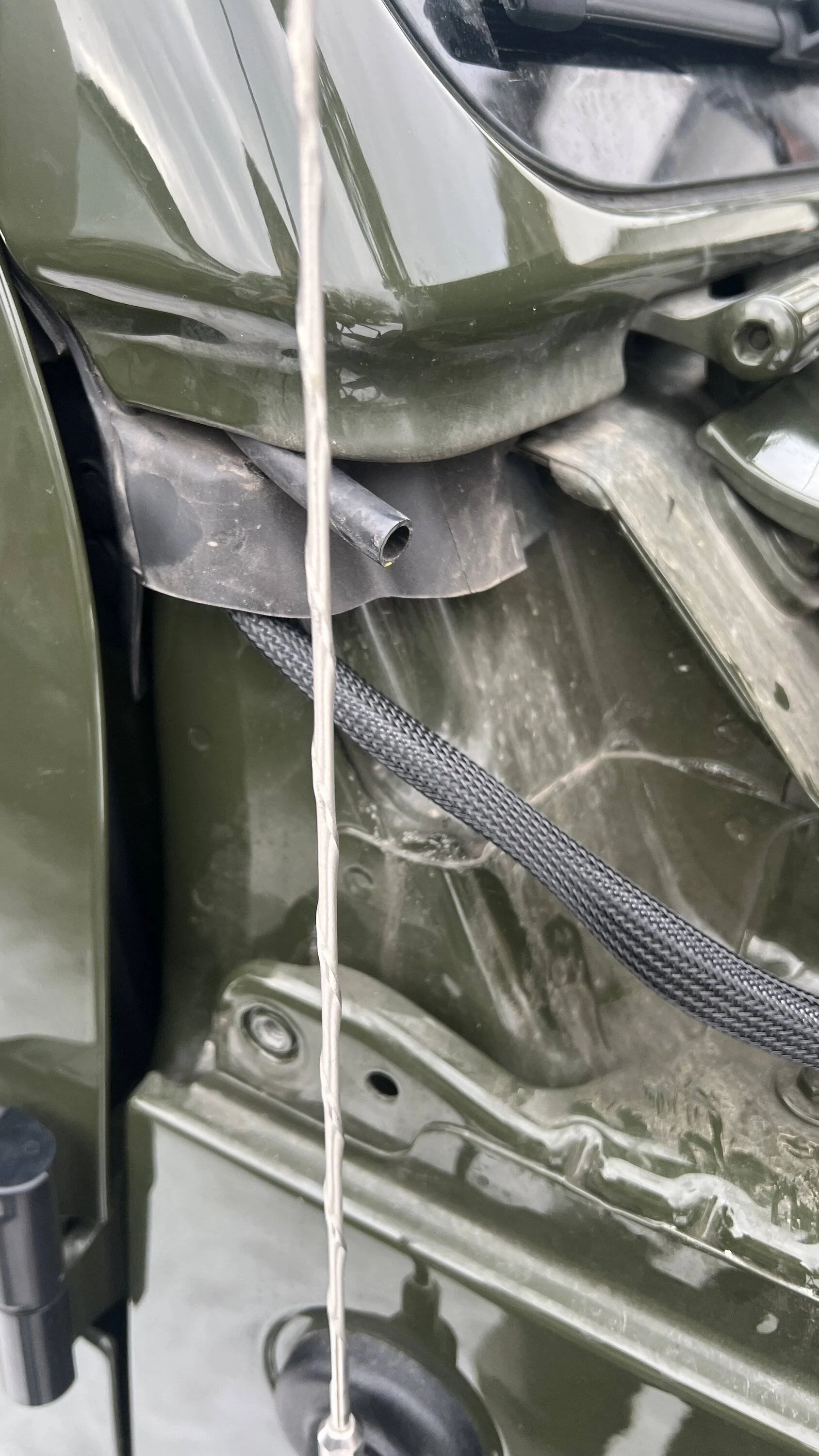
The rest of the wiring was fairly simple. I ran the data cable the same way as the GMRS on the drivers side - only on the passenger side. Hopefully there will be enough room for the CB coax as well. This was the easiest method and I couldn't find a firewall grommet when the battery box was taken out. I actually prefer this method as future repairs/replacement is much easier. The drivers side grommet that most use is not available as it already has wires going through it for the switch pro system, the 12v engine on signal from under the glove box, and power/ground wires for future additional in cab dome lights. The cable relatively easily passes under the weather seal.
IMG_9923.JPG

IMG_9924.JPG


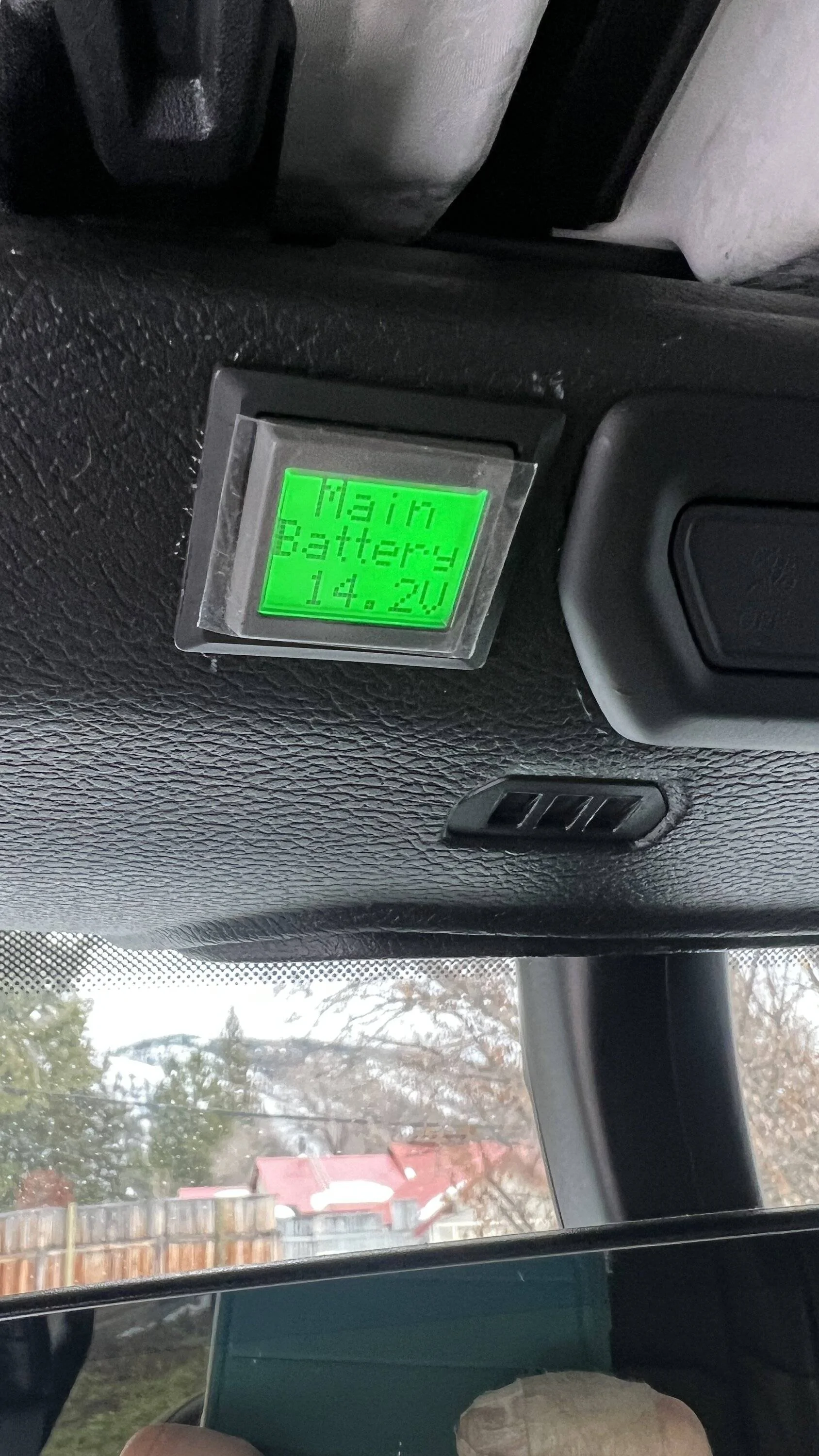
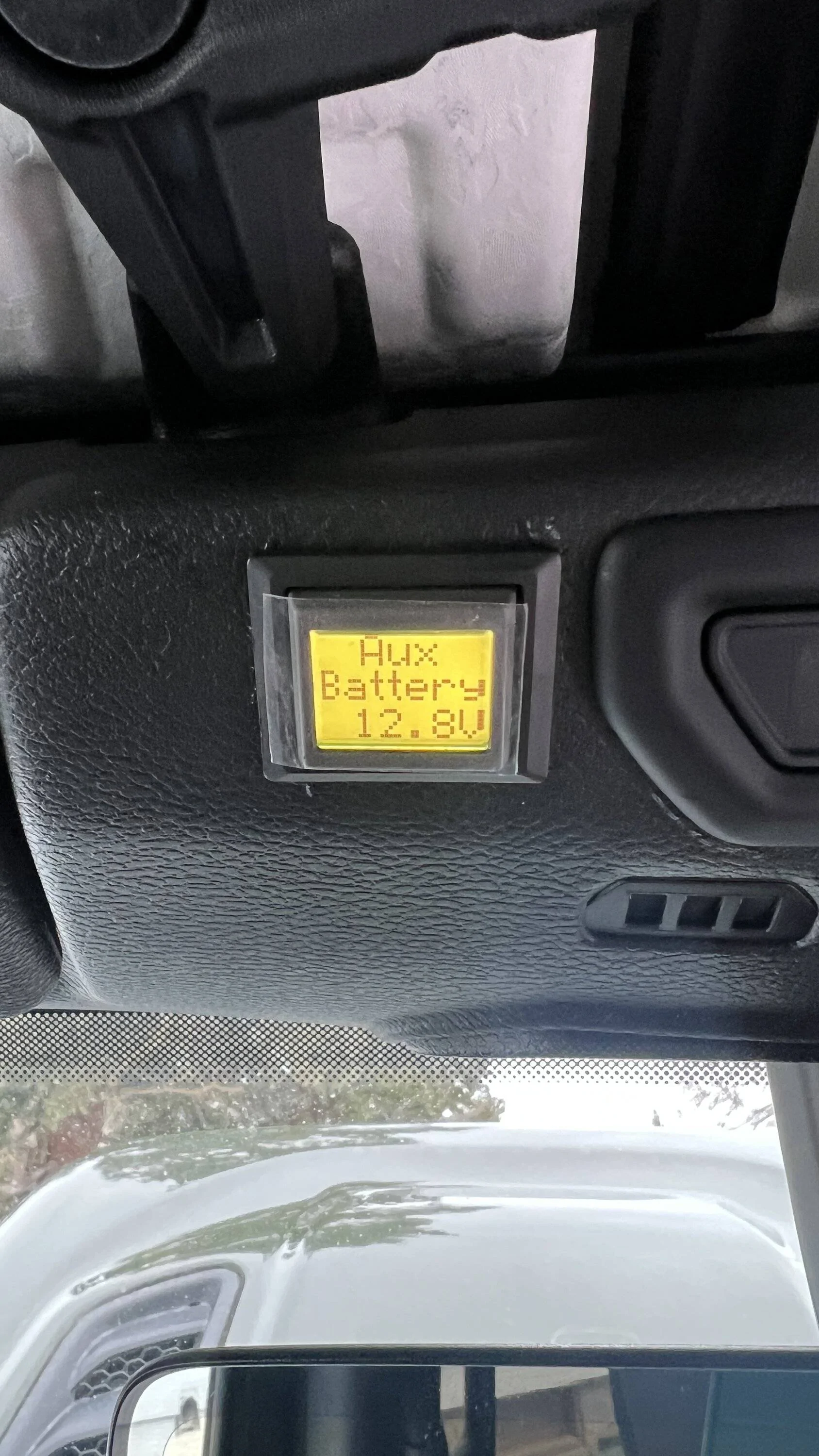
The rest of the cable simply routes to the Genesis system and plugs in with a weatherproof twist lock connector. The screen is pretty sweet. It's easy to see battery voltages of each battery, turn the auto connecting combiner on or off, or 'boost' mode which just forces the batteries to be combined no matter the voltages.
IMG_9926.JPG

IMG_9922.JPG


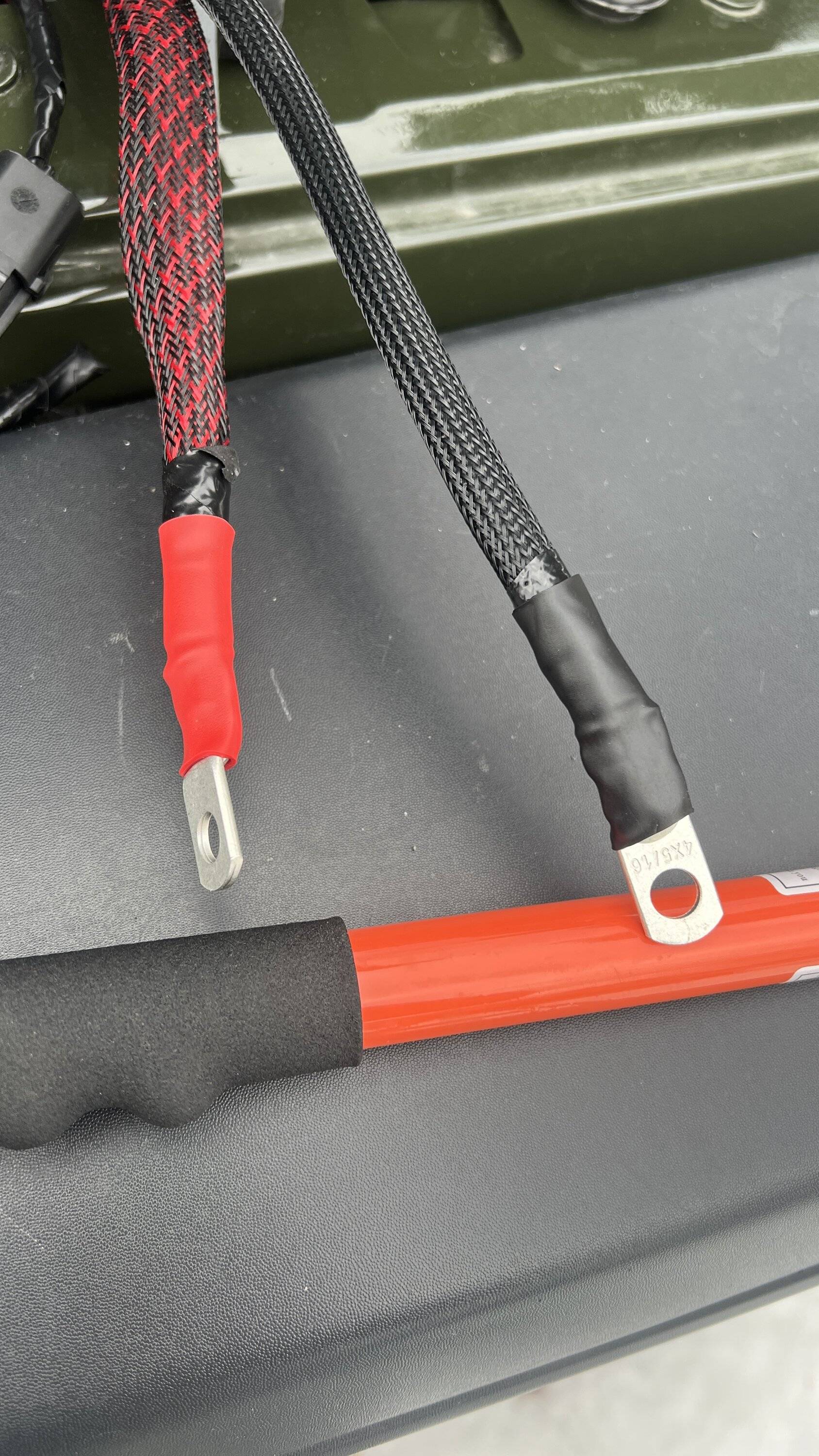
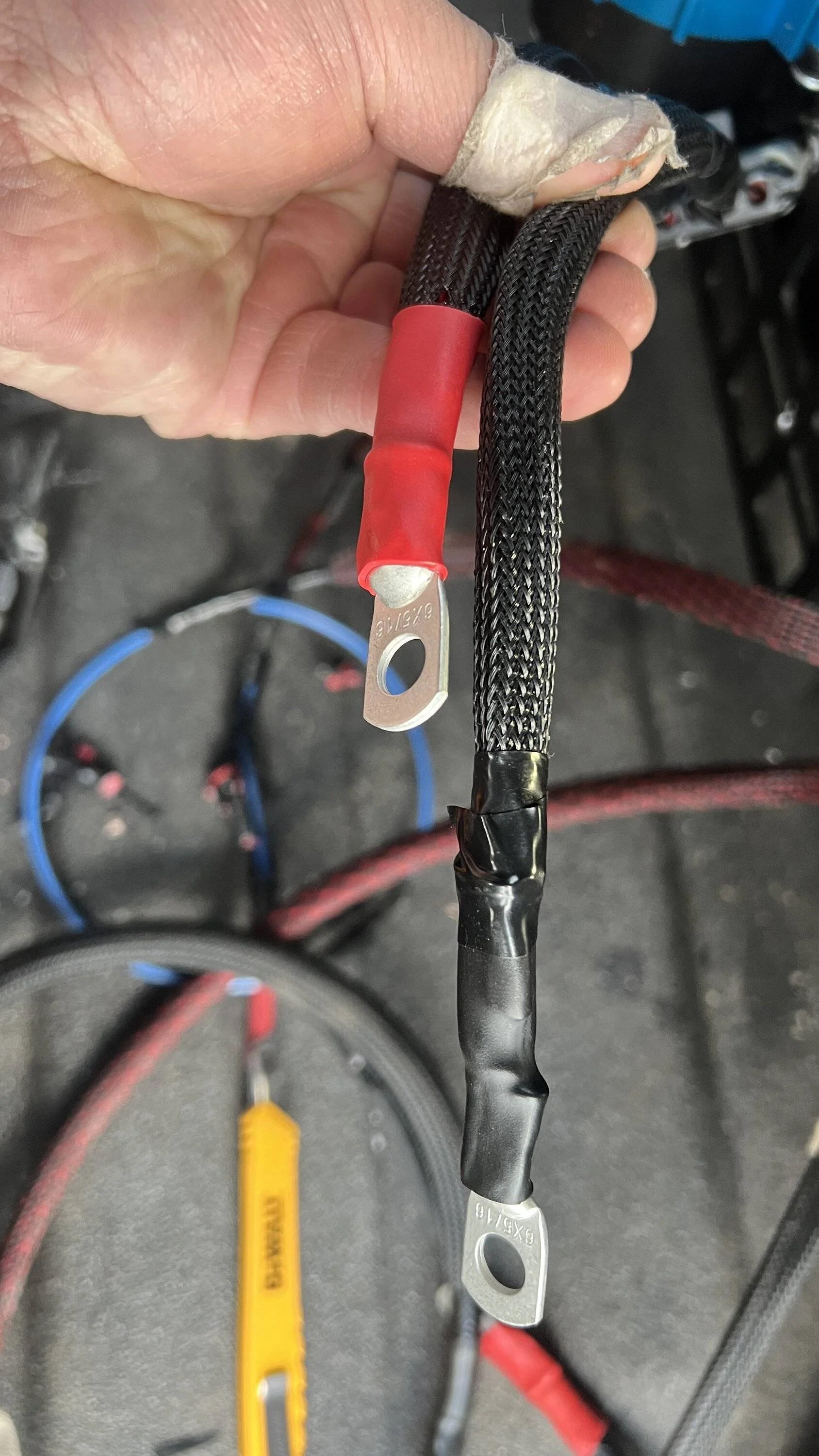
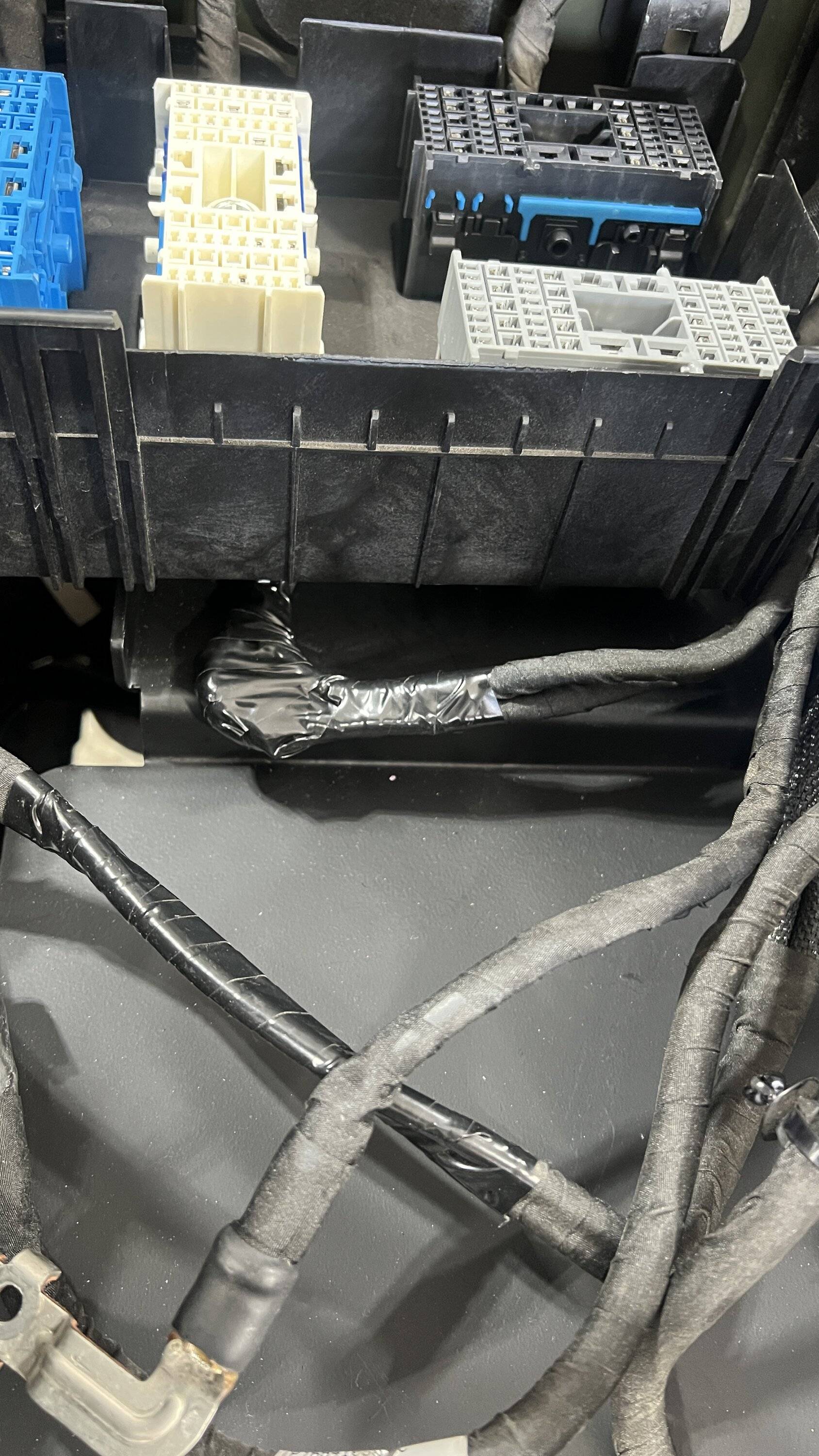
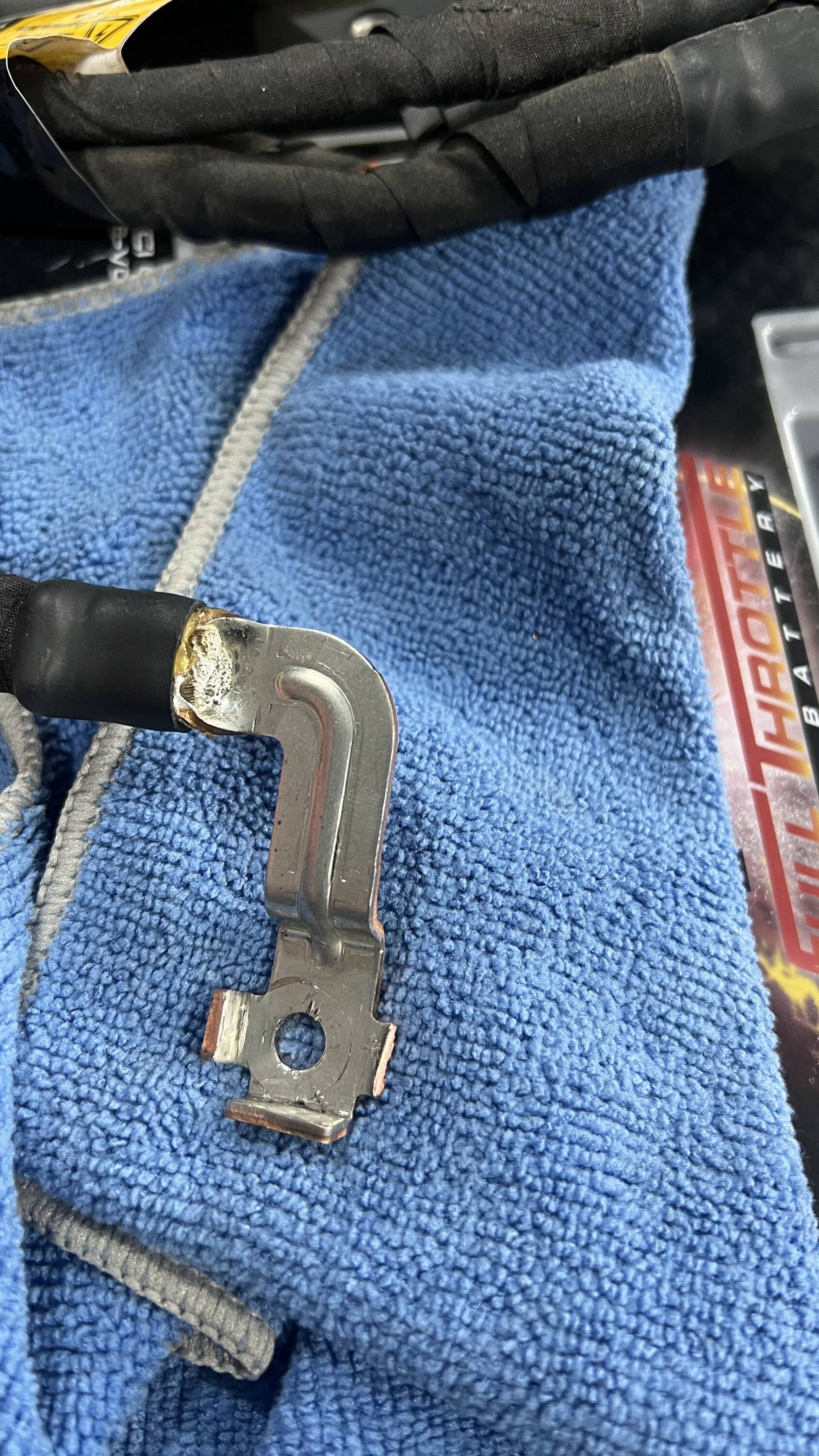
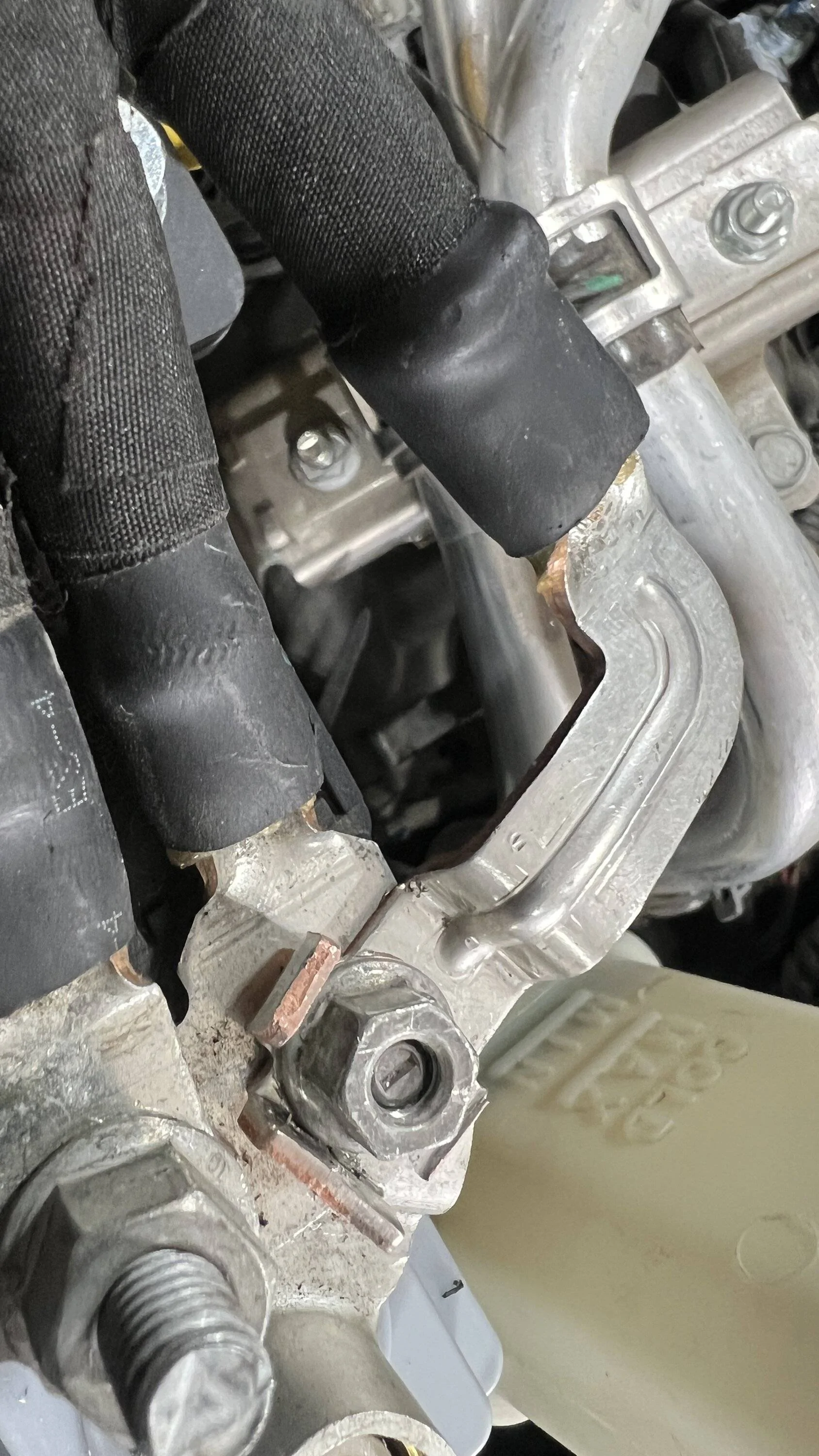
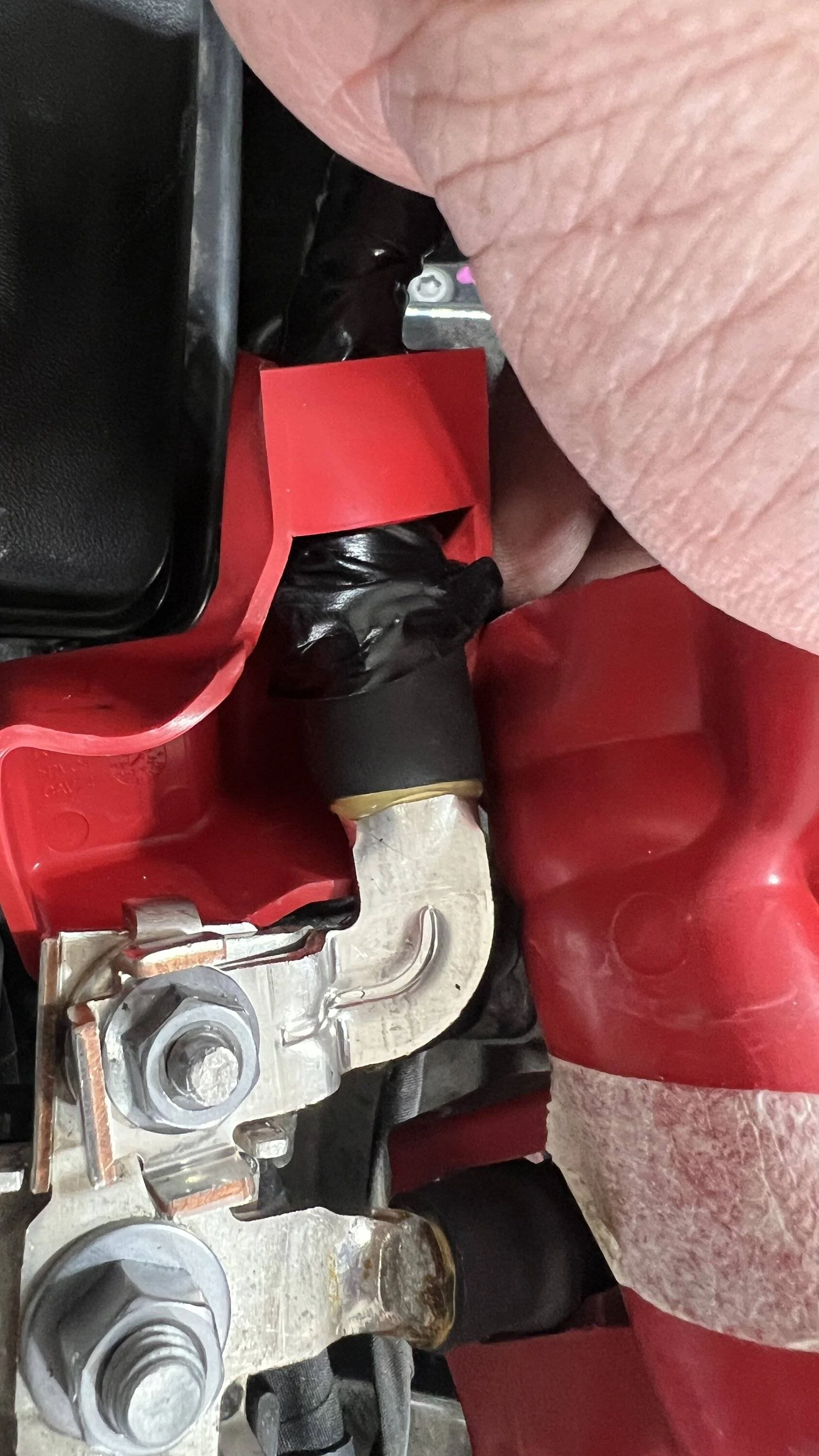
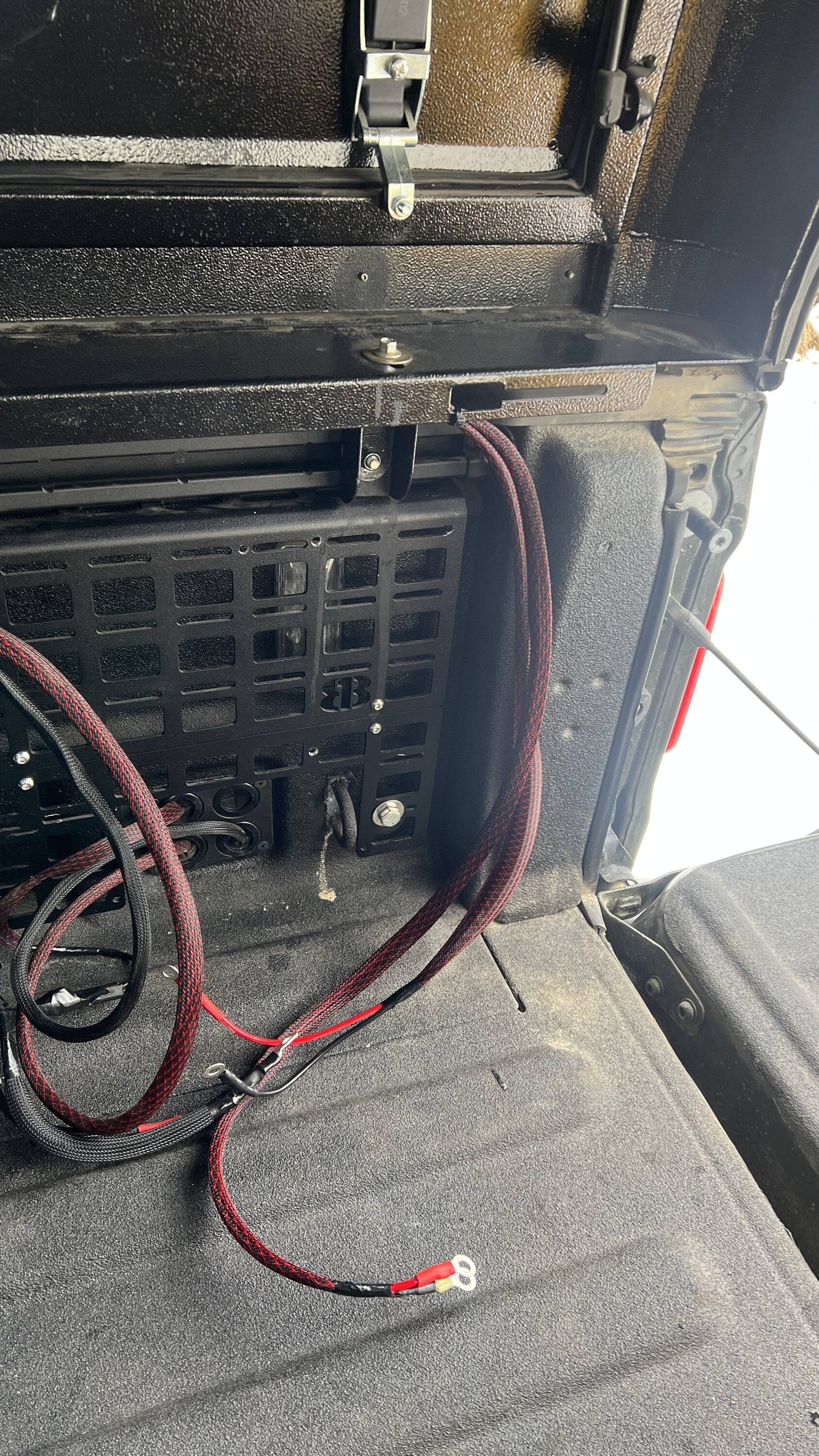
I also took advantage of being under the hood to clean up my mistake from Friday and find a decent place to store the factory aux negative battery cable. And, put some lugs on the 4ga wires going to the bed as well as put new lugs and electrical connector on the ARB in preparation of hooking it back up.
IMG_9925.JPG

IMG_9927.JPG
Well yesterday was a fun, monumental, and frustrating day in one.

It was the day of installing the Genesis dual battery kit - but...with problems.

So before anyone says how much I dont need it - the primary reason for me doing this kit was not actually to have a aux battery for camping. That is just a side benefit that works for me being in such a cold environment where an always on board lithium would not last. But the primary reason for me to install this system is to get rid of the factory aux battery, and have nice lugs to attach accessories to. After seeing how many people are having troubles with their aux batteries, and the difficulty it is to replace them - I wanted something significantly easier to replace if needed. The Genesis provides that for me.

And it's a good thing because testing the factory battery and aux battery after removal revealed the larger system battery was sitting at 12.5v and the aux was already at 12.3v. Granted I dont drive a ton to commute, and it has been sitting a lot lately, in the cold, but at less than a year old this is what I was worried about with the factory system.

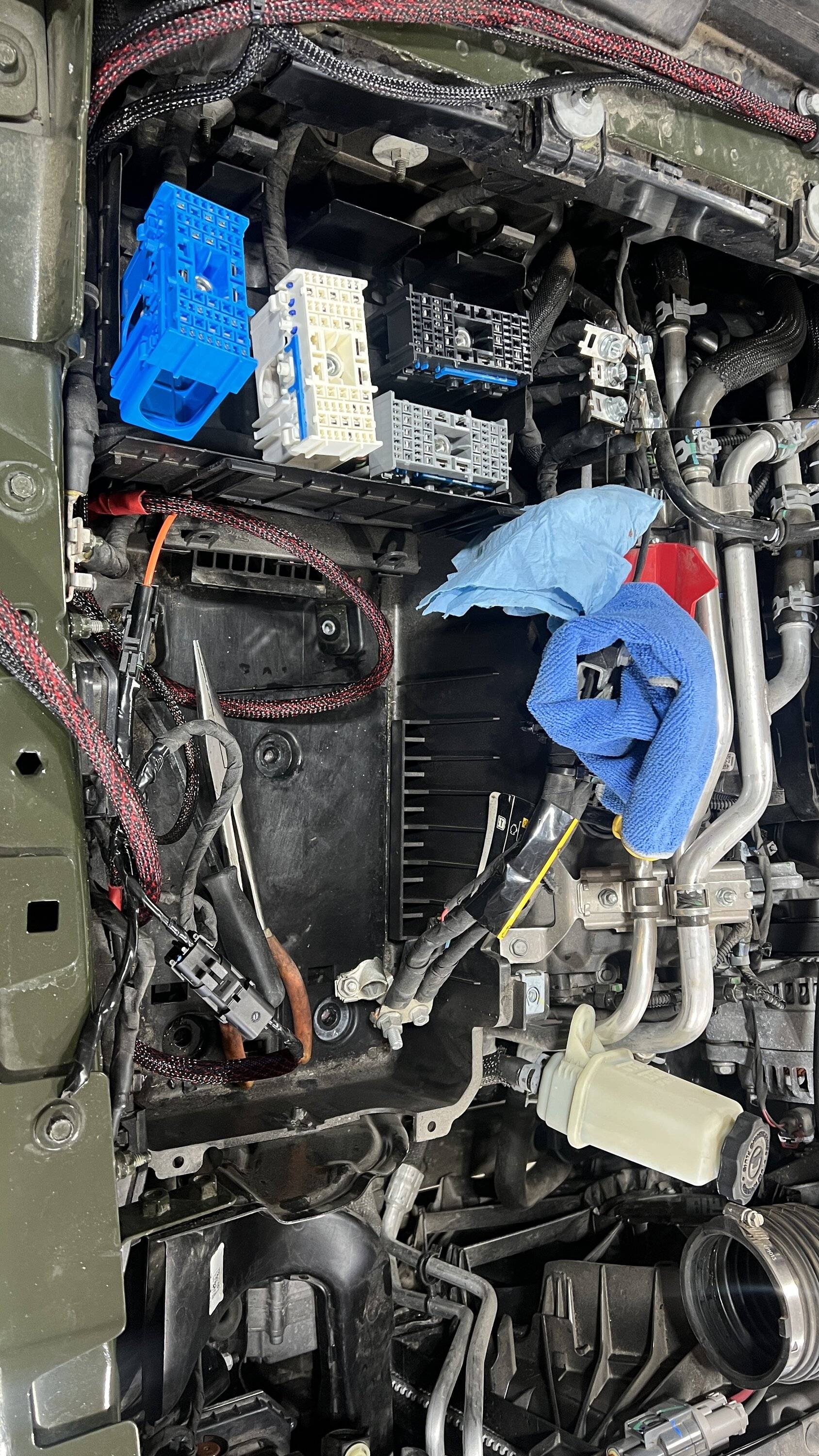
Removing the factory batteries and tray was relatively uneventful. Although I took careful note to keep in mind where everything is and went as I did not want to have issues reinstalling - well... I did anyway. Being careful, using hand tools, and chit-chatting with a friend who is letting me use his garage, the removal took nearly 4 hours. I can't imagine having to do this every single time to replace the factory aux battery - thats insanity.

Oh and I also saw this - looks like the factory way overtightened the hold down bracket. I have not touched the battery components since purchase.
IMG_9896.JPG


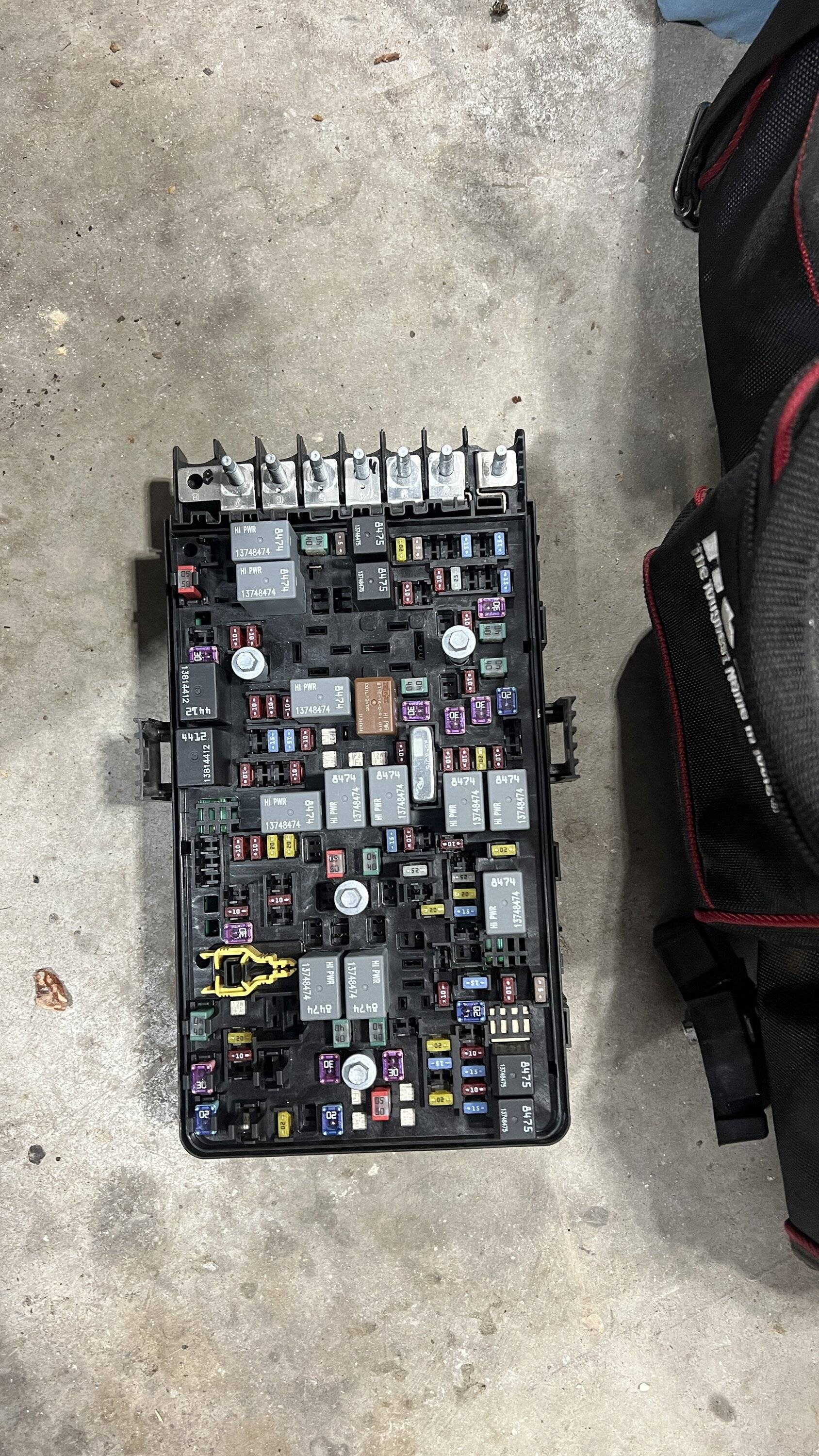
You can see that post 4 and 8 are unused in mine. I would assume #4 has something to do with the rear bed inverter and I dont have one, just the in cab version. I labeled all the posts just to make it easier
IMG_9897.JPG


Being sure to protect the positive wires as much as possible - I wasn't sure if any of the others were also hot but based on other videos I have seen they seem to not be.
IMG_9898.JPG


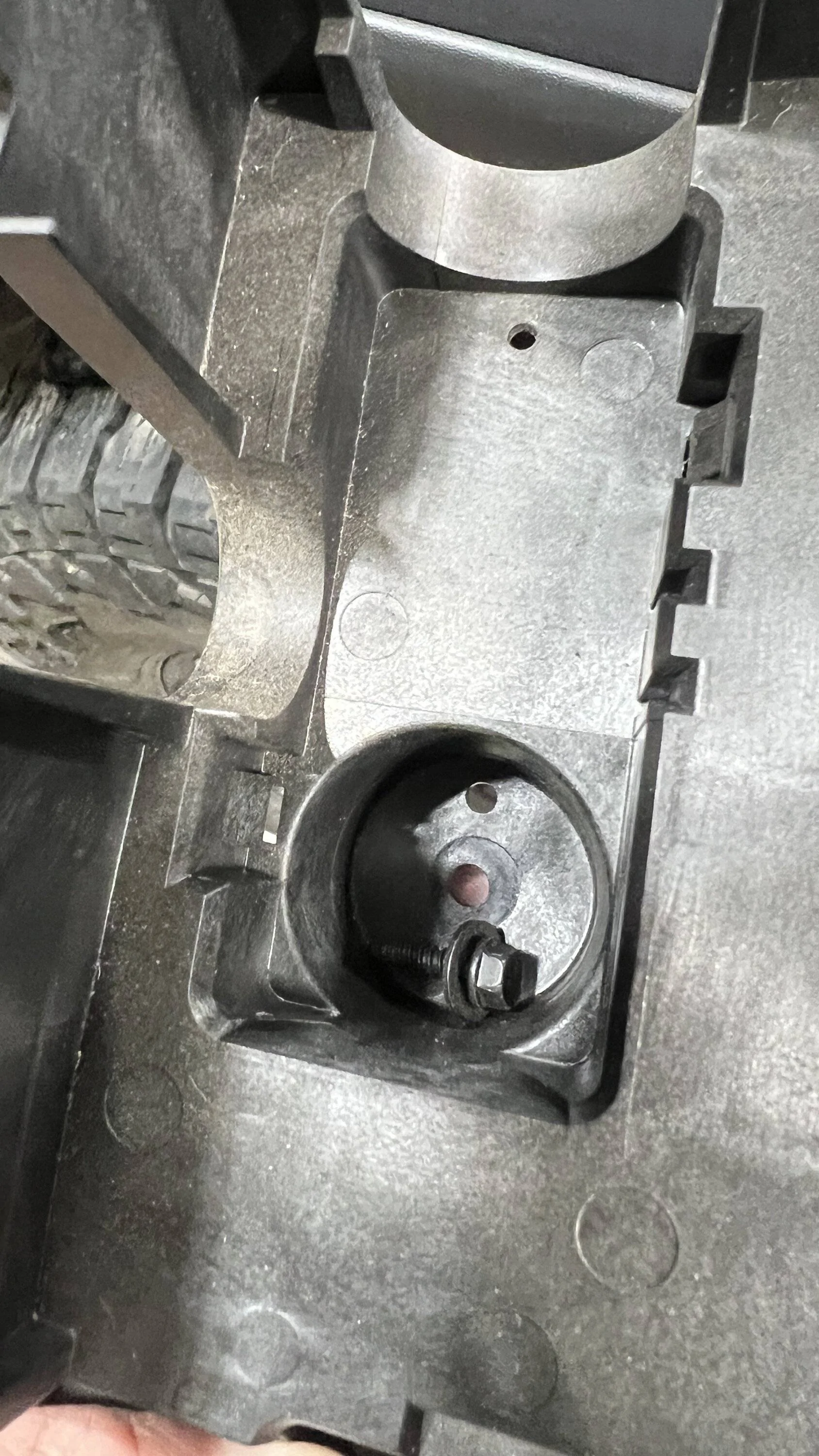
There was another change sometime half way through 2021. The Genesis video shows there to be 2 bolts and 1 Phillips screw under the distribution panel to remove the box. Mine had a little 7mm bolt instead.
IMG_9899.JPG


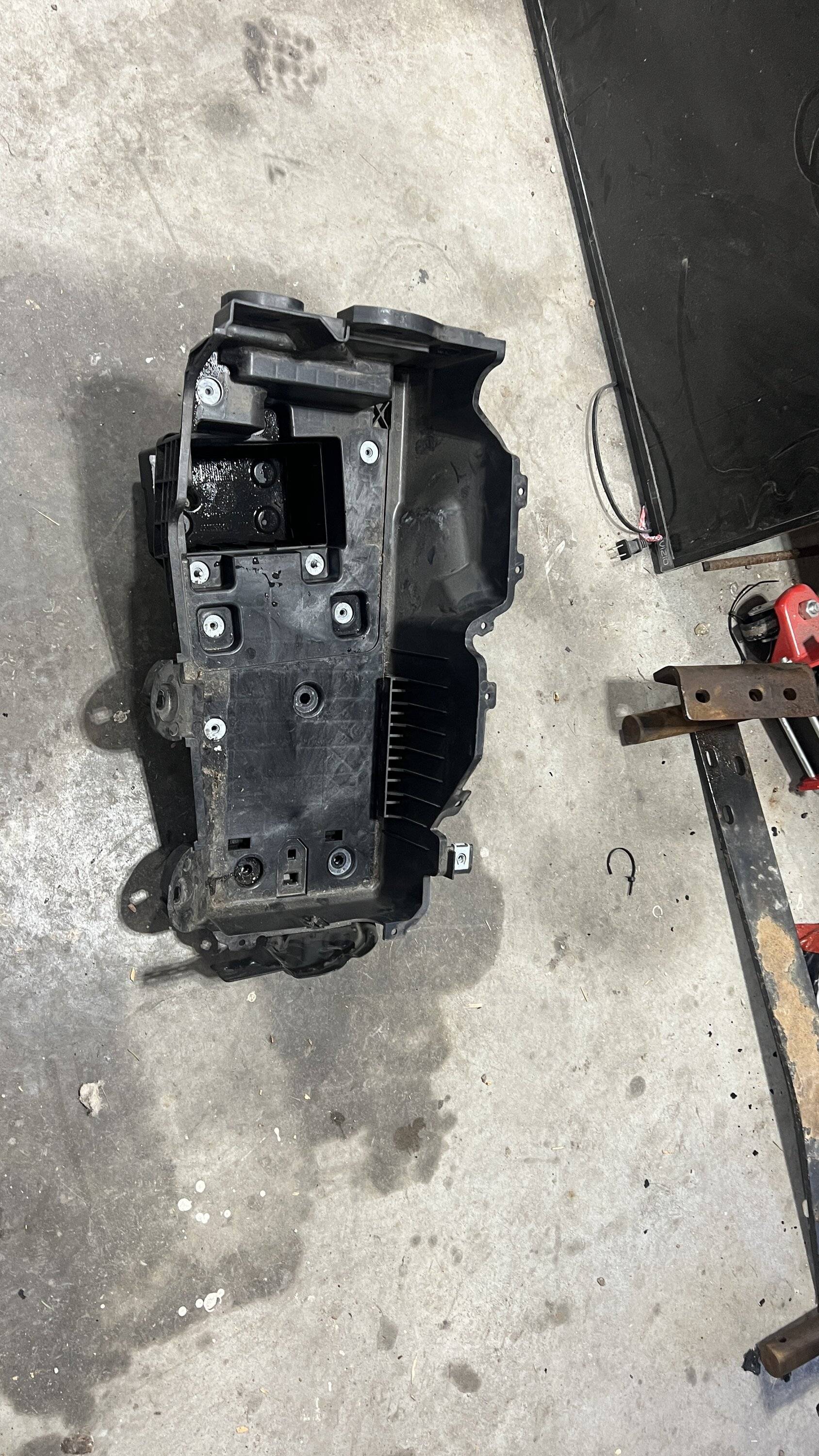
That tray was unnecessarily difficult to remove. It still boggles my mind this was actually considered a valid design. I know there is the method of going through the fender, but still, batteries are known replacement items - terrible design.
IMG_9902.JPG

IMG_9903.JPG


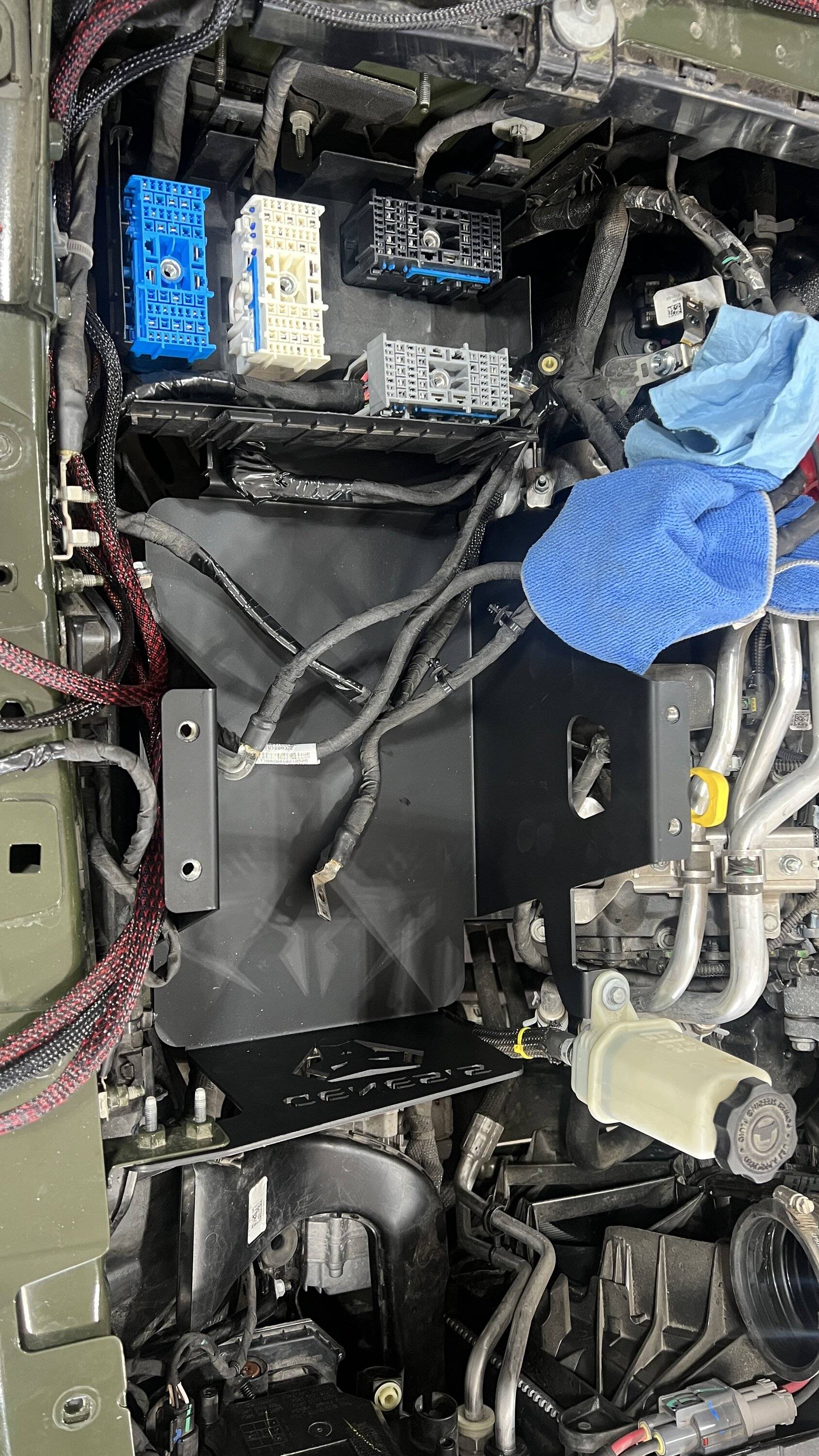
Now is when things take a turn and get interesting. The new tray went in relatively 'ok'. Although it still didn't fit perfectly. There must have been even more changes between 21 and 22. There was a bit of a gap at the front of the tray where it uses the two bolts to secure it next to the air box. I was very surprised to learn that Genesis only designed it to use 4 mounting points. So I have a bunch of leftover bolts. I wish they would have designed it to be more secure. I'm sure it is fine, but it could be better IMO.
IMG_9904.JPG


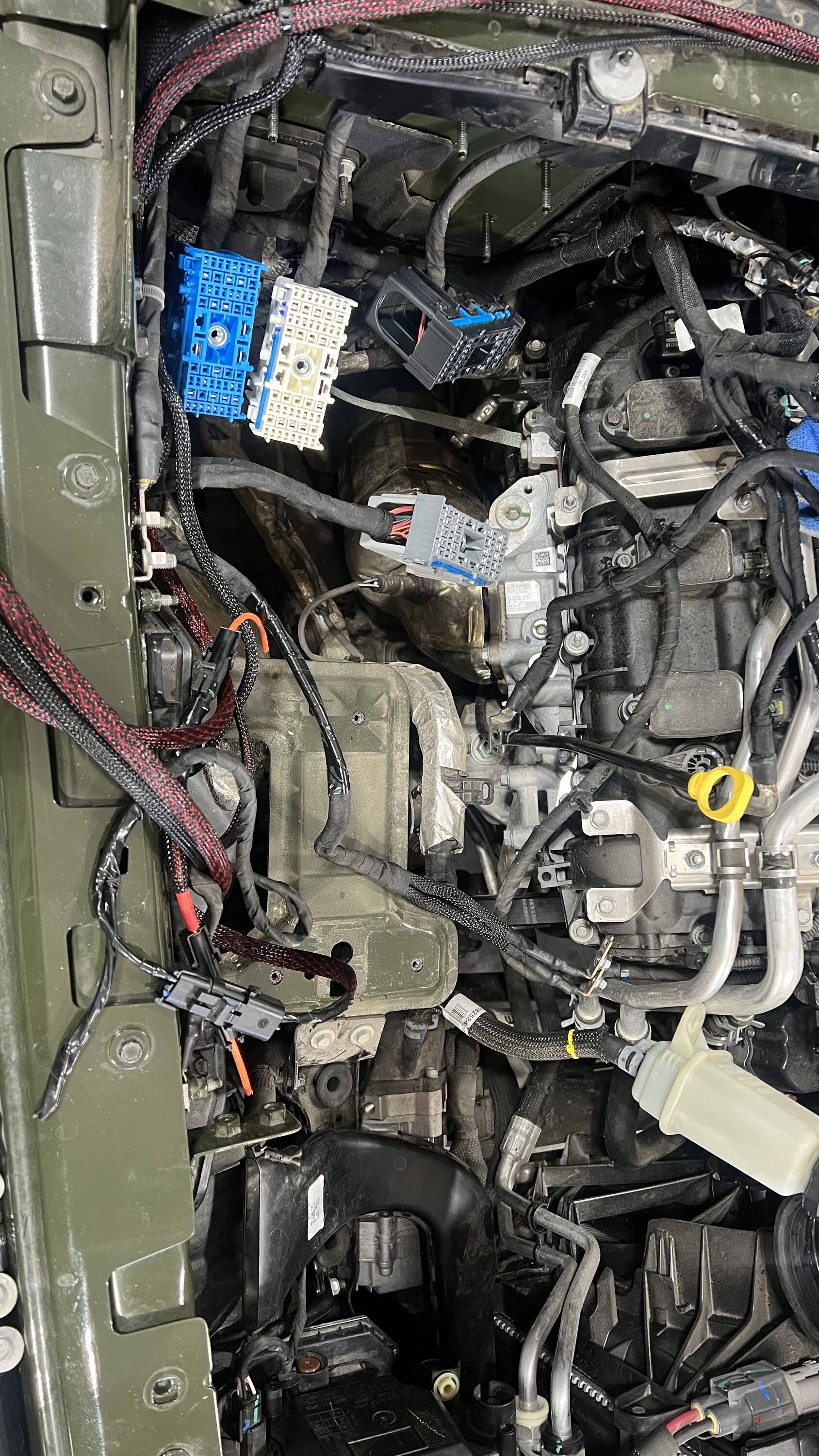
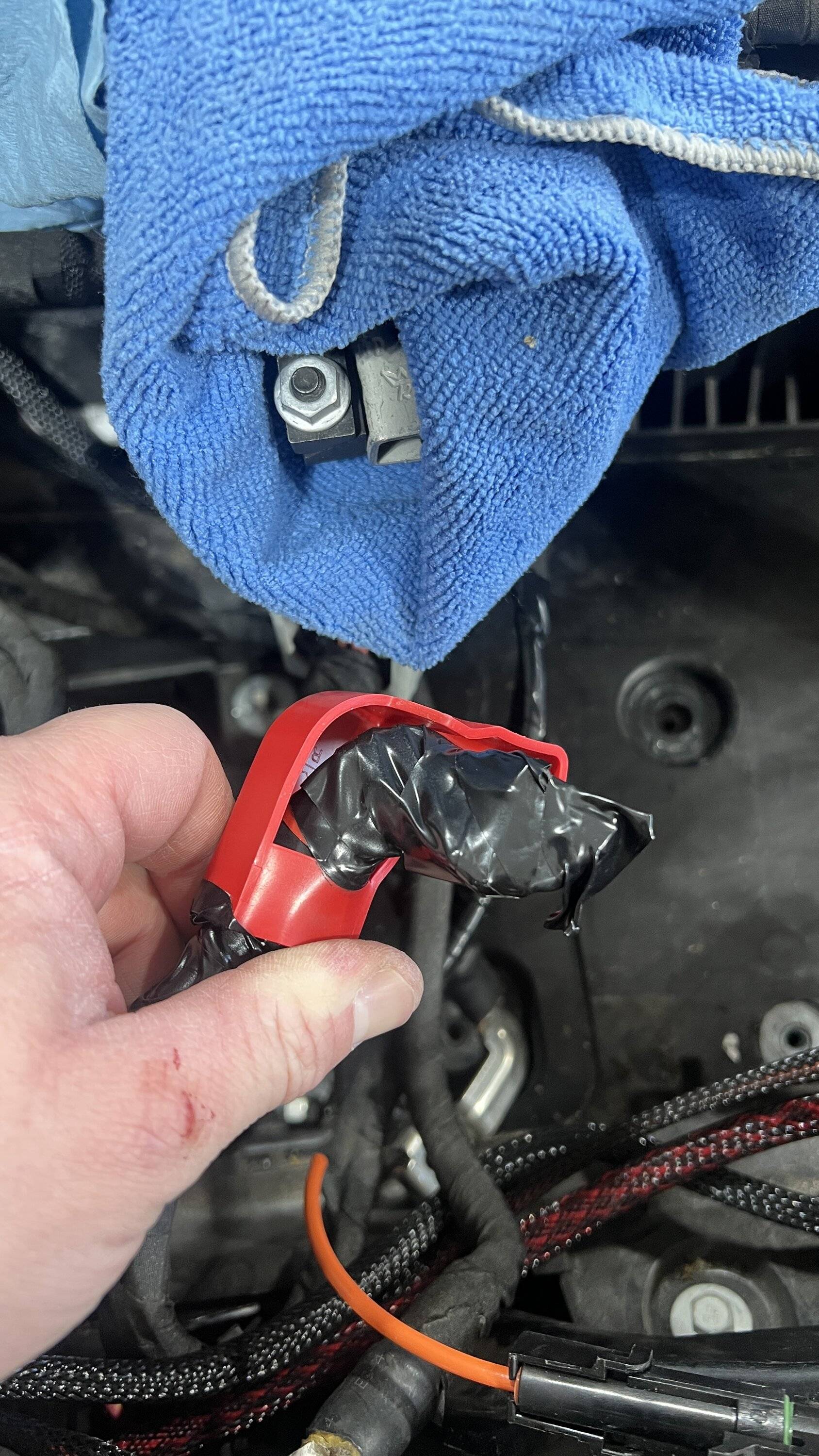
This is where my first mistake was made. I got mixed up thinking the factory aux positive needed to remain left off. DONT DO THIS
IMG_9901.JPG


Continuing my mistake of storing away the positive cable
IMG_9905.JPG

IMG_9906.JPG


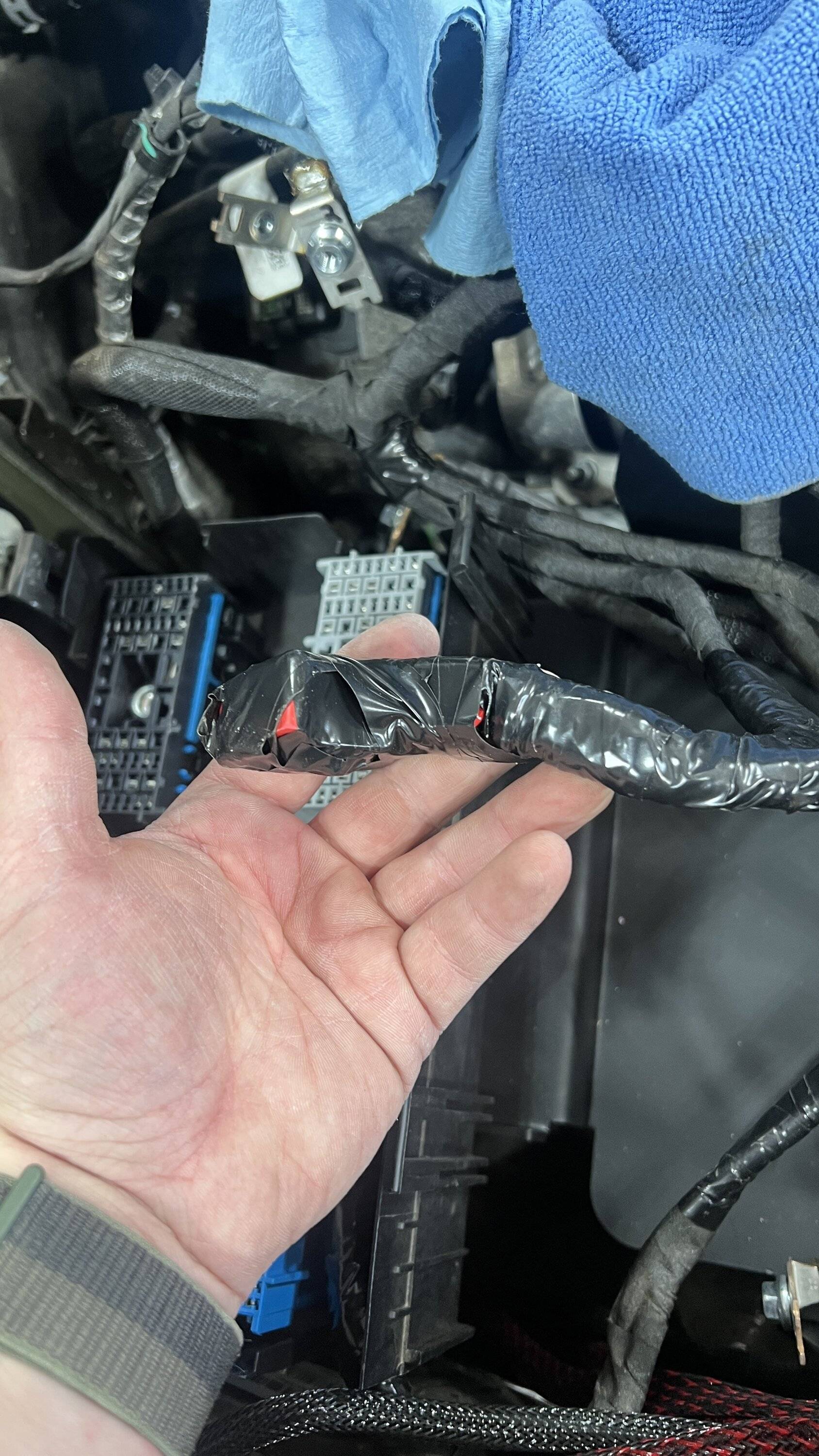
This was another mistake - after having read about others experiencing issues on various forums due to a change in wiring harnesses sometime between 21 and 22, I mistakenly thought the factory aux negative needed to be attached to the main negative. This caused about 35 minutes of frustration as the negative really did NOT want to go there. I pulled hard - hopefully no strands are broken internally. Eventually it did go, but clearly it was not happy. At this point I knew something just wasn't right. Did Genesis really miss this and not catch that there was a substantial change? Nope...it was all me and my lack of paying attention in excitement of having this system in.
IMG_9907.JPG

IMG_9910.JPG


After putting the distribution box back in is when trouble began. Now - take note that I misunderstood some things a few times. After covering up the factory aux power cable and getting the new batteries in I realized I was supposed to have kept that and tied it to the main power terminal. So that was fun - these batteries are about 50 pounds each. Then, I realized immediately that there would be difficulty in getting the factory aux negative cable to attach to the main negative cable (which goes on the negative post of the new aux battery). This was an issue because I had read a few places (probably incorrectly) that there was a change in 2021 where the aux negative cable goes to body ground, and back to the IBS instead of the original only going to body ground. So, being under the impression that the factory aux negative needed to go to the main negative, I had great difficulty in pulling out enough wire. Now keep in mind this happened only after I already tripped a code of some sort. Eventually though I got it to work, enough wire was pulled - hopefully without damaging any strands, and the aux negative was placed on the IBS. But....a code was still showing. So I decided to go for a drive, and cycle the engine about 7 or 8 times in case it just needed to clear, but it was still there. After returning home, and doing more reading/watching, I realized there was a major mistake and mixup in information. The factory aux negative in fact does not need to be connected to the top of the IBS, but the factory aux positive wire does need to go to the main positive. So I removed the negative, taped it, and temporarily tied it off to the side, while securing the positive correctly. Time for another test drive.
IMG_9911.JPG


I also took the time to disconnect the positive cable from the battery for a few minutes in order to clear the system in hopes that the 'service start/stop' warning would correct itself. And it did. So after another 15-20 mile test drive, the system was functioning well. I even left the ESS on to see if it would work, and sure enough it did - just the same as other methods folks use to get rid of the factory aux battery but keep the factory main battery - such as removing fuse 42 or disconnecting the aux negative. Unfortunately disconnecting the battery this time also caused the radio to freak out and reset, booting back up as if it was just a sport and not rubicon.... It took some more community forum help, and time (until 2am to be specific) for the radio to re-center itself and once again provide all the rubicon features.

So the Genesis system at the moment is functioning. I do need to go back and clean up some wires and find a nice place to tuck the aux negative cable. Hopefully today I can finish getting the G screen installed and possibly wire up the battery charger/tender.

IMG_9912.JPG


I must also give thanks to the folks on this forum who helped to resolve the issues by providing great info! Looking back - I could have done it a different way, and kept the factory group 31 size, and put an additional battery or two in the bed. That could arguably be a better way, and cheaper. But this is a sweet system with all the components included, and without a shop my fabrication options are limited and difficult to accomplish. I also like the G-screen option quite a lot, and having the lugs to attach my primary accessory distribution blocks to is cleaner than a bunch of wires on one single lug. Of course keeping all items taken off for every upgrade in the event I want to revert it back to stock form. Given I had a shop, all my tools, and better fabrication options than the current - I would have opted to keep the factory battery, deleted the aux, and fabricated my own system to go in the bed

After some work this morning I will check to see what battery voltages are for curiosity since it is cold, finish cleaning up some wiring, and begin G-screen install and hopefully battery tender as well.
Looks super clean and I definitely like this setup :rock:
Sponsored

 
OP
OP
chorky

chorky

Well-Known Member
First Name
Chad
Joined
Feb 26, 2022
Threads
175
Messages
3,466
Reaction score
3,801
Location
Montana
Website
www.youtube.com
Vehicle(s)
'22JTR, '06 LJ, '06 TJ GE
Build Thread
Link
Occupation
GIS Specialist
I wanted to take a moment and talk a little about batteries and some things that I have been figuring out for my own use case. A little disclaimer though - it's always very important, IMO, to really think about your individual, and realistic, use case. There are a ton of really awesome options out there these days for power management, and some are underperformers, and some are way overkill - depending on your individual use.....

So to start, my individual use is the typical one nighter with maybe a day and a half of no driving trips maybe 2 times a month with the occasional 4 day trip a few times a year, and a week long trip maybe once a year or every other year. This is important!!!!! Because, combined with the items I want to be able to use when camping, a massive 400 ah lithium system is WAY overkill....

Before I forget - some additional reading can be found here, post #15
https://www.jeepgladiatorforum.com/forum/threads/genesis-batteries-lets-do-some-math.62165/


Ok so that being said, to know where you are, assumptions need to be made. My assumption is the use of up to 6 or 7 items (with the engine off). Here is a breakdown with their average rated amperage use.
Jeep Gladiator Destination Unknown - 2022 JTR journal Screenshot 2023-02-04 at 22.48.46

Here I also used the duty cycle for each item - mostly because of the fridge since all others can be considered 100% when on.

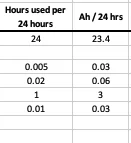
Next I calculated the estimated average hours used for each item in a 24 hour period. Though this calculation makes estimating how many hours of use you get more difficult, it is easier than trying to calculate the average amps used per hour....
Jeep Gladiator Destination Unknown - 2022 JTR journal Screenshot 2023-02-04 at 22.59.06


So, the calculated estimated use of amps in a full 24 hour period is about 26.5 amps. Keeping in mind this could be, for example, arriving to a camp at 1400, and not starting the engine and leaving until 1400 the next day. Also take into account that this assumes no additional charging methods such as a solar option.

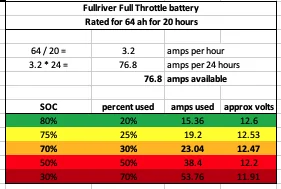
Now, the Genesis kit comes with two batteries, both rated at a total of 76.8 amp hours. Now it is common knowledge that AGM batteries cannot be drained as far as lithium without damage. Different people have different comfort levels of what DOD they are willing to go. I think the consensus is that past 50% DOD/SOC, you are risking permanent battery damage. That damage really is just reduced lifecycles. I dont think major damage, like shorting out or immediate failure would occur until going past 30% SOC. Personally, I am sticking with the manufacturer (Fullriver) and planning on staying above 70% which should equal about 12.47 volts I believe.

So here is a graph of the specs on the batteries included in the Genesis system - note that of course this is for one battery - discharging both would not be wise.
Jeep Gladiator Destination Unknown - 2022 JTR journal Screenshot 2023-02-04 at 22.55.12


With these calculations, of an average use of about 26.5 amps in a 24 hour period, and a usable amount of 23.4 amps - with this setup, one could expect to get about 21 hours of use until dropping below 70% SOC.

So to put this into practicality, an example would be driving most the morning, arriving at a camp at 1400, and leaving at 1000 the next day. That is probably a pretty realistic use case for a lot of people.
Jeep Gladiator Destination Unknown - 2022 JTR journal Screenshot 2023-02-04 at 23.07.41


But what if I found a really sweet fishing spot and want to have an entire day to spend there.... That could mean something like, needing 45 hours worth of battery. This would essentially be the full 21 hour example before, plus a full day. So arriving, say Friday at 1400, and leaving Sunday morning at 1000.

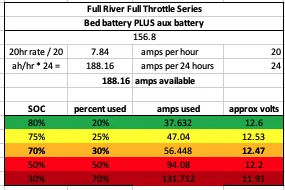
Well I figured this out....So Fullriver offers, in the Full Throttle lineup, a 96 amp hour (80 a/h @ 20 hour rate) battery - its about 60 pounds thanks to being AGM, but the same chemistry as the aux battery. This gives a total of 156.8 ah capacity
Jeep Gladiator Destination Unknown - 2022 JTR journal Screenshot 2023-02-04 at 23.13.47


With this added to the system, and combined with the 64 (at a 20 hour rate) ah battery, one could expect to see that fishing spot for a full day after finding camp the previous afternoon, and maybe a little the next morning, and not even have taken the batteries down by 30% DOD (70% SOC).
Jeep Gladiator Destination Unknown - 2022 JTR journal Screenshot 2023-02-04 at 23.16.18


So, while the standard battery alone will get me about a day, adding another battery of a little more capacity gets me a little more than twice the available fun at camp.

Now I want to make another important point. Lithium vs AGM. Yes...yes...Lithium is how most people go because it is significantly lighter (like 1/4 of the weight), it recharges more than twice as fast, and you can use a much greater capacity - so lithium can be drained to about 20% (I believe) SOC without causing damage as compared to AGM's 70%. Now, in my last example above, that means instead of only being able to use 56 amps out of a 188 amp capacity, with lithium you could use more than 131 amps (30%).

But I am not interested in lithium. For a few reasons.
  • It doesn't do well in cold - I live in a cold climate. Around Christmas, we had temps below zero for 2 weeks solid... Yes, lithium batteries have internal heaters, but even with those, with the jeep just sitting outside for 2 weeks, those batteries would have drained themselves...I am attempting to build a system where I don't have to constantly remove batteries and gear.
  • It requires a DC/DC system. These are really cool technologies!! But, it effectively creates two separate systems. Meaning, the Lithium batteries are charged via a DC/DC connected to the main battery - but, unless jumpers and another DC/DC is used, voltage cannot go from the lithium batteries back into the main vehicle batteries. I want to have this option.
  • Lithium is more fragile. They are still very tough don't get me wrong.... But they are not as tough as AGM
  • And...I just don't need that capacity (lithium is expensive!). Going back to my specific use case, my typical use will, realistically, be one nighters - maybe 2 nighters every now and then. I would love to say "hey I'm going to MOAB this week, and next week doing the Rubicon, and the week after going to the Oazarks, and then taking 2 months to cruise up to Yellowknife in Canada and see Alaska". But the truth is I still have to work, and with medical issues those trips probably won't happen anyway. So my specific use case does not warrant the need for 150 usable amps. That would equate to more than 6 days - 6 days in the same spot, not starting the engine, not using solar. Not many people really do that. Most of us drive for a day, camp, maybe sleep in, and drive for half a day, camp again, get up and then go home. So 6 solid days is WAY excessive for most.
Ok rant over


So I hope this information was helpful to folks. It certainly was for me, to see the numbers of what to expect instead of someone just saying 'oh it works for 3 days". Well...sure..but at the end of those 3 days what is your battery status - these are the things I wanted to know. It will be cool to put it into practice this summer and see, through testing, what actually occurs. Hopefully this will help you figure your own capacity needs for your own trips and uses. It was certainly fun to figure out.
 
OP
OP
chorky

chorky

Well-Known Member
First Name
Chad
Joined
Feb 26, 2022
Threads
175
Messages
3,466
Reaction score
3,801
Location
Montana
Website
www.youtube.com
Vehicle(s)
'22JTR, '06 LJ, '06 TJ GE
Build Thread
Link
Occupation
GIS Specialist
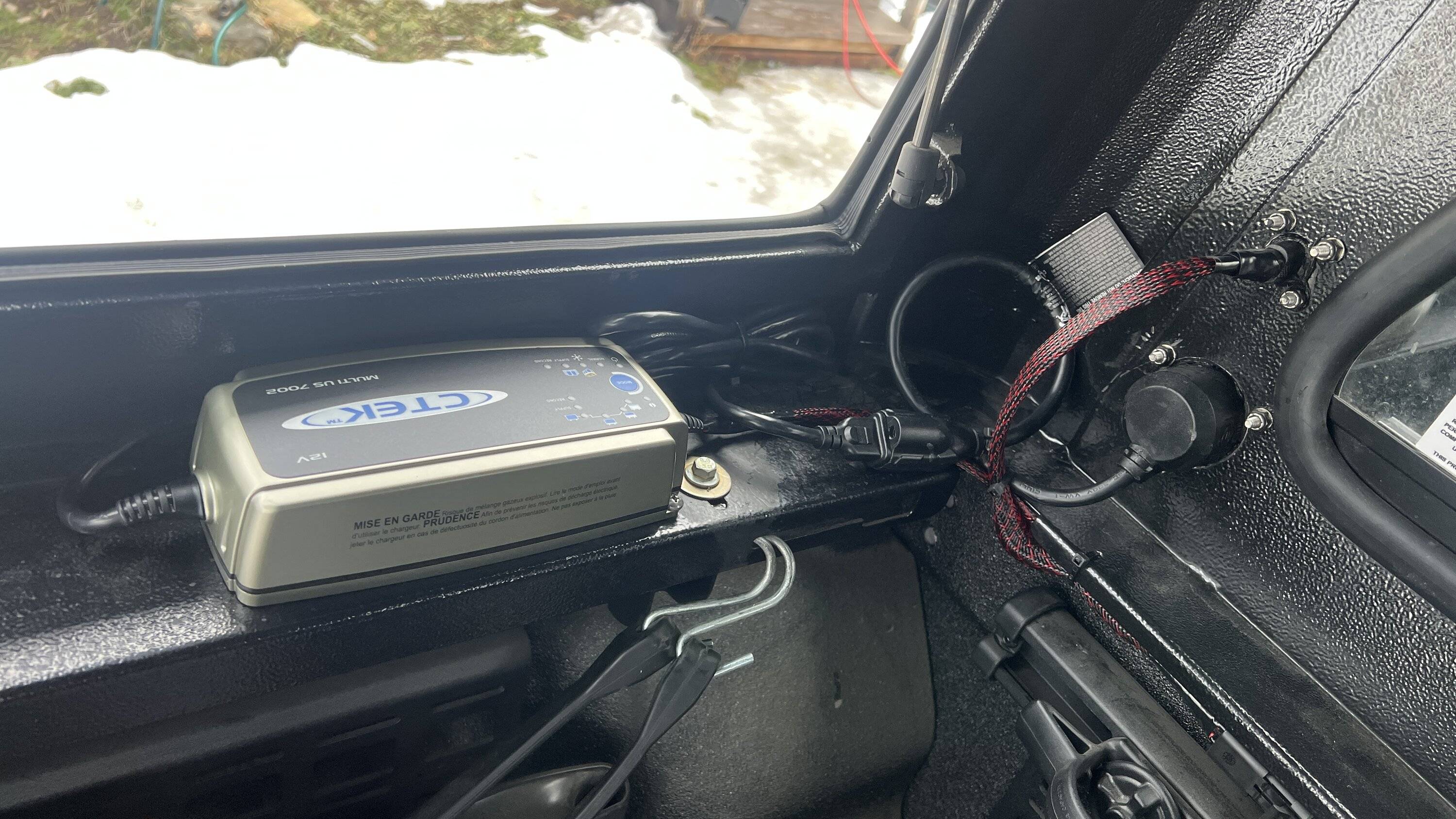
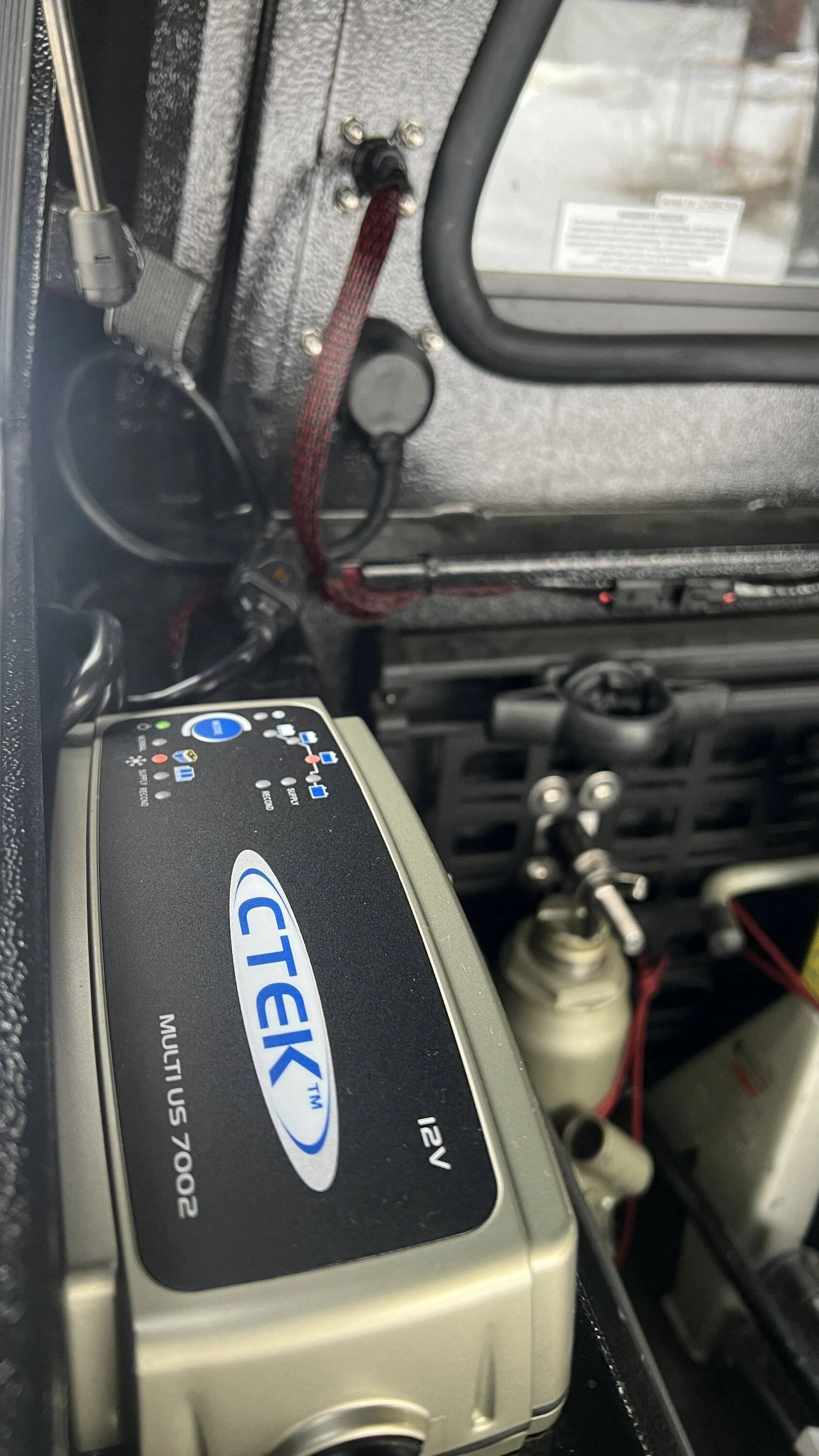
Today I got the wiring for a future portable solar panel installed and wires run to their destination. Along with it I also got the CTEK charger installed as well. The wiring isn't totally finished, but the charger is in, hooked up temporarily, and keeping the batteries fresh. Good thing too as over the last day and a half with the temps and the jeep sitting, the new batteries drained down a couple decimal points. This cold is really tough on batteries.

Post #24 outlines the install of the ports themselves.

The solar wiring will run through a relay switched on by the panel when it arrives. I decided to do this to prevent the exterior port from always having power. Not that it would cause problems, and it is fairly protected and quite hidden, but I didn't want to risk that as it likely won't really be used all that much anyway.

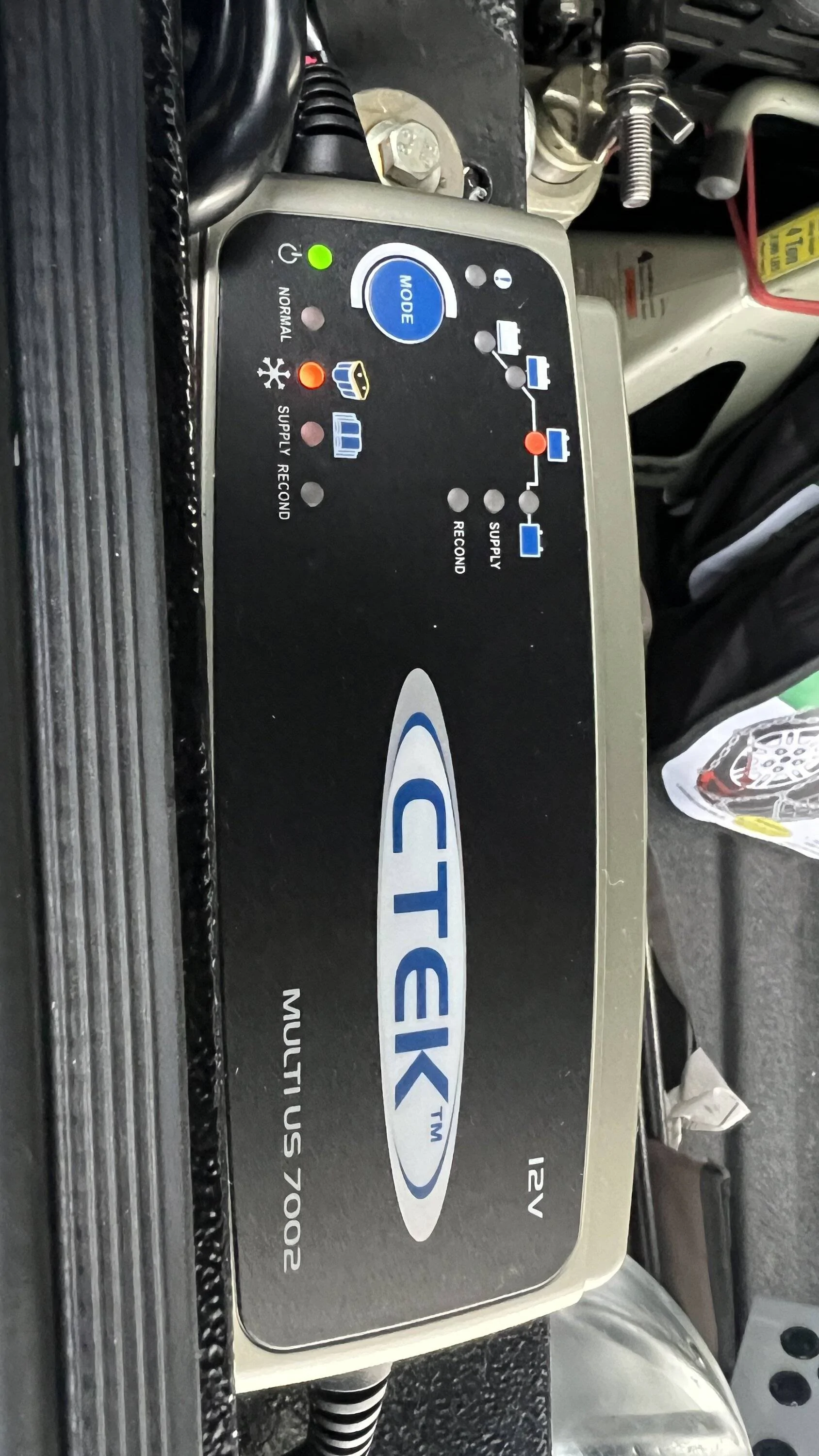
I decided on the CTEK charger instead of the NOCO for a few reasons. The CTEK has a good reputation and has been around for some time. NOCO has as well, but I recall hearing and seeing CTEK more with little failures. It also specifies a temperature range of down to -4 F for operation normally, and on the cold setting (also the setting for AGM batteries) it supposedly can operate to -40 (although they must have come out with a new version right after I purchased mine because they 10a version has a temperature sensor). Now, I believe the NOCO can operate to -10 or so, but it doesn't list it anywhere in the specs that I found online anyway - maybe in the owners manual. And that is a relatively new development based on lots of reviews I saw with issues charging below freezing even. But I didn't like that the temperature range was not specified. That is very important to me due to cold winter temps.

I have never had CTEK before so time will tell how it lasts, but one thing I already noticed is it remembers its previous setting. Meaning I can just plug it in and let it work - and I don't have to open the door to select the mode first. Simplified, I like that. I did still mount it on the drivers side near the side door so it is easily accessible and visualized, but seeing as I have AGM batteries, there is only one setting that will be used. Another thing I like about this charger is it shows what state of charge it is in: bulk, absorb, float, etc... the NOCO options I saw did not specify this at all and that had me question if it even had those modes.


My goal with the mounting location was specifically to be on the drivers side. This way, if I wasn't paying attention in the morning it would be easily noticed if it was plugged in - avoiding the potential to drive off with it still powered up.
Jeep Gladiator Destination Unknown - 2022 JTR journal IMG_9928.JPG


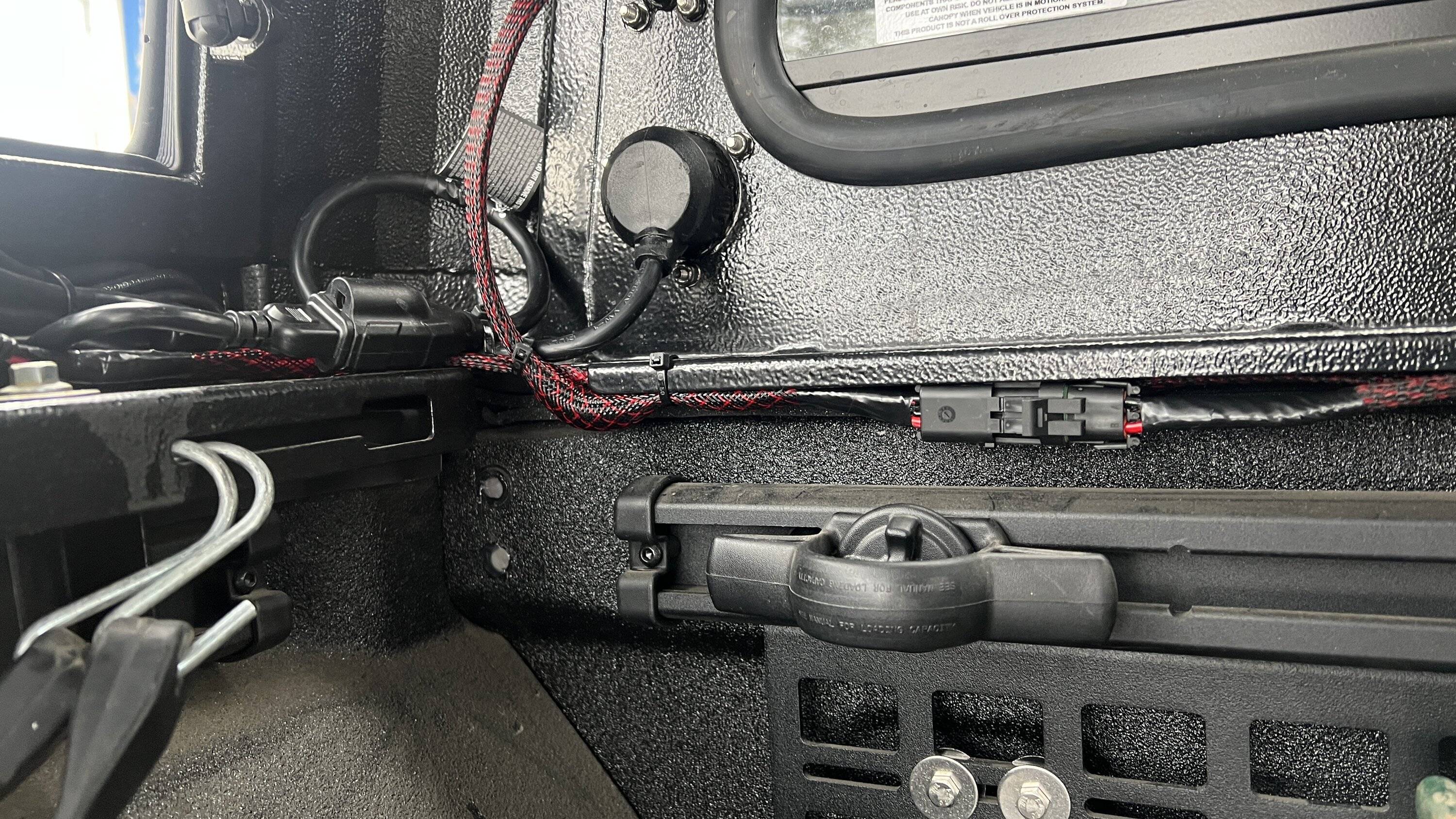
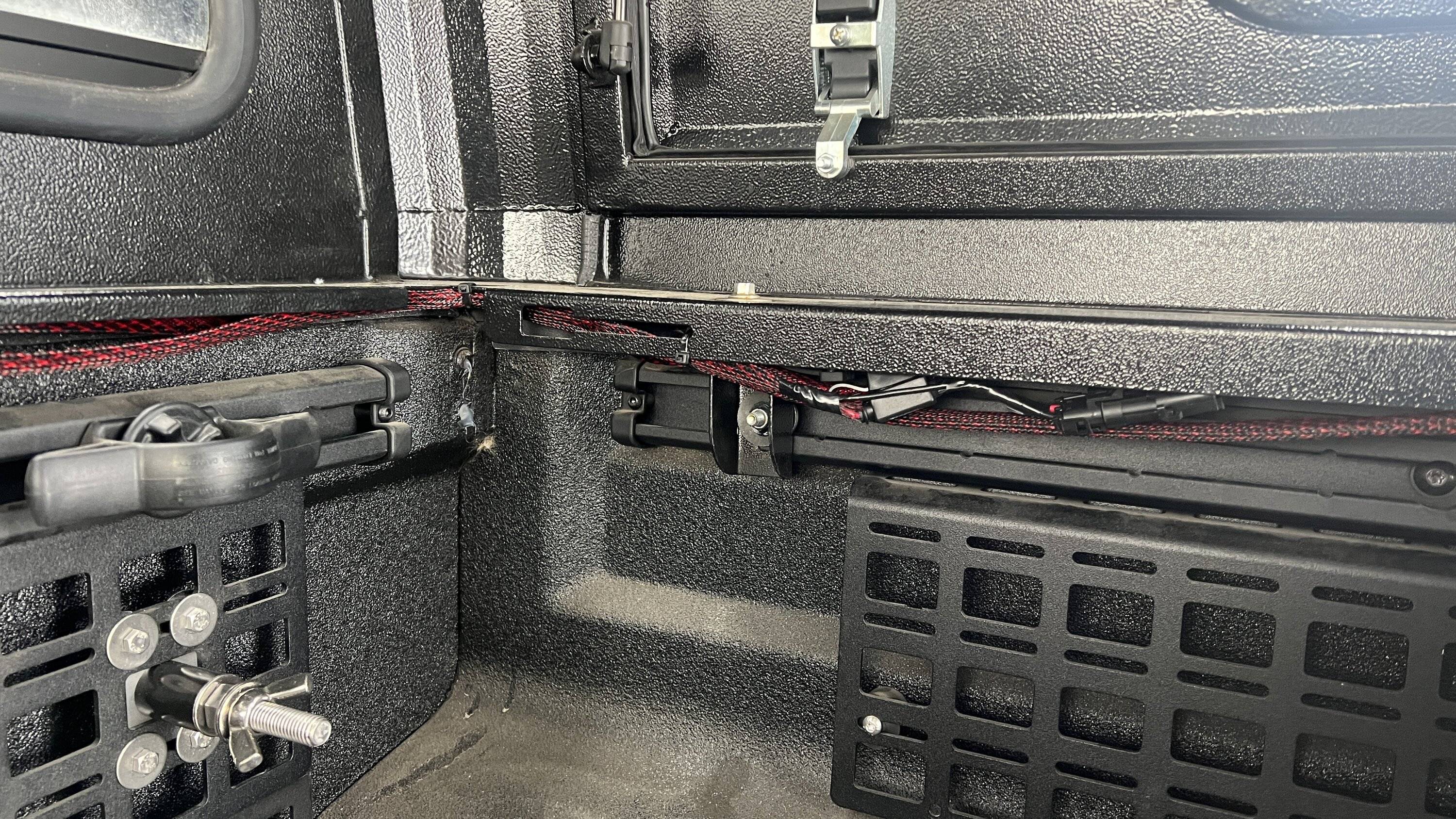
I ran the wires for both ports under the lip of the canopy. On the front side I had to drill a few holes for zip ties to secure it. I like that it is tucked away and I can still mount a platform later on if I desire.
Jeep Gladiator Destination Unknown - 2022 JTR journal IMG_9929.JPG

Jeep Gladiator Destination Unknown - 2022 JTR journal IMG_9930.JPG

Jeep Gladiator Destination Unknown - 2022 JTR journal IMG_9931.JPG


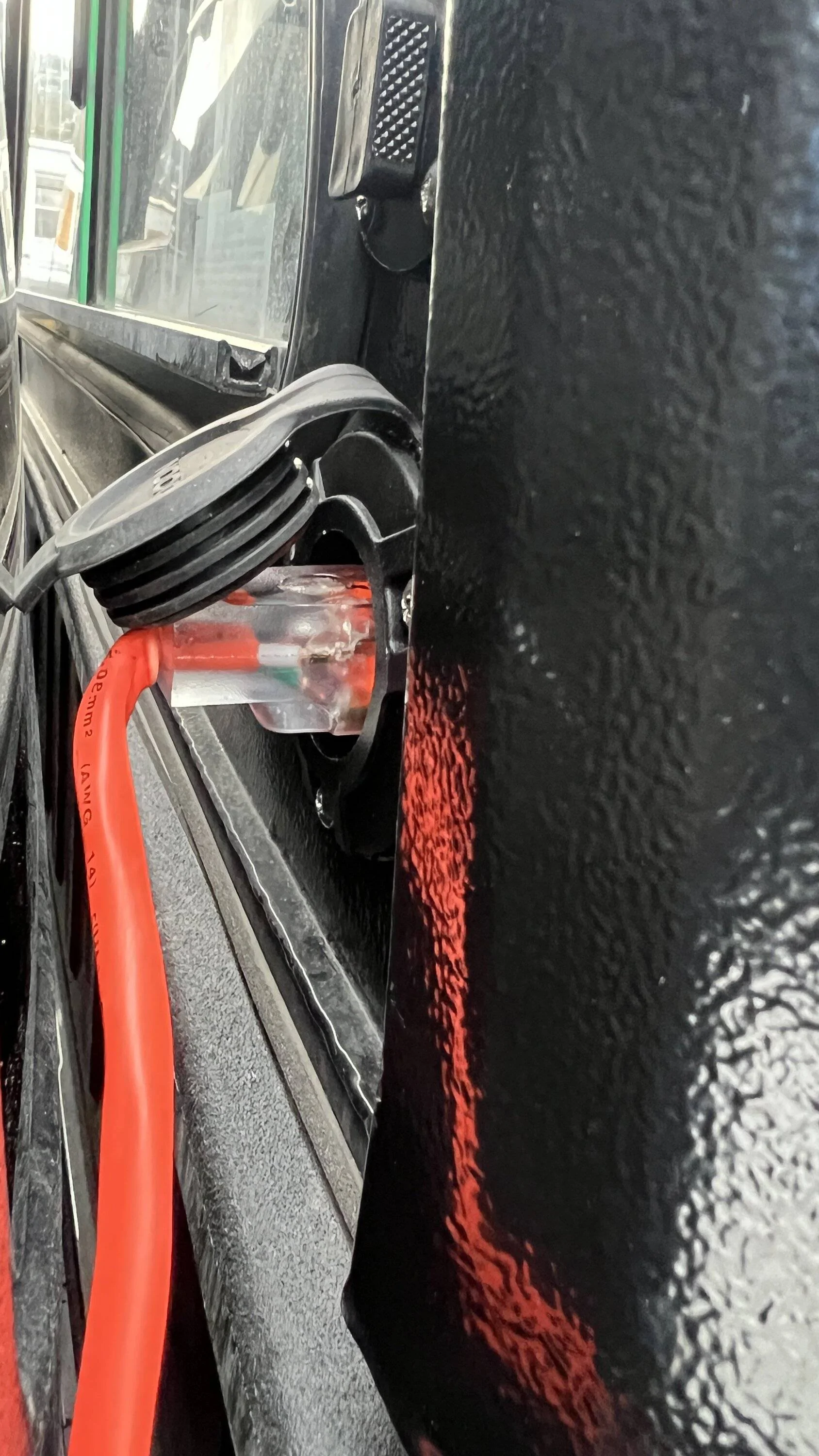
The plug is a tight squeeze.... I will have to try and find a 90 degree elbow and see if that helps. I'm not a fan of bending cords so tight. But I do like this location a lot - it is mostly hidden, and protected from the weather and sun.
Jeep Gladiator Destination Unknown - 2022 JTR journal IMG_9932


I should have stepped back on this pic, but it has easy access in case I want to see the lights, or change the mode (highly unlikely)
Jeep Gladiator Destination Unknown - 2022 JTR journal IMG_9933


So far I'm happy with this install.
Jeep Gladiator Destination Unknown - 2022 JTR journal IMG_9934
 
OP
OP
chorky

chorky

Well-Known Member
First Name
Chad
Joined
Feb 26, 2022
Threads
175
Messages
3,466
Reaction score
3,801
Location
Montana
Website
www.youtube.com
Vehicle(s)
'22JTR, '06 LJ, '06 TJ GE
Build Thread
Link
Occupation
GIS Specialist
Well I continued work on a couple more items today.

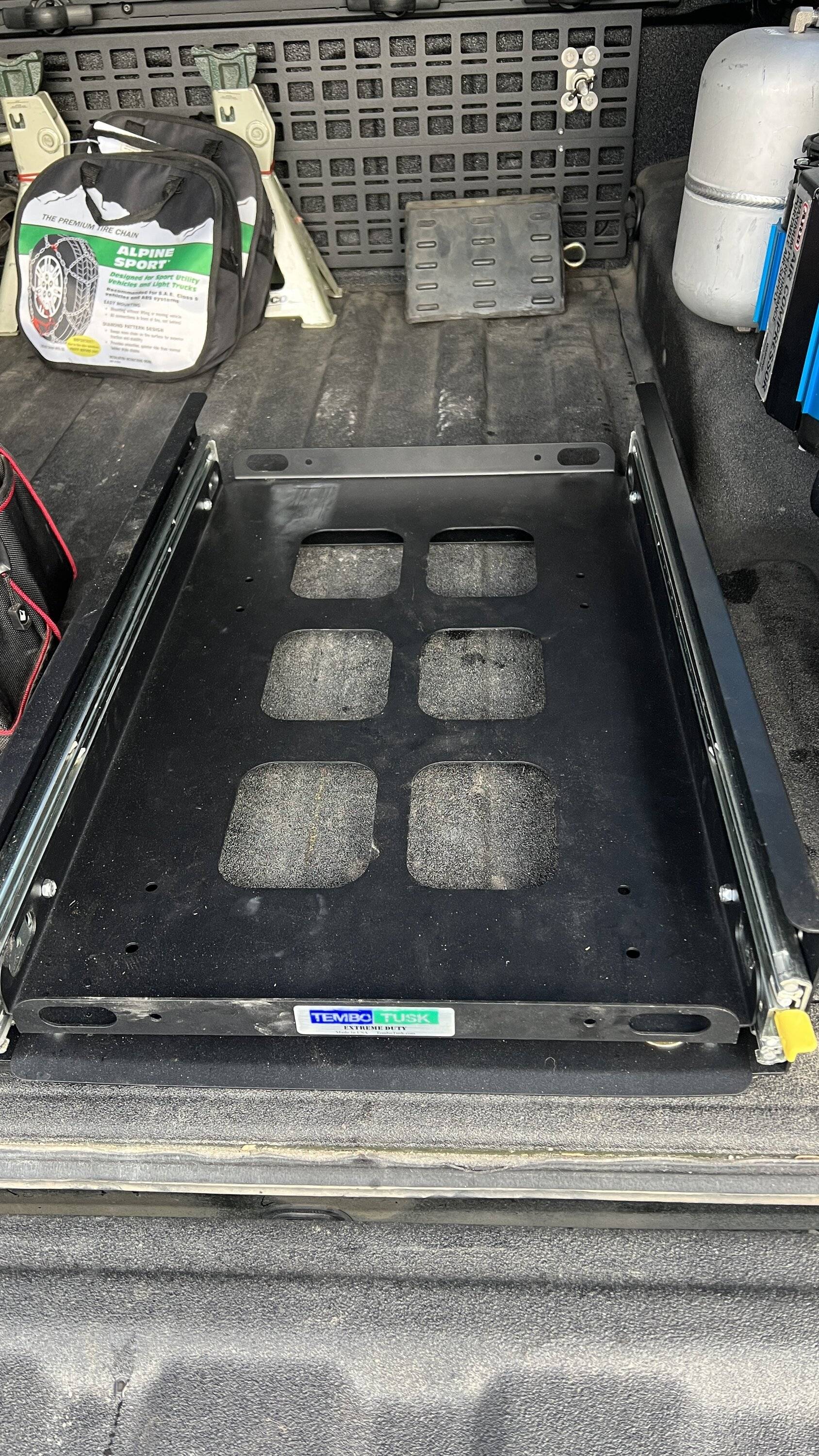
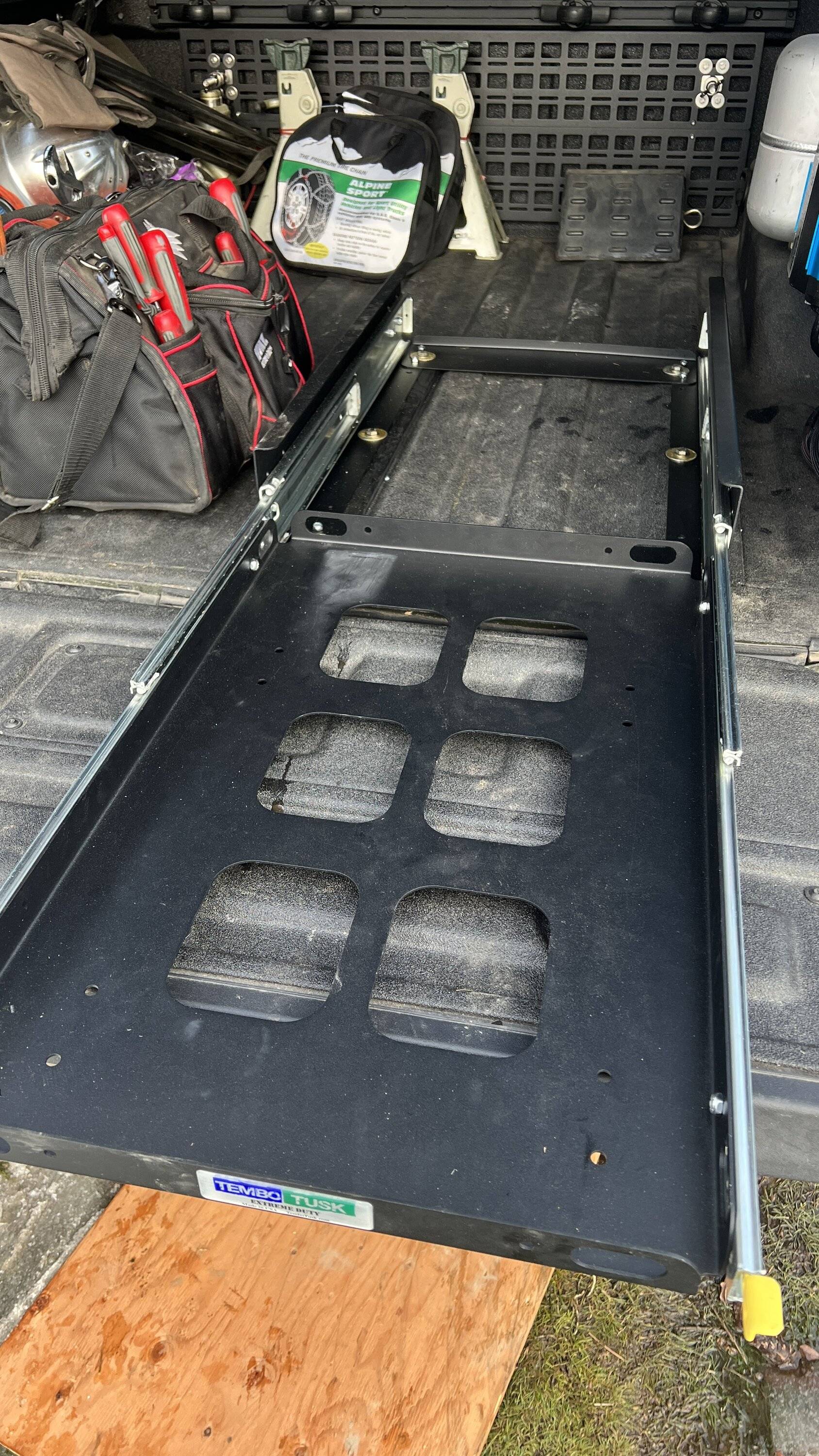
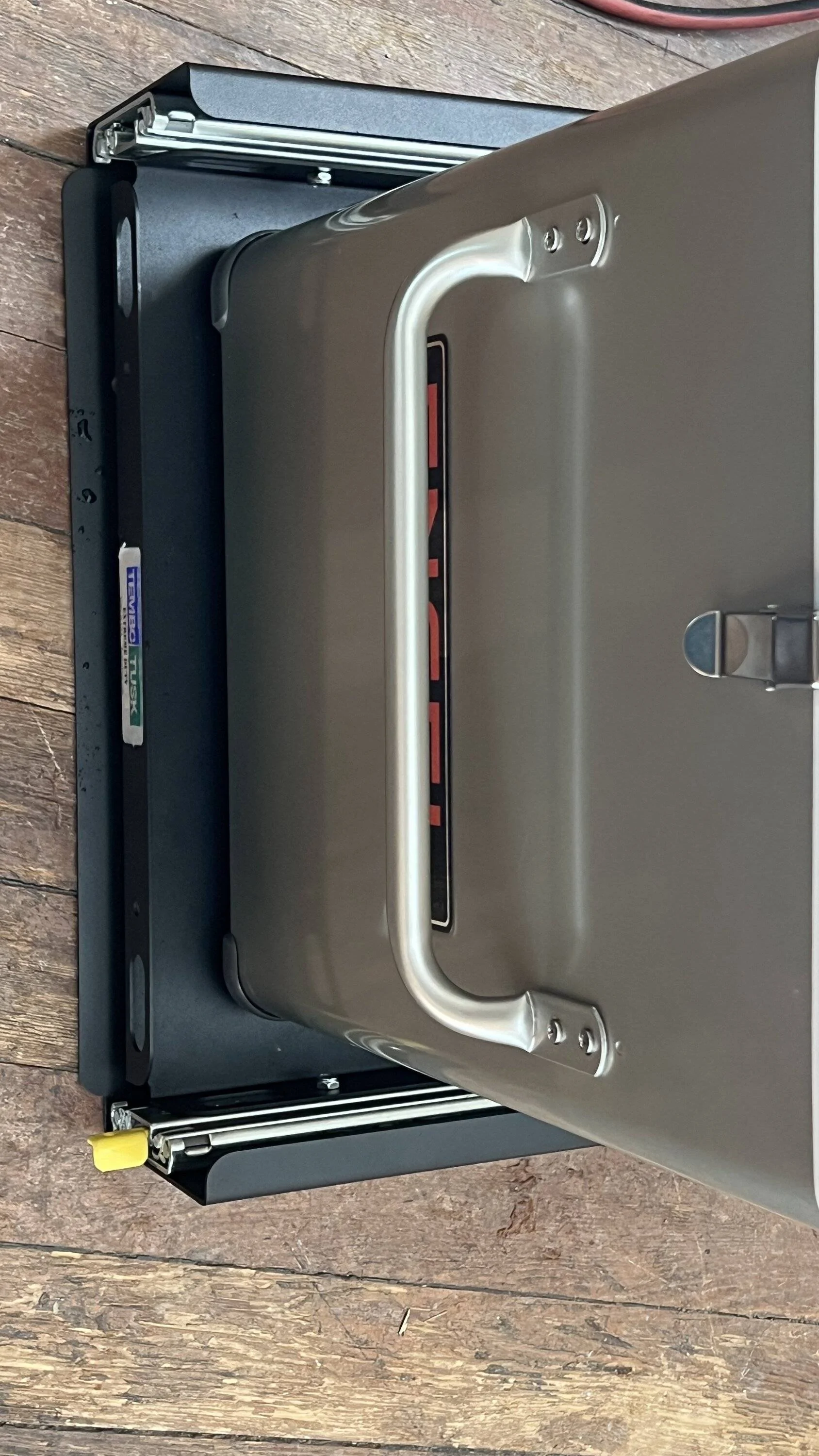
After really thinking of how to secure the fridge slide to the bed, I finally decided to just drill holes. After all, summer is coming quick and I need to get going on some projects. I had though about making some brackets and slides myself using extruded aluminum to have a lower profile and narrower slide (this one is probably 6-8 inches total wider than the fridge :-( ), but looking at extruded alum options, their slides are SUPER expensive... And I already had this one, so figured to just make it work.
Jeep Gladiator Destination Unknown - 2022 JTR journal IMG_9843

Jeep Gladiator Destination Unknown - 2022 JTR journal IMG_9844


Before drilling any holes I wanted to test fit it. I was surprised to see that the width of the slide unfortunately did not match very nicely with the ridges in the bed. So I used a bolt head and a bunch of washers to figure out what amount of height I needed. It was about 1/2 an inch or so.
Jeep Gladiator Destination Unknown - 2022 JTR journal IMG_9842


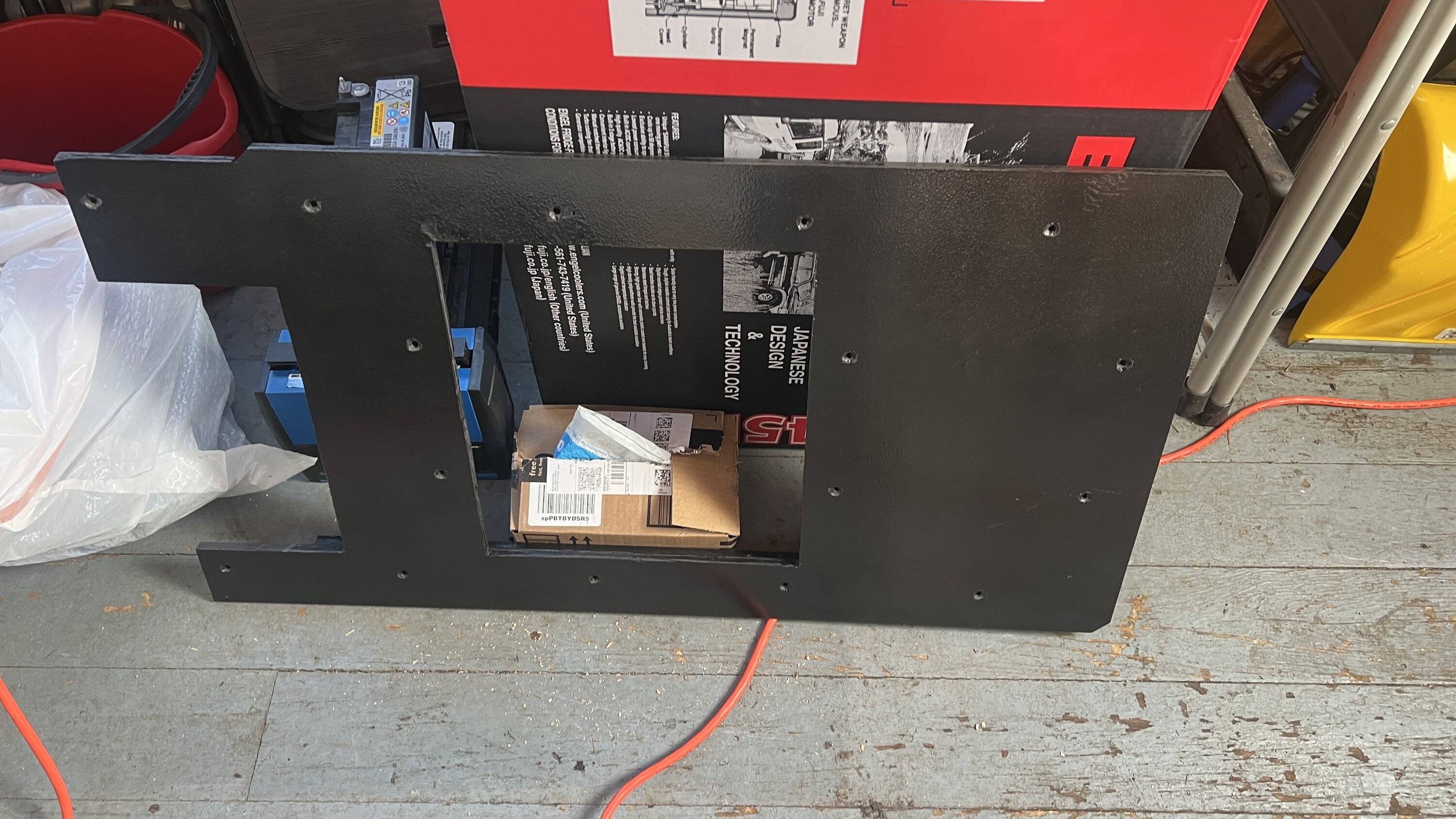
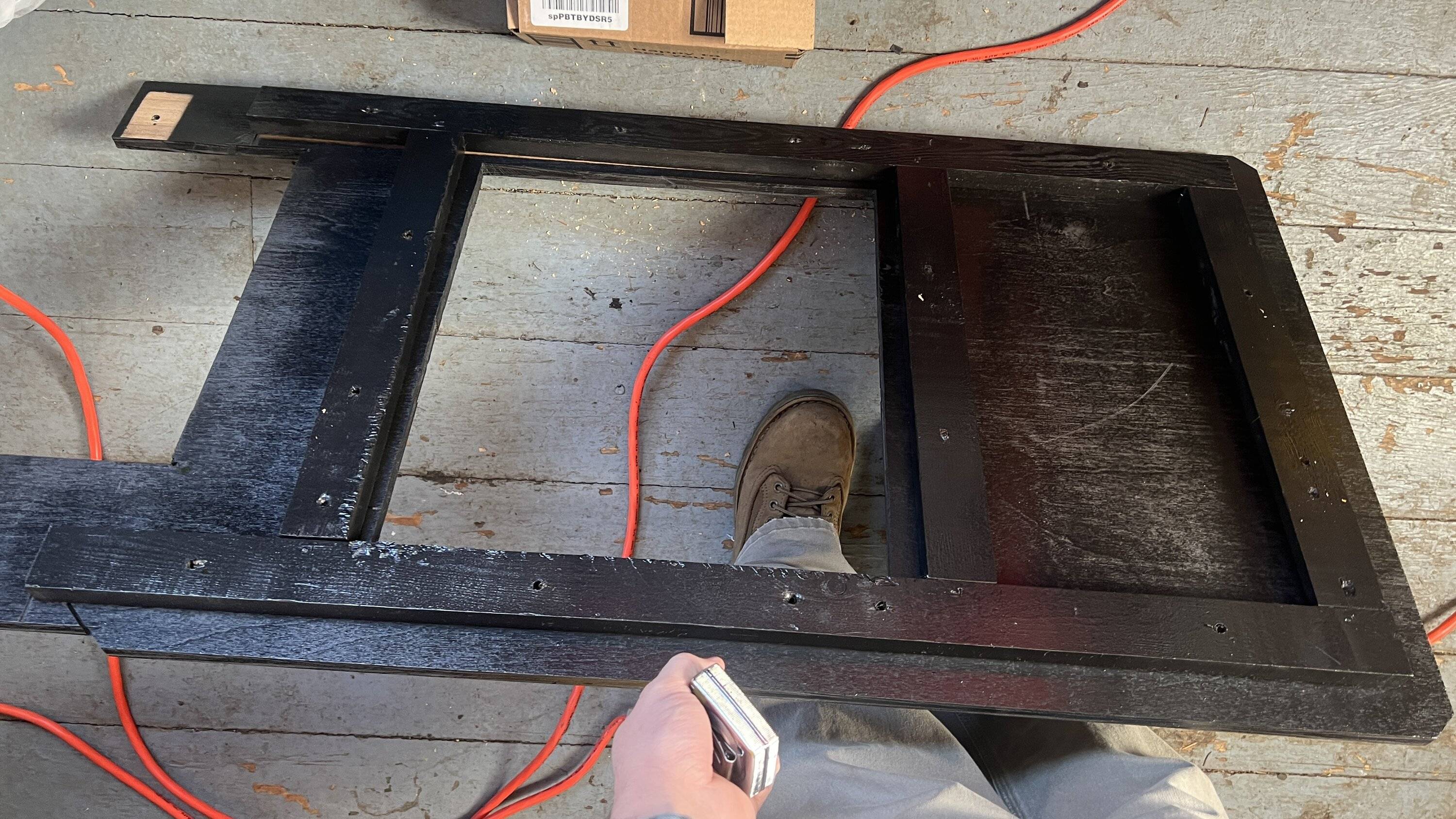
After thinking of the best way to deal with this, I ended up opting to just cut a slice of 3/4" plywood I had, paint it really well, and drill corresponding holes. No doubt it will have to be replaced in time, but short of having a sheet of 1/2" thick steel, which would be heavy and expensive, this is the next best thing.

After drilling holes, I took time to clean and paint them to help ward off any oxidizing and rust. Hopefully I am successful in this!!! Time will tell I guess. After letting it cure for a couple of days with the temps being so cold it was time to put things in place. I was hoping another package would arrive home first so I could finish another project, but I am crossing my fingers I can still access needed areas despite the slide being bolted in place - otherwise it will have to come out again.

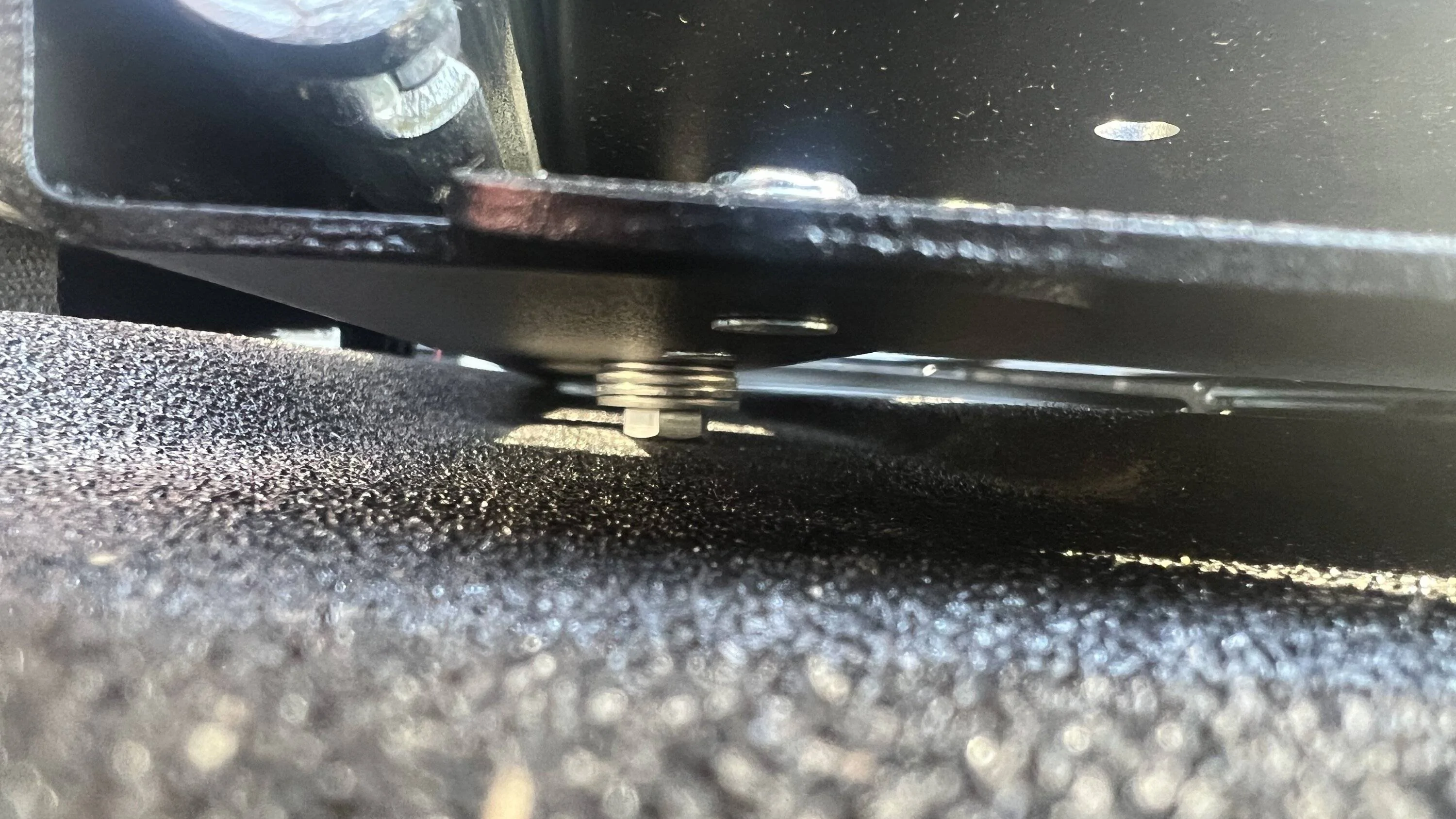
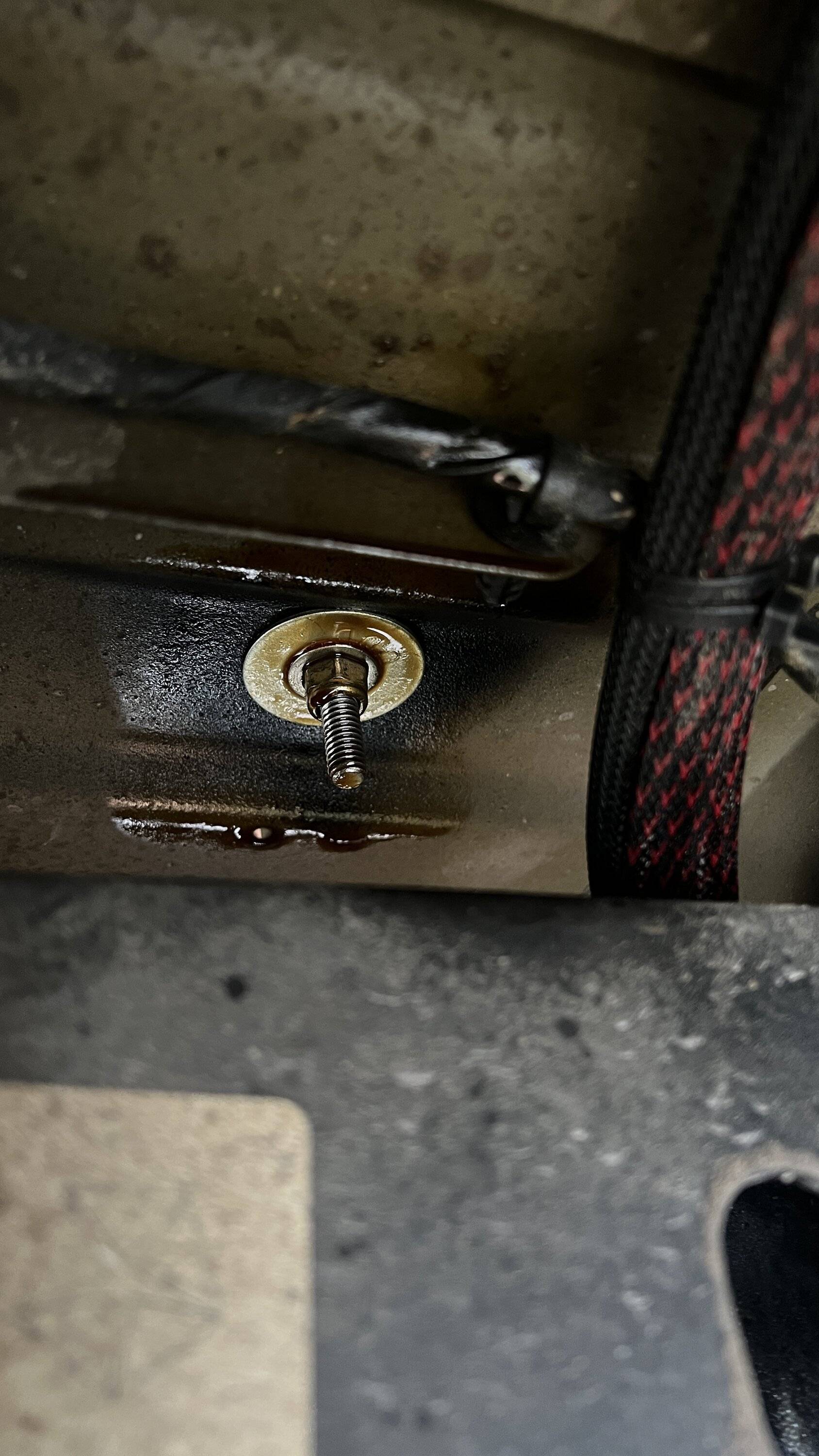
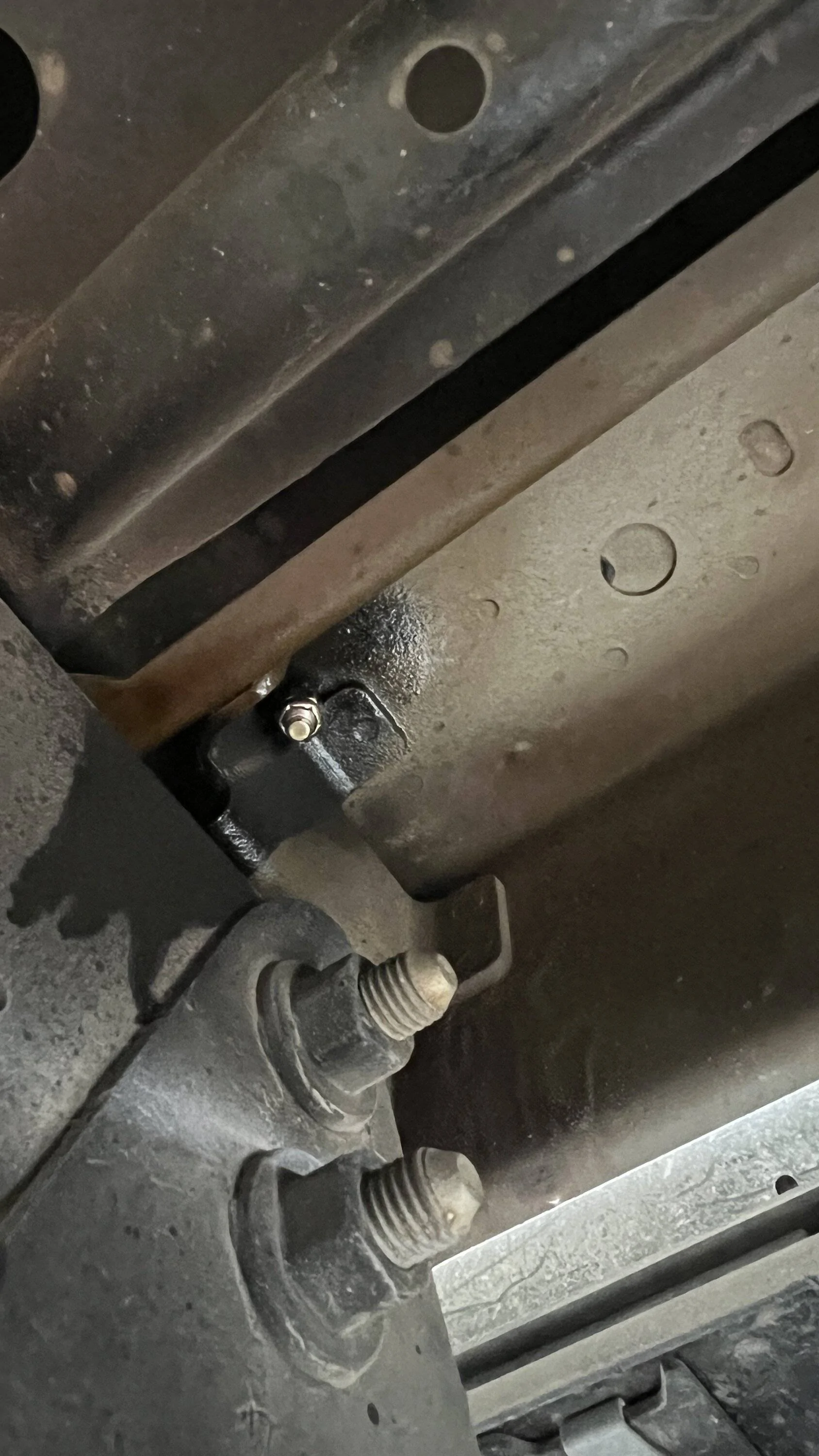
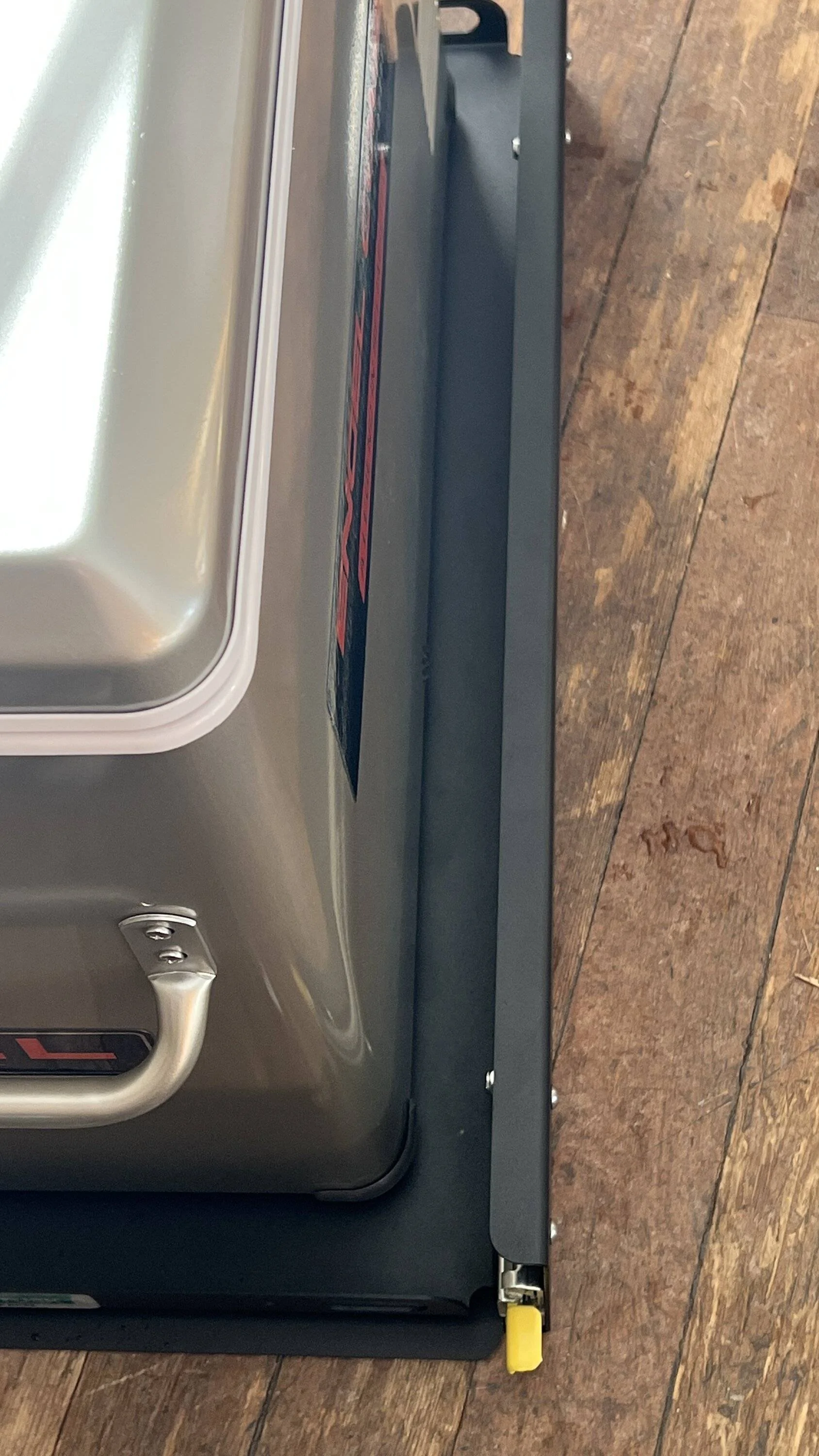
I added in 2 more holes in the slide itself so that there would be 6 points of contact instead of just 4. The sheet metal the bed is made of is SUPER thin - surprisingly thin. I dont like that at all really. So I opted for a double washer setup - only because I couldn't find a large washer with a small enough hole for the bolts I had. Also using mostly all stainless hardware. Sadly, the large washers are zinc plated because that's all I could find - so I coated them twice with Amsoil HD Metal Protect.
Jeep Gladiator Destination Unknown - 2022 JTR journal IMG_9975.JPG


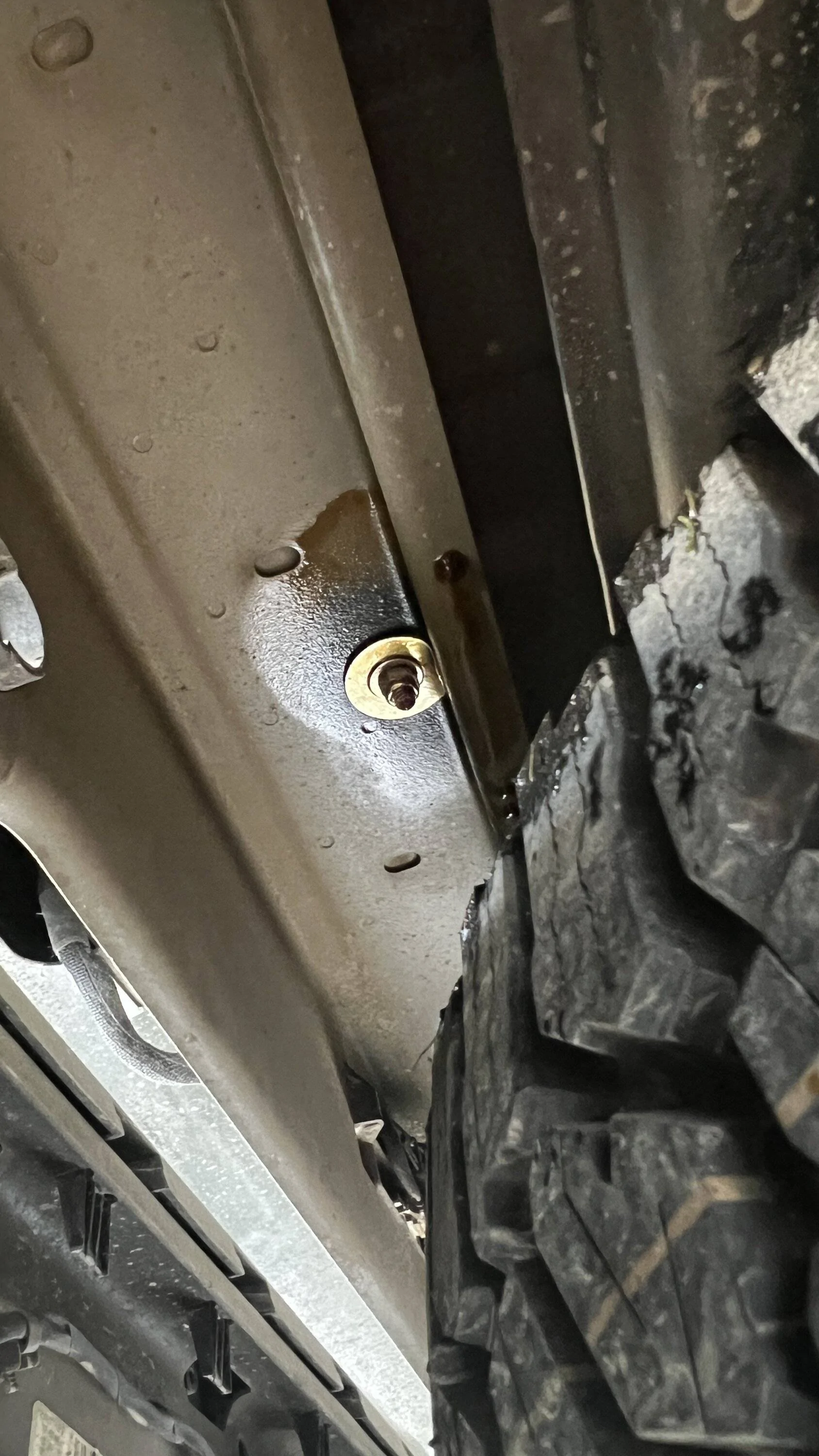
One problem I did create, was one hole was in a not so good location. Fortunately I did not mess up any spot welds. But it did prevent me from being able to use a washer. However, since there are 6 bolts - and it's not carrying a crazy ton of weight, I am hoping it will be ok. At least this portion is through some thicker steel whereas the the other 4 bolts are just the thin piece of sheet metal.
Jeep Gladiator Destination Unknown - 2022 JTR journal IMG_9974

Jeep Gladiator Destination Unknown - 2022 JTR journal IMG_9973


But, it turned out ok. The slide ended up bending just a tad bent from being under load of the bolts, enough so that it doesn't slide super smooth. But I'm sure extra weight of the fridge will help with that - and it is far more important that it be secured to the bed well than to have it loose for a good slide. In hindsight - I should have built my own slide after seeing some of the super awesome options that extruded aluminum offers - but maybe in the future. For now, this will work just fine.
Jeep Gladiator Destination Unknown - 2022 JTR journal IMG_9971.JPG

Jeep Gladiator Destination Unknown - 2022 JTR journal IMG_9972.JPG
 
OP
OP
chorky

chorky

Well-Known Member
First Name
Chad
Joined
Feb 26, 2022
Threads
175
Messages
3,466
Reaction score
3,801
Location
Montana
Website
www.youtube.com
Vehicle(s)
'22JTR, '06 LJ, '06 TJ GE
Build Thread
Link
Occupation
GIS Specialist
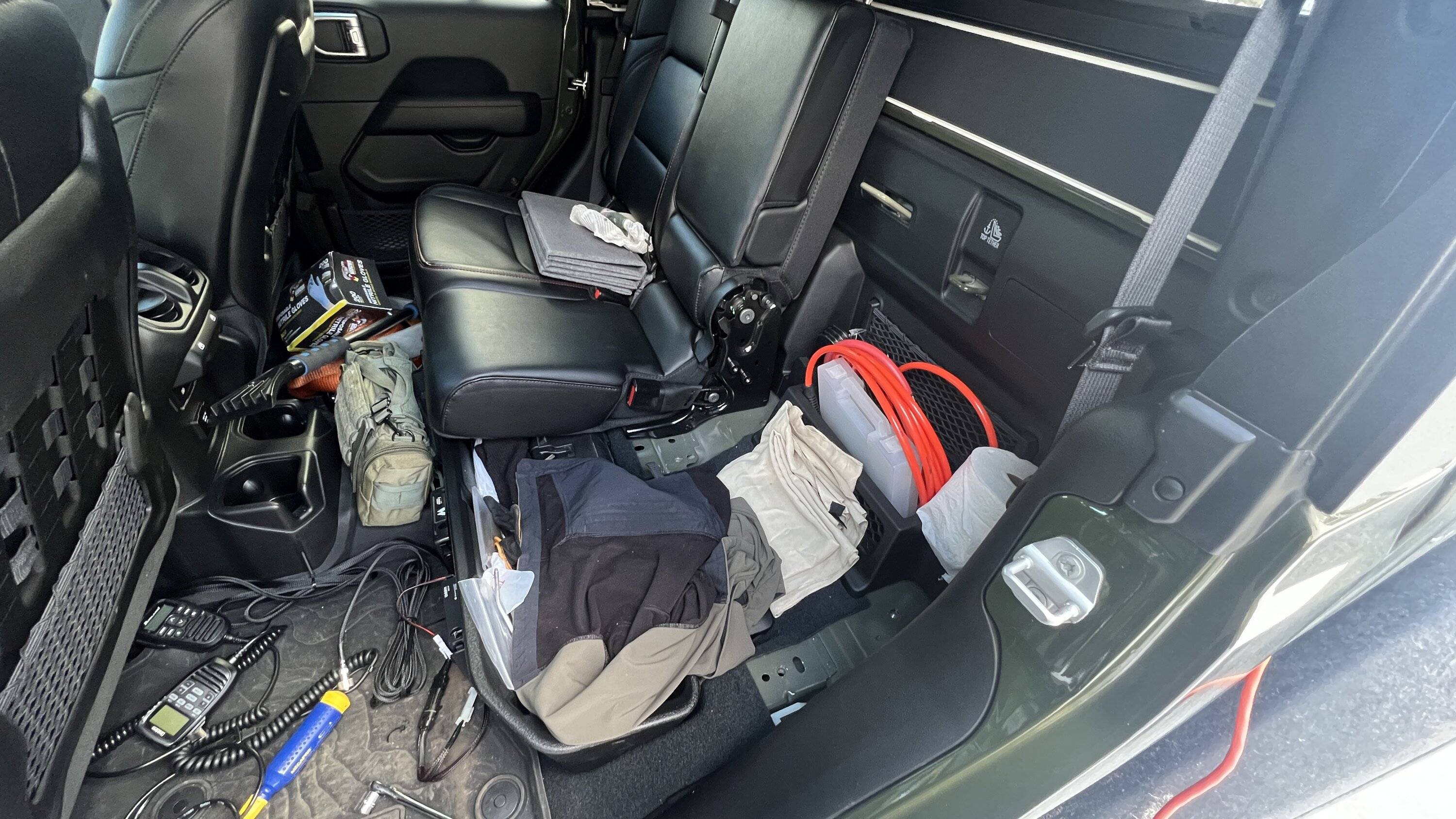
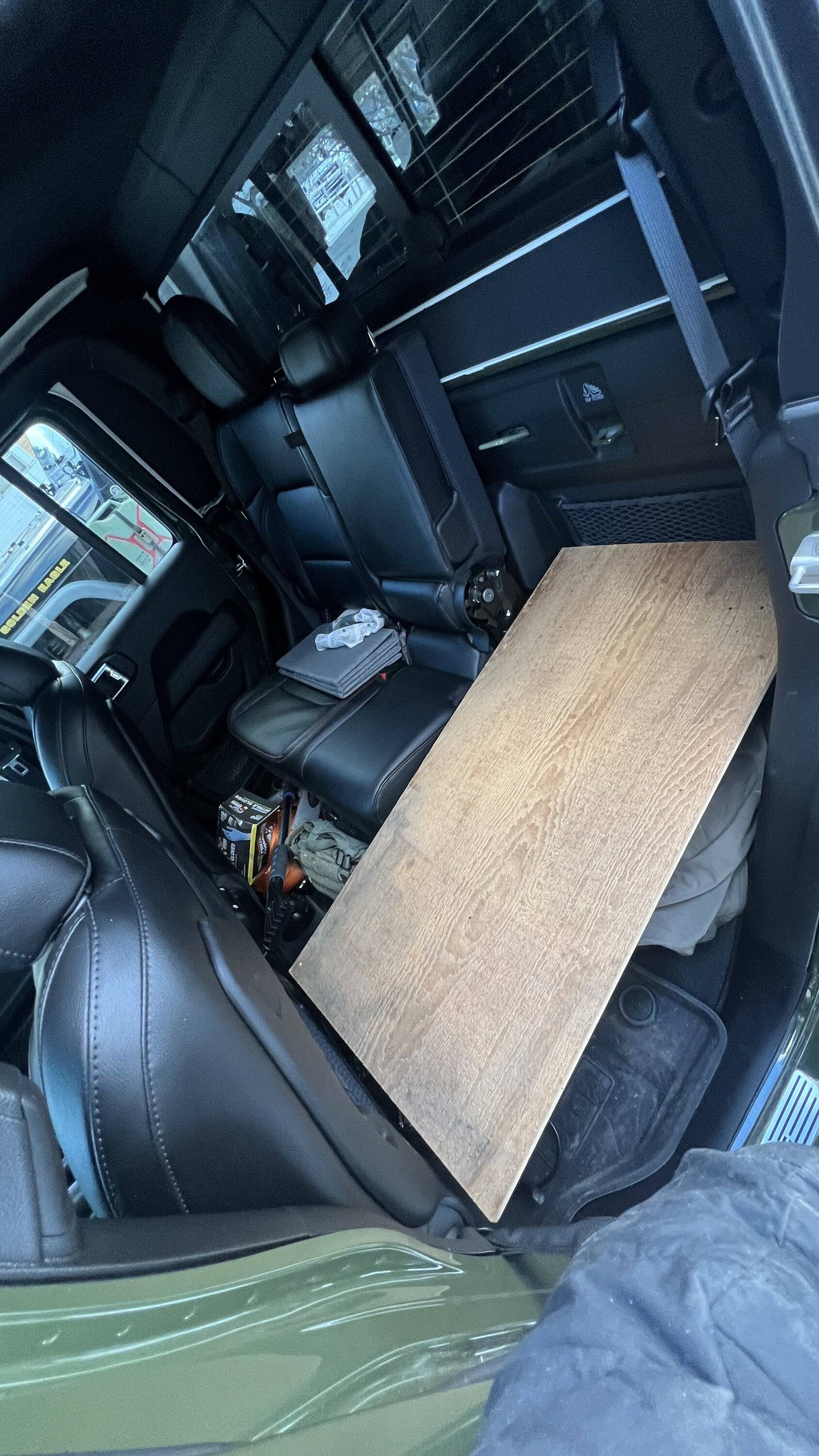
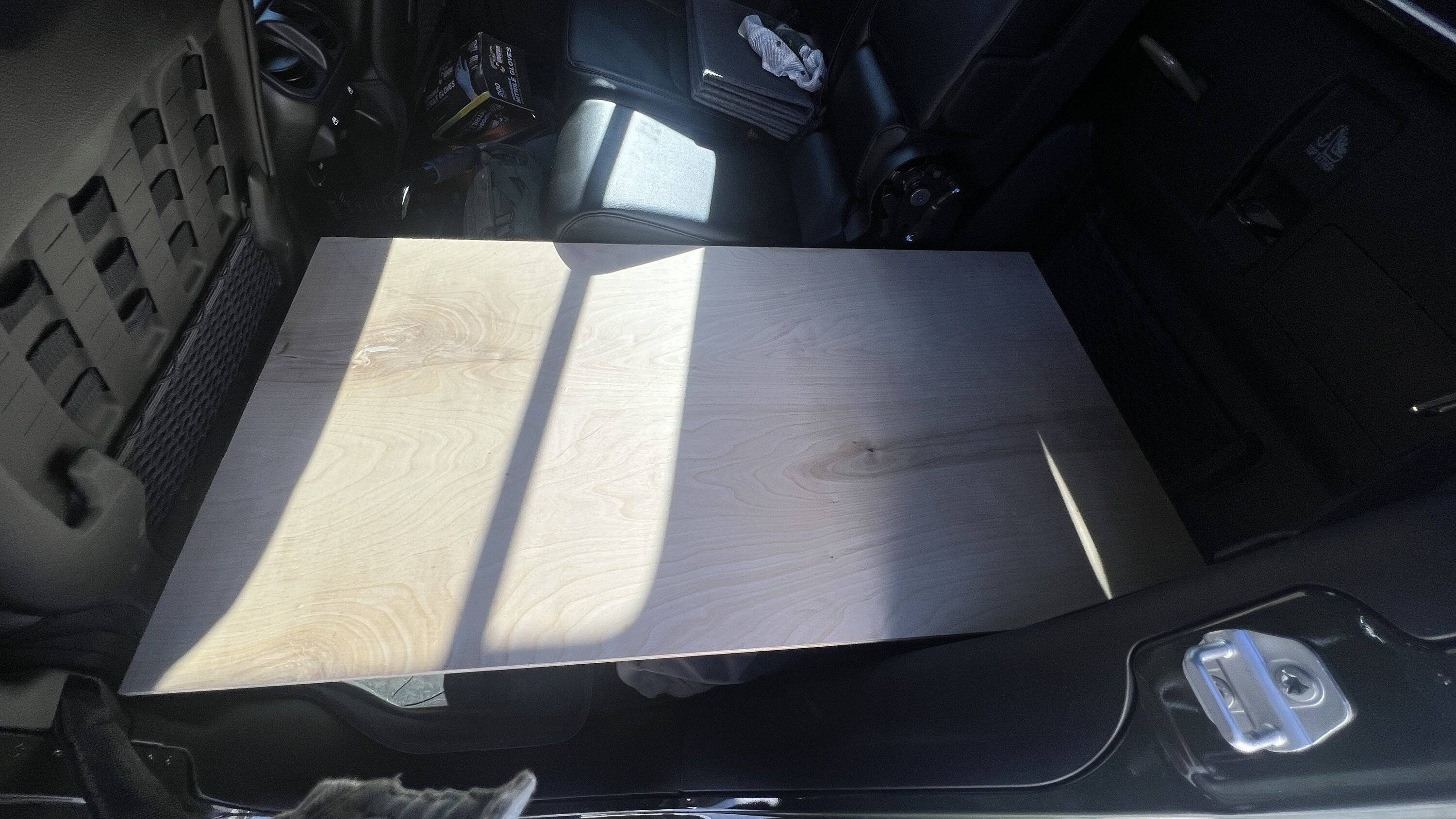
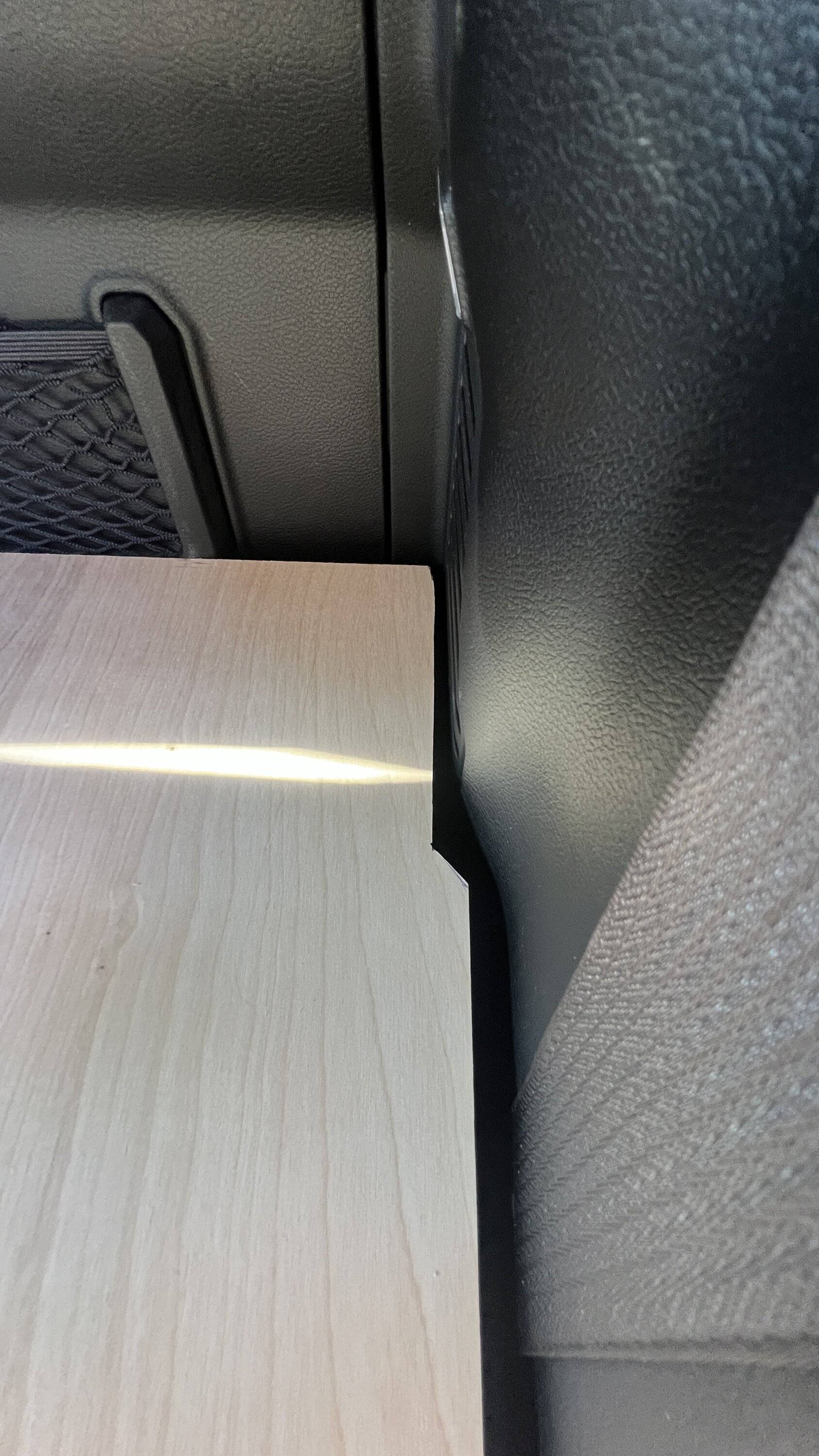
Now earlier in the day today I continued another project.... A couple of days ago I decided to move forward with a rear seat delete on the drivers side. After seeing a couple other do-it-yourselfers accomplish it I thought how to also do that myself. Seeing as how I had some spare wood lying around from the house remodel, and I do have some wood working tools, I opted to remove the rear seat and get a rough idea of size.
Jeep Gladiator Destination Unknown - 2022 JTR journal IMG_9952.JPG

Jeep Gladiator Destination Unknown - 2022 JTR journal IMG_9953.JPG

Jeep Gladiator Destination Unknown - 2022 JTR journal IMG_9956.JPG


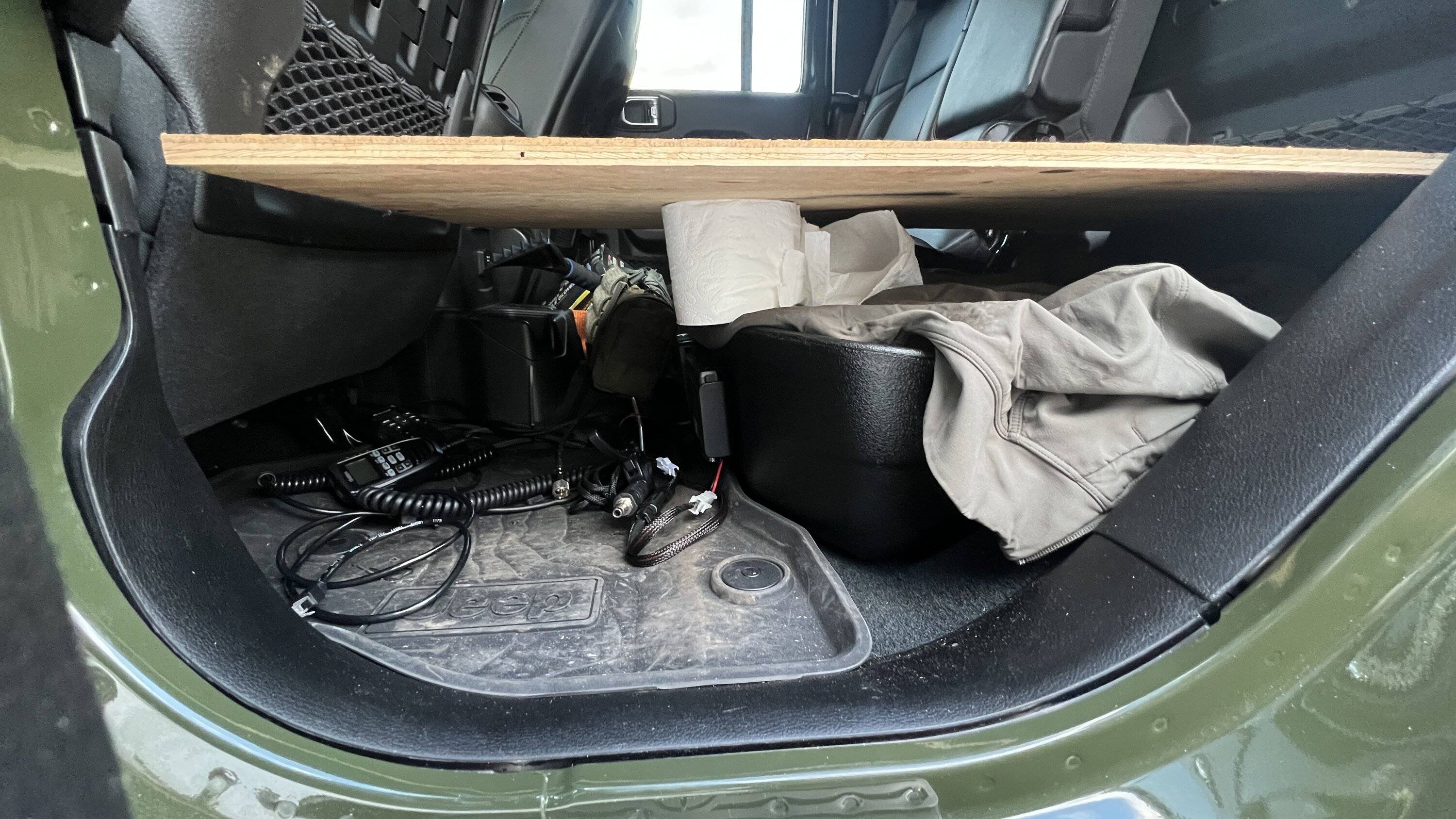
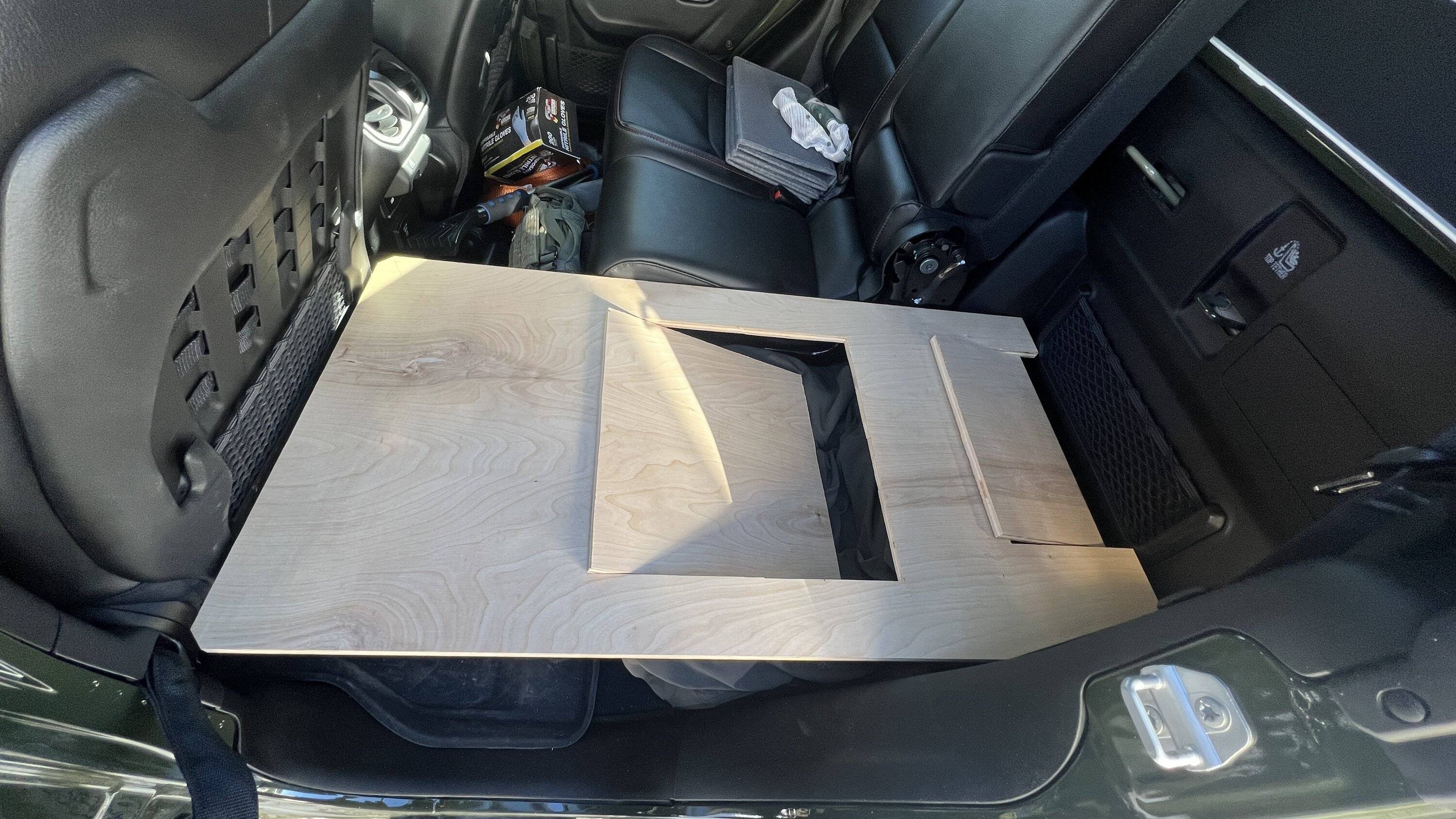
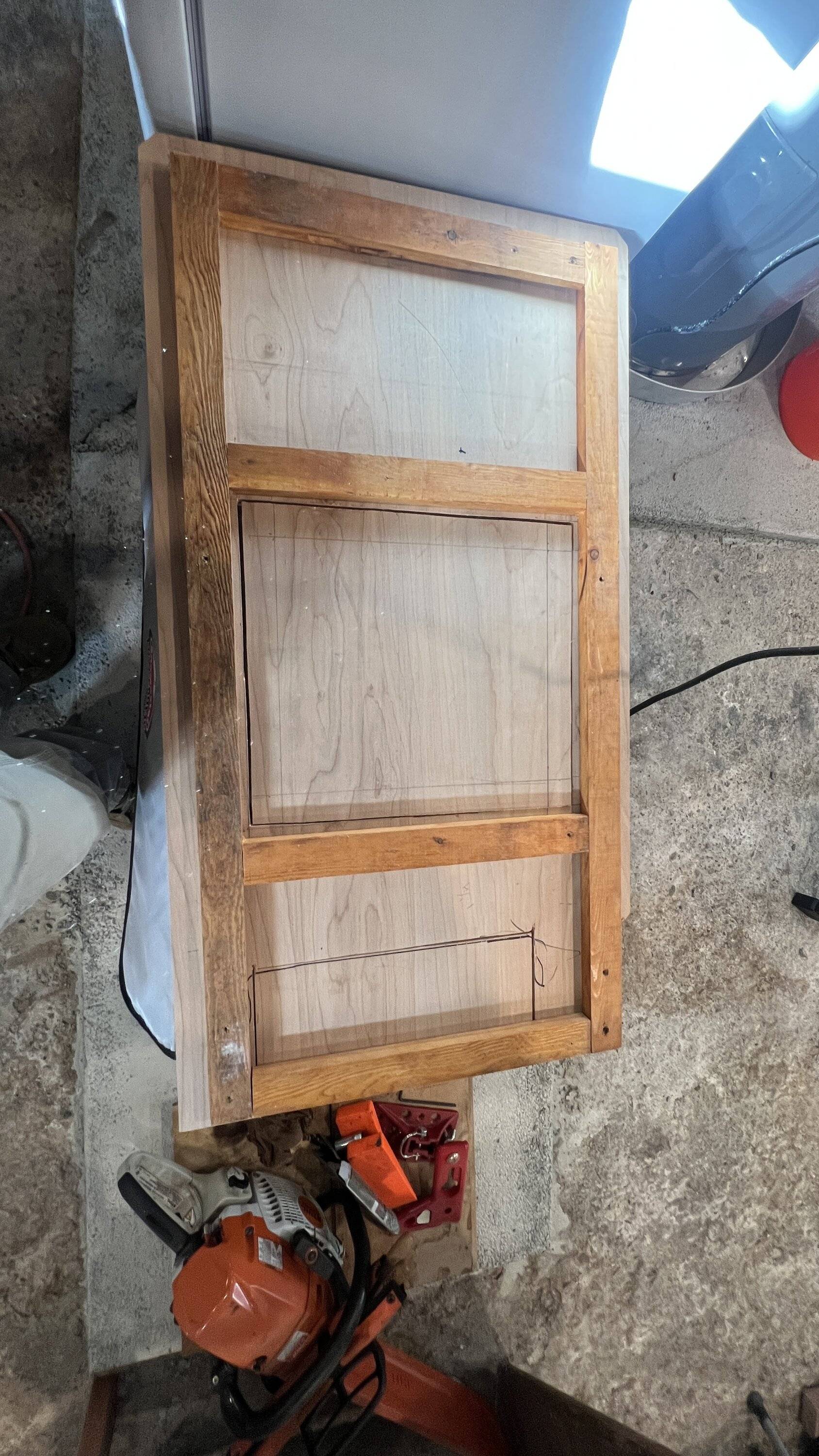
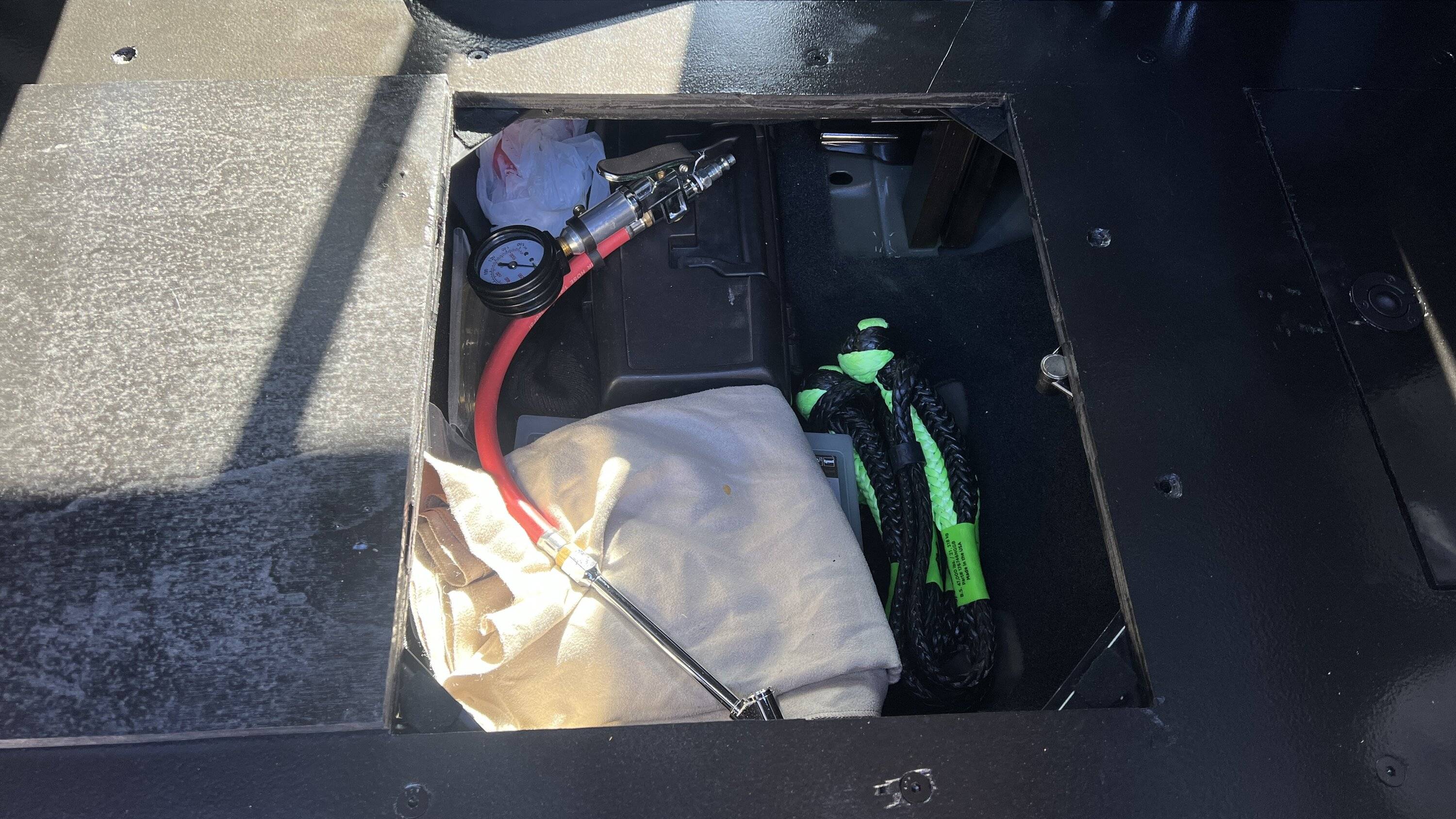
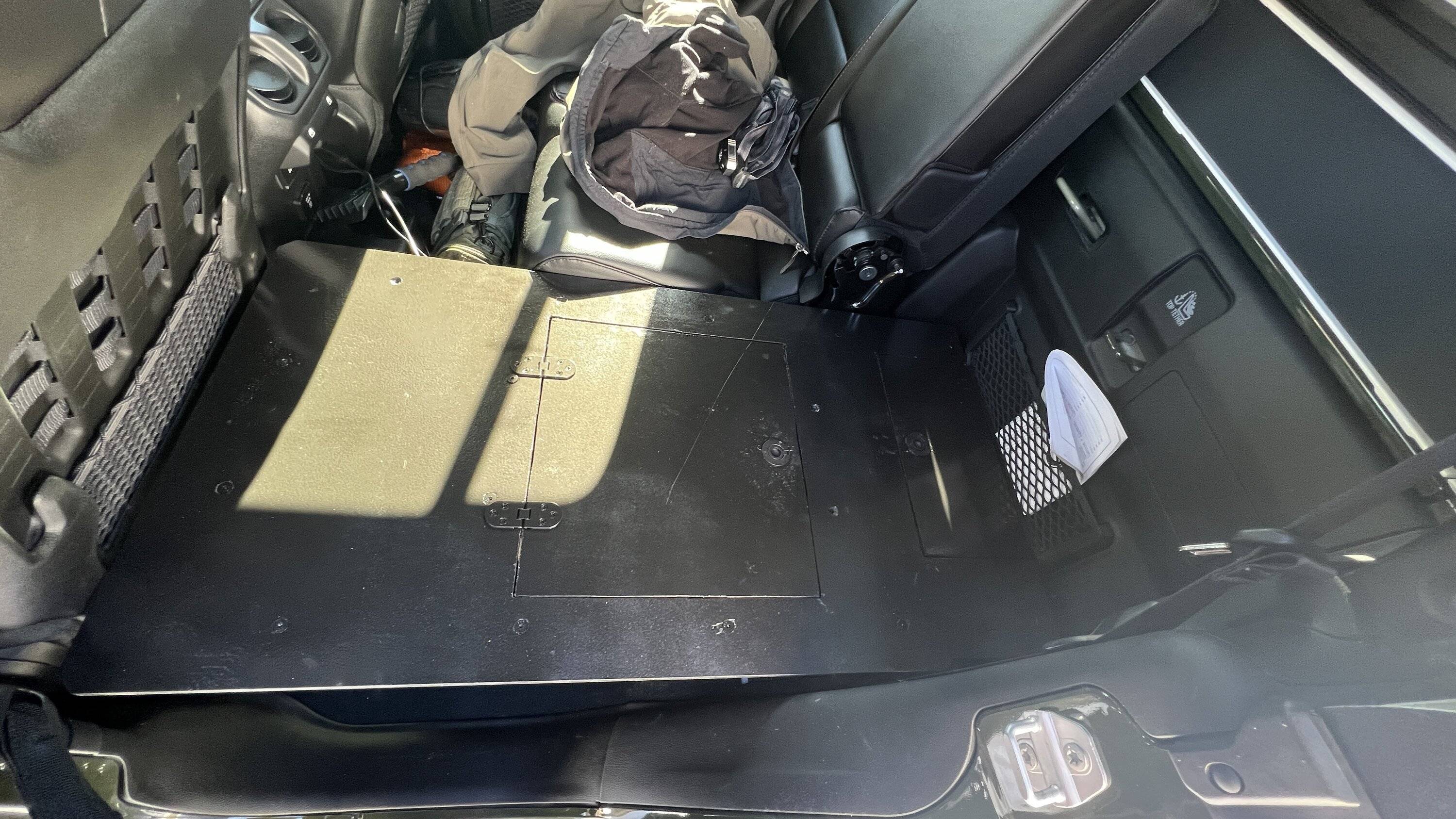
Then I made more measurements, and thought on it for a few days of how I wanted it to work. The idea, for me, is to have more storage options over having a platform. Although having a flat space to haul groceries and things will be nice. So I am making the platform taller - similar to the high option goose gear offers. Of course this will certainly make it more difficult and complex to tie down into the vehicle. I also wanted to take advantage of the rear plastic pocket thing normally behind the seat. So I made a door hatch for that spot, as well as for the area around the factory under-seat cargo box. I have not decided yet on if I want to have another hatch for the front area, or just leave the side open and accessible - that would be the easiest method of course.
Jeep Gladiator Destination Unknown - 2022 JTR journal IMG_9965.JPG

Jeep Gladiator Destination Unknown - 2022 JTR journal IMG_9966.JPG

Jeep Gladiator Destination Unknown - 2022 JTR journal IMG_9968.JPG

Jeep Gladiator Destination Unknown - 2022 JTR journal IMG_9969.JPG


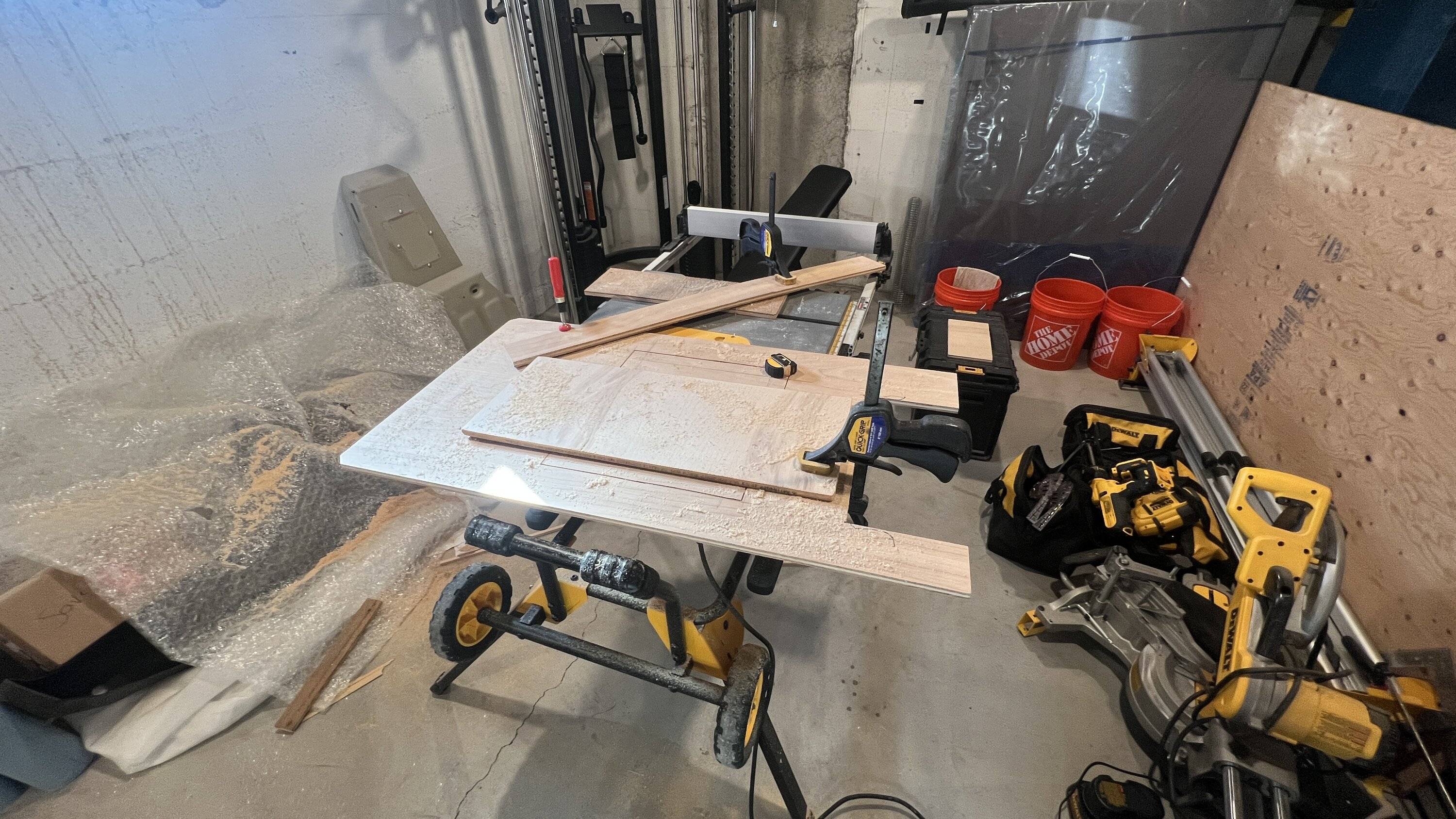
Once it was cut out, a test fit showed it was pretty good. Good thing too because I only had one piece of Birch! The rearmost hatch ended up being a little larger than planned but it will work plenty good. Now I just needed to sort out a good method of framing. This is important so that it can handle some weight, as well as tie-down brackets, and prevent all that force from being applied solely to the plywood. So using some 1X2's I had lying around as a stencil, I cut out what I thought would be a good frame. The idea with the frame is to support plenty of weight, while being able to allow for hinges and door stops. Thanks to another member here, I will be ordering from https://8020.net/ as they will cut to length each piece for you! Since I don't really have a good aluminum saw, that will be super beneficial and reduce further work. Now do keep in mind this is 1X2, and I think I will be using just 1X1 for the extruded since it should be more than strong enough.
Jeep Gladiator Destination Unknown - 2022 JTR journal IMG_9970.JPG


So, off to placing orders we go.... Updates coming when parts arrive.
 

Sponsored
OP
OP
chorky

chorky

Well-Known Member
First Name
Chad
Joined
Feb 26, 2022
Threads
175
Messages
3,466
Reaction score
3,801
Location
Montana
Website
www.youtube.com
Vehicle(s)
'22JTR, '06 LJ, '06 TJ GE
Build Thread
Link
Occupation
GIS Specialist
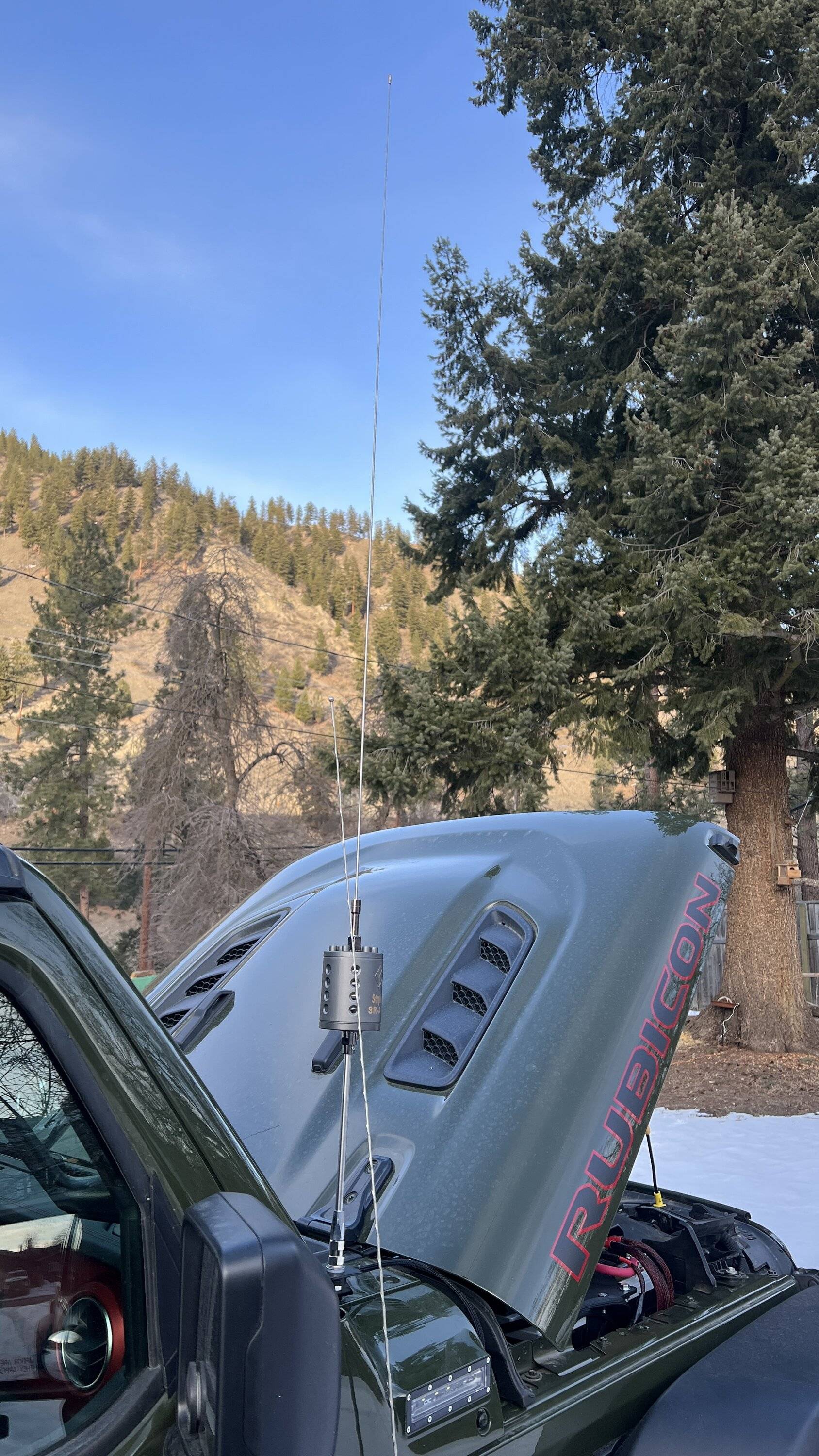
Some parts arrived yesterday - the fire stick fire ring coax. So I was able to get the CB antenna installed and tested. I was a bit rushed so didn't get good pictures like I did for the GMRS, but the process was relatively the same. The EVO mount bolt hole had to be opened up from 3/8 to 1/2 inch. This was to accommodate the plastic isolators found on the fire stick ring mount. Unfortunately I didn't paint it (details below) so hopefully that doesn't end up being a problem. I opted to use the ring mount as using other styles of coax (where you have to ground manually) never really netted the best SWR results. Plus, this looks a lot smoother and is more streamline and better protected from the elements.

However, I did encounter a situation I am not super fond of. The top side of the fire ring has a metal plate that physically touches the EVO mount. This is for the ground plane, and there should be consistency with the outside coax wiring, this, all the way through the body of the vehicle. I had a hard time getting a good connection for continuity. This was due to the EVO mount being painted of course. I really was hesitant to remove any paint as that leads to rust - but there wasn't any way around it.... So I had to grind off some of the paint on the bottom side for a good connection. I really hope this doesn't cause issues in the long run but I probably will have to check SWR a few times a year to be sure, which is unfortunate. Either way, the antenna looks great! As you can see, I did opt to only use one of the 10" mast below the coil. I did try it out with the other 10" mast for a full 20" but it seemed to put quite a bit more strain on the base mount, and I just wasn't comfortable with that. Hopefully this will work well enough for my needs.

Jeep Gladiator Destination Unknown - 2022 JTR journal IMG_9986


I also didn't take pictures of routing the coax to the inside of the vehicle as it is essentially the same as how the GMRS cable went. Fortunately there was plenty of room for the CB coax to go alongside the harness for the G-Screen! Without any protruding plastic panels.

So next was checking continuity of the CB antenna. After soldering the PL connector (I did not yet cut to length as the location might move for the radios a few feet) I found resistance to be 0.00 between coax center wire and the antenna base, and resistance to be about 0.03 between the outside of the PL connector and a body ground. This seems plenty good. So hooking up wires, it was time to check and tune SWR.

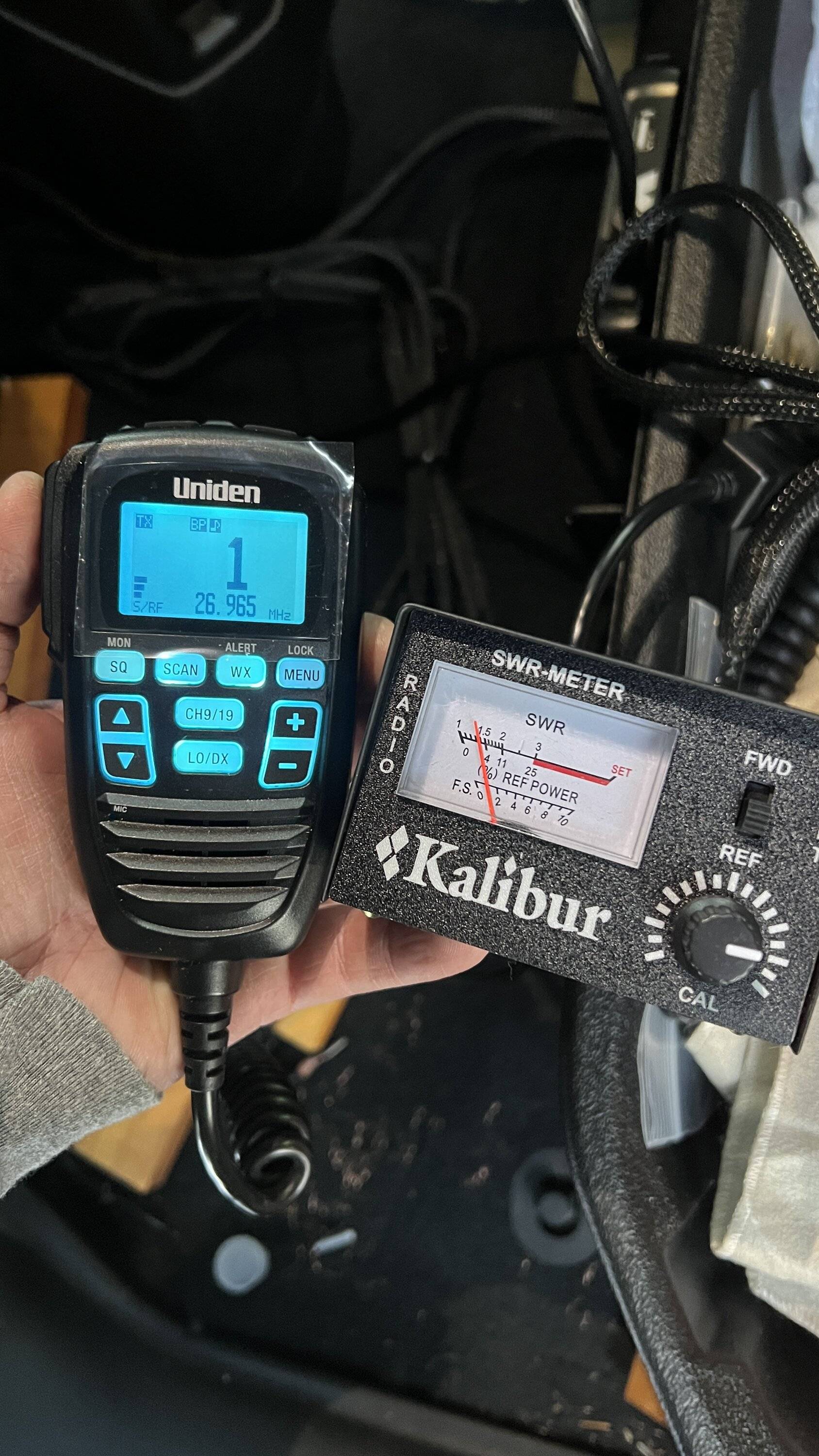
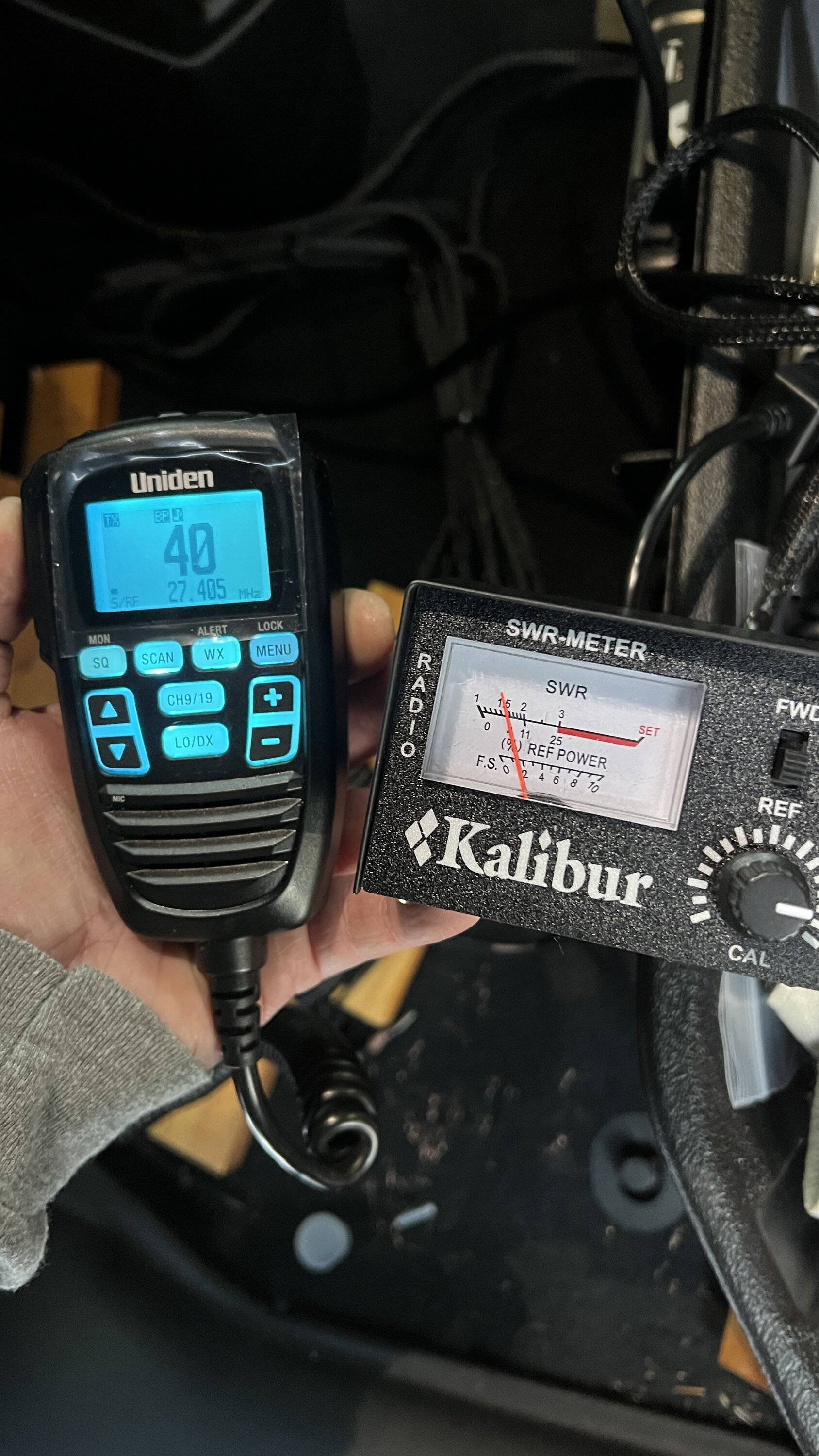
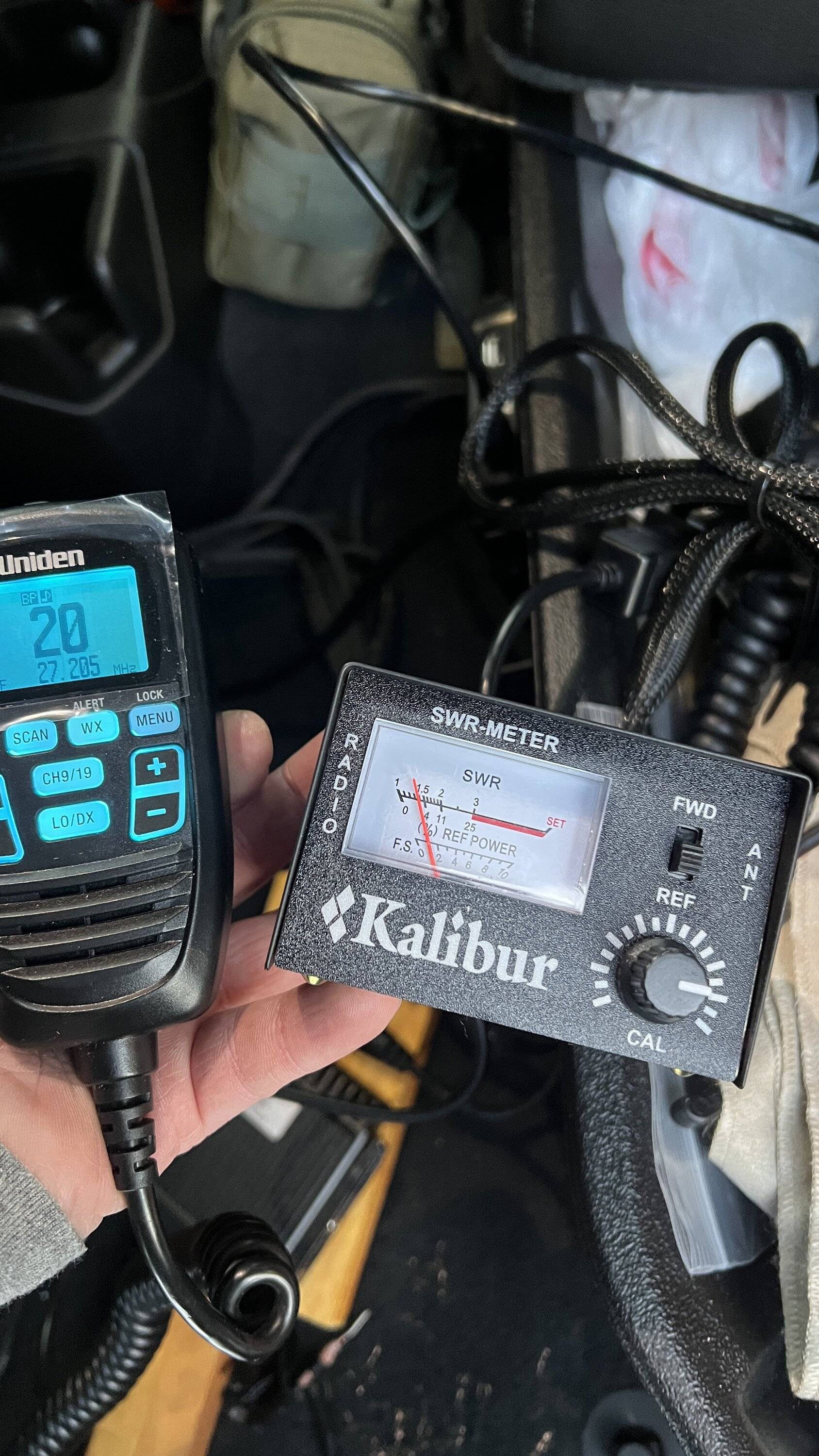
Unfortunately I did have to cut some of the whip down. Probably about 3/4 to 1 inch in total. Kinda surprising actually. But, SWR readings were within spec! I wish they could get lower, and be as good as the GMRS readings though, but I have a feeling it's due to the ground resistance.

I was hoping to get CH 1 at or below 1.25, but I didn't want to cut anymore until after adjusting the coax to length....
Jeep Gladiator Destination Unknown - 2022 JTR journal IMG_9988

Jeep Gladiator Destination Unknown - 2022 JTR journal IMG_9989


And as per Stryker, CH 20 is at or below 1.5 - so it should work sufficiently for now.
Jeep Gladiator Destination Unknown - 2022 JTR journal IMG_9987


Jeep Gladiator Destination Unknown - 2022 JTR journal IMG_9987
 
OP
OP
chorky

chorky

Well-Known Member
First Name
Chad
Joined
Feb 26, 2022
Threads
175
Messages
3,466
Reaction score
3,801
Location
Montana
Website
www.youtube.com
Vehicle(s)
'22JTR, '06 LJ, '06 TJ GE
Build Thread
Link
Occupation
GIS Specialist
After building some active haul maps at work today, and then loosing AAALLLLLLLLL my GIS data I hung up the day early in frustration - better luck tomorrow I guess.

SO, I opted to continue work on the Jeep and change my thought process. First thing I did was hook up the SWR meter on the GMRS and test it out. I am happy to report that I have a SWR reading of just below 1.5 on CH 1, CH 40 and CH 20 thanks to help from @Radio Guy. Hopefully some functional testing will come soon. I also noticed that the Uniden CB remembers its last state before loosing power. Meaning, as it and the GMRS is hooked up to my aux 1 switch with ign on power, when I turn on the truck the CB also turns on to its last state. This is a awesome feature. Unfortunately the GMRS requires the purchase of a $90 mic and the USB-C version of the 275 or 575 to have the same feature.

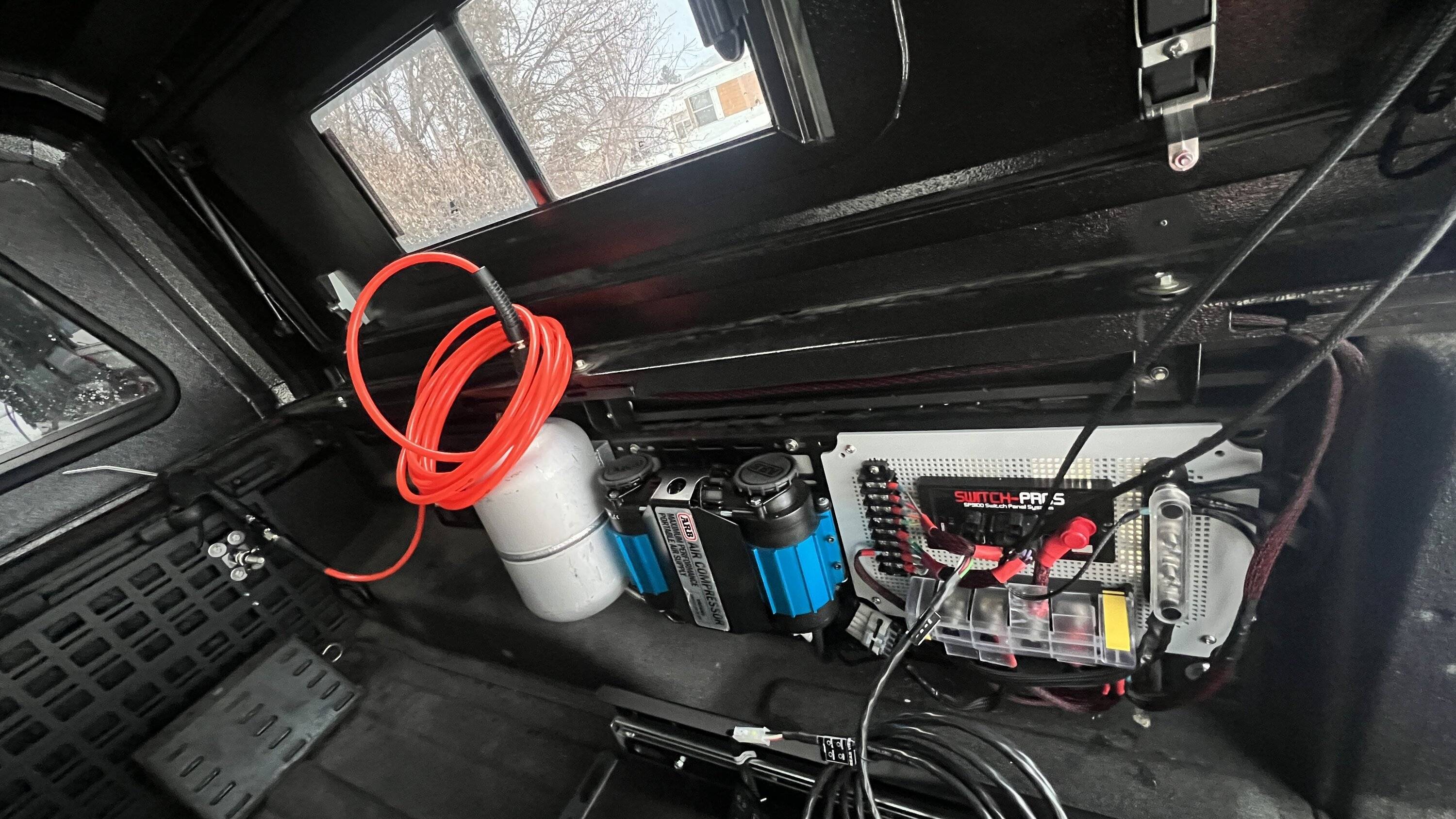
Today some much needed parts arrived! I have waited nearly 4 weeks so this was a happy sight! Perfect contrast to the GIS debacle. Another Switch Pros panel. There are plenty of options to choose from but I really am happy with the low profile of this system for all my off road lights, so figured it would be good to use for all my 'house' items as well. I have of course had this layout and thought in mind for some time. Months ago, when figuring out where and how to mount the ARB compressor and tank, I opted to mount the tank slightly forward in order to leave room for electrical wiring. This seemed like the most convenient and appropriate place to me as the port through the bed (for the factory 115v inverter) is unused. As stated a few posts back, I ran 4ga wire (+ and -) into the bed through some grommets and this bed port. Also running through is aux 2 power to signal the compressor relays to close - so that power is not always flowing. The 4 ga wire is fused by a block fuse conveniently directly on the Genesis System's aux lugs via a 125a fuse. This should provide plenty of power for all the bed accessories, the compressor, an additional battery if desired, and an inverter if desired (not all at the same time of course).

So the Switch Pros system is really key in putting it all together. I put together as much as possible on the bench inside since it's rather difficult to access things on the Jeep.
Jeep Gladiator Destination Unknown - 2022 JTR journal IMG_9990


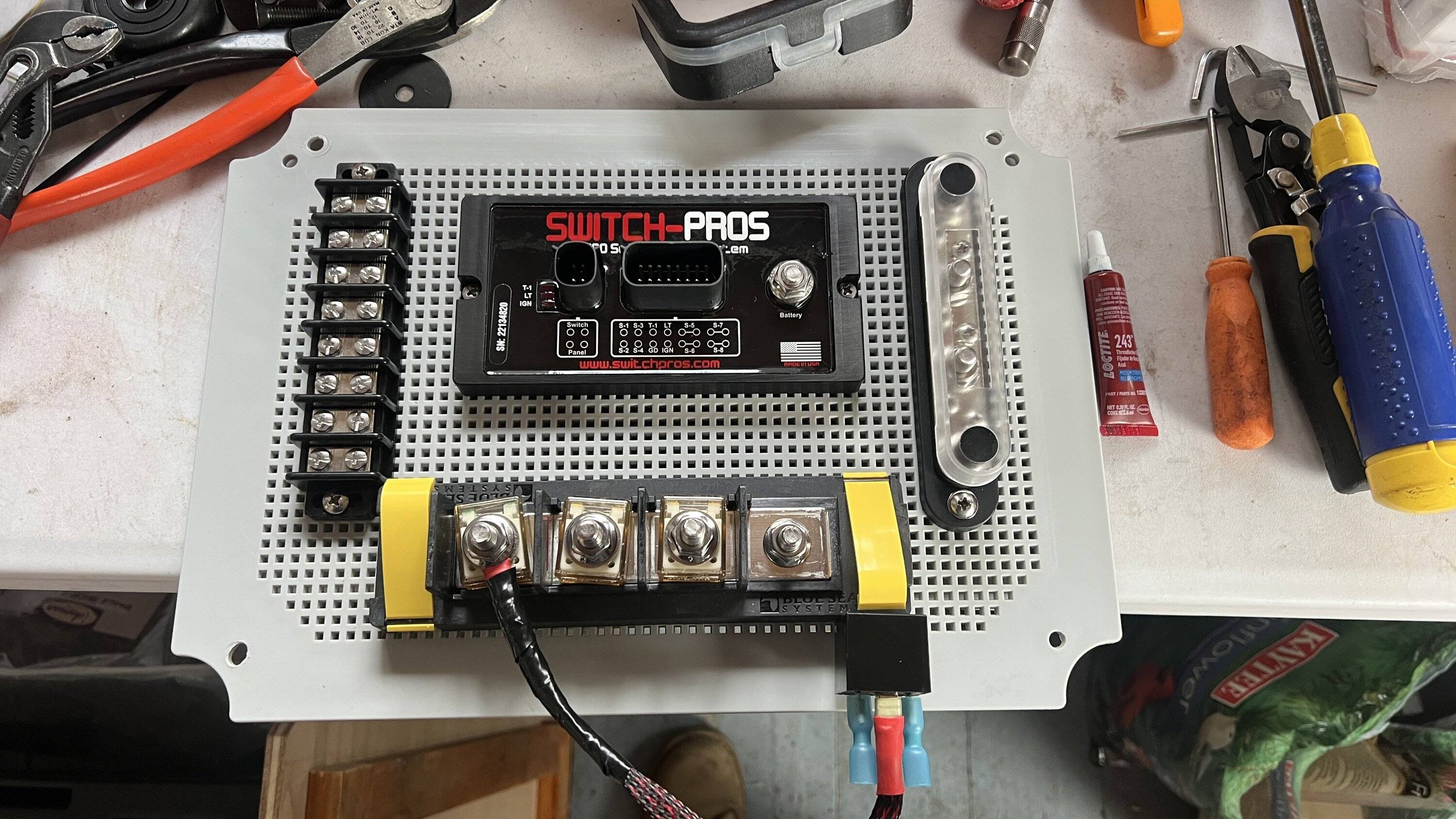
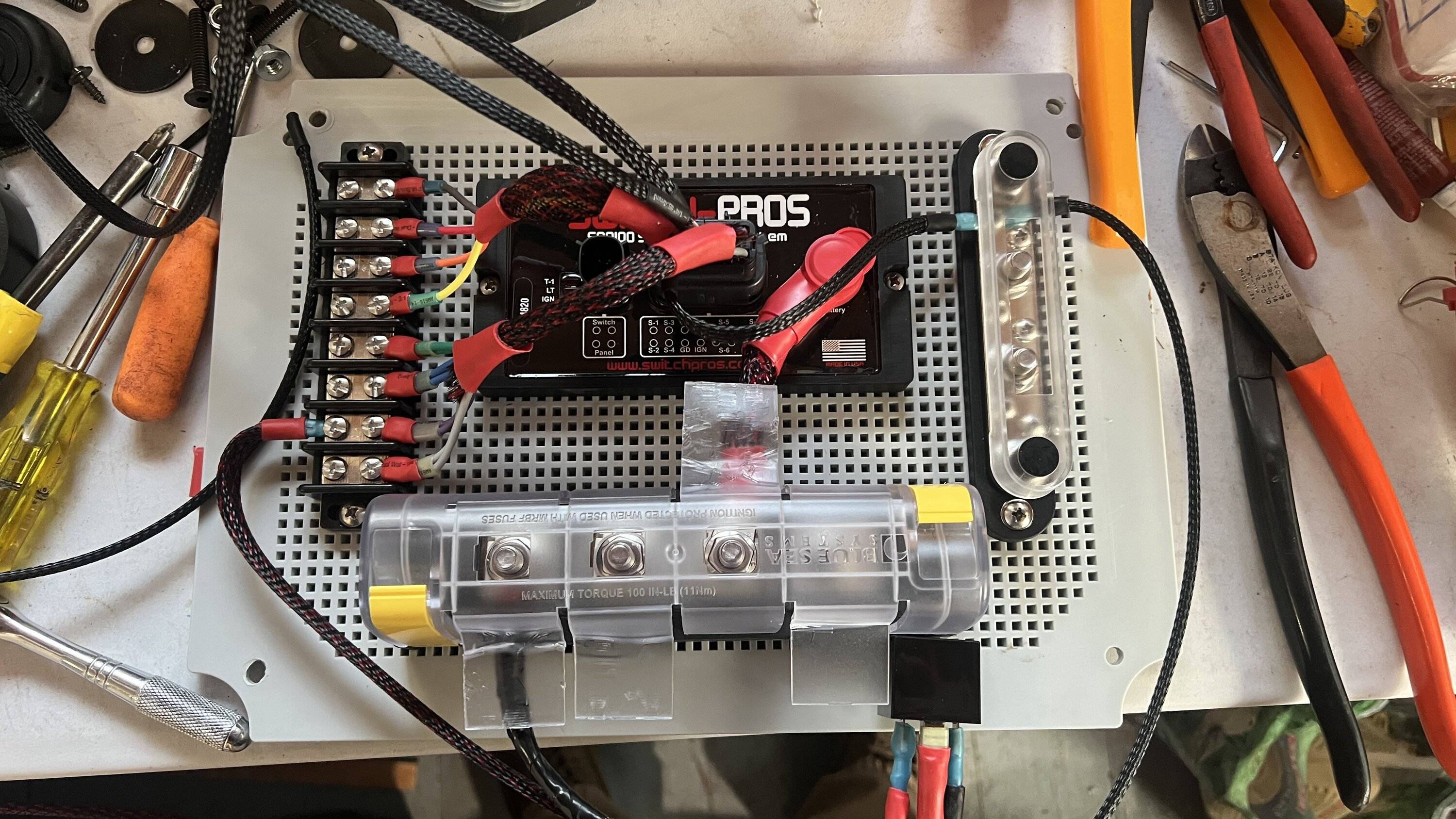
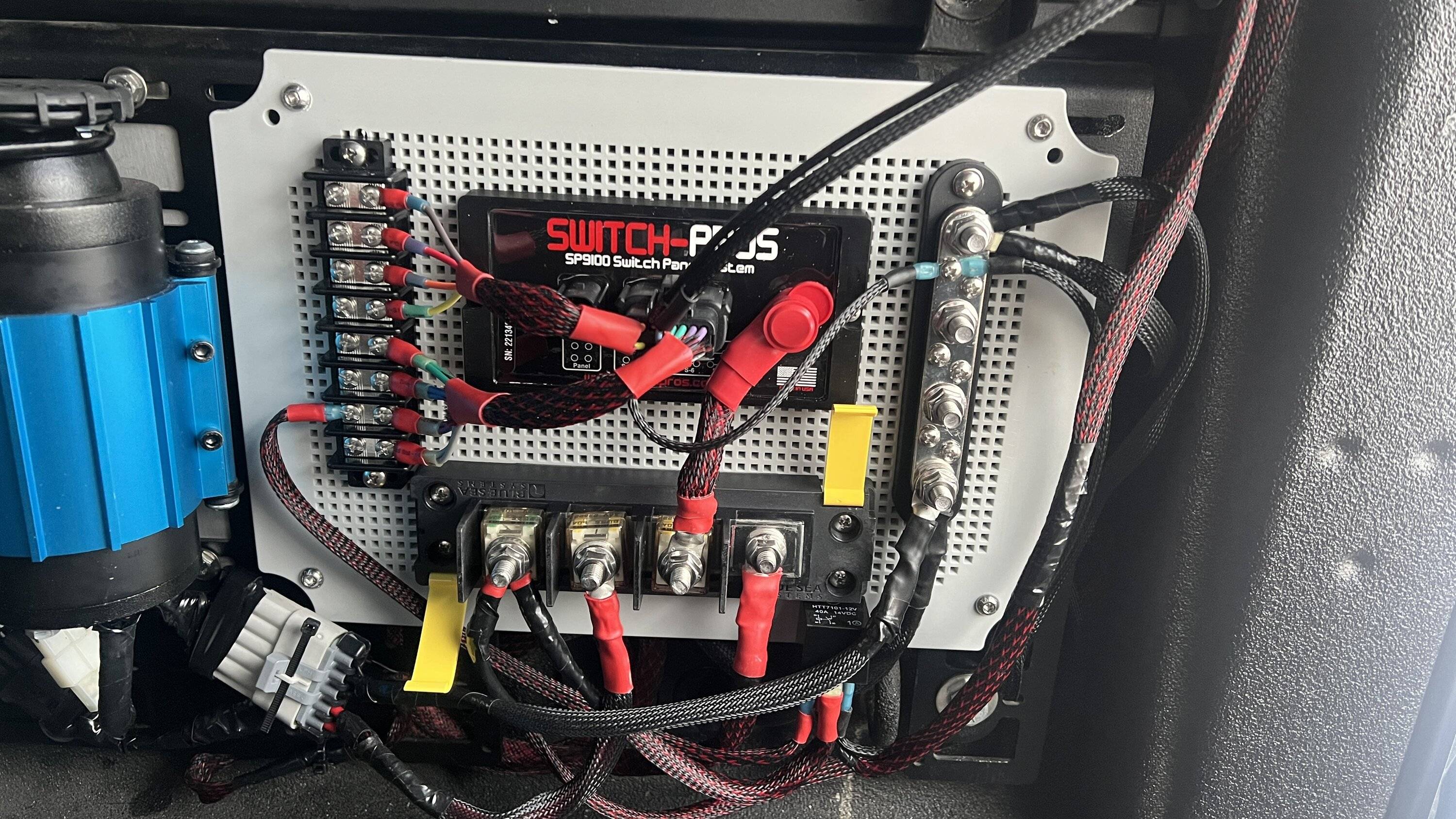
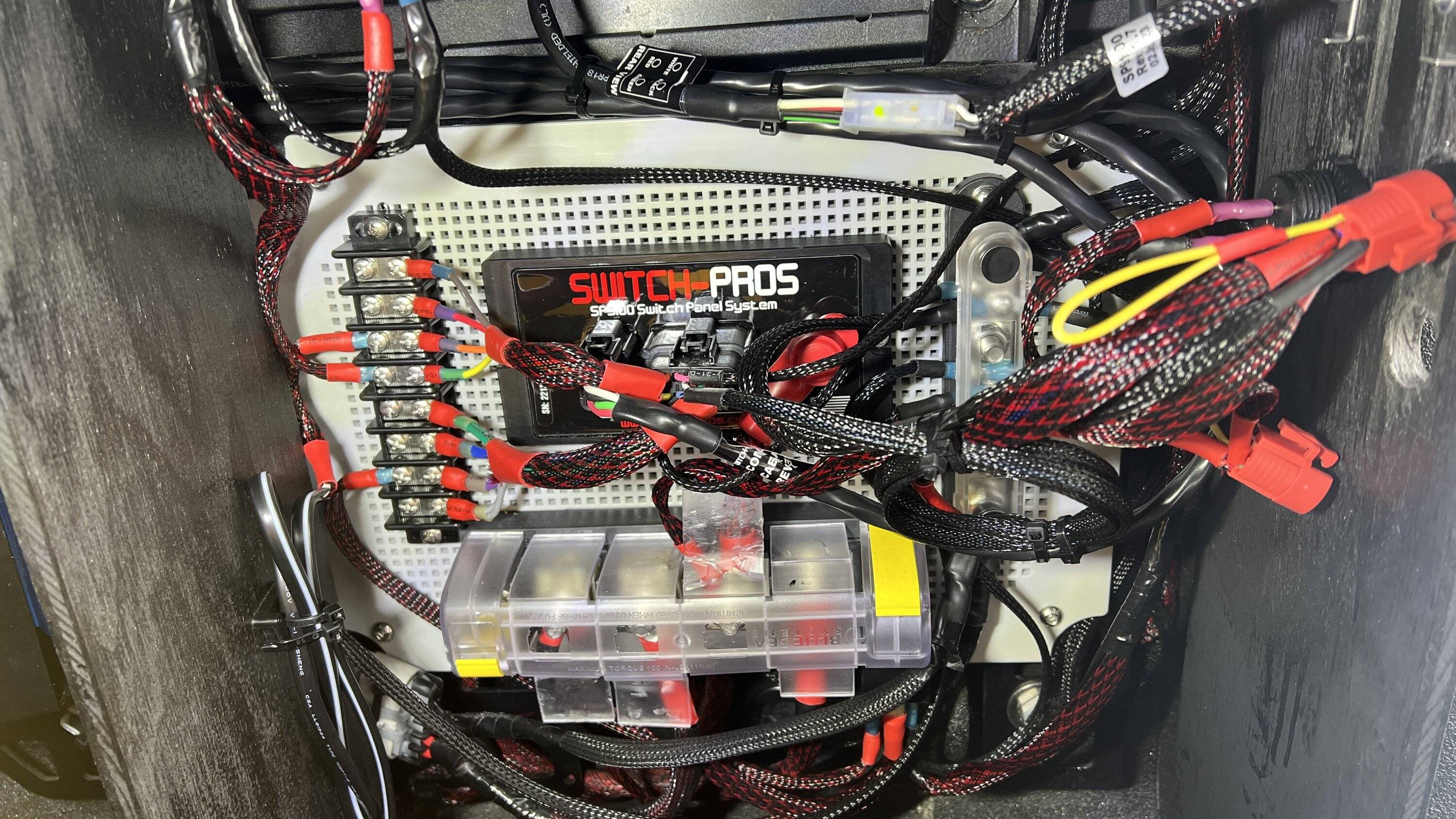
Next I started pre-wiring. I already laid out what switches I want to operate what, so that was relatively easy. I chose to use the buss bar's because it will make hook up and removal much easier. Each item of course will have some type of connector in addition to these buss bars for seamless removal (such as the fridge) even though all items are really planned to remain in the bed at all times throughout the year. And if you pay attention to the bottom right of the Blue Sea + buss bar you will see a standard 40a relay. The purpose of this is to open/close power flow to the SAE port. If you recall, I added a SAE port above the NOCO 110v input. The NOCO input of course goes to the 7a CTEK battery charger/maintainer, while the SAE port is available for future options of either solar, or a battery charger if higher amperage is needed, etc... The CTEK plugs onto the left most 3/8 lug on the Blue Sea + buss bar. The SAE port connects to 12 ga wire, passes through the 40a relay, and then plugs into the same 3/8 lug. This lug is fused to 30a which is the lowest I could find for a block fuse. It should work good enough to prevent problems. Now the 40a relay will be powered (closed) by switch 7 of the Switch Pros - so that, even though it will require a tad bit of power, when hooked into solar or some other source, I can close the relay allowing power to flow to the SAE port. Otherwise that port would be hot at all times, and that's something I really did not want.
Jeep Gladiator Destination Unknown - 2022 JTR journal IMG_9991


In addition to the 125a fuse on the aux battery lug under the hood, the Switch Pros itself is fused at 60a, and the currently open lug has another 60a fuse for the ARB compressor. In the future, I can opt to connect another wire or two to the main + lug (unfused) and run it to another bed mounted battery, and/or a inverter - as they will be fused by the main underwood 125a fuse. I already did do the math based on most likely use and it should be plenty safe. For that 125a fuse to blow I would have to run the compressor, and an inverter, and nearly all the accessories the Switch Pros will power. Realistically, the switch pros should only be a 30a fuse, which is on order.

Additionally, I have, and will install, a 4 way blue sea battery selector switch which will allow the option of adding an additional AGM OR Lithium battery in the bed. So with an AGM I could run the Switch Pro's off of the Genesis aux battery, or a in bed AGM battery, or both the Genesis aux and an in bed AGM battery or a in bed lithium battery. So, this is providing me with MANY options.
 
Last edited:
OP
OP
chorky

chorky

Well-Known Member
First Name
Chad
Joined
Feb 26, 2022
Threads
175
Messages
3,466
Reaction score
3,801
Location
Montana
Website
www.youtube.com
Vehicle(s)
'22JTR, '06 LJ, '06 TJ GE
Build Thread
Link
Occupation
GIS Specialist
Well after working half the day since the weather was not optimum for working on the Jeep, it finally cleared up enough to get the electrical panel back in.

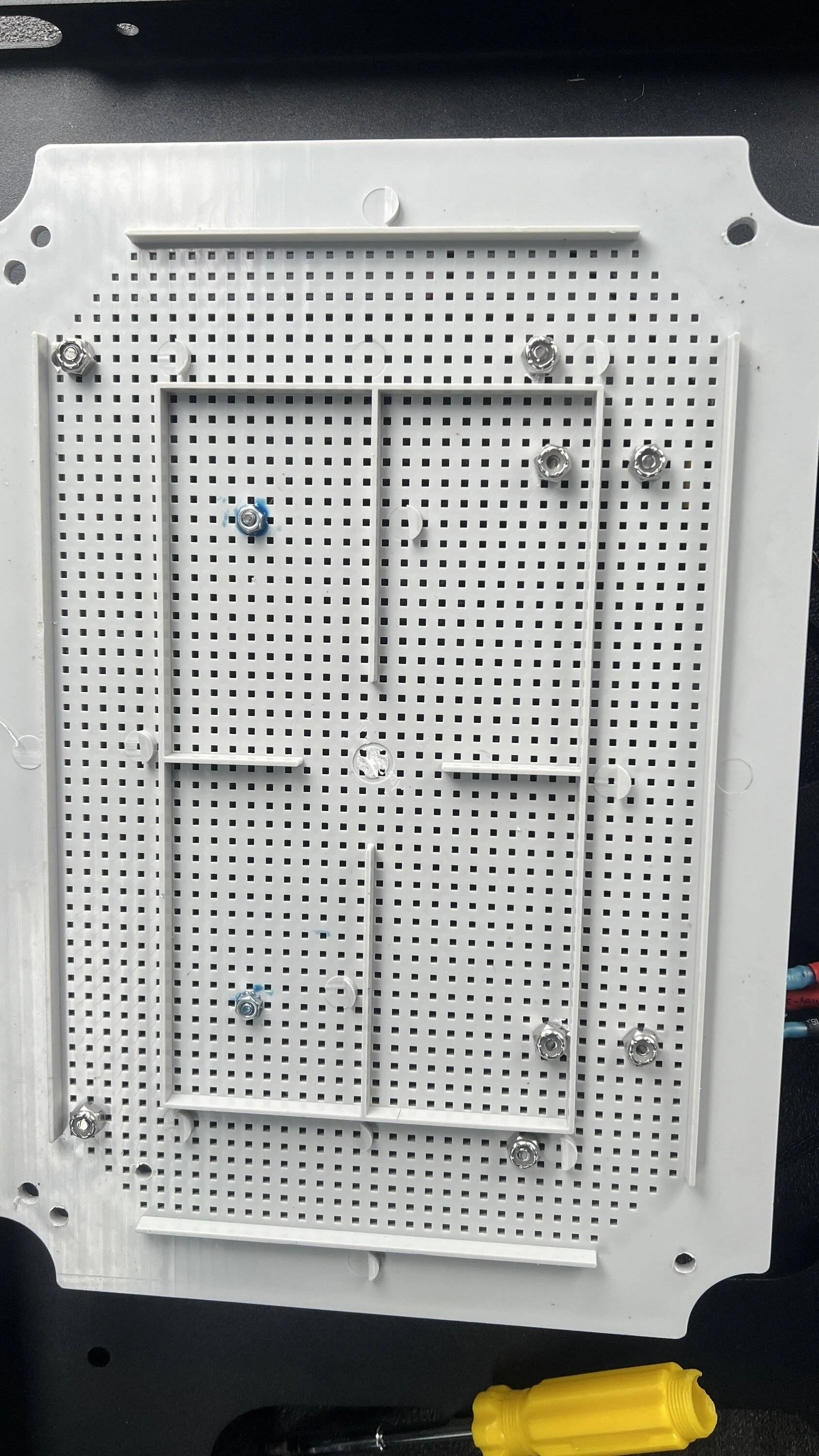
The back of the panel is pictured here. This is the reason I decided on this plastic panel in the first place. It has plastic ridges to act as a standoff from whatever the panel is mounted to. This provides me with just enough room for locknuts to attach items securely without those nuts rubbing against whatever I opted to mount this to - in my case, the 813 mole panel. You can see that the nuts are not on too deep but they are on very tight - hopefully they stay put! I put extra measures of blue locktite on the Switch Pro's panel for safety.
Jeep Gladiator Destination Unknown - 2022 JTR journal IMG_9996


It went back in easier than it came out despite the fridge slide being in the way, so I was pretty happy about that. And a quick test revealed the system to be working. The wiring looks a little complex because it's in a confined space, but it's pretty straight forward. Main power comes in to the buss +, and power exists through the other buss -. Power flows through whatever sized fuse is appropriate. I did change the fuse under the hood from 125a to 100a as thats appropriate for the 4ga wire and should be more than enough for my needs. A 30a fuse is on the way for the Switch Pros as it currently has a 60a. The 60a fuse for the ARB compressor after just 3 minutes of it running did not blow, so that's great. Although longer and more intense tests are needed. The standard fuse from ARB in their harness is 80a, and the compressor itself pulls a max of 55a - so I'm only 5a over to allow for resistance. I have a feeling it might not be enough, but I can step up to a 75a fuse if necessary which still puts it below the factory rating. And if it does blow, or not, it will give me a good indication of where its amp draw truly is to make other calculations and make sure I'm not exceeding the wire capacity.
Jeep Gladiator Destination Unknown - 2022 JTR journal IMG_9998


The biggest issue now is finding the best place to mount the control panel. I really wanted to mount it at the right rear corner of the canopy, so basically facing at an angle toward the driver seat. This would allow access from either the rear or the side of the canopy, and I could even see it while driving in the rear view mirror to, say, make sure the fridge is on. Most likely, I will just cut some plywood, paint it, and make a cover over the front of the electrical panel and just mount the control module to that. But it would be nice to build a box out of extruded alum - maybe in the future.
Jeep Gladiator Destination Unknown - 2022 JTR journal IMG_0001


It feels great to have the compressor working again - you just never know....

And a little teaser......
Jeep Gladiator Destination Unknown - 2022 JTR journal Screenshot 2023-02-18 at 18.45.43
 
OP
OP
chorky

chorky

Well-Known Member
First Name
Chad
Joined
Feb 26, 2022
Threads
175
Messages
3,466
Reaction score
3,801
Location
Montana
Website
www.youtube.com
Vehicle(s)
'22JTR, '06 LJ, '06 TJ GE
Build Thread
Link
Occupation
GIS Specialist
Today I finished the rear seat delete platform. Well, except for 3 bolts I need to get and put in.

Overall, it will work just fine. There are a handful of things that really didn't turn out the way I wanted. I think, considering the time spent in creating it, had I had a full wood shop with all the cool tools it would have gone significantly better, but since I don't, likely it will get replaced with a goose gear in the future. I don't think the money saved, for my situation, was worth the frustration and cost of materials.

Continuing from post #35 I opted to not use extruded aluminum. I really wanted to, but after figuring all the parts needed, and putting them in the cart - the cost couldn't be justified considering I could have put that toward a much nicer goose gear. The point of doing this myself was to have a more budget friendly option. So, I started trilling holes and picked up some bolts to use the 1X2 boards as the frame.
Jeep Gladiator Destination Unknown - 2022 JTR journal IMG_0009


I opted to use a 1/2" bit to help countersink the bolts, and it worked well
Jeep Gladiator Destination Unknown - 2022 JTR journal IMG_0010


Next it was time to paint and start putting it together. The bolts went together just fine and added some good structure.
Jeep Gladiator Destination Unknown - 2022 JTR journal IMG_0020

Jeep Gladiator Destination Unknown - 2022 JTR journal IMG_0021


I also added some brackets to serve as structural support as well as a base for the center door to sit on. They work plenty well.
Jeep Gladiator Destination Unknown - 2022 JTR journal IMG_0029


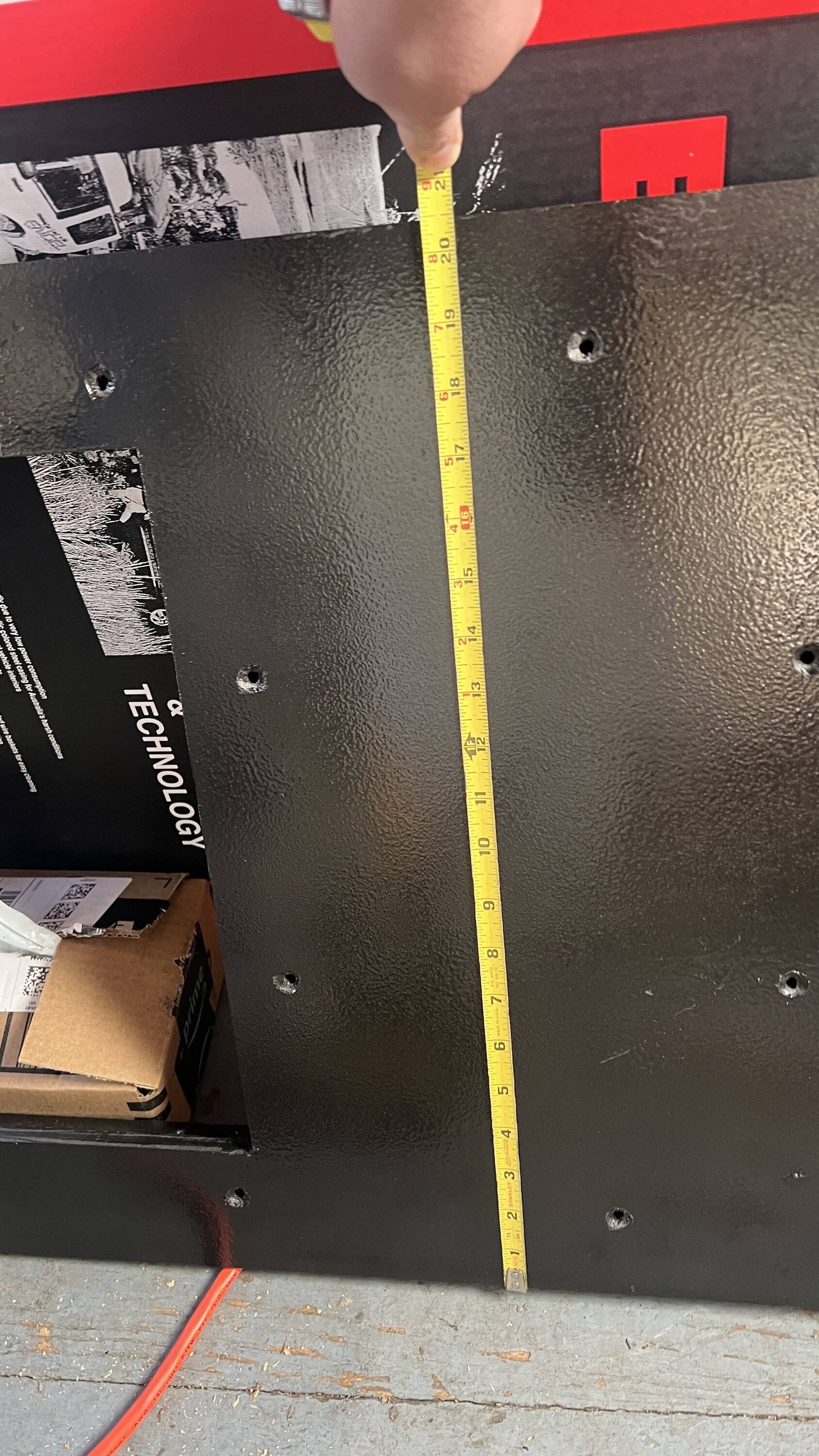
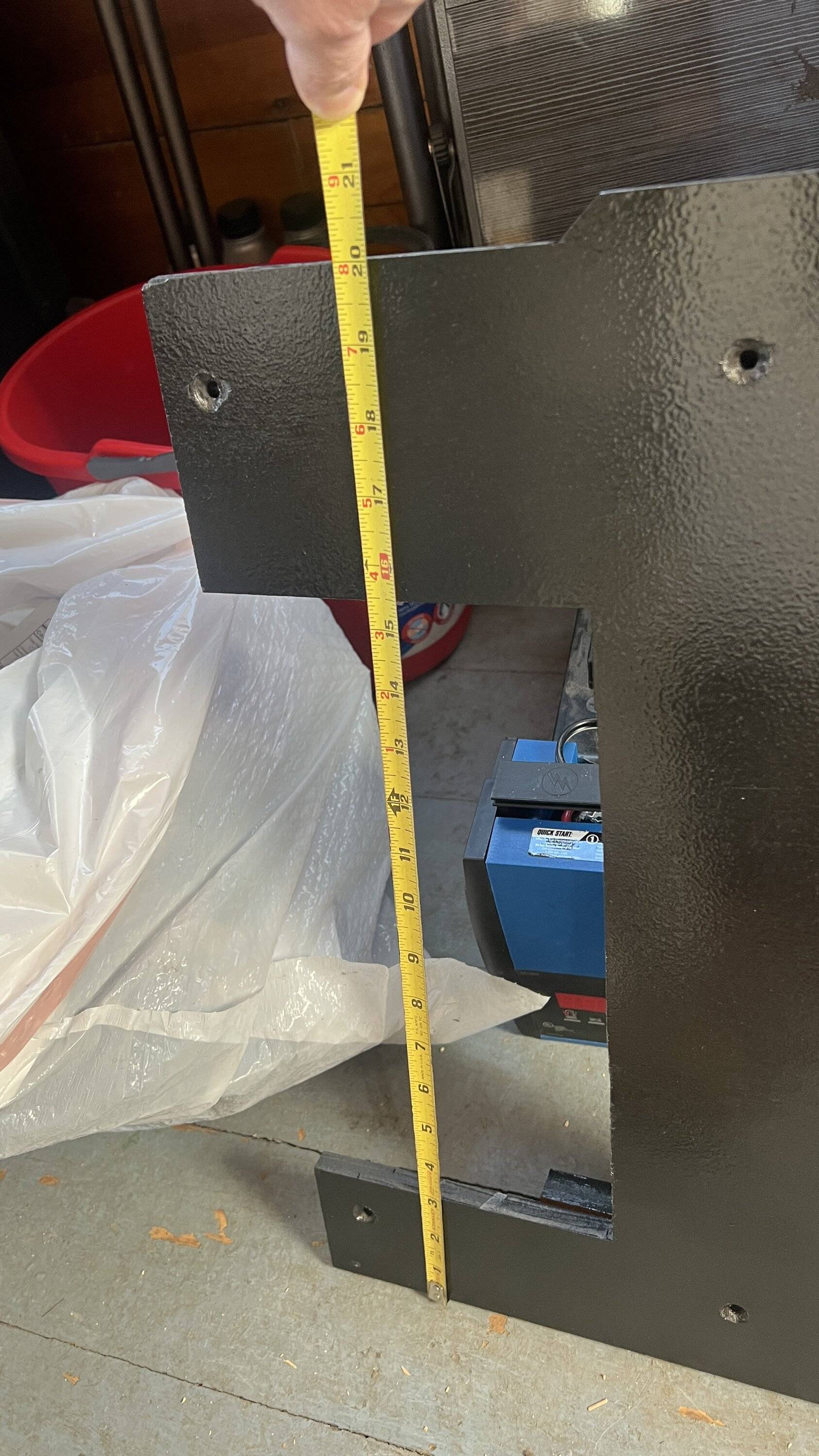
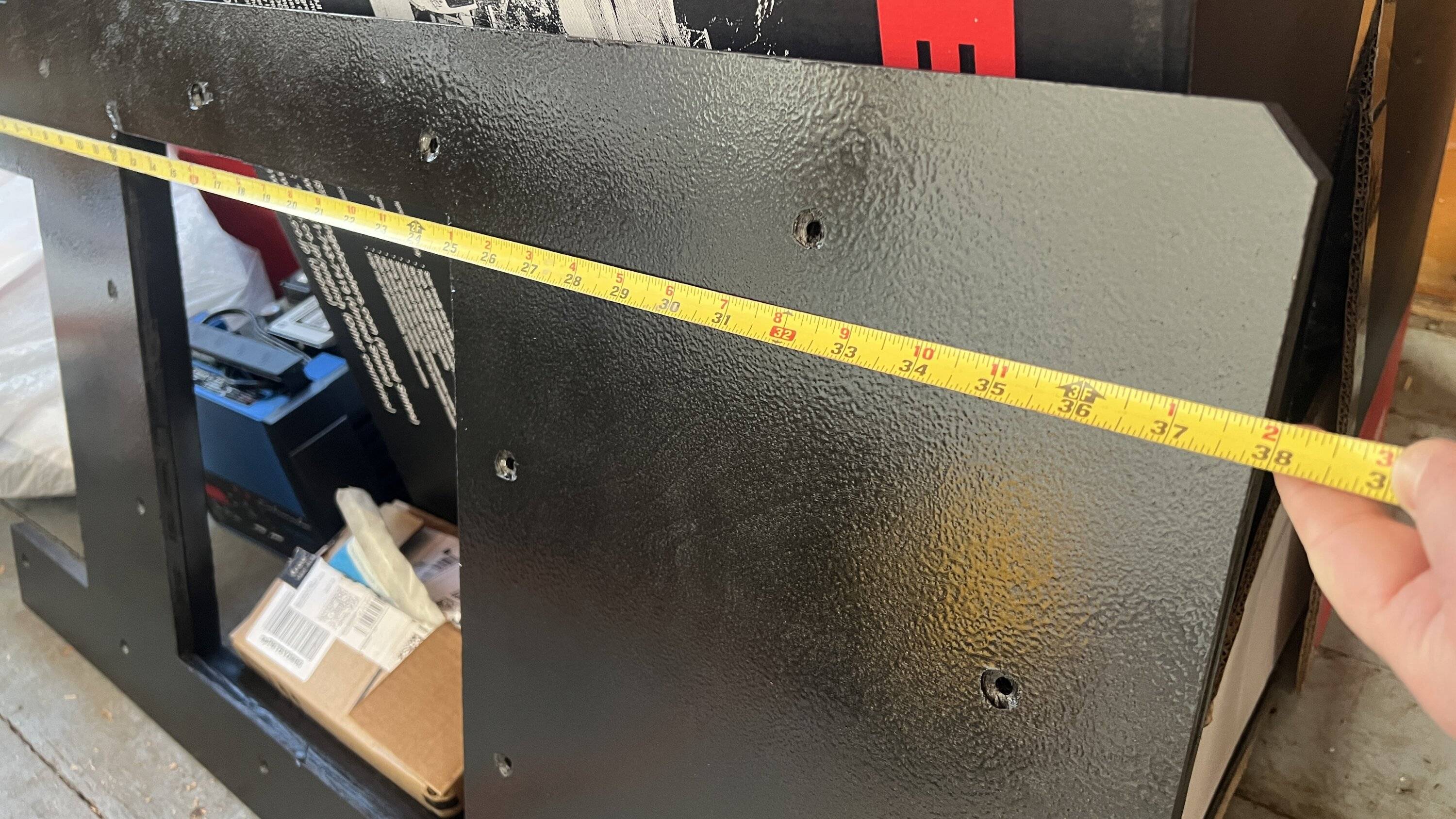
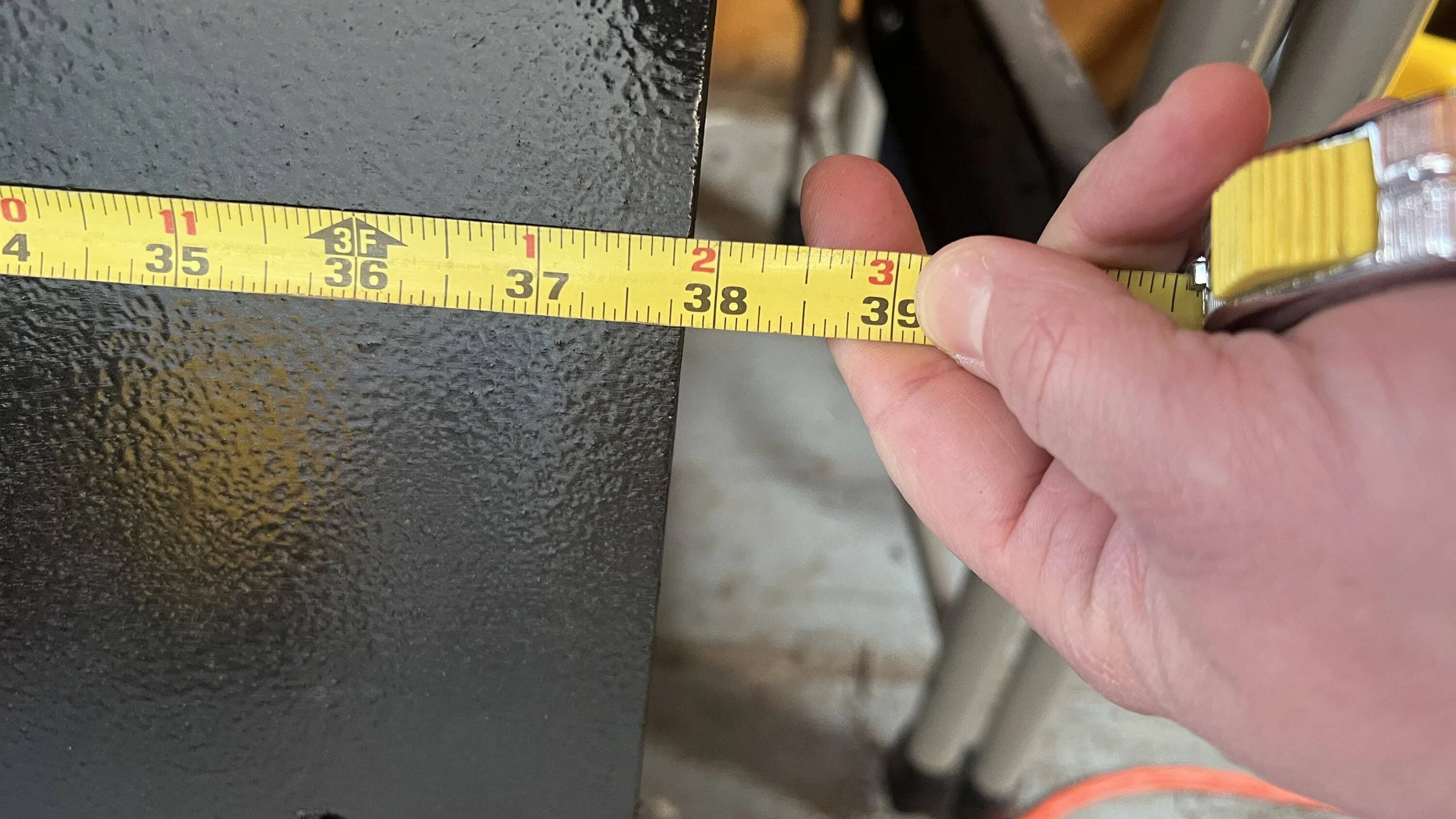
Also, another forum member was asking about dimensions so I figured I would post some here. The goose gear setup is likely shorter and wider, but I was not interested in making fancy angles and cuts. This will suffice just fine and with the door closed, gets pretty close to the door panel itself.
Jeep Gladiator Destination Unknown - 2022 JTR journal IMG_0022

Jeep Gladiator Destination Unknown - 2022 JTR journal IMG_0023

Jeep Gladiator Destination Unknown - 2022 JTR journal IMG_0024

Jeep Gladiator Destination Unknown - 2022 JTR journal IMG_0025


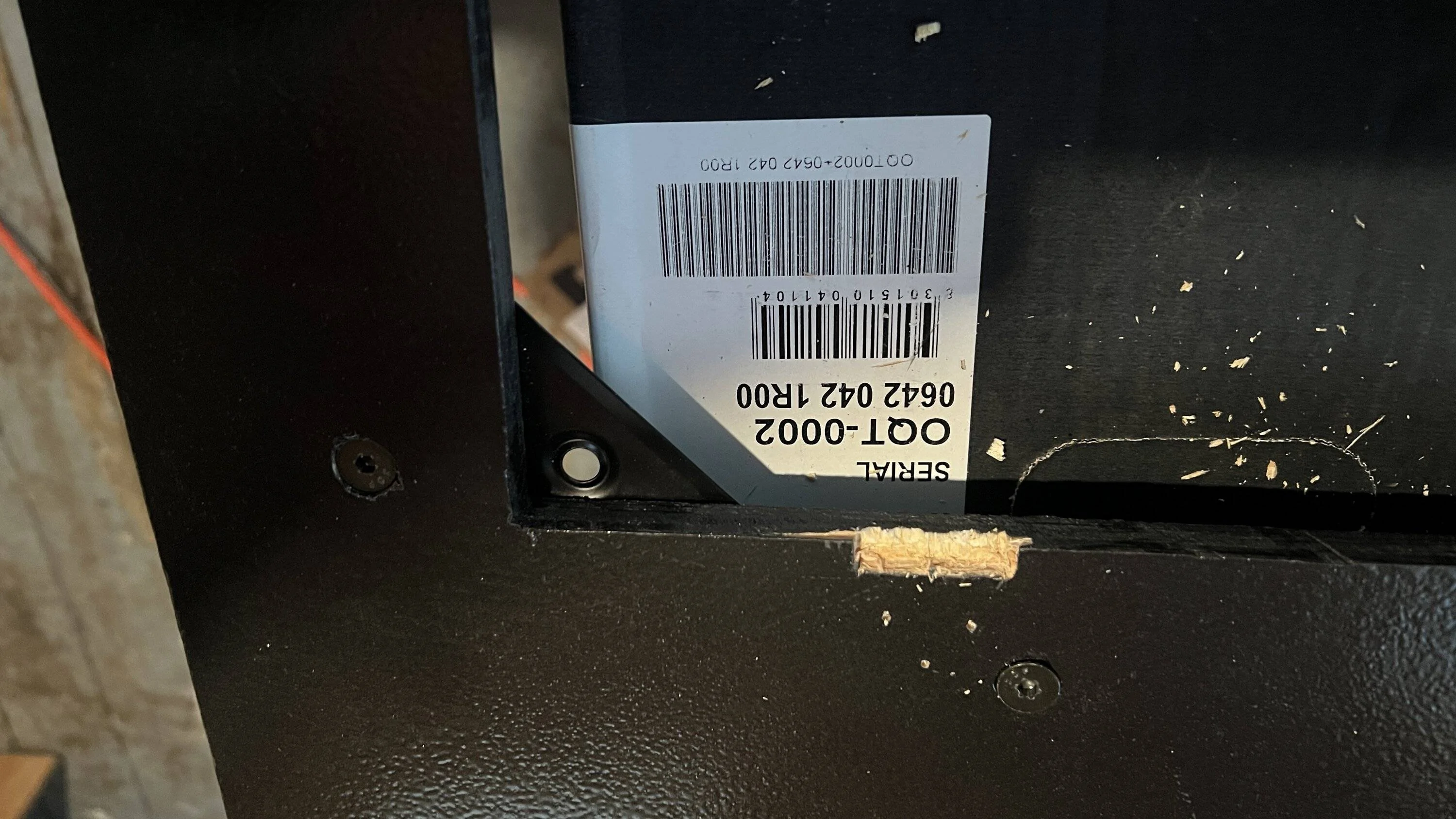
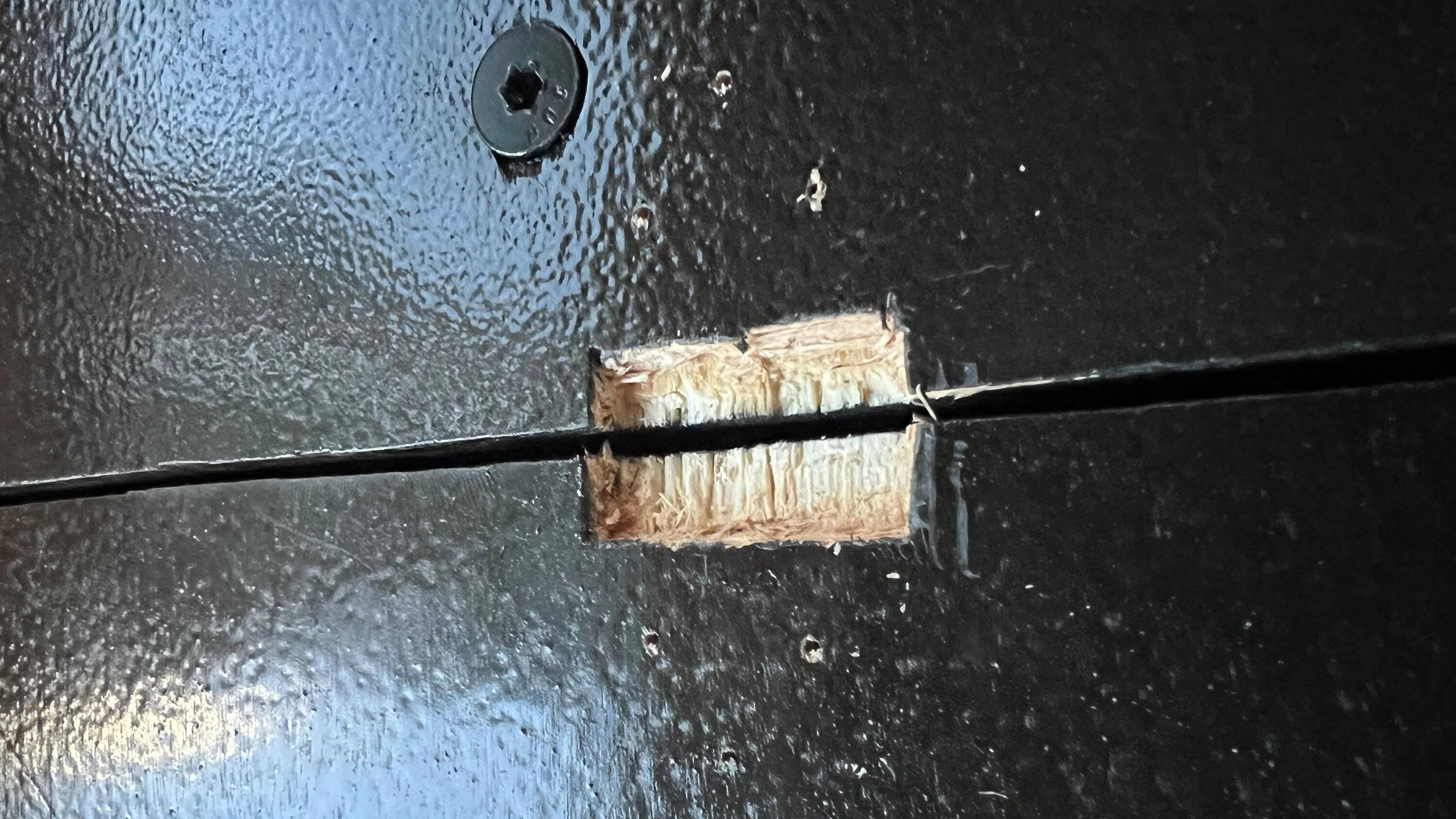
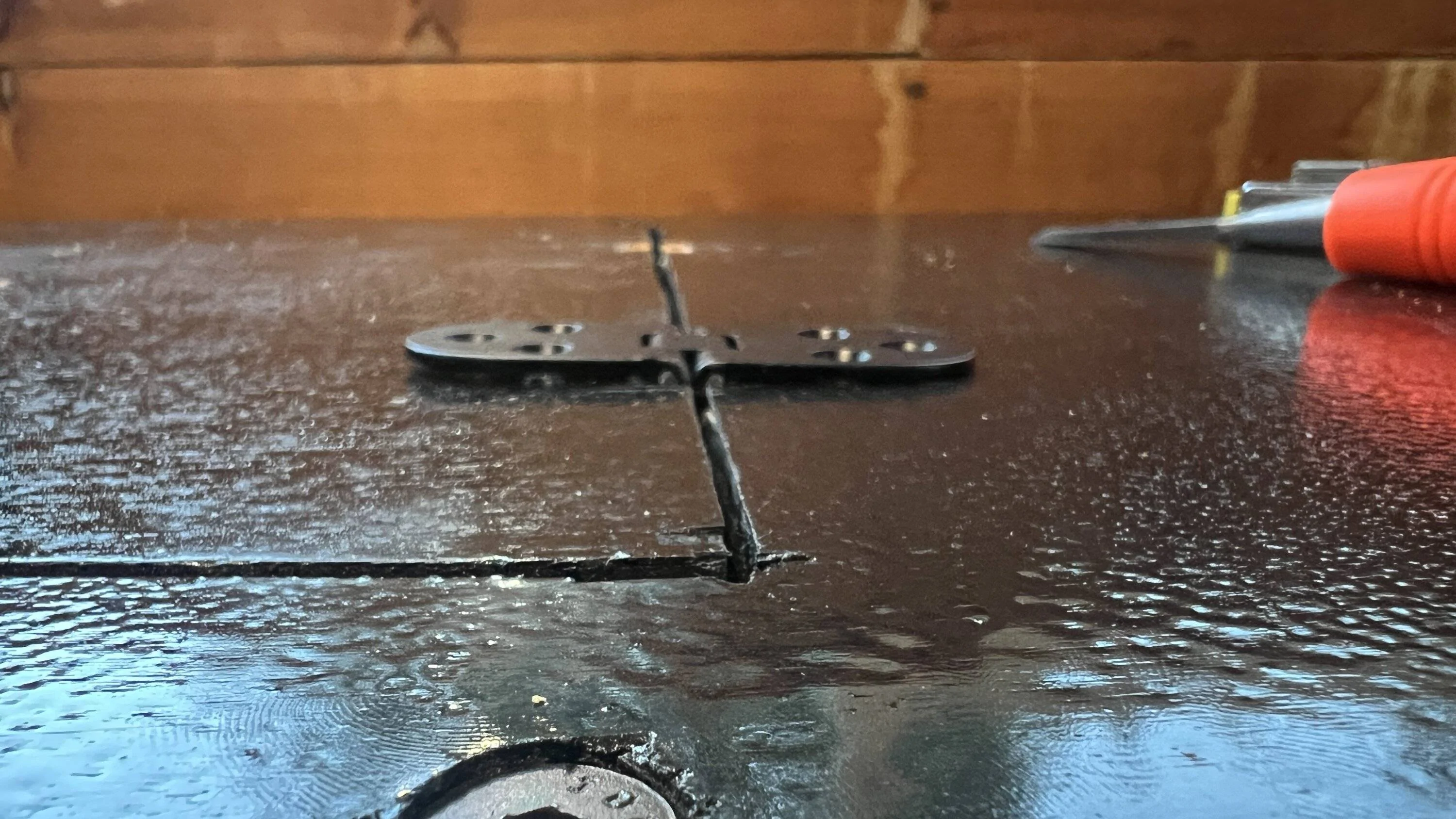
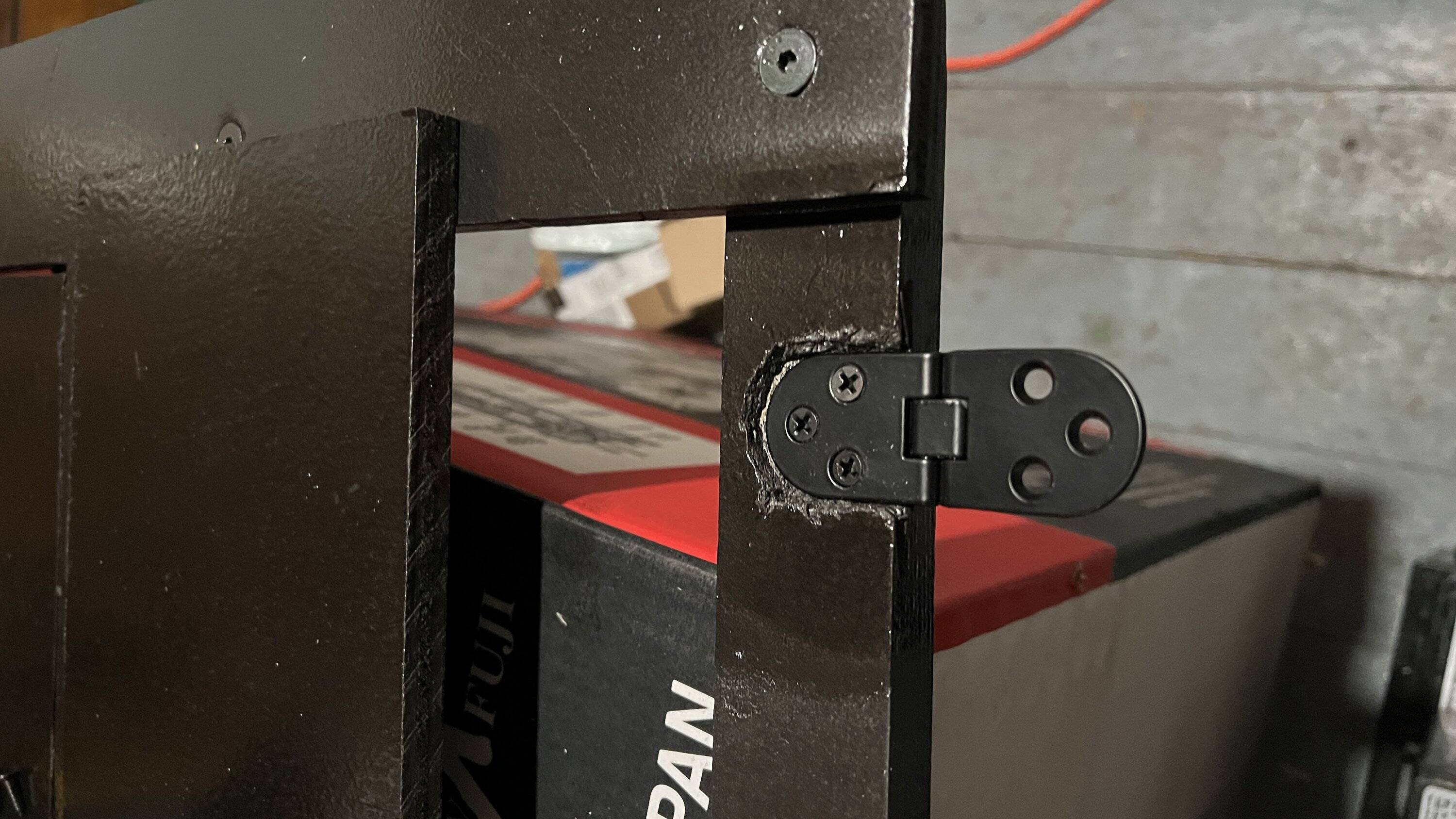
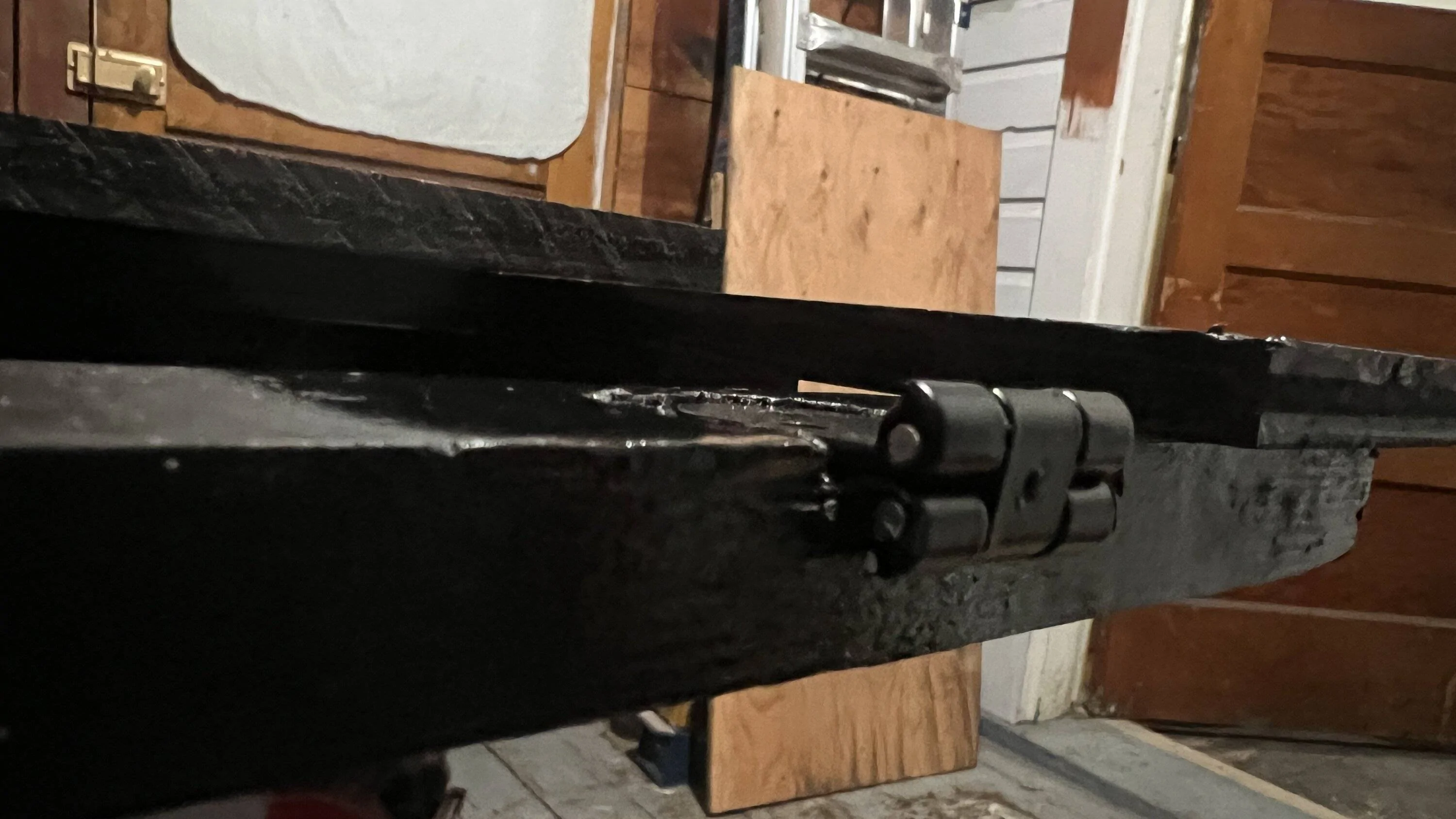
For hinges and hardware I turned to good 'ol amazon. I found some nice flat hinges that looked decent online for a ok price. My overall goal was to make a surface as flat as possible. This is one beef I had with the goose gear option is the door latches sit probably 1/8 to 1/4 inch above the wood. I really wanted as flat of an option as possible and the ones I found are a little under 1/8 above the wood. One thing I didn't not count on though was needing to recess the hinges. This took me several hours to complete - again because I don't have a shop or full wood working tools. I did have some old beat up chisels that ended up doing the job however.
Jeep Gladiator Destination Unknown - 2022 JTR journal IMG_0030

Jeep Gladiator Destination Unknown - 2022 JTR journal IMG_0027

Jeep Gladiator Destination Unknown - 2022 JTR journal IMG_0028


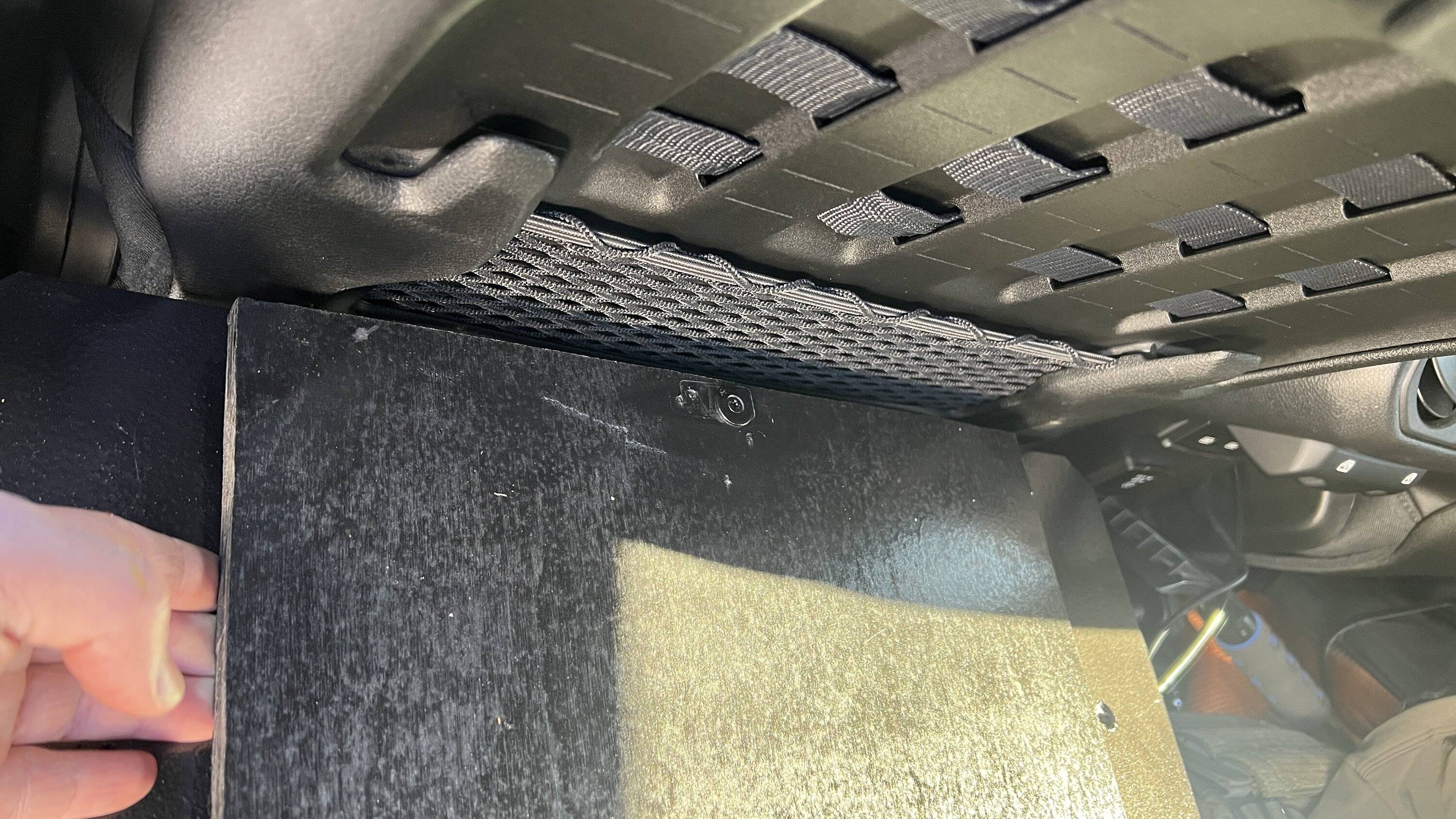
The rear hinges were more difficult as I decided to have the door open reverse since it will add easier access without having to potentially move large items on the top of the deck. This required recessing the hinge its full thickness which was probably 1/4 inch into the stronger 1X2. The 1X2 serves as the door hinge point as well as structure at the back of the platform and just about rests on top of the factory plastic cubby. Though not pretty, it's relatively out of sight and works plenty well.
Jeep Gladiator Destination Unknown - 2022 JTR journal IMG_0031

Jeep Gladiator Destination Unknown - 2022 JTR journal IMG_0032


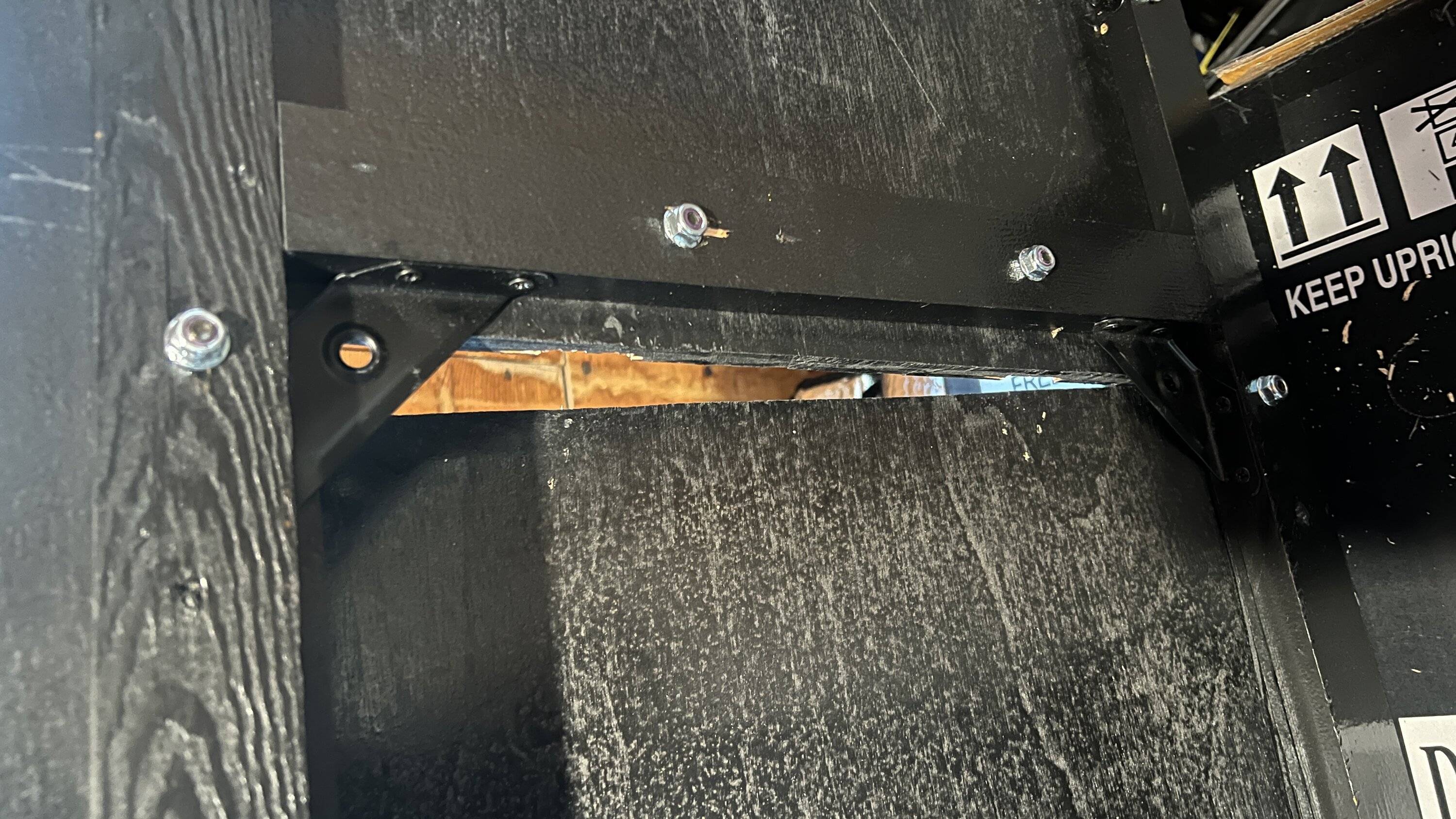
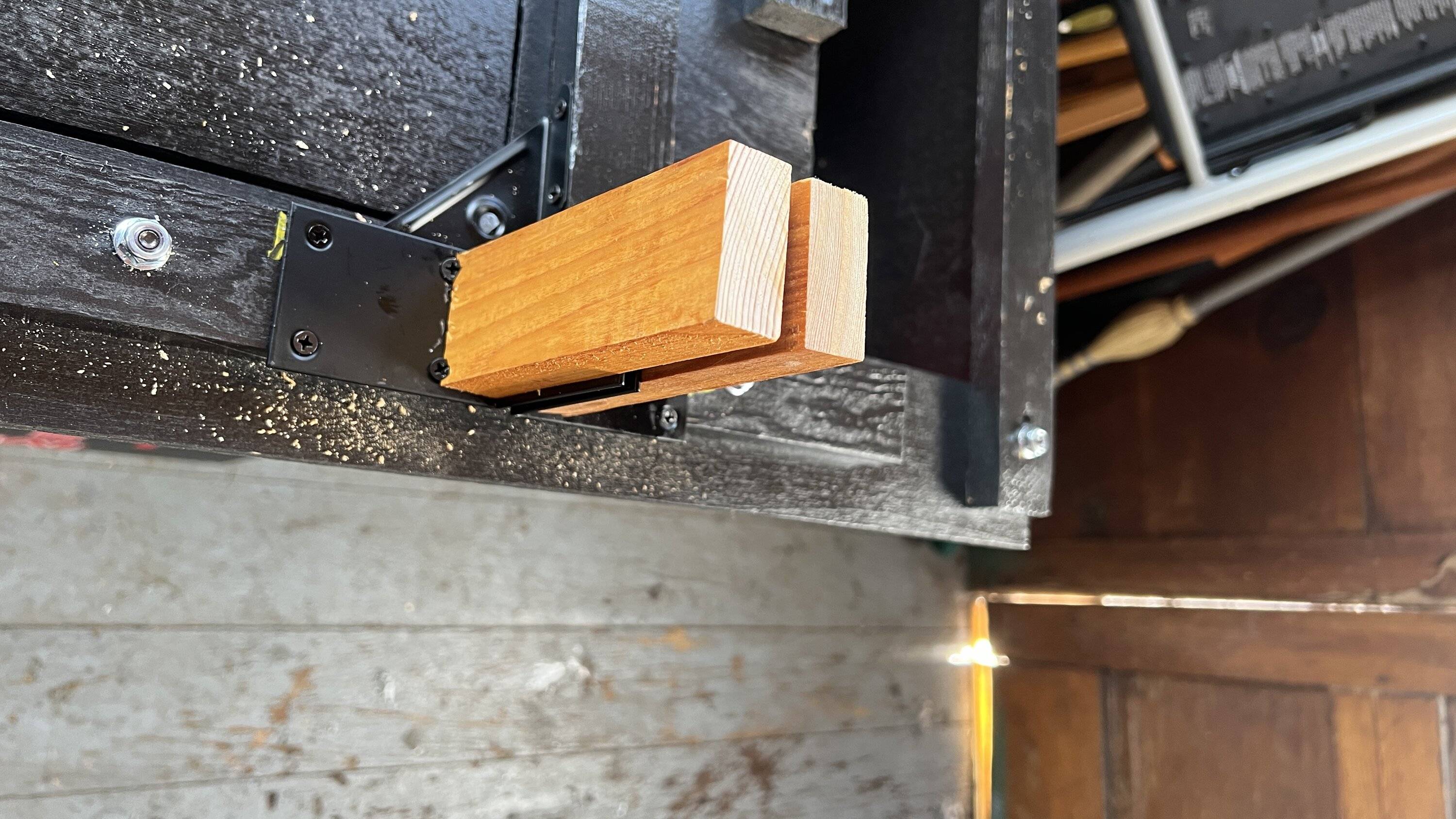
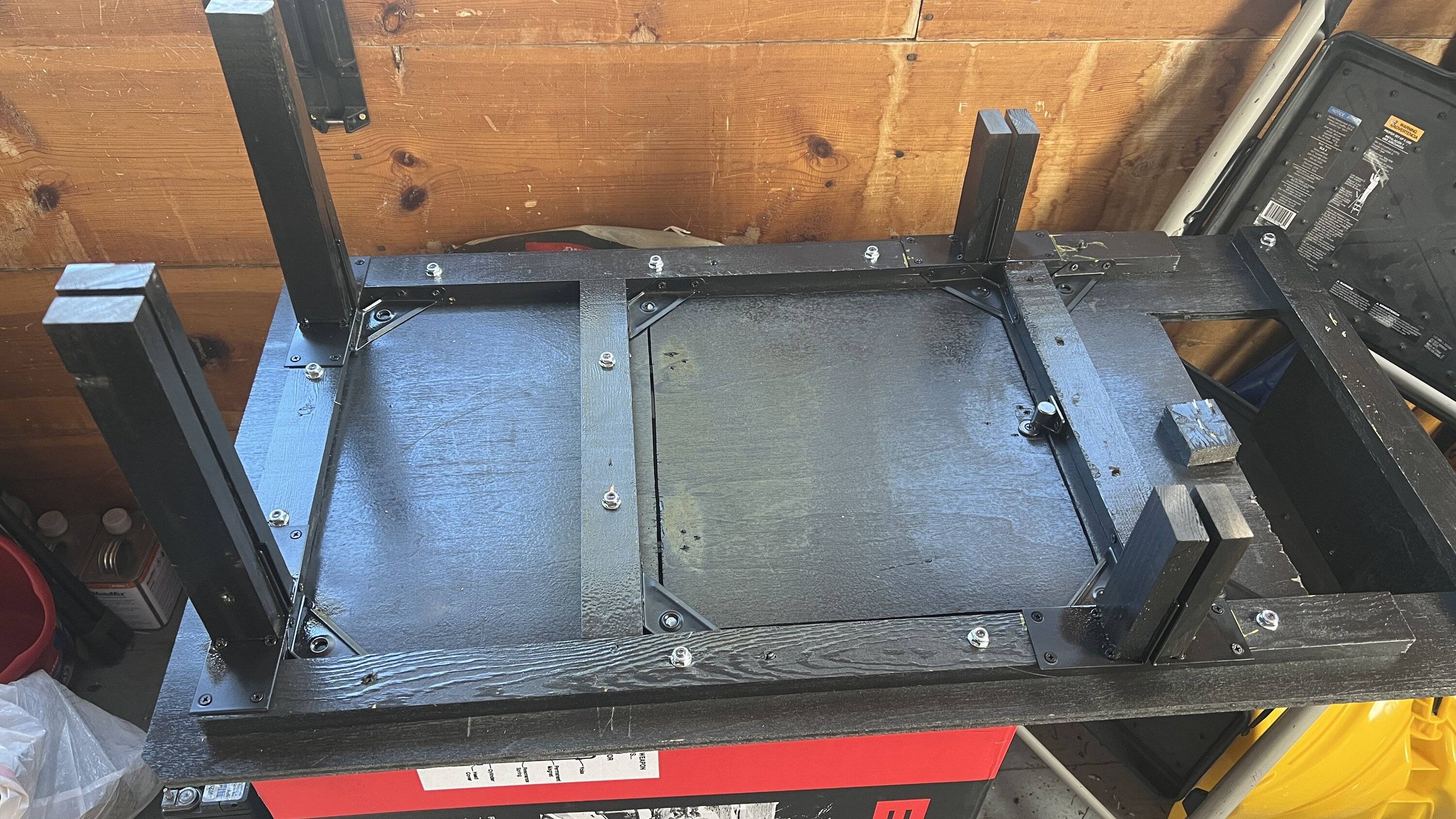
Now, this next bit was quite frustrating. The intent was to create 4 legs (using 2 1X2's for each leg) with L brackets that would secure to the bottom side of the frame of the platform. Now the rear most legs were supposed to have additional L brackets on the floor side so that I could bolt it down into the factory seat bolt hole. However, whatever metal these brackets are made from must be some insanely high strength metal. The standard black oxide drill bits didn't make a dent. So I switched to my expensive cobalt bits. Nothing. So using some WD40 and a small 1/8 bit, I couldn't even get a small pinhole. I couldn't believe how crazy strong these brackets are. So, for now the platform is loosely on the floor and not secured down. But, with weight of items on top of it I really don't think it will move much at all anyway so it's not a total loss frustrating as it is.
Jeep Gladiator Destination Unknown - 2022 JTR journal IMG_0037


I also added a small magnet latch and accidentally a overly small (pinky finger size) lift ring for hardware.
Jeep Gladiator Destination Unknown - 2022 JTR journal IMG_0038


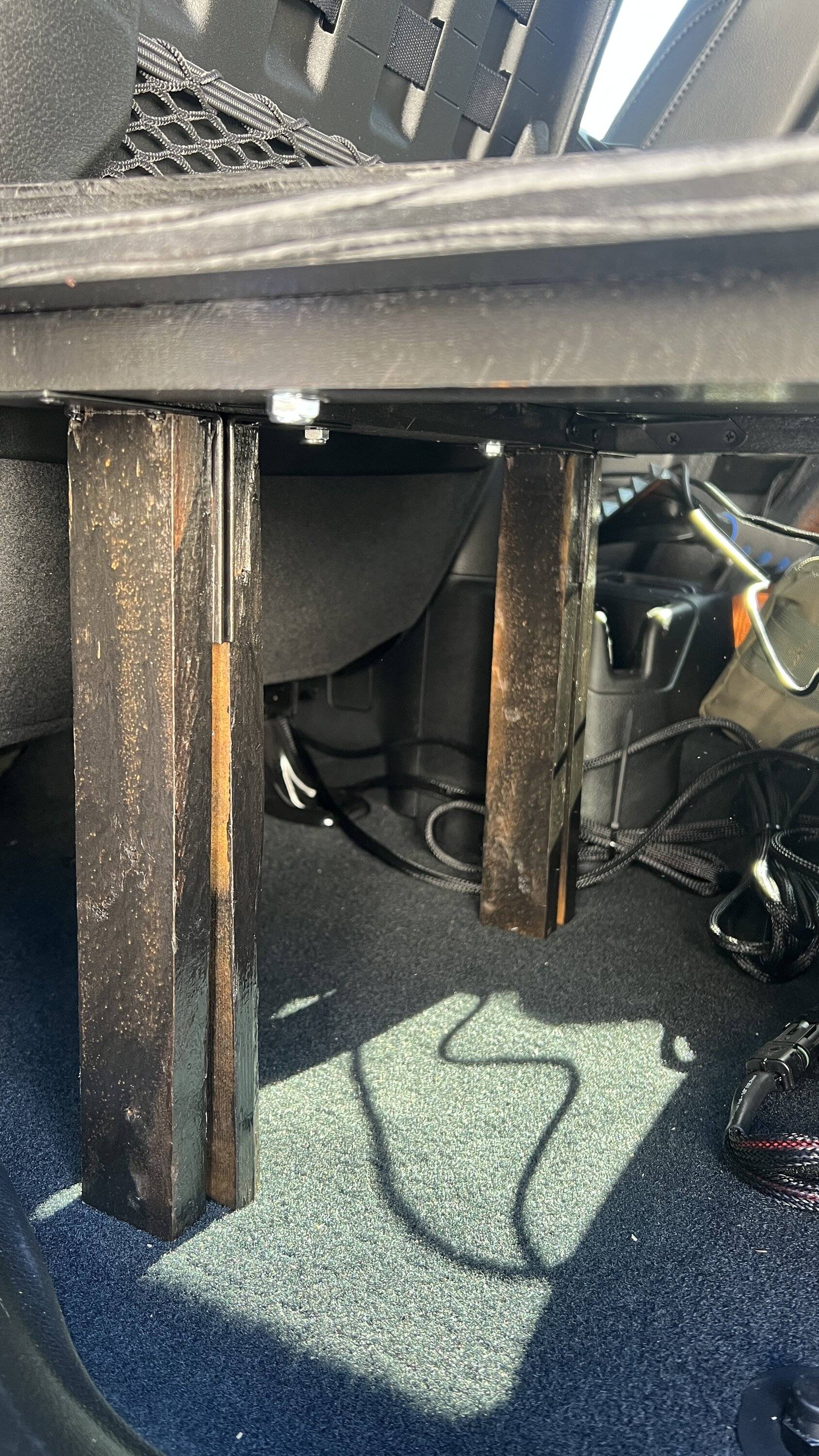
And, in it goes. The legs are sparse on paint as I do plan to remove the carpet so I didn't want to waste paint on legs that might end up getting replaced depending on the thickness of the replacement.
Jeep Gladiator Destination Unknown - 2022 JTR journal IMG_0039


You can see here the bolt holes for the rear seat that I was going to try and tie into. Pretty frustrating how hard these metal brackets are. I tried bending one after realizing the hardness and couldn't get it to even budge. So if I ever need strong L brackets in the future these will be my first choice!
Jeep Gladiator Destination Unknown - 2022 JTR journal IMG_0041

Jeep Gladiator Destination Unknown - 2022 JTR journal IMG_0040


The doors open perfectly. The rear door only needs to open a little bit since theres not much that would go in that cubby - and yeah some paint wasn't quite dry when I put it together so it peeled off some.
Jeep Gladiator Destination Unknown - 2022 JTR journal IMG_0042


The front door is even more impressive. I failed to measure the door size for when it would be open if there would be interference with the seat back. And it is a perfect fit. about 1/8" clearance as the door is opened, so it can lay flat if needed. Lucky? Or just that good? haha. But, pretty happy with that part.
Jeep Gladiator Destination Unknown - 2022 JTR journal IMG_0043

Jeep Gladiator Destination Unknown - 2022 JTR journal IMG_0044


The main door opens perfectly. Exactly where I wanted it. This is another beef I have with the goose gear. I really wanted to have the option to separate the under seat storage bit from the floor where your feet would normally go. I do like this particular setup a lot.
Jeep Gladiator Destination Unknown - 2022 JTR journal IMG_0045


And here is the finished product. I really like the height. It allows for a lot more storage under neath and is a good lifting height. My only wish is for the rear door to open more. I think there might be a fix for that. So overall, it works well.
Jeep Gladiator Destination Unknown - 2022 JTR journal IMG_0046
 
Last edited:

Flyin6

Well-Known Member
First Name
Don
Joined
Jan 2, 2023
Threads
17
Messages
1,324
Reaction score
1,797
Location
Kintuckee
Vehicle(s)
22AEV JT370, 24 Ram 3500, 22 Caddy XT6
Build Thread
Link
Occupation
Aviator, rotary and fixed wing, Writer
Here's to the do-it-yourselfers, a dying breed! The rear seat delete is coming right up on my build, but probably the whole thing for me. Did you by any chance weigh the seat you removed? I am wondering about the weight savings for just that section.
 

Sponsored
OP
OP
chorky

chorky

Well-Known Member
First Name
Chad
Joined
Feb 26, 2022
Threads
175
Messages
3,466
Reaction score
3,801
Location
Montana
Website
www.youtube.com
Vehicle(s)
'22JTR, '06 LJ, '06 TJ GE
Build Thread
Link
Occupation
GIS Specialist
Here's to the do-it-yourselfers, a dying breed! The rear seat delete is coming right up on my build, but probably the whole thing for me. Did you by any chance weigh the seat you removed? I am wondering about the weight savings for just that section.
Great question. The drivers side rear seat weighed in at a surprisingly low 37.2 #'s. The home made platform weighed in at 14.6 #'s - So that's a weight savings of 22.6.

I used birch plywood for the deck, so that's pretty light. All the hardware I used probably was maybe a pound, so also pretty light. And the legs and frame support is just 1X2 Doug-fir. 2 thick coats of pain on the top, and just 1 coat underneath totaled to about 1.75 cans of aerosol.

By math, seeing as how this is only 40%, if you did the entire rear seat you probably could save around 56.5 #'s total. It's not a ton, but it is the weight of my 45 combo Engle fridge (which will be in the bed though). So that's also about 1/3 to 1/2 of a large breed dog as well.

I suspect the Goose Gear option would be about the same. I think (no good pics of their system so can't confirm) that they use a lighter version of birch plywood, but I think they use extruded aluminum for the frame and have a thick heavy coat of a version of bedliner. Their system might actually be a little heavier than mine.


But this brings up a point of a bigger concern. Overall weights. I have a spreadsheet going with factory unloaded (no people) curb weight minus items removed plus items added. In all reality, 99% of everybody will be at least 200 pounds over GVWR. But probably under (unless you have an Alu-Cab) GAWR. Unless folks go to campgrounds and camp like the 90's with a simple tent, cooler, one water jug, toys, and chairs - and no armor, no recovery gear or bumpers, etc.. Then they would be under. But even with only a canopy, RTT, fridge, fridge slide, compressor, genesis, rear seat delete, and random items - I am already about 350 pounds away from maxing out. That is with ONE person - me. So I can't see how anyone with a family of 1 or 2 kids could ever be under GVWR. If I have time this week I'll try and share that spreadsheet for others to copy since it already has all the formulas.
 

Flyin6

Well-Known Member
First Name
Don
Joined
Jan 2, 2023
Threads
17
Messages
1,324
Reaction score
1,797
Location
Kintuckee
Vehicle(s)
22AEV JT370, 24 Ram 3500, 22 Caddy XT6
Build Thread
Link
Occupation
Aviator, rotary and fixed wing, Writer
That's good info.
Weight is horsepower, and that is the perspective I am coming at this. The Jeep is so underpowered IMO that I need to increase power somewhere. Weight savings is about the only place I can go since I have the GEPC 5 spec computer. Maybe a Hemi swap or an LT with the 10 speed
But
That's $30K
Ya know, I've done alright with my career but that is still a chunk of change!
Sa after going around that reasoning loop, I have come up with the notion to cut weight everywhere, and just go with the essentials and live with going slow everywhere.
Where I may differ from most other folks is that a few years ago, I built an overland "Sort-of" teardrop. It actually looks more like a tactical application, but it sleeps all of us weighs under 4K and might fit behind this JT if the darned thing had some push, but it doesn't.
Full seat delete is also to make room for the Bernese Mountain Dog. I am going to go floor height and do it a little differently than I have seen by following the floor contour somewhat to maximize space for the big guy.
Plan for the base material to be laminates of 3/8" Baltic Birch covered in bed liner. I did that on the camper roof and it's strong enough.
I'd appreciate seeing your actual weight measurements and calculations. Save me the time to have to do all that myself.
Danke'
 
OP
OP
chorky

chorky

Well-Known Member
First Name
Chad
Joined
Feb 26, 2022
Threads
175
Messages
3,466
Reaction score
3,801
Location
Montana
Website
www.youtube.com
Vehicle(s)
'22JTR, '06 LJ, '06 TJ GE
Build Thread
Link
Occupation
GIS Specialist
That's good info.
Weight is horsepower, and that is the perspective I am coming at this. The Jeep is so underpowered IMO that I need to increase power somewhere. Weight savings is about the only place I can go since I have the GEPC 5 spec computer. Maybe a Hemi swap or an LT with the 10 speed
But
That's $30K
Ya know, I've done alright with my career but that is still a chunk of change!
Sa after going around that reasoning loop, I have come up with the notion to cut weight everywhere, and just go with the essentials and live with going slow everywhere.
Where I may differ from most other folks is that a few years ago, I built an overland "Sort-of" teardrop. It actually looks more like a tactical application, but it sleeps all of us weighs under 4K and might fit behind this JT if the darned thing had some push, but it doesn't.
Full seat delete is also to make room for the Bernese Mountain Dog. I am going to go floor height and do it a little differently than I have seen by following the floor contour somewhat to maximize space for the big guy.
Plan for the base material to be laminates of 3/8" Baltic Birch covered in bed liner. I did that on the camper roof and it's strong enough.
I'd appreciate seeing your actual weight measurements and calculations. Save me the time to have to do all that myself.
Danke'
Yeah there are some faster vehicles out there, but it's leaps and bounds above my TJ and old 1990 Ranger - so I'm happy enough with the power it has. I'm sure it will feel it once I get everything added on so that will be interesting to see performance differences.

There was another member on here that posted their idea of a rear seat delete and it was adding a bunch of 2 or 3" foam with either velcro or sticky tape and just sticking it to the floor. They might even have removed the carpet I can't remember. But all surfaces were covered with the foam and that was their delete system - they too had large dogs and it looked like it worked pretty well. Might be another idea, probably doesn't look as clean but certainly functional and cheap/easy.

I'll try to get those weights posted up later probably mid week sometime as I need to make a few changes to the spreadsheet first. But it certainly is an eye opener.
 

Flyin6

Well-Known Member
First Name
Don
Joined
Jan 2, 2023
Threads
17
Messages
1,324
Reaction score
1,797
Location
Kintuckee
Vehicle(s)
22AEV JT370, 24 Ram 3500, 22 Caddy XT6
Build Thread
Link
Occupation
Aviator, rotary and fixed wing, Writer
I would like to pick your brain some more on your build and share what I have as well... I'm more active on the forum in my signature. I only visit this site every once in a while but do like it for the sheer volume of information.
As for power, I always build a lot. Have an overlander Suburban with a 600HP Supercharged LS riding on 37's and 4.56s. Have a 600+ HP Duramax on a 6" lift and 37's with a real locker. Only used to tow things, not serious off-roading. Just picked up a new Ram 3500 Cummins which is pretty sporty as well. With all those, this Jeep seems a bit thin in places. Nevertheless, I think Jeep is on to something with this JT platform. I will continue to develop it until I start bumping into some limitations.
 
OP
OP
chorky

chorky

Well-Known Member
First Name
Chad
Joined
Feb 26, 2022
Threads
175
Messages
3,466
Reaction score
3,801
Location
Montana
Website
www.youtube.com
Vehicle(s)
'22JTR, '06 LJ, '06 TJ GE
Build Thread
Link
Occupation
GIS Specialist
Today I finally got around to finishing up the main part of the electrical system. It was functional as of post #38 but just barely, requiring use of my phone via blootooth to get things turned on and off. Not that I had a need for it to run anyway - the compressor was working and that was the important part.

If you recall, it started a while ago with needing a solution for a main distribution panel and a place to mount the switch pros system. The switch pros is my main distribution system. Expensive, but small and convenient with built in overcurrent protection reducing the need for fuses. I did test this operation on the switch pros that powers my lights so I know it works well and decided to get one for the bed.

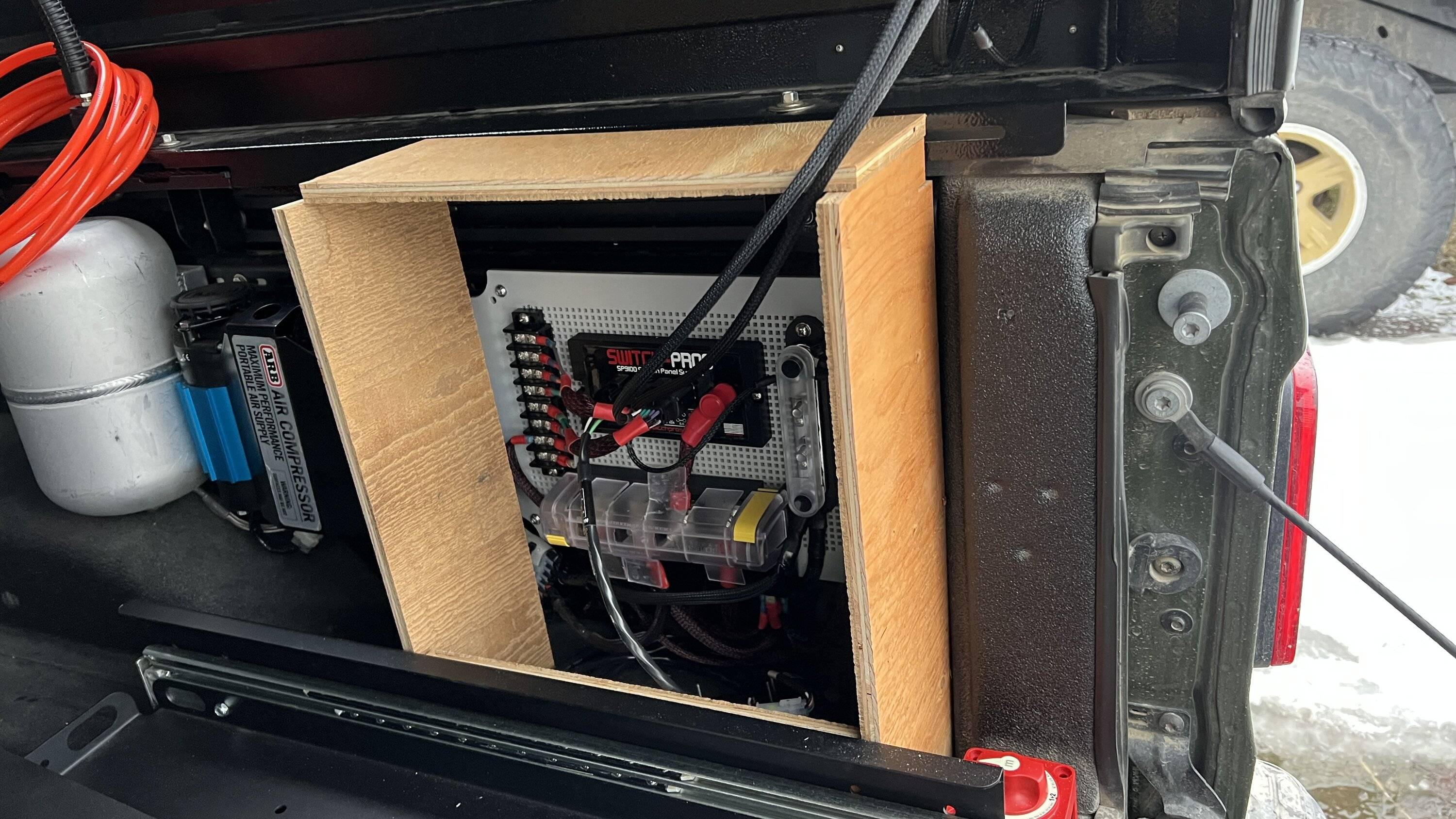
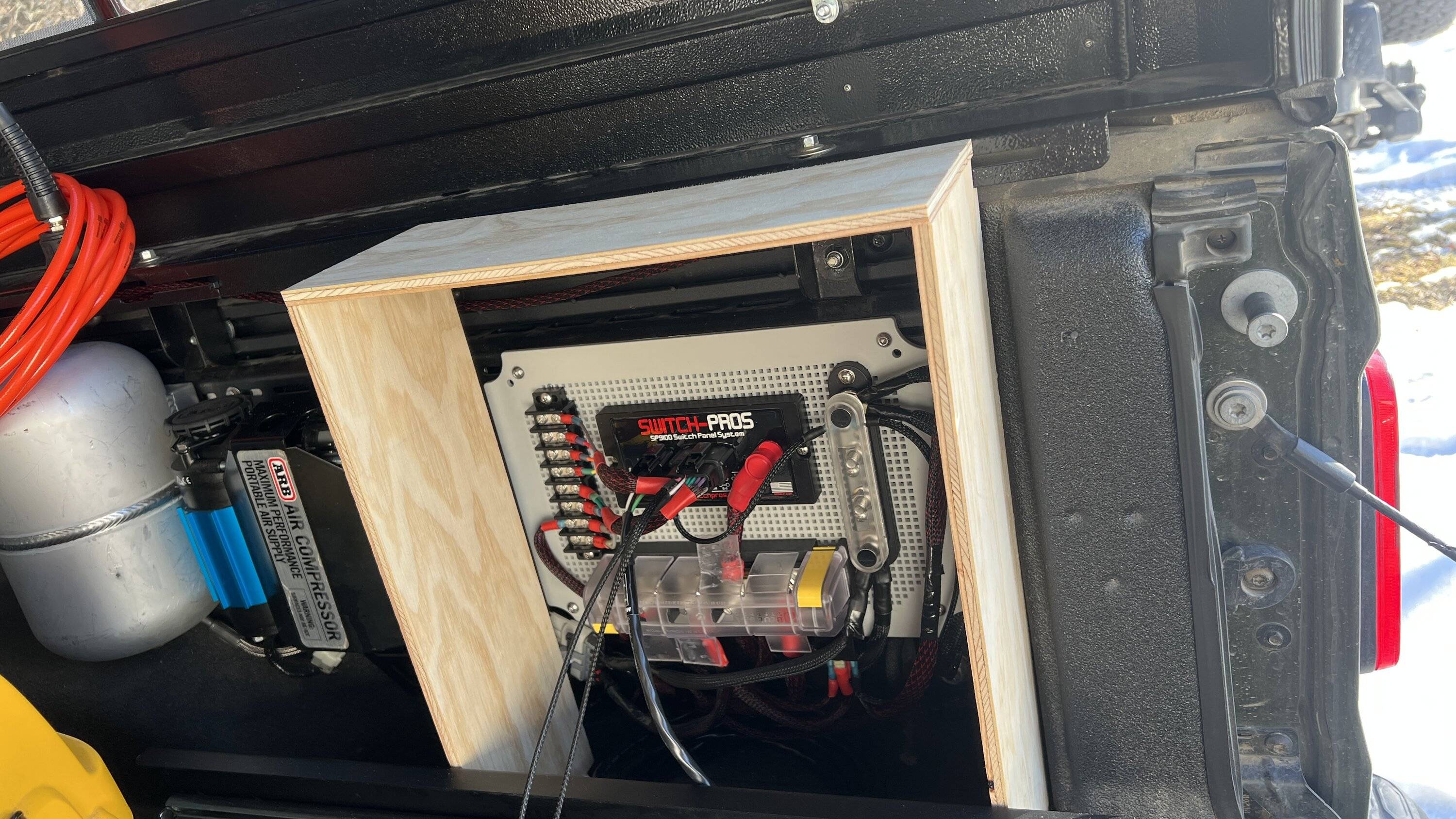
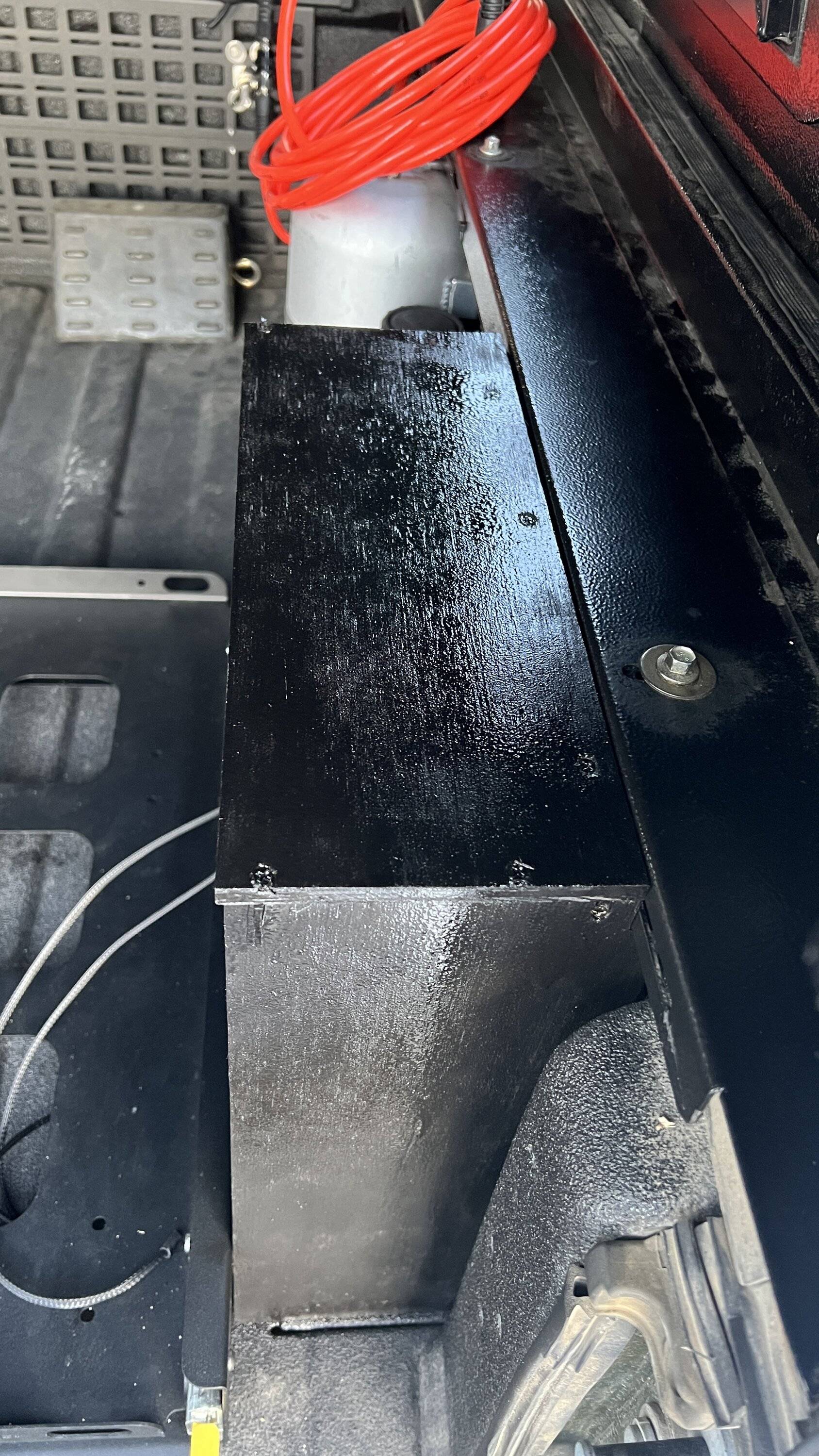
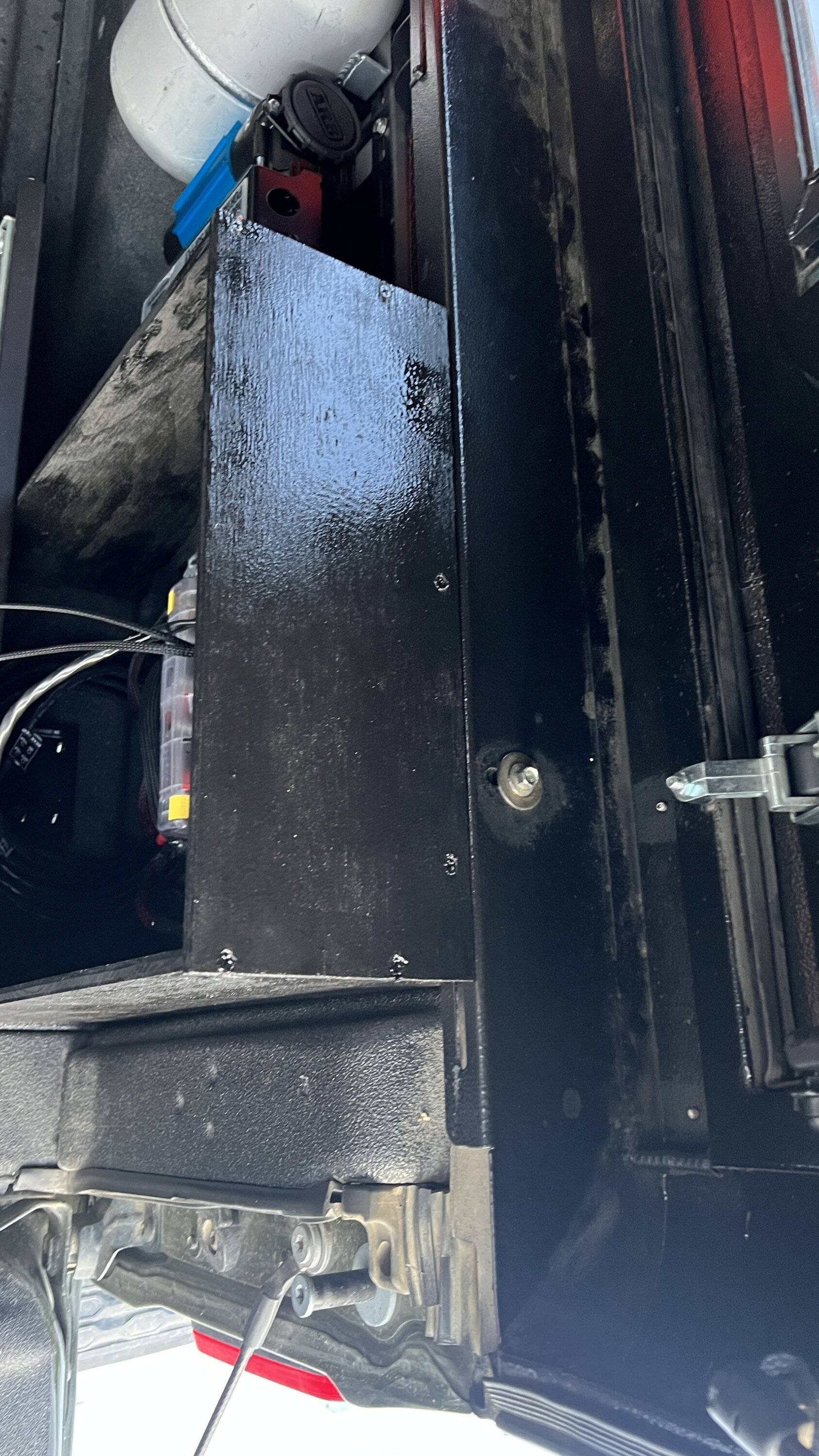
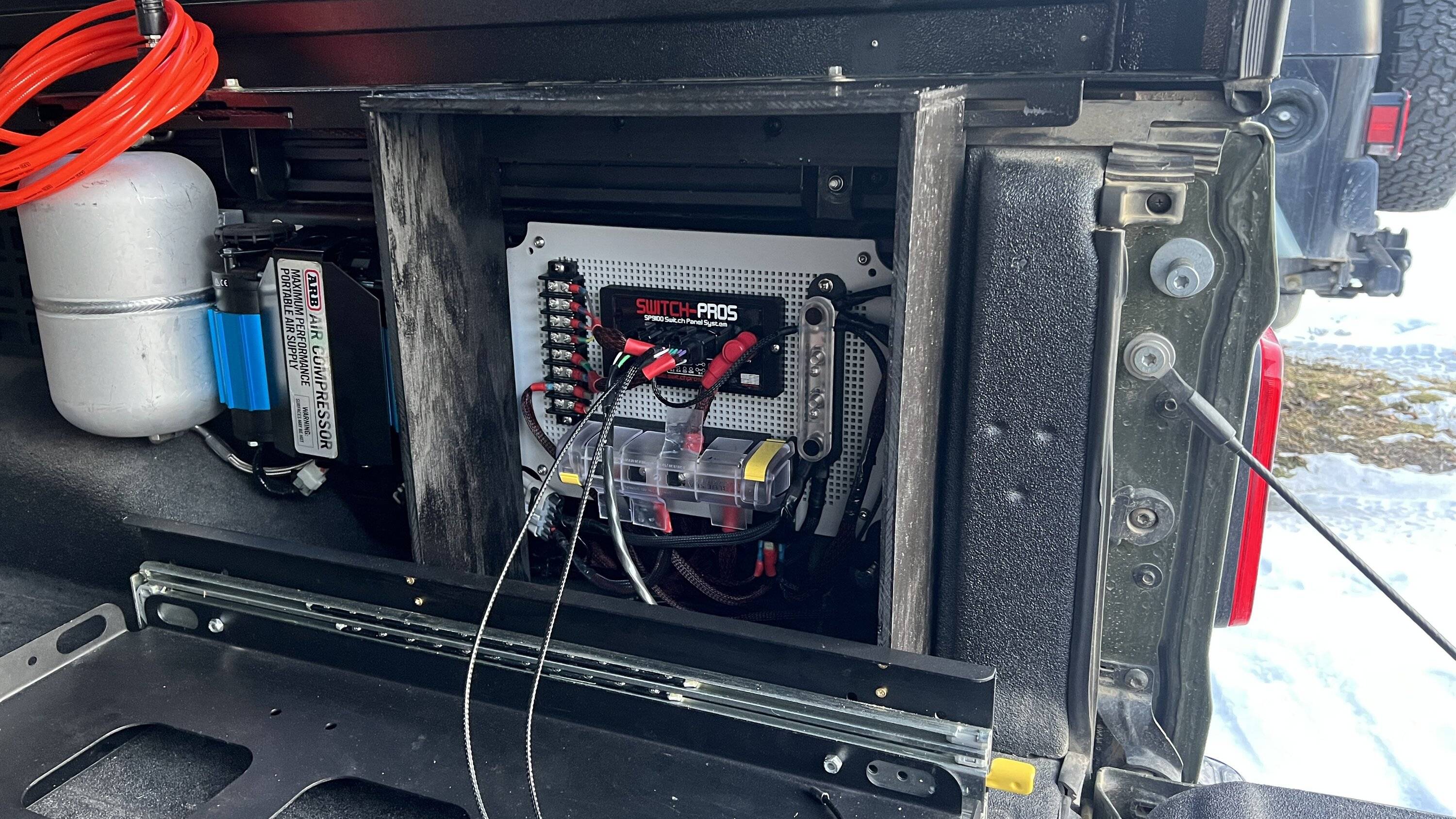
The initial idea with this was to run one set of power/ground wires to the bed that would power all bed accessories. As previously discussed, I ran a hot and ground 4ga wire fused directly on the genesis power block via 100a blue sea block fuse. I did have to create some power insulators so that if the fuse ever blew, power wouldn't just run through the bolt head and into the wire. This was easy enough and worked super slick reducing the need for another mount under the hood. All this power then runs to a blue sea block in the bed where it has 3 block fused studs. 1 for the compressor, 1 for the CTEK and SAE charge port, and the last for the switch pro's system. The hard part was figuring how to mount it all in the confined space and provide protection for the circuitry. I found this (https://www.amazon.com/dp/B0BFPXDN8M?psc=1&ref=ppx_yo2ov_dt_b_product_details) on amazon. The dimensions were perfect! So to the cart it went. However, after realizing that the space was just too tight to mount the box, I opted to mount the pane directly to the 813 mole panel. And it worked great! Except, there was no real protection for the wiring. I was not concerned of something hitting the wires as the fridge will be in its slide nearly all the time. But I was concerned about UV rays - typically wires are hidden from the sun, and I didn't want to have wiring issues in a year or two. So - with some scrap wood lying around, I started thinking of ideas. Plus I needed a place to mount the control panel and a few other things.
Jeep Gladiator Destination Unknown - 2022 JTR journal IMG_0004


I wanted to have a front panel large enough to mount the switch pros system, a couple of button switches, and the future option to mount a battery selector. The battery selector offers modular options in that I could run a second aux AGM battery in the bed and have the system pull from the main aux or secondary aux or both. It also offers the option to directly connect a lithium battery AND allow me to power the system either from the under hood AGM aux, OR the lithium - note that in this configuration I would NOT use the bottom 1+2 option as connecting AGM directly to lithium wouldn't be great. Also note that this would only power the switch pro's system. The other two studs for the compressor and CTEK/SAE port would be always on the under hood aux battery system
Jeep Gladiator Destination Unknown - 2022 JTR journal IMG_0005
\

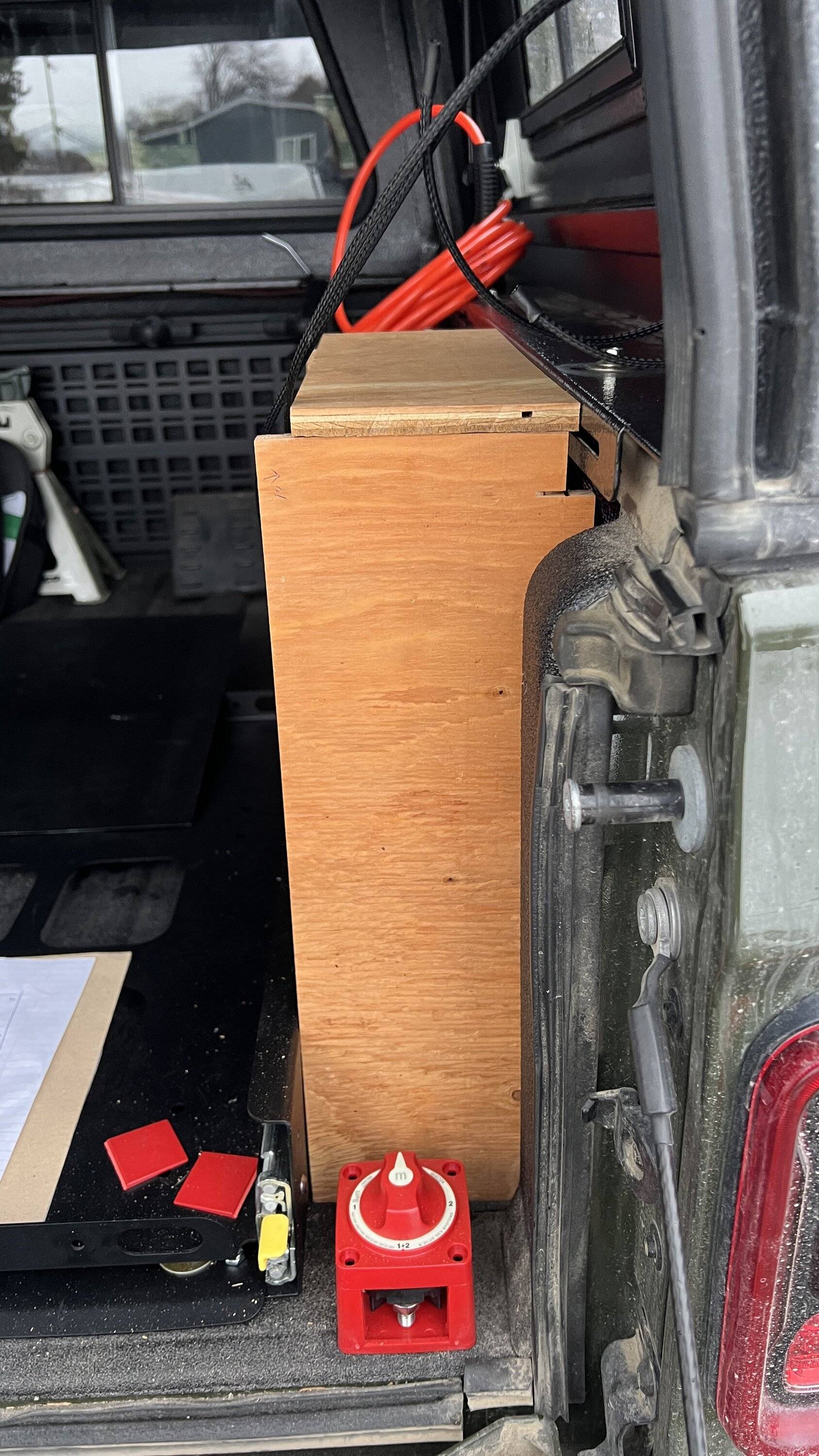
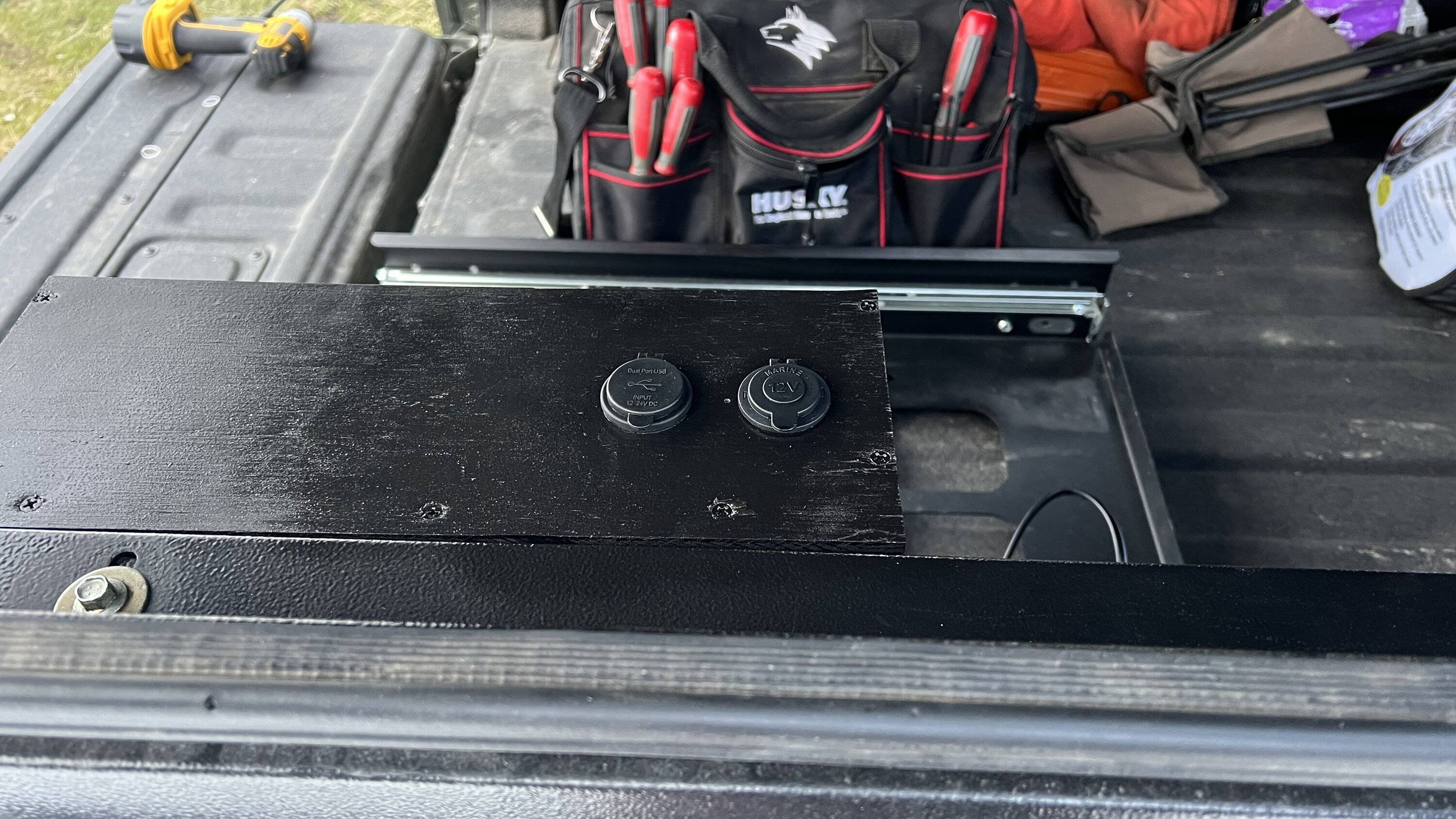
After pondering for a while I also opted to make the box the same height as the canopy so that items could be placed on a relatively flat and level surface. I did plan on having a cigar lighter style port and a usb/usb-c port for smaller items if needed when the engine is off. The benefit to this is that if for some reason their primary wiring for the Engle fridge had a problem, I could plug it directly into the cigar style port and still have a functioning fridge. This idea came to me after seeing plenty of videos of folks with a fridge on a slide and thinking that at some point the little copper strands in that wire must brake and loose connection.
Jeep Gladiator Destination Unknown - 2022 JTR journal IMG_0006


Being happy with the overall idea it was time to make a few measurement adjustments and cut some final pieces. I didn't have any more birch unfortunately, so some smooth face 3/8" plywood would have to do.
Jeep Gladiator Destination Unknown - 2022 JTR journal IMG_0048

Jeep Gladiator Destination Unknown - 2022 JTR journal IMG_0047


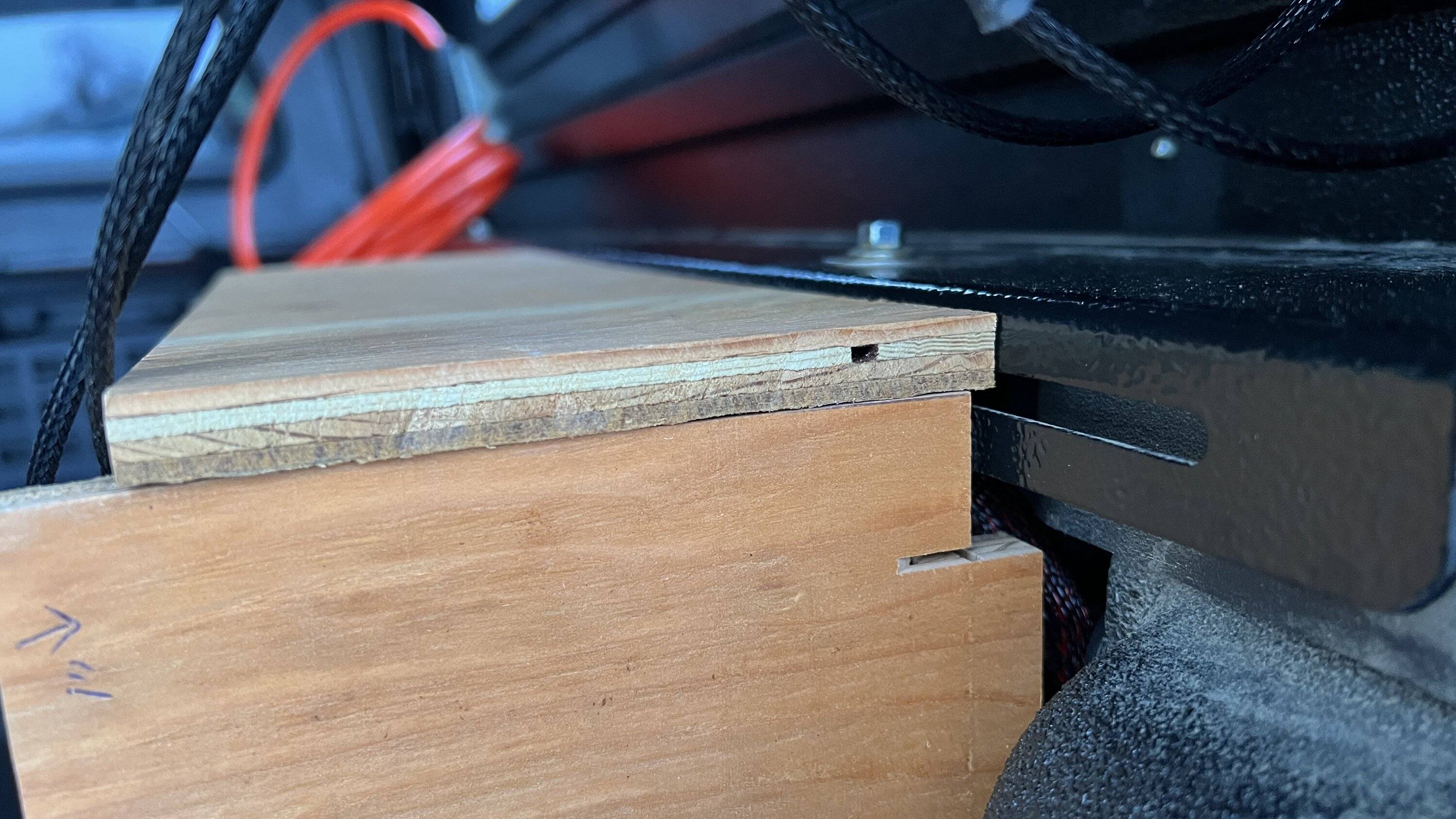
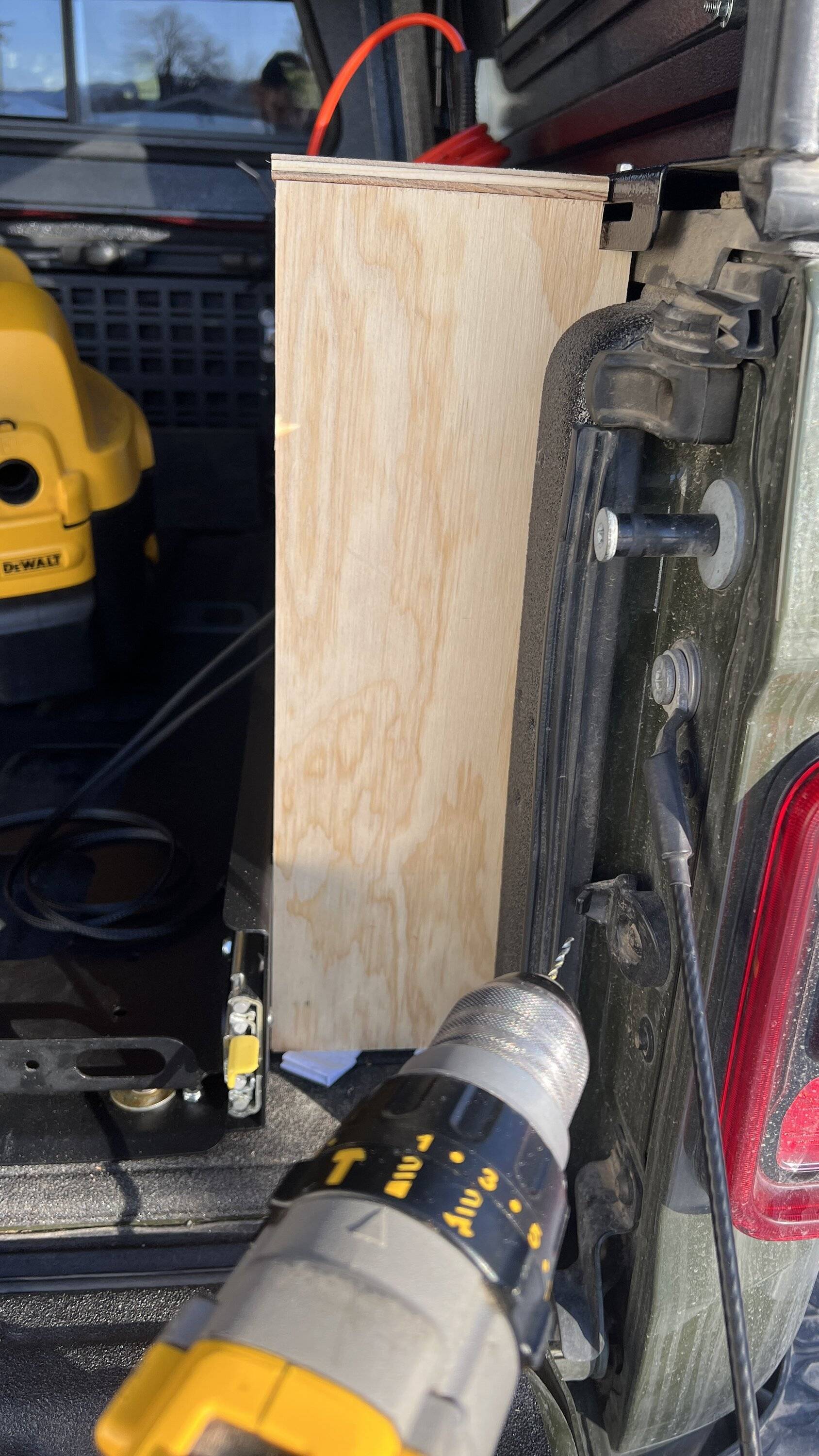
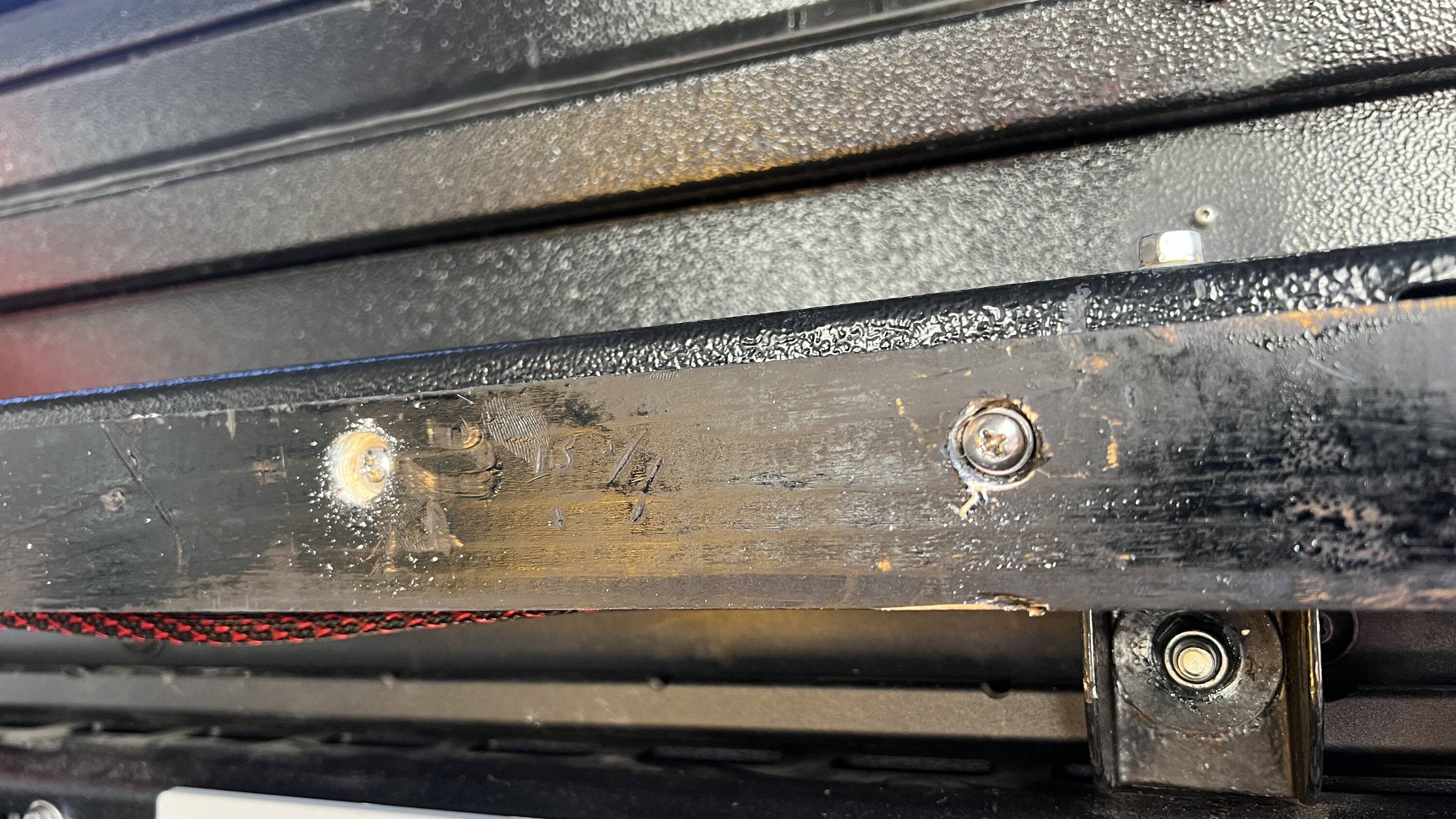
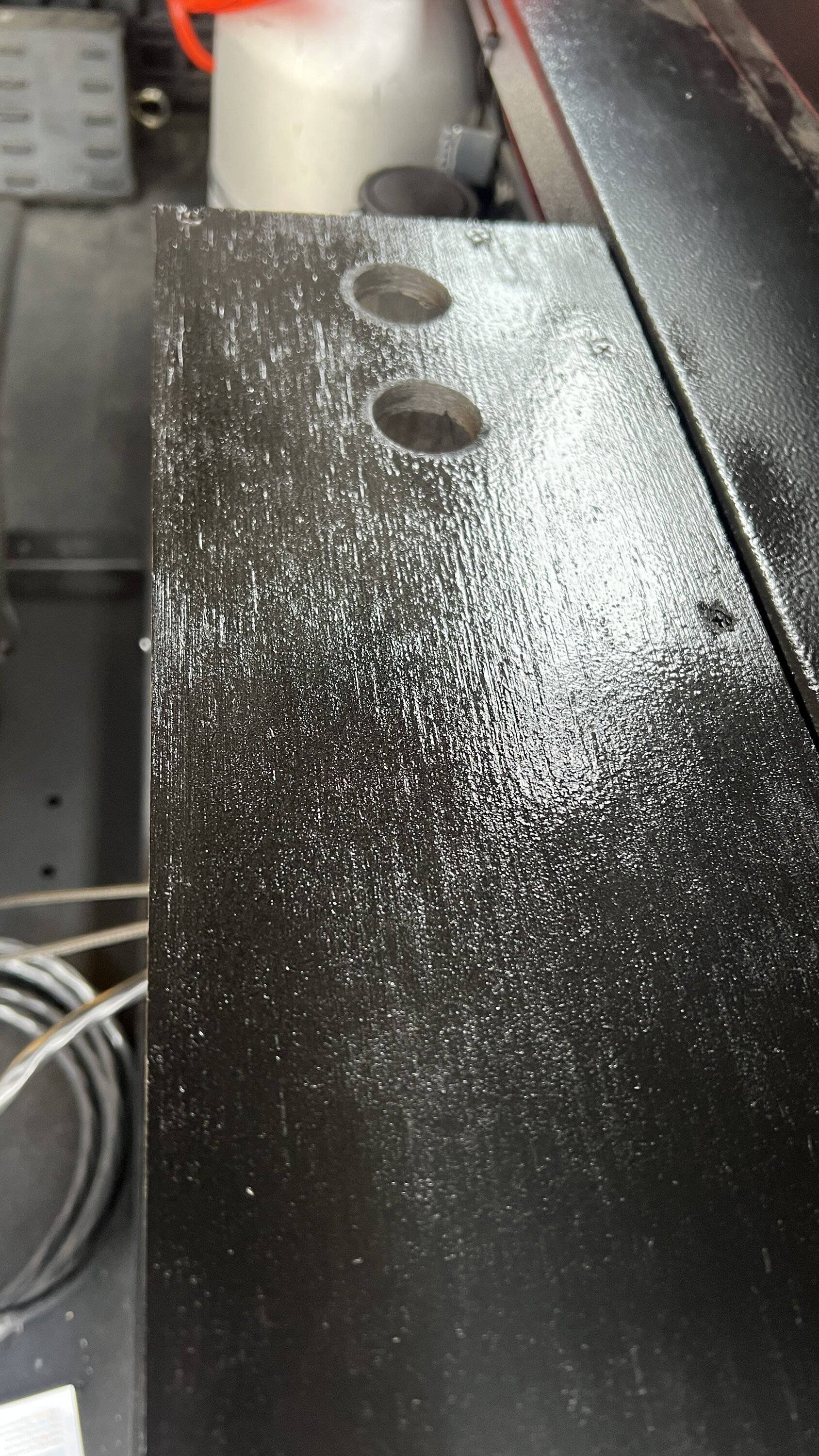
Being happy with the results here, it was time to pre-drill some holes, paint, and put it in place. First up was a cut to fit 1X2 Doug-fir. I needed something for the top piece of plywood to sit on and secure to. I didn't want gaps so having something to attach the top and sides to was important. I did have to recess these bolts I had lying around some as they weren't long enough otherwise, and just drilled a couple holes into the side lip of the canopy, being careful not to hit the charging wires that you can see behind the wood.
Jeep Gladiator Destination Unknown - 2022 JTR journal IMG_0049


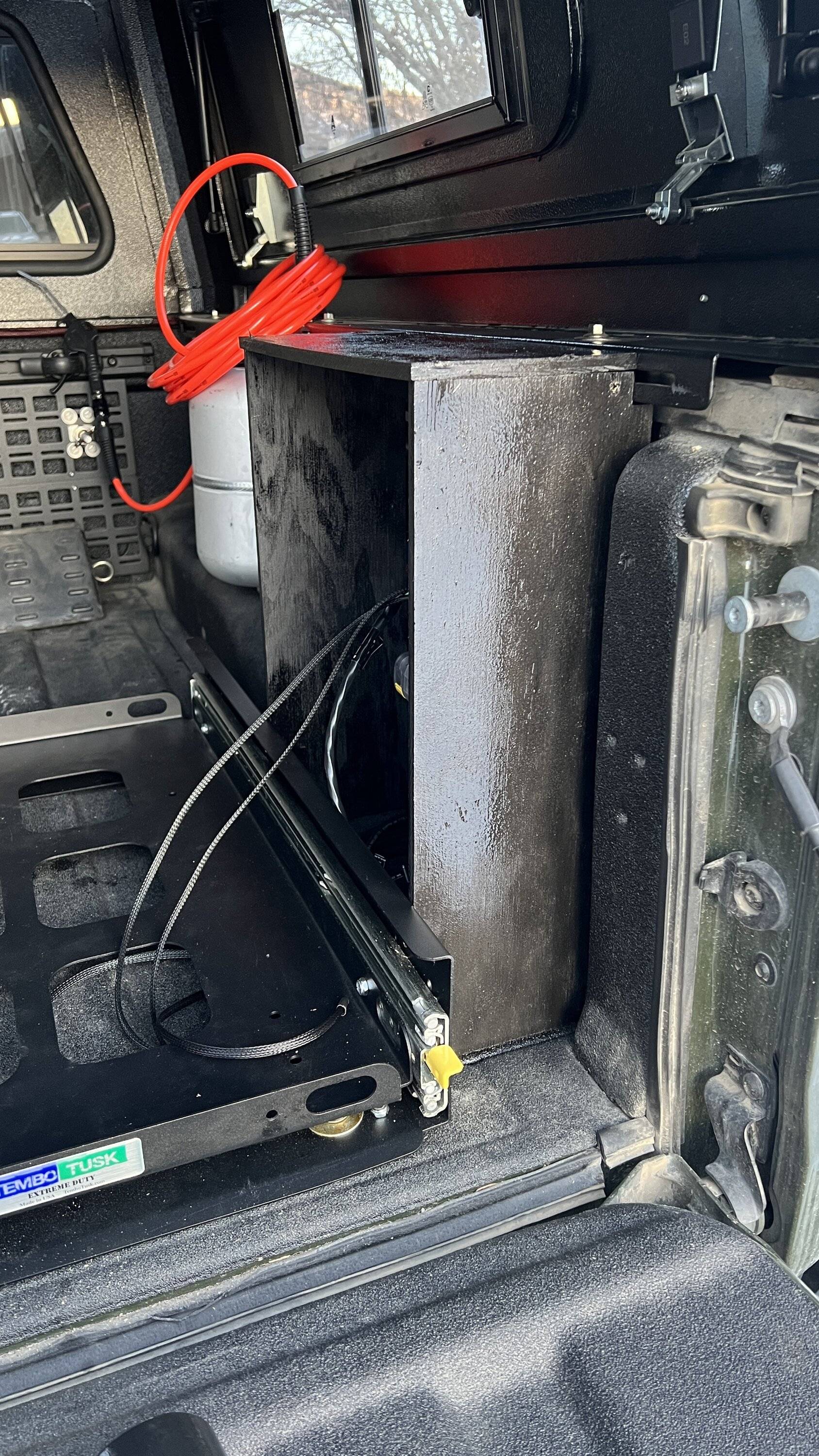
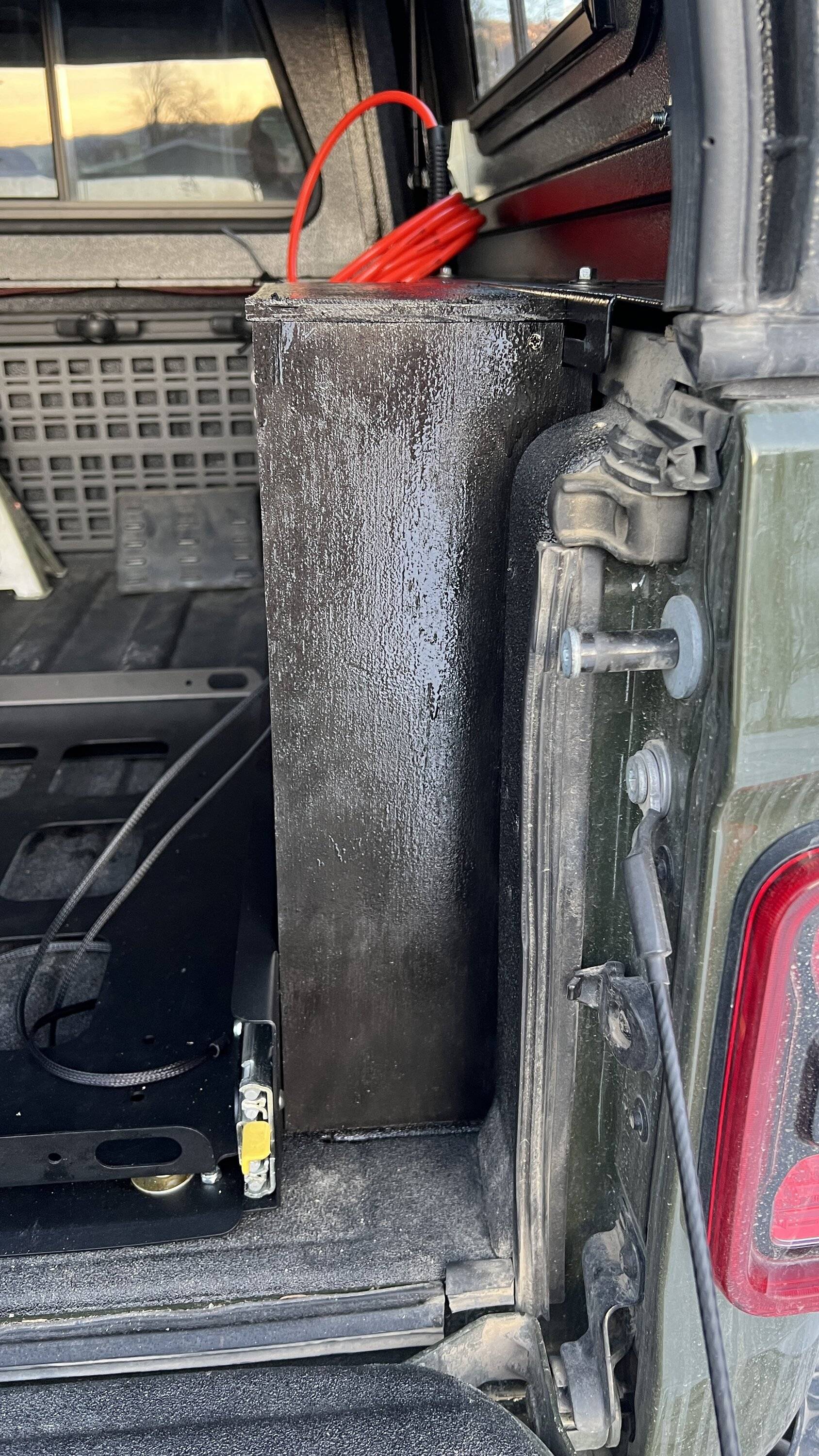
The paint was still a little wet here but I had to get a couple pictures. The fit - good, the finish - ok. But that's about as good as I can get for plywood. If you look close, you will see 4 screw heads on the inside of the fridge slide. I used this to hold the sides securely in place. The sides then screwed with one screw each into the 1X2. And finally the top screwed into the 1X2 and the sides. I fortunately had some screws that were small but long enough to provide for a good hold. And since the holes were drilled before painting, and applying a final thin coat after it was in place, it should be protected from any water - then again if water gets inside, having a canopy and all, I probably have bigger problems.
Jeep Gladiator Destination Unknown - 2022 JTR journal IMG_0055

Jeep Gladiator Destination Unknown - 2022 JTR journal IMG_0050

Jeep Gladiator Destination Unknown - 2022 JTR journal IMG_0051

Jeep Gladiator Destination Unknown - 2022 JTR journal IMG_0054


I am particularly proud of this because it was a good solution to a problem that, maybe minor, could over time be a big issue. I thought a few times about closing off the front and making a door to access wires and fuses - but seeing as how the fridge will be fairly close, I opted to leave it open. I am not overly concerned about any dust or the like as this, along with other vehicle wiring, should be just fine being inundated with dust/dirt and/or water. But still, it is under a canopy so relatively protected compared to items under the hood.
Jeep Gladiator Destination Unknown - 2022 JTR journal IMG_0053


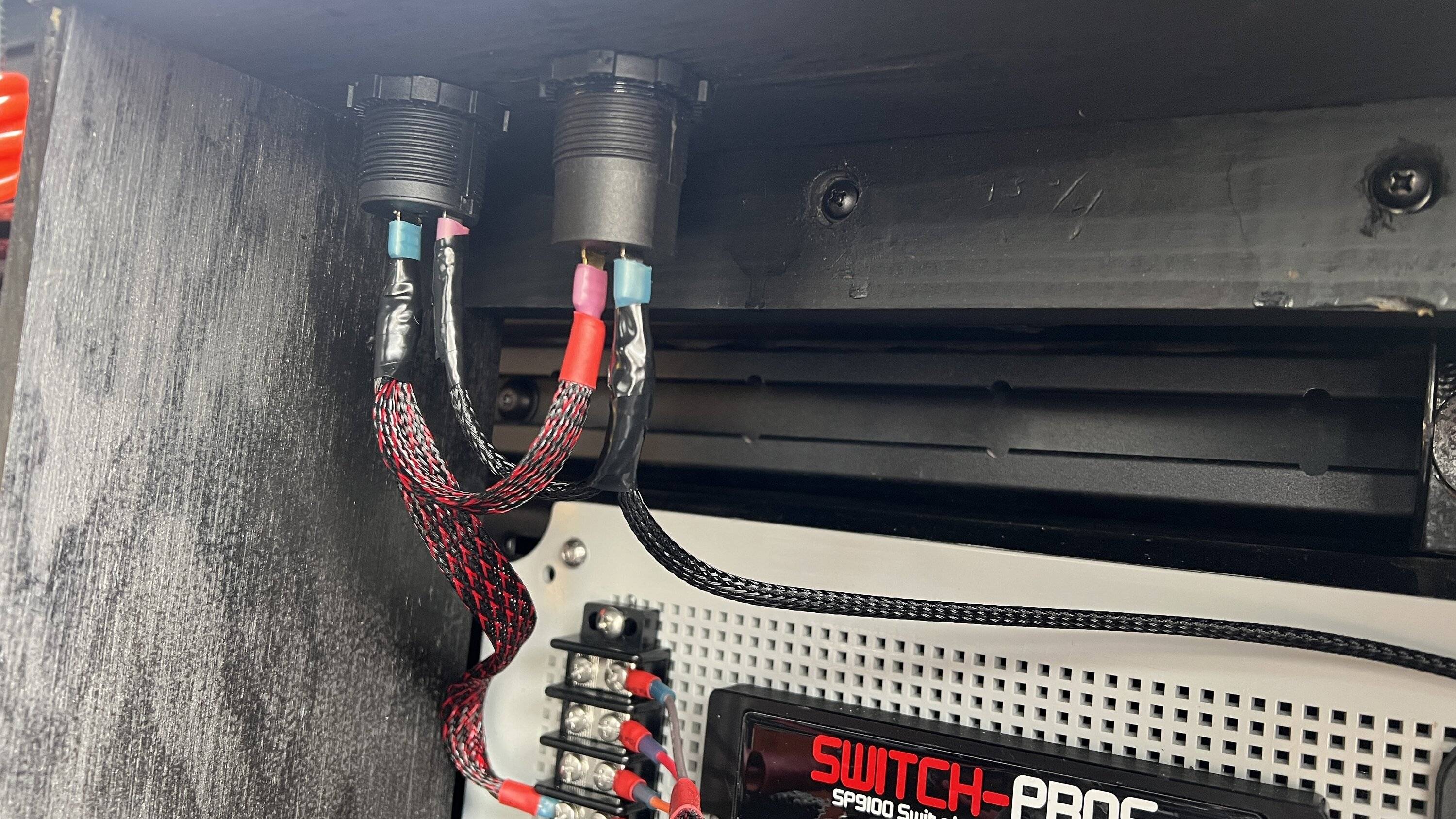
Next up it was time to start wiring! I chose to do the easy ones first. I decided to put the cigar and usb ports on the top toward the rear. This would provide ample access from either the rear, but primarily the side, and provide for a place to put items. I also wanted to keep the wiring away from the front as that would be pretty busy with ground wires, the switch pro's and other items.
Jeep Gladiator Destination Unknown - 2022 JTR journal IMG_0056


The usb/usb-c port is rated at 5a total, and I believe the cigar style is rated at 10a - so I opted to daisy chain the wires with them being well under a foot in length, and used 16ga copper wire.
Jeep Gladiator Destination Unknown - 2022 JTR journal IMG_0060


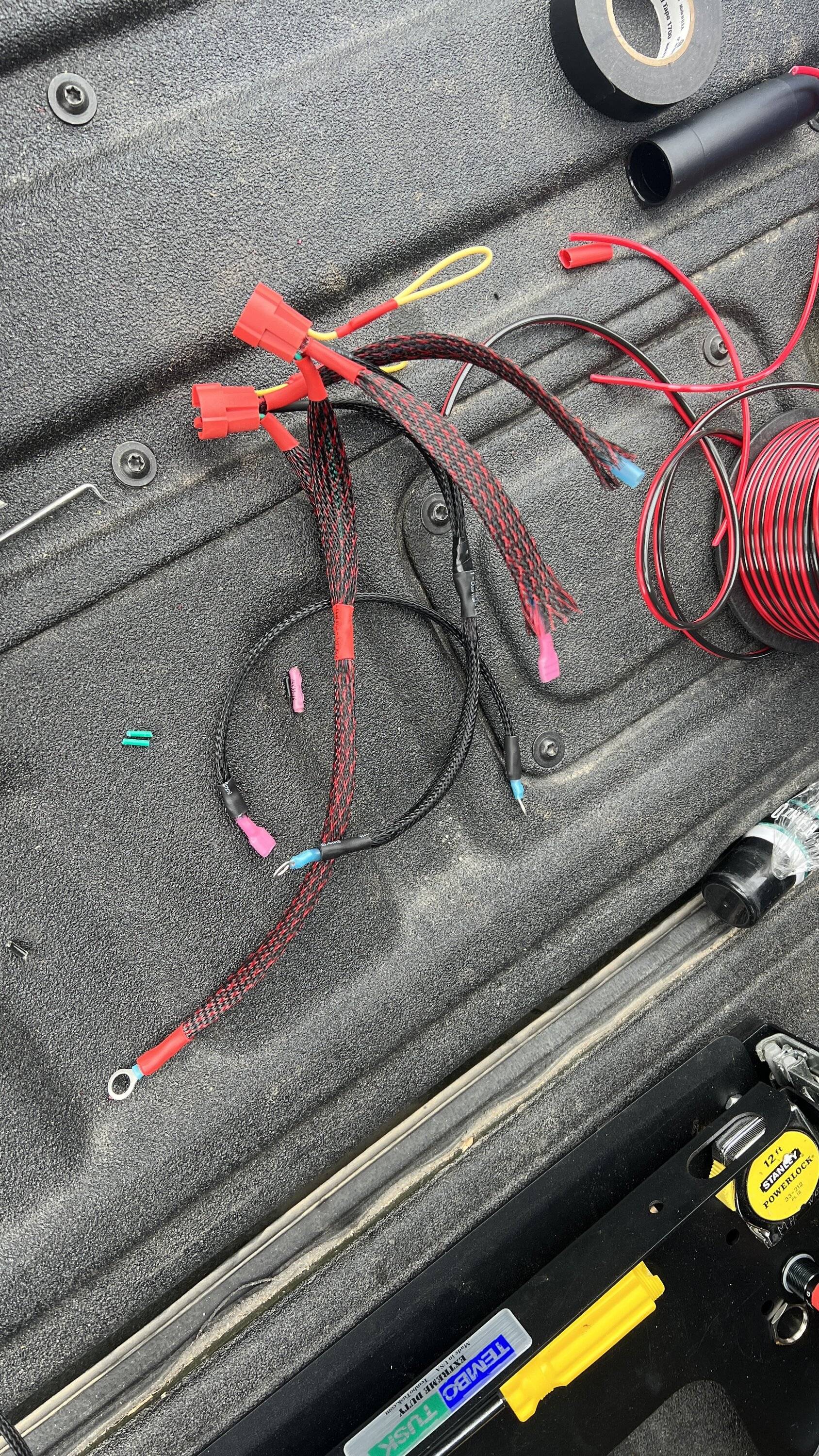
So now it was time to get going on the switch pros. I really needed to finish this up today. I extended and combined some of the wires with the little pigtail harness included with the button switches. The button switches I opted for (https://www.amazon.com/dp/B08N4GFGLN?psc=1&ref=ppx_yo2ov_dt_b_product_details) are smaller than anticipated but have a great feel, are black anodized aluminum, and will go along well with the switch pros system.
Jeep Gladiator Destination Unknown - 2022 JTR journal IMG_0059


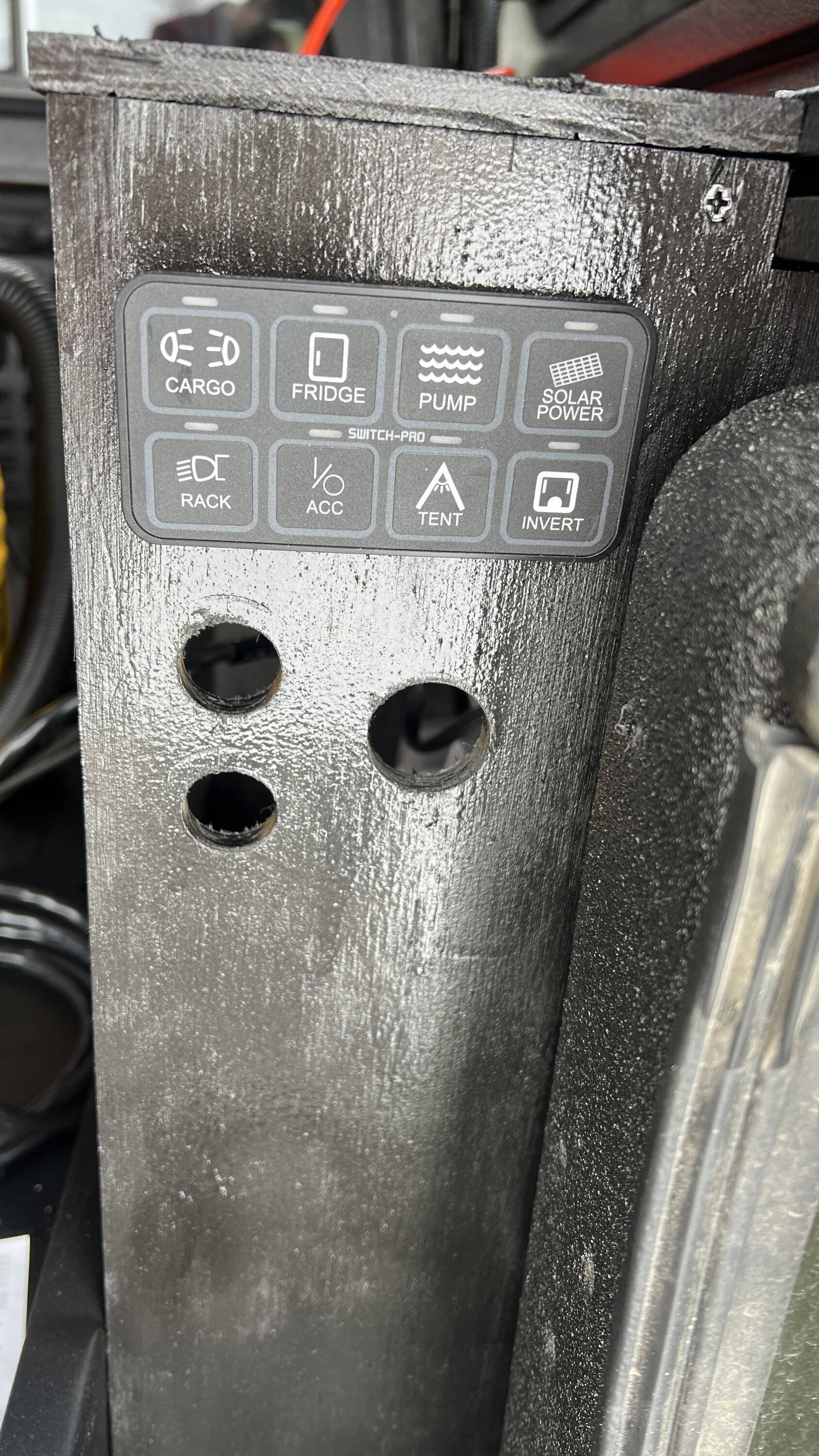
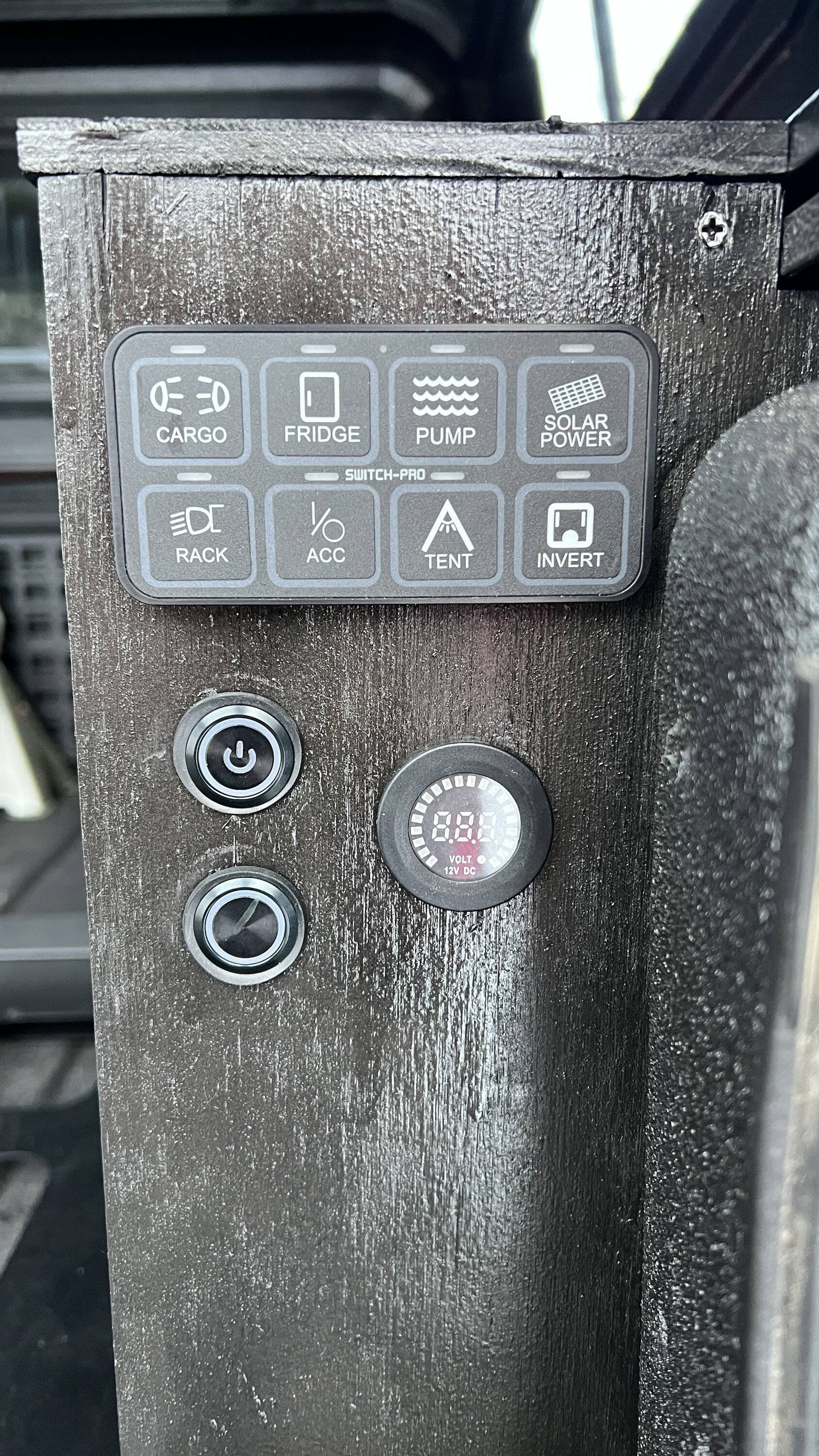
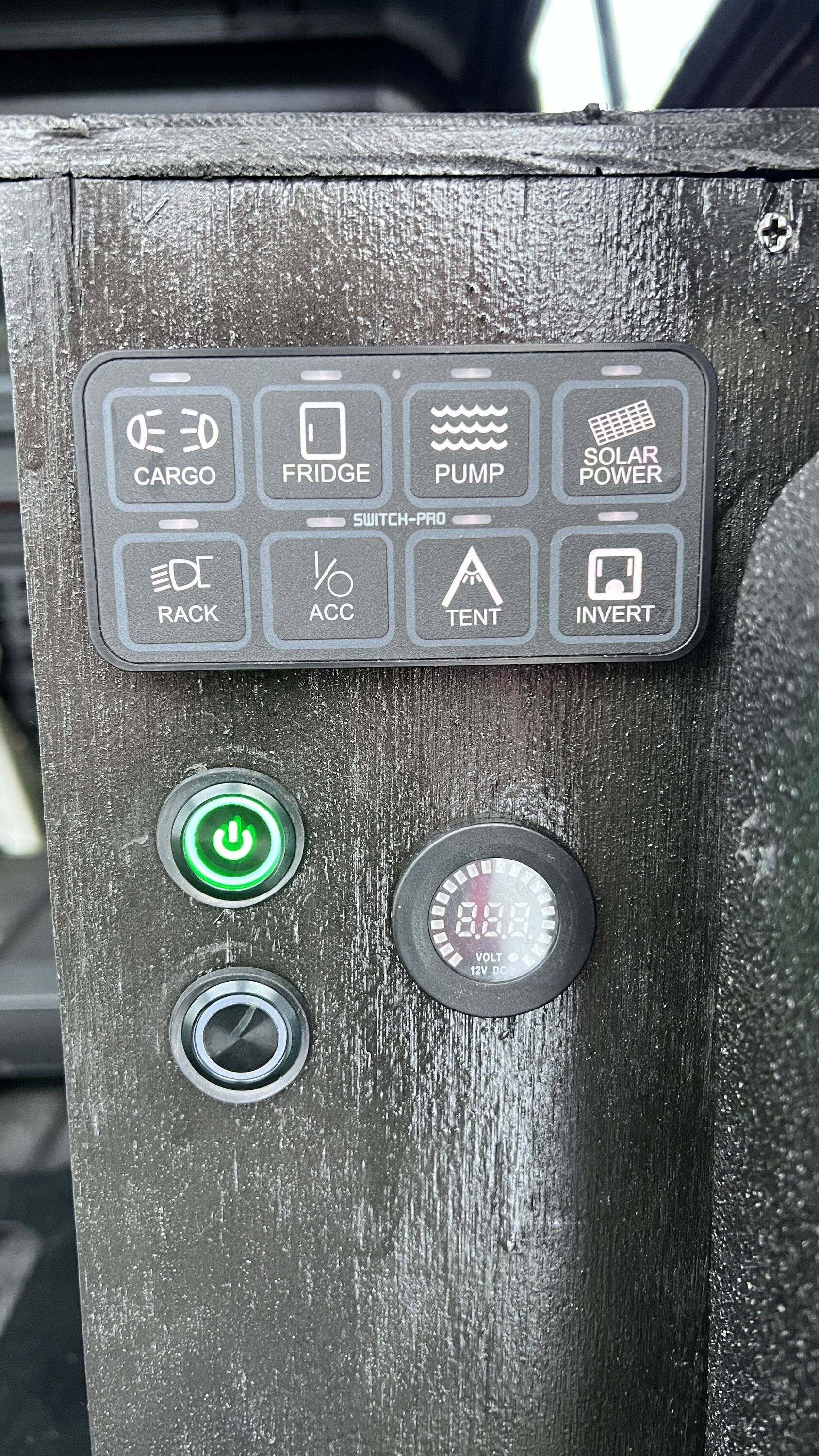
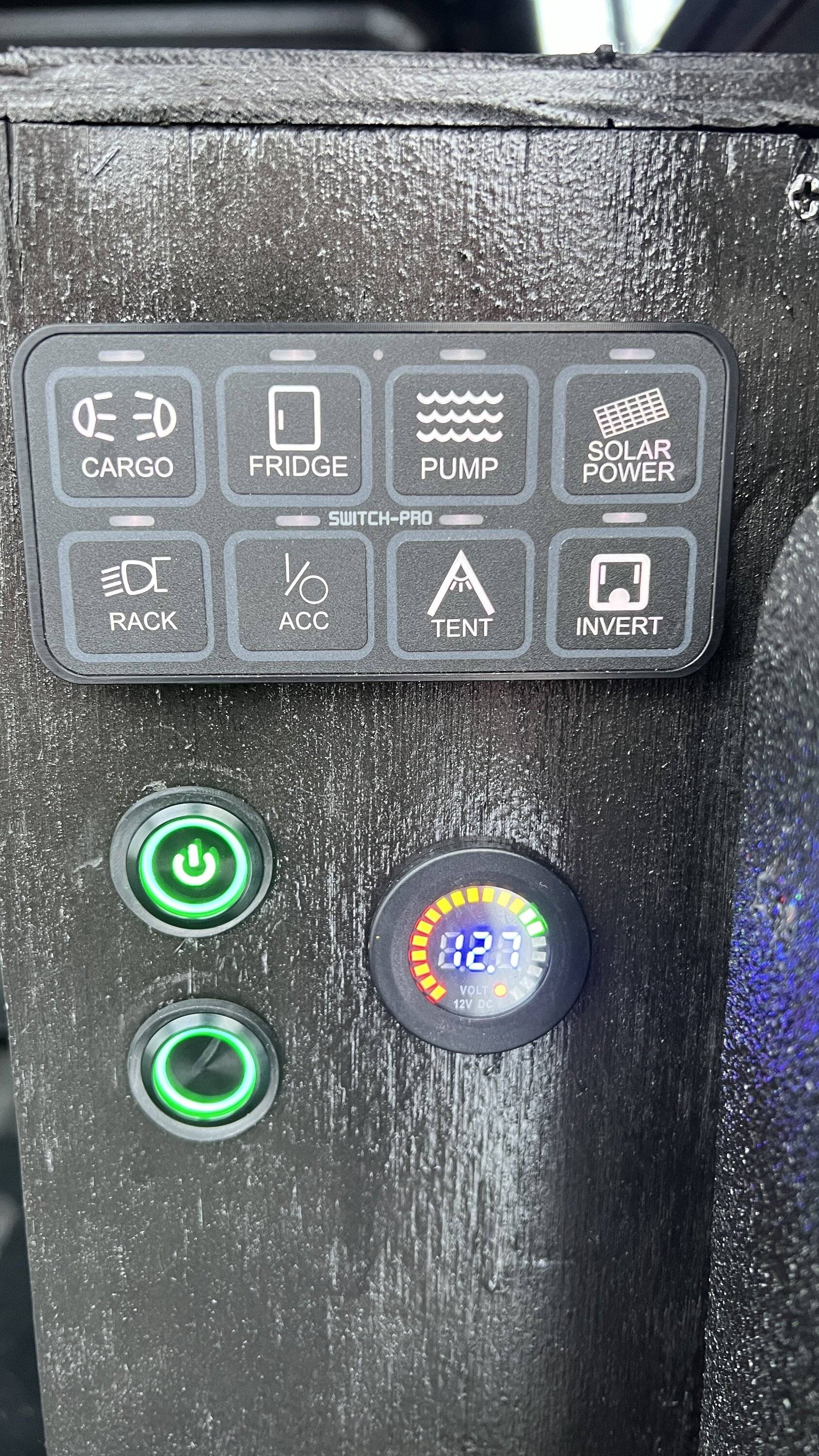
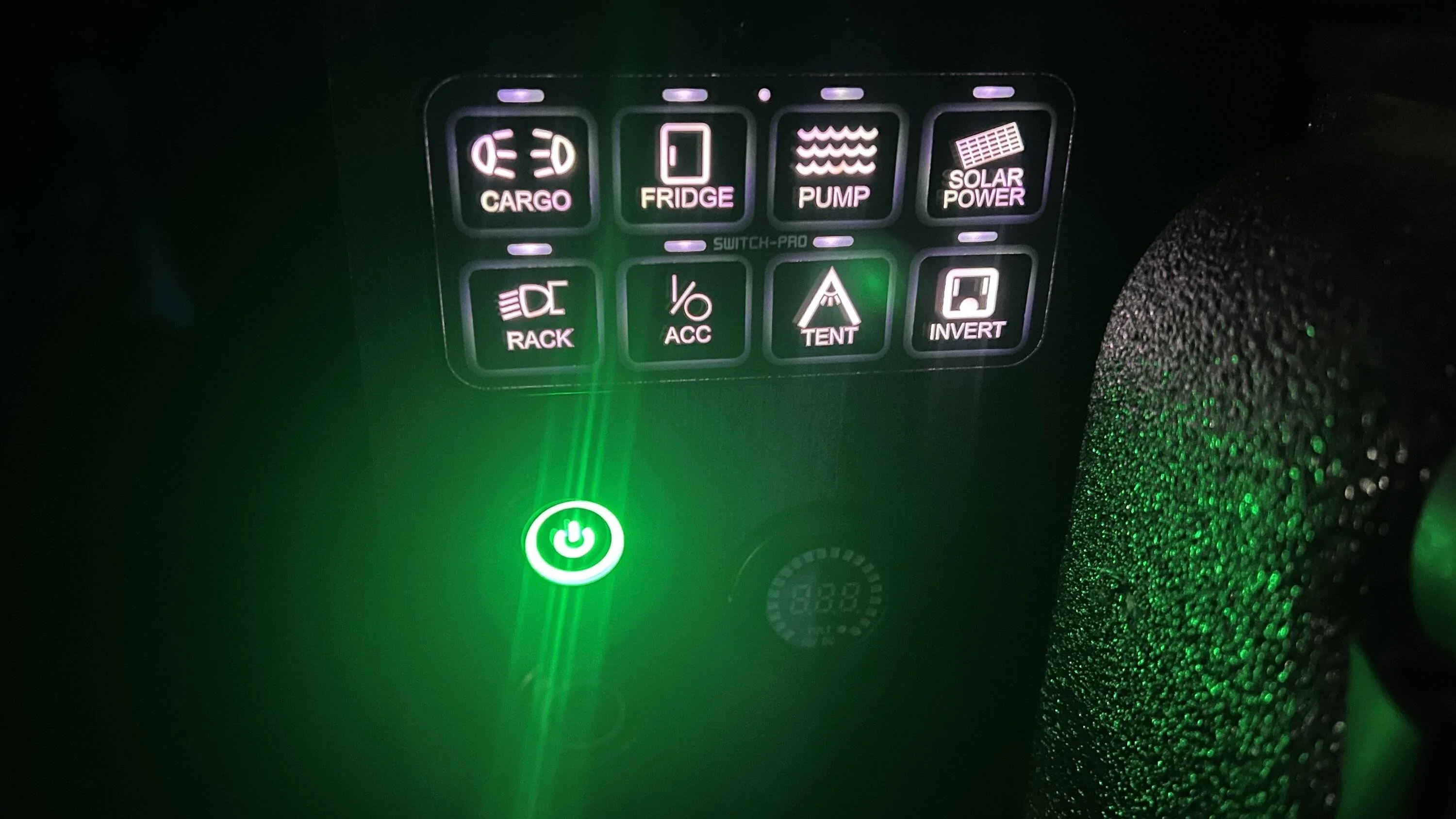
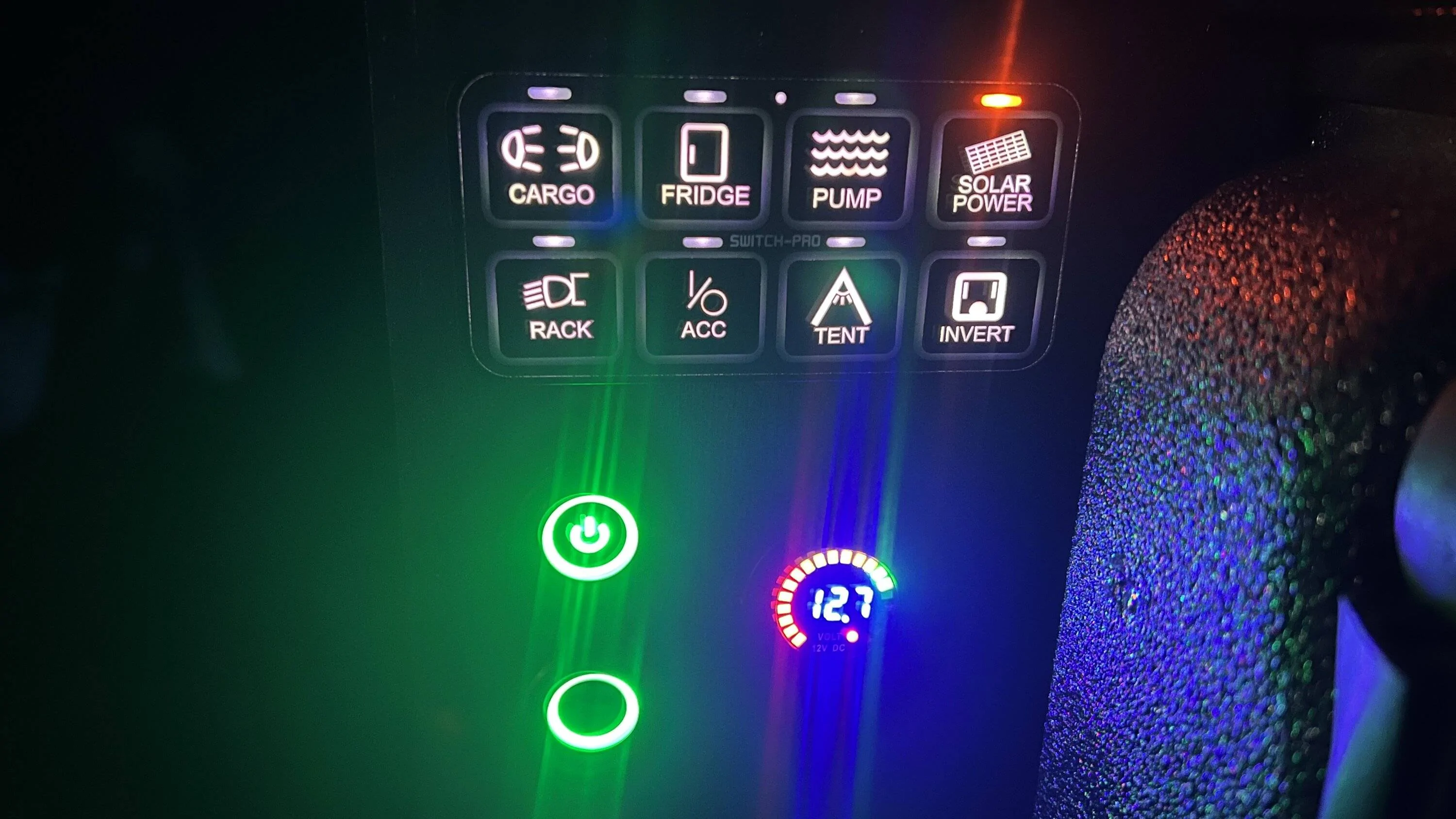
Now I had to drill more holes after first deciding where to put these button switches in relation to the voltage display and the switch pros interface. And after pondering for a while, I opted to put the switch pro's up top, the button switches above one another and the voltage readout to the right side. I think this looks really good, clean, and is easily understood.
Jeep Gladiator Destination Unknown - 2022 JTR journal IMG_0057

Jeep Gladiator Destination Unknown - 2022 JTR journal IMG_0058


Now to wire things up. There is a lot going on here - it is quite busy, and I don't like busy. But, to my own fault I didn't mount the compressor further to the front of the bed so my real estate is limited. It does look ok, things are tied up, and routed in a way that the wire naturally want's to go so all that is good. The one thing I really don't like though is that some of the wires have to hang relatively loosely. Vibration and time will surely sever the internal copper strands, but hopefully that's not for at least 5 years. In that time, I probably will take it all apart and allow myself more room.
Jeep Gladiator Destination Unknown - 2022 JTR journal IMG_0061


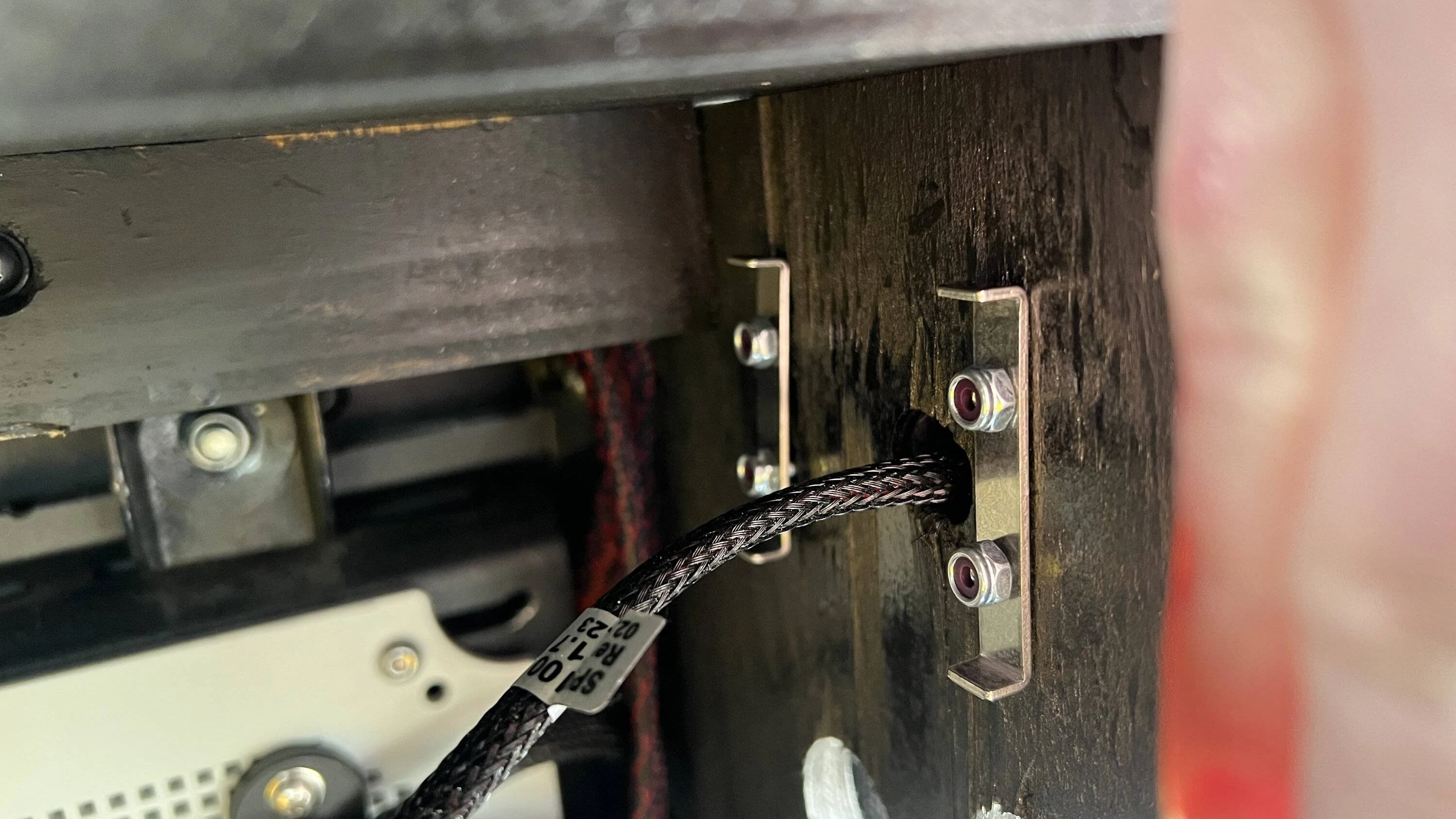
So it was time to get it all in place now. I did make a calculated and known mistake when drilling holes for the button switches. I didn't have the right size drill bit or hole saw. So I had to make it a little larger, and ran to the hardware store to get some rubber washers that I cut to size. It doesn't look super great, but only those with significant OCD like myself will really ever know at first glance. All in all it looks good.
Jeep Gladiator Destination Unknown - 2022 JTR journal IMG_0062


So, it was time for a test. Power works!
Jeep Gladiator Destination Unknown - 2022 JTR journal IMG_0063


And so does the voltage readout! Now this may seem confusing so I will break it down. For anyone not familiar with the switch pro's system, it can be powered a couple different ways. There is a wire that will be connected to a battery source. Another wire next to it needs to either also be connected to battery + or to a 12v ignition on circuit. Connecting to an ignition circuit, like the one in the cab powering my lights, will only operate and turn on when it senses 12v+ from that ignition circuit. So since I would not be powering this with the ignition, I connected it to battery positive. Now, to take it a step further is allowing the ability to fully turn the system off. If the positive wire and the on trigger wire is connected to battery +, then the system will fully be on at all times. Even though this draws very little power, I wanted to have the option and ability to fully turn the system off when not in use. Hence the I/O button switch. When pressed, this provides battery power and a battery+ signal to the switch pro's powering it on. Now another way to have done this would be to connect the power wire directly to the battery+ on the buss bar, and then only run the trigger wire through the switch. However doing this would allow the system to still be on 'standby' mode - although the power draw is insignificant, it still would be there. And in the case I would park and leave the JT for some time, say if I had another surgery, I really didn't not want any power draw. So by running the power and batt+ signal wire to the switch, when turned off it is essentially fully turned off. I'm sure it still is drawing some amount of minuscule power, but I doubt it would affect the aux battery even if left alone for a month. The starting battery would probably be significantly drained from the main vehicle system before the aux battery is drained. Now additionally is the lower button switch. This is to provide power for the voltage readout. I could have wired this also along with the main power switch, but as I figure, that readout is a power draw, and when I'm sleeping at 2 in the morning - theres nobody watching it, so it would be a unnecessary power draw no matter how little it is. So I added a switch for that as well. And with the two switches to the side of the voltage readout, it feels relatively 'even'.
Jeep Gladiator Destination Unknown - 2022 JTR journal IMG_0064


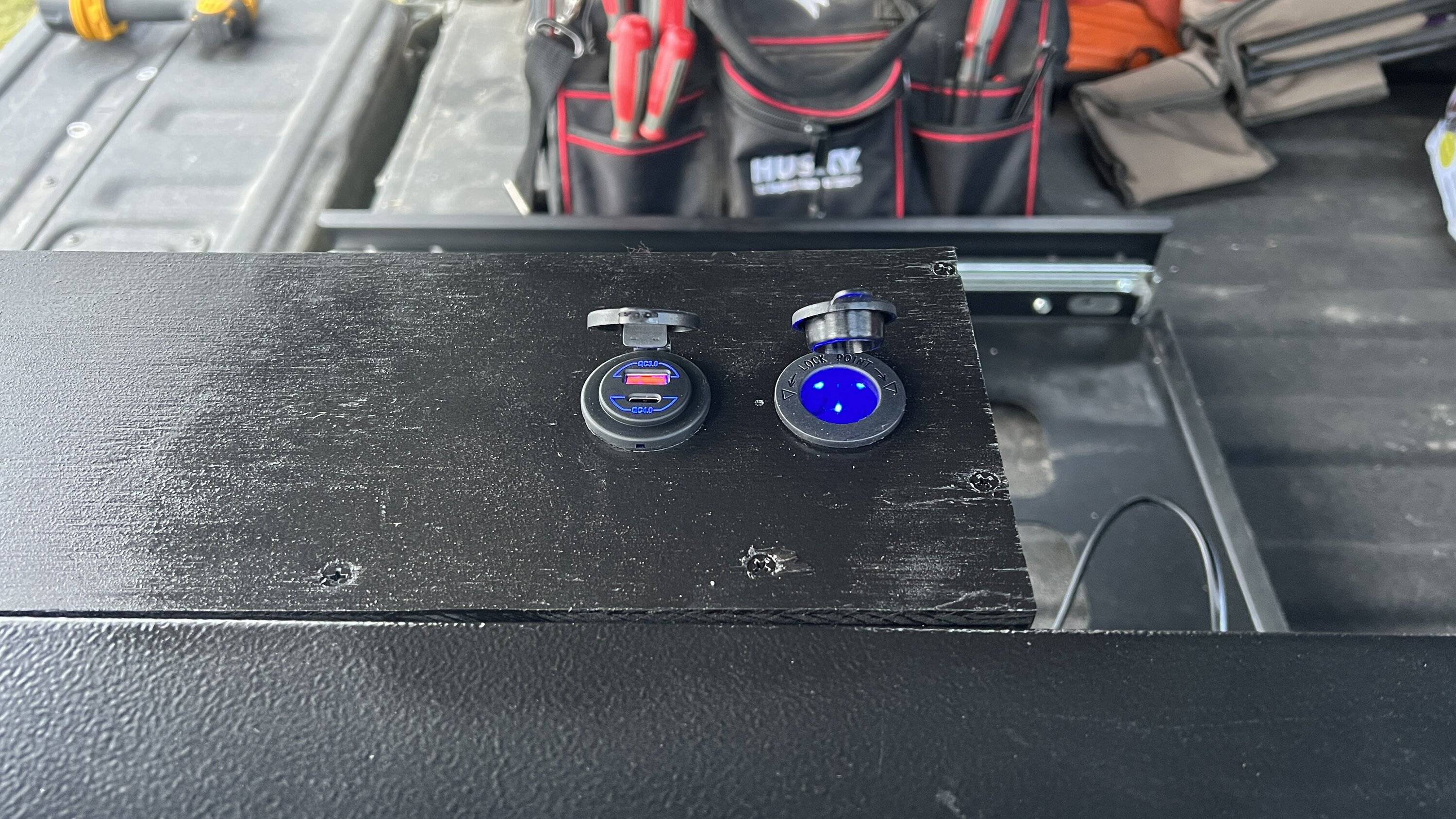
The 12v acc ports are in a great spot as well. Seen from the side door, I did consider stacking them on top of each other or side by side and decided on the side by side as seen here, with the cigar style power port to the right so that if needed to power the fridge it doesn't have to cross over any items potentially plugged into the usb/usb-c port.
Jeep Gladiator Destination Unknown - 2022 JTR journal IMG_0065


I didn't test anything being plugged in, but they do have power. In this case I did opt for the backlighting. Unnecessary - maybe, additional power draw - yes. However, it will allow for a visual indication if by chance I left them on by mistake and the plugs are lifted off.
Jeep Gladiator Destination Unknown - 2022 JTR journal IMG_0066


All in all I am pleased. In the future I may do something different but considering the space constraints I think this worked out really well and I am happy with the result.
Jeep Gladiator Destination Unknown - 2022 JTR journal IMG_0067


And another night shot, just because it's so cool.
Jeep Gladiator Destination Unknown - 2022 JTR journal IMG_0068


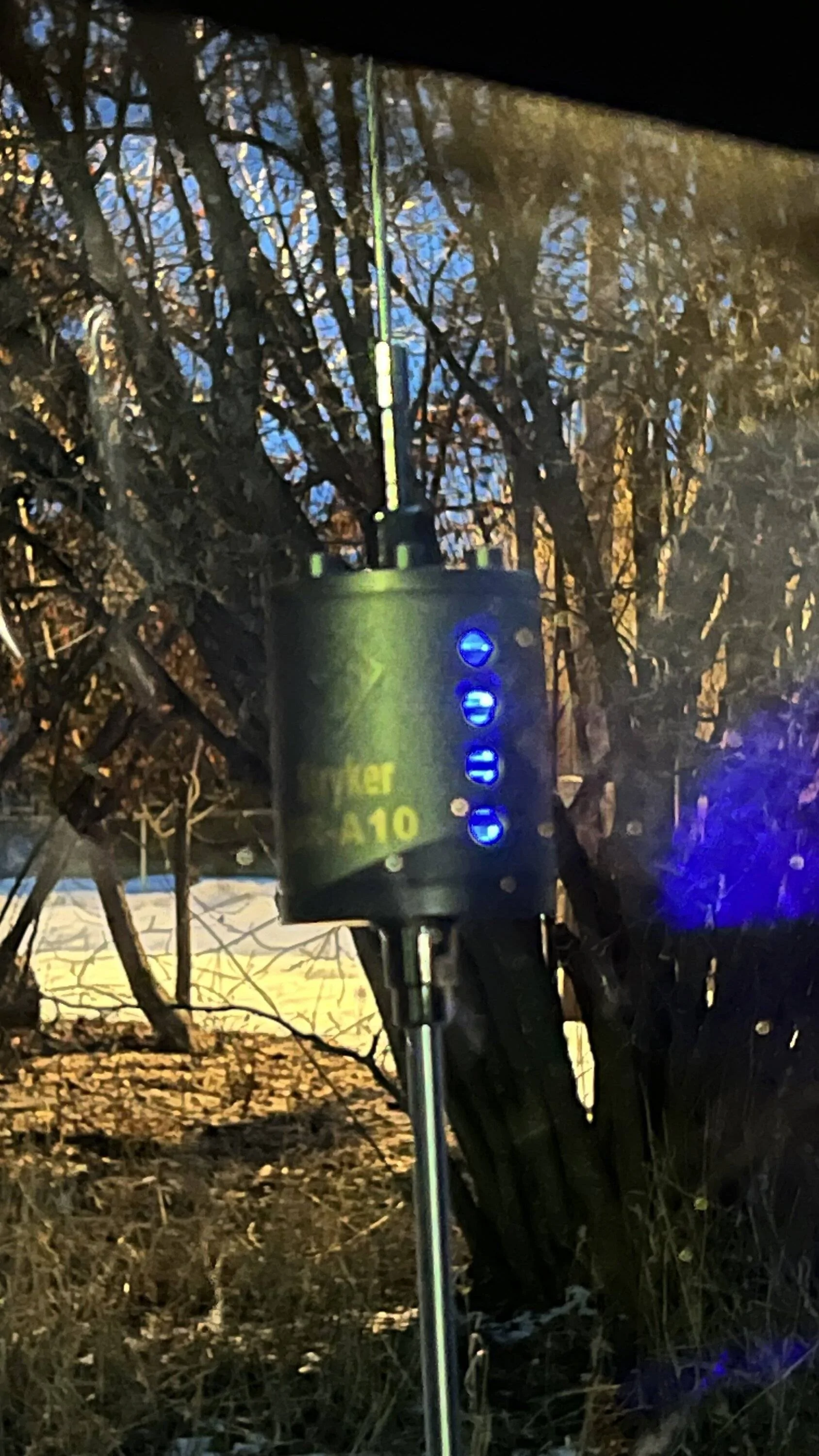
And lastly, a while ago I mentioned the Stryker antenna lights up. Well here it is - when transmitting. Kinda gimmicky, but pretty cool I think. Still amazes me that there is enough electricities produced when transmitting that it self powers this light. Yes you read that right, there is NO power or power wire going to the antenna for this. It is lit up entirely from the RF electricities generated during transmission.
Jeep Gladiator Destination Unknown - 2022 JTR journal IMG_0069
Sponsored


Top