
Sponsored

Dodge, Ram Engines Could Have a Turbo Cast Directly Into the Head

Uparms

Well-Known Member
Joined
Feb 23, 2019
Threads
109
Messages
1,080
Reaction score
869
Location
Delaware
Vehicle(s)
2023 JT, 2020 JT, 72 CJ5,2005 LJ, 2002 TJ, 92 YJ
Vehicle Showcase
1
https://www.thedrive.com/news/44795...ould-have-a-turbo-cast-directly-into-the-head

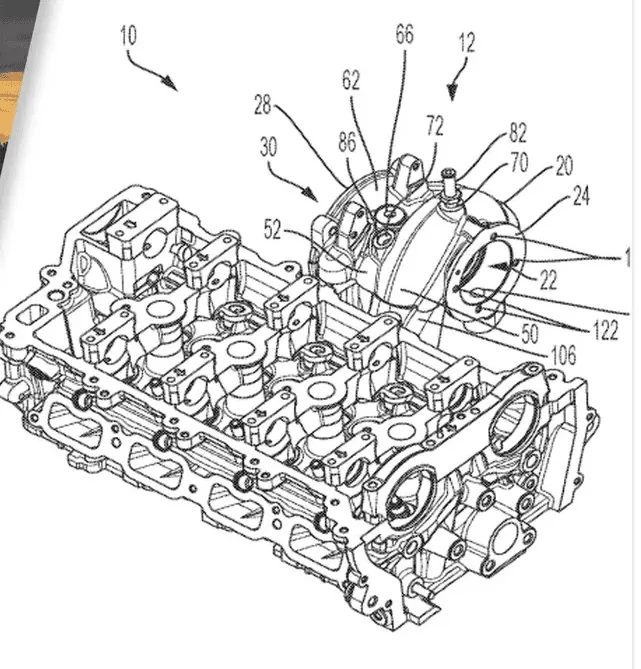
The automaker apparently plans to do more than cast exhaust manifolds into cylinder heads as some others have—it wants to integrate entire turbochargers.

The patent was only just published on March 9, but it was formally submitted to the U.S. Patent and Trademark Office back in May of 2020. As hinted at above, the purpose of this sort of system is to reduce the number of parts in turbocharged engines and reduce cost. In order to achieve these savings, a lot of the turbo system is cast directly into the head.

The exhaust manifold is, of course, cast in, as is the exhaust housing. It goes a lot further than that, though. The document notes that parts like the wastegate, or at least a place to mount the moving parts of a wastegate, can be cast directly into place, as can parts of the compressor side of the turbo. The core of the turbocharger—the bearings, shaft, turbine, and compressor wheel themselves—are part of a separate cartridge.

Continued / More in Article!

Jeep Gladiator Dodge, Ram Engines Could Have a Turbo Cast Directly Into the Head 1647527167127
Sponsored

 
OP
OP
Uparms

Uparms

Well-Known Member
Joined
Feb 23, 2019
Threads
109
Messages
1,080
Reaction score
869
Location
Delaware
Vehicle(s)
2023 JT, 2020 JT, 72 CJ5,2005 LJ, 2002 TJ, 92 YJ
Vehicle Showcase
1
""It also must be said that this is bad for serviceability and aftermarket tuning. If a conventional car today has a failure in its turbo system, those parts can just be replaced. With this setup, that's no longer an option. An entire head has to come off or some serious jerry-rigging must be done to correct a potential failure. The bottom line is that this setup heavily focused on increasing manufacturing efficiency, with other considerations far more compromised.

Indeed, the patent document explicitly states that all of this is being done to reduce "cost and complexity." Turbo systems today work great and they're pretty reliable, as the text notes; however, the metals required to make the exhaust ends of turbos—it specifically mentions nickel and chrome—are expensive, as is the slew of componentry needed to assemble the systems. "Gaskets, fasteners, mating tubes, ducts and other components" all translate into an expensive and complex piece of hardware. That's not such a big deal for an enthusiast looking to add some power later in a vehicle's life, but it is a big deal for an automaker producing millions of vehicles.


The bottom line is that Chrysler engineers, if you can still call them that, are wading into an unknown ocean of innovation here. Combination turbo housings and exhaust manifolds have been done before, as have exhaust manifolds integrated into heads. However, at least in terms of a mass-market automotive product, integrated turbos have not. Just the same, a turbocharger exhaust side made of aluminum, which this design hangs its hat on, has not been widely developed.

If it gets it right, Stellantis could save a lot of money and make its vehicles simpler. If it gets it wrong, it's a potential warranty and recall nightmare. In any case, it's interesting engineering, and we'll have to wait and see whether it ends up on any vehicles in the Stellantis family. Will Ram follow Chevy's lead and put a big four-cylinder turbo engine in its full-sized pickups? Will Dodge make every Mopar enthusiast on the planet angry and make a four-cylinder Challenger? Drivetrains for either of those cars could feature this sort of turbo system"".
 

NachoRuby

Well-Known Member
First Name
Chad
Joined
Apr 28, 2021
Threads
28
Messages
2,992
Reaction score
4,428
Location
Pennsylvania
Vehicle(s)
'21 JTR , '18 JLU, 73 VW Bug, 97 VW Jetta, all MTs
Not a great idea. Turbos fail, and fail often. I have no problem with a good 4cyl turbo motor, since that's what I drove before. It makes tuning fun. However a turbo integrated into the exhaust manifold makes for a difficult repair. This makes a relatively easy repair far more expensive.
 
Last edited:

Orange01z28

Well-Known Member
First Name
Andrew
Joined
Aug 19, 2020
Threads
69
Messages
1,420
Reaction score
1,814
Location
Queen Creek Arizona
Vehicle(s)
2020 JTR
Why not dispense with the power adders and continue to use good ol fashioned cubic inches?
 

Sponsored

Glad_he_ate

Well-Known Member
Joined
Jun 11, 2021
Threads
10
Messages
790
Reaction score
1,076
Location
Mexico ny.
Vehicle(s)
2021 gladiator Willie's ecodiesel
Occupation
Union electrician
Why not dispense with the power adders and continue to use good ol fashioned cubic inches?
EPA ring a bell?? Ci are heavy inefficient and unfortunately on the way out. However building a full ish turbo system into the head is just adding expensive repairs to the end user. If they go that route they will likely make sure it will last as long as the warranty and then wash their hands of it. Probably not hard to make it work past 60k however not likely to make it last 120k
 

rharr

Well-Known Member
Joined
May 6, 2021
Threads
29
Messages
2,024
Reaction score
2,771
Location
Tucson, AZ
Vehicle(s)
21 JTRD 3" RKK lift, (former) 95 XJ 5sp 8" lift
Hate to break it to you but cars are becoming a disposable commodity, soon to be a subscription service. Buy a car run it for 100k get a new one, keep paying a monthly fee. These systems are not design for serviceability they are design for low cost manufacturing, to meet new EPA standards, and to get to a car to last until 100k when the warranty is over. Then things go south and you get a new one because repairs cost more then the value of the car. Don't fool yourself into thinking no one thought about designing in a limited lifecycle into cars.

Just wait until we have standardized electric chassis' with swappable coaches. Once you go electric then there is less to fail on a power train/chassis but manufactures will need to still sell product so they will offer swappable coaches appointed/styled to your wants and needs to keep selling stuff. The old coaches get recycled.

End of the day the populace are not auto enthusiasts and just want something that gets from A to B safely and comfortably with a little flash to show off your status in life.
 

Orange01z28

Well-Known Member
First Name
Andrew
Joined
Aug 19, 2020
Threads
69
Messages
1,420
Reaction score
1,814
Location
Queen Creek Arizona
Vehicle(s)
2020 JTR
EPA ring a bell?? Ci are heavy inefficient and unfortunately on the way out. However building a full ish turbo system into the head is just adding expensive repairs to the end user. If they go that route they will likely make sure it will last as long as the warranty and then wash their hands of it. Probably not hard to make it work past 60k however not likely to make it last 120k
Engineers have made huge jumps in efficiency using cubic inches rather than power adders to the point where we're seeing the best in history

I guess the engineers know best

Don't get me wrong, I'm well-versed in the efficiency and power forced induction can make, especially turbos but at the end of the day this goes against the KISS principle

Can someone smarter than me explain how a power-adder is more efficient? All it is doing is pumping more air through the engine, which needs fuel as well in order to keep the proper air/fuel ratio. How is that any different than 8 larger cylinders pumping the same amount of air and fuel?
 

Klutch

Well-Known Member
Joined
May 25, 2019
Threads
19
Messages
822
Reaction score
1,015
Location
Colorado Springs
Vehicle(s)
1986 Jeep Comanche, 2000 Jeep Cherokee
Hate to break it to you but cars are becoming a disposable commodity, soon to be a subscription service. Buy a car run it for 100k get a new one, keep paying a monthly fee. These systems are not design for serviceability they are design for low cost manufacturing, to meet new EPA standards, and to get to a car to last until 100k when the warranty is over. Then things go south and you get a new one because repairs cost more then the value of the car. Don't fool yourself into thinking no one thought about designing in a limited lifecycle into cars.

Just wait until we have standardized electric chassis' with swappable coaches. Once you go electric then there is less to fail on a power train/chassis but manufactures will need to still sell product so they will offer swappable coaches appointed/styled to your wants and needs to keep selling stuff. The old coaches get recycled.

End of the day the populace are not auto enthusiasts and just want something that gets from A to B safely and comfortably with a little flash to show off your status in life.
I can remember the early 1970s when a new car was doing really well to provide 100,000 miles of reliable service. And those 100,000 miles involved numerous oil changes as well as many sets of points, spark plugs, rotors, distributor caps, plug wires, water pumps, fuel pumps, v-belts, coolant hoses, shock absorbers, tie rod ends, ball joints, carburetor rebuilds and maybe even a valve job. Bias ply tires didn't last very long. And after ten years, if the vehicle was driven anywhere other than a desert, it was completely rusted out.

The old 3-speed automatic transmissions were another story. Those things typically went a quarter million miles.
Sponsored


Top