

WesternJeep401
Active Member
- First Name
- Lance
- Joined
- Jan 2, 2023
- Threads
- 0
- Messages
- 25
- Reaction score
- 50
- Location
- Sedona, AZ
- Vehicle(s)
- 2021 JTR EcoDiesel, 2020 JLUR Supercharged
- Occupation
- Govt
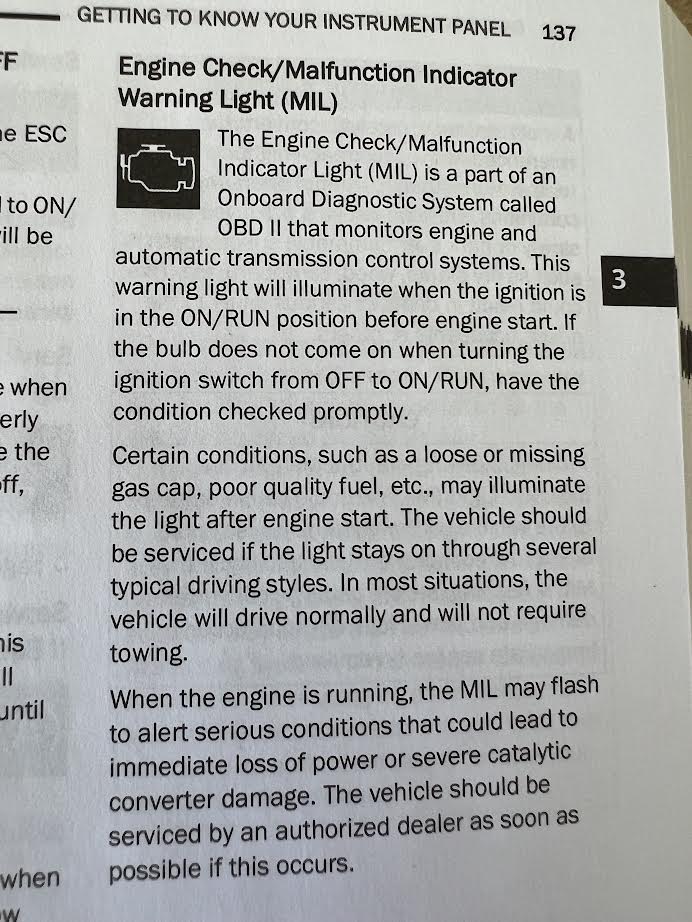
See attach from pp 137 of the 21' Gladiator Operator's Manual. It's always a good idea to refer to the manual for all manner of information regarding your platform! Regardless, the mistake I make is to communicate to you, the OP, in the manner of an automotive technician directly to customer/operator. Note the final paragraph of attach; it emphasizes that a flashing MIL means you have an active misfire, and should be taken seriously. You previously wrote that it flashes on initial start, then stops after awhile, with no apparent loss in drivability or a steady-lit MIL. This is further affirmed by the service rep, therefore, with no stored codes, there's basically no way for the service tech to verify the complaint. Transient issues are frustrating for both the owner operator as well as the servicing shop.
Perhaps take a video (if you can safely) of the light flashing next time, with a full-view of the instrument cluster. A further step, if your Jeep is equipped with Jeep Pages - Instrument view at the center stack display - pull that up and include in your short video.
For my part in the last 32 years, and in the case of integrated Misfire, EVAP, Heated O2, and myriad other IM240 "monitors", the misfire monitor was one that demanded immediate attention for reasons already explained. The weirdest case was a 1996 Mazda B pickup where a mouse had gotten behind the plastic (Pinto 2.3) timing cover. Upon crank, the carcass interjected itself between the cam drive and belt, causing it to jump one tooth. Driver complained, not that the MIL was occasionally flashing, but that he was down on power (which, for that powertrain, was pretty obvious). Some years later, a 3.8 JK had a somewhat steady flashing MIL with no noticeable loss of driveability. It ended-up being a fresh dirt-dauber (wasp) nest built on the crankshaft front pulley, causing a disparity between the crank and cam sensors.
In any case, assuming everything is functioning properly, it could just be a case of a cold-natured engine, shaking-off the cobwebs until it gets a little heat on. All speculation as to what's going on, unless it's in front of me.

Perhaps take a video (if you can safely) of the light flashing next time, with a full-view of the instrument cluster. A further step, if your Jeep is equipped with Jeep Pages - Instrument view at the center stack display - pull that up and include in your short video.
For my part in the last 32 years, and in the case of integrated Misfire, EVAP, Heated O2, and myriad other IM240 "monitors", the misfire monitor was one that demanded immediate attention for reasons already explained. The weirdest case was a 1996 Mazda B pickup where a mouse had gotten behind the plastic (Pinto 2.3) timing cover. Upon crank, the carcass interjected itself between the cam drive and belt, causing it to jump one tooth. Driver complained, not that the MIL was occasionally flashing, but that he was down on power (which, for that powertrain, was pretty obvious). Some years later, a 3.8 JK had a somewhat steady flashing MIL with no noticeable loss of driveability. It ended-up being a fresh dirt-dauber (wasp) nest built on the crankshaft front pulley, causing a disparity between the crank and cam sensors.
In any case, assuming everything is functioning properly, it could just be a case of a cold-natured engine, shaking-off the cobwebs until it gets a little heat on. All speculation as to what's going on, unless it's in front of me.
Sponsored