Sponsored

Let's have a conversation about inflation...

calling4life

Member
Joined
Nov 12, 2024
Threads
0
Messages
6
Reaction score
5
Location
N. MN
Vehicle(s)
2020 Gladiator Rubicon
I fear as though my tact was perhaps off and some offense may have been taken at what I noted, that was not the intent, perhaps reading too many threads on said topic and seeing so much blind advice got me in a mode where I was a bit flippant.


The computer on my gladiator when I bought it noted 14.4 MPG for over 5,000 miles of trip, whatever that meant for the gentleman that owned it before me.
I reset that and my hour long drive home had me at 13.7mpg.
Changed tire pressures after and I've done some rather minor driving, more in city. 12.8mpg.

To be noted, the computer is not calibrated for the tires. And I would also say I've not driven enough to know truly if it would affect MPGs much. As we're still talking being set on appropriate PSI given weight, I wouldn't imagine so, maybe a touch.

My FJ Cruiser got about 13mpg with its 35's, I feel that this Gladiator is doing great given the MPG's will actually be higher than stated, I will get a tazer mini to adjust the computer and also to keep the dang auto shut off thing shut down.

I will note, this thing revs higher than I think any truck in which I've ever even rode, it likes to drive around like it thinks it's a race car, the FJ liked to sit at low rpm, would bog then go, almost like turbo lag.

This thing likes to sit at 2k or so rpm and if you hit it, it doesn't mind seeing 6k or so rpm.

Odd the way they tuned these... especially with peak torque at 4400, that isn't truck, she's tuned up like a 1/4 mile car.

But gas mileage is good enough and I don't mind the extra speed, just odd for me given how my FJ felt...
Sponsored
 
OP
OP
red/green hawk

red/green hawk

Well-Known Member
First Name
Ryan
Joined
Apr 4, 2020
Threads
48
Messages
728
Reaction score
1,217
Location
Moscow, ID
Vehicle(s)
2020 JT Sport S with max tow package, 2008 Suburban LTZ
Occupation
PACU Nurse
You betcha. That's what I did with my Generals. They wanted to know the truck weight, the extact General tire number I had, the prior tire size and so on and gave me a figure of about 35-36. Handles and rides like a dream, and they are wearing perfectly.
Yokohama just got back to me with all the specs they asked for and told me to run them at 35 cold so that's what I'm going to do.

Do whatever you want, there's probably 4 dozen threads on this all over here in the last 5+ years, and you'll never find the exact same answer because no one can tell you what to run for pressure unless their truck weighs the same and they have the exact same tires/size.

Your truck, your tires, your money.
You'll get many different takes, no consensus, so you'll have to sort through and choose.
This is why I've been perseverating on this for so long. I got a great deal on these tires but still spent some cash. I want them to last!
 

XraytecH

Well-Known Member
First Name
Bernie
Joined
Jan 14, 2021
Threads
208
Messages
1,899
Reaction score
2,793
Location
South San Francisco
Vehicle(s)
2021 Jeep Gladiator Sport
Occupation
Xraytech
Vehicle Showcase
1
Not sure if this answers your question but how about the Chalk Test.


calling4life

Member
Joined
Nov 12, 2024
Threads
0
Messages
6
Reaction score
5
Location
N. MN
Vehicle(s)
2020 Gladiator Rubicon
Yokohama just got back to me with all the specs they asked for and told me to run them at 35 cold so that's what I'm going to do.


This is why I've been perseverating on this for so long. I got a great deal on these tires but still spent some cash. I want them to last!

The math way is the answer for everybody.

So, Yokohama notes on their site, E rating is 80psi max psi, their 121 load rating you also noted in your original post is 3,197lbs.

So, math.

3197 x 4 = 12,788lbs is the max weight 4 of these tires can support.

Ok, I need your truck weight, but I don't have it, so I'm going to use a generic 5500lbs.

Your 5500lbs truck weight divided into the 12,788lb max weight = .4301

That means that your 5500lb truck is 43.01% of the total max weight that can be supported by those tires.

So, we take that 43.01% and we multiply it by the tires max psi of 80psi and get 34.407psi

So 34.407 is the psi for the 5500lb truck, add weight and it'll need more, take away weight and it'll need less.

Outside of that, you're just doing you, that's the math of it.

For on road normal driving, that'll be the minimum number you want, because at less psi the tires aren't geared for your weight, so you'll want to go more, if anything. But remember, high pressure can lead to blow outs, loss of traction, uneven wear and so on as well, it isn't just the "easy" button.

Again, lawyers will have built safety margins into those tire numbers as well, so we don't need to be pedantic about it, but nonetheless, that's the minimum safe tire pressure for normal on road driving.


That works for everyone. Do the math for your tires and vehicle, it WILL work for you.

Yokohama recommended you 35, I don't know if you gave them a weight of 5500lbs for your truck, or if they just looked up Gladiators and used that, but the math I just did is right there with them...

Then, people can get into what makes them feel good, thumb test, chalk test, traction test, heat test, and so on... to adjust further to how they WANT, what gives them the good feelies.

But the need can be determined by math, and your chalk test should actually show quite great results at the mathematical psi, I've never had it test bad.
 

Wheelin98TJ

Well-Known Member
First Name
Ryan
Joined
Jul 27, 2021
Threads
11
Messages
3,708
Reaction score
4,371
Location
Devils Lake, MI
Vehicle(s)
2021 Jeep Gladiator
Occupation
Bean Counter
The math way is the answer for everybody.

So, Yokohama notes on their site, E rating is 80psi max psi, their 121 load rating you also noted in your original post is 3,197lbs.

So, math.

3197 x 4 = 12,788lbs is the max weight 4 of these tires can support.

Ok, I need your truck weight, but I don't have it, so I'm going to use a generic 5500lbs.

Your 5500lbs truck weight divided into the 12,788lb max weight = .4301

That means that your 5500lb truck is 43.01% of the total max weight that can be supported by those tires.

So, we take that 43.01% and we multiply it by the tires max psi of 80psi and get 34.407psi

So 34.407 is the psi for the 5500lb truck, add weight and it'll need more, take away weight and it'll need less.

Outside of that, you're just doing you, that's the math of it.

For on road normal driving, that'll be the minimum number you want, because at less psi the tires aren't geared for your weight, so you'll want to go more, if anything. But remember, high pressure can lead to blow outs, loss of traction, uneven wear and so on as well, it isn't just the "easy" button.

Again, lawyers will have built safety margins into those tire numbers as well, so we don't need to be pedantic about it, but nonetheless, that's the minimum safe tire pressure for normal on road driving.


That works for everyone. Do the math for your tires and vehicle, it WILL work for you.

Yokohama recommended you 35, I don't know if you gave them a weight of 5500lbs for your truck, or if they just looked up Gladiators and used that, but the math I just did is right there with them...

Then, people can get into what makes them feel good, thumb test, chalk test, traction test, heat test, and so on... to adjust further to how they WANT, what gives them the good feelies.

But the need can be determined by math, and your chalk test should actually show quite great results at the mathematical psi, I've never had it test bad.
80 PSI might not be the correct max. The 4 different 35x12.50x17 Yokohama load range E tires are all 65 PSI max.

So if we’re talking about 65 max PSI tires, 43% of 65 PSI = about 28 PSI to carry 5,500 lbs.
 

Sponsored

calling4life

Member
Joined
Nov 12, 2024
Threads
0
Messages
6
Reaction score
5
Location
N. MN
Vehicle(s)
2020 Gladiator Rubicon
Yes, I went by numbers they had in tables on their site, not specific tires.
Link to that, not that it matters at all, you'll have the numbers, they are on your tires. https://www.yokohamatire.com/tires-101/how-to-read-a-sidewall-1/sizing-information

Hopefully to convey the message, the numbers are there for you on the tire that is on your truck, only other number is the trucks specific weight.

Then of course, as noted prior, if you want to get even more precise, you can break it down by front weight vs. back weight, and even side to side differences.

Overall point, math is there to save the day, you can know what you need to run for psi and this works for everyone, then adjust if and as you feel the need for specific traction goals or what not.

I'll stop, I type too much.
 

Blade1668

Well-Known Member
First Name
Darrell
Joined
Jan 7, 2020
Threads
12
Messages
3,263
Reaction score
3,149
Location
N. AL.
Vehicle(s)
90XJ, 91XJ, 91MJ, 05 LJ, 20 JT
Build Thread
Link
Vehicle Showcase
1
The math way is the answer for everybody.

So, Yokohama notes on their site, E rating is 80psi max psi, their 121 load rating you also noted in your original post is 3,197lbs.

So, math.

3197 x 4 = 12,788lbs is the max weight 4 of these tires can support.

Ok, I need your truck weight, but I don't have it, so I'm going to use a generic 5500lbs.

Your 5500lbs truck weight divided into the 12,788lb max weight = .4301

That means that your 5500lb truck is 43.01% of the total max weight that can be supported by those tires.

So, we take that 43.01% and we multiply it by the tires max psi of 80psi and get 34.407psi

So 34.407 is the psi for the 5500lb truck, add weight and it'll need more, take away weight and it'll need less.

Outside of that, you're just doing you, that's the math of it.

For on road normal driving, that'll be the minimum number you want, because at less psi the tires aren't geared for your weight, so you'll want to go more, if anything. But remember, high pressure can lead to blow outs, loss of traction, uneven wear and so on as well, it isn't just the "easy" button.

Again, lawyers will have built safety margins into those tire numbers as well, so we don't need to be pedantic about it, but nonetheless, that's the minimum safe tire pressure for normal on road driving.


That works for everyone. Do the math for your tires and vehicle, it WILL work for you.

Yokohama recommended you 35, I don't know if you gave them a weight of 5500lbs for your truck, or if they just looked up Gladiators and used that, but the math I just did is right there with them...

Then, people can get into what makes them feel good, thumb test, chalk test, traction test, heat test, and so on... to adjust further to how they WANT, what gives them the good feelies.

But the need can be determined by math, and your chalk test should actually show quite great results at the mathematical psi, I've never had it test bad.
Good point on how to determine correct tire pressure in general. My reply isn't that anyone is right or wrong. I generally run higher pressure on my JT. When I was running 33s or 35 on my XJ it was about 20-25 psi locally driving, maybe 35 if I-state driving. With 33s on my LJ max of 25 normally less, unless driving any more than 20 miles at highway speeds. When I had OEM tires on my JT I found that around maximum pressure worked out better for me. On the road it seems to be squirm or wandering around and not as responsive.
Handling and mileage suffered for me at less than max pressure. But that's with a topper, RTT and stuff. Not a empty but driver vehicle. I've hauled over 1200 lbs of bagged concrete with my JT without the topper and rest of the stuff. At maximum tire pressure it didn't feel any different handling. Some of my experience is doing EVOC driving and driving VIP'S in up-armor SUV’S so vehicle handling is a different thing in them conditions you run high tire pressure to keep tires on bead and for controlling of skidding. FYI the traction control on JT can be interesting driving some roads with curves and hairpin turns. (Done when new and not loaded up with gear) stock 245x70r17 AT tires. ;) It surprised me some with the automatic braking on inside tires hitting a few tight turns... not letting the rear to slide out. Not something to try running lower tire pressure though.
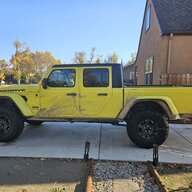
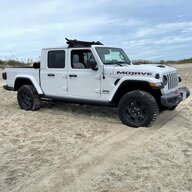
So in the end "it depends on what the owner/ driver likes" simply put what you want. Your paying for the tires use them the way you want.
 
OP
OP
red/green hawk

red/green hawk

Well-Known Member
First Name
Ryan
Joined
Apr 4, 2020
Threads
48
Messages
728
Reaction score
1,217
Location
Moscow, ID
Vehicle(s)
2020 JT Sport S with max tow package, 2008 Suburban LTZ
Occupation
PACU Nurse
80 PSI might not be the correct max. The 4 different 35x12.50x17 Yokohama load range E tires are all 65 PSI max.

So if we’re talking about 65 max PSI tires, 43% of 65 PSI = about 28 PSI to carry 5,500 lbs.
The 285/75/17 E tires i have are 80 psi.
 

calling4life

Member
Joined
Nov 12, 2024
Threads
0
Messages
6
Reaction score
5
Location
N. MN
Vehicle(s)
2020 Gladiator Rubicon
In case people didn't know this, every 10 degrees of temp movement means about 1psi of pressure.

So, here in N. MN, it may be 50 degrees for a high and we may have 10 degrees for a low.

If I fill my tires to 25psi at the time of day when it is 50 degrees, at 10 degrees when I leave for work at 6am, they'll be about 21psi.

So account for that, if you don't like messing with psi constantly and the low for the month is 10 degrees, account for that.

If you need 25psi in your tire and you are filling it when it is 50 degrees out, 50 is 40 more than 10, 40 is four 10 degree temp changes, that means 4psi or thereabouts.

So fill the tire to 29psi if you're filling it when it's 50 degrees out, that way when it's 10 degrees out it's 25psi.


Again, lawyers will have built in safety, but this is all great "general guidelines."

Sorry for the violation of my prior promise.
 

Sponsored

Zachanadandy

Well-Known Member
First Name
Zach
Joined
Oct 17, 2023
Threads
4
Messages
3,000
Reaction score
4,756
Location
Patterson, ca
Vehicle(s)
2023 gladiator Mojave
Occupation
Electrical foreman
In case people didn't know this, every 10 degrees of temp movement means about 1psi of pressure.

So, here in N. MN, it may be 50 degrees for a high and we may have 10 degrees for a low.

If I fill my tires to 25psi at the time of day when it is 50 degrees, at 10 degrees when I leave for work at 6am, they'll be about 21psi.

So account for that, if you don't like messing with psi constantly and the low for the month is 10 degrees, account for that.

If you need 25psi in your tire and you are filling it when it is 50 degrees out, 50 is 40 more than 10, 40 is four 10 degree temp changes, that means 4psi or thereabouts.

So fill the tire to 29psi if you're filling it when it's 50 degrees out, that way when it's 10 degrees out it's 25psi.


Again, lawyers will have built in safety, but this is all great "general guidelines."

Sorry for the violation of my prior promise.
The problem there is your tires won't only rise to ambient temps. I'd bet after some time at freeway speed they are pushing 90⁰ regardless of outside temps. I'd set them at the average ambient temp as "cold". Setting or adjusting to a frigid over night low would just mean they were way over inflated once driven on for a while.
 

Just Mark

Well-Known Member
Joined
Oct 27, 2020
Threads
6
Messages
71
Reaction score
61
Location
Virginia
Vehicle(s)
ME: 2021 JT Mojave, Wife: 2023 JT Mojave
Be sure you pay extra and get Nitrogen in your tires, weighs less and is a much more comfortable ride, and it's better for the environment. Nitrogen for the win!
I’m a big fan of a nitrogen gas blend. I find a ratio of about 78% nitrogen with something real close to 1% argon optimizes both my ride and my wallet.
 

Billkowski

Well-Known Member
Joined
Oct 1, 2023
Threads
7
Messages
233
Reaction score
507
Location
Huntsville Alabama
Vehicle(s)
2021 JL 80th 2D 3.6 Etorque, 2023 JT Mojave
I’m a big fan of a nitrogen gas blend. I find a ratio of about 78% nitrogen with something real close to 1% argon optimizes both my ride and my wallet.
To each their own, but I find that blend extremely hard to find and argon is an overrated gas that is not really effective for lifted vehicles.
 

Just Mark

Well-Known Member
Joined
Oct 27, 2020
Threads
6
Messages
71
Reaction score
61
Location
Virginia
Vehicle(s)
ME: 2021 JT Mojave, Wife: 2023 JT Mojave
To each their own, but I find that blend extremely hard to find and argon is an overrated gas that is not really effective for lifted vehicles.
Here in the mid Atlantic area, it is available anywhere you need to air up.
 

Mad Mac

Well-Known Member
Joined
May 2, 2021
Threads
41
Messages
727
Reaction score
1,266
Location
Far Northwest Deep East Texas in the Dirty South
Website
www.best-motorcycle.com
Vehicle(s)
2021 Gladiator Rubicon, 1998 Wrangler Sahara
That reminds me,
once I asked my dentist if he was going to use gas (nitrous oxide).
"No", he replied. "Do you want me to?"
"I'm fine." I answered, "But go ahead and help yourself."

He and his assistant both laughed
and he blurted that I would not want him using gas.

I always thought those valve stems with green caps
were a gimmick for which dealers could upcharge
and get you to come back for service.

Anyway, if a person actually offroads
and airs down and airs up at the trailhead
it's for nought.

The ordinary air we breathe
and pump into our tires is already 78% nitrogen.

Maybe if I had asymmetrical directional tires
of different sizes front to rear on my Ferrari
and a bifurcated air hose to balance pressure left and right
I might.
Sponsored


Top