Sponsored

OIL, 0-20 or otherwise (couldn't find the other oil threads)

Stan H

Well-Known Member
First Name
Stanley
Joined
Oct 26, 2022
Threads
10
Messages
5,517
Reaction score
5,497
Location
WV
Vehicle(s)
Gladiator Rubicon 2021
Occupation
Safety Consultant
The oil spray holes could be "blueprinted" to "aim" the oil flow, but in an otherwise stock engine it probably wouldn't be worthwhile. Just checking each exhaust rocker spray hole for interference is more than most techs would ever do, especially on a warranty repair. If the holes are clear, there is just one more thing that really needs to be checked, the oil galley plugs behind and below the phasers. Make sure they are tight, when loose the oil pressure is reduced and this can affect the oil spray from the exhaust rockers.
My engine has 124499 miles on it . OW-20 Amsoil signature series the entire time except the oil that was in it when I drove it home.
One weird thing I have done since Maybe the first few oil changes is I did not like how small these oil filters are . I came from a 6.7 Cummins turbo diesel and the filter was HUGE . And then I seen this little tiny cartridge filter . So what I started doing is when my oil minder gets to 50% I would change the oil filter. Then when it would get down to 10-15% I changed the oil. Depending on how much I idled the engine or how hard it has been ran the mileage was ranging from 5000-6500 . I just changed the oil today and it literally was 6499 miles and oil minder was on 11% left . And yes I changed the filter at 50% .
What's your thoughts on that .
Sponsored

 

ShadowsPapa

Well-Known Member
First Name
Bill
Joined
Oct 12, 2019
Threads
247
Messages
40,514
Reaction score
54,044
Location
Runnells, Iowa
Vehicle(s)
'25 JTMX, '23 JLU 4xe, '82 SX4, '73 Javelin
Occupation
Retired auto mechanic, frmr gov't ntwrk security admin
Vehicle Showcase
3
The oil spray holes could be "blueprinted" to "aim" the oil flow, but in an otherwise stock engine it probably wouldn't be worthwhile. Just checking each exhaust rocker spray hole for interference is more than most techs would ever do, especially on a warranty repair. If the holes are clear, there is just one more thing that really needs to be checked, the oil galley plugs behind and below the phasers. Make sure they are tight, when loose the oil pressure is reduced and this can affect the oil spray from the exhaust rockers.
You've said it all so well.

We know how much and how far oil can shoot with only 10-20 psi - we used to have to use shields on some engines while setting lifter preload (remember the SBC - loosen until rattle, then tighten slowly until rattle was gone, then 3/4 turn more) - you took a BATH while doing that, all at idle with oil shooting out over 16 rocker arms, clear over the fenders. I had oil soaked arms in some cases.

I used a speed handle to spin up the oil pump for priming - not a drill - I could feel exactly how the pump was responding, how long/how many revolutions before pressure built and more.

I just have trouble seeing these having a "design issue" with oiling.
 

Stan H

Well-Known Member
First Name
Stanley
Joined
Oct 26, 2022
Threads
10
Messages
5,517
Reaction score
5,497
Location
WV
Vehicle(s)
Gladiator Rubicon 2021
Occupation
Safety Consultant
Still though, one side is the lions share of problems?

I do not know how true, but the only thing that ever made sense was the claim the RH side head was the last place to build oil pressure from sitting cold.
That is actually the first I heard anyone say that but it makes since that it must travel a specific route through the motor strange that those aren't equal 🤔
 

ShadowsPapa

Well-Known Member
First Name
Bill
Joined
Oct 12, 2019
Threads
247
Messages
40,514
Reaction score
54,044
Location
Runnells, Iowa
Vehicle(s)
'25 JTMX, '23 JLU 4xe, '82 SX4, '73 Javelin
Occupation
Retired auto mechanic, frmr gov't ntwrk security admin
Vehicle Showcase
3
That is actually the first I heard anyone say that but it makes since that it must travel a specific route through the motor strange that those aren't equal 🤔
The claim is incorrect, though, if you look at the Pentastar oiling diagrams. The right side is actually closer.
Further - it's not going to matter as nothing starts shooting out until pressure is built.
Some time watch an engine builder prime an oiling system. Oil trickles out, but until all passages are filled, there's no to very little pressure so it's not going to shoot out, it trickles out.
someone who hasn't done any engine building and didn't know hydraulics was guessing, tossing mud at the wall to see what sticks.
There's almost no difference, but the diagrams I have show the right side closer to the main oil gallery which also feeds the mains and rod bearings and so on.
If it was up to unequal oil distances, the rear mains on all engines would fail first, rear rockers would always fail first, that sort of thing.
An engineer friend in Canada challenged such things by building an engine, putting it on the dyno, and put pressure gauges at several points in the engine. Pressure was there at all points pretty well equally.
 

ecidiego

Well-Known Member
First Name
Chris
Joined
Nov 3, 2021
Threads
62
Messages
3,637
Reaction score
5,590
Location
San Diego
Vehicle(s)
2021 Gladiator Mojave
Occupation
IT
The VVL rocker arms are oiled by oil sprayed from the exhaust rockers arms on both banks. All the rocker arms of both types (VVL intake and exhaust) are the same, there is no left intake rockers or right intake cams . There are two factors in oiling the high lift rockers, and how they last or fail, that I have observed.

First, the rotation of the camshafts in relation to the exhaust rockers on each side. Difficult to explain without diagrams, but I studied this and realized that on the left bank, the intake cam rotates about one fourth as far to get to the actual high lift cam lobe and high lift rocker arm contact points. On the tight bank, the cam must rotate three fourths more before the this contact point is reached. This allows that much longer for oil to sling off of the cam before reaching the high lift lobe and high lift rocker arm contact point. This is why the right bank is more likely to have an intake cam failure.

Secondly, this leads to the question, why some engines, such as '20 and up models, have more problems than earlier engines? Normally, earlier production engines are more likely to experience problems than later de-bugged engines. This is my theory, but I cannot prove it. I believe the quality of the exhaust rockers (and possibly other components, such as cams) went down for some reason. I suspect a change in vendors or change in manufacturing technique, or even possibly worn tooling, but I have no proof. I have removed exhaust rockers and checked the oil spray holes, and found inconsistent spray patterns on rockers that were opposite failed intake rockers. So, if the intake camshaft fails, I would want the exhaust rock(s) opposite the faied intake rockers replaced as well.

Finally, best preventative maintenance is oil changes with a high quality oil and filter. Bottom end failure is incredibly rare in 3.6 engines of any generation, so ignore the GM 6.2 oil change "doping " nonsense, it doesn't apply to any engine used in a Jeep.
finally a post by an intelligent person who understands the engine
 

Sponsored

Charles 236

Well-Known Member
First Name
Charles
Joined
Feb 13, 2022
Threads
0
Messages
609
Reaction score
1,232
Location
Greenville, SC
Vehicle(s)
Jeep Gladiator Overland
Occupation
Jeep technician
My engine has 124499 miles on it . OW-20 Amsoil signature series the entire time except the oil that was in it when I drove it home.
One weird thing I have done since Maybe the first few oil changes is I did not like how small these oil filters are . I came from a 6.7 Cummins turbo diesel and the filter was HUGE . And then I seen this little tiny cartridge filter . So what I started doing is when my oil minder gets to 50% I would change the oil filter. Then when it would get down to 10-15% I changed the oil. Depending on how much I idled the engine or how hard it has been ran the mileage was ranging from 5000-6500 . I just changed the oil today and it literally was 6499 miles and oil minder was on 11% left . And yes I changed the filter at 50% .
What's your thoughts on that .
Since your engine has lasted this long without any oiling related failure, I would continue to do the same thing. In the forums, it amount common to read about failures so often that people get the idea that failure is inevitable. It is not, as your experience shows.

Also, the oil pressure builds at the same rate and same amount (or so close that the difference is totally negligible) everywhere in the oiling system. This is basic hydraulics, all hydraulic systems work this way.
 

ShadowsPapa

Well-Known Member
First Name
Bill
Joined
Oct 12, 2019
Threads
247
Messages
40,514
Reaction score
54,044
Location
Runnells, Iowa
Vehicle(s)
'25 JTMX, '23 JLU 4xe, '82 SX4, '73 Javelin
Occupation
Retired auto mechanic, frmr gov't ntwrk security admin
Vehicle Showcase
3
Since your engine has lasted this long without any oiling related failure, I would continue to do the same thing. In the forums, it is common to read about failures so often that people get the idea that failure is inevitable. It is not, as your experience shows.
Forums are where people collect to share problems and look for solutions. It's a magnet for trouble. And yet - of the millions of these out there, still what's in forums is a small fraction of those. It looks worse because you are visiting a repair shop or a forum to find answers- look, I'm surrounded by failures!
But out in the wild - no, you are not. You are surrounded by successes.
For those who experience the failures, that doesn't make them feel any better. It sucks for them, it's a bad bad thing - it's expensive, inconvenient, and costs time, money and hassles. And no amount of "but 99.999% are just fine" will make them feel any better or help - because at that point it sucks to be them with a failed engine.

Who comes into a forum to say "100,000 trouble-free miles!"? Pretty much zero (except for me, maybe LOL)

Who comes in to express anger, frustration, being pissed, looking for answers, and seeking those who have the same bad experiences (like a support group, it's comforting at a human level to find others with the same problem - you are not alone)
Great, I'm not alone with this problem! I've found others! I feel better, and now we have a common foe in all of this - Jeep!

Psychology.

All of my oil analysis results came back perfect. That doesn't mean much for 100,000 miles down the line - things can happen, but it was a trend that indicated my prior Jeeps were not likely headed for disaster.

Me - I'm sticking with the stock stuff, but if I ever did change, it would be to Mobil 1.
 

ShadowsPapa

Well-Known Member
First Name
Bill
Joined
Oct 12, 2019
Threads
247
Messages
40,514
Reaction score
54,044
Location
Runnells, Iowa
Vehicle(s)
'25 JTMX, '23 JLU 4xe, '82 SX4, '73 Javelin
Occupation
Retired auto mechanic, frmr gov't ntwrk security admin
Vehicle Showcase
3
finally a post by an intelligent person who understands the engine
I guess he missed all of the other discussions we've had, including and especially where Charles and I have gone back and forth on a few of these exact things in past years (including posting some oiling diagrams, showing the oil "squirt holes" in the rockers), and including what Charles said again here.
Oh, well.

Frankly I think Charles and I aren't too far apart in our thinking on these - both of us with practical experience with oiling systems and oil, cams, lifters/followers/rockers and more.
I would imagine that if teamed up and turned loose, we'd have things nailed down pretty well.
This may be a huge insult for Charles, but I see little difference in our basic thinking along these lines.
 
Last edited:

ShadowsPapa

Well-Known Member
First Name
Bill
Joined
Oct 12, 2019
Threads
247
Messages
40,514
Reaction score
54,044
Location
Runnells, Iowa
Vehicle(s)
'25 JTMX, '23 JLU 4xe, '82 SX4, '73 Javelin
Occupation
Retired auto mechanic, frmr gov't ntwrk security admin
Vehicle Showcase
3
I came from a 6.7 Cummins turbo diesel and the filter was HUGE . And then I seen this little tiny cartridge filter . So what I started doing is when my oil minder gets to 50% I would change the oil filter. Then when it would get down to 10-15%
You'd be surprised, or maybe not - how many owners manuals and books talk of changing the filter at some half-way point, then changing oil and filter again at the end.
It's a thing - so you aren't doing anything weird.

You should see how small the filters are I use on my 360 - but they are a totally different synthetic filtering material and will hold many many more times the "gunk" than the traditional larger pleated paper filters will handle. It's a lot to do with filter media.
For a paper filter, these do seem small.

I use Mobil 1 or Bosch filters on my cars - tiny, but capable of holding a lot more stuff and actually guaranteed for the miles. Oi talked to a tech at the factory that makes them about the filter media, size of the cartridge vs. legacy filters and so on. It was interesting....... (and he listed all of the filter brands they made there)
 

Charles 236

Well-Known Member
First Name
Charles
Joined
Feb 13, 2022
Threads
0
Messages
609
Reaction score
1,232
Location
Greenville, SC
Vehicle(s)
Jeep Gladiator Overland
Occupation
Jeep technician
I guess he missed all of the other discussions we've had, including and especially where Charles and I have gone back and forth on a few of these exact things in past years (including posting some oiling diagrams, showing the oil "squirt holes" in the rockers), and including what Charles said again here.
Oh, well.

Frankly I think Charles and I aren't too far apart in our thinking on these - both of us with practical experience with oiling systems and oil, cams, lifters/followers/rockers and more.
I would imagine that if teamed up and turned loose, we'd have things nailed down pretty well.
This may be a huge insult for Charles, but I see little difference in our basic thinking along these lines.
Thanks for the compliment. I do enjoy figuring out how things work, and the cam wear issues in the PUG took a bit more thinking than some things. It does seem odd that some issues show up in certain years and are uncommon or even unknown in other years, but that is why I came to the conclusion that different vendors and/or indifferent quality control are still issues yet to be resolved.
 

Sponsored

Charles 236

Well-Known Member
First Name
Charles
Joined
Feb 13, 2022
Threads
0
Messages
609
Reaction score
1,232
Location
Greenville, SC
Vehicle(s)
Jeep Gladiator Overland
Occupation
Jeep technician
I still use the Mopar oil filters and Penzoil Platinum 0w20 oil. It works for me just fine, I have seen oil filters that were too restrictive cause VVT issues. I don't see issues with 0w30 or 5w30 affecting VVT, but I have worked on the idea that the engine is designed with 0w20 use in mind. Different from the original Pentastar engines which originally specified 5w30, but a couple or years later were changed to 5w20, without any changes other than the oil filler cap.
 

ShadowsPapa

Well-Known Member
First Name
Bill
Joined
Oct 12, 2019
Threads
247
Messages
40,514
Reaction score
54,044
Location
Runnells, Iowa
Vehicle(s)
'25 JTMX, '23 JLU 4xe, '82 SX4, '73 Javelin
Occupation
Retired auto mechanic, frmr gov't ntwrk security admin
Vehicle Showcase
3
Thanks for the compliment. I do enjoy figuring out how things work, and the cam wear issues in the PUG took a bit more thinking than some things. It does seem odd that some issues show up in certain years and are uncommon or even unknown in other years, but that is why I came to the conclusion that different vendors and/or indifferent quality control are still issues yet to be resolved.
I wish I was as eloquent as you in your descriptions, explanations and so on.

So far, I find most people talking of failures are in Jeep vehicles like the JL and JT - and that brings me to country of origin. Are the JL engines sourced from Mexico?
From another tech -

Jeep Gladiator OIL, 0-20 or otherwise (couldn't find the other oil threads) 1747594745893-x0


Most of my working life was spent in troubleshooting, diagnosing problems, getting to root causes of failures - and like you, knew what to modify to avoid such failures, based on solid experiences and observations.
It's my real love - figuring things out, troubleshooting, and that's what I was usually called in to do.

I have to wonder what life would be like today if I had said yes to the GM at Bud Mulcahy's Jeep Inc. when he called and offered me the service manager position. It was based only on reputation. It was a totally shocking call - "the job is yours if you want it" - yes, really, a cold call from the GM at that dealership.
I guess I have a habit of saying "no" to life-changing offers - several years ago Symantec called me and said they'd like to offer me the QA position for their corporate products. All I had to do is fly out there on their dime, talk a bit and say yes. Since it would be based next to Hollyweed, CA, I said no.

Damn, two massively life-changing offers, a YES would have been my only effort, and I said NO instead.

It would be great to be partnered with an younger tech with totally current experience on all of the latest.

Oh, well, that part of life is in the rear view mirror.
 

Stan H

Well-Known Member
First Name
Stanley
Joined
Oct 26, 2022
Threads
10
Messages
5,517
Reaction score
5,497
Location
WV
Vehicle(s)
Gladiator Rubicon 2021
Occupation
Safety Consultant
You'd be surprised, or maybe not
Actually yes that surprises me . But I am glad to hear that it isn't a bad thing .
One thing that I have noticed is that the filters always look dirty but not as heavy as they did at the first few oil changes before I started the double filter change routine.
 

ShadowsPapa

Well-Known Member
First Name
Bill
Joined
Oct 12, 2019
Threads
247
Messages
40,514
Reaction score
54,044
Location
Runnells, Iowa
Vehicle(s)
'25 JTMX, '23 JLU 4xe, '82 SX4, '73 Javelin
Occupation
Retired auto mechanic, frmr gov't ntwrk security admin
Vehicle Showcase
3
Here's a good interview with Valvoline...

Pretty much summarizes what's been said over this and other threads.
It does reinforce why I like many of the Valvoline products, though - and they are in my top 3 overall.

What was left out from the very good explanation of the superior/better base oils and additive packages as being one reason for longer intervals is - LOSS OF THE CARBURETOR, the choke that often stuck leaving you overly-rich, washing fuel into the crankcase, or overly-lean, running hot and so on, fuel dripping washing down cylinder walls, scoring rings, ignition systems that were ignored and left the timing off, or leading to misfires and so on. It's not just the oil that started to change back then, it's the engines themselves. Electronic ignition held the timing where it belonged, no more point rubbing block wear increasing dwell and retarding timing over a few thousand miles. No more chokes causing overly-rich startup conditions contaminating the oil with raw gas. We also have low tension rings compared to the high tension rings of the past, superior bearing technology and much more.
Oil changed, the base oils, additives, all changed, but so did the engines.

And that brings me to - he ain't old enough to truly remember the 1970s and what the oil change intervals were back then. He said multiple times "3,000 miles" - that's wrong, it was the old-school stuff carried forward from the 1950s and early 60s, it was what people said, but not what the auto makers said.
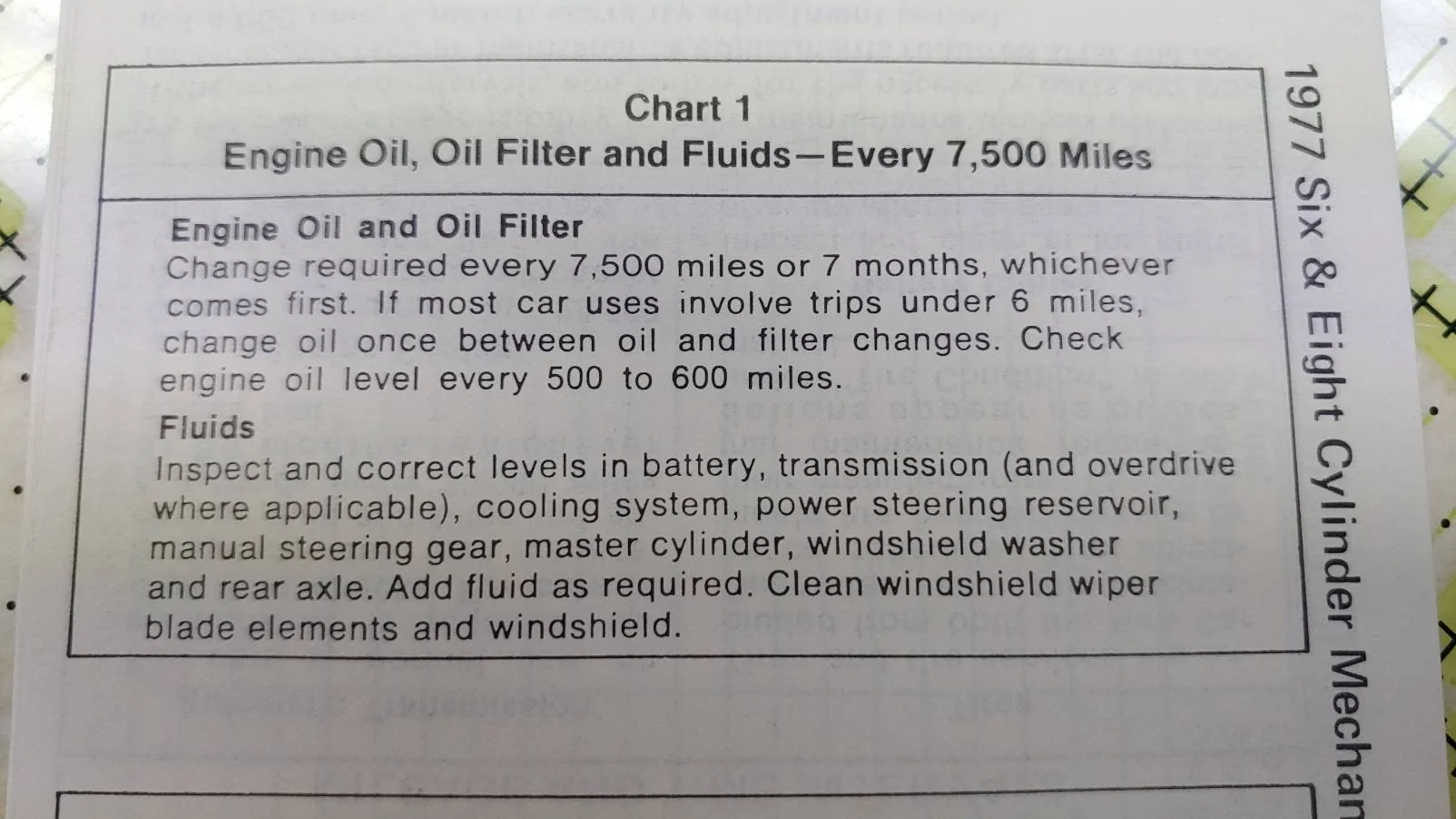
By the 1970s, oil change intervals were going into the 7,500 mile range. I've posted shots of various owners manuals I have from the 1970s and none mention 3,000 miles.
My first boss would say "you should change it every 3,000 miles" because he trained and started in the 1940s and never bothered reading the communications from the car companies for the very cars his shop was an official part of. That shop was part of a dealership.
So to say 10,000 miles now, in 2025 - think back to 1975 when the recommendation for V8s and I6s was 7,500 - that's not a lot more in the last 50 years! So it's not a stretch at all to believe that yes, with superior oils, superior additives, and tightly controlled combustion processes and A/F ratios we can't see over 7,500 today - cars were carbureted with points in most cases back then.

Dude, where are you coming up with that 3,000 miles bit?

Jeep Gladiator OIL, 0-20 or otherwise (couldn't find the other oil threads) 1977 oil change interval
Sponsored


Top