Sponsored
Jeeperjamie
Well-Known Member
- First Name
- Jamie
- Joined
- Feb 12, 2020
- Threads
- 135
- Messages
- 4,754
- Reaction score
- 5,412
- Location
- Kannapolis nc
- Vehicle(s)
- 2020 jeep gladiator
- Occupation
- Weyerhaeuser
- Vehicle Showcase
- 1
I run 44 in the rear and 41 in the front. Found the ride to be way better with the higher PSI than lower. This JT weighs more than my JK did.

ShadowsPapa
Well-Known Member
- First Name
- Bill
- Joined
- Oct 12, 2019
- Threads
- 247
- Messages
- 40,445
- Reaction score
- 53,880
- Location
- Runnells, Iowa
- Vehicle(s)
- '25 JTMX, '23 JLU 4xe, '82 SX4, '73 Javelin
- Occupation
- Retired auto mechanic, frmr gov't ntwrk security admin
- Vehicle Showcase
- 3
I run my Overland 38 all around - that's what the door sticker says. Even the Rubicon Falken take-offs I run in bad weather I run about 36-37 psi.
I don't run softer as it's not necessary for my tire sizes, and, they handle loads worse under-inflated as the sidewalls flex a whole lot more, and run hotter.
NORMALLY with a fatter/bigger footprint on the ground you run a bit less pressure than tires with a smaller footprint or less rubber on the road.
I don't run softer as it's not necessary for my tire sizes, and, they handle loads worse under-inflated as the sidewalls flex a whole lot more, and run hotter.
NORMALLY with a fatter/bigger footprint on the ground you run a bit less pressure than tires with a smaller footprint or less rubber on the road.
Sponsored
JTDean
Member
- Thread starter
- #6
OK, thanks for the info guys.I run my Overland 38 all around - that's what the door sticker says. Even the Rubicon Falken take-offs I run in bad weather I run about 36-37 psi.
I don't run softer as it's not necessary for my tire sizes, and, they handle loads worse under-inflated as the sidewalls flex a whole lot more, and run hotter.
NORMALLY with a fatter/bigger footprint on the ground you run a bit less pressure than tires with a smaller footprint or less rubber on the road.
Renegade
Well-Known Member
- First Name
- Zac
- Joined
- Sep 11, 2017
- Threads
- 38
- Messages
- 3,615
- Reaction score
- 4,816
- Location
- Signal Mountain, TN
- Vehicle(s)
- 2020 JT
- Build Thread
- Link
No, no, no! The psi stated on the sidewalk of a tire is the Max psi for which that particular tire is rated. It is totally unnecessary to run that unless you are at that particular tires’a max weight. Running high pressures result in a harsh ride. Start with your Jeep’s recommended tire pressure and adjust from there based on load.They say it right on the tire.
Personally I run light for a softer run. JK is @ 20psi and JT is at 26PSI.
Jeeperjamie
Well-Known Member
- First Name
- Jamie
- Joined
- Feb 12, 2020
- Threads
- 135
- Messages
- 4,754
- Reaction score
- 5,412
- Location
- Kannapolis nc
- Vehicle(s)
- 2020 jeep gladiator
- Occupation
- Weyerhaeuser
- Vehicle Showcase
- 1
I agree with this, totally true. That's why I went up to 41 in the front and 44 in the rear. I may adjust down a little bit but as of now it rides great. I found the lesser psi, 33 All around was a little to soft for my likings. Plus the tires seem to be wearing perfect at that PSI.No, no, no! The psi stated on the sidewalk of a tire is the Max psi for which that particular tire is rated. It is totally unnecessary to run that unless you are at that particular tires’a max weight. Running high pressures result in a harsh ride. Start with your Jeep’s recommended tire pressure and adjust from there based on load.
ShadowsPapa
Well-Known Member
- First Name
- Bill
- Joined
- Oct 12, 2019
- Threads
- 247
- Messages
- 40,445
- Reaction score
- 53,880
- Location
- Runnells, Iowa
- Vehicle(s)
- '25 JTMX, '23 JLU 4xe, '82 SX4, '73 Javelin
- Occupation
- Retired auto mechanic, frmr gov't ntwrk security admin
- Vehicle Showcase
- 3
Supposedly there's a formula for taking the max at so much load and working backwards but I tried that and it left me really too low on pressure.I agree with this, totally true. That's why I went up to 41 in the front and 44 in the rear. I may adjust down a little bit but as of now it rides great. I found the lesser psi, 33 All around was a little to soft for my likings. Plus the tires seem to be wearing perfect at that PSI.
Mine are wearing perfectly at the door jamb sticker pressures minus 1 or 2 pounds depending.
Some vehicles are good with the same pressure on all corners, pickups not so much, depending on LOAD.
I found the Rubicon take-offs - the Falken A/Ts I ran for a few months to get through the nasty weather wore funny with the low pressures some advocate, they work fine at 36 on my truck.
When I tow, I'll adjust up accordingly.
I laid out how it all works in another thread as far as the foot print changing due ot weight vs. pressure in the tire because it's the PSI working against the tire's foot print that supports the vehicle. More weight then you need more PSI to keep the same foot print or keep it on the ground properly. Take weight out and suddenly you are riding in the center of the tire because it takes less force to hold the truck up - you have the same PSI but it needs to work on fewer square inches to support that truck with less weight. More weight that same psi has to work against more surface to hold the truck up so the tire footprint grows.
It's basically hydraulics - pressure working against area to balance a force -the weight of the truck.
But bottom line -the last couple of posts, including Jamie - that number on the sidewall - that is MAXIMUM PSI at MAXIMUM LOAD. In other words, if you load that truck to the top of the tire's load rating, that's the most you should put in the tire- period. That's never normal running psi because when they make the tire they have NO CLUE how much your vehicle weighs!
Tire pressure depends on the WEIGHT of the vehicle.
That's why you can't ask "what do you run" unless the person answering has a truck that weighs exactly the same as yours does.
You can only use that as a starting point - maybe.
Now the big warning - what if the people telling you what THEY run are all messed up and running them waaay to soft or waaaay to hard? Is it worth ruining your tires? Or having a blow-out on the highway? Too soft and you make the sidewalls HOT - and they could BLOW.
Use what tire makers recommend for a given weight. That's the only time you'll get good, reliable and solid info.
I was pleasantly suprised to see one person actually not going with the crowd and running what's best for their truck, wear and ride..... (Jamie)
Jeeperjamie
Well-Known Member
- First Name
- Jamie
- Joined
- Feb 12, 2020
- Threads
- 135
- Messages
- 4,754
- Reaction score
- 5,412
- Location
- Kannapolis nc
- Vehicle(s)
- 2020 jeep gladiator
- Occupation
- Weyerhaeuser
- Vehicle Showcase
- 1
Makes sense. I normally just eyeball it and go from there. The JT weighs more than my JK and I ran 33 most of the time on it at all corners, figured I'd start there with the JT. Plus I had 35 12.5 17 BFG KO2s on the JKU and I got 315 70 17 BFG KO2s on the JT. Pretty much the same tire other than the 315 being just slightly smallerSupposedly there's a formula for taking the max at so much load and working backwards but I tried that and it left me really too low on pressure.
Mine are wearing perfectly at the door jamb sticker pressures minus 1 or 2 pounds depending.
Some vehicles are good with the same pressure on all corners, pickups not so much, depending on LOAD.
I found the Rubicon take-offs - the Falken A/Ts I ran for a few months to get through the nasty weather wore funny with the low pressures some advocate, they work fine at 36 on my truck.
When I tow, I'll adjust up accordingly.
I laid out how it all works in another thread as far as the foot print changing due ot weight vs. pressure in the tire because it's the PSI working against the tire's foot print that supports the vehicle. More weight then you need more PSI to keep the same foot print or keep it on the ground properly. Take weight out and suddenly you are riding in the center of the tire because it takes less force to hold the truck up - you have the same PSI but it needs to work on fewer square inches to support that truck with less weight. More weight that same psi has to work against more surface to hold the truck up so the tire footprint grows.
It's basically hydraulics - pressure working against area to balance a force -the weight of the truck.
Sponsored
TrainMan
Well-Known Member
- First Name
- Jared
- Joined
- Mar 8, 2020
- Threads
- 29
- Messages
- 592
- Reaction score
- 891
- Location
- Pennsylvania
- Vehicle(s)
- 2015 Chevy Silverado, 2020 Jeep Gladiator Sport S.
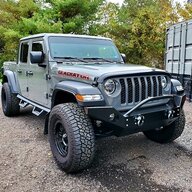
I tried 32 in my 35s. I like the ride. I just have to fix the warning light now. Getting Jscan.
Riccochet
Well-Known Member
I've always done the chalk test on my tires.
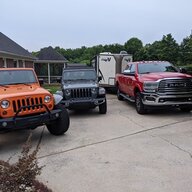
35x12.5R15 on my JKR. I run them at 24-25 PSI. All day. Any more and they'll start losing edge contact when they get up to temp.
Everyone's tires and vehicles will be different. Chalk test doesn't lie. Do it when the tires are at operating temp. Cold pressure will be a couple PSI lower.
35x12.5R15 on my JKR. I run them at 24-25 PSI. All day. Any more and they'll start losing edge contact when they get up to temp.
Everyone's tires and vehicles will be different. Chalk test doesn't lie. Do it when the tires are at operating temp. Cold pressure will be a couple PSI lower.
Tall Mike
Well-Known Member
- First Name
- Michael
- Joined
- Jun 18, 2020
- Threads
- 4
- Messages
- 105
- Reaction score
- 106
- Location
- New York State
- Vehicle(s)
- 2021 Gladiator Rubicon-2020 Grand Cherokee Limited X
- Occupation
- Truck Driver
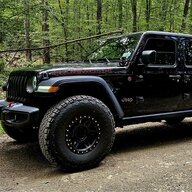
I'm generally mid 30's..
Running 35's on my stock Overland wheels.
Running 35's on my stock Overland wheels.
ShadowsPapa
Well-Known Member
- First Name
- Bill
- Joined
- Oct 12, 2019
- Threads
- 247
- Messages
- 40,445
- Reaction score
- 53,880
- Location
- Runnells, Iowa
- Vehicle(s)
- '25 JTMX, '23 JLU 4xe, '82 SX4, '73 Javelin
- Occupation
- Retired auto mechanic, frmr gov't ntwrk security admin
- Vehicle Showcase
- 3
That makes sense - larger tires have a larger footprint so take a bit less pressure - my stock tires are more narrow than those on Rubicon, or on your Overland so take more pressure due to smaller footprint.I'm generally mid 30's..
Running 35's on my stock Overland wheels.
Stock Overland tires are 8" compared to stock Rubicon A/T at 10" wide. On the same truck if all else was equal (sidewall stiffness and so on) they'd (the Rubicon wider tires) take a bit less pressure to hold the same truck up.
I run the door sticker pressure - it gives good contact across the face, and even wear.
I could drop a couple psi and still keep good contact across the face but this coming week it will drop a couple of PSI anyway as we're going from 95 to 60 for a high in the next day or two.
My tread wear is very perfectly even across the whole face of each tire at the door jamb sticker number. (38)
It's not a soft ride as far as the tires but the wear is perfect. Huge, heavy tires mean a harsher ride anyway and compensating by lowering pressure, well..... that's a ton of unsprung weight - what the heck do people expect??? More unsprung weight (as in heavier tires) mean a rougher ride. That's the law of suspension, ANY suspension.
BLK HOLE
Well-Known Member
- First Name
- Zach
- Joined
- Jun 6, 2019
- Threads
- 17
- Messages
- 1,275
- Reaction score
- 2,337
- Location
- San Antonio
- Vehicle(s)
- 2020 JTR, 2012 JKUR
- Vehicle Showcase
- 1
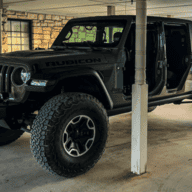
Hence my low tire pressure.No, no, no! The psi stated on the sidewalk of a tire is the Max psi for which that particular tire is rated. It is totally unnecessary to run that unless you are at that particular tires’a max weight. Running high pressures result in a harsh ride. Start with your Jeep’s recommended tire pressure and adjust from there based on load.
Sponsored


