Sponsored

Trying to think through front spring options

ajkaz

Well-Known Member
First Name
Arun
Joined
Jan 9, 2022
Threads
45
Messages
255
Reaction score
172
Location
SoCal
Vehicle(s)
22 JTRD
Has anyone here actually used Synergy front springs - specifically the 8863-10 which is supposed to give a fully loaded Rubicon JT a 1" lift, meaning other JT versions get more than 1" ?

Seems the coils are closely spaced in 1 or 2 pics I've seen.

Is the 2" bump stop bit necessary - I mean if you get 1" lift, closing that bump stop gap by 2" means you lose that 1" of travel or am I thinking about it all wrong........ ?
Yes, they are going to give you the closest rate to factory. They are soft and very smooth. They will definitely compress under the weight of the plow, otherwise you’ll be fine. I spoke with them on the phone, the bump stop spacing is not necessary for what you’re doing. The coil is set from the factory meaning even at full compression or bind it will not be damaged.
Sponsored

 
OP
OP
ShadowsPapa

ShadowsPapa

Well-Known Member
First Name
Bill
Joined
Oct 12, 2019
Threads
247
Messages
40,442
Reaction score
53,860
Location
Runnells, Iowa
Vehicle(s)
'25 JTMX, '23 JLU 4xe, '82 SX4, '73 Javelin
Occupation
Retired auto mechanic, frmr gov't ntwrk security admin
Vehicle Showcase
3
I think the problem is your wants vs needs.

You can't have a light spring that won't severely sag when you add the weight. A 3" spring like a Synergy will likely sag 2" with your bumper, winch, and plow. Then remove the plow and you are too high for the wife to be happy.

A heavy rate spring like the Clayton will not sag near as much, but it will not ride like OE. I personally liked the Clayton 188lb in my diesel, but they might be firm under a gasser.

Then comes shock valving into the mix.......I put my diesel Rubi springs into my buddy's gas JT to help level it out with his winch/bumper and now it drives horrible on the Fox Rubi shocks because there isn't nearly enough rebound damping. Even his wife asked him what was wrong with his truck!

You could put on a large shaft adjustable shock and increase nitrogen pressure seasonally to help with spring rate and ride height? 75psi in my 7/8 shaft shocks is worth about 1/2". This way you could also match compression damping for the weight as needed? For reference, Fox 2.5's come with 100psi installed.
This is why I was looking at the Synergy 1" springs.
It's 1" after the weight is added.
They have the multi-rate springs, and have accounted for the weight of the bumper, skid plate and a winch already when they mention 1" of lift.
So it would be a bit of lift after those things were added.

If I read their marketing correctly, with the added bumper and winch, it would be 1" higher than stock - maybe more.
From their site - Lift heights are based off fully loaded Rubicon models. Other models will see more lift.

Their 3" spring is a 3" lift on a fully loaded Rubicon. Others would see more lift.

Any reason you aren't just looking at like the 1.5 inch teraflex front spacers
I'd do simple spacers if not adding weight and only wanted lift.
I want more weight support for the front. The Synergy being multi-rate and 5 to 10% or so higher rate than stock would make sense........
Assume the truck is 5,000 pounds and the front is 2500 - the front springs are holding up 2500 pounds. 5% of that is 125 pounds. So spring rate may be a close match if my midnight math isn't too wacky.

I have Daystar spacers under the rear already.

Yes, they are going to give you the closest rate to factory. They are soft and very smooth. They will definitely compress under the weight of the plow, otherwise you’ll be fine. I spoke with them on the phone, the bump stop spacing is not necessary for what you’re doing. The coil is set from the factory meaning even at full compression or bind it will not be damaged.
Interesting - I did see something about their ability to handle full compression - not that I'd test that, but the 2" bump stop spacing seemed a bit much for a gain of only 1" in height - although they did say it would be 1" for a loaded Rubicon, more for other models.
The plow idea is 4 months out of 12 tops - and with the right plow it's minutes to take it off when not needed.
 

bleda2002

Well-Known Member
Joined
May 11, 2021
Threads
24
Messages
2,751
Reaction score
4,493
Location
34655
Vehicle(s)
2021 JTR Firecracker Red
Diesel Rubicon springs with some spacers? Diesels should be the beefiest stock springs able to handle the extra weight very easily upfront
 
OP
OP
ShadowsPapa

ShadowsPapa

Well-Known Member
First Name
Bill
Joined
Oct 12, 2019
Threads
247
Messages
40,442
Reaction score
53,860
Location
Runnells, Iowa
Vehicle(s)
'25 JTMX, '23 JLU 4xe, '82 SX4, '73 Javelin
Occupation
Retired auto mechanic, frmr gov't ntwrk security admin
Vehicle Showcase
3
Diesel Rubicon springs with some spacers? Diesels should be the beefiest stock springs able to handle the extra weight very easily upfront
They can't even hold themselves up over bumps LOL.

That's another unknown, though - it's going to be a higher rate because it's Rubicon, and even higher because it's diesel, and what would it do to the stance of the truck?

I have been wondering - Are the diesel springs like the other Rubicon springs? 3 different springs for the front?

I would think Mojave springs would be better.
 

CrazyCooter

Well-Known Member
First Name
Tony
Joined
Nov 1, 2020
Threads
11
Messages
2,304
Reaction score
2,557
Location
Far NorCal
Website
www.overlandvehicledynamics.com
Vehicle(s)
1991 JEEP YJ, 2021 JTR Ecodiesel
Occupation
Specialty Off Road Shop Owner
You should also plan on .5-1" lower than posted JL lift heights on a JT due to higher steer axle weights depending on spring rate? A 110-120lb spring will be more difference than a 200lb spring.

If you read my post, you would know that the diesel spring could be a good candidate for a loaded gas rig. Yes, they are light for the diesel, but I think most of the issue there is less bump travel than a gas truck combined with too light shock damping since they just use the same shock as the gas rig. Adding significant low speed damping to my 2.5s has eliminated the bottoming and made the truck a joy to drive in a spirited manner. I could probably give you a loaded spring height from a gas rig running rubi diesel springs and you could work the math backward from there. I swapped his side to side since the fuel tanks are on opposing sides.

I like the air bag idea the best, but that bump in the spring makes that a challenge.

What about a set of those Synergy tunable bump stops with a set of Sumo Springs up front? Easy to pop out a 1" spacer for the season without the plow? Then you also have a progressive bumps stop?
 

Sponsored

Summitsearcher

Well-Known Member
First Name
John
Joined
Dec 21, 2020
Threads
39
Messages
1,316
Reaction score
2,329
Location
Northern Michigan
Vehicle(s)
2021 Stingrey JTR
Occupation
Retired
Vehicle Showcase
2
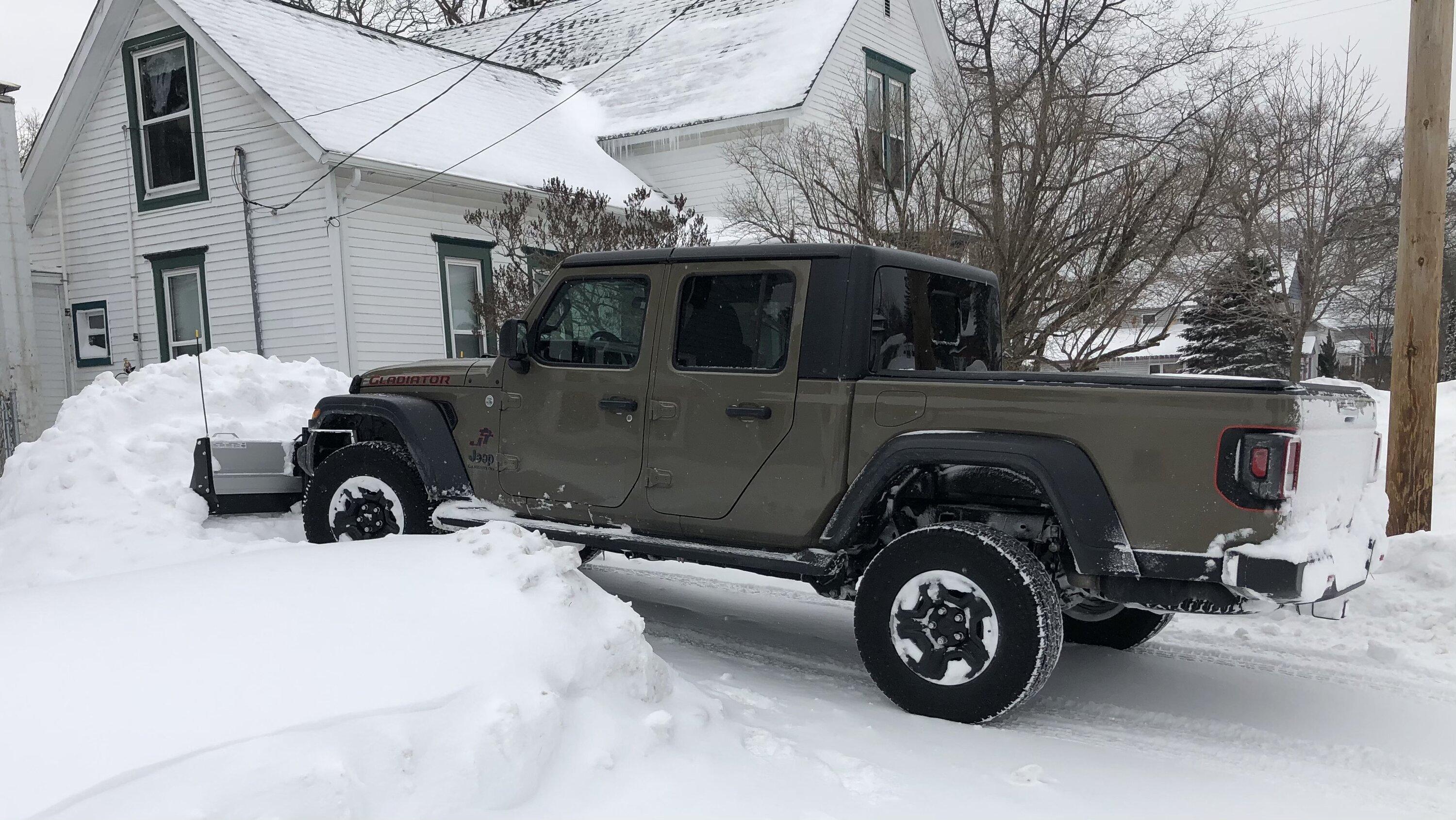
I went through this same process before I bought my plow. It all came down to this. It only stays on long enough to clear the drive and my neighbor. The sag is only temporary and with it being removed so fast there is no long compression of the springs or suspension. Because it’s a floating plow the front only carries it during transport and not while In use.
Jeep Gladiator Trying to think through front spring options 7E2C3F2B-2AE0-4B45-91ED-6E0D61753237
 
OP
OP
ShadowsPapa

ShadowsPapa

Well-Known Member
First Name
Bill
Joined
Oct 12, 2019
Threads
247
Messages
40,442
Reaction score
53,860
Location
Runnells, Iowa
Vehicle(s)
'25 JTMX, '23 JLU 4xe, '82 SX4, '73 Javelin
Occupation
Retired auto mechanic, frmr gov't ntwrk security admin
Vehicle Showcase
3
You should also plan on .5-1" lower than posted JL lift heights on a JT due to higher steer axle weights depending on spring rate? A 110-120lb spring will be more difference than a 200lb spring.

If you read my post, you would know that the diesel spring could be a good candidate for a loaded gas rig. Yes, they are light for the diesel, but I think most of the issue there is less bump travel than a gas truck combined with too light shock damping since they just use the same shock as the gas rig. Adding significant low speed damping to my 2.5s has eliminated the bottoming and made the truck a joy to drive in a spirited manner. I could probably give you a loaded spring height from a gas rig running rubi diesel springs and you could work the math backward from there. I swapped his side to side since the fuel tanks are on opposing sides.

I like the air bag idea the best, but that bump in the spring makes that a challenge.

What about a set of those Synergy tunable bump stops with a set of Sumo Springs up front? Easy to pop out a 1" spacer for the season without the plow? Then you also have a progressive bumps stop?
Synergy says 1" lift for JLU. 2" for JL
That 1" has already taken into account the weight of a winch and bumper.
So if I put them under my JT right now, before winch and bumper, according to Synergy, it would lift it more than 1"
They are saying a Rubicon JLU with a steel bumper, winch and skid plate it would lift it 1"
They say the same for Gladiator.
Hard to imagine the front of a JT Overland being heavier than a JLU Rubicon with all the steel accessories on it.

Air bags are for temporary weight - and not really worth the effort of the on and off of a blade since there's only weight on it during transport when it's on in the winter. The thought of airing up air bags in the winter inside the front springs isn't appealing, but it's not possible anyway with the bump stop inside the front coils.

Aren't Sumo springs more of an over-load spring like what my F250 had? Simply prevent bottoming out on harsh bumps, or supporting weight when there's a lot of extra weight and the real springs sag? So you'd have to space those things so that you'd be using them to support the truck 100% of the time once you install a bumper and winch?
 

CrazyCooter

Well-Known Member
First Name
Tony
Joined
Nov 1, 2020
Threads
11
Messages
2,304
Reaction score
2,557
Location
Far NorCal
Website
www.overlandvehicledynamics.com
Vehicle(s)
1991 JEEP YJ, 2021 JTR Ecodiesel
Occupation
Specialty Off Road Shop Owner
Synergy says 1" lift for JLU. 2" for JL
That 1" has already taken into account the weight of a winch and bumper.
So if I put them under my JT right now, before winch and bumper, according to Synergy, it would lift it more than 1"
They are saying a Rubicon JLU with a steel bumper, winch and skid plate it would lift it 1"
They say the same for Gladiator.
Hard to imagine the front of a JT Overland being heavier than a JLU Rubicon with all the steel accessories on it.

Air bags are for temporary weight - and not really worth the effort of the on and off of a blade since there's only weight on it during transport when it's on in the winter. The thought of airing up air bags in the winter inside the front springs isn't appealing, but it's not possible anyway with the bump stop inside the front coils.

Aren't Sumo springs more of an over-load spring like what my F250 had? Simply prevent bottoming out on harsh bumps, or supporting weight when there's a lot of extra weight and the real springs sag? So you'd have to space those things so that you'd be using them to support the truck 100% of the time once you install a bumper and winch?
You are a technical guy Bill.........The wheelbase is longer on JT and most other component weights forward of the rear axle on a JL are consistent with an equally spec'd JT, so naturally the steer axle will be heavier no? You can choose to believe what you want, but the math and science disproves so many claims in the aftermarket. I've lived this with my diesel JT swapping in 5 different spring/spacer combos and dialing the shock valving each time.

Also factor in the dynamic cross weights on a heavier vehicle with longer wheelbase........Heavier rear spring will require a heavier front for everything to work right. With a 110-120lb front spring, the rear dictates what the front does because that front spring rate is too light. Are you getting a max tow this time? If so, the heavier rear spring rate will amplify this effect in the front.

I would space the Sumos to contact with the blade picked up, then remove a spacer puck in the spring when you remove the blade to increase bump gap and comfort level. Here is the bump stop kit so you can wrap your head around what I'm suggesting because it's a first of it's type where you can easily swap pucks in mins. https://www.synergymfg.com/synergy-jeep-snap-lock-bump-stop-spacer-system.html It's just a suggestion.......

For reference, I did install a pair of 1000lb Sumos in the rear of a Nissan Xterra with 270K miles on it last week........They unfortunately were just touching down due to the condition of the old springs and did slightly affect ride quality, but it wasn't bone jarring. How much weight will be added with the blade and how much will be transferred forward from the rear with the leverage effect?
 

LostWoods

Well-Known Member
Joined
Mar 13, 2020
Threads
15
Messages
2,027
Reaction score
2,420
Location
Gilbert, AZ
Vehicle(s)
2024 4Runner / 1995 YJ
Aren't Sumo springs more of an over-load spring like what my F250 had? Simply prevent bottoming out on harsh bumps, or supporting weight when there's a lot of extra weight and the real springs sag? So you'd have to space those things so that you'd be using them to support the truck 100% of the time once you install a bumper and winch?
Yeah that's exactly what they're for. I have the Timbrens on my truck and they're amazing but they are not for anything more than preventing bottoming out while towing by adding a little extra resistance to the compression stroke. If you relied on them full time they would wear out in fairly short order.
 
OP
OP
ShadowsPapa

ShadowsPapa

Well-Known Member
First Name
Bill
Joined
Oct 12, 2019
Threads
247
Messages
40,442
Reaction score
53,860
Location
Runnells, Iowa
Vehicle(s)
'25 JTMX, '23 JLU 4xe, '82 SX4, '73 Javelin
Occupation
Retired auto mechanic, frmr gov't ntwrk security admin
Vehicle Showcase
3
Yeah that's exactly what they're for. I have the Timbrens on my truck and they're amazing but they are not for anything more than preventing bottoming out while towing by adding a little extra resistance to the compression stroke. If you relied on them full time they would wear out in fairly short order.
That's what I thought based on all of the comments about them here and elsewhere. They aren't overloads really but to prevent hitting the bump stop abruptly.
My rear air bags will be used when towing - although with the 2020 I never once bottomed on anything with the trailer connected with the max tow springs under the truck.
The thing is that with the weight of the bumper, winch and skid plate up front, the leverage effect means there will be very slightly less weight on the rear since the weight is added ahead of the front axle - but the front axle is so far forward on these, the impact should be minimal. That's one reason I decided to stay with the stock rear springs and use air bags (something 2 years ago I swore I would never ever do)
For some reason, JT seems to sit differently than the 2020 did. The rear seems to be higher and the front lower but my measurements say this one is only 1/8" lower in front.
The rear of this one is definitely higher than the 2020 was - my numbers say almost 1" taller in the rear BEFORE I added the daystar 3/4" spacers back there.
 

Sponsored

ajkaz

Well-Known Member
First Name
Arun
Joined
Jan 9, 2022
Threads
45
Messages
255
Reaction score
172
Location
SoCal
Vehicle(s)
22 JTRD
They can't even hold themselves up over bumps LOL.

That's another unknown, though - it's going to be a higher rate because it's Rubicon, and even higher because it's diesel, and what would it do to the stance of the truck?

I have been wondering - Are the diesel springs like the other Rubicon springs? 3 different springs for the front?

I would think Mojave springs would be better.
It was the shocks that were the issue here. My 22 JTRD came with the factory TSB correction already installed, same springs as all the others, no bottoming. The shocks are much firmer to control compression better. I can hit speed bumps at 15-20 without issue.
 

LostWoods

Well-Known Member
Joined
Mar 13, 2020
Threads
15
Messages
2,027
Reaction score
2,420
Location
Gilbert, AZ
Vehicle(s)
2024 4Runner / 1995 YJ
You should also plan on .5-1" lower than posted JL lift heights on a JT due to higher steer axle weights depending on spring rate? A 110-120lb spring will be more difference than a 200lb spring.

If you read my post, you would know that the diesel spring could be a good candidate for a loaded gas rig. Yes, they are light for the diesel, but I think most of the issue there is less bump travel than a gas truck combined with too light shock damping since they just use the same shock as the gas rig. Adding significant low speed damping to my 2.5s has eliminated the bottoming and made the truck a joy to drive in a spirited manner. I could probably give you a loaded spring height from a gas rig running rubi diesel springs and you could work the math backward from there. I swapped his side to side since the fuel tanks are on opposing sides.

I like the air bag idea the best, but that bump in the spring makes that a challenge.

What about a set of those Synergy tunable bump stops with a set of Sumo Springs up front? Easy to pop out a 1" spacer for the season without the plow? Then you also have a progressive bumps stop?
I think the problem is that people assume springs prevent bottoming out. That is never the case - springs are for managing ride height and suspension travel (i.e. enough spring for the full flex). You balance spring rate against length to ensure the springs aren't so long they prevent compression, too short that they unseat when extended, and have an appropriate ride height when static.

The shocks are what control the actual travel itself and if you're experiencing bottoming out, it's 100% the shocks, not the springs.
 

ajkaz

Well-Known Member
First Name
Arun
Joined
Jan 9, 2022
Threads
45
Messages
255
Reaction score
172
Location
SoCal
Vehicle(s)
22 JTRD
I used sumo springs in the rear of my JKU, I set them up to engage when I had my dual sport on the hitch carrier instead of readjusting coil overs every time I loaded it. You could setup your front in the same way, to engage under the weight of the plow. Otherwise without it they are a standard bump stop.
 
OP
OP
ShadowsPapa

ShadowsPapa

Well-Known Member
First Name
Bill
Joined
Oct 12, 2019
Threads
247
Messages
40,442
Reaction score
53,860
Location
Runnells, Iowa
Vehicle(s)
'25 JTMX, '23 JLU 4xe, '82 SX4, '73 Javelin
Occupation
Retired auto mechanic, frmr gov't ntwrk security admin
Vehicle Showcase
3
I think the problem is that people assume springs prevent bottoming out. That is never the case - springs are for managing ride height and suspension travel (i.e. enough spring for the full flex). You balance spring rate against length to ensure the springs aren't so long they prevent compression, too short that they unseat when extended, and have an appropriate ride height when static.

The shocks are what control the actual travel itself and if you're experiencing bottoming out, it's 100% the shocks, not the springs.
One reason I want to try to stay with springs with a rate to match the truck weight is to keep the tires planted. Using stiffer springs to hold the truck up higher is problematic for keeping the tires in contact with the road. You want the springs to compress some with the weight so if your tires hit a hole and drop, the spring can uncompress and push the tire down. If it's not compressed enough, the tire loses contact and the truck drops into the hole.

Stiffer isn't better on the street, or even some off-roading.


Jeep Gladiator Trying to think through front spring options 1660577234419


I used sumo springs in the rear of my JKU, I set them up to engage when I had my dual sport on the hitch carrier instead of readjusting coil overs every time I loaded it. You could setup your front in the same way, to engage under the weight of the plow. Otherwise without it they are a standard bump stop.
I can see that's where they'd work - for when the plow was raised and full weight was on the truck.
That makes sense. An overload with the plow raised, otherwise a nicer bump stop.
 

LostWoods

Well-Known Member
Joined
Mar 13, 2020
Threads
15
Messages
2,027
Reaction score
2,420
Location
Gilbert, AZ
Vehicle(s)
2024 4Runner / 1995 YJ
One reason I want to try to stay with springs with a rate to match the truck weight is to keep the tires planted. Using stiffer springs to hold the truck up higher is problematic for keeping the tires in contact with the road. You want the springs to compress some with the weight so if your tires hit a hole and drop, the spring can uncompress and push the tire down. If it's not compressed enough, the tire loses contact and the truck drops into the hole.

Stiffer isn't better on the street, or even some off-roading.
Well that's a little give and take. Softer springs are going to be more compliant which means that on a compression stroke, they transfer less energy to the chassis and keep more rubber on the road but the opposite is true for extension as they are slower to respond. Really the range of acceptable firmness is insanely wide and what you posted is more appropriate for a car than a pickup where spring rate has a lot more responsibility such as the towing and plow cases.

So I guess what it comes down to is suck it up or buy another truck haha. You unfortunately have a multi-use scenario that requires opposing strategy and there's just no way around that. You aren't increasing rate enough here that it will really change handling but you will see changes in ride. It's just the nature of the beast when setting a truck up for both unladen daily driving and loaded work duty.
Sponsored


Top