Sponsored

GMRS / CB antenna locations - near A pillar or mid point on hood

OP
OP
chorky

chorky

Well-Known Member
First Name
Chad
Joined
Feb 26, 2022
Threads
175
Messages
3,466
Reaction score
3,801
Location
Montana
Website
www.youtube.com
Vehicle(s)
'22JTR, '06 LJ, '06 TJ GE
Build Thread
Link
Occupation
GIS Specialist
So what would be a true 1/4 wave then? To my understanding it relates to the frequency and that frequencies wavelength.... So UHF being a broad term should have a wide range of wavelengths...unless I'm not understanding something right? Or maybe antenna length doesn't really matter that much but then how is it that a 102 with a spring is so much better than a firestik?
Sponsored
 

Radio Guy

Well-Known Member
First Name
Mike
Joined
Feb 24, 2021
Threads
6
Messages
716
Reaction score
882
Location
So Cal
Vehicle(s)
2021 Jeep Gladiator Mojave
Occupation
Retired Broadcast Engineer
A 5/8 over 5/8 has more gain than a 1/4 wave by taking radiation wasted upward and putting it at the horizon where it can do some good. I would not call it a "spot beam" in any way and it still has a fairly wide beamwidth above and below the horizon. It narrower than a 1/4 wave and will have more flutter and dead spots trying to talk to the top of a mountain compared to a 1/4 wave whip which has a wider beamwidth.

BTW, a 5/8 over 5/8 wave or even a 1/2 over 1/2 wave will always have a 1/4 wavelength phasing coil between the two fractional wavelength elements. This is to put the bottom of each fractional wavelength element in phase with each other to properly align the pattern of each whip so they can combine and add with some gain. Otherwise the radiation pattern would be a mess and not provide any gain at the horizon.

In my area we have lots of repeaters on 5,000ft and higher mountains and I have used both a 1/4 wave whip and higher gain types at the base of these mountains and have experienced the degraded and nosier reception due to the lack of visibility the antenna has at high upward angles. Its not a night and day difference and more in the range of subtle to annoying.

I usually run a higher gain 5/8 over 5/8 type when mobile as most of my travel does not take up right up against the mountains and I enjoy slightly better extreme distance with the higher gain mobile antennas.

As for not seeing any 1/4 wave whips out there, I have several for the VHF, UHF and 800/900MHz bands and use them here and there. Many police and public service vehicles around here run 1/4 wave whips, they are fairly common if you look around.

On using an 18" whip for GMRS, I do that occasionally but only out of laziness. It turns out a 3/4 wavelength whip will match close to 50 ohms and for the 2m amateur band around 146Mhz, a 19" long 1/4 wave whip is also a 3/4 wavelength whip on the 440MHz amateur band. Its also close enough to GMRS to work and give a reasonable match but there is an inherent problem doing this. Where a 1/4 wave whip with a good ground plane under it gives a reasonable pattern out to the horizon, a 3/4 wavelength whip puts a gain lobe up at a high angle and one down low. The low one gets interfered with by the ground plane and it all gets messy but in the end a 3/4 wave antenna puts out enough signal at the horizon to still be useful. You can do much better like using a tuned 5/8 wave antenna for GMRS but would generally be a single band UHF only antenna and should not tune up on the 2m amateur band or anywhere else useful.

Bottom line is you would never reach for an 18" type whip for GMRS use alone but if your radio can do dual use amateur and GMRS then it can be an option if your willing to put up with a little loss on UHF/GMRS.


Efficiency is also important though... But I am still surprised that all the 0 gain, or even 3 db gain antennas are quite short... I would think that would inhibit good operation.

That being said....I can't seem to find hardly any antennas with a low db gain. So, what kind of performance loss in the mountains would one really notice with a 5/8 over 5/8? since its a high gain antenna (spot beam). And is there any way to quantify this type of performance visually to give us non-HAM's a better depiction of what actually happens? I have found photos of sketches online in regards to antenna and wattage performance but it always relates to general HAM frequencies like the 2m/70cm band - haven't found anything of the like for GMRS, or CB for that matter

I did just a quick google search - and the 467.x frequency band is 65cm in length which translates to 25.5 inches.

So, if my theory and math is right here, a 5/8 over 5/8 at 31.5" long is two 5/8 antennas (15.25' rounded from 15.9375") stacked on top (not sure how this actually affects signal though). But a 'standard' off the shelf antenna I found is 18" long which translates to essentially a 5.6/8 (not sure what other fraction that might be - 0.7 of the original wavelength).

So this is where it gets confusing to me. Because the CB band, I think is also called the 11m band (433 inch), is a 27.4 MHz range with a 36' (432 inch) wavelength. So this makes sense that the 102" whip with the 'standard' 6" spring is 108" which is 1/4 wavelength (the 'perfect' antenna).

So by the math, a 1/4 wave 0db gain antenna for GMRS is 6.375 inches tall - however, I never see any of these unless I'm looking in the wrong place. A half wavelength would be 12.75" tall. And a full wavelength is 25.5" (again never see these....). But, a 5/8 wavelength would be 15.9x inches long

So how does the 18" GMRS antenna factor into this? It seems to be a sub-fractional length of the original signal wavelength - not sure how this affects signal, but it bothers me when it doesn't make sense. Wouldn't just a standard 25.5" antenna be better performance? Its confusing to me how these various lengths are calculated and how they affect performance.
 
OP
OP
chorky

chorky

Well-Known Member
First Name
Chad
Joined
Feb 26, 2022
Threads
175
Messages
3,466
Reaction score
3,801
Location
Montana
Website
www.youtube.com
Vehicle(s)
'22JTR, '06 LJ, '06 TJ GE
Build Thread
Link
Occupation
GIS Specialist
Has anyone here mounted their CB and GMRS in the center console?
 

Radio Guy

Well-Known Member
First Name
Mike
Joined
Feb 24, 2021
Threads
6
Messages
716
Reaction score
882
Location
So Cal
Vehicle(s)
2021 Jeep Gladiator Mojave
Occupation
Retired Broadcast Engineer
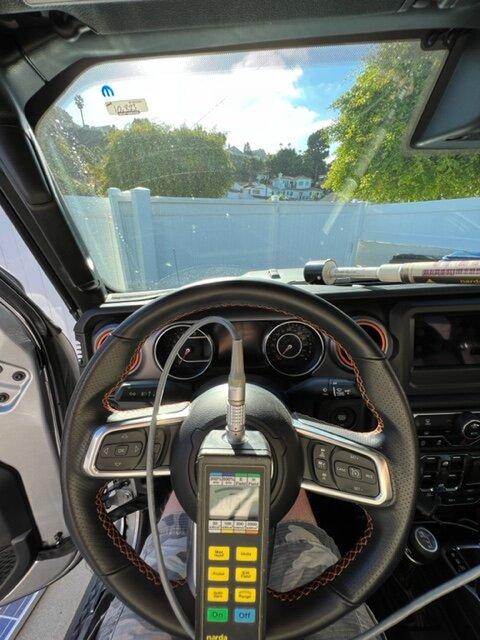
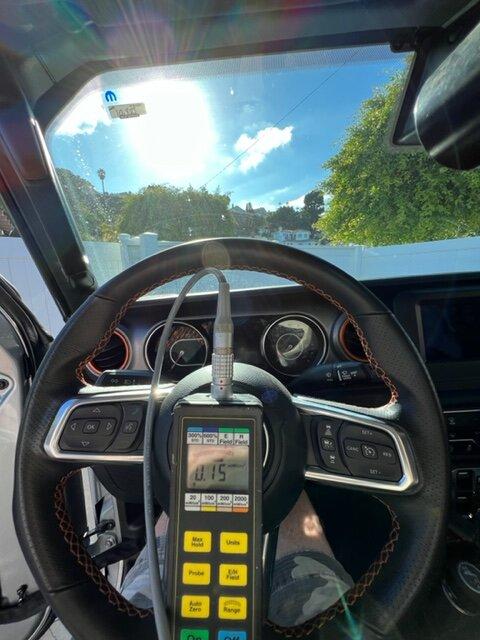
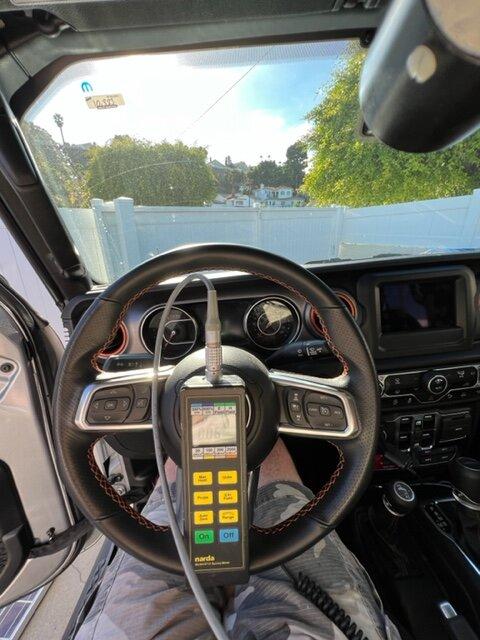
As threatened, I did a quick RF exposure test on my hood/cowl mounted UHF 1/4 wave whip antenna using a 50 watt UHF amateur radio on 446MHz, which is close to GMRS.

With my Narda RF exposure meter probe out in front of my head, which would be about the furthest you could push the seat forward with your head slightly above and behind the steering wheel, the maximum level measured was 0.15 mw/cm2. Pulling the probe further back closer to where my head usually is during driving I measured 0.06 mw/cm2.

The maximum level inside the cab was at the dash/window junction slightly to the right of the steering wheel center. It seems there is less ground plane from the antenna going straight back towards the driver producing less level there and more ground plane as you go towards the passenger making the levels higher and at some point the contribution of the ground plane and the ultimate distance from the antenna cancel each other out and that one spot has the highest measured level of 1.43 mw/cm2.

The current FCC specification for exposure at 446MHz is 1.49 mw/cm2 in a controlled area (meaning the people exposed are aware of the radio transmitter and potential RF levels). With the worse case in the drivers seat measuring 0.15 mw/cm2, I think its safe.

There are a couple of other things to consider like time constraints on how long you transmit that can modify the final FCC acceptable level and I didn't measure the power output of the radio and would not be surprised if it were a little low with the engine off. There is also about 15ft of RG-58 coax between the radio and antenna resulting in about 1.5dB of power loss which is roughly 25%. I would not be surprised if there was only 20-25w reaching the antenna during the test.

Here are a few pics of the test meter doing its magic and the round black thing in the upper right corner of a few pics is the probe. And my hands were full so I was keying the microphone with my knees.

Jeep Gladiator GMRS / CB antenna locations - near A pillar or mid point on hood 1664670059067

Jeep Gladiator GMRS / CB antenna locations - near A pillar or mid point on hood 1664670081846

Jeep Gladiator GMRS / CB antenna locations - near A pillar or mid point on hood 1664670109376


I have a cowl/hood hinge mount, a 50w dual band radio and a calibrated Narda RF exposure meter. When I get some time I will make a measurement in the drivers seat at various power levels.
 

ColoradoDennis

Well-Known Member
First Name
Dennis
Joined
Jun 5, 2020
Threads
0
Messages
51
Reaction score
85
Location
Colorado, USA
Vehicle(s)
Jeep Gladiator Rubicon
Occupation
Retired RN
And my hands were full so I was keying the microphone with my knees.
Well done. Thanks for the data.

I am familiar with the facetious Q code “QLF.” You may have introduced a new one, “QBK.” ?
 

Sponsored

Radio Guy

Well-Known Member
First Name
Mike
Joined
Feb 24, 2021
Threads
6
Messages
716
Reaction score
882
Location
So Cal
Vehicle(s)
2021 Jeep Gladiator Mojave
Occupation
Retired Broadcast Engineer
Well done. Thanks for the data.

I am familiar with the facetious Q code “QLF.” You may have introduced a new one, “QBK.” ?
Thanks. If I had more time I could have tested a couple different antennas and the mount up against my rear window. Bottom line is I don't think anyone is going to create a dangerous situation even with a 50w watt GMRS radio with an antenna mounted external to the cab. Most radios are much less power and nobody is keying the mic for 10 minutes straight which would lower the potential hazard level some.
 

dawghauler

Well-Known Member
First Name
pete
Joined
Jul 9, 2020
Threads
2
Messages
108
Reaction score
88
Location
hubert, nc
Vehicle(s)
2020 jt sport s max tow
Occupation
hvac
Made a bracket to mount to a bolt on the fender under the edge of the hood
 

bd100

Well-Known Member
Joined
May 31, 2022
Threads
28
Messages
757
Reaction score
744
Location
USA Midwest
Vehicle(s)
JT, WK2, ole' Ram
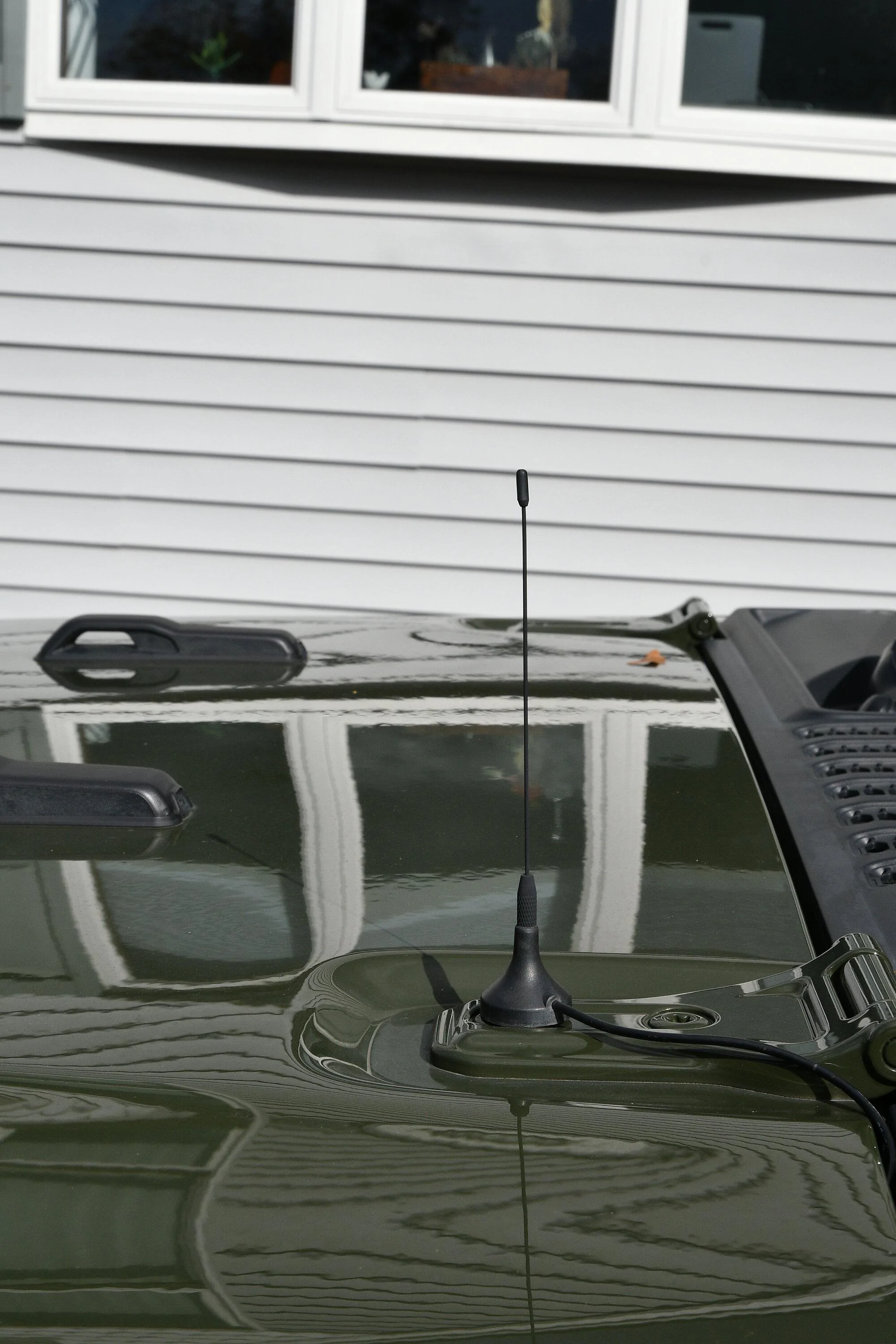
Keeping things simple, I just used the small mag-mount that came with the GMRS radio. Stays there through everything but the power washer!

500_2013.JPG
I noticed that location works really well. I chose to use the stick-on metal disk to move the antenna closer to the side, but still not at the edge. Ground plane on all sides, and I ran a grounded wire from the hood to the windshield just behind the antenna, as well, hopefully acting as an additional ground radial. Or you could add grounded metal tape to the underside of the plastic cowl.

If you are comfortable with coax tools, you can shorten that cable to remove a lot of losses. 20 feet of RG174. An online coax calculator says this effectively turns your 15 watt radio into a 6 watt radio. With a radio mounted under the steering wheel, you can shorten that to 6 feet or so, making it effectively an 11 watt radio. If you used an NMO mount with RG58 cable, it becomes a 13 watt radio.

Coax calculator

RG174 PL-256 connector
Crimper for RG58 and RG174
Cable tool for RG174

Why spend this money for these tools just to make a cheap antenna work better? Well, this little antenna doesn't scream "expensive radio on board!", and when the hood is opened the antenna can be tucked away under the cowl for hidden storage. And when mounted a bit closer to the edge of the hood, this antenna still works well but it's more off to the side of the field of view of the driver.
 

Sponsored

OP
OP
chorky

chorky

Well-Known Member
First Name
Chad
Joined
Feb 26, 2022
Threads
175
Messages
3,466
Reaction score
3,801
Location
Montana
Website
www.youtube.com
Vehicle(s)
'22JTR, '06 LJ, '06 TJ GE
Build Thread
Link
Occupation
GIS Specialist
Keeping things simple, I just used the small mag-mount that came with the GMRS radio. Stays there through everything but the power washer!

500_2013.JPG
this is a really great idea. Thanks for sharing
 
OP
OP
chorky

chorky

Well-Known Member
First Name
Chad
Joined
Feb 26, 2022
Threads
175
Messages
3,466
Reaction score
3,801
Location
Montana
Website
www.youtube.com
Vehicle(s)
'22JTR, '06 LJ, '06 TJ GE
Build Thread
Link
Occupation
GIS Specialist
Ok resurrecting this thread to hopefully choose a final solution for the antenna mount debate.

Maybe @Radio Guy will pop in again

I settled on the following items:

CB
https://www.rightchannelradios.com/products/stryker-center-load-antenna-1
https://www.rightchannelradios.com/products/uniden-off-road-cmx760

GMRS
https://midlandusa.com/collections/...ucts/micromobile-mxta26-6db-gain-whip-antenna

It is amazing how hard it is to find good information or maybe my searches are bad. Anyway. So doing a lip mount for the GMRS is possible but I would prefer a different option that doesn't damage the paint for a good grounding.

The main issue is the typical cowl mount for lights won't work for me as the sides will cover the lights on their way. And having the antenna very close to the windshield just seems like inviting frequency distribution issues to me. Otherwise I do like this option - https://evomfg.com/products/jeep-jl-gladiator-a-pillar-cowl-light-mounts-pair-black

Mounting the CB is a bit tougher of a situation. It's larger than expected. Currently the base portion of the antenna is 20" long. It can be lowered to 10" or even zero and have a base coil. But mounting seems to be an issue. Preferably having it on a single cross rack on the roof would be great however that causes ground plane issues - unless there is a way around that? Then there is the issue or wiring the coax....

Mounting to the center of the canopy sounds nice, with the exception of a future RTT, so that sorta kills that option I think.

I could mount to the bumper - but then signal is really degraded. I suppose cowl mounting with the above link could be used - but I do worry about the proximity to the windshield especially if that whip gets going.

Suggestions? I really don't know radio signal distribution very well which is the reason for tagging Radio Guy.
 

Timoleon

Well-Known Member
First Name
Tim
Joined
Oct 26, 2021
Threads
1
Messages
163
Reaction score
285
Location
Las Cruces, NM
Vehicle(s)
2021 Gladiator Rubicon, 2021 Gladiator Overland
Occupation
Tech
Remember, getting the signal from the redio to the antenna with GMRS can be a little bit of a challenge. The cable (or better understood as a pipe) will handle the signal to the antenna, but there are some restrictions in the pipe (cable) at the GMRS frequencies. It is something that we deal with all the time. There are charts that talk about that loss of signal power on line. It's easy, just look at your cable (it should be labled with an RG/ number. That number crosses over to the chart to tell you how much loss there is at a specific frequency. It's pretty high with RG/8U but not as bad as RG/58 or that type of cable. So a 50 watt radio at the antenna port on the radio is subject to that loss in the cable. Here is an on line calculator that will help factor in the total loss/gain: https://timesmicrowave.com/calculator/. All of the loss/gain is additive. So if you have a cable with 3db loss at your length, then you need to add the gain of the antenna. We'll assume 1db gain. So, 3db minus the gain of 1db gives you 2db of loss. Rule of thumb is that 3db of loss equates to a half power loss in signal to the antenna. So, your 50 watt radio is getting through the feedline and delivering 25 watts to the antenna. Add 1db of gain and you aren't getting much to the antenna.

Because it is more economical to locate your antenna in some area where it doesn't interfere with operating the vehicle, you could have significant loss through the cable. Your best bet is to re-coup that with an antenna with some better gain numbers.

In all honesty, you could do most of your comms with a hand held radio and a decent antenna just outside of any reflecting surfaces. The entire top of the Gladiator is plastic (with the exception of the roll bars) so there isn't much worry about that. Just get a decent antenna on your handheld.
 
OP
OP
chorky

chorky

Well-Known Member
First Name
Chad
Joined
Feb 26, 2022
Threads
175
Messages
3,466
Reaction score
3,801
Location
Montana
Website
www.youtube.com
Vehicle(s)
'22JTR, '06 LJ, '06 TJ GE
Build Thread
Link
Occupation
GIS Specialist
Remember, getting the signal from the redio to the antenna with GMRS can be a little bit of a challenge. The cable (or better understood as a pipe) will handle the signal to the antenna, but there are some restrictions in the pipe (cable) at the GMRS frequencies. It is something that we deal with all the time. There are charts that talk about that loss of signal power on line. It's easy, just look at your cable (it should be labled with an RG/ number. That number crosses over to the chart to tell you how much loss there is at a specific frequency. It's pretty high with RG/8U but not as bad as RG/58 or that type of cable. So a 50 watt radio at the antenna port on the radio is subject to that loss in the cable. Here is an on line calculator that will help factor in the total loss/gain: https://timesmicrowave.com/calculator/. All of the loss/gain is additive. So if you have a cable with 3db loss at your length, then you need to add the gain of the antenna. We'll assume 1db gain. So, 3db minus the gain of 1db gives you 2db of loss. Rule of thumb is that 3db of loss equates to a half power loss in signal to the antenna. So, your 50 watt radio is getting through the feedline and delivering 25 watts to the antenna. Add 1db of gain and you aren't getting much to the antenna.

Because it is more economical to locate your antenna in some area where it doesn't interfere with operating the vehicle, you could have significant loss through the cable. Your best bet is to re-coup that with an antenna with some better gain numbers.

In all honesty, you could do most of your comms with a hand held radio and a decent antenna just outside of any reflecting surfaces. The entire top of the Gladiator is plastic (with the exception of the roll bars) so there isn't much worry about that. Just get a decent antenna on your handheld.
thats some great info thank you. I will check out that link and look into some cable options. Thats a bug reason why I want to find a good solution for mounting the antennas because there already is loss in the cable and with having less than optimum ground plane.

that also makes sense why there are so many 3 and 6 db gain antennas. Its almost like they know of these issues and are trying to compensate without just being outright about it. The GMRS antenna I settled on is about 31” and a 6db gain. I went with that just because I didnt find another option I was looking for. The stryker antenna is just a hopeful guess that it might work better being a center load.

as for handhelds, well I already have radios and antennas so Im really not looking to toss them in favor of a handheld. I really want to find good mounting solutions for them.
 

Radio Guy

Well-Known Member
First Name
Mike
Joined
Feb 24, 2021
Threads
6
Messages
716
Reaction score
882
Location
So Cal
Vehicle(s)
2021 Jeep Gladiator Mojave
Occupation
Retired Broadcast Engineer
Ok resurrecting this thread to hopefully choose a final solution for the antenna mount debate.

Maybe @Radio Guy will pop in again

I settled on the following items:

CB
https://www.rightchannelradios.com/products/stryker-center-load-antenna-1
https://www.rightchannelradios.com/products/uniden-off-road-cmx760

GMRS
https://midlandusa.com/collections/...ucts/micromobile-mxta26-6db-gain-whip-antenna

It is amazing how hard it is to find good information or maybe my searches are bad. Anyway. So doing a lip mount for the GMRS is possible but I would prefer a different option that doesn't damage the paint for a good grounding.

The main issue is the typical cowl mount for lights won't work for me as the sides will cover the lights on their way. And having the antenna very close to the windshield just seems like inviting frequency distribution issues to me. Otherwise I do like this option - https://evomfg.com/products/jeep-jl-gladiator-a-pillar-cowl-light-mounts-pair-black

Mounting the CB is a bit tougher of a situation. It's larger than expected. Currently the base portion of the antenna is 20" long. It can be lowered to 10" or even zero and have a base coil. But mounting seems to be an issue. Preferably having it on a single cross rack on the roof would be great however that causes ground plane issues - unless there is a way around that? Then there is the issue or wiring the coax....

Mounting to the center of the canopy sounds nice, with the exception of a future RTT, so that sorta kills that option I think.

I could mount to the bumper - but then signal is really degraded. I suppose cowl mounting with the above link could be used - but I do worry about the proximity to the windshield especially if that whip gets going.

Suggestions? I really don't know radio signal distribution very well which is the reason for tagging Radio Guy.
A trunk lip mount will not damage any paint that you can see. The mounts usually have a rubber pad under them and the only possible damage would be from the two set screws that poke into the underside of the hood about 1/2" in from the edge. I've installed at least 100 of them over the last 45yrs and never had a problem.

On coax loss, good quality RG-58 has about 1dB loss per 10ft or .1dB loss per foot at GMRS frequencies. If you put a trunk lip mount on the drivers side hood near the hinge and use the convenient existing hole in the firewall to run coax and put the GMRS radio under the dash I think you can get by with about 6ft of coax or about .6dB loss. Putting the radio under the front seat might take 12ft of coax and now you have about 1.2dB loss which is starting to get up there but still not that bad. BTW the Midland 6dB GMRS antenna is actually about 3dBd gain. Mfrs lie a lot about antennas. It takes about 8ft of antenna to get 6dBd gain at UHF and Midland can't change the laws of physics no matter how they advertise it.

The Stryker CB antenna is a bit heavy and I think one of the mounts that goes along the side of the hood near the cowl would be ok. There are some brands that would be strong enough to hold up the big Stryker antenna. This location is not something I would recommend for a GMRS antenna due to being 6" below hood level but for CB its fine. I would not worry about the antenna hitting the windshield, it should be stiff enough and far enough back from the windshield to not cause any problems. Coax loss at CB frequencies is nothing to worry about in a vehicle unless your going to run lots of power like more than 500w, then you might want to upgrade.

So with all that I would put the GMRS antenna on the drivers side and the CB antenna on the passenger side since the GMRS antenna has a lower visual impact and you can also carry a 6" whip for GMRS to use much of the time when you don't need the distance. That also puts both antennas within view when going through thick brush so you can keep an eye on them for snagging stuff. One thing about the hood mount near the hinge is it pitches the antenna a degree or two to the outside and I just put a little bend at the base of the whip to make it perfectly vertical.

With these two mounts on your vehicle, one being an NMO for GMRS and a 3/8-24 for CB, they will be universal for many other antennas if you wish to upgrade later. I mentioned a 6" whip for GMRS which you could probably run all the time and get plenty of range. You can also swap out the big Stryker for a smaller and lighter CB whip and still be fine for caravanning and off roading. If you like talking across the country on CB then the Stryker will come in handy, but then you would probably be into amplifiers and preamp mics and all that goes a different direction at than point. For those guys the vehicle is simply a thing to carry around your radio station.
Sponsored


Top