Sponsored

Aftermarket 3.6 Engine Oil Cooler?

troverman

Well-Known Member
Joined
Mar 31, 2023
Threads
7
Messages
114
Reaction score
84
Location
NH
Vehicle(s)
2022 Jeep Gladiator
As to the OP, I also have seen high temps. Ambient was just under 80 degrees and I pulled some mild hills, about a mile or so long, with my 5,000lb 102" enclosed box trailer at 55mph. Plenty of power, but coolant was 230 and oil was 253. That seems quite high. The liquid to liquid oil cooler is very common these days and can be quite effective, but with coolant at 230 I don't think the cooler could bring oil down that much. It seems the radiator and fan combo were somewhat inadequate.

As for the oil pump, it seems pressure was either at 31psi or at 80psi. At high RPMs, it was at 80; otherwise it was at 31. 80psi is quite impressive for thin, hot engine oil. I'm wondering if its accurate though, because I would have expected the 31psi to drop on a fully hot engine sitting in Drive at a traffic light.
Sponsored


 

Stinggrey 21 Rubi

Well-Known Member
First Name
Brian
Joined
Sep 29, 2022
Threads
6
Messages
60
Reaction score
71
Location
Usa
Vehicle(s)
21 JT, 1998 ram 12 valve
Occupation
Bum
I did PPE engine and trans pans and have been happy with temp reduction while towing. I have never seen 220 oil temp. I think each pan added 1.5 qt but the magnets in the drain plugs are really strong. I do my own maintenance, just to keep an eye on things.
 

ShadowsPapa

Well-Known Member
First Name
Bill
Joined
Oct 12, 2019
Threads
247
Messages
40,445
Reaction score
53,878
Location
Runnells, Iowa
Vehicle(s)
'25 JTMX, '23 JLU 4xe, '82 SX4, '73 Javelin
Occupation
Retired auto mechanic, frmr gov't ntwrk security admin
Vehicle Showcase
3
Not sure I can agree. Air-cooled Harley-Davidsons use 20w50 motor oil, because the heavier oil can handle the higher heat those engines see. Likewise, heavy duty diesel engines use 15w40 for similar reasons. Very light oils, like the 0w20 the Pentastar wants, are great for less wear on very cold starts, they crank easier, and they get better fuel economy. However, they tend not to protect metal as well.
WRONG - especially the last sentence - viscosity doesn't protect, the oil's film protects. You are talking very very different engines, apples to apples, not even the same operating parts inside.
LOL - funny comparing an air cooled leaky engine to a water cooled engine that runs cooler within a controlled range with extremely different valve lash adjusters, followers and VVT and VVL.
Don't compare diesel engines to gas engines - they don't experience the same heats and stresses in the same areas. I can give details on that as well.

As for the oil pump, it seems pressure was either at 31psi or at 80psi. At high RPMs, it was at 80; otherwise it was at 31. 80psi is quite impressive for thin, hot engine oil. I'm wondering if its accurate though, because I would have expected the 31psi to drop on a fully hot engine sitting in Drive at a traffic light.
Confirms you are not understanding how oil, oil pumps and protection works........
These are high volume pumps. They are vane type pumps.
They pump VOLUME - a higher volume than the gear pumps you may be thinking of. And volume against a restriction or resistance results in pressure. So you have pressure - proof that the oil is "thick enough" and getting where it is needed.
As long as the oil is quality oil with good film strength, viscosity matters little.
The pump is controlled by a solenoid that drops volume at RPM lower than about 3,000 to reduce the parasitic load on the engine. You do NOT need high oil pressure. The only reason they keep it high at higher speeds is for the VVL, VVT and other functions, otherwise lower pressure would be fine as long as the volume was there.
Engineers have proven that thicker oil flows slower, runs HOTTER and removes heat more slowly, shedding heat more slowly.
And still - arm-chair experts believe otherwise contradicting trained techs/mechanics and engineers.
 

smlobx

Well-Known Member
First Name
Eddie
Joined
Jun 28, 2018
Threads
86
Messages
2,647
Reaction score
4,518
Location
Mid Atlantic
Vehicle(s)
JTR, F-350 diesel, Porsche Spyder, Model Y
Occupation
Semi retired consultant
Shadow papa I value your opinion as a mechanic but you are not an expert oil fluid dynamics.

‘The fact that Jeep recommends either a 0W-30 or 5W-30 synthetic oil in virtually the rest of the world from Europe to Asia for the 3.6 and 2.0 engines to me speaks volumes as to which is the better oil. The oil spec’d for the US is driven by CAFE …
 

Hootbro

Well-Known Member
First Name
Don
Joined
Apr 13, 2019
Threads
57
Messages
10,184
Reaction score
19,950
Location
Delaware
Vehicle(s)
2025 Gladiator Sport
Shadow papa I value your opinion as a mechanic but you are not an expert oil fluid dynamics.

‘The fact that Jeep recommends either a 0W-30 or 5W-30 synthetic oil in virtually the rest of the world from Europe to Asia for the 3.6 and 2.0 engines to me speaks volumes as to which is the better oil. The oil spec’d for the US is driven by CAFE …
You sure about that? I have looked at owners manual for both the South American/Mexican and Middle East market for the Gladiator and they all globally spec the 0W-20 for all markets in relation to the 3.6L with no alternate grades listed.

I have noticed the same thing in other FCA/Stellantis models in that they are only listing one weight grade globally that mirrors North American call outs. That is something that has changed within the last few years where prior they would list different grades for different markets.
 

Sponsored

troverman

Well-Known Member
Joined
Mar 31, 2023
Threads
7
Messages
114
Reaction score
84
Location
NH
Vehicle(s)
2022 Jeep Gladiator
@ShadowPapa - you think you're an expert, apparently, but I'm not seeing it. A modern Harley big twin uses a water cooled cylinder head and still runs 20w50. Heavier weight oils provide more protection against heat. There's no way around that. A manufacturer knows they will have to compromise to some extent on oil when an engine may be used in sub-zero conditions as well as 100F+ conditions. Harley-Davidson very likely knows they don't need to worry about operation in very cold conditions, so they have an advantage. Same with a snowmobile manufacturer not worrying about hot conditions, although my Yamaha 4-stroke sled runs 0w40. Your explanation of volume and pressure is not necessarily accurate either. With a pump, you can have volume or you can have pressure. Generally not both. If the Pentastar doesn't "need" 80psi at high RPM, why would they engineer it to produce this pressure? As you mention, more pressure equals more parasitic drag. And oil pressure doesn't indicate the oil is thick enough, that's a ridiculous statement. You could pressurize water to 80psi.

I'm hardly an arm-chair mechanic. You don't know me at all. I'm no expert on these engines...never had one before. But I've worked on a variety of different vehicles over the years and am qualified to perform most repairs one could do to a vehicle. Generally speaking, manufacturers today are more concerned about low emissions and better fuel economy than engine longevity. In my experience, engine oil temps at 255F (what I hit this past weekend towing) and coolant at 233F are pretty high. If you tell me "there's nothing wrong with that" then I would ask why my RAM 2500 operates at much lower temperatures while pulling twice the load - and its a gas Hemi, not a diesel.
 

ShadowsPapa

Well-Known Member
First Name
Bill
Joined
Oct 12, 2019
Threads
247
Messages
40,445
Reaction score
53,878
Location
Runnells, Iowa
Vehicle(s)
'25 JTMX, '23 JLU 4xe, '82 SX4, '73 Javelin
Occupation
Retired auto mechanic, frmr gov't ntwrk security admin
Vehicle Showcase
3
Shadow papa I value your opinion as a mechanic but you are not an expert oil fluid dynamics.
What does fluid dynamics have to do with it?

I've studied engine failures, engine damage, the effects of lack of lubrication and read many various studies on oil, engine protection and so on. It's one of the things I do - research, troubleshooting.
(I've included snippets from an SAE member who does oil testing and studies)

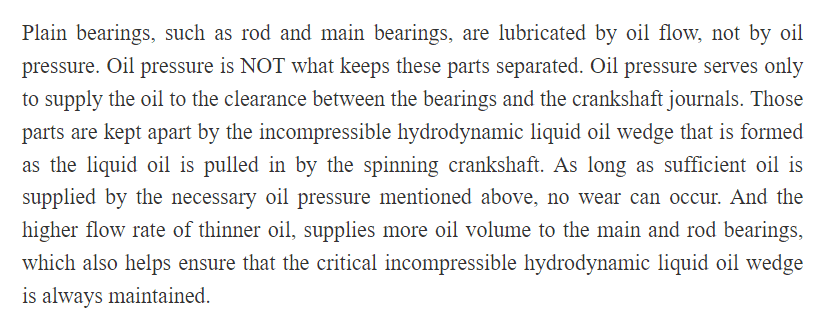
This is about protection - the oil wedge protecting between journal and bearing, and the film strength between cam lobe and follower.
Fluid can't be compressed so as long as there is oil between journal and bearing, it's protected.
In other areas, followers, cams, scraping and rubbing parts, it's the film strength. And that's nothing to do with viscosity. That's the ability to handle pressure.
We're not talking flow in various shaped passages, galleries, pipes or fittings. That's for exhaust, intake, coolant and so on.
We have a pressurized system with a flow far larger than prior factory oil pumps of the past. That's ensuring adequate supply. The pressures reflect that.
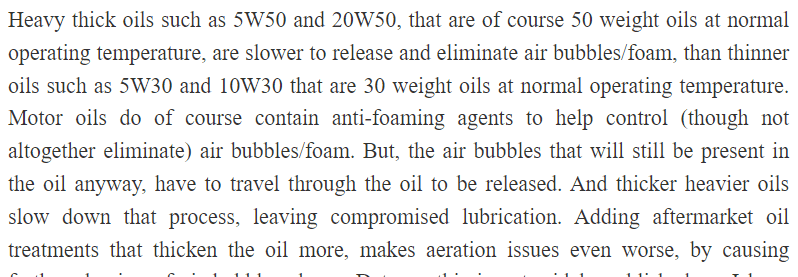
Running thicker oil has a side effect, too - trapping the air that is mixed into the oil by normal engine operation. Thicker oil doesn't let the air escape from the oil as quickly so it remains aerated longer - more air, less oil to each part. Thinner oil releases the air trapped by the windage, spinning and moving engine parts forming an oil mist in the crankcase.
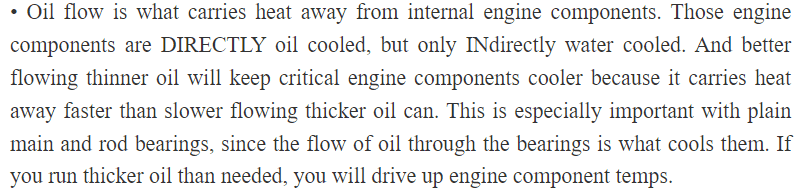
You increase engine temperatures by slowing oil flow as oil directly cools the internal parts, and you trap more air longer in the oil. Air in oil = not good.

Jeep Gladiator Aftermarket 3.6 Engine Oil Cooler? 1690895059117


@ShadowPapa - you think you're an expert, apparently, but I'm not seeing it. A modern Harley big twin uses a water cooled cylinder head and still runs 20w50. Heavier weight oils provide more protection against heat. There's no way around that.
I literally had to laugh about that because it's backwards. Thicker oil runs HOTTER and offers less protection "against heat". Oil directly cools engine parts - thicker oil flows slower and runs hotter - due to shear and slower flow.
I don't give a rip if a Harley runs oil made for loose clearances. These are NOT harley engines. These are made with totally different needs and clearances. 20w50 in these would kill them eventually. Piss-poor for heavy loads and towing.
You keep comparing apples to rocks - not even the same class engine putting out the same HP and not built to the same clearances and specs. Tell me that Harley has VVL and VVT and a variable displacement vane type high volume oil pump.
I'm over 50 years into this - many hundreds of engines, college and factory trained, and to this day still spend hours studying SAE papers and studies - and the work of people testing and writing about these things.

Jeep Gladiator Aftermarket 3.6 Engine Oil Cooler? 1690895585774


Jeep Gladiator Aftermarket 3.6 Engine Oil Cooler? 1690895674407


With a pump, you can have volume or you can have pressure. Generally not both. If the Pentastar doesn't "need" 80psi at high RPM, why would they engineer it to produce this pressure? As you mention, more pressure equals more parasitic drag. And oil pressure doesn't indicate the oil is thick enough, that's a ridiculous statement. You could pressurize water to 80psi.
Pumps produce volume, not pressure. You apparently failed that quarter on hydraulics, and then the later ag maintenance classes.
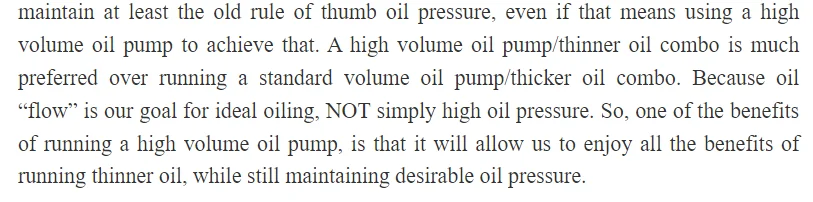
A high volume pump is capable of building more pressure than a low volume pump against the same resistance. Not sure what the heck you are trying to get at with "you can have volume or you can have pressure Generally not both" because that statement defeats itself. High volume pumps can allow you to have more pressure in a given oiling system. Oil goes in one end and leaks out along the way. If the amount that leaks out is greater than what the pump pushes in, you can't build pressure. If the pump can supply more volume than what leaks out, you build pressure. The greater the difference between what goes in vs what leaks out, the higher the pressure can be - limited by a valve.
Yes, you could pressurize water to 80 psi but what's that got to do with anything? It's input vs. output volume. You simply don't get it. You would have to have extremely high volume or almost no clearances (meaning no leakage) to get that much pressure.
As long as you can maintain the required pressure, then a thinner oil is good. You don't need more viscosity than what's required in that engine with those clearances and that pump's volume capabilities to maintain pressure.

As far as why the higher oil pressure above 3,000 RPM, you keep forgetting VVL and VVT. They literally keep the VVL system charged with oil at low pressure to keep it ready to change modes quickly, no lag, as near instantaneous as possible. They need pressure to operate that system. It's not all for lubrication.
They also spray lubricate the followers by shooting oil out the exhaust followers onto the cam lobes - takes pressure to do that. Consider it like you watering a tree 50 feet away but the water hose is only 30 feet long - you need pressure to shoot the water the remaining 20 feet to get to the tree. These shoot oil streams at multiple lobes and followers a distance away and the higher the RPM, the more the oil is flung off and scraped off so they need pressure to shoot a lot of oil at those cams. Increase viscosity and you reduce the ability of the oil to go as far - you may cut the amount of oil getting to the cam lobes and followers.
The crank journals on the 2nd Gen Pentastar (PUD) are also more narrow and the bearings are of different materials than before - or than motorcycle and other engines. Bearing materials, clearances, sizes............. can't see how anyone can keep comparing with "but xyz uses this and it's fine". To that - so what?

It's not all about bearings - these operate a lot more things than your Harley or Yamaha you are fond of comparing to. Unreal - totally different engines, different pumps, different lubrication needs, very different clearances and bearing types.

If you tell me "there's nothing wrong with that" then I would ask why my RAM 2500 operates at much lower temperatures while pulling twice the load - and its a gas Hemi, not a diesel.
Because it's a freakin' hemi V8 and not a little 3.6 V6 built TOTALLY different! Again - why do you keep comparing to very different engines in very different vehicles? At least compare similar or same engine designs.
It takes so much energy to pull a load a given distance at a given speed. To get there, you generate BTUs. Your BTUs are coming from 8 cylinders, very different cooling system, much larger radiator able to remove more BTUs faster and the heat energy is concentrated over smaller areas on the 3.6.

Jeep Gladiator Aftermarket 3.6 Engine Oil Cooler? 1690898745243


BTW - both of my JTs and our last Grand Cherokee saw 30 and 70 psi for oil pressure. Not 80 - not sure the difference other than perhaps the oil was colder to get the 80 psi?
Think of the old school formula for figuring oil pressure - don't look it it! And you'll see that high oil pressure was never a goal. As low as 8 to 10 psi was ok, and a max of 60 was fine
 
Last edited:

troverman

Well-Known Member
Joined
Mar 31, 2023
Threads
7
Messages
114
Reaction score
84
Location
NH
Vehicle(s)
2022 Jeep Gladiator
My background with pumps - aside from the traditional eccentric gear oil pumps and high pressure oil pumps for HEUI diesel fuel systems, is firefighting. That was my statement regarding volume vs pressure. On a fire engine, if you want more pressure, you can't have as much volume, be that multiple lines or a single line with a larger nozzle. Obviously not apples to apples, but generally the same concept. If you have the same power driving a pump and you have a larger chamber, you can have more volume; if you narrow the chamber the reduce volume but increase pressure. Hydrostatic transmissions work on this principle as well.

I'm fairly sure the updated Pentastar uses cam-torque actuation for VVT control vs oil pressure. Of course you would still need oil pressure for VVL operation.

My JT is definitely always pinging up to 80psi when the oil pump switches at high RPM, which I found impressive. I can replicate it easily, I'm happy to send you a screenshot if you are curious.

So although I'm now realizing the high coolant and oil temps I'm seeing while towing near the limit of my Jeep are "normal," it still makes rational sense to believe these high temps vs much lower temps will wear the engine out more quickly. The components are very similar from one internal combustion engine to another - cam, crank, bearings, etc. An engine operating fully warmed up is good, but one running that warm cannot be good long term. Clearly, the high temps are happening while the engine is under sustained load but nevertheless operating within its design limits. ECT and EOT rise very rapidly while towing, which seems like poor cooling system control.

Finally, regarding oil weight - I've noticed Ford specifies a 5w20 syn-blend on both their V6 twin turbo engines as well as their 5.0L V8 applications. Yet, for their Super Duty vehicles with the larger 6.2L V8 and 7.3L V8, they specify a 5w30 - a thicker oil, interestingly, for their engines which will be doing heavy-duty work. Seeming to lend credence to the notion that a thicker oil is superior in applications which will work harder and be subject to high heat.
 

red/green hawk

Well-Known Member
First Name
Ryan
Joined
Apr 4, 2020
Threads
48
Messages
728
Reaction score
1,217
Location
Moscow, ID
Vehicle(s)
2020 JT Sport S with max tow package, 2008 Suburban LTZ
Occupation
PACU Nurse
Enough about viscosity and oil weights, what is an acceptable coolant/tranny/oil temp for 3.6 running on 0W 20? It's been above 100 for almost a month here in the desert SW and I've consistently been running in the mid 220s for coolant temps, low 200s for tranny temps, and mid to upper 230s for oil temps without pulling anything. I've been wondering if my winch on the front has been a factor in "higher" temps.
 

troverman

Well-Known Member
Joined
Mar 31, 2023
Threads
7
Messages
114
Reaction score
84
Location
NH
Vehicle(s)
2022 Jeep Gladiator
In the northeast, its 75F yesterday and my JT saw 230 coolant and 250 oil, but the trans never exceeded 208F. This was towing. Normally I'm around 200F trans, as high as 220F coolant, and 230 oil without towing but it varies.
 

Sponsored

JarHeadLV

Banned
Banned
First Name
Gerard
Joined
Aug 19, 2022
Threads
16
Messages
379
Reaction score
305
Location
Las Vegas
Vehicle(s)
2023 Jeep Gladiator Mohave, 2020 Porsche 911 Turbo
Occupation
Financial Retirement Planner
Vehicle Showcase
1
In the northeast, its 75F yesterday and my JT saw 230 coolant and 250 oil, but the trans never exceeded 208F. This was towing. Normally I'm around 200F trans, as high as 220F coolant, and 230 oil without towing but it varies.
Man, we are thinking alike!!!
For the "non-experts" here (including myself) what #'s are considered a high temp for coolant, oil, trans, etc???? This is important to know. I do not tow anything with my truck.

I was driving today here in Las Vegas - outside temp was 95, my coolant temp was 221, oil was 230 and trans was 197. This was me driving on the street and driving the speed limits. Are these numbers seem a little high???
 

Mr._Bill

Well-Known Member
First Name
Bill
Joined
Jul 22, 2019
Threads
38
Messages
6,647
Reaction score
7,727
Location
North Las Vegas, NV
Vehicle(s)
2023 Gladiator High Altitude - 2013 Nissan Leaf SV
Vehicle Showcase
1
Man, we are thinking alike!!!
For the "non-experts" here (including myself) what #'s are considered a high temp for coolant, oil, trans, etc???? This is important to know. I do not tow anything with my truck.

I was driving today here in Las Vegas - outside temp was 95, my coolant temp was 221, oil was 230 and trans was 197. This was me driving on the street and driving the speed limits. Are these numbers seem a little high???
When I'm watching it, oil and coolant usually don't go above 210. I have occasionally seen higher numbers around town. Oil gets to 230 when going up the hill heading to Pahrump, but always drops down after reaching the top.
 

Blade1668

Well-Known Member
First Name
Darrell
Joined
Jan 7, 2020
Threads
12
Messages
3,263
Reaction score
3,149
Location
N. AL.
Vehicle(s)
90XJ, 91XJ, 91MJ, 05 LJ, 20 JT
Build Thread
Link
Vehicle Showcase
1
Dang I'm sorry to have found this thread late... as I was looking for a thread on oil temperature noted. During the last few trips I've been on I have been watching the oil temperature and cooling. I've been seeing oil temperature 220s-230s coolant up to 230 Trans temp 210. A note that the oil life monitoring has been cutting back on oil life substantially during this higher ambient air temp and oil temperature driving. In approximately 1000 miles it has cut oil life back 13-19% off or so. 7163.7 miles on oil, oil life monitoring had 10% left. Monday a sample is off to Blackstone Labs for testing. So I will try to follow up post results on the oil
 

TCheek

Member
First Name
Terry
Joined
Dec 24, 2022
Threads
2
Messages
17
Reaction score
9
Location
Western North Carolina
Vehicle(s)
2020 Glaidator Overland
Occupation
Technician
I realize the answer to my question is probably in the owner's manual but here goes. How do I display my oil and tranny temps?
 

Mr._Bill

Well-Known Member
First Name
Bill
Joined
Jul 22, 2019
Threads
38
Messages
6,647
Reaction score
7,727
Location
North Las Vegas, NV
Vehicle(s)
2023 Gladiator High Altitude - 2013 Nissan Leaf SV
Vehicle Showcase
1
I realize the answer to my question is probably in the owner's manual but here goes. How do I display my oil and tranny temps?
If you have the 8.4 head unit, and a model that includes the Off Road Pages, that is the easiest way.

Otherwise, use the arrows on the center display. Down/Up arrow to the tire pressure screen, then Left/Right arrow for the temps.
Sponsored


Top