Sponsored

Bent Frames - Big Thing or isolated?

LostWoods

Well-Known Member
Joined
Mar 13, 2020
Threads
15
Messages
2,027
Reaction score
2,420
Location
Gilbert, AZ
Vehicle(s)
2024 4Runner / 1995 YJ
True - there's cross braces that spread the load in the bed out so it's not concentrated

And your latter part hits on something I've seen here over and over where people buy a JT without the tow package, go buy a receiver, and hey that receiver is a class x so I can handle a tongue weight of yyy pounds, the receiver says so..........
They aren't accounting for the frame and other restrictions. Doesn't matter what a class whatever receiver can handle - it's what it's bolted to can handle. And yet here, and on other forums, I see the insistence that the receiver is the limiting factor.
They ignore the book
There's a reason these are limited to the tow ratings and tongue weights they are (and in another area here, I see adding heavier springs and better trackbars, etc. will increase your towing ability - no, it won't)

Also must figure physics - hit a big bump with that 600 pounds and what sort of force does it hit that frame with? More than 600 pounds.
I think the issue isn't the raw tongue weight or occasional hit as much as it is oscillations. Off-road with a trailer, I would only want to pull half what my truck is rated because continual bouncing significantly increases the effective force on the hitch and frame. Singular hits are largely absorbed but repeated cycles cause fatigue.

People don't think about it but any manufacturer rating is for typical on-road use only. Off-road is going to be much closer to two-thirds or half that number.
Sponsored


 

ShadowsPapa

Well-Known Member
First Name
Bill
Joined
Oct 12, 2019
Threads
247
Messages
40,463
Reaction score
53,908
Location
Runnells, Iowa
Vehicle(s)
'25 JTMX, '23 JLU 4xe, '82 SX4, '73 Javelin
Occupation
Retired auto mechanic, frmr gov't ntwrk security admin
Vehicle Showcase
3
I think the issue isn't the raw tongue weight or occasional hit as much as it is oscillations. Off-road with a trailer, I would only want to pull half what my truck is rated because continual bouncing significantly increases the effective force on the hitch and frame. Singular hits are largely absorbed but repeated cycles cause fatigue.

People don't think about it but any manufacturer rating is for typical on-road use only. Off-road is going to be much closer to two-thirds or half that number.
In one of the other threads on this topic, I posted the forces involved with something like 16 pounds dropped from xx inches, and then one can figure - 300 pounds, coming down from xx" and you get over a thousand pounds.
It's not too far removed from a slide hammer effect.

I can have 600 pound tongue weight - on the highway, as it's mostly at rest, but there's no way I'd take that into a washboard road or rough territory.
Funny thing, I was watching a new GM or Chevrolet commercial for their trucks and they showed towing a small camper and taking dips and jumps through rough roads and I thought - you are gonna either bust the hitch on that camper or something. I can't see how it could survive much of that, and it's likely why that bit of the commercial was only about 2 seconds - they had to take it back and fix some things after that shot.
 

ShadowsPapa

Well-Known Member
First Name
Bill
Joined
Oct 12, 2019
Threads
247
Messages
40,463
Reaction score
53,908
Location
Runnells, Iowa
Vehicle(s)
'25 JTMX, '23 JLU 4xe, '82 SX4, '73 Javelin
Occupation
Retired auto mechanic, frmr gov't ntwrk security admin
Vehicle Showcase
3
Figure I would drop this here.

Bingo.
That's the exact sort of thing discussed in other threads on the topic of bent frames.
Towing alone will not do it. Towing a very light load on a rough road won't do it, but get the right conditions, and physics come into play.

I've seen comments like "we never saw this in the old days" - no, you didn't - but you did see first responders dragging out dead people instead of dealing with cervical braces and back boards rescuing a live person. Survival rates were much lower back then with a rigid, ungiving frame.
It's physics - and modern design doing what it was meant to do - and being used for what it was never designed to do.
 

hepcat

Well-Known Member
First Name
Roger
Joined
Mar 7, 2024
Threads
3
Messages
110
Reaction score
277
Location
Eastern Iowa
Vehicle(s)
2022 Gladiator Overland
Occupation
Retired
Disclaimer: I am NOT a structural engineer, nor have I ever played one on TV. I AM, however, a qualified traffic collision reconstructionist and I have investigated hundreds of crashes in a thirty year law enforcement career. Time-motion studies, and the physics of collisions are key to understanding what happens when one vehicle physically interacts with another at speed.

I've read this thread and watched the linked videos with interest as I myself am towing a trailer that is near the top of my '22 Overland's rated capacity, but still is in spec for trailer weight, tongue weight and GCVWR. There are a couple of points I've taken away from that video that are of particular interest. The first is that the Gladiator frames are designed with a rear crumple zone. Second that the bent frame in the video was done in an area of desert known for whoop-dee-doos. I surmise from the damage that speed was likely involved. That makes sense as under those conditions, force vectoring is applied at angles that the frame wasn't designed to absorb; for example, hard braking coming out of a trough where the Jeep is at an angle going up, but the trailer is still on it's way down to the trough setting up a situation where the entire weight of the trailer is now plowing into the hitch with the Jeep frame at a significant "down" angle in relation to the trailer tongue essentially creating a rear-end collision situation for the Jeep. The frame folds down where it's supposed to fold in a collision such as that to absorb some of the energy impacting it from the rear. This is obviously a sample of one incident, and without examining more it'd be hard to generalize... but in this particular case I suspect that the causes are pretty simple.
 

ShadowsPapa

Well-Known Member
First Name
Bill
Joined
Oct 12, 2019
Threads
247
Messages
40,463
Reaction score
53,908
Location
Runnells, Iowa
Vehicle(s)
'25 JTMX, '23 JLU 4xe, '82 SX4, '73 Javelin
Occupation
Retired auto mechanic, frmr gov't ntwrk security admin
Vehicle Showcase
3
Disclaimer: I am NOT a structural engineer, nor have I ever played one on TV. I AM, however, a qualified traffic collision reconstructionist and I have investigated hundreds of crashes in a thirty year law enforcement career. Time-motion studies, and the physics of collisions are key to understanding what happens when one vehicle physically interacts with another at speed.

I've read this thread and watched the linked videos with interest as I myself am towing a trailer that is near the top of my '22 Overland's rated capacity, but still is in spec for trailer weight, tongue weight and GCVWR. There are a couple of points I've taken away from that video that are of particular interest. The first is that the Gladiator frames are designed with a rear crumple zone. Second that the bent frame in the video was done in an area of desert known for whoop-dee-doos. I surmise from the damage that speed was likely involved. That makes sense as under those conditions, force vectoring is applied at angles that the frame wasn't designed to absorb; for example, hard braking coming out of a trough where the Jeep is at an angle going up, but the trailer is still on it's way down to the trough setting up a situation where the entire weight of the trailer is now plowing into the hitch with the Jeep frame at a significant "down" angle in relation to the trailer tongue essentially creating a rear-end collision situation for the Jeep. The frame folds down where it's supposed to fold in a collision such as that to absorb some of the energy impacting it from the rear. This is obviously a sample of one incident, and without examining more it'd be hard to generalize... but in this particular case I suspect that the causes are pretty simple.
When Dad was killed by the sleeping young driver in 2018, I was totally amazed and impressed by the IHP trooper's ability to literally reconstruct on computer exactly what happened, a play by play, vehicle speed of the other guy at pretty much every point, just amazing and impressive.
Even back in 1977 when I was hit broadside in an accident on a wet highway - the trooper who did the investigation of that accident, without aid of the computers and software they have now, had things pretty well figured out - speeds, angles and more. (he later asked permission to use photos and other information from that accident in training videos and classes for other crash investigators - he was amazed I survived, I guess, considering the speed and size of the other vehicle and so on)

There's only one or two points I have a tiny bit of "issue" with in the videos -

Pintle - that's only going to help for rotation of the trailer vs. the tow vehicle. You still have the exact same forces forward and downward. It's not going to do a thing to prevent what they were talking about. Pintles can twist but so can a ball hitch to a fair degree. So a pintle would only help with side angles, not the whoop-de-doops they are talking about. Pintle can prevent the tongue of the trailer from getting twisted like a twizzler, but it won't do anything for impact forces.

Shock length - they talked as if the vehicle would still hit the bump stops which slow down the final impact. If the shocks are too long - then THEY bottom out and the bump stops can't do their whole job. You may touch them, maybe compress them a bit, but if the shock is too long, then you reach the end of shock travel and it becomes a solid rod attaching the axle to the frame and the bump stop can't work.
The bump stops can't work!
It's similar to why Synergy says hey, if you use our longer springs, you really need to extend the bump stop - otherwise once that spring is fully compressed and you are into coil bind, it's a solid object, just as if you put a 4x4 in there - the bump stops can't do their job.
So, IMO, they really missed the mark on talking about suspension mods - if you have shocks that are too long, they'll read a dead stop at the downward end of travel and act like a solid rod, your bump stops can't possibly do what they were intended to do - slow that final impact.
If your springs reach coil bind before the bump stop can work - same thing, it becomes a solid block of steel - BAM as you hit bottom.
The bump stops must be able to do their job.
I can see the attraction of the fancier hydraulic stops - makes sense for off-roading, especially with modified suspension.
Bottom line for me - make sure that the springs don't reach coil bind and the shocks don't reach the bottom end of travel before the bump stops can do their job to bring that final impact down to a slow bump instead of a fast bang.
So in that respect, I disagree a bit with their thing that "shocks that are too long don't matter". When they bottom out, yeah, it's an impact that the bump stops can't or don't get a chance to absorb.
 

Sponsored

hepcat

Well-Known Member
First Name
Roger
Joined
Mar 7, 2024
Threads
3
Messages
110
Reaction score
277
Location
Eastern Iowa
Vehicle(s)
2022 Gladiator Overland
Occupation
Retired
When Dad was killed by the sleeping young driver in 2018, I was totally amazed and impressed by the IHP trooper's ability to literally reconstruct on computer exactly what happened, a play by play, vehicle speed of the other guy at pretty much every point, just amazing and impressive.
Even back in 1977 when I was hit broadside in an accident on a wet highway - the trooper who did the investigation of that accident, without aid of the computers and software they have now, had things pretty well figured out - speeds, angles and more. (he later asked permission to use photos and other information from that accident in training videos and classes for other crash investigators - he was amazed I survived, I guess, considering the speed and size of the other vehicle and so on)
I'm from the old school. We didn't have computers, we had calculators, formulas and accident templates and did our drawings and calculations by hand.

There's only one or two points I have a tiny bit of "issue" with in the videos -

Pintle - that's only going to help for rotation of the trailer vs. the tow vehicle. You still have the exact same forces forward and downward. It's not going to do a thing to prevent what they were talking about. Pintles can twist but so can a ball hitch to a fair degree. So a pintle would only help with side angles, not the whoop-de-doops they are talking about. Pintle can prevent the tongue of the trailer from getting twisted like a twizzler, but it won't do anything for impact forces.
I'd have a bit of a problem using a pintle on-road. The military gets by with it because of the relatively slow speeds of their convoys. They have too much slop to be comfortable with one at highway speeds.

Shock length - they talked as if the vehicle would still hit the bump stops which slow down the final impact. If the shocks are too long - then THEY bottom out and the bump stops can't do their whole job. You may touch them, maybe compress them a bit, but if the shock is too long, then you reach the end of shock travel and it becomes a solid rod attaching the axle to the frame and the bump stop can't work.
The bump stops can't work!
...
Bottom line for me - make sure that the springs don't reach coil bind and the shocks don't reach the bottom end of travel before the bump stops can do their job to bring that final impact down to a slow bump instead of a fast bang.
So in that respect, I disagree a bit with their thing that "shocks that are too long don't matter". When they bottom out, yeah, it's an impact that the bump stops can't or don't get a chance to absorb.
My question is this: Is the failure point going to be the shock, or upper or lower shock mount, or the frame? And if the shock becomes a solid rod and doesn't fail, and the shock mounts don't fail, the upper shock mount becomes the fulcrum for the load in the bed (and on the hitch) for the load, how much payload/tongue capacity aft of that fulcrum does it actually take to bend the frame? If the shock mount doesn't fail, and the shock itself doesn't fail and deform, then the frame takes all that force itself and deflects, and those forces are greatly amplified by force vector angles, the angle of the truck frame in relation to the trailer's momentum, and the abrupt slowing of the truck in relation to the trailer (which in this case has no brakes.)
 

ShadowsPapa

Well-Known Member
First Name
Bill
Joined
Oct 12, 2019
Threads
247
Messages
40,463
Reaction score
53,908
Location
Runnells, Iowa
Vehicle(s)
'25 JTMX, '23 JLU 4xe, '82 SX4, '73 Javelin
Occupation
Retired auto mechanic, frmr gov't ntwrk security admin
Vehicle Showcase
3
I'm from the old school. We didn't have computers, we had calculators, formulas and accident templates and did our drawings and calculations by hand.


I'd have a bit of a problem using a pintle on-road. The military gets by with it because of the relatively slow speeds of their convoys. They have too much slop to be comfortable with one at highway speeds.


My question is this: Is the failure point going to be the shock, or upper or lower shock mount, or the frame? And if the shock becomes a solid rod and doesn't fail, and the shock mounts don't fail, the upper shock mount becomes the fulcrum for the load in the bed (and on the hitch) for the load, how much payload/tongue capacity aft of that fulcrum does it actually take to bend the frame? If the shock mount doesn't fail, and the shock itself doesn't fail and deform, then the frame takes all that force itself and deflects, and those forces are greatly amplified by force vector angles, the angle of the truck frame in relation to the trailer's momentum, and the abrupt slowing of the truck in relation to the trailer (which in this case has no brakes.)
Chemistry class - no calculators, we had to use slide rules. I may even still have mine.
 

JTGuy

Well-Known Member
First Name
Pascual
Joined
Jul 23, 2023
Threads
57
Messages
1,748
Reaction score
1,680
Location
San Dimas CA
Vehicle(s)
20022 Jeep Gladiator
Occupation
Manager
If you are risking bending your frame you are probably doing something wrong.
 

TheSolarWizard

Well-Known Member
First Name
Memphis
Joined
Aug 5, 2019
Threads
107
Messages
3,117
Reaction score
3,794
Location
sun belt
Vehicle(s)
3.0 JT
Occupation
Solar & EV infrastructure
Name the three shops


I would like to add for clarity and specificity:
1) The pic I referenced at the beginning of my thread was of a Mojave that was towing and going fast.
2) I never said that I could see a deformity by gauging the distance between the cab and the bed. I said I performed the inspection that Jerry described, found something that did not feel right on one side, and had it inspected by a professional that I trust with the proper equipment to determine whether the frame was "in true".
3) The common denominator that I am observing is towing. I don't know how the JT holds up to dune hopping or rock crawling or water crossings or any other activity that we subject our Jeeps to. 4) There are tens of thousands of JTs out there that aren't reporting this problem - maybe some have the problem and don't know it, but let's agree that most do not. HOWEVER - if three reputable off-road shops, a thousand miles away from each other, have each developed a reinforcement bridge truss to address this, and each had 3 or more JTs in the shop for the same problem at the same time when I called - that might be evidence that something is not right in JT world.
5) I was prepared for some of the reactions I have received to my post. What I wasn't expecting was haters calling me stupid for making an observation - observations which are also factual. My conclusion(s) may be off, but don't challenge me on what I reported.
6) My observations are not prima facia evidence that all JTs are bad, or that there was a second shooter on the grassy knoll, or that Elvis is still alive. My observation was that three separate, certified, professional establishments each had more than one JT in their shops for the same exact reason at the same exact moment. Each shop had invested the resources to develop a specialized fix for the problem, and had done enough repairs previously to justify the development.
7) And the common denominator was towing.
 

ShadowsPapa

Well-Known Member
First Name
Bill
Joined
Oct 12, 2019
Threads
247
Messages
40,463
Reaction score
53,908
Location
Runnells, Iowa
Vehicle(s)
'25 JTMX, '23 JLU 4xe, '82 SX4, '73 Javelin
Occupation
Retired auto mechanic, frmr gov't ntwrk security admin
Vehicle Showcase
3
Name the three shops
Just tossing this out there, not necessarily ending up this way with this thread, but in some cases, things seem to fall apart when names, links or pictures are asked for.
I would like to know what shops, where they are located, and pictures.

For the most part, frame bending has been pretty well explained here by a couple of othe rmembers who actually know stuff about frames, and a video explanation and so on.

I think I should change my screen name to Paul Harvey.
"and now you know....... the rest of the story.........."
There almost always is more to it.
 

Sponsored

TheSolarWizard

Well-Known Member
First Name
Memphis
Joined
Aug 5, 2019
Threads
107
Messages
3,117
Reaction score
3,794
Location
sun belt
Vehicle(s)
3.0 JT
Occupation
Solar & EV infrastructure
well if bending the frame can happen when bashing the tail off a 7’ ledge or bombing through sandy washes, id like to find out whos making these kits.
after this week at mob moab with Rockkrawler ive done a whole bunch of both and id like to toss em in next month when the big build starts
 
Last edited:

rubicon4wheeler

Well-Known Member
First Name
Geoff
Joined
Jan 1, 2022
Threads
1
Messages
228
Reaction score
373
Location
Sierra Nevada, California
Vehicle(s)
2022 Gladiator Rubicon Diesel
Occupation
Safety Supervisor
I should have looked there, duh.

Anyway, maybe I'm missing something and someone really really clever with physics and geometry can shed light on this, but here's my take........
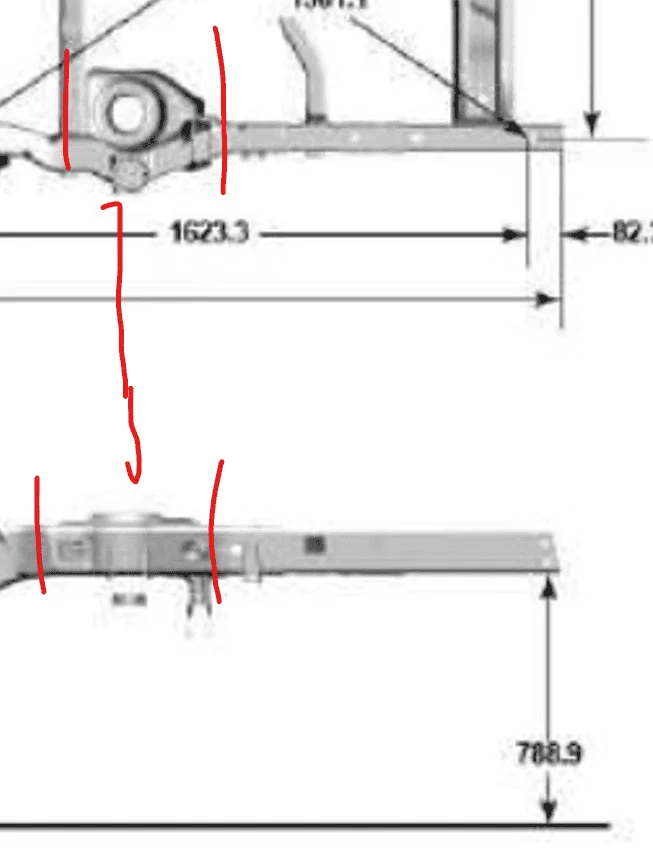
In my shot below, the red, that's where the rear of the truck is being supported. The springs support the weight of the truck and that's where the bulk of any force will be, some at the shock mount when there's abrupt jolts, holes in the road, that sort of thing, but it's all concentrated there.
Your receiver is supporting the tongue weight at the very back - to the far right.
The spring/shock area is like a fulcrum. I'd think any bending or stresses would be in that red area - nothing forward, because the weight of the trailer tongue is tiny, compared to payload in the bed, and it's supported by the springs (and shock mounts on hard hits)

So - what am I missing?
If all you do is drive it, and tow a little bit - what's up.............any bend from towing should be around the spring mount area, or to the rear.

1716521656512-hn.png
Bingo!

This is why leaf springs are a superior design for towing and load carrying. Instead of putting all of the load that the axle supports on a single 6-inch area of the frame above the coil springs, a leaf spring distributes its load over two points that are 4-5 feet apart; the rear shackle being much closer to the end of the frame, thus reducing the lever length of the receiver hitch.

This is how heavier-duty trucks have been able to get away with junky C-channel frames for all these years, yet there are reports of Gladiators with their strong boxed frames getting bent.

Modern trucks also have to account for things like rear impact that older trucks didn't have to, so weak points have to be engineered in to allow for crumple zones. A frame is likely to bend at one of the areas in which it's designed to deform in an impact, so a reinforcement brace is likely to affect the crumple zone's effectiveness. This may or may not be a priority for you.

Regardless of any other factor, you should definitely not be allowing your vehicle's suspension to bottom out. If whatever you're doing is causing the bumpstops to be utilized, you need to back down your speed. You may not have an impact that immediately bends your frame, but you'll be work-hardening the metal which over time will make it brittle and lead to cracks and eventual failure.
 

Rusty PW

Well-Known Member
First Name
Russ
Joined
Jan 10, 2022
Threads
37
Messages
11,386
Reaction score
30,368
Location
Fayette Nam, Pennsyltucky
Website
www.youtube.com
Vehicle(s)
'22 JTRD, '11 370Z Nismo, '07 Honda VFR
Build Thread
Link
Occupation
Muff Diver
well if bending the frame can happen when bashing the tail of a ledge or bombing through sandy washes, id like to find out whos making these kits because after this week in moab with Rockkrawler ive done a whole bunch of both and id like to toss em in next month when the big build starts
E-mail I got back from Shift Autowerx

Hello Russ, this is Jerry, the bracket isn’t yet available for purchase but it will be by the end of next month, my truck was the experimental prototype and we figured out all the things needed to make it exactly what we expected it to be. Follow @shiftautowerx on Instagram we will be posting updates on it as it gets closer to being out to the public


Top