
Flanders
Well-Known Member
- Thread starter
- #1
The claim that the batteries are isolated during ESS stops is often repeated. Is it true?
I haven't seen any evidence to support it. I found just one post observing that the voltages of the two batteries fall in tandem during ESS events:
To test this, I connected a digital multimeter across Power Distribution Center terminals N1 and N2 and recorded the voltage between them. It varied when driving but it was always right about 40mV during ESS stops (within maybe 2mV), the higher voltage being at N2 (MAIN battery side), consistent with what @ShadowsPapa measured above.
Aside: The voltage I'm measuring is almost just the difference between the voltages of the two batteries, except everything has some resistance and when current is flowing voltage depends where in the circuit the measurement is taken.
I would expect more divergence if the Power Control Relay were open. It seems to me exceedingly unlikely that voltages on two completely separate batteries would fall at exactly the same rate under completely different loads.
On the other hand, this result is entirely consistent with the PCR being closed during ESS stops. If this is the case, the 40mV delta is voltage across the PCR, fuse and cabling. MAIN should supply about 85% of whatever current the vehicle draws during an ESS stop, based on the ratio of battery capacities. Any current MAIN supplies to circuits on the N1 terminal must go through the PCR. In other words, MAIN is providing current to N1 through the PCR with an accompanying voltage drop of 40mV.
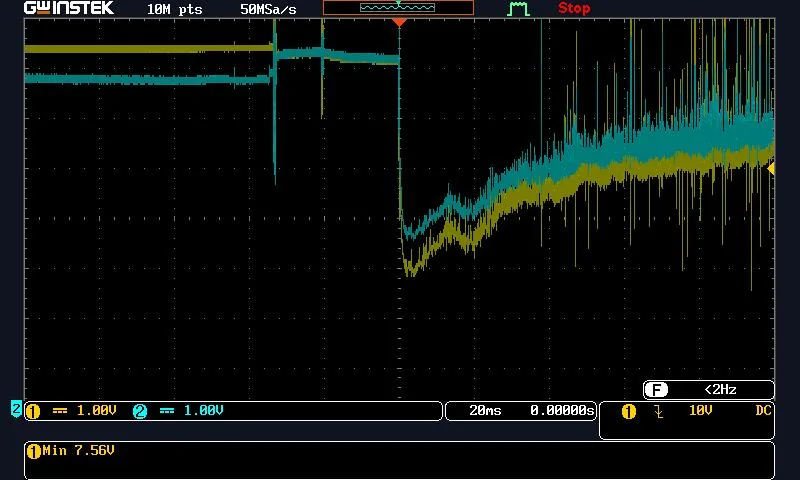
Is it plausible? I know from measuring voltages on N1 and N2 during cold start with a scope that the resistance across the PCR is very roughly 7.5 Ohms. It could be half that or double that, but not far outside that range. And I know that my JT draws around 8A with the ignition on RUN (engine off) and with the brake pedal down. Compare 85% * 7.5mOhms * 8A = 51mV with the 40mV delta. Yes, it is at least plausible.
I haven't seen any evidence to support it. I found just one post observing that the voltages of the two batteries fall in tandem during ESS events:
Consider another possibility: The crank battery voltage drops at the same rate as the aux during ESS stops because the PCR is closed and the batteries are connected.It took me 2.5498 seconds to figure out why during an ESS stop the crank battery voltage also dropped quickly, although it was always a bit higher than the aux battery. Then I realized - the EHPS is connected to the crank battery, ALWAYS.
...
There's never more than .04 to .05 or so volts difference
To test this, I connected a digital multimeter across Power Distribution Center terminals N1 and N2 and recorded the voltage between them. It varied when driving but it was always right about 40mV during ESS stops (within maybe 2mV), the higher voltage being at N2 (MAIN battery side), consistent with what @ShadowsPapa measured above.
Aside: The voltage I'm measuring is almost just the difference between the voltages of the two batteries, except everything has some resistance and when current is flowing voltage depends where in the circuit the measurement is taken.
I would expect more divergence if the Power Control Relay were open. It seems to me exceedingly unlikely that voltages on two completely separate batteries would fall at exactly the same rate under completely different loads.
On the other hand, this result is entirely consistent with the PCR being closed during ESS stops. If this is the case, the 40mV delta is voltage across the PCR, fuse and cabling. MAIN should supply about 85% of whatever current the vehicle draws during an ESS stop, based on the ratio of battery capacities. Any current MAIN supplies to circuits on the N1 terminal must go through the PCR. In other words, MAIN is providing current to N1 through the PCR with an accompanying voltage drop of 40mV.
Is it plausible? I know from measuring voltages on N1 and N2 during cold start with a scope that the resistance across the PCR is very roughly 7.5 Ohms. It could be half that or double that, but not far outside that range. And I know that my JT draws around 8A with the ignition on RUN (engine off) and with the brake pedal down. Compare 85% * 7.5mOhms * 8A = 51mV with the 40mV delta. Yes, it is at least plausible.
Sponsored