
Sponsored

Are the batteries really isolated during ESS stops?

Flanders

Well-Known Member
Joined
Dec 2, 2023
Threads
11
Messages
152
Reaction score
121
Location
Dyer, NV
Vehicle(s)
2023 JT
The claim that the batteries are isolated during ESS stops is often repeated. Is it true?

I haven't seen any evidence to support it. I found just one post observing that the voltages of the two batteries fall in tandem during ESS events:

It took me 2.5498 seconds to figure out why during an ESS stop the crank battery voltage also dropped quickly, although it was always a bit higher than the aux battery. Then I realized - the EHPS is connected to the crank battery, ALWAYS.
...
There's never more than .04 to .05 or so volts difference
Consider another possibility: The crank battery voltage drops at the same rate as the aux during ESS stops because the PCR is closed and the batteries are connected.

To test this, I connected a digital multimeter across Power Distribution Center terminals N1 and N2 and recorded the voltage between them. It varied when driving but it was always right about 40mV during ESS stops (within maybe 2mV), the higher voltage being at N2 (MAIN battery side), consistent with what @ShadowsPapa measured above.

Aside: The voltage I'm measuring is almost just the difference between the voltages of the two batteries, except everything has some resistance and when current is flowing voltage depends where in the circuit the measurement is taken.

I would expect more divergence if the Power Control Relay were open. It seems to me exceedingly unlikely that voltages on two completely separate batteries would fall at exactly the same rate under completely different loads.

On the other hand, this result is entirely consistent with the PCR being closed during ESS stops. If this is the case, the 40mV delta is voltage across the PCR, fuse and cabling. MAIN should supply about 85% of whatever current the vehicle draws during an ESS stop, based on the ratio of battery capacities. Any current MAIN supplies to circuits on the N1 terminal must go through the PCR. In other words, MAIN is providing current to N1 through the PCR with an accompanying voltage drop of 40mV.

Is it plausible? I know from measuring voltages on N1 and N2 during cold start with a scope that the resistance across the PCR is very roughly 7.5 Ohms. It could be half that or double that, but not far outside that range. And I know that my JT draws around 8A with the ignition on RUN (engine off) and with the brake pedal down. Compare 85% * 7.5mOhms * 8A = 51mV with the 40mV delta. Yes, it is at least plausible.
Sponsored


 

sharpsicle

Well-Known Member
Joined
Apr 29, 2021
Threads
22
Messages
2,765
Reaction score
6,255
Location
Tampa, FL / Milwaukee, WI
Vehicle(s)
2020 Gladiator Overland, 2002 VTX1800
I mean, the system design is to separate the batteries. That's the whole purpose of it. It's not like people figured that out via random testing and put the pieces together themselves. Diagrams and information from Jeep show this to be the case.
 
OP
OP
Flanders

Flanders

Well-Known Member
Joined
Dec 2, 2023
Threads
11
Messages
152
Reaction score
121
Location
Dyer, NV
Vehicle(s)
2023 JT
I mean, the system design is to separate the batteries. It's not like people figured that out via random testing and put the pieces together themselves. Diagrams from Jeep shows this.
I'm looking for hard evidence. I don't have a lot of faith in the wisdom of the forum.

The factory service manual inexplicably fails to call out this highly salient feature. It has only this to say:
In a normally functioning system, the two batteries and sides of the system are always connected through the power control relay except for the brief periods during cranking events.
and
It can be difficult to test the power control relay for properly disconnecting during an engine cranking event without using a lab scope. This is due to the relay only being energized (open) for approximately 20-40ms.
and
The normally closed power control relay should be closed 99% of the time. It is only opened by the PCM during the starter in-rush at initial engine cranking.
The FSM is half-ass in places, but it certainly doesn't describe a system that powers certain vehicle systems solely from the AUX during ESS stops.
 

sharpsicle

Well-Known Member
Joined
Apr 29, 2021
Threads
22
Messages
2,765
Reaction score
6,255
Location
Tampa, FL / Milwaukee, WI
Vehicle(s)
2020 Gladiator Overland, 2002 VTX1800
So you don't think it ever separates the batteries at any time? I ask because you're pointing to things that clearly says it does. It does this during ESS crank events to protect system voltage provided to the electronics. We've seen people who remove the AUX have issues with ESS voltage drops after a crank event on their systems later.
 

ShadowsPapa

Well-Known Member
First Name
Bill
Joined
Oct 12, 2019
Threads
247
Messages
40,442
Reaction score
53,859
Location
Runnells, Iowa
Vehicle(s)
'25 JTMX, '23 JLU 4xe, '82 SX4, '73 Javelin
Occupation
Retired auto mechanic, frmr gov't ntwrk security admin
Vehicle Showcase
3
I can't say the voltages fall "in lockstep" like a good Marine marching band where you can't hear any individual steps, but it's fairly close.
Part of the issue in measuring could be the fact there's going to be some rounding, part could be I used two different meters/measuring devices, and part can be voltage drops across the cables involved.

Evidence showing that the PCR opens can be seen when people try to remove the aux battery by pulling a negative cable and fail to pull the F42 fuse.

But then, we know the thing opens during a cold start as well - so the F42 fuse may only have impact at that time when the BCM tests the aux battery. Perhaps that's where things open up.
I'd rely on the factory TSM more than anything else, especially after my testing since things were actually very close and it's really hard to believe the factory has the load split so very perfectly that the main and aux would fall even within 0.3 of a volt during an ESS stop.

In other words, I'm beginning to suspect the TSM (Technical Service Manual - that's what we AMC people call them because that's what the factory called them) is closer to truth.

My measurements were my efforts (and I sort of dropped it after things went south health-wise last winter) to figure out once and for all what was powered by what and when.
I was a bit baffled by the voltages BOTH dropping like they did - and wanted to figure out exactly what was powered by what, and how it could be like that even with aging batteries which will lose capacity at different rates over time.
I mean - the HVAC fan pulls a fair load, headlights (even LED lights across the whole vehicle, inside and out, front and rear), radio - all of it keeps on running just like nothing happened. That little aux battery can't possibly handle all of that. It's just not possible - and if it did, then the differences in the voltage of the two batteries at the end of an ESS stop event would fry the PCR when it reconnected after the stop.
I recently pulled things apart and charged each of my batteries independently and reset the IBS (checking on the health of things for the most part)
I had a charger on each battery, they were charging at the same time. The aux battery charged of course a lot faster (DUH) but they settled at similar voltages after I disconnected the chargers and let them sit for a few hours. The aux sat at about 12.76 and the main was 12.80
When I connected them back together, fireworks at the ground cables because of that difference in potential.
So imagine the PCR opening for 90 seconds, and the loads on the batteries being varied and the voltages between the two being different - the relay contacts would have to handle quite a zap.

I guess in short - after I sit and think about all of my testing, observations, and your TSM quotes, I am inclined to believe that the PCR does not open during a stop.............
My voltage drop tests actually support your own although our exact methodology varies a bit, the resulting differences could be mathematically explained.

Here's the thing I might do next - put a meter on F42 and watch it during an ESS stop event. There should be nothing, then a quick jump when it restarts. It would take one of those fuse extensions I have in a cabinet somewhere (I put things where I know I'll find them again - yeah, right)
 

Sponsored

OP
OP
Flanders

Flanders

Well-Known Member
Joined
Dec 2, 2023
Threads
11
Messages
152
Reaction score
121
Location
Dyer, NV
Vehicle(s)
2023 JT
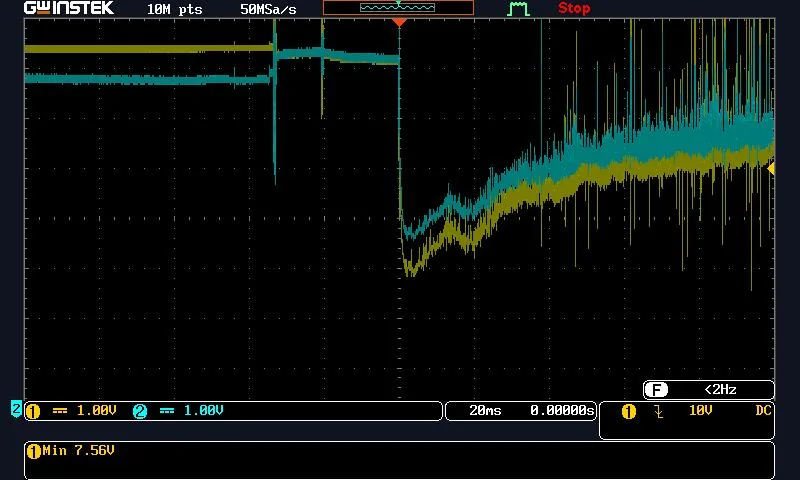
Here's an oscilloscope trace from a cold start. Blue is N1. Yellow is N2. The vertical scale is 1V per division, centered at 9V. Horizontal is time, scale is 20ms per division, 200ms total. Trigger was a 10V falling edge on N2.

Jeep Gladiator Are the batteries really isolated during ESS stops? cold_start


Analysis:
For the first 65ms, N2 is at 12.4V and the N1 is at 11.8V. The PCR is open but we only know this for sure because of what happens next.

Around -33ms the PCR closes. There's a lot of ringing and noise, and both quickly converge to 12.3V.

The ringing around -20ms is likely another relay closing. Both channels fall to 12.2V over the next 20ms.

The starter relay closes around t = -1.6us, and N2 falls below 10V at t = 0. It should be clear that both batteries are driving the same load after this point. Also the resistance between N1 and the load is greater than that of N2. That's because current from the AUX to the load has to pass through the PCR and fuse to N2.

This conflicts with the TSM (thank you @ShadowsPapa for the correct term), which states that the PCR should be open during starter inrush. This was not, however, an ESS stop.
 

ShadowsPapa

Well-Known Member
First Name
Bill
Joined
Oct 12, 2019
Threads
247
Messages
40,442
Reaction score
53,859
Location
Runnells, Iowa
Vehicle(s)
'25 JTMX, '23 JLU 4xe, '82 SX4, '73 Javelin
Occupation
Retired auto mechanic, frmr gov't ntwrk security admin
Vehicle Showcase
3
For the first 65ms, N2 is at 12.4V and the N1 is at 11.8V. The PCR is open but we only know this for sure because of what happens next.
When you press the big button on the dash, it appears to trigger a check of the aux battery. IF the battery fails the check (and I have the criteria in my notes somewhere in the house), then you get the ESS error light.

I wasn't a bit surprised to see the TSM said the relay was open during cranking - a permanent magnet starter is a generator while it spins after the current is removed.
I also wonder - does the PCR have a clamping diode? It would have to handle some real reverse current with that large relay being shut down. Any relay coil IS a coil in other respects and the collapsing magnetic field would generate a reverse current. GOOD relays handle this internally, otherwise the circuit has to have other provisions for dealing with it. Maybe that's done because there's a PCR control relay that also opens, so the current generated by the PCR can't go anywhere if the other relay is open.

Just tossing out random thoughts while prepping the shop for some work - and cleaning up millions of those @@#$% flies that are all over the place, dead and dying. Ugh - fall and spring in Iowa. BUG TIME as they seek warmth.
 
OP
OP
Flanders

Flanders

Well-Known Member
Joined
Dec 2, 2023
Threads
11
Messages
152
Reaction score
121
Location
Dyer, NV
Vehicle(s)
2023 JT
...it's really hard to believe the factory has the load split so very perfectly that the main and aux would fall even within 0.3 of a volt during an ESS stop.
That's what I'm thinking. Also, what would be the point of isolating the two if the loads are in the same proportion as the capacities - so well matched that you can't tell from the voltages that they are in fact isolated?

I wasn't a bit surprised to see the TSM said the relay was open during cranking
Yes, it seems eminently reasonable. But that's not what happened in my case. It is possible that it still hasn't relearned everything since I reset the IBS three weeks ago.
 
OP
OP
Flanders

Flanders

Well-Known Member
Joined
Dec 2, 2023
Threads
11
Messages
152
Reaction score
121
Location
Dyer, NV
Vehicle(s)
2023 JT
A quick and dirty test:
  1. Connect a voltmeter to the main positive and chassis ground so that you can see it from inside the vehicle.
  2. Disconnect the AUX connection at the main battery so that everything is powered by AUX.
  3. As quickly as possible, jump in the truck, close the door, push the big button twice to RUN and then hold the brake pedal.
  4. Watch the voltage fall below 12.0 in just a few seconds.

This proves that the AUX battery by itself cannot possibly hold 12.0V for a minute during an ESS stop. This is only an 8.5A load. Headlights or HVAC fan could easily double that.
 

ShadowsPapa

Well-Known Member
First Name
Bill
Joined
Oct 12, 2019
Threads
247
Messages
40,442
Reaction score
53,859
Location
Runnells, Iowa
Vehicle(s)
'25 JTMX, '23 JLU 4xe, '82 SX4, '73 Javelin
Occupation
Retired auto mechanic, frmr gov't ntwrk security admin
Vehicle Showcase
3
A quick and dirty test:
  1. Connect a voltmeter to the main positive and chassis ground so that you can see it from inside the vehicle.
  2. Disconnect the AUX connection at the main battery so that everything is powered by AUX.
  3. As quickly as possible, jump in the truck, close the door, push the big button twice to RUN and then hold the brake pedal.
  4. Watch the voltage fall below 12.0 in just a few seconds.

This proves that the AUX battery by itself cannot possibly hold 12.0V for a minute during an ESS stop. This is only an 8.5A load. Headlights or HVAC fan could easily double that.
It's a crazy weekend here with my wife's birthday, a big event she wants to go to, getting my shop ready for our street rod gang next Tuesday and so on, otherwise I'd do some more checks like that in the next few days (not to mention, it's cold in that garage now).

Too bad you are so far away, I bet in a day we could have it all figured out. I'd bring my Fluke and other meters, digital scope, whatever and map it all out.

Anyway - I figured there was too much draw for that little battery to "handle everything" in a 2 minute ESS stop. When my batteries were at their peak, I could sit at one of our longer lights and the engine would stay off literally for the length of the light at that highway. The voltage on the cluster might finally drop to 12.1 or 12.0, but I'm talking with my HVAC in auto mode, lights, radio, whatever.
We also know that some things are directly fed from the main battery - these won't count during a stop - but things like the EHPS, cooling fan, among others, are direct feed through that high current fuse "bus" at the bottom. On the other hand - I can gently move the steering wheel a little bit while stopped and not always trigger the engine to restart. It takes a torque number I can't recall to trigger a start. It measures torque against the steering column........

My take originally was - that load is SPLIT during ESS stop.
Now I'm modifying that to - that just can't be based on the amperage draw and observations of having dual volt meters connected during ESS stops as tests of the voltage drop at both batteries. The minimal differences I saw could be explained by meter differences as well as voltage drop across the vehicle wiring (for the aux, anyway - I was connected directly to the main battery with my Fluke)
 

Sponsored

jebiruph

Well-Known Member
First Name
Jerry
Joined
Dec 9, 2018
Threads
15
Messages
806
Reaction score
730
Location
IA
Vehicle(s)
2018 Wrangler JL 2024 Grand Cherokee L WL 2020 Gladiator JT
Monitor the voltage on the PCR control wires, if there is voltage the batteries are separated, no voltage and they are connected.
 

jebiruph

Well-Known Member
First Name
Jerry
Joined
Dec 9, 2018
Threads
15
Messages
806
Reaction score
730
Location
IA
Vehicle(s)
2018 Wrangler JL 2024 Grand Cherokee L WL 2020 Gladiator JT
I forgot about this, that if the battery voltages read the same for 6 ESS stops in a row, the system assumes there is an error and disables the system. The system is expecting to read the individual battery voltages during an ESS stop, in able to do that it is expecting the batteries to be separated during that ESS stop.

You can test this by pulling fuse F42, which will disable the PCR and prevent the batteries from separating. Then try to engage ESS several times, after 6 times it will be disabled.
 

ShadowsPapa

Well-Known Member
First Name
Bill
Joined
Oct 12, 2019
Threads
247
Messages
40,442
Reaction score
53,859
Location
Runnells, Iowa
Vehicle(s)
'25 JTMX, '23 JLU 4xe, '82 SX4, '73 Javelin
Occupation
Retired auto mechanic, frmr gov't ntwrk security admin
Vehicle Showcase
3
Jeep Gladiator Are the batteries really isolated during ESS stops? 1731628309919-


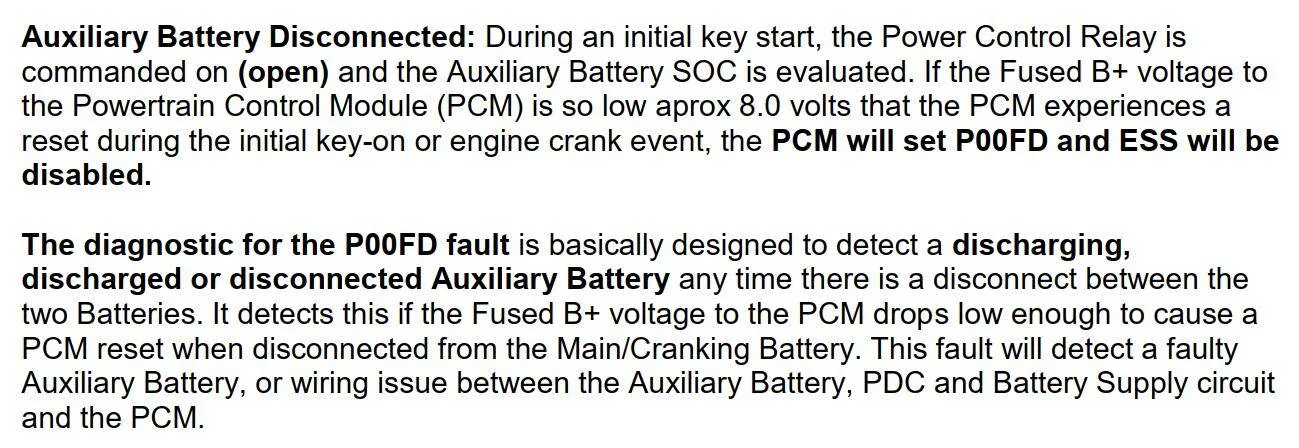
Jeep Gladiator Are the batteries really isolated during ESS stops? 1731628346220-am


Jerry - it sort of seems, from the above, that the aux is disconnected by a PCR open during an ess stop/start event.........
But note it says the voltage is detected during an ESS START event. Not during the stop, but when it goes into START mode.
That would support the idea that they are indeed connected during the stop, but the PCR opens when it restarts and that's when it detects the aux battery voltage. Not while stopped, but during the start (which happens so darned fast, blink and you'd miss it)

I've tested this in multiple ESS stops and the voltages drop within a couple of tenths of a volt of each other.
I can't see how these things have the load balanced so well that the main drops right along with the aux battery.
I had two meters connected - reading voltages during the stop, and they were BOTH falling, not just the aux.
That suggests they are still in parallel, and that when it goes into ESS start mode, the PCR opens, the aux is checked, and then it closes again.
 

ShadowsPapa

Well-Known Member
First Name
Bill
Joined
Oct 12, 2019
Threads
247
Messages
40,442
Reaction score
53,859
Location
Runnells, Iowa
Vehicle(s)
'25 JTMX, '23 JLU 4xe, '82 SX4, '73 Javelin
Occupation
Retired auto mechanic, frmr gov't ntwrk security admin
Vehicle Showcase
3
Wait, I thought that was known. At least to me it was. They separate at start from ESS because that’s where the voltage drops occur.
Yeah there's a fair drop across the main battery at cranking. The idea may be to prevent the voltage to the PCM dropping so low that it causes a PCM reset.

It makes more sense that they are always connected except during the beginning of a start cycle, cold or otherwise.

When I'm stopped at a long light at night, all vehicle exterior lights on, dash/cluster lights, HVAC fan running, radio on, power to each module such as BCM, PCM and others there's no way in the world one small battery is going to handle that. Then add the starter load, the voltage could drop a fair amount to those modules.

The TSM, the snippets from ESS and IBS troubleshooting documents I posted, and my own volt meter tests sure support that they are always connected except when it's initiating an engine crank/start cycle.
THAT makes sense.

Note the snippets from the FCA docs I posted say that it checks at initial start cycle, then at the onset of an ESS restart.
Sponsored


Top