Sponsored

Are the batteries really isolated during ESS stops?

ShadowsPapa

Well-Known Member
First Name
Bill
Joined
Oct 12, 2019
Threads
247
Messages
40,463
Reaction score
53,908
Location
Runnells, Iowa
Vehicle(s)
'25 JTMX, '23 JLU 4xe, '82 SX4, '73 Javelin
Occupation
Retired auto mechanic, frmr gov't ntwrk security admin
Vehicle Showcase
3
My shopping car, a Honda, sometimes sits for 2 months without being driven. It always cranks.
Yes, it always cranks, but it will live a shorter lift. Cranks doesn't mean fully charged, and sitting with less than a full charge is bad (go to the battery sites, "battery university" and other sites - sitting partially charged is bad)
Smart chargers, aren't. The $80 toy with the slick marketing won't optimize your battery for peak performance and maximal longevity. It can't really detect and reverse damage to your battery. Patented pulsing at a precise resonance frequency won't turn hardened lead sulfate back to active material.
Yes, and no......... I have a battery on my bench that was actually dead by all other standards. Multiple chargers I had wouldn't charge it, they'd begin, then fail. I put one of my "smart chargers" on it for several days. I'm using it years later. Is it up to full capacity? No, however, I've "recovered" more than one battery over the decades using chargers that claim to rejuvenate........... and they have.

They CAN work, if you don't let the battery sit for days undercharged. That's what testing actually proves.

Look it up - it's very possible, and there's several articles from battery experts explaining that if caught early, it works, but it takes TIME to work. Not just a few hours.

Thus - my BatteryMinders - I use them pretty regular and get good life out of my batteries - 12 years out of a Ford battery, over 10 out of a John Deere lawn tractor battery, my classic cars get the chargers put on and left on - and the batteries last. I forgot to do that with the battery in my SX4 and it was too late to salvage it - the sulphate had been there too long.


From the web:
Permanent sulfation builds-up when a battery has been in a low state-of-charge for weeks or months. At this stage, restoration of the battery or reversal of the sulfation, is highly unlikely. As a result, the battery will suffer the effects of permanent sulfation.
Jeep Gladiator Are the batteries really isolated during ESS stops? 1762097396997-lh


From a BITOG post - as everyone says, it takes TIME. It's not going to happen in a few hours, maybe even a couple of days - but regular use, and not letting the sulphate harden is the key - catch it early, use them LONG TERM.

Jeep Gladiator Are the batteries really isolated during ESS stops? 1762097567314-o4

Jeep Gladiator Are the batteries really isolated during ESS stops? 1762097652196-bo
Sponsored


J Sierra

Well-Known Member
First Name
James
Joined
Dec 29, 2020
Threads
9
Messages
158
Reaction score
197
Location
Tucson AZ
Vehicle(s)
2020 Jeep gladiator
Occupation
retired
Vehicle Showcase
1
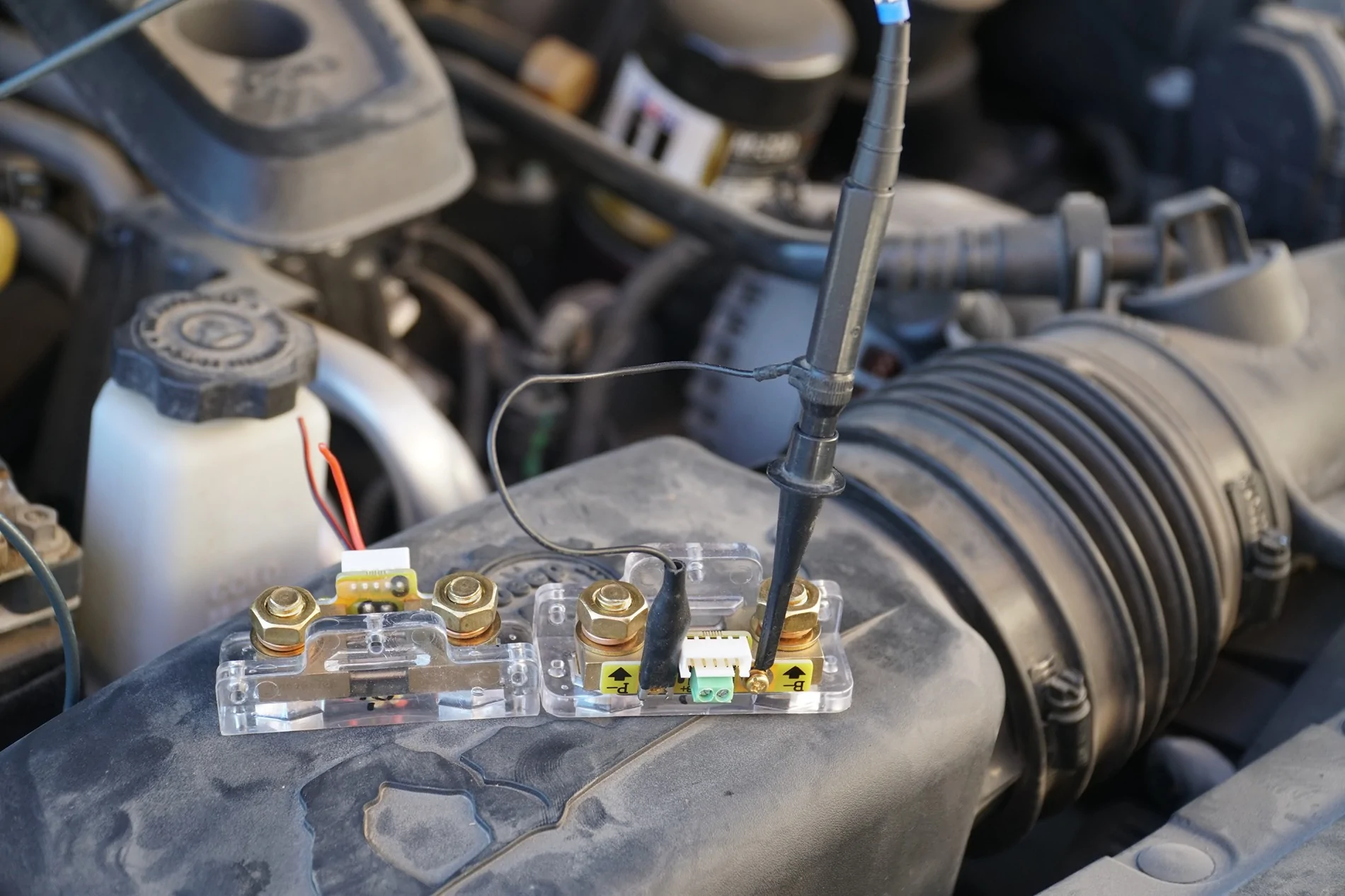
Getting ready to measure current.
Jeep Gladiator Are the batteries really isolated during ESS stops? DSC05512
 

ShadowsPapa

Well-Known Member
First Name
Bill
Joined
Oct 12, 2019
Threads
247
Messages
40,463
Reaction score
53,908
Location
Runnells, Iowa
Vehicle(s)
'25 JTMX, '23 JLU 4xe, '82 SX4, '73 Javelin
Occupation
Retired auto mechanic, frmr gov't ntwrk security admin
Vehicle Showcase
3
Getting ready to measure current.
DSC05512.webp
i wish i was up to snuff on work and lifting and bending and my head and neck felt better - I'm wanting to get a comparison of the actual starter draw - the starter itself - for a TIP (cold engine) start vs. an ESS restart.

The current should be a lot less, and of course the crank time will be much shorter due to the PCM tracking everything including crank position and movement during ESS shutdown, last firing of each injector, ignition and more.
 
OP
OP
Flanders

Flanders

Well-Known Member
Joined
Dec 2, 2023
Threads
11
Messages
152
Reaction score
121
Location
Dyer, NV
Vehicle(s)
2023 JT
Yes, and no......... I have a battery on my bench that was actually dead by all other standards. Multiple chargers I had wouldn't charge it, they'd begin, then fail. I put one of my "smart chargers" on it for several days. I'm using it years later. Is it up to full capacity? No, however, I've "recovered" more than one battery over the decades using chargers that claim to rejuvenate........... and they have.

They CAN work, if you don't let the battery sit for days undercharged. That's what testing actually proves.
It is possible to recover some capacity in a mostly dead battery. I'm not disputing that. I'm saying that there's no secret sauce.

Nothing in the scientific literature supports the claims that some patented algorithm accomplishes something constant voltage charging could not.

Desulfating is a marketing term. Charging is desulfating. There's nothing more to it. It's just time at voltage.

One study I read showed that 40% of batteries returned to auto parts stores recovered significant capacity after charging at 14.80V for 24 hours, followed by an 8-hour constant 0.01C charge rate at whatever voltage that required. Others have shown that a gentle 13.50V for a few weeks, followed by much shorter balancing at higher voltages, accomplishes the same thing.

Smart chargers don't do those things by default, for good reason. Some have special modes for it.

It's nothing you can't do with an adjustable power supply.
 

Sponsored

J Sierra

Well-Known Member
First Name
James
Joined
Dec 29, 2020
Threads
9
Messages
158
Reaction score
197
Location
Tucson AZ
Vehicle(s)
2020 Jeep gladiator
Occupation
retired
Vehicle Showcase
1
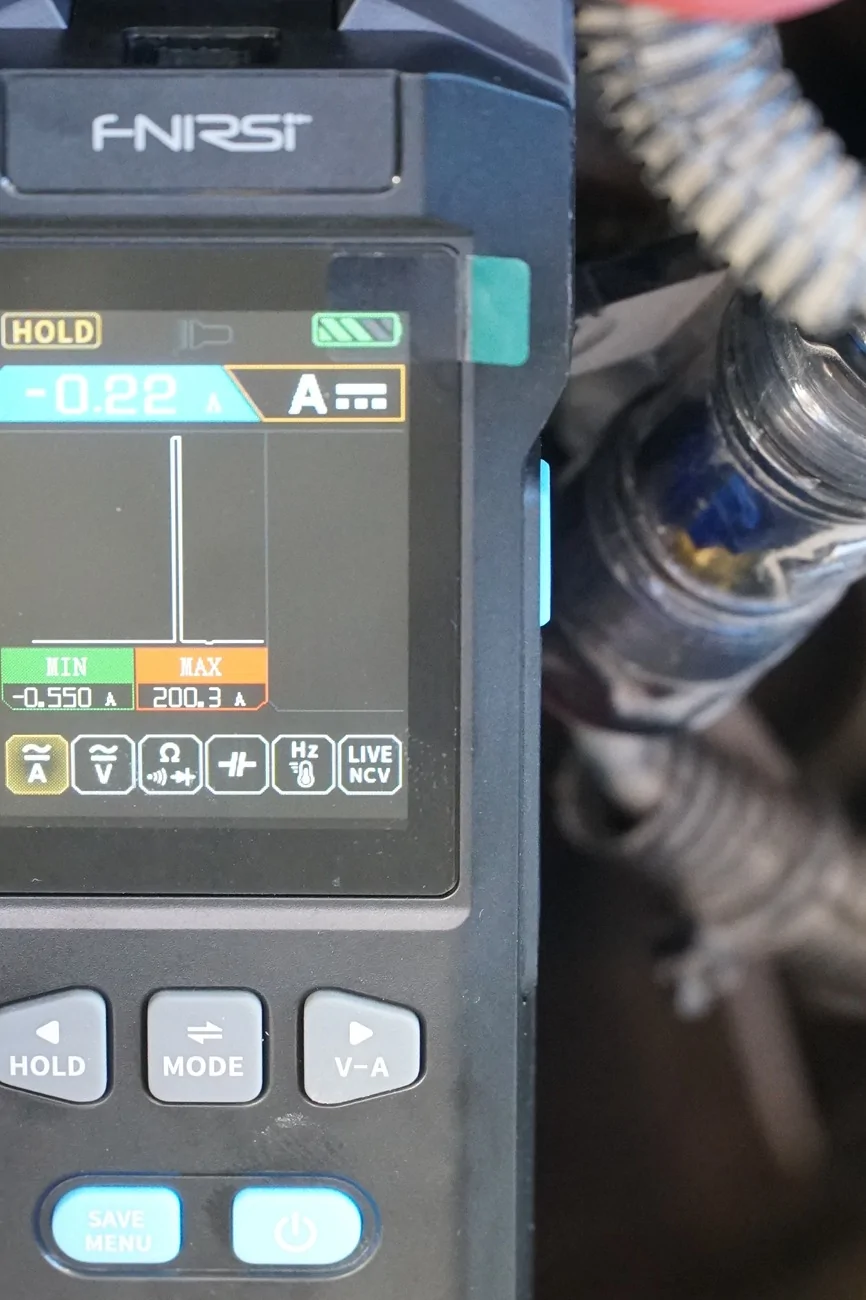
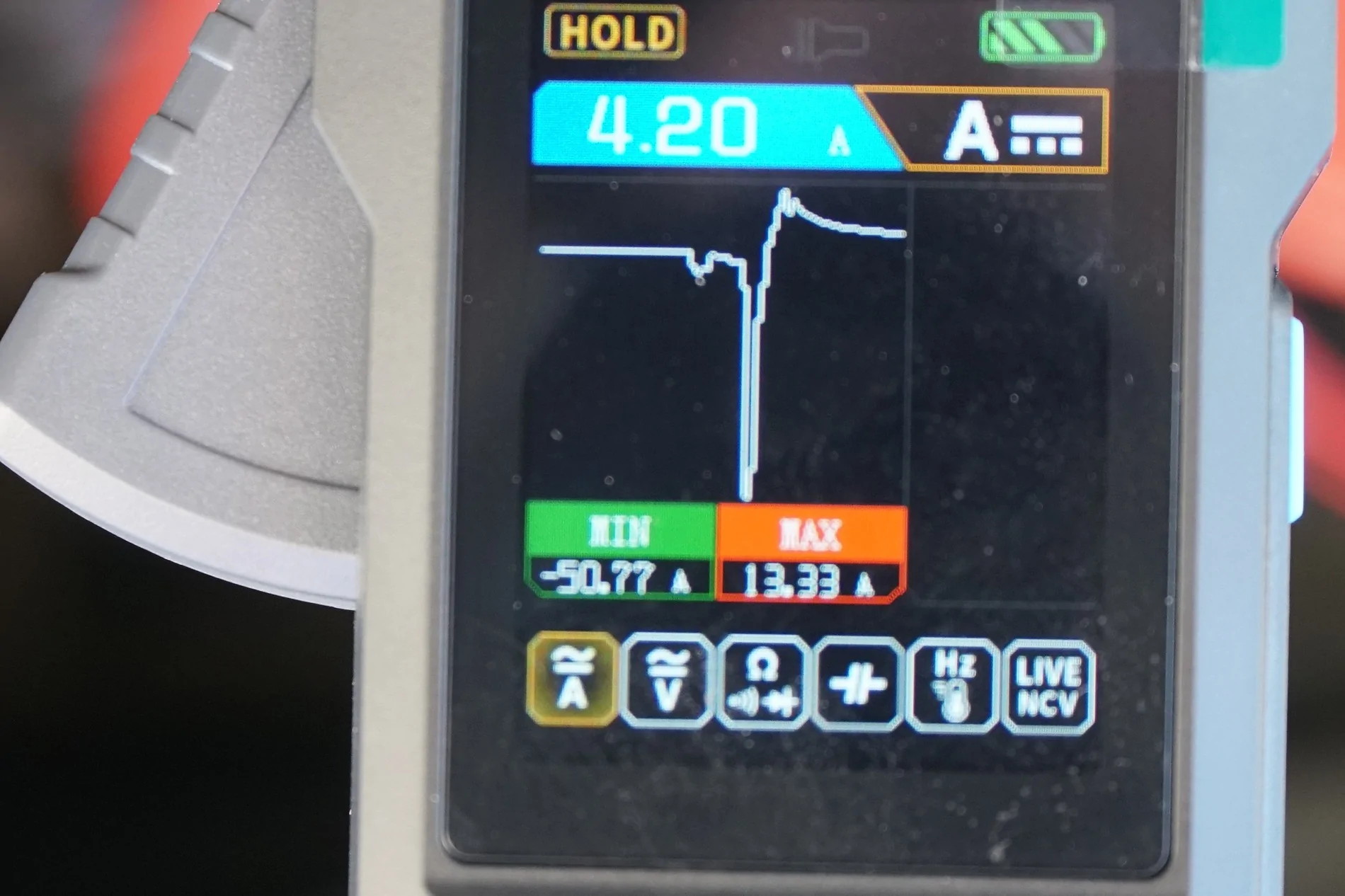
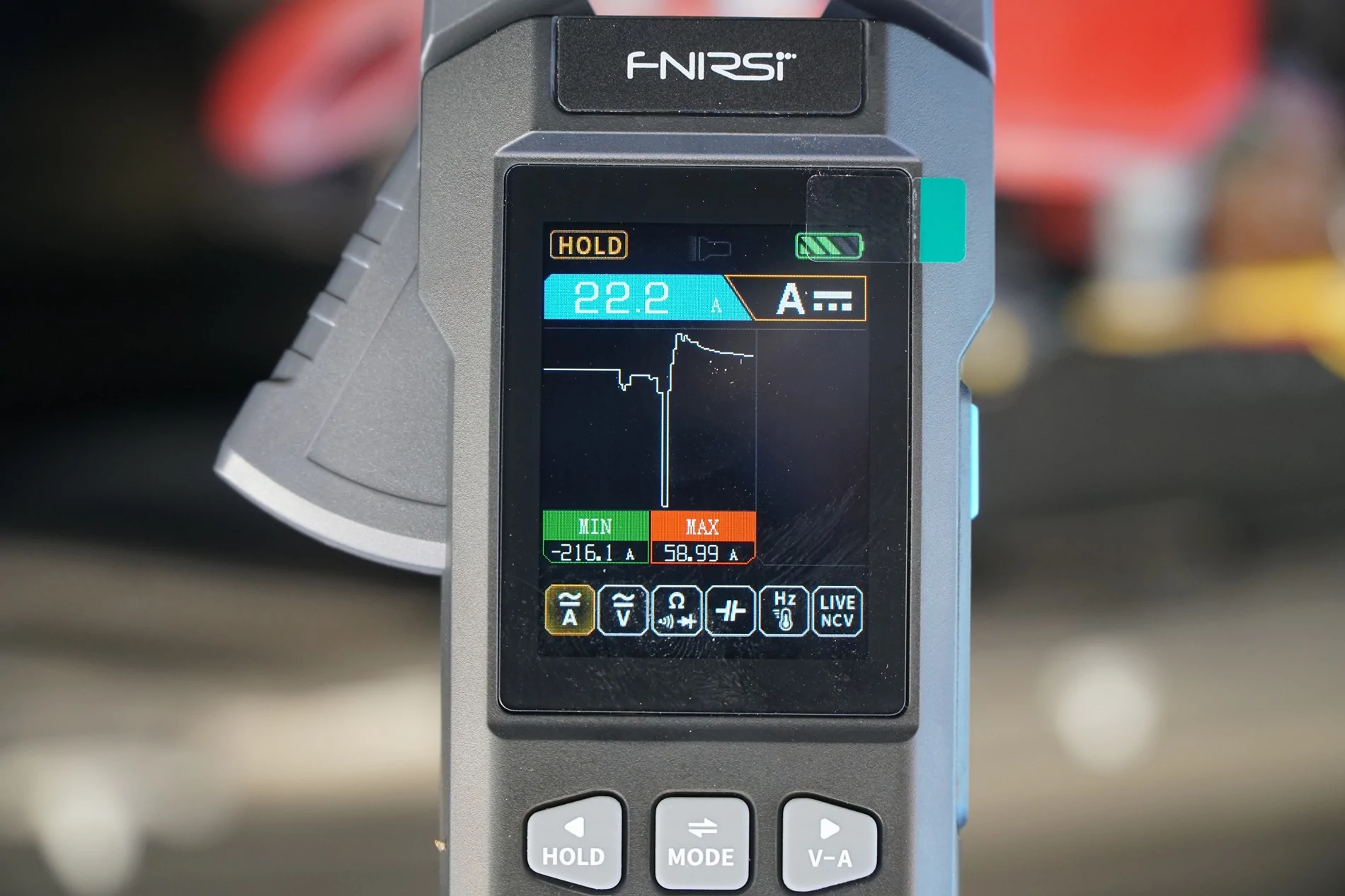
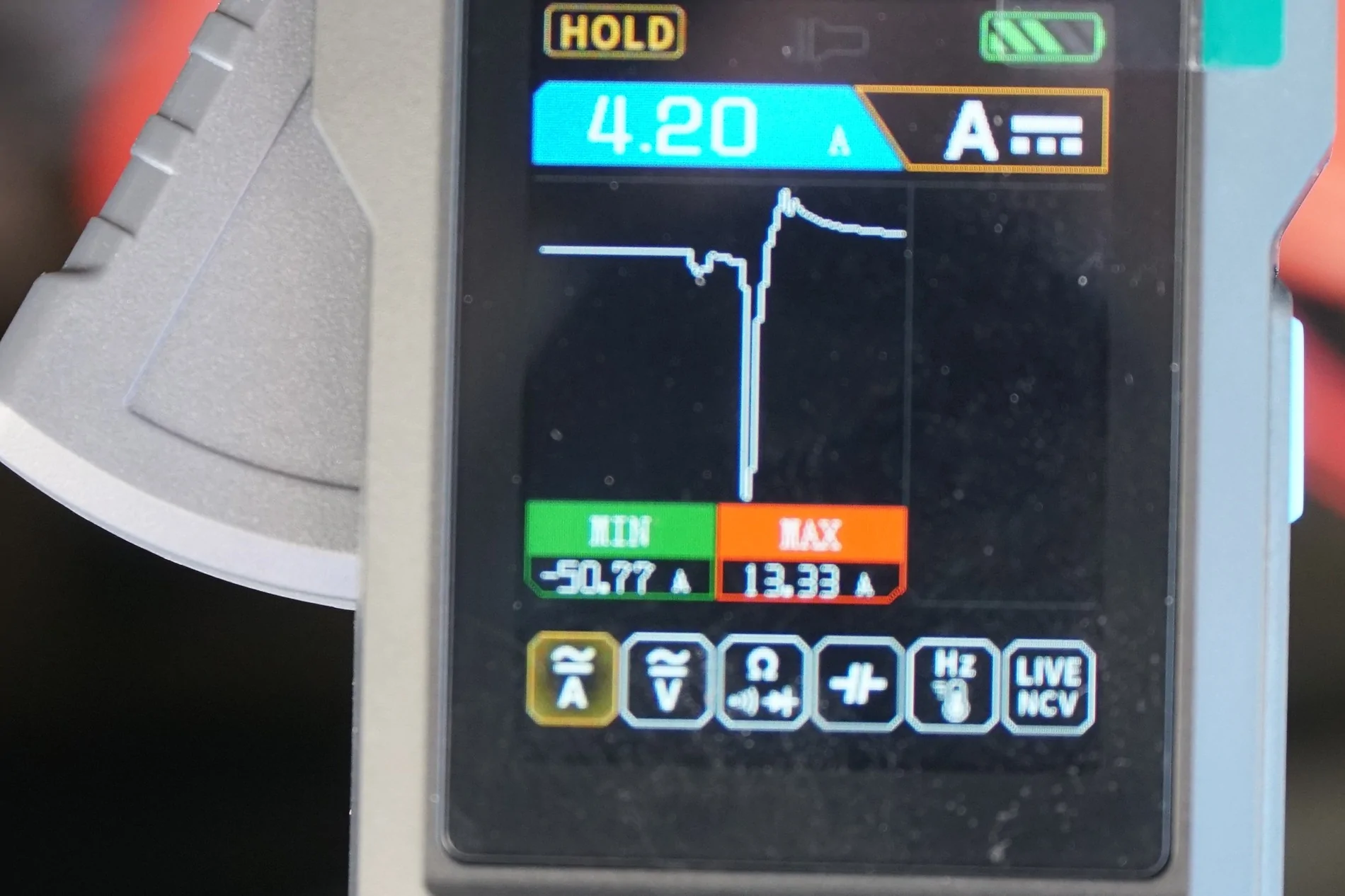
I put a clamp on amp meter on both grounds and the plus starter cable. First is starter cable.
Jeep Gladiator Are the batteries really isolated during ESS stops? DSC05521
Jeep Gladiator Are the batteries really isolated during ESS stops? DSC05520
Jeep Gladiator Are the batteries really isolated during ESS stops? DSC05517
 
Last edited:

J Sierra

Well-Known Member
First Name
James
Joined
Dec 29, 2020
Threads
9
Messages
158
Reaction score
197
Location
Tucson AZ
Vehicle(s)
2020 Jeep gladiator
Occupation
retired
Vehicle Showcase
1
Note the engine is running in all the pictures. The spike is the start current. Picture 2 is inverted I think. This picture is better.
Jeep Gladiator Are the batteries really isolated during ESS stops? DSC05520
 
Last edited:
OP
OP
Flanders

Flanders

Well-Known Member
Joined
Dec 2, 2023
Threads
11
Messages
152
Reaction score
121
Location
Dyer, NV
Vehicle(s)
2023 JT
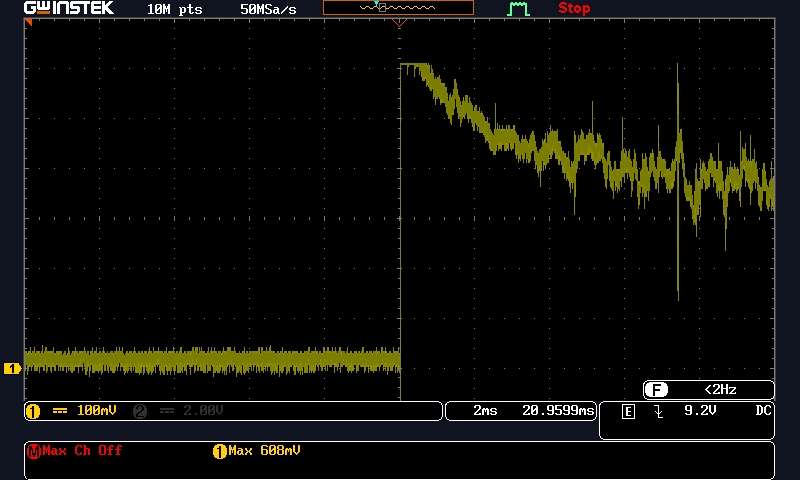
I'm not sure a DC clamp meter can measure what I want to know. So I did my own cold start current test.

I used the wire from the main negative to ground as a shunt resistor. This carries all current from the batteries, not just to the starter. Change mV to A and multiply by 2.5 to read the trace.
Jeep Gladiator Are the batteries really isolated during ESS stops? DS0021.PNG

Over 1500A for nearly a millisecond! The waveform top is clipped. That was a little more than I expected. It was still drawing around 900A at the 10ms mark.

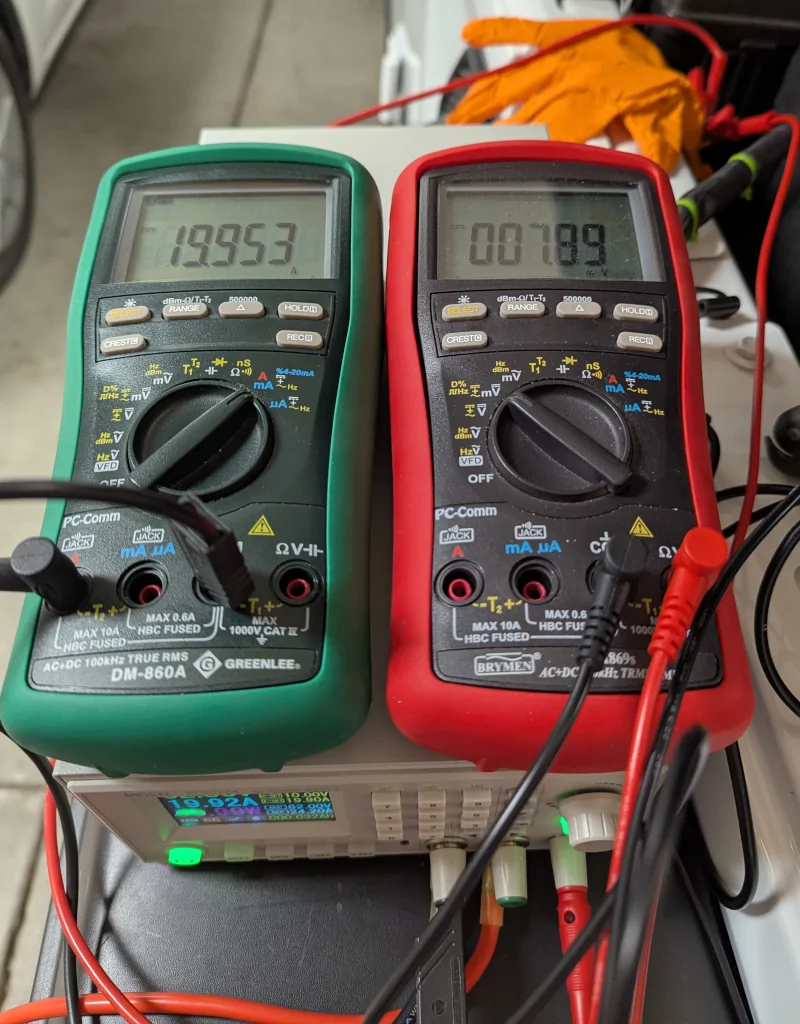
The factor of 2.5 is the reciprocal of the resistance across the shunt wire, which I measured by disconnecting it at the chassis end and putting 20A through it:
Jeep Gladiator Are the batteries really isolated during ESS stops? shunt_resistanc

1/R = 19.953A / 7.89mV = 2.5 kmhos.
 

J Sierra

Well-Known Member
First Name
James
Joined
Dec 29, 2020
Threads
9
Messages
158
Reaction score
197
Location
Tucson AZ
Vehicle(s)
2020 Jeep gladiator
Occupation
retired
Vehicle Showcase
1
Just having fun.
 

Sponsored

ShadowsPapa

Well-Known Member
First Name
Bill
Joined
Oct 12, 2019
Threads
247
Messages
40,463
Reaction score
53,908
Location
Runnells, Iowa
Vehicle(s)
'25 JTMX, '23 JLU 4xe, '82 SX4, '73 Javelin
Occupation
Retired auto mechanic, frmr gov't ntwrk security admin
Vehicle Showcase
3
Over 1500A for nearly a millisecond! The waveform top is clipped. That was a little more than I expected. It was still drawing around 900A at the 10ms mark.
A legacy Ford V8 starter will be in the 200-300 range and that's for a V8, and the massive windings of the old 4.5" direct drive starter.
A DC motor will be a short when it's at rest, so a spike is expected until it starts to move.
But that should be a very short blast, once it turns, it will drop like a rock.

The solenoid will usually have two windings - pull-in and hold-in windings, so it will draw a spike until the solenoid is in the hold mode.

These don't have field windings.
 

Andy29847

Well-Known Member
First Name
Andy
Joined
Oct 25, 2020
Threads
14
Messages
558
Reaction score
938
Location
South Carolina
Vehicle(s)
2020 Wrangler Rubicon, 2020 Gladiator Rubicon
Occupation
Retired
From the Wrangler forum / J Harp -
I appreciate you bringing this very well documented and instrumented test data over to this forum. I was reading the thread over on the gladiator forum and found it very interesting.

In my line of work (building control systems to run large data center cooling and electrical systems) we do failover/redundancy testing all the time. I've generally always assumed the little power sports battery was in our vehicles to stabilize critical module power and communication circuits during frequent engine stop/start events. It makes sense that both batteries are tied together for a cold start, as the modules are all in start-up mode.

My theory is that Stellantis CAN bus systems are 'finicky' - they've had recalls over loss of signals/bits causing cruise control to not cancel, and things like that.

Engagement and disengagement of the starter motor not only creates a large electrical load on the batteries, but also generates a strong electromagnetic impulse (noise) signature. The inrush load to the starter motor, and the collapsing magnetic field from the solenoid when the starter disengages can pulse high frequency noise into the DC power network in the vehicle.

It seems very possible to me that those high frequency impulse noise patterns could destabilize CAN bus messaging, if done often enough. We test data center power systems by turning them off and on again and again, sometimes back to back with little or no delay. We sometimes see loss of communication on sensitive control systems due to noise in the communication bus caused by transformer fields collapsing.

I think the small battery is there to keep communication on the CAN bus network stable during the engine restart event. It's partially there to keep voltage stable for the modules on the bus, but it's also there to act as a clean source of power, isolated from the noise of the starter motor and solenoid. I think of it as a power filter more than anything else....
 

sharpsicle

Well-Known Member
Joined
Apr 29, 2021
Threads
22
Messages
2,770
Reaction score
6,260
Location
Tampa, FL / Milwaukee, WI
Vehicle(s)
2020 Gladiator Overland, 2002 VTX1800
From the Wrangler forum / J Harp -
I appreciate you bringing this very well documented and instrumented test data over to this forum. I was reading the thread over on the gladiator forum and found it very interesting.

In my line of work (building control systems to run large data center cooling and electrical systems) we do failover/redundancy testing all the time. I've generally always assumed the little power sports battery was in our vehicles to stabilize critical module power and communication circuits during frequent engine stop/start events. It makes sense that both batteries are tied together for a cold start, as the modules are all in start-up mode.

My theory is that Stellantis CAN bus systems are 'finicky' - they've had recalls over loss of signals/bits causing cruise control to not cancel, and things like that.

Engagement and disengagement of the starter motor not only creates a large electrical load on the batteries, but also generates a strong electromagnetic impulse (noise) signature. The inrush load to the starter motor, and the collapsing magnetic field from the solenoid when the starter disengages can pulse high frequency noise into the DC power network in the vehicle.

It seems very possible to me that those high frequency impulse noise patterns could destabilize CAN bus messaging, if done often enough. We test data center power systems by turning them off and on again and again, sometimes back to back with little or no delay. We sometimes see loss of communication on sensitive control systems due to noise in the communication bus caused by transformer fields collapsing.

I think the small battery is there to keep communication on the CAN bus network stable during the engine restart event. It's partially there to keep voltage stable for the modules on the bus, but it's also there to act as a clean source of power, isolated from the noise of the starter motor and solenoid. I think of it as a power filter more than anything else....
That makes a lot of sense as well.
 

ShadowsPapa

Well-Known Member
First Name
Bill
Joined
Oct 12, 2019
Threads
247
Messages
40,463
Reaction score
53,908
Location
Runnells, Iowa
Vehicle(s)
'25 JTMX, '23 JLU 4xe, '82 SX4, '73 Javelin
Occupation
Retired auto mechanic, frmr gov't ntwrk security admin
Vehicle Showcase
3
From the Wrangler forum / J Harp -
I appreciate you bringing this very well documented and instrumented test data over to this forum. I was reading the thread over on the gladiator forum and found it very interesting.

In my line of work (building control systems to run large data center cooling and electrical systems) we do failover/redundancy testing all the time. I've generally always assumed the little power sports battery was in our vehicles to stabilize critical module power and communication circuits during frequent engine stop/start events. It makes sense that both batteries are tied together for a cold start, as the modules are all in start-up mode.

My theory is that Stellantis CAN bus systems are 'finicky' - they've had recalls over loss of signals/bits causing cruise control to not cancel, and things like that.

Engagement and disengagement of the starter motor not only creates a large electrical load on the batteries, but also generates a strong electromagnetic impulse (noise) signature. The inrush load to the starter motor, and the collapsing magnetic field from the solenoid when the starter disengages can pulse high frequency noise into the DC power network in the vehicle.

It seems very possible to me that those high frequency impulse noise patterns could destabilize CAN bus messaging, if done often enough. We test data center power systems by turning them off and on again and again, sometimes back to back with little or no delay. We sometimes see loss of communication on sensitive control systems due to noise in the communication bus caused by transformer fields collapsing.

I think the small battery is there to keep communication on the CAN bus network stable during the engine restart event. It's partially there to keep voltage stable for the modules on the bus, but it's also there to act as a clean source of power, isolated from the noise of the starter motor and solenoid. I think of it as a power filter more than anything else....
Yeah, pretty much a summary of what we have here in this thread.

(But now that it comes from another sources, it's more likely be believed 🤪 ??)

Let's see, The starter solenoid collapsing field and subsequent voltage generated by same, electronics on-off-on-off (some of the testing we did at CCC, along with environmental testing)...............

Along with that, I posted a while back (year or two) about how a weak diode in an alternator can generate enough ripple to cause EFI and other systems to freak out. Toyota found that years back - customers had issues with the fuel injection and it was found to be weak alternator diodes creating ripple.
CANbus traffic assumes that because a message was sent, it was also received. There is no acknowledgement as with, say, IP traffic, internet or standard networks in business. So if the message was to be sent, but doesn't make sense at the other end or was never received, we get bus errors.
 
OP
OP
Flanders

Flanders

Well-Known Member
Joined
Dec 2, 2023
Threads
11
Messages
152
Reaction score
121
Location
Dyer, NV
Vehicle(s)
2023 JT
Anyone care to guess how much charge a cold start takes? Amp-hours or percentage of battery capacity, your choice.
Sponsored


Top