
Sponsored

If anyone is curious if a Gladiator starts in -40...

MarineHawk

Well-Known Member
Joined
Oct 24, 2019
Threads
13
Messages
525
Reaction score
636
Location
Virginia
Vehicle(s)
2020 Jeep Gladiator Rubicon
Vehicle Showcase
1
incorrect
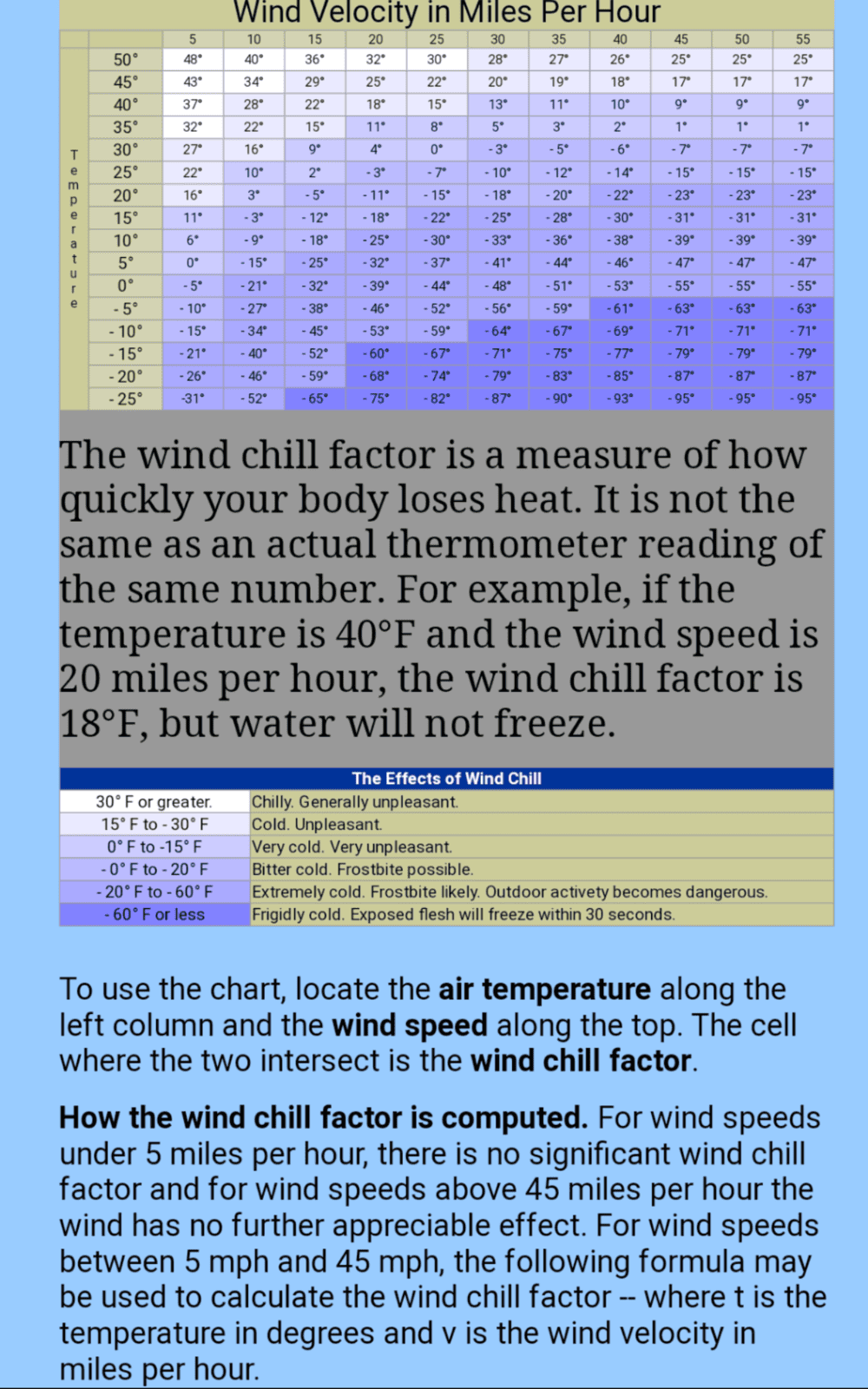
They’re correct. Wind-chill affects something with an internal heat source. If, say, it’s 30 F and really windy, it makes a human body have to work much harder to sustain its internal 98.6 F temperature because it is bombarded by a greater volume of 30 F air than if there was less/no wind. However, if you died and laid there for a while, the 30 F air would reduce your body temp to 30 F and no lower no matter how much wind there was. X deg. F air cannot reduce an object below X deg. F. However, it will make it come to X deg. F faster and require more heat production to prevent that. Whiskey can’t be made colder than the outside air temperature surrounding it. It’s physics. It’s possible that the outside air was colder or the booze was weaker than you thought. Otherwise, your booze was defying basic undeniable principles of science, which seems implausible.
Sponsored


ShadowsPapa

Well-Known Member
First Name
Bill
Joined
Oct 12, 2019
Threads
247
Messages
40,476
Reaction score
53,957
Location
Runnells, Iowa
Vehicle(s)
'25 JTMX, '23 JLU 4xe, '82 SX4, '73 Javelin
Occupation
Retired auto mechanic, frmr gov't ntwrk security admin
Vehicle Showcase
3
From a site explaining how to chill or not chill your alcohol........

While the entire contents of the bottle will not freeze, the water will. This creates a slush out of your beverage and can ruin the flavor as well.

So they slush up because the WATER freezes. The water froze - so it was SLUSHY.
It wasn't frozen SOLID - but was slush.

Wine is 85 to 90 percent water, so it freezes at about 20 F (-6.7 C) — the water freezes first at 32 F (zero C) and then the alcohol after that [source: Wine Spectator]. It'll be slushy for a while before it becomes solid.
 

steffen707

Well-Known Member
Joined
Jan 28, 2018
Threads
204
Messages
8,624
Reaction score
8,940
Location
Middle Wisconsin
Vehicle(s)
2001 Jetta TDI RIP, 89' Civic SI, 2019 Pacifica Hybrid, 2020 GLADIATOR SPORT S "GLADYS"
Do you guys have garage refrigerators in Canada that actually heat up to combat the cold? How else do you drink beer from your garage fridge...... Errrr beer warmer?
 

steffen707

Well-Known Member
Joined
Jan 28, 2018
Threads
204
Messages
8,624
Reaction score
8,940
Location
Middle Wisconsin
Vehicle(s)
2001 Jetta TDI RIP, 89' Civic SI, 2019 Pacifica Hybrid, 2020 GLADIATOR SPORT S "GLADYS"
Do you guys have garage refrigerators in Canada that actually heat up to combat the cold? How else do you drink beer from your garage fridge...... Errrr beer warmer?
Don't leave your beer in the wind though, I hear there's a debate over how fast a Wisconsinite thinks he can drink their beer before it freezes.
 

Sponsored

ShadowsPapa

Well-Known Member
First Name
Bill
Joined
Oct 12, 2019
Threads
247
Messages
40,476
Reaction score
53,957
Location
Runnells, Iowa
Vehicle(s)
'25 JTMX, '23 JLU 4xe, '82 SX4, '73 Javelin
Occupation
Retired auto mechanic, frmr gov't ntwrk security admin
Vehicle Showcase
3
Do you guys have garage refrigerators in Canada that actually heat up to combat the cold? How else do you drink beer from your garage fridge...... Errrr beer warmer?
Solution - heat the garage - a minisplit system will heat in the winter to keep it from freezing and cool in the summer to prevent your beer from boiling.

My poor JT - sitting out under the lean-to for lack of a place to keep it inside. It looks like something you'd see in Fairbanks right now. A drift over the front bumper, hardly see the windshield, all under a nice ice blanket.
Love the cold weather group.
 

BDoug

Member
First Name
Doug
Joined
Nov 23, 2019
Threads
1
Messages
9
Reaction score
14
Location
West-central Minnesota
Website
www.pgfarm.com
Vehicle(s)
03 F250 6.0 Diesel, 2017 E250 Transit Van
Occupation
Specialty crop farmer
The greater the difference between an object's temperature and ambient temperature, the faster it loses heat. All windchill means is that the object loses heat faster as if the windchill were ambient, but of course the object's temperature won't go below the actual ambient. Make sense? The actual temperature is your final destination, the windchill is the speed at which you get there. Doesn't matter if the object is living or not (though I hear that a lot).
 

MarineHawk

Well-Known Member
Joined
Oct 24, 2019
Threads
13
Messages
525
Reaction score
636
Location
Virginia
Vehicle(s)
2020 Jeep Gladiator Rubicon
Vehicle Showcase
1
The actual temperature is your final destination, the windchill is the speed at which you get there. Doesn't matter if the object is living or not (though I hear that a lot).
It does matter. Your body is generating heat. A bottle of booze isn't. If you're healthy, have eaten enough calories, and have some decent clothing on, your internal temperature won't fall at all--below 98.6 deg. F. In that scenario, your temperature won't fall at all; you just will burn more calories and possibly be more uncomfortable making that happen when the winds are higher, as opposed to when they aren't.
 

ShadowsPapa

Well-Known Member
First Name
Bill
Joined
Oct 12, 2019
Threads
247
Messages
40,476
Reaction score
53,957
Location
Runnells, Iowa
Vehicle(s)
'25 JTMX, '23 JLU 4xe, '82 SX4, '73 Javelin
Occupation
Retired auto mechanic, frmr gov't ntwrk security admin
Vehicle Showcase
3
It does matter. Your body is generating heat. A bottle of booze isn't. If you're healthy, have eaten enough calories, and have some decent clothing on, your internal temperature won't fall at all--below 98.6 deg. F. In that scenario, your temperature won't fall at all; you just will burn more calories and possibly be more uncomfortable making that happen when the winds are higher, as opposed to when they aren't.
Funny thing about facts - you can post them, you can post screen shots, info from NOAA, from meteorology sites, weather dot come, post the comments from world-renowned scientists - and you STILL get push-back. Why are we wasting our tax dollars if even NOAA can't get it right. Maybe planes will start falling out of the sky, they are wrong.
I posted what, 5 things at least that say it has no effect on inanimate objects and still......................

I know there are multiple methods for determining it - one was to have a person out in the wind with their face exposed, another considers moisture, etc. There are winds that feel worse because of the humidity, or lack of - that's considered in some scenarios.
But still, every single resource agrees - does not affect inanimate objects, no matter which method you subscribe to.

I have a friend who is a local meteorologist, went to Alaska with her and her husband, will be going to Australia with her and her husband - maybe I need to get them to join in the fun here LOL
 

Sponsored

BDoug

Member
First Name
Doug
Joined
Nov 23, 2019
Threads
1
Messages
9
Reaction score
14
Location
West-central Minnesota
Website
www.pgfarm.com
Vehicle(s)
03 F250 6.0 Diesel, 2017 E250 Transit Van
Occupation
Specialty crop farmer
I'm not going to debate this - physics is physics, and thermodynamics is thermodynamics, and I was trying to offer a simple explanation. In my post I was describing one way that objects lose heat (that's pertinent to the discussion). It's certainly true that the object (in the case of a warm-blooded animal) can be creating heat at the same time, and especially if insulated (thus slowing the heat loss), the rate of heat created can meet or even exceed the rate of heat loss. No object, living or not, will become colder than ambient, but every object, living or not, will lose heat faster in a wind that's constantly bring cold air next to it, maintaining a large temperature difference. Windchill is not an important concept with inanimate objects - they don't "feel" how quickly they change temperature - but it is inaccurate to suggest that their rate of heat loss is unaffected by wind.
 

ShadowsPapa

Well-Known Member
First Name
Bill
Joined
Oct 12, 2019
Threads
247
Messages
40,476
Reaction score
53,957
Location
Runnells, Iowa
Vehicle(s)
'25 JTMX, '23 JLU 4xe, '82 SX4, '73 Javelin
Occupation
Retired auto mechanic, frmr gov't ntwrk security admin
Vehicle Showcase
3
I'm not going to debate this - physics is physics, and thermodynamics is thermodynamics, and I was trying to offer a simple explanation. In my post I was describing one way that objects lose heat (that's pertinent to the discussion). It's certainly true that the object (in the case of a warm-blooded animal) can be creating heat at the same time, and especially if insulated (thus slowing the heat loss), the rate of heat created can meet or even exceed the rate of heat loss. No object, living or not, will become colder than ambient, but every object, living or not, will lose heat faster in a wind that's constantly bring cold air next to it, maintaining a large temperature difference. Windchill is not an important concept with inanimate objects - they don't "feel" how quickly they change temperature - but it is inaccurate to suggest that their rate of heat loss is unaffected by wind.
Now we're into heat transfer rates - BTUs, BTUs per hour, that sort of thing. Wind speeds the heat transfer process. That's something that cannot be argued - it's the whole idea for air cooled engines, radiators, and more.
Engines generate heat - for cooling systems we often use the BTU, roughly 250 calories or something like that. The heat energy required to raise the temperature of a pound of water 1 degree (F)
So if an engine generates xx BTU of heat - the cooling system must remove that heat just as quickly if not more-so.
A lot of "beginners" wanting to modify their car engine so they can go racing on weekends gripe "gee, what's wrong, my engine keeps over-heating". Well DUH. It takes so much fuel energy to make HP - you just upped the HP output, meaning you've upped the heat energy produced by that same engine and increased the BTU output but left the same two row core radiator in there? Genius.
More BTU produced by engine in a given time means the cooling system has to remove that extra heat as well.
So - you can INCREASE the AIR FLOW to help compensate - remove the heat faster, use a shroud, better fan, or increase the radiator capacity, whatever.

Air cooled engines produce heat and the air moving over the cooling fins removes that heat - if it's not getting air flow it will over-heat, so you improve the air flow - clean the fins, whatever it takes to increase the air flow to remove the heat faster.
Simple example - air cooled motorcycle. Keep it moving to keep it cooler.

Absolutely the rate of heat transfer is impacted by the air flow. The larger temperature difference between the item being cooled and the air cooling it matters - and once that air reaches a certain point, it's more efficient to bring in cooler air as the air by the item is warmed.
 

Up venture

Well-Known Member
First Name
Josh
Joined
Jun 11, 2019
Threads
2
Messages
251
Reaction score
436
Location
UP Michigan
Vehicle(s)
2020 Gladiator
Vehicle Showcase
2

ShadowsPapa

Well-Known Member
First Name
Bill
Joined
Oct 12, 2019
Threads
247
Messages
40,476
Reaction score
53,957
Location
Runnells, Iowa
Vehicle(s)
'25 JTMX, '23 JLU 4xe, '82 SX4, '73 Javelin
Occupation
Retired auto mechanic, frmr gov't ntwrk security admin
Vehicle Showcase
3
Sure, confuse folks with science! LOL

Reminds me of a song - she blinded me with science..............

Around here some stations call it the "feels like" temp - for a reason.


Top