HighGround
Member
- First Name
- Russ
- Joined
- Jan 10, 2021
- Threads
- 4
- Messages
- 22
- Reaction score
- 33
- Location
- Southern California
- Vehicle(s)
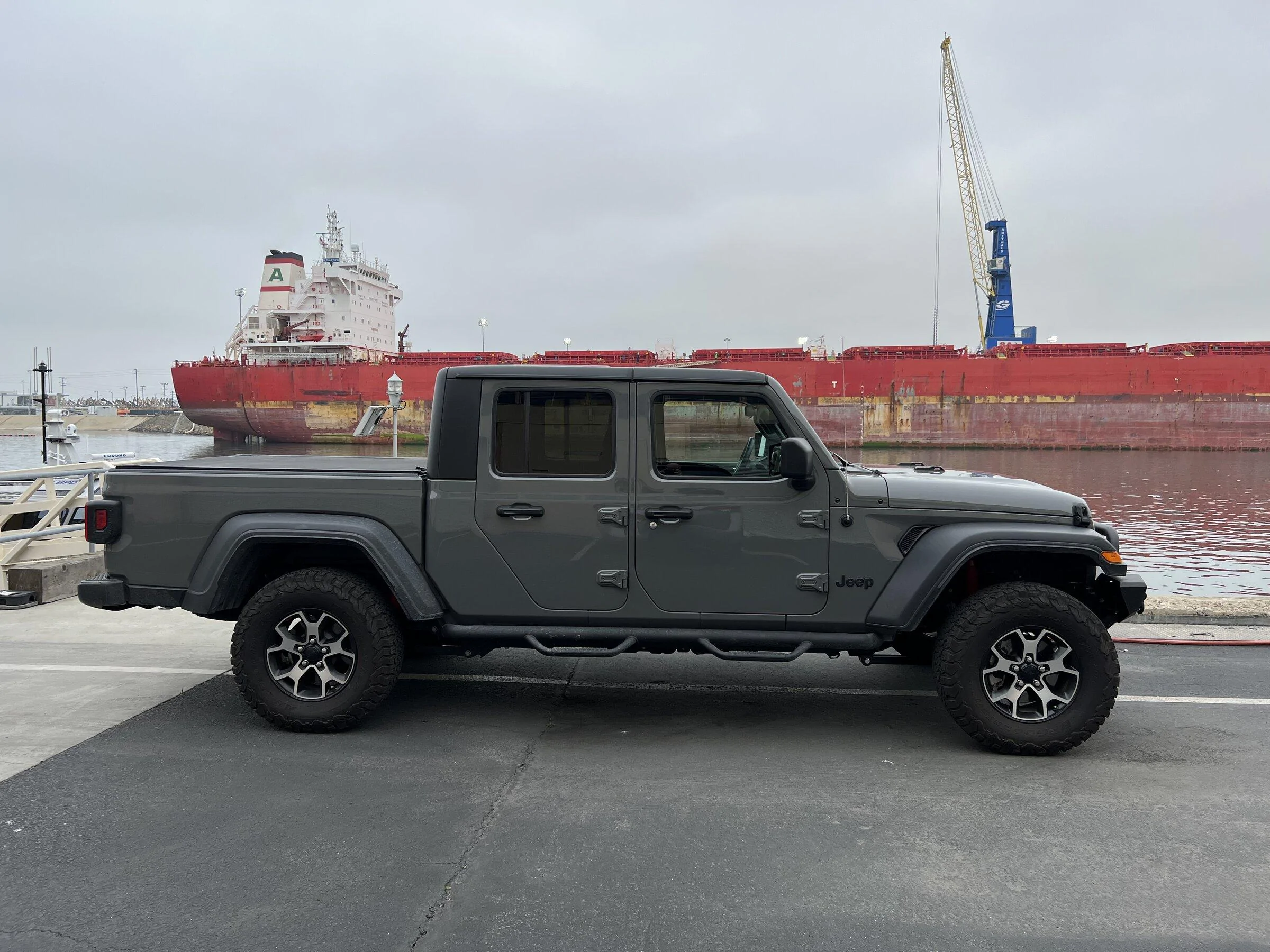
- 2021 Gladiator Sport
- Thread starter
- #1
I want to add my information to the hopper for anybody that’s seeking solutions down the road as it relates to lifts and death wobble.
So many of the death wobble and steering issues are specific to the different parts that each of us are installing, so I share this with that in mind. I appreciate the folks that have taken the time to share their experiences on this forum. I believe it saved me quite a bit of frustration and money to get to where I’m at now
FOR THE RECORD:
My truck is a Sport S with the Max Tow package.
My truck has always had the steel steering box.
I live in Southern California and commute 60 miles per workday on Interstate 405, which sucks as far as the road surface is concerned.
STEP 1:
Day 1 of ownership, I installed a Teraflex 1.5” spacer and swapped the sport wheels/tires for Rubicon take-offs. At this point the steering was stable through the steering wheel, but keeping the truck in its lane would be a bit dicey over 70mph. This didn’t really concern me, as I didn’t get it to race around and it just felt like old solid axle trucks I remember from my youth.
STEP 2:
I installed-
1) Rancho Level It kit (springs, shocks, end links). The kit is a stated 1.5” lift, but a Rancho rep stated it would be closer to 2” with my full width steel bumper (no winch).
2) A Teraflex 0.5” spacer above the Rancho coils.
3) Mopar extended length lower control arms.
4) Readylift adjustable track bar.
5) Rancho RS9000XL series shocks.
6) 3/4” Daystar rear coil spacers.
The combined components resulted in a bit over 2.5” of true lift. The pinion angle was reading 0 degrees on my phone
My first time driving the above combo resulted in a steering feel that was very sensitive to bumps (edge of DW) and a couple occasions of full death wobble at roughly 45mph and 70mph. These were bad enough to require a full stop. I will also say that the ride was rougher than I would have expected, but I chalked it up to the spring and shock swap.
STEP 3:
I adjusted tow, which stopped the true DW incidents, but still had a truck on the very edge of it. I was expecting it to go full DW with every pot hole and expansion joint.
STEP 4:
I checked torque specs on ALL parts of the steering system including the ball joints.
The tie rod wasn’t up to spec at the knuckles but it didn’t have any play in it either.
The above step didn’t have any tangible effects on the steering.
STEP 5:
I installed Rancho geometry correction brackets. I used the top (smallest adjustment) hole. The pinion angle was bouncing between 1-2 degrees on my phone.
This was the game changer!!!!
The ride is now super smooth by comparison. The truck tracks dead straight and there is zero hint of the wobbles no matter what I run over, regardless of my typical driving speeds.
I will say that I can tell caster is high in the steering feel. It’s simply not as light as it was when stock. But, as a comparison, it’s not as heavy as my wife’s Land Rover and it’s way more stable at higher speeds that it was when stock. In fact, I found myself regularly going about 5mph faster than I thought the first time I drove to work.
As I stated at the beginning, this is simply my experience with the specific components I have installed.
That being said, I think the geometry correction brackets are an underrated component. I was worried about them being low, but they aren’t any lower than the rear LCA mounts. For my use (daily driver, fire roads, general trail use) they won’t be a hinderance.
I sincerely hope this helps someone dealing with their own modification issues.
Cheers.

So many of the death wobble and steering issues are specific to the different parts that each of us are installing, so I share this with that in mind. I appreciate the folks that have taken the time to share their experiences on this forum. I believe it saved me quite a bit of frustration and money to get to where I’m at now
FOR THE RECORD:
My truck is a Sport S with the Max Tow package.
My truck has always had the steel steering box.
I live in Southern California and commute 60 miles per workday on Interstate 405, which sucks as far as the road surface is concerned.
STEP 1:
Day 1 of ownership, I installed a Teraflex 1.5” spacer and swapped the sport wheels/tires for Rubicon take-offs. At this point the steering was stable through the steering wheel, but keeping the truck in its lane would be a bit dicey over 70mph. This didn’t really concern me, as I didn’t get it to race around and it just felt like old solid axle trucks I remember from my youth.
STEP 2:
I installed-
1) Rancho Level It kit (springs, shocks, end links). The kit is a stated 1.5” lift, but a Rancho rep stated it would be closer to 2” with my full width steel bumper (no winch).
2) A Teraflex 0.5” spacer above the Rancho coils.
3) Mopar extended length lower control arms.
4) Readylift adjustable track bar.
5) Rancho RS9000XL series shocks.
6) 3/4” Daystar rear coil spacers.
The combined components resulted in a bit over 2.5” of true lift. The pinion angle was reading 0 degrees on my phone
My first time driving the above combo resulted in a steering feel that was very sensitive to bumps (edge of DW) and a couple occasions of full death wobble at roughly 45mph and 70mph. These were bad enough to require a full stop. I will also say that the ride was rougher than I would have expected, but I chalked it up to the spring and shock swap.
STEP 3:
I adjusted tow, which stopped the true DW incidents, but still had a truck on the very edge of it. I was expecting it to go full DW with every pot hole and expansion joint.
STEP 4:
I checked torque specs on ALL parts of the steering system including the ball joints.
The tie rod wasn’t up to spec at the knuckles but it didn’t have any play in it either.
The above step didn’t have any tangible effects on the steering.
STEP 5:
I installed Rancho geometry correction brackets. I used the top (smallest adjustment) hole. The pinion angle was bouncing between 1-2 degrees on my phone.
This was the game changer!!!!
The ride is now super smooth by comparison. The truck tracks dead straight and there is zero hint of the wobbles no matter what I run over, regardless of my typical driving speeds.
I will say that I can tell caster is high in the steering feel. It’s simply not as light as it was when stock. But, as a comparison, it’s not as heavy as my wife’s Land Rover and it’s way more stable at higher speeds that it was when stock. In fact, I found myself regularly going about 5mph faster than I thought the first time I drove to work.
As I stated at the beginning, this is simply my experience with the specific components I have installed.
That being said, I think the geometry correction brackets are an underrated component. I was worried about them being low, but they aren’t any lower than the rear LCA mounts. For my use (daily driver, fire roads, general trail use) they won’t be a hinderance.
I sincerely hope this helps someone dealing with their own modification issues.
Cheers.
Sponsored
 Not disputing your claim, I just truly don't understand the difference. I just take my magnetic angle finder and put it on the bottom of the steering knuckle and subtract the reference angle of the floor... I'm hillbilly.