Sponsored

Are the batteries really isolated during ESS stops?

J Sierra

Well-Known Member
First Name
James
Joined
Dec 29, 2020
Threads
9
Messages
157
Reaction score
189
Location
Tucson AZ
Vehicle(s)
2020 Jeep gladiator
Occupation
retired
Vehicle Showcase
1
The PCR is powered from N1. The starter relay from N2. Scale is always 2V per div, I am moving the PCR and starter relay trace down, after the capture.
Sponsored


 

Andy29847

Well-Known Member
First Name
Andy
Joined
Oct 25, 2020
Threads
14
Messages
552
Reaction score
934
Location
South Carolina
Vehicle(s)
2020 Wrangler Rubicon, 2020 Gladiator Rubicon
Occupation
Retired
The PCR is powered from N1. The starter relay from N2. Scale is always 2V per div, I am moving the PCR and starter relay trace down, after the capture.
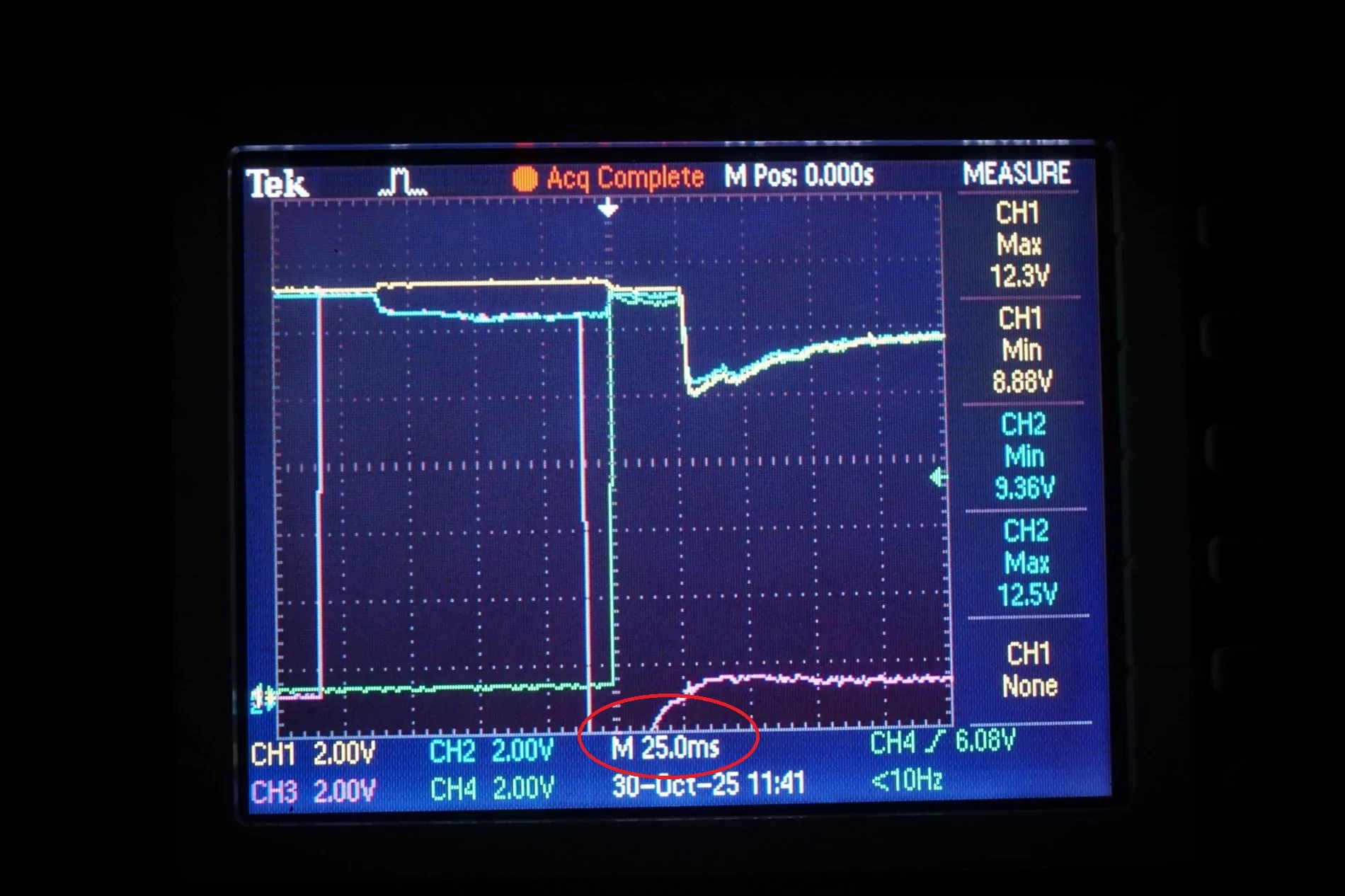

Thanks for the reply. I don't have a scope so I am trying to reason things out with the help of you and others. I see that the x-scale is constantly 2.0 volts. I also see the time scale changing. If I recall correctly, I've seen 20ms, 25ms, 50ms, and 250ms. The varying scales change the wave shapes. It's only important if the reader doesn't notice the changes.

Jeep Gladiator Are the batteries really isolated during ESS stops? timne scal
 

jebiruph

Well-Known Member
First Name
Jerry
Joined
Dec 9, 2018
Threads
15
Messages
806
Reaction score
730
Location
IA
Vehicle(s)
2018 Wrangler JL 2024 Grand Cherokee L WL 2020 Gladiator JT
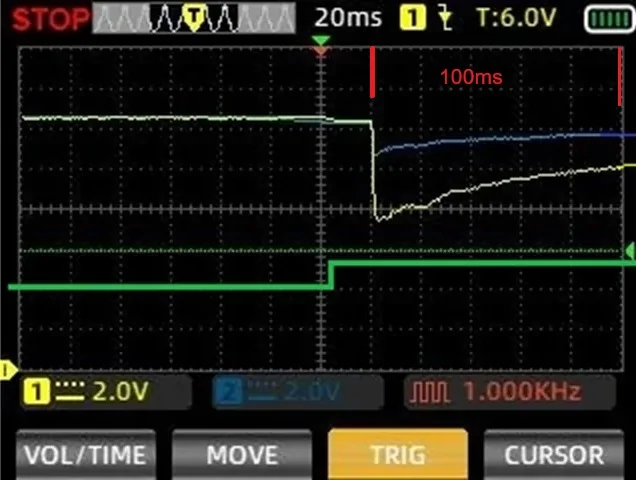
There is a lot of info regarding several subjects in this thread. I'm struggling to finalize conclusions, and I may be missing somethings. The mystery that currently remains for me is the actions during an ESS stop/start. As far as I know, we only have one trace for that circumstance. That trace shows a difference in voltage between N1 and N2 after the start is initiated. The 2 traces do not get back together on the test. Logically, the PCR is open.


ess restart 1.webp
I see your point, 100ms and the batteries are still separated, seemingly contrary to the previously posted documentation of 20-40ms.

Jeep Gladiator Are the batteries really isolated during ESS stops? 1761849779187-9
 

jebiruph

Well-Known Member
First Name
Jerry
Joined
Dec 9, 2018
Threads
15
Messages
806
Reaction score
730
Location
IA
Vehicle(s)
2018 Wrangler JL 2024 Grand Cherokee L WL 2020 Gladiator JT
It is indeed. It's common to exceed a fuse's rating for short periods.

The engineers put a 150A fuse on the 200CCA AUX battery, with nothing to limit current.

The Fluke 87V uses 440mA and 11A Bussmann fast-acting fuses (datasheet). Fluke's user manual says:

For the 440mA circuit,


For the 11A circuit,


wrong-all-the-time-the-simpsons-0.webp
And yet we know that the N3 fuse blows almost instantaneously when the aux battery positive cable is shorted to ground, is that due to a residual charge like I referred to earlier in this thread?
 

ShadowsPapa

Well-Known Member
First Name
Bill
Joined
Oct 12, 2019
Threads
247
Messages
40,442
Reaction score
53,859
Location
Runnells, Iowa
Vehicle(s)
'25 JTMX, '23 JLU 4xe, '82 SX4, '73 Javelin
Occupation
Retired auto mechanic, frmr gov't ntwrk security admin
Vehicle Showcase
3
On the one ESS stop/Start trace that we have, the N1 and N2 lines do not merge while the test is running. My logic from the info at hand is that the PCR separated N1 and N2 for the ESS start. Then the PCR remains open for an undetermined period of time. I'd guess that it stays open until N1 and N2 are almost the same (volts).
You are going by ONE trace which isn't very long at all.
If it stayed open until N1 and N2 are almost the same, that could be forever.
Stop looking at that one trace.
Since almost the entire vehicle load comes off N1 when the PCR is open, you'll be waiting a long time for the voltages to be equal.

I'd also guess this happens fairly fast because the aux battery is discharging on the cab load and the main battery is charging from the alternator.
If that's the case, it should take a while, since the main battery has almost no load and the aux battery is running HVAC, lights and all modules.
 

Sponsored

ShadowsPapa

Well-Known Member
First Name
Bill
Joined
Oct 12, 2019
Threads
247
Messages
40,442
Reaction score
53,859
Location
Runnells, Iowa
Vehicle(s)
'25 JTMX, '23 JLU 4xe, '82 SX4, '73 Javelin
Occupation
Retired auto mechanic, frmr gov't ntwrk security admin
Vehicle Showcase
3
The PCR is powered from N1. The starter relay from N2. Scale is always 2V per div, I am moving the PCR and starter relay trace down, after the capture.
But it's still the same cold start in all cases. Not an ESS hot start.
 

ShadowsPapa

Well-Known Member
First Name
Bill
Joined
Oct 12, 2019
Threads
247
Messages
40,442
Reaction score
53,859
Location
Runnells, Iowa
Vehicle(s)
'25 JTMX, '23 JLU 4xe, '82 SX4, '73 Javelin
Occupation
Retired auto mechanic, frmr gov't ntwrk security admin
Vehicle Showcase
3
I see your point, 100ms and the batteries are still separated, seemingly contrary to the previously posted documentation of 20-40ms.
Take two batteries of different voltages and rig through similar sized wiring into a parallel circuit and see how long it takes for the voltage to equalize.
They are different capacities, different absorption rates, and start out at fairly different voltages. It's not going to happen fast even if they are connected back together.
The test needs to show the PCR action, instead of viewing only battery voltages.
Show how long the PCR is active/open - ignore the battery voltages as that's going to take time. Voltage won't be equal instantaneously.
Even write-ups about batteries in parallel talk of the length of time the voltages may be different, and the aux battery is connected directly to N1, so it's got a load directly connected the whole time.
It's a small battery, will take some time to recover.
 

Andy29847

Well-Known Member
First Name
Andy
Joined
Oct 25, 2020
Threads
14
Messages
552
Reaction score
934
Location
South Carolina
Vehicle(s)
2020 Wrangler Rubicon, 2020 Gladiator Rubicon
Occupation
Retired
You are going by ONE trace which isn't very long at all.
If it stayed open until N1 and N2 are almost the same, that could be forever.
Stop looking at that one trace.
Since almost the entire vehicle load comes off N1 when the PCR is open, you'll be waiting a long time for the voltages to be equal.


If that's the case, it should take a while, since the main battery has almost no load and the aux battery is running HVAC, lights and all modules.

I'm OK if you turn out to be right. I just want to know the facts. Our group here has already put to rest some of the legend about the Jeep battery system. Let's finish the job.

FWIW, Jerry has a portable 2 lead oscilloscope. It's new to him. As soon as he gets comfortable with the scope, it will be easy to get a trace on the PCR relay during an ESS stop/start. Until then, all of the arguments are just speculation.
 

Andy29847

Well-Known Member
First Name
Andy
Joined
Oct 25, 2020
Threads
14
Messages
552
Reaction score
934
Location
South Carolina
Vehicle(s)
2020 Wrangler Rubicon, 2020 Gladiator Rubicon
Occupation
Retired
Take two batteries of different voltages and rig through similar sized wiring into a parallel circuit and see how long it takes for the voltage to equalize.
They are different capacities, different absorption rates, and start out at fairly different voltages. It's not going to happen fast even if they are connected back together.
The test needs to show the PCR action, instead of viewing only battery voltages.
Show how long the PCR is active/open - ignore the battery voltages as that's going to take time. Voltage won't be equal instantaneously.
Even write-ups about batteries in parallel talk of the length of time the voltages may be different, and the aux battery is connected directly to N1, so it's got a load directly connected the whole time.
It's a small battery, will take some time to recover.

The issue is that once the 2 batteries are joined together via the PCR, the only measurement available is an average of the 2 batteries.

I been doing some left field thinking trying to clarify the usefulness of the Jeep 2 battery system. I accept that one purpose is to shield the cab electronics from low voltages. I'd guess another is to protect the PCM, since there is a programed threshold for a reset and a warning light. What hasn't been mentioned is how the system is cushioned when 2 batteries with dissimilar voltage are joined together. I'm thinking that this act is what's making the traces go squiggly. Maybe that's not an issue, but it is something I've been thinking about.
 

ShadowsPapa

Well-Known Member
First Name
Bill
Joined
Oct 12, 2019
Threads
247
Messages
40,442
Reaction score
53,859
Location
Runnells, Iowa
Vehicle(s)
'25 JTMX, '23 JLU 4xe, '82 SX4, '73 Javelin
Occupation
Retired auto mechanic, frmr gov't ntwrk security admin
Vehicle Showcase
3
The issue is that once the 2 batteries are joined together via the PCR, the only measurement available is an average of the 2 batteries.
You can take voltage measurements off the PCR terminals or the battery terminals.
They will eventually equalize, even out, but it takes time. (but will look instant as long as they are measured from a common point)
Battery internal resistance, battery state of charge, age, several factors will determine how quickly they equalize - one source says minutes to hours.
In other words, you can connect them together, wait a few minutes, then disconnect the two batteries, then check the voltage of each and there may be a fair difference between the two.
They won't be the same.
 

Sponsored

Andy29847

Well-Known Member
First Name
Andy
Joined
Oct 25, 2020
Threads
14
Messages
552
Reaction score
934
Location
South Carolina
Vehicle(s)
2020 Wrangler Rubicon, 2020 Gladiator Rubicon
Occupation
Retired
You can take voltage measurements off the PCR terminals or the battery terminals.
They will eventually equalize, even out, but it takes time. (but will look instant as long as they are measured from a common point)
Battery internal resistance, battery state of charge, age, several factors will determine how quickly they equalize - one source says minutes to hours.
In other words, you can connect them together, wait a few minutes, then disconnect the two batteries, then check the voltage of each and there may be a fair difference between the two.
They won't be the same.

What I would like to know is when the 2 batteries are joined back together on an ESS stop/start. What makes me ask the question is the differences between N1 and N2 on the ESS stop/start trace (the only one we have) after the start. That difference is not seen on numerous traces that we have for a cold start.

 

ShadowsPapa

Well-Known Member
First Name
Bill
Joined
Oct 12, 2019
Threads
247
Messages
40,442
Reaction score
53,859
Location
Runnells, Iowa
Vehicle(s)
'25 JTMX, '23 JLU 4xe, '82 SX4, '73 Javelin
Occupation
Retired auto mechanic, frmr gov't ntwrk security admin
Vehicle Showcase
3
What I would like to know is when the 2 batteries are joined back together on an ESS stop/start. What makes me ask the question is the differences between N1 and N2 on the ESS stop/start trace (the only one we have) after the start. That difference is not seen on numerous traces that we have for a cold start.
It won't be seen on a cold start as they are connected together the whole time the starter is running.

They should be VERY different traces - the cold start one shows the PCR open BEFORE the starter begins. that's pretty simple. You see it open, then close, then a bit later, the starter is triggered and voltage for each drops together.
 

Andy29847

Well-Known Member
First Name
Andy
Joined
Oct 25, 2020
Threads
14
Messages
552
Reaction score
934
Location
South Carolina
Vehicle(s)
2020 Wrangler Rubicon, 2020 Gladiator Rubicon
Occupation
Retired
We have had several posts on this issue. One of us is not understanding the other. My perspective is that you keep referring to a cold start. My concerns are about an ESS stop/start. The one trace we have on an ESS stop/start is similar to the cold start except for the prestart test and the time after the starter is triggered. I believe Jeep documentation says that an ESS stop/start does not include a pre-start test. That jives with the test trace. The traces of the voltage for the 2 batteries after the start signal are different.
 
OP
OP
Flanders

Flanders

Well-Known Member
Joined
Dec 2, 2023
Threads
11
Messages
152
Reaction score
121
Location
Dyer, NV
Vehicle(s)
2023 JT
There's too much going on for me to follow.

@J Sierra Could you add a math trace showing the difference between whichever channels you have on N2 and N1, at 500 mV/div?
 

ShadowsPapa

Well-Known Member
First Name
Bill
Joined
Oct 12, 2019
Threads
247
Messages
40,442
Reaction score
53,859
Location
Runnells, Iowa
Vehicle(s)
'25 JTMX, '23 JLU 4xe, '82 SX4, '73 Javelin
Occupation
Retired auto mechanic, frmr gov't ntwrk security admin
Vehicle Showcase
3
My perspective is that you keep referring to a cold start.
The cold start trace keeps getting posted, modified, and posted again. It's really about all we have short of someone actually capturing a FULL ESS restart - including PCR closing, and the trace showing the PCR being activated and then deactivated.
So far, I don't believe we have that. We are assuming because the images don't show the PCR trigger itself.

Correct, the "test" is during the initial BUTTON start.
There is no test other than when you press the button to start the TIP sequence.
The ESS restart isn't a TIP start and won't include the test.
The ESS restart should show the PCR being activated - do we have a hot ESS start with the PCR being tracked DIRECTLY?
Sponsored


Top