
Sponsored

Are the batteries really isolated during ESS stops?

Higher_Ground

Well-Known Member
First Name
J. T.
Joined
Jun 10, 2020
Threads
7
Messages
485
Reaction score
355
Location
South Carolina
Vehicle(s)
2020 Gator Sport S
I finally got to experience the "Service ESS" warning light last weekend.

The last two ESS events prior to the warning, the engine did not start "immediately" and the slight delay was enough to give kind of a clunk/lurch... nothing to make your hair stand up, but it didn't sound exactly like it does every other time.

I suspect the auxiliary battery is on its way out. A few years ago my truck sat at the body shop for ~7 months and when they finally gave it back, there was no gas in the tank. In order to get me out of there, they put in some gas and I was on my way. Later that day I needed to jump it to get started. I took it back and they put in a new main battery - I assume they left the original aux battery in place.

The truck seems to start just fine, but it's a nice 65°F in the morning right now. No sluggishness, sounds, or lurching - but the "Service ESS" light remains.

I've been reading threads for days now. I have a pretty short commute so I went ahead and bought the Noco Genius battery charger others have recommended. I have not tried to let it sit and charge yet - I am assuming I should leave it all connected and charge both batteries at first?

I figure I will be asking about replacing the auxiliary battery soon enough.
Sponsored

 

jebiruph

Well-Known Member
First Name
Jerry
Joined
Dec 9, 2018
Threads
15
Messages
806
Reaction score
730
Location
IA
Vehicle(s)
2018 Wrangler JL 2024 Grand Cherokee L WL 2020 Gladiator JT
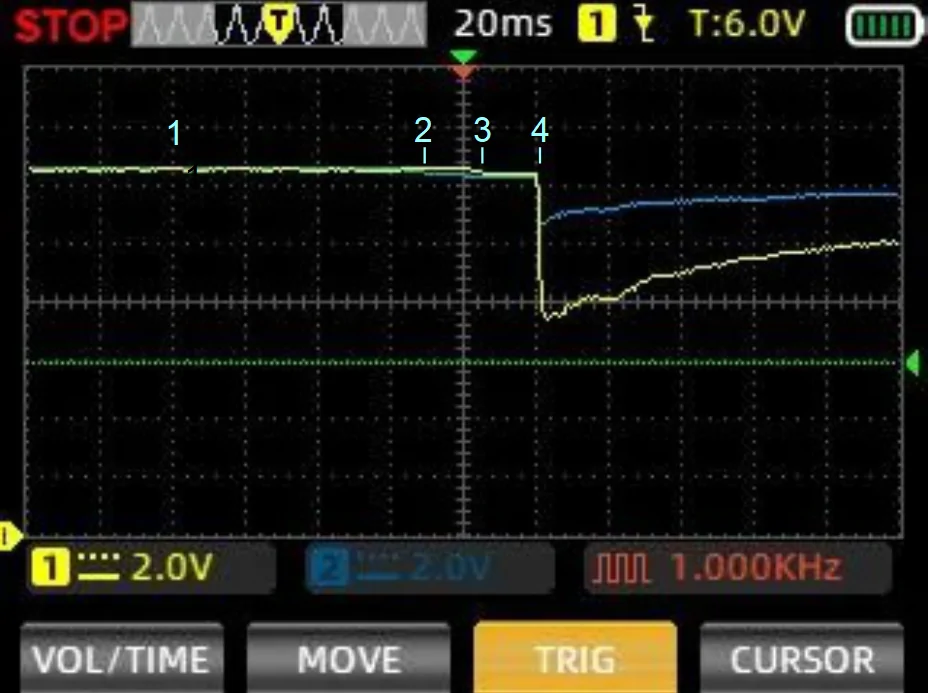
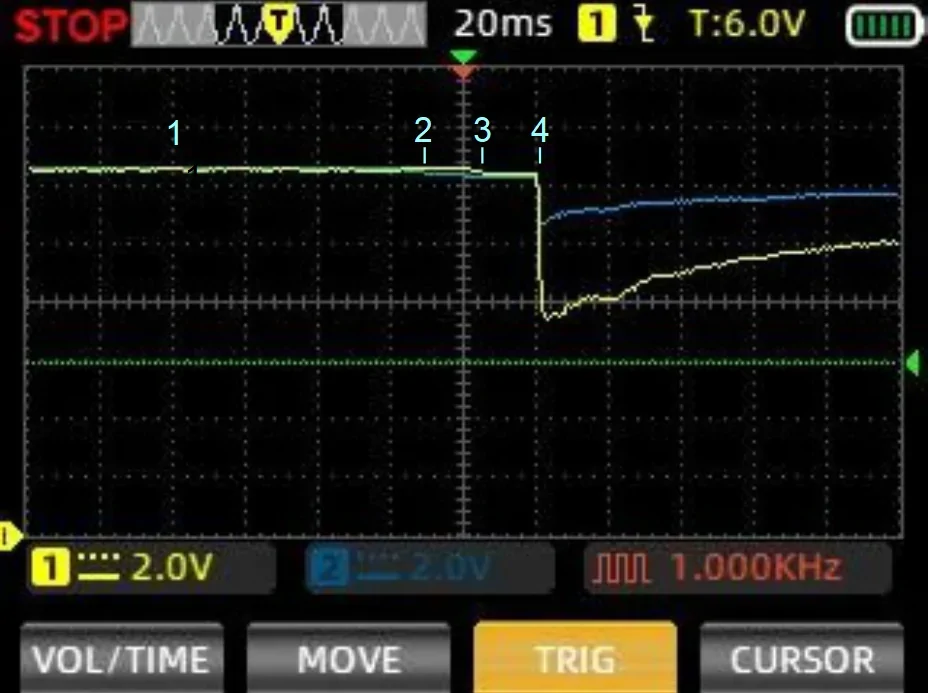
I don't agree with your assessment. Point 4 shows the batteries are separate, and that the draw of the starter on the main creates a larger drop in voltage than the now isolated draw of the electronics on the aux battery. This makes complete sense.

Points 2 and 3 aren't saying anything meaningful other than being an extremely minor reading discrepancy that can happen in any dual-battery setup. As you said, "Keep in mind that since the voltages are taken from different points in the circuit, it's more important to look for simultaneous changes in the voltages as opposed to how close the voltages are to each other" so these should be ignored.

The drop occurring at the same time is because it's one action creating a coordinated change on 2 voltage sources, but not necessarily because they're powering the same thing. In fact, if they were both powering the starter, they would need independent and isolated connections to the starter for you to get two separate voltage readings in the magnitude shown. We know this isn't present.

What's really happening is that the aux now has to do more work to cover what the main was helping with before, hence the simultaneous voltage drop but not as much as the main experiences. This aligns with the intent and design of the system.

From what you've posted, you've really proven that the batteries do separate at the moment of restart and have unequal load (one for the starter, the other for electronics).
Are you saying that both batteries are powering everything the whole time and that the additional load of powering the starter means the main battery provides less power to the electronics and accessories, putting more load on the aux battery to power the electronics and accessories and that's why there's a difference in the voltage of the batteries?

Then is the simultaneous leveling off of the voltage drop because as the starter spins up the main battery provides less power to the starter and more power to the electronics and accessories?
 

sharpsicle

Well-Known Member
Joined
Apr 29, 2021
Threads
22
Messages
2,762
Reaction score
6,255
Location
Tampa, FL / Milwaukee, WI
Vehicle(s)
2020 Gladiator Overland, 2002 VTX1800
Are you saying that both batteries are powering everything the whole time and that the additional load of powering the starter means the main battery provides less power to the electronics and accessories, putting more load on the aux battery to power the electronics and accessories and that's why there's a difference in the voltage of the batteries?

Then is the simultaneous leveling off of the voltage drop because as the starter spins up the main battery provides less power to the starter and more power to the electronics and accessories?
Umm.....what? No.....

If both were powering both all the time, you'd have essentially equal voltage at all times. Clearly that's not the case.

I'm saying that both batteries power everything up to the point of the restart, which is what you marked as 4. At that point, they separate, and the main powers the starter while the aux deals with the rest of the load. This is an increase for both batteries, hence an observed dip in voltage on both. But they are not connected at that moment, which is why the voltage drop amount isn't the same.
 

Higher_Ground

Well-Known Member
First Name
J. T.
Joined
Jun 10, 2020
Threads
7
Messages
485
Reaction score
355
Location
South Carolina
Vehicle(s)
2020 Gator Sport S
Umm.....what? No.....

I'm saying that both batteries power everything up to the point of the restart, which is what you marked as 4. At that point, they separate, and the main powers the starter while the aux deals with the rest of the load. This is an increase for both batteries, hence an observed dip in voltage on both. But they are not connected at that moment.

This makes sense to me from an empirical standpoint - when my ESS decided to quit, the last two starts were sluggish compared to normal. It was almost like a drained battery, but not as bad. The initial startup before was fine though, and every start up since has been fine. I assume that's because the "slow" start up only had one battery and every other start-up had both.
 

jebiruph

Well-Known Member
First Name
Jerry
Joined
Dec 9, 2018
Threads
15
Messages
806
Reaction score
730
Location
IA
Vehicle(s)
2018 Wrangler JL 2024 Grand Cherokee L WL 2020 Gladiator JT
Umm.....what? No.....

If both were powering both all the time, you'd have essentially equal voltage at all times. Clearly that's not the case.

I'm saying that both batteries power everything up to the point of the restart, which is what you marked as 4. At that point, they separate, and the main powers the starter while the aux deals with the rest of the load. This is an increase for both batteries, hence an observed dip in voltage on both. But they are not connected at that moment, which is why the voltage drop amount isn't the same.
If this was what was happening, wouldn't the load on the aux battery be consistent? What explains the aux battery voltage going up instead of being flat?

The drop occurring at the same time is because it's one action creating a coordinated change on 2 voltage sources, but not necessarily because they're powering the same thing. In fact, if they were both powering the starter, they would need independent and isolated connections to the starter for you to get two separate voltage readings in the magnitude shown. We know this isn't present.
What one action separates the batteries and cranks the starter at the same instance in time? The simultaneous drop of both battery voltages is triggered by a single relay, but each one of those functions is control by a different circuit.
 

Sponsored

sharpsicle

Well-Known Member
Joined
Apr 29, 2021
Threads
22
Messages
2,762
Reaction score
6,255
Location
Tampa, FL / Milwaukee, WI
Vehicle(s)
2020 Gladiator Overland, 2002 VTX1800
If this was what was happening, wouldn't the load on the aux battery be consistent? What explains the aux battery voltage going up instead of being flat?


What one action separates the batteries and cranks the starter at the same instance in time? The simultaneous drop of both battery voltages is triggered by a single relay, but each one of those functions is control by a different circuit.
Come on. Seriously?

Load on the aux battery would not be consistent, because prior to separation that load is shared with the main. I think I was pretty clear about that in my previous reply.

The action that separates the batteries is the PCR opening. Yes, this happens at the same time the starter is engaged after an ESS stop. Vehicle load changes to aux-only while starter load is added to the main. The whole reason why this dual-battery system exists.

Pretty simple stuff. This'll be the last I reply to you on it, because either you're not willing to help yourself learn or you're trolling if you keep going. Either way, not worth it to keep talking to a wall.
 

jebiruph

Well-Known Member
First Name
Jerry
Joined
Dec 9, 2018
Threads
15
Messages
806
Reaction score
730
Location
IA
Vehicle(s)
2018 Wrangler JL 2024 Grand Cherokee L WL 2020 Gladiator JT
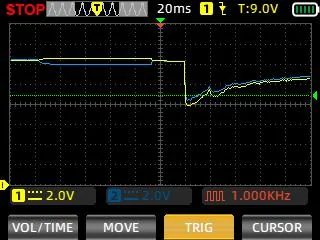
Cold start
Jeep Gladiator Are the batteries really isolated during ESS stops? cold start sco

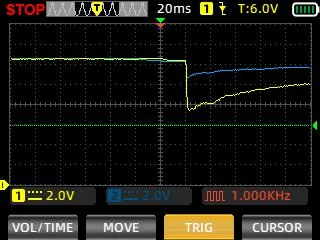
Restart
Jeep Gladiator Are the batteries really isolated during ESS stops? restart sco


I believe that there is agreement that for a cold start, both the aux battery and main battery power the starter. If you look at the cold start image and the restart image, they are virtually identical except for the offset of the aux battery voltage on the restart image. If the restart process was totally different than the cold start process as some say, there would be more differences in the oscilloscope images.

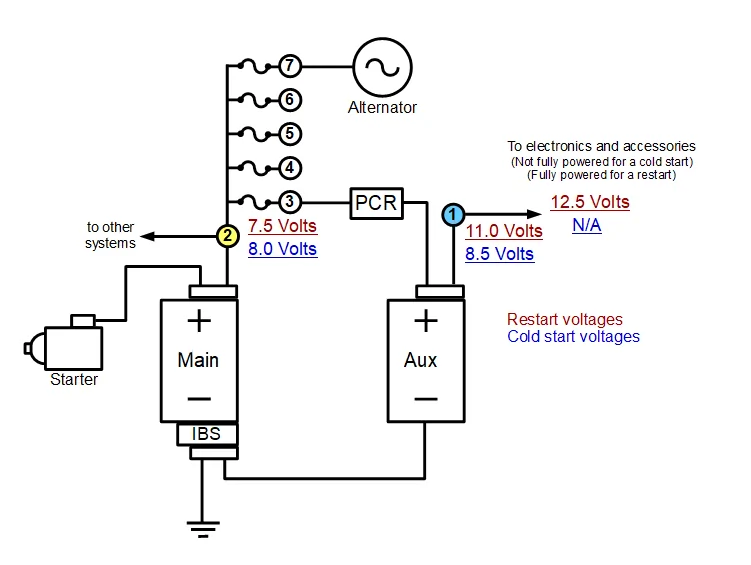
I've added the voltages from the oscilloscope images to my drawing to better illustrate my explanation. Although we are referring to these voltages as battery voltages, they are actually taken from the N1 and N2 terminals and not directly from the batteries. This matters because for the restart, the voltage at the N1 terminal is higher than the aux battery voltage because it is also connected to the to the 12.5 volts from the electronics and accessories. The 12.5 volts of the electronics and accessories holds the N1 terminal at 11.0 volts when the starter cranks and holds it higher throughout the cranking process.

That explains why the aux battery voltage is higher during the restart even though it is cranking the starter just like with the cold start.

Jeep Gladiator Are the batteries really isolated during ESS stops? ess voltages
 
Last edited:

jebiruph

Well-Known Member
First Name
Jerry
Joined
Dec 9, 2018
Threads
15
Messages
806
Reaction score
730
Location
IA
Vehicle(s)
2018 Wrangler JL 2024 Grand Cherokee L WL 2020 Gladiator JT
Come on. Seriously?

Load on the aux battery would not be consistent, because prior to separation that load is shared with the main. I think I was pretty clear about that in my previous reply.

The action that separates the batteries is the PCR opening. Yes, this happens at the same time the starter is engaged after an ESS stop. Vehicle load changes to aux-only while starter load is added to the main. The whole reason why this dual-battery system exists.

Pretty simple stuff. This'll be the last I reply to you on it, because either you're not willing to help yourself learn or you're trolling if you keep going. Either way, not worth it to keep talking to a wall.
Reply or not as you see fit, I am replying to your post for the benefit of anyone else following this thread.

Jeep Gladiator Are the batteries really isolated during ESS stops? restart sco


From #4 on, if the aux battery was only powering the electronics and accessories the voltage would be flat because that is a constant load. Instead the voltage of the aux battery is going up, just like when it is powering the starter where the load decreases over time.
 

ShadowsPapa

Well-Known Member
First Name
Bill
Joined
Oct 12, 2019
Threads
247
Messages
40,440
Reaction score
53,854
Location
Runnells, Iowa
Vehicle(s)
'25 JTMX, '23 JLU 4xe, '82 SX4, '73 Javelin
Occupation
Retired auto mechanic, frmr gov't ntwrk security admin
Vehicle Showcase
3
Consider these facts:
The auxiliary battery is connected directly to N1.
N1 is EVERYTHING - I mean ALL of it,
except
EHPS,
cooling fan,
PCR,
IBS itself

So from N1 - and thus the auxiliary battery - all of these get their power:
The whole truck except the above.
Radio
HVAC, including the fan
LIGHTS - all of them
Windows
Locks
TCM
PCM
BCM (which is the whole body, lighting and all that the BCM controls - brake lights, ABS and so on)

In other words - the main battery is only directly connected to the high current fuse array, PCR and starter.
IT is indirectly connected to N1 via the PCR, past the aux battery to N1
So if the batteries were separated during an ESS stop - that aux battery would be powering the whole truck, radio (with how many watts going out) all lighting, HVAC fan
and the main battery would be doing NOTHIING because the cooling fan and EHPS won't be running during a stop.
And yet - the main battery drops just as fast as the aux during an ess stop. Well, how is that possible if they are disconnected? What would cause that main battery to drop down to under 12 volts during a stop if it's not connected to N1 powering the whole truck?
EHPS is off, cooling fan is off, so why does it drop, too?
Because they are connected and share the load of all of the trucks modules, ALL of them, everything about the truck, during an ESS stop.
I've shown this using two volt meters, one connected to the aux, one to the main. They dropped together.

Plus - I have these -

Jeep Gladiator Are the batteries really isolated during ESS stops? Screenshot 2025-10-03 215902


Jeep Gladiator Are the batteries really isolated during ESS stops? Screenshot 2025-10-03 215824


They are always connected except during initial starter engagement - this ensures the electronics don't drop voltage during cranking or a restart. When the starter engages, the electronics can't drop voltage or suffer a dip or "brownout".
 

jebiruph

Well-Known Member
First Name
Jerry
Joined
Dec 9, 2018
Threads
15
Messages
806
Reaction score
730
Location
IA
Vehicle(s)
2018 Wrangler JL 2024 Grand Cherokee L WL 2020 Gladiator JT
Consider these facts:
The auxiliary battery is connected directly to N1.
N1 is EVERYTHING - I mean ALL of it,
except
EHPS,
cooling fan,
PCR,
IBS itself

So from N1 - and thus the auxiliary battery - all of these get their power:
The whole truck except the above.
Radio
HVAC, including the fan
LIGHTS - all of them
Windows
Locks
TCM
PCM
BCM (which is the whole body, lighting and all that the BCM controls - brake lights, ABS and so on)

In other words - the main battery is only directly connected to the high current fuse array, PCR and starter.
IT is indirectly connected to N1 via the PCR, past the aux battery to N1
So if the batteries were separated during an ESS stop - that aux battery would be powering the whole truck, radio (with how many watts going out) all lighting, HVAC fan
and the main battery would be doing NOTHIING because the cooling fan and EHPS won't be running during a stop.
And yet - the main battery drops just as fast as the aux during an ess stop. Well, how is that possible if they are disconnected? What would cause that main battery to drop down to under 12 volts during a stop if it's not connected to N1 powering the whole truck?
EHPS is off, cooling fan is off, so why does it drop, too?
Because they are connected and share the load of all of the trucks modules, ALL of them, everything about the truck, during an ESS stop.
I've shown this using two volt meters, one connected to the aux, one to the main. They dropped together.

Plus - I have these -

Screenshot 2025-10-03 215902.webp


Screenshot 2025-10-03 215824.webp


They are always connected except during initial starter engagement - this ensures the electronics don't drop voltage during cranking or a restart. When the starter engages, the electronics can't drop voltage or suffer a dip or "brownout".
Thanks Bill for the work on what's powered from which battery. Did you happen to see what powers the coils and injectors?

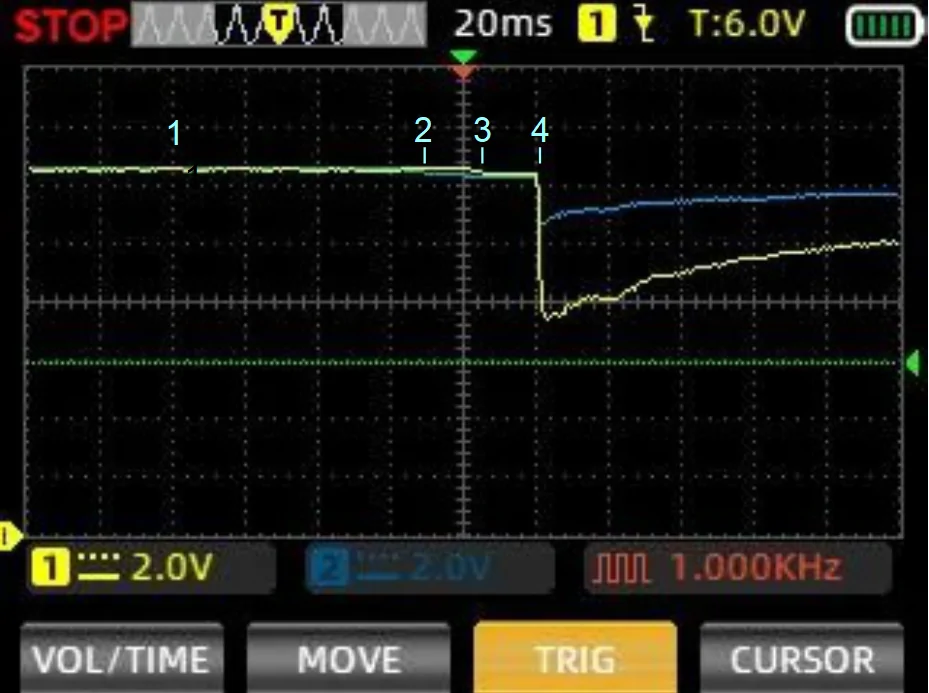
I also over the past few months ran the N1, N2 during an ESS stop voltage test and got pretty much the same result of consistent voltage drops between the two. I ran the test differently with a single meter between the terminals. But when I look at the more accurate oscilloscope image I see subtle variations between N1 and N2 (at #1) , except when they are exactly the same (at #3). I wonder what explains that.

Also sometime during an ESS stop the system evaluates whether the aux battery voltage matches the main battery voltage, does it do that with the batteries connected?

If they are connected at #1, maybe #2 is the disconnect for battery evaluation, #3 is the reconnect before the starter crank at #4.

Jeep Gladiator Are the batteries really isolated during ESS stops? restart sco


I'm not very impressed with the information provided in the following paragraph. Bosch defines SOC as "The SOC indicates how much power is available". In the paragraph they appear to be substituting battery voltage for SOC and a battery's voltage and it's SOC are not the same thing. I suspect that is old information.

Jeep Gladiator Are the batteries really isolated during ESS stops? 1759625354872-a2


And finally, how do you get to stay up so late, posting at 10:54 like that. Now that I'm retired my bedtime is 9:30.
 

Sponsored

ShadowsPapa

Well-Known Member
First Name
Bill
Joined
Oct 12, 2019
Threads
247
Messages
40,440
Reaction score
53,854
Location
Runnells, Iowa
Vehicle(s)
'25 JTMX, '23 JLU 4xe, '82 SX4, '73 Javelin
Occupation
Retired auto mechanic, frmr gov't ntwrk security admin
Vehicle Showcase
3
Thanks Bill for the work on what's powered from which battery. Did you happen to see what powers the coils and injectors?

I also over the past few months ran the N1, N2 during an ESS stop voltage test and got pretty much the same result of consistent voltage drops between the two. I ran the test differently with a single meter between the terminals. But when I look at the more accurate oscilloscope image I see subtle variations between N1 and N2 (at #1) , except when they are exactly the same (at #3). I wonder what explains that.

Also sometime during an ESS stop the system evaluates whether the aux battery voltage matches the main battery voltage, does it do that with the batteries connected?

If they are connected at #1, maybe #2 is the disconnect for battery evaluation, #3 is the reconnect before the starter crank at #4.

restart scope.webp


I'm not very impressed with the information provided in the following paragraph. Bosch defines SOC as "The SOC indicates how much power is available". In the paragraph they appear to be substituting battery voltage for SOC and a battery's voltage and it's SOC are not the same thing. I suspect that is old information.

1759625354872-a2.webp


And finally, how do you get to stay up so late, posting at 10:54 like that. Now that I'm retired my bedtime is 9:30.
I don't know exactly where the scope was connected during that test. Subtle differences can be voltage drops across connections, especially relay contacts, fuses and even across a length of wire.

I dug out more schematics and the fuel injectors, pump, and coils are all handled via the PCM which is powered through N1

Crank battery literally handles just that - starting - I should include the start/stop relay (not associated with ESS from what I see) and the starter solenoid relay for the crank battery.
But literally everything else is N1

I need to start shutting down before 11pm! I'm not as young as I used to be, if I ever was.

I have not seen where it evaluates the aux battery voltage during an ESS stop - only when they disconnect for starter use. It's not possible to check the aux battery while it's stopped, but it is very possible when it opens the PCR for cranking - it has only the aux battery voltage to look at then since the crank battery is disconnected from almost everything. So during cranking is the only time it can check the aux battery voltage. It knows the state of charge of the crank battery as well as voltage of the pair via the IBS, so it can extrapolate the aux battery during cranking.
Voltage isn't the same, but it's an indication of the state of charge. There's really nothing else it can go by - voltage.


Jeep Gladiator Are the batteries really isolated during ESS stops? 1759635583315-nk


For the crank battery, it has more information as it can use the load vs. voltage. SoC can be estimated by measuring voltage under load and using equation for that specific load.

But voltage has been used to estimate the SoC for a long time and there's no other way for the aux battery since it can't measure the load, only the voltage.
 
OP
OP
Flanders

Flanders

Well-Known Member
Joined
Dec 2, 2023
Threads
11
Messages
152
Reaction score
121
Location
Dyer, NV
Vehicle(s)
2023 JT
The action that separates the batteries is the PCR opening. Yes, this happens at the same time the starter is engaged after an ESS stop. Vehicle load changes to aux-only while starter load is added to the main. The whole reason why this dual-battery system exists.
This. 100%.

@jebiruph Please, reread what @sharpsicle wrote until you understand it before writing another word. You're making mountains of maybe a 0.1V difference between traces on an $80 scope while waving away the 4V difference during ESS restart. Why?
 

jebiruph

Well-Known Member
First Name
Jerry
Joined
Dec 9, 2018
Threads
15
Messages
806
Reaction score
730
Location
IA
Vehicle(s)
2018 Wrangler JL 2024 Grand Cherokee L WL 2020 Gladiator JT
This. 100%.

@jebiruph Please, reread what @sharpsicle wrote until you understand it before writing another word. You're making mountains of maybe a 0.1V difference between traces on an $80 scope while waving away the 4V difference during ESS restart. Why?
The characteristics of the system change between the cold start and the restart. The powered electronics act as an additional voltage source that can account for the voltage difference on the restart. How do you account for the similarity in the shape of the wave form if the circuits are separated?

How do you account for the batteries being separated at the same instant in time as the starter is cranked? There should be some indication of the two different events on the oscilloscope image. Unless the PCM is multiprocessor/multi threaded, it would trigger the associated relays one at a time. I see the battery voltage is different between 2 and 3, identical from 3 to 4 and then the starter cranks. That would correspond to disconnected, connected and starter cranked.
Jeep Gladiator Are the batteries really isolated during ESS stops? 1760754854942-u4
 

ShadowsPapa

Well-Known Member
First Name
Bill
Joined
Oct 12, 2019
Threads
247
Messages
40,440
Reaction score
53,854
Location
Runnells, Iowa
Vehicle(s)
'25 JTMX, '23 JLU 4xe, '82 SX4, '73 Javelin
Occupation
Retired auto mechanic, frmr gov't ntwrk security admin
Vehicle Showcase
3
Jeep Gladiator Are the batteries really isolated during ESS stops? 1760759086252-r1


As said previously, it opens the PCR only for the first engagement of the starter, not beyond that.
Yes, it can do things simultaneously, In this case, engage PCR control relay to open the PCR, and start the starter sequence, then let the PCR close again - supporting the contention that it's there to protect while the starter drops the main battery, to isolate the electronics from that surge that would otherwise take place.

Jeep Gladiator Are the batteries really isolated during ESS stops? Screenshot 2025-10-17 224603


I don't know the details of that other scope test, where things were hooked up and so on, but where the leads were connected can make all of the difference in the world.

The batteries are always connected, except during the initial starter sequence and engagement, then they are isolated from each other, until after the starter has engaged. At that time the load on the starter has dropped drastically. Starter draw is largest when it first engages, there is draw for the solenoid and relays, and a DC motor has a surge of draw then once moving, the draw diminishes a lot. The rush of power into the starter is the issue, not the starter once it's cranking the engine. I've got charts of starter draw tests dating back decades.

So the answer to the thread topic or subject is no - they are not isolated during an ESS stop. They are connect in parallel.

So when are they separated from each other?
During initial starter engagement.
That's it. Not even during the entire time the starter is spinning, because once it engages with the flywheel and has overcome the inertia of an engine at rest, the huge amperage draw is over, the electronics have been isolated from the surges and brownouts - so once that starter is engages ad turning, they connect again.
Sponsored


Top