
Sponsored

ShadowsPapa
Well-Known Member
- First Name
- Bill
- Joined
- Oct 12, 2019
- Threads
- 247
- Messages
- 40,483
- Reaction score
- 53,972
- Location
- Runnells, Iowa
- Vehicle(s)
- '25 JTMX, '23 JLU 4xe, '82 SX4, '73 Javelin
- Occupation
- Retired auto mechanic, frmr gov't ntwrk security admin
- Vehicle Showcase
- 3
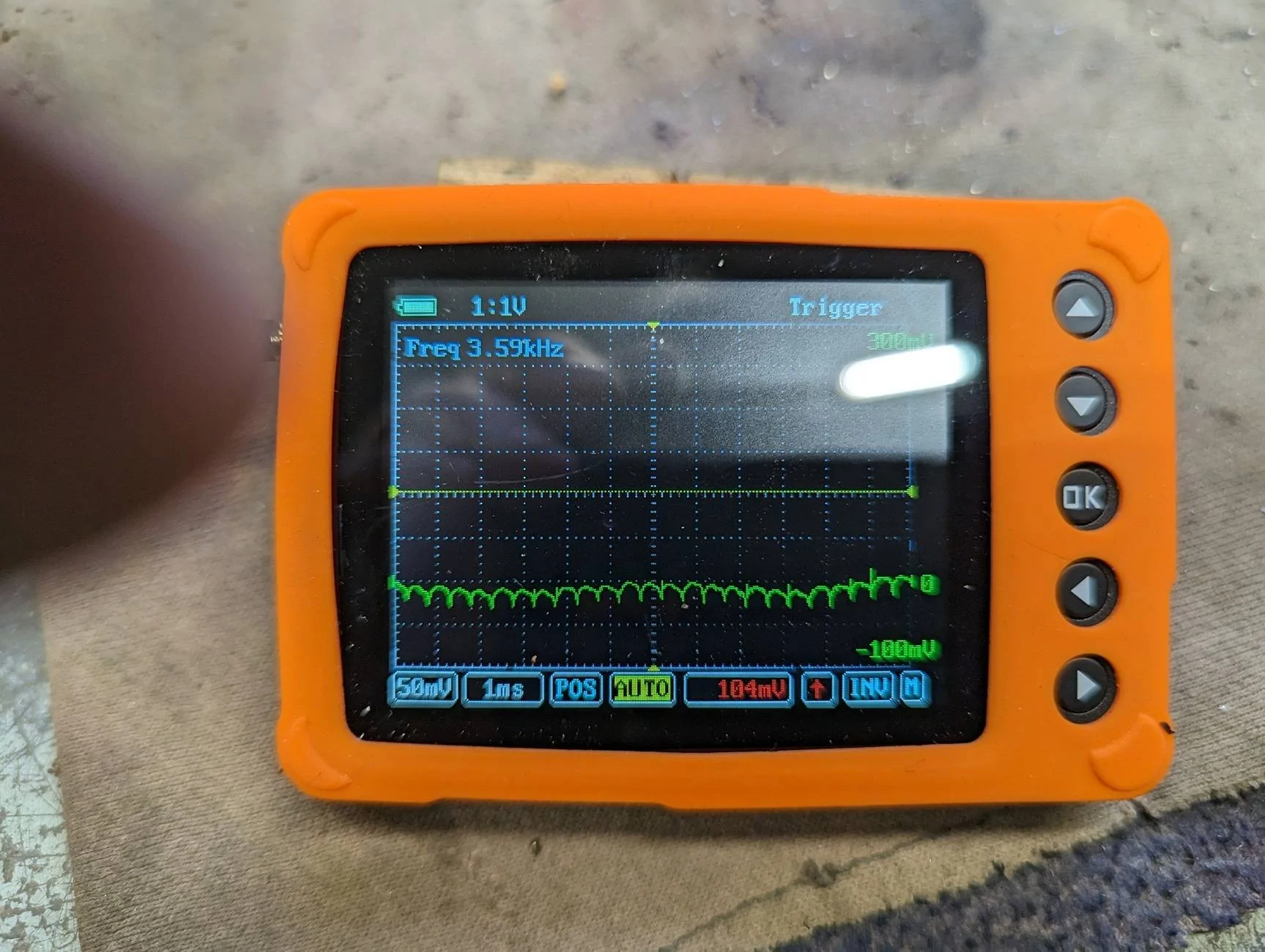
aeswave uScope single channel. Needed something quickly, had things to test.
Would like to get a bit better, larger scope at some point, but this one has worked ok so far.
There's some youtube videos out there on it, and they looked positive - other techs and mechanics using them.
OP
OP

Flanders
Well-Known Member
- Thread starter
- #48
I don't think so. It looks to me that the batteries are separated about 30ms before the starter relay closes and remain separated for cranking on the ESS restart. That apparent convergence before cranking is probably not the relay closing.For the ESS restart it looks to me like the batteries are equal for a while, but then the aux battery voltage drops below the main battery (indicating they are separated). This drop in voltage terminates the ESS event, the batteries are reconnected (back to identical voltage) and then both power the restart.
The cold start shows what it looks like when both batteries power the starter. The voltages fall together. The difference is at most 750mV, consistent with the expected voltage drop across the PCR, fuse and wiring carrying current on the order of 100A.
The ESS restart was different. MAIN fell a little lower than it did on the cold start, consistent with not having help from AUX. AUX held well above 10V, compared with a low of about 8.2V on the cold start. Why AUX fell even that far is subject to discussion, but it's clearly not, IMO, driving the starter.
Also, that's what the TSM describes and also the post you cited. If both batteries are involved in cranking in all cases then the AUX serves no purpose. Now, I wouldn't put it past a carmaker to implement such a complex system and later neuter it in firmware because they're being killed in warranty costs. But I hope not.
ShadowsPapa
Well-Known Member
- First Name
- Bill
- Joined
- Oct 12, 2019
- Threads
- 247
- Messages
- 40,483
- Reaction score
- 53,972
- Location
- Runnells, Iowa
- Vehicle(s)
- '25 JTMX, '23 JLU 4xe, '82 SX4, '73 Javelin
- Occupation
- Retired auto mechanic, frmr gov't ntwrk security admin
- Vehicle Showcase
- 3
As I've witnessed with alternator testing using a battery and carbon pile on my test bench - voltages will dip and rise on sort of a bounce when loads are applied or removed. It's not always clean. If there's a load the battery isn't 100% keeping up with and voltage is gradually falling, I've found that once the load is removed, the voltage doesn't always climb backup up on a nice even ramp.I don't think so. It looks to me that the batteries are separated about 30ms before the starter relay closes and remain separated for cranking on the ESS restart. That apparent convergence before cranking is probably not the relay closing.
Of course I'm talking about older batteries I still use for my test bench (it only needs a decent battery, not a "good" battery")
One of the ideas of this system is that they want to ensure a restart after an ESS stop.
A failure to start when parked somewhere is one thing, but a failure to restart in an intersection at a light or stop sign is something else completely.
I suspect that's why the ESS restarts are handled a bit differently, plus, it's a heck of a lot easier to crank and start a warm engine vs. a cold start. They spin a whole lot easier when warm. The PCM also knows where things are in the restart cycle - piston position, last injector fired and so on, making an ESS restart take a fraction of the work a cold start takes.
In short - this is, among other things, designed to ensure it's going to start while you are on the street at an intersection because failure there is more problematic than a failure to make a cold start in your driveway.
OP
OP
Flanders
Well-Known Member
- Thread starter
- #50
The >2V difference between N1 and N2, persisting over 100ms, is pretty convincing evidence that the relay joining them is not closed during the ESS restart. I wrote a lot of words before without making that point clearly.
Here's a silly experiment I did awhile back to prove this point to myself:
I put a 16 ohm resistor across the terminals of the main battery in my JT. It should draw around 800mA, a small load for an 87Ah battery.
Voltage on the terminals was 12.82 beforehand. It fell to 12.68V after 2 minutes and below 12.65V after 5 minutes, at which time I disconnected it. Total discharge was less than 80mAh, less than 0.1% of capacity.
It rebounded to 12.77V 5 minutes after disconnect and 12.80V after 20 minutes. A few hours later it was over 12.83V, higher than at the start.
A naive calculation of battery's internal resistance yields R = (12.82 - 12.68)V / 800mA = 175mOhm, and the naive conclusion is that this battery can only deliver 12.8V / 0.175Ohm = 73A before voltage on the terminals falls to zero.
Here's a Panasonic white paper that discusses non-linearity in voltage / current for AGM:
https://actec.dk/media/documents/68F4B35DD5C5.pdf
They cite the master's thesis of one Christopher Suozzo, which you can easily find online. It is an easy and worthwhile read. Among many interesting findings, he observed wide variations in resting voltage of the same fully charged SLI AGMs and significant capacity losses after only a few discharges.
I've seen this too. The internal resistance model is completely inadequate. Even the Randles model fails to predict real-world behavior outside the loads from which the parameters were established.As I've witnessed with alternator testing using a battery and carbon pile on my test bench - voltages will dip and rise on sort of a bounce when loads are applied or removed. It's not always clean. If there's a load the battery isn't 100% keeping up with and voltage is gradually falling, I've found that once the load is removed, the voltage doesn't always climb backup up on a nice even ramp.
Here's a silly experiment I did awhile back to prove this point to myself:
I put a 16 ohm resistor across the terminals of the main battery in my JT. It should draw around 800mA, a small load for an 87Ah battery.
Voltage on the terminals was 12.82 beforehand. It fell to 12.68V after 2 minutes and below 12.65V after 5 minutes, at which time I disconnected it. Total discharge was less than 80mAh, less than 0.1% of capacity.
It rebounded to 12.77V 5 minutes after disconnect and 12.80V after 20 minutes. A few hours later it was over 12.83V, higher than at the start.
A naive calculation of battery's internal resistance yields R = (12.82 - 12.68)V / 800mA = 175mOhm, and the naive conclusion is that this battery can only deliver 12.8V / 0.175Ohm = 73A before voltage on the terminals falls to zero.
Here's a Panasonic white paper that discusses non-linearity in voltage / current for AGM:
https://actec.dk/media/documents/68F4B35DD5C5.pdf
They cite the master's thesis of one Christopher Suozzo, which you can easily find online. It is an easy and worthwhile read. Among many interesting findings, he observed wide variations in resting voltage of the same fully charged SLI AGMs and significant capacity losses after only a few discharges.
Sponsored
ShadowsPapa
Well-Known Member
- First Name
- Bill
- Joined
- Oct 12, 2019
- Threads
- 247
- Messages
- 40,483
- Reaction score
- 53,972
- Location
- Runnells, Iowa
- Vehicle(s)
- '25 JTMX, '23 JLU 4xe, '82 SX4, '73 Javelin
- Occupation
- Retired auto mechanic, frmr gov't ntwrk security admin
- Vehicle Showcase
- 3
I haven't read as much or to the depth you have but ran across some of the same information over the years. Especially about capacity losses after xx discharges of yy depth and so on.The >2V difference between N1 and N2, persisting over 100ms, is pretty convincing evidence that the relay joining them is not closed during the ESS restart. I wrote a lot of words before without making that point clearly.
I've seen this too. The internal resistance model is completely inadequate. Even the Randles model fails to predict real-world behavior outside the loads from which the parameters were established.
Here's a silly experiment I did awhile back to prove this point to myself:
I put a 16 ohm resistor across the terminals of the main battery in my JT. It should draw around 800mA, a small load for an 87Ah battery.
Voltage on the terminals was 12.82 beforehand. It fell to 12.68V after 2 minutes and below 12.65V after 5 minutes, at which time I disconnected it. Total discharge was less than 80mAh, less than 0.1% of capacity.
It rebounded to 12.77V 5 minutes after disconnect and 12.80V after 20 minutes. A few hours later it was over 12.83V, higher than at the start.
A naive calculation of battery's internal resistance yields R = (12.82 - 12.68)V / 800mA = 175mOhm, and the naive conclusion is that this battery can only deliver 12.8V / 0.175Ohm = 73A before voltage on the terminals falls to zero.
Here's a Panasonic white paper that discusses non-linearity in voltage / current for AGM:
https://actec.dk/media/documents/68F4B35DD5C5.pdf
They cite the master's thesis of one Christopher Suozzo, which you can easily find online. It is an easy and worthwhile read. Among many interesting findings, he observed wide variations in resting voltage of the same fully charged SLI AGMs and significant capacity losses after only a few discharges.
Part of the reason I suggest people do a full charge, all 4 phases of a true AGM charger, then let it sit, are things like you touched.
Of course in the old days, we "removed the surface charge" with headlights, then turned them off, then let the battery sit a while, THEN measure the voltage. Too many charged, immediately measured, and said all is well.
Oops, gotta run....... wife's birthday tomorrow and that's when all heck breaks loose decorating everything for Christmas.
emiddio
Member
- First Name
- gary
- Joined
- May 16, 2024
- Threads
- 3
- Messages
- 19
- Reaction score
- 3
- Location
- snohomish, wa
- Vehicle(s)
- 2023 ecoDiesel gladiator sport s
- Occupation
- retired
You are missing two elephants in the room:
If they are truly isolated during the entire ESS stop, why does the main battery drop almost exactly the same as the aux battery
and
Look again at the technical service documents, training documents and the service manual.
It still isolates things during the crank, just not the entire time.
Thanks for the insight - Only truly disconnected during the actual Starting Event
emiddio
Member
- First Name
- gary
- Joined
- May 16, 2024
- Threads
- 3
- Messages
- 19
- Reaction score
- 3
- Location
- snohomish, wa
- Vehicle(s)
- 2023 ecoDiesel gladiator sport s
- Occupation
- retired
ESS said ready, selected battery Voltage for the Instrument display; came to a stop light;
Watching the battery V display when ESS shuts off engine; headlights on;
The Voltage begins dropping rapidly, within about 3 seconds the ESS starts up the engine;
Wondering what conclusions I can come too ?;
If both batteries are powering during ESS stop then seems both are weak?;
Since this Thread seems to conclude batteries only separated during the actual Starting Event and not during the Engine off duration of the ESS?;
Later in eve when get home, by putting in Neutral, then stop, turn off headlights, ESS is saying Ready again, then put in Drive, and ESS shuts off engine;
Watching Voltage display - drops more slowly, eventually reaching 12.3 V, and stays there;
After around 30 seconds put into Park and ESS restarts engine;
Let idle for a minute or so, watching Voltage creep back up - just idling;
Then shut off;
I monitor battery V - the LoJack device reports battery voltage; check it daily with App;
Usually have connected to a smart Battery Charger, max of 1.5 Amp charge;
But when don't, keep eye on Battery Voltage and always hook up to charger before Voltage drops to 12.6 V;
What does this data indicate?
Thanks
Watching the battery V display when ESS shuts off engine; headlights on;
The Voltage begins dropping rapidly, within about 3 seconds the ESS starts up the engine;
Wondering what conclusions I can come too ?;
If both batteries are powering during ESS stop then seems both are weak?;
Since this Thread seems to conclude batteries only separated during the actual Starting Event and not during the Engine off duration of the ESS?;
Later in eve when get home, by putting in Neutral, then stop, turn off headlights, ESS is saying Ready again, then put in Drive, and ESS shuts off engine;
Watching Voltage display - drops more slowly, eventually reaching 12.3 V, and stays there;
After around 30 seconds put into Park and ESS restarts engine;
Let idle for a minute or so, watching Voltage creep back up - just idling;
Then shut off;
I monitor battery V - the LoJack device reports battery voltage; check it daily with App;
Usually have connected to a smart Battery Charger, max of 1.5 Amp charge;
But when don't, keep eye on Battery Voltage and always hook up to charger before Voltage drops to 12.6 V;
What does this data indicate?
Thanks

Lost1wing
Well-Known Member
- First Name
- Tim
- Joined
- Dec 22, 2020
- Threads
- 24
- Messages
- 2,612
- Reaction score
- 2,877
- Location
- West Georgia
- Vehicle(s)
- 2020 Jeep Gladiator Rubicon
- Occupation
- Retired AMT
You could still have one bad battery dragging the other down with it.
What was the ESS message after the engine started, battery charging, not ready, or cabin heating cooling? I agree, something is not right to have ESS to start the engine that quick.
What was the ESS message after the engine started, battery charging, not ready, or cabin heating cooling? I agree, something is not right to have ESS to start the engine that quick.
Sponsored
Lost1wing
Well-Known Member
- First Name
- Tim
- Joined
- Dec 22, 2020
- Threads
- 24
- Messages
- 2,612
- Reaction score
- 2,877
- Location
- West Georgia
- Vehicle(s)
- 2020 Jeep Gladiator Rubicon
- Occupation
- Retired AMT
12.3vdc is actually pretty good considering the engine is off and you have several items causing this voltage drop. Your 12.6vdc is okay but a good time to put the charger on it. The ESS should tell you why the engine restarted during an ess event. I have only seen this when the cabin temp is out of range of selected temp. I have not seen it for the battery voltage dropping too low, but it is supposed to.
ShadowsPapa
Well-Known Member
- First Name
- Bill
- Joined
- Oct 12, 2019
- Threads
- 247
- Messages
- 40,483
- Reaction score
- 53,972
- Location
- Runnells, Iowa
- Vehicle(s)
- '25 JTMX, '23 JLU 4xe, '82 SX4, '73 Javelin
- Occupation
- Retired auto mechanic, frmr gov't ntwrk security admin
- Vehicle Showcase
- 3
mine has dropped as low as 12.0 volts before a restart. But then, the batteries are good, and I try to keep things charged. Some of our lights here are long and it might restart due to timing, or cabin temp and so on. I've even had it work fine and hold voltage above 12.1 or so when I had the seat heat and steering wheel heat on and those take some draw.12.3vdc is actually pretty good considering the engine is off and you have several items causing this voltage drop. Your 12.6vdc is okay but a good time to put the charger on it. The ESS should tell you why the engine restarted during an ess event. I have only seen this when the cabin temp is out of range of selected temp. I have not seen it for the battery voltage dropping too low, but it is supposed to.

jebiruph
Well-Known Member
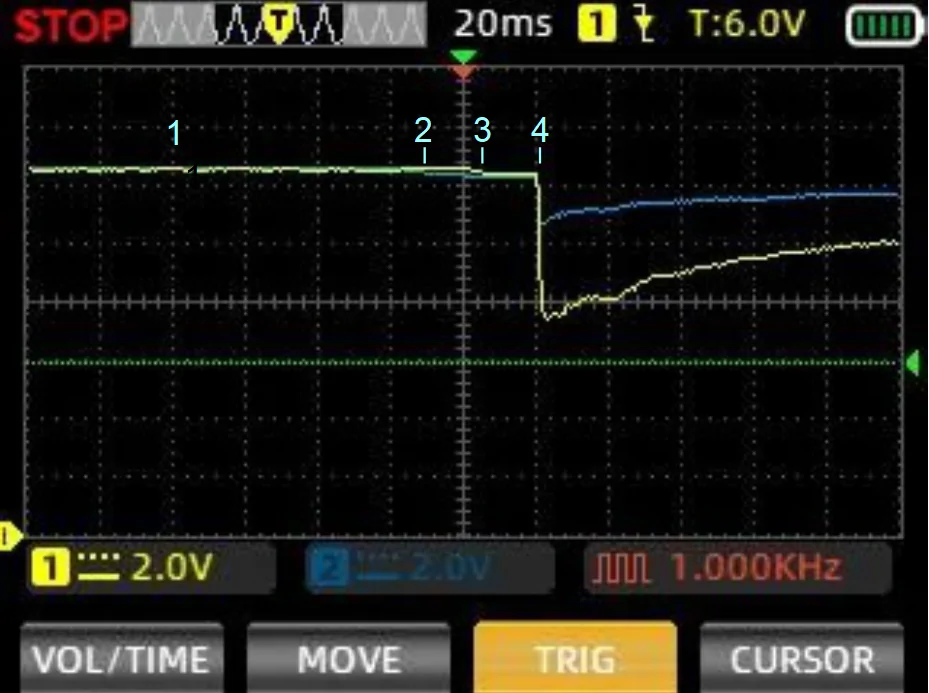
When @Flanders posted the ESS restart oscilloscope image, I was surprised that people viewing the image were drawing exact opposite conclusions. Over the past few months I've tried to come up with other ways (without modifying or risky damage to my system) to determine what actually happens with the batteries during an ESS stop, but I have not been successful and the oscilloscope image is still the best source of information.
Keep in mind that since the voltages are taken from different points in the circuit, it's more important to look for simultaneous changes in the voltages as opposed to how close the voltages are to each other. Here's my write up of what I see happening during the restart as shown by the oscilloscope image. I've added numbers to the image as points of reference.

1. When the image is enlarged, it's easier to see that while the aux battery (blue line) and main battery (yellow line) voltages are similar, they are not identical. The aux battery voltage appears flat until it starts dropping, while the main battery voltage is fluctuating. This difference between the voltage changes indicates the batteries are separated.
2. Here the voltage of both batteries starts going down, but not at the same time indicating that the batteries are still separated.
3. Now neither voltage is changing indicating a possible reconnection.
4. This is when power is applied to the starter and both voltages drop simultaneously and follow a similar pattern indicating that the batteries are connected and both are powering the starter on a restart.
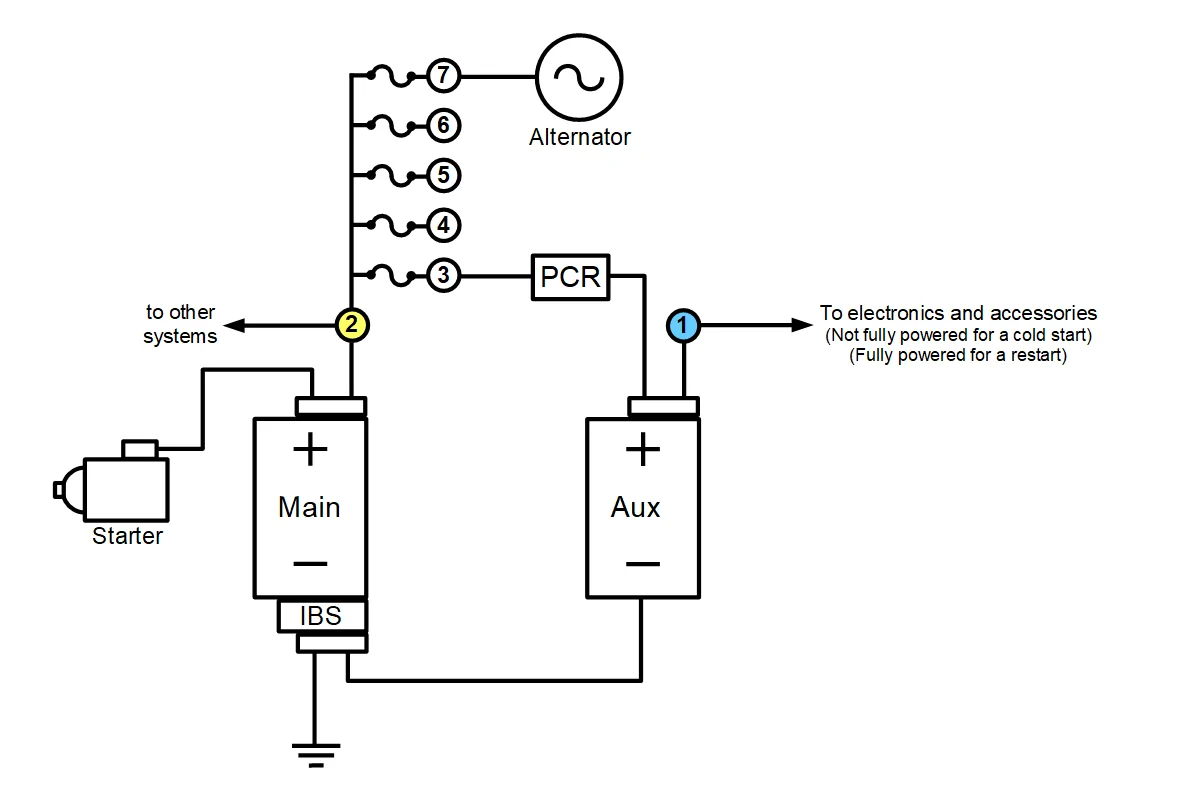
Some have questioned why the aux battery voltage did not drop as far on the restart as it did on the cold start. I'll refer to the next diagram to explain what is happening.

As I indicate on the diagram, the aux battery voltage is taken from PDC terminal N1. N1 also connects to electronics and accessories. During a cold start, minimal electronics and accessories are powered up and they have minimal effect on the voltage reading at N1.
But during a restart, the electronics and accessories are fully powered. The additional voltage present in the system from the fully powered electronics and accessories will prevent the voltage reading at N1 from dropping as much as it did during the cold start.
Also, as a result of this additional ESS monitoring over the past few months, I have a theory that the reason for the increase in the alternator voltage during deceleration is to increase the voltage present in the system so more power is available for a potential ESS stop.
Feel free to comment on my conclusions.
Keep in mind that since the voltages are taken from different points in the circuit, it's more important to look for simultaneous changes in the voltages as opposed to how close the voltages are to each other. Here's my write up of what I see happening during the restart as shown by the oscilloscope image. I've added numbers to the image as points of reference.
1. When the image is enlarged, it's easier to see that while the aux battery (blue line) and main battery (yellow line) voltages are similar, they are not identical. The aux battery voltage appears flat until it starts dropping, while the main battery voltage is fluctuating. This difference between the voltage changes indicates the batteries are separated.
2. Here the voltage of both batteries starts going down, but not at the same time indicating that the batteries are still separated.
3. Now neither voltage is changing indicating a possible reconnection.
4. This is when power is applied to the starter and both voltages drop simultaneously and follow a similar pattern indicating that the batteries are connected and both are powering the starter on a restart.
Some have questioned why the aux battery voltage did not drop as far on the restart as it did on the cold start. I'll refer to the next diagram to explain what is happening.
As I indicate on the diagram, the aux battery voltage is taken from PDC terminal N1. N1 also connects to electronics and accessories. During a cold start, minimal electronics and accessories are powered up and they have minimal effect on the voltage reading at N1.
But during a restart, the electronics and accessories are fully powered. The additional voltage present in the system from the fully powered electronics and accessories will prevent the voltage reading at N1 from dropping as much as it did during the cold start.
Also, as a result of this additional ESS monitoring over the past few months, I have a theory that the reason for the increase in the alternator voltage during deceleration is to increase the voltage present in the system so more power is available for a potential ESS stop.
Feel free to comment on my conclusions.

sharpsicle
Well-Known Member
- Joined
- Apr 29, 2021
- Threads
- 22
- Messages
- 2,772
- Reaction score
- 6,271
- Location
- Tampa, FL / Milwaukee, WI
- Vehicle(s)
- 2020 Gladiator Overland, 2002 VTX1800
I don't agree with your assessment. Point 4 shows the batteries are separate, and that the draw of the starter on the main creates a larger drop in voltage than the now isolated draw of the electronics on the aux battery. This makes complete sense.
Points 2 and 3 aren't saying anything meaningful other than being an extremely minor reading discrepancy that can happen in any dual-battery setup. As you said, "Keep in mind that since the voltages are taken from different points in the circuit, it's more important to look for simultaneous changes in the voltages as opposed to how close the voltages are to each other" so these should be ignored.
The drop occurring at the same time is because it's one action creating a coordinated change on 2 voltage sources, but not necessarily because they're powering the same thing. In fact, if they were both powering the starter, they would need independent and isolated connections to the starter for you to get two separate voltage readings in the magnitude shown. We know this isn't present.
What's really happening is that the aux now has to do more work to cover what the main was helping with before, hence the simultaneous voltage drop but not as much as the main experiences. This aligns with the intent and design of the system.
From what you've posted, you've really proven that the batteries do separate at the moment of restart and have unequal load (one for the starter, the other for electronics).
Points 2 and 3 aren't saying anything meaningful other than being an extremely minor reading discrepancy that can happen in any dual-battery setup. As you said, "Keep in mind that since the voltages are taken from different points in the circuit, it's more important to look for simultaneous changes in the voltages as opposed to how close the voltages are to each other" so these should be ignored.
The drop occurring at the same time is because it's one action creating a coordinated change on 2 voltage sources, but not necessarily because they're powering the same thing. In fact, if they were both powering the starter, they would need independent and isolated connections to the starter for you to get two separate voltage readings in the magnitude shown. We know this isn't present.
What's really happening is that the aux now has to do more work to cover what the main was helping with before, hence the simultaneous voltage drop but not as much as the main experiences. This aligns with the intent and design of the system.
From what you've posted, you've really proven that the batteries do separate at the moment of restart and have unequal load (one for the starter, the other for electronics).
ShadowsPapa
Well-Known Member
- First Name
- Bill
- Joined
- Oct 12, 2019
- Threads
- 247
- Messages
- 40,483
- Reaction score
- 53,972
- Location
- Runnells, Iowa
- Vehicle(s)
- '25 JTMX, '23 JLU 4xe, '82 SX4, '73 Javelin
- Occupation
- Retired auto mechanic, frmr gov't ntwrk security admin
- Vehicle Showcase
- 3
I've connected two meters and watched them drop in lockstep. Also, the schematics show what each powers. That little battery can't handle the load by itself, and, why would the main drop in voltage at all? It only directly powers about three things, all high current, and they are off during an ESS stop.I don't agree with your assessment. Point 4 shows the batteries are separate, and that the draw of the starter on the main creates a larger drop in voltage than the now isolated draw of the electronics on the aux battery. This makes complete sense.
Points 2 and 3 aren't saying anything meaningful other than being an extremely minor reading discrepancy that can happen in any dual-battery setup. As you said, "Keep in mind that since the voltages are taken from different points in the circuit, it's more important to look for simultaneous changes in the voltages as opposed to how close the voltages are to each other" so these should be ignored.
The drop occurring at the same time is because it's one action creating a coordinated change on 2 voltage sources, but not necessarily because they're powering the same thing. In fact, if they were both powering the starter, they would need independent and isolated connections to the starter for you to get two separate voltage readings in the magnitude shown. We know this isn't present.
What's really happening is that the aux now has to do more work to cover what the main was helping with before, hence the simultaneous voltage drop but not as much as the main experiences. This aligns with the intent and design of the system.
From what you've posted, you've really proven that the batteries do separate at the moment of restart and have unequal load (one for the starter, the other for electronics).
And, a tech doc shows how it functions.
The reason there's any difference shown is voltage drop across wires, relays, connectors, and differs battery abilities.
The drop will never be identical and one can demonstrate that in the shop with multiple batteries in parallel.
Sponsored
Similar threads


- Replies
- 13
- Views
- 4,716


- Replies
- 22
- Views
- 2,751

- Replies
- 43
- Views
- 5,825
