Sponsored

Can’t figure out odd voltage numbers

theSubdude

Member
First Name
Johnnie
Joined
Jun 7, 2020
Threads
2
Messages
13
Reaction score
14
Location
Arroyo Seco, New Mexico
Vehicle(s)
Jeep Gladiator, BMW R1200 GS, Husqvarna 501
Occupation
Artist
2021 Mojave 29k: Returning from a 300 mile trip, my battery voltage gauge dropped from 14.2v to 12.6v. while highway driving. The odd thing is if I take my foot off the accelerator, it goes back to 14.2v, the moment that I touch the accelerator it drops back to 12.6v. Idle is 12.6v. Off, 12.2v according to the gauge. After sitting for a few days it goes back up to the 14v range and all is happy, until i put a few hundred miles on ???? Help.
Sponsored


 

Erievon

Well-Known Member
First Name
Al
Joined
Apr 20, 2020
Threads
1
Messages
695
Reaction score
933
Location
Cleveland, OH
Vehicle(s)
2023 JTR., 2021 JLU Altitude
Occupation
International Banker
Just means your batteries are fully charged. This is a good thing. Once the Jeep considers your batteries topped off it backs the voltage down to just what it needs. "Adaptive Charging".
 

hjdca

Well-Known Member
Joined
Oct 27, 2019
Threads
9
Messages
1,733
Reaction score
2,494
Location
Southern California Mountains
Vehicle(s)
Jeep Gladiator Rubicon manual Sting Gray
Build Thread
Link
2021 Mojave 29k: Returning from a 300 mile trip, my battery voltage gauge dropped from 14.2v to 12.6v. while highway driving. The odd thing is if I take my foot off the accelerator, it goes back to 14.2v, the moment that I touch the accelerator it drops back to 12.6v. Idle is 12.6v. Off, 12.2v according to the gauge. After sitting for a few days it goes back up to the 14v range and all is happy, until i put a few hundred miles on ???? Help.
Note: The Gladiator has a "smart" charging system. It purposely reduces charging voltage when you have your foot into the gas --- this reduces drag on the motor, reduces emissions, increases mileage. It increases charging voltage when you are coasting, ie. possibly coming to a stop.... The idea is to save energy and charge the batteries when you want to scrub off energy.
 
OP
OP

theSubdude

Member
First Name
Johnnie
Joined
Jun 7, 2020
Threads
2
Messages
13
Reaction score
14
Location
Arroyo Seco, New Mexico
Vehicle(s)
Jeep Gladiator, BMW R1200 GS, Husqvarna 501
Occupation
Artist
Thank you, I thought of something like that, but I am just an old school guy, and smart charging is too smart for my simple old mind.
 

Sponsored

Hootbro

Well-Known Member
First Name
Don
Joined
Apr 13, 2019
Threads
57
Messages
10,204
Reaction score
19,988
Location
Delaware
Vehicle(s)
2025 Gladiator Sport
What @Erievon said. There is a clutch on the alternator belt pulley that is electronically controlled to engage on demand and supply voltage as needed rather than a constant voltage like the old school alternators. Incremental small gas savings and also better on the batteries.
 

Rocksalt

Banned
Banned
Joined
Aug 13, 2019
Threads
24
Messages
1,581
Reaction score
1,898
Location
Illinois
Vehicle(s)
2020 Jeep Gladiator Sport
2021 Mojave 29k: Returning from a 300 mile trip, my battery voltage gauge dropped from 14.2v to 12.6v. while highway driving. The odd thing is if I take my foot off the accelerator, it goes back to 14.2v, the moment that I touch the accelerator it drops back to 12.6v. Idle is 12.6v. Off, 12.2v according to the gauge. After sitting for a few days it goes back up to the 14v range and all is happy, until i put a few hundred miles on ???? Help.
mine does same
 

ShadowsPapa

Well-Known Member
First Name
Bill
Joined
Oct 12, 2019
Threads
247
Messages
40,465
Reaction score
53,924
Location
Runnells, Iowa
Vehicle(s)
'25 JTMX, '23 JLU 4xe, '82 SX4, '73 Javelin
Occupation
Retired auto mechanic, frmr gov't ntwrk security admin
Vehicle Showcase
3
Like already said - the ECM controls the output and uses engine torque, battery temperature, battery state of charge (SoC) to determine need.
If it sees the batteries are hot, or fully charged, it simply cuts current to the rotor, which is the field winding in an alternator, and it simply spins with no load.
Frankly, it's never actually not charging at all except under heavy acceleration when the battery's SoC is deemed high. Then the field current is cut to 0 to take the load off the engine.

Otherwise, at about 12.6-12.7, it's simply putting out only enough to maintain that voltage.
The load of the running engine - the fans, fuel pump, injector firing, ignition system, EHPS and more dictate that there's always some output otherwise you'd see voltages below 12.6.
So no, the alternator isn't ever "off" except when you really hit that throttle, and then it cuts field current to nothing until it sees a reduced need for torque, or the voltage drops below a set level
If it completely shut off, you'd see the voltage drop pretty quickly. So it's always doing something, but dropping the voltage down like that is to maintain the running systems and not be high enough to charge the batteries.
At 12.6, that alternator is still charging. If it stopped completely, you'd soon see voltages drop to the lower 12s. Proof of that is watch the main battery voltage during an ESS stop - it drops fairly quickly after only a minute or so.

These aren't regulated at a constant voltage like in the past with the Delco 10si, 12si and others that had internal regulation set at about 14.2 volts, or even others with an external regulator that throttled the field current to maintain that voltage.
These use the PCM to handle output based on the historical data, temperatures, loads and so on, reported by the IBS (Intelligent Battery Sensor)


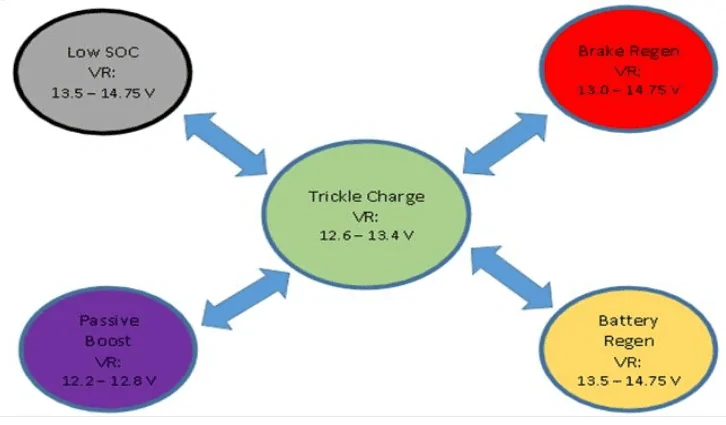
Jeep Gladiator Can’t figure out odd voltage numbers 1681928202886


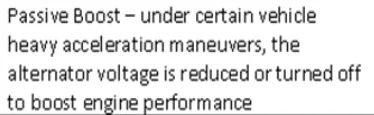
The purple is "passive boost" where the voltage to the field is cut off to allow heavy acceleration -

Jeep Gladiator Can’t figure out odd voltage numbers 1681928480091


Clutch functioning would see the voltage drop into the 12.2-12.6 range or so. You'll know if a clutch disengages, voltage will drop.
But if it's at 12.6 or above, it's likely still engaged to maintain the heavy load of a running engine but the field current will have been cut drastically to "trickle" or "maintenance" mode.
If you nail the throttle, really need that engine to put out and you mash it, don't be shocked by a voltage below 12.6 for a short time. That's because it's fully disengaged - no field current, rotor not spinning at all. Normal, unless it doesn't recover when you let up on the throttle.
 

ShadowsPapa

Well-Known Member
First Name
Bill
Joined
Oct 12, 2019
Threads
247
Messages
40,465
Reaction score
53,924
Location
Runnells, Iowa
Vehicle(s)
'25 JTMX, '23 JLU 4xe, '82 SX4, '73 Javelin
Occupation
Retired auto mechanic, frmr gov't ntwrk security admin
Vehicle Showcase
3
and also better on the batteries.
Remember the days of a bad voltage regulator and boiling the battery?
We should be thankful that at least much of the time, these are "smart" systems.
 

Sponsored

Rocksalt

Banned
Banned
Joined
Aug 13, 2019
Threads
24
Messages
1,581
Reaction score
1,898
Location
Illinois
Vehicle(s)
2020 Jeep Gladiator Sport
mine is a new AGM battery (aux was disconnected) and it appears a folks have said, these will have variable charging
 
OP
OP

theSubdude

Member
First Name
Johnnie
Joined
Jun 7, 2020
Threads
2
Messages
13
Reaction score
14
Location
Arroyo Seco, New Mexico
Vehicle(s)
Jeep Gladiator, BMW R1200 GS, Husqvarna 501
Occupation
Artist
I sure do remember. The gauges, the needle pointed straight up, a “-“ on one side “+” on the other. When you left the ignition on with the motor off, “-“ when the motor started it would tick “+” for a bit. When you hooked some aux light poorly the upright needle would swing way “-“ right, a few moments before the glass fuse blew!
 

ShadowsPapa

Well-Known Member
First Name
Bill
Joined
Oct 12, 2019
Threads
247
Messages
40,465
Reaction score
53,924
Location
Runnells, Iowa
Vehicle(s)
'25 JTMX, '23 JLU 4xe, '82 SX4, '73 Javelin
Occupation
Retired auto mechanic, frmr gov't ntwrk security admin
Vehicle Showcase
3
ugh, the dreaded ammeter. Was sooo glad when auto makers got smart and used volt meters instead. That tells so much more about things.
Automotive electric followed the lead of tractors and ag equipment for years. That meant alternators because it was so easy for anyone to see it's either charging or discharging.

Voltage was regulated to a steady state. As long as the alternator could handle the load on the system, the voltage stayed at the regulated point. Voltage dropped when the alternator wasn't keeping up.
At first they were mechanical then one car maker decided to use a fully transistorized regulator system.
When used in ag and marine applications, those systems had the transistorized regulator attached to the back of the alternator.
Later Dayton Electric Corp took that a step further and put the regulator inside the alternator case for GM - the 10si.

It went from there - by the 1990s, Jeep (and others) had integrated voltage regulation into the PCM instead of inside the alternator, or a discrete component, but it still wasn't very smart and ran a constant regulated voltage of a bit over 14 volts. with the 1990s Jeep version you could use a 1970s MOPAR voltage regulator if the PCM regulation failed because it was a type A field. No need to replace the whole PCM.

Today it's even more complex with the IBS and other things reporting in and all of that information controlling the voltage output of the alternator - all done via controlling the field current to the rotor, or in the extreme case of max engine output needed, totally disengaging the spinning rotor which does have weight or mass and a resistance to acceleration.


Top