
Flanders
Well-Known Member
- Thread starter
- #1
The Battery Tender 5A is a 3-stage constant-voltage charger. The Costco in Reno was selling them for $46.99 over the holidays. I had already borrowed a 12-bit oscilloscope when I was in town and I thought this might be fun.
The rest of this post is scope traces and observations. Kindly move along if this sort of thing is not your bag, baby.

Yellow is current, pink is voltage in the traces. The color scheme has grown on me.
Edit: I forgot to describe the setup. Current is calculated by measuring voltage across a 0.1 ohm resistor (1%, 2W, metal film) in series between the negative clamp and the top plate of the IBS. Voltage is measured across the charger's clamps. This is what the charger sees.
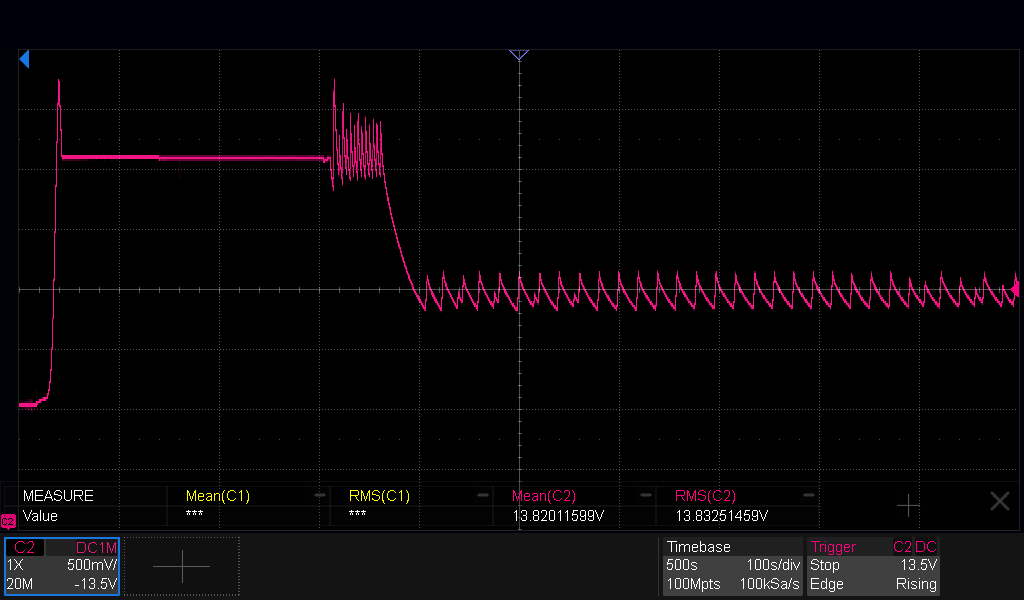
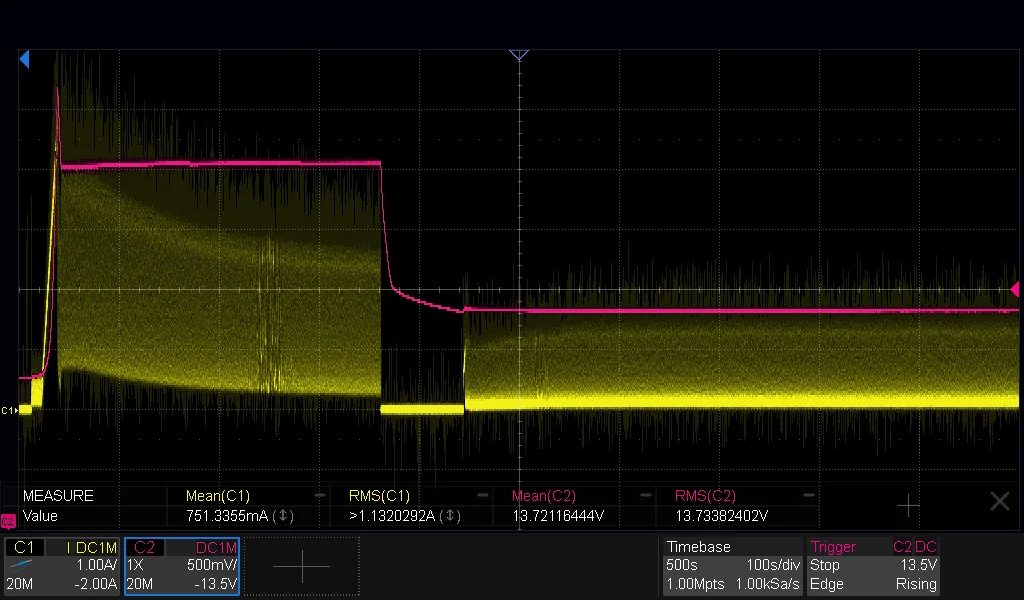
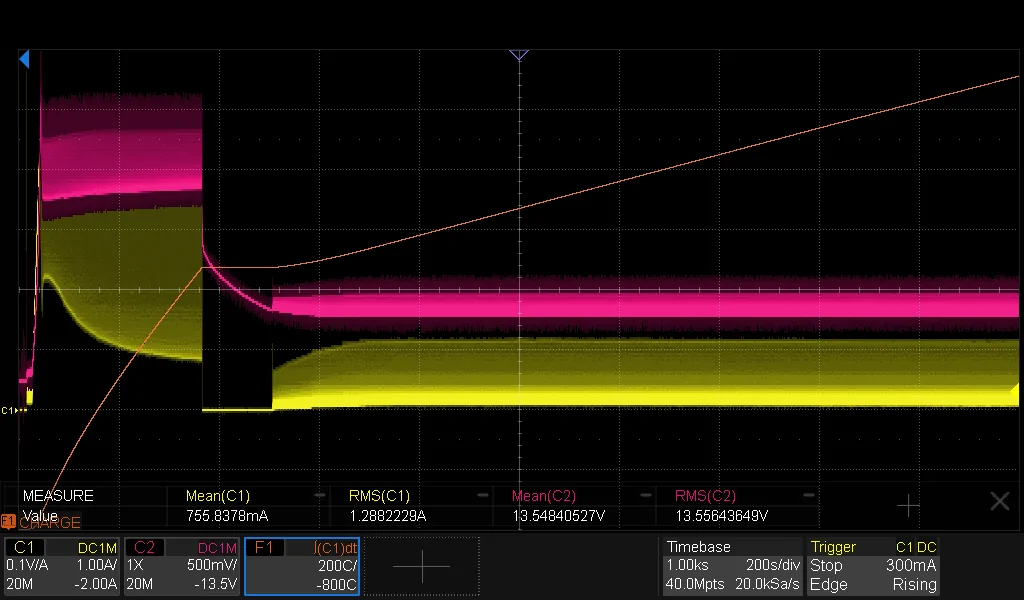
My JT had sat for about 9 days. It should need 2.5-3Ah. The temperature is 50-55F. The Battery Tender 5A did this:

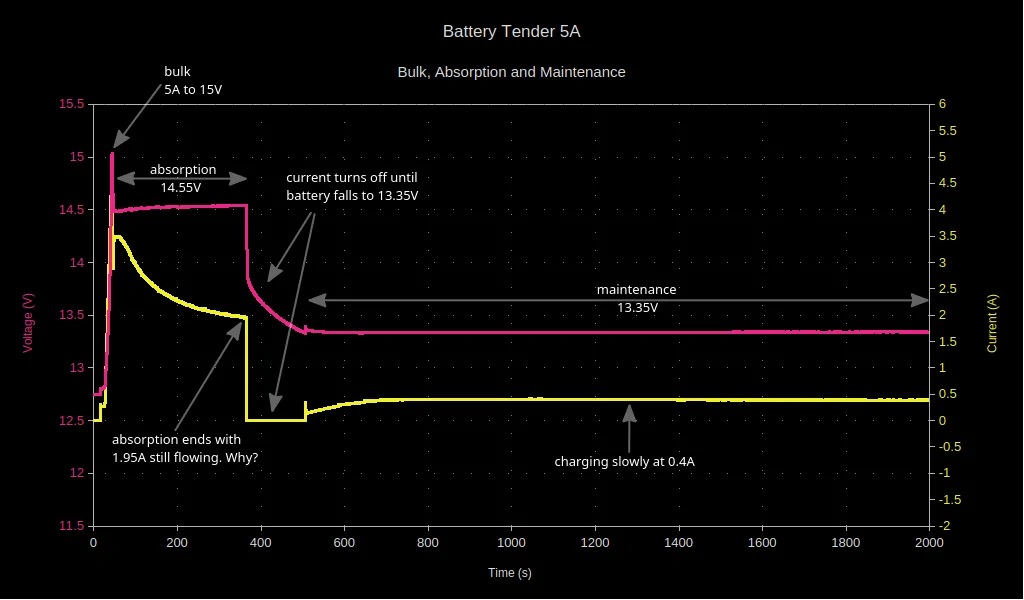
Downsampling from 20kHz to 10Hz cleaned it up nicely:
I'm guessing it's designed for 14.40V absorption, 13.20V maintenance, and temperature compensation is +0.15V.
Disappointingly, it ended absorption after about 6 minutes, with the battery still accepting ~2A, and having only delivered 900C = 0.25Ah or 10% of the expected charge needed.
It's still charging in maintenance mode and will eventually get near a full charge. It's just going to take a long time.
The 13.20V maintenance voltage is commonly used because it minimizes corrosion due to oxygen at the positive plate. Oxygen is produced by electrolysis of water, increasing exponentially with higher voltage, and by self-discharge reactions at lower voltages; 13.2V is approximately the sweet spot. This is not a proper float voltage and won't prevent slow self-discharge at the negative plate.
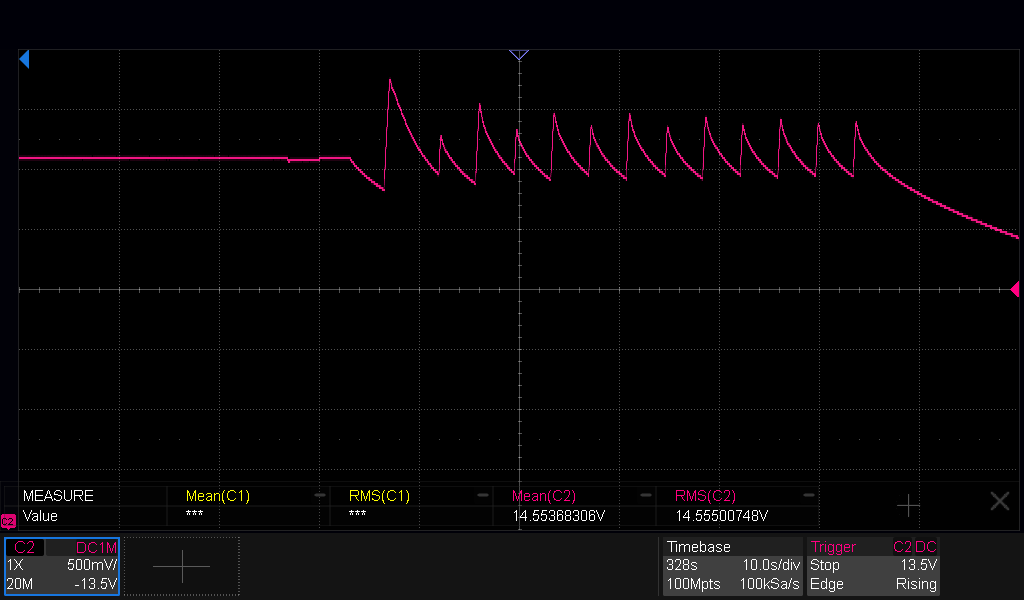
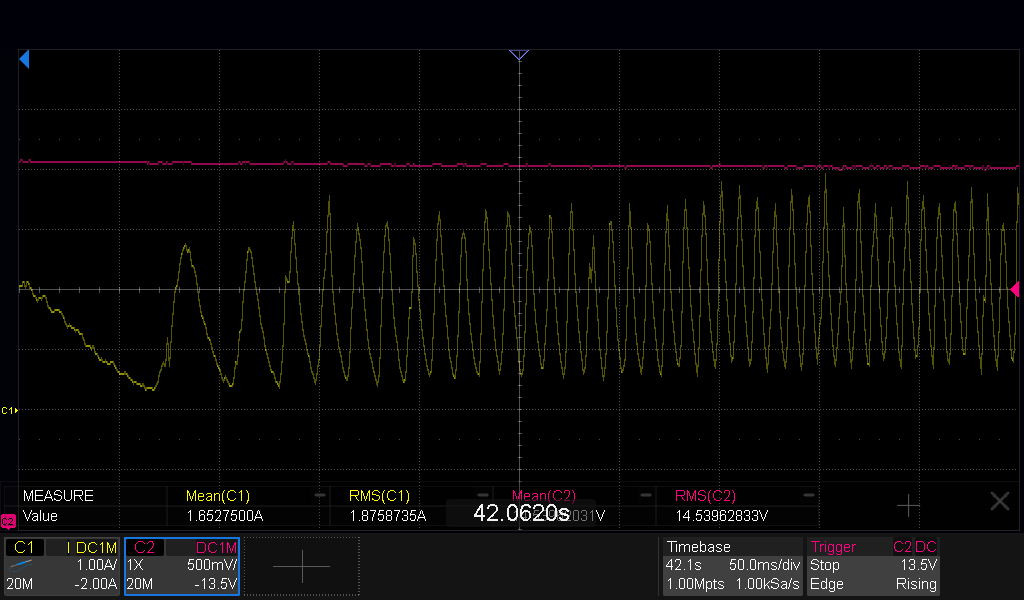
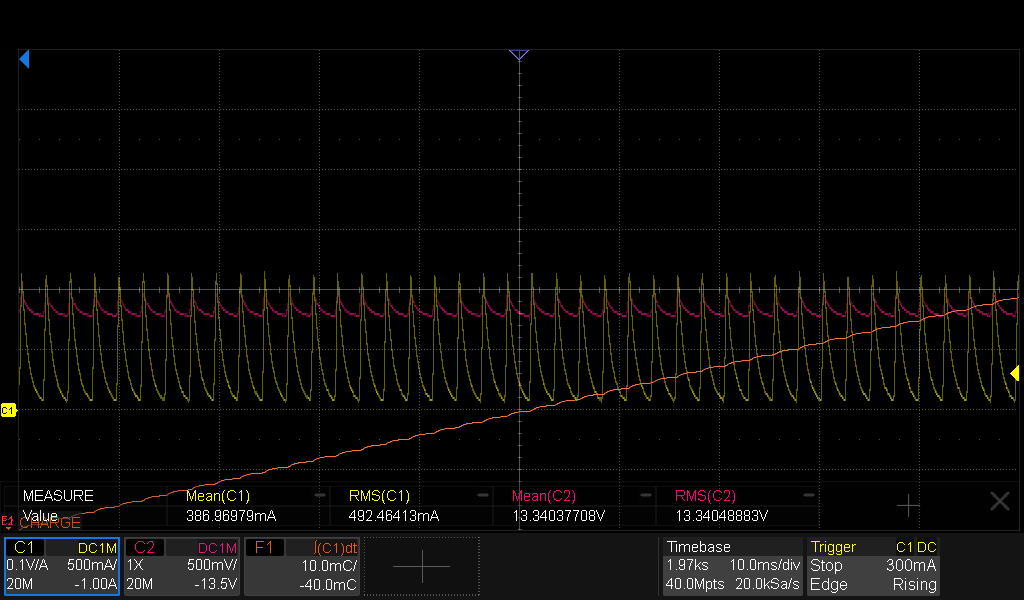
A closer look from the last 30 seconds of the waveform:
The voltage swings are 200mV peak-to-peak. That's within 0.5% and good enough.
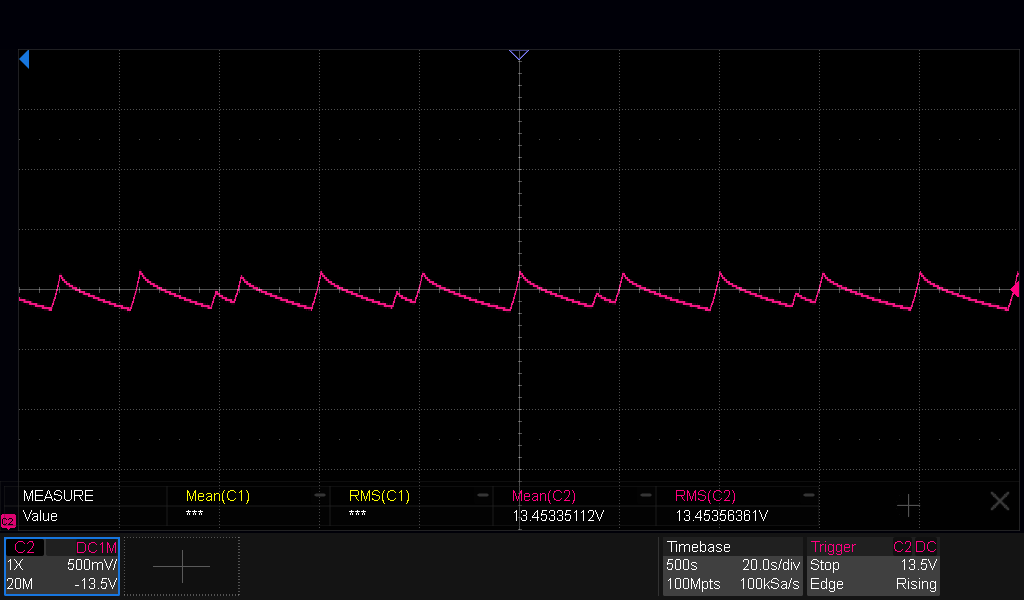
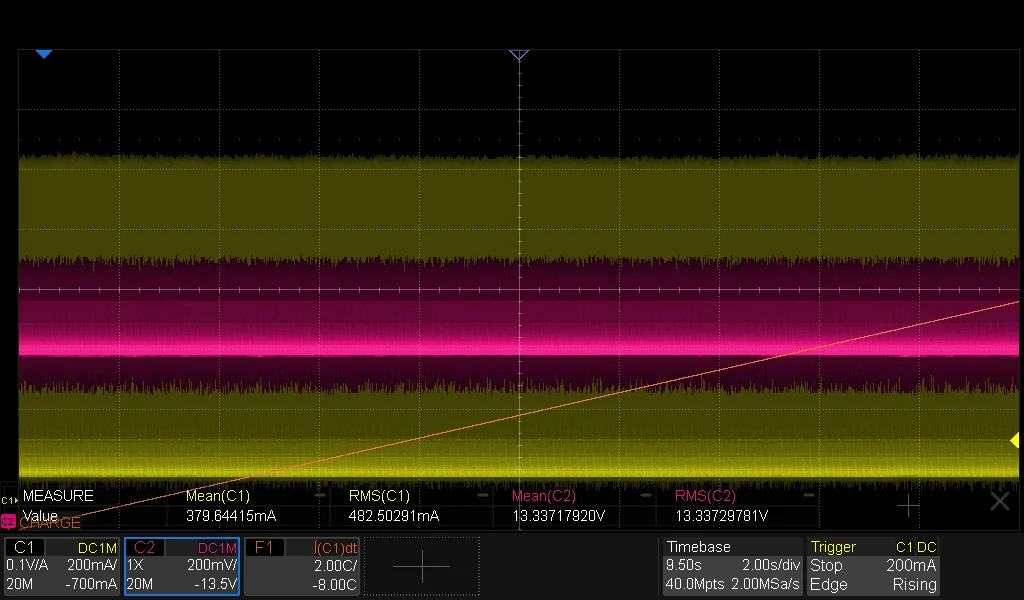
I used a Victron Blue Smart IP22 in power supply mode to hold it at 13.4V overnight. The Victron is in another league from these 1-button chargers, and its voltage regulation is much better.
Battery Tender 5A:
Victron:
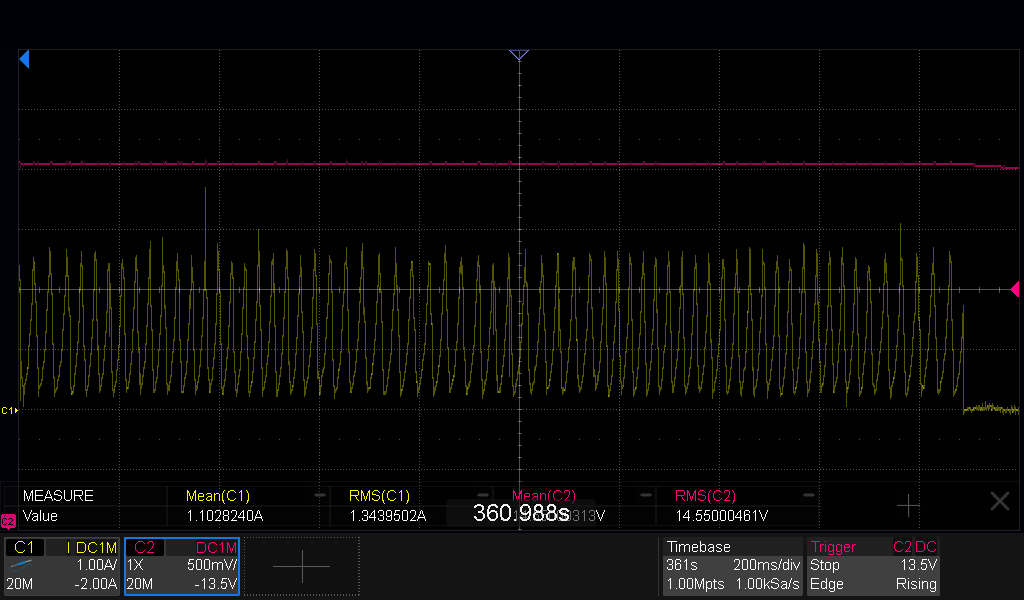
Charging current had fallen below 40mA by the next morning. I gave the Battery Tender another go:
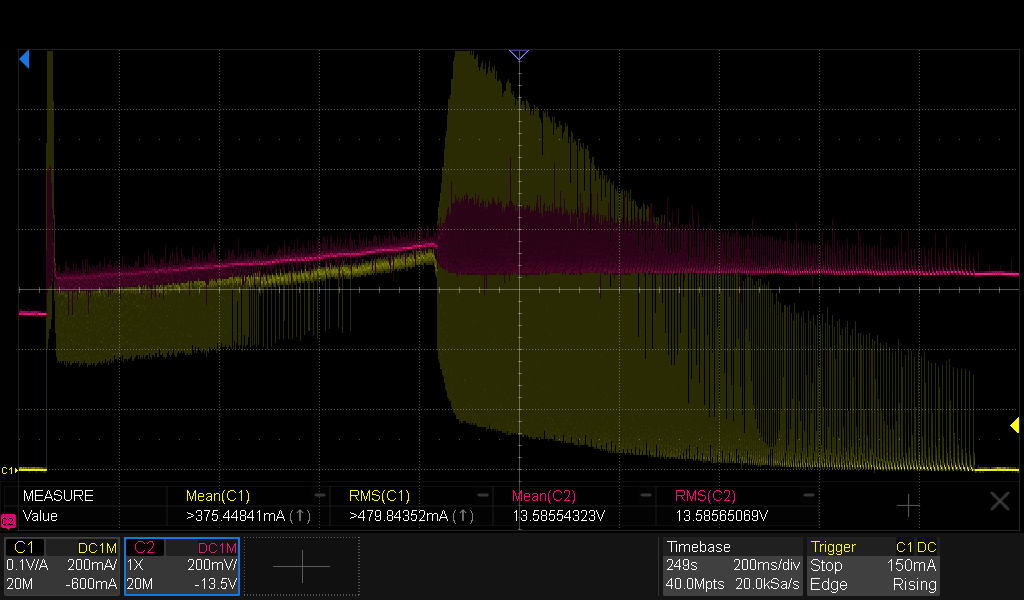
A closer look at the first 100 seconds:
That last flat section of pink is 20 seconds of decent regulation. Why doesn't it do that all the time?
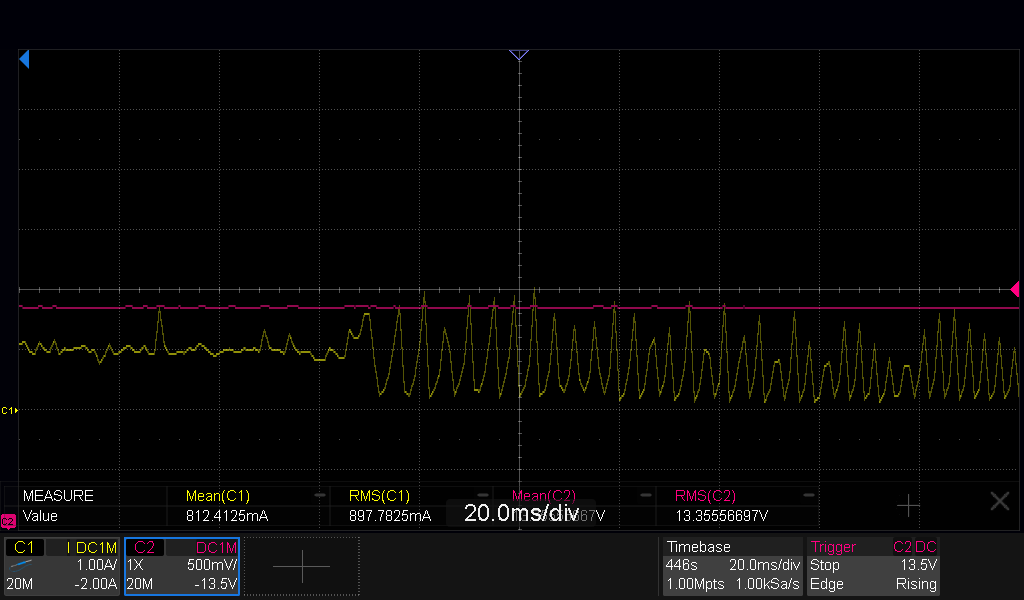
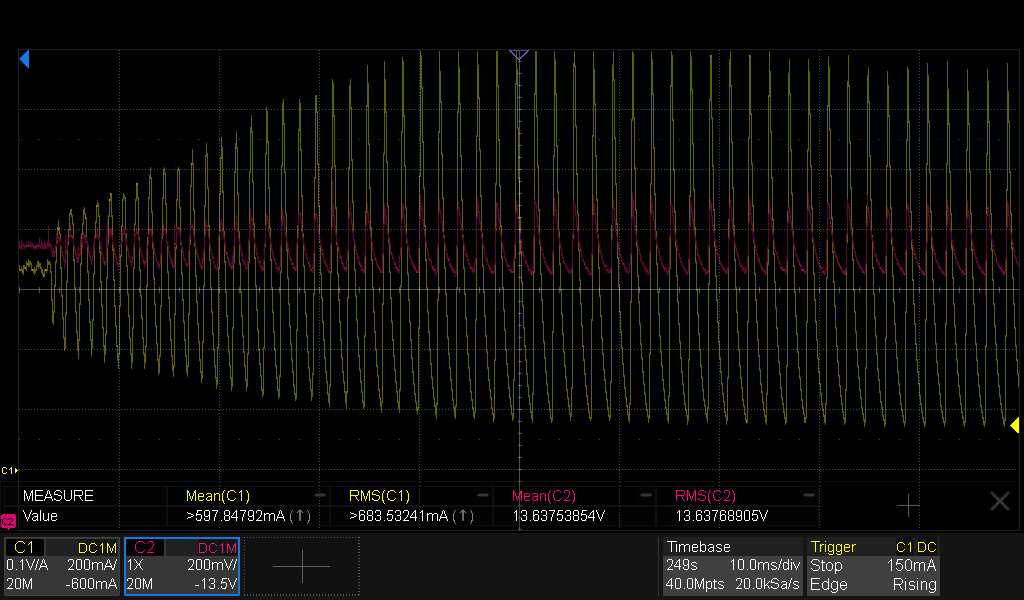
Between pulses, no current flows.
The pulses last less than 2 seconds and oscillate wildly at about 500Hz.
After the first run, I improved my measurement technique to reduce inductance and gave the BT5 another shot, on a flooded lead acid battery discharged lightly by turning on the headlights for 2 minutes.
It ended absorption after 6 minutes, about the same as before, this time with 1A flowing. The trace looks cleaner but not much different.
Voltage and current ramp up smoothly during startup with no oscillation until it reaches the constant voltage absorption stage.
400mV peak-to-peak at the start of absorption.
100mV peak-to-peak in maintenance.
Voltage regulation blows up once charging current drops below about 100mA.
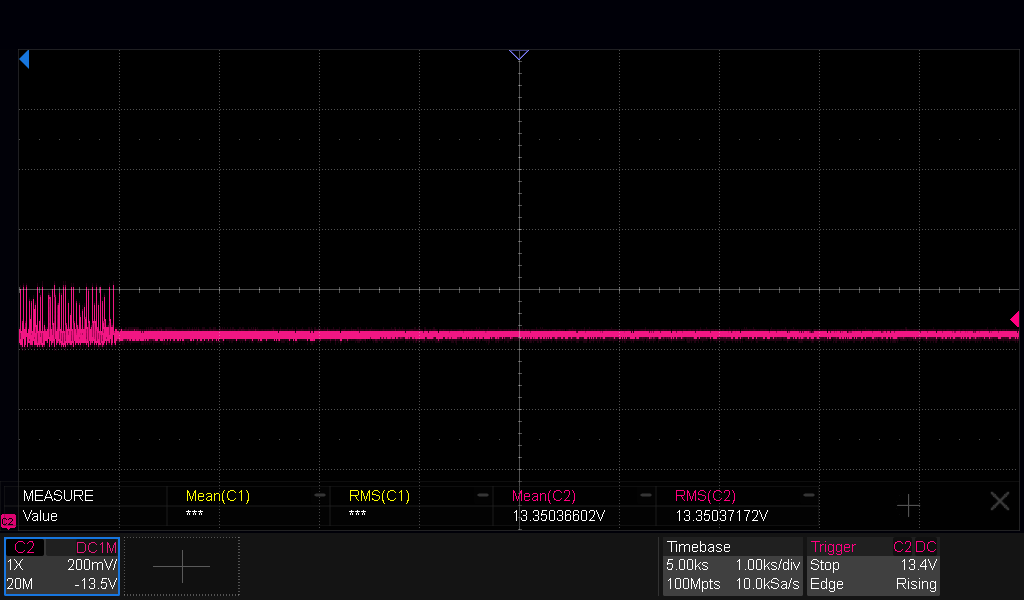
A 10,000-second capture of maintenance. These new scopes are nice.
The first 500 seconds looks like before.
The trace looks cleaner after 2700s. Something different is happening:
The BT5 can regulate voltage!
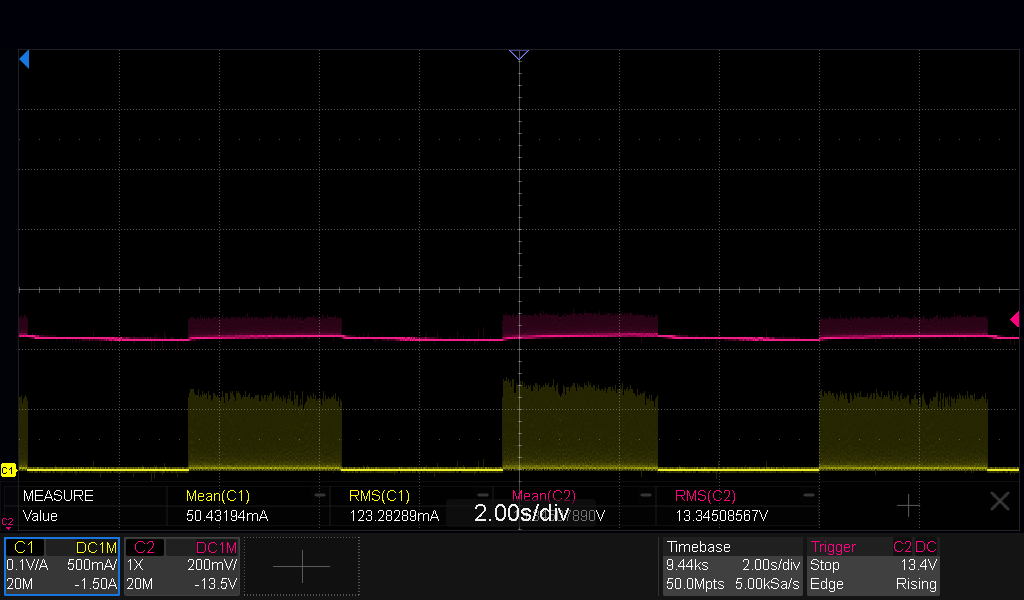
It didn't stop doing this:
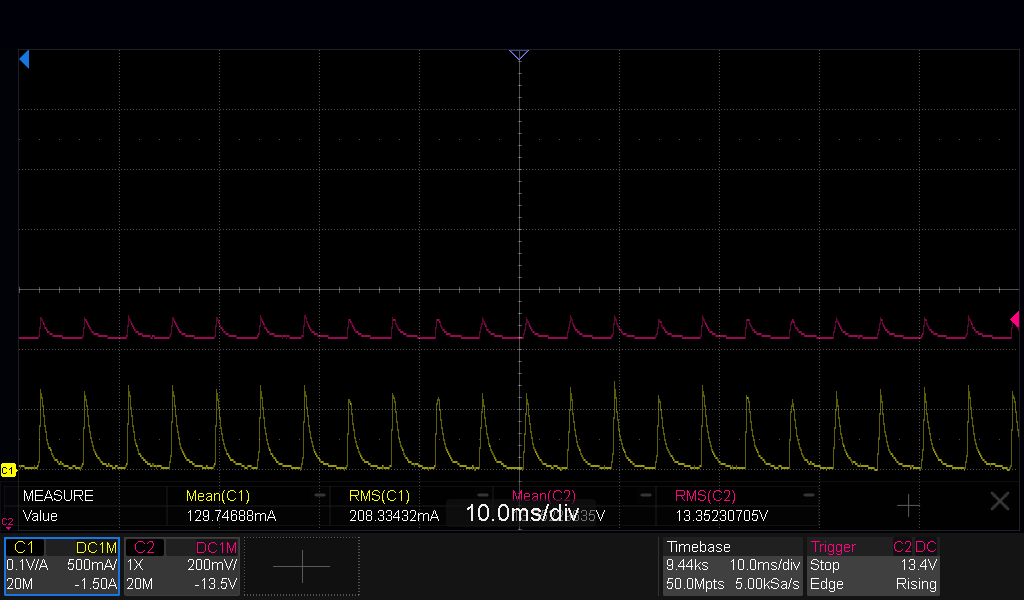
but it did it less.
After that, I turned on the headlights for 30 seconds. The Battery Tender smoothly increased current to its max.
Battery voltage starts to recover when I turned off the headlights. The BT5 did not restart absorption.
Conclusions:
I like this design in principle: 14.4V absorption and 13.2V maintenance, reasonable temperature compensation. Maintenance mode is constant voltage, which means you can open a door and the charger will pick up the load without restarting the charge cycle or discharging the battery. It's not going to overcharge.
But:
1. I wasn't able to get anything close to a full charge out of this thing before it went into maintenance mode, always about 6 minutes in and with the battery still accepting significant charge. The green light went solid (fully charge) with amp-hours left to go.
It looks like the BT5 is limiting absorption time, possibly depending on the 5A bulk charge time, which in both cases was only few seconds. The problem is this: A lead acid that has been sitting lightly discharged simply won't accept 5A.
The BT5 doesn't have a real float stage. Once it times out of absorption it stays at 13.2V indefinitely.
2. Voltage regulation is generally not great, and alarming at low currents.
The rest of this post is scope traces and observations. Kindly move along if this sort of thing is not your bag, baby.

Yellow is current, pink is voltage in the traces. The color scheme has grown on me.
Edit: I forgot to describe the setup. Current is calculated by measuring voltage across a 0.1 ohm resistor (1%, 2W, metal film) in series between the negative clamp and the top plate of the IBS. Voltage is measured across the charger's clamps. This is what the charger sees.
My JT had sat for about 9 days. It should need 2.5-3Ah. The temperature is 50-55F. The Battery Tender 5A did this:
Downsampling from 20kHz to 10Hz cleaned it up nicely:
I'm guessing it's designed for 14.40V absorption, 13.20V maintenance, and temperature compensation is +0.15V.
Disappointingly, it ended absorption after about 6 minutes, with the battery still accepting ~2A, and having only delivered 900C = 0.25Ah or 10% of the expected charge needed.
It's still charging in maintenance mode and will eventually get near a full charge. It's just going to take a long time.
The 13.20V maintenance voltage is commonly used because it minimizes corrosion due to oxygen at the positive plate. Oxygen is produced by electrolysis of water, increasing exponentially with higher voltage, and by self-discharge reactions at lower voltages; 13.2V is approximately the sweet spot. This is not a proper float voltage and won't prevent slow self-discharge at the negative plate.
A closer look from the last 30 seconds of the waveform:
The voltage swings are 200mV peak-to-peak. That's within 0.5% and good enough.
I used a Victron Blue Smart IP22 in power supply mode to hold it at 13.4V overnight. The Victron is in another league from these 1-button chargers, and its voltage regulation is much better.
Battery Tender 5A:
Victron:
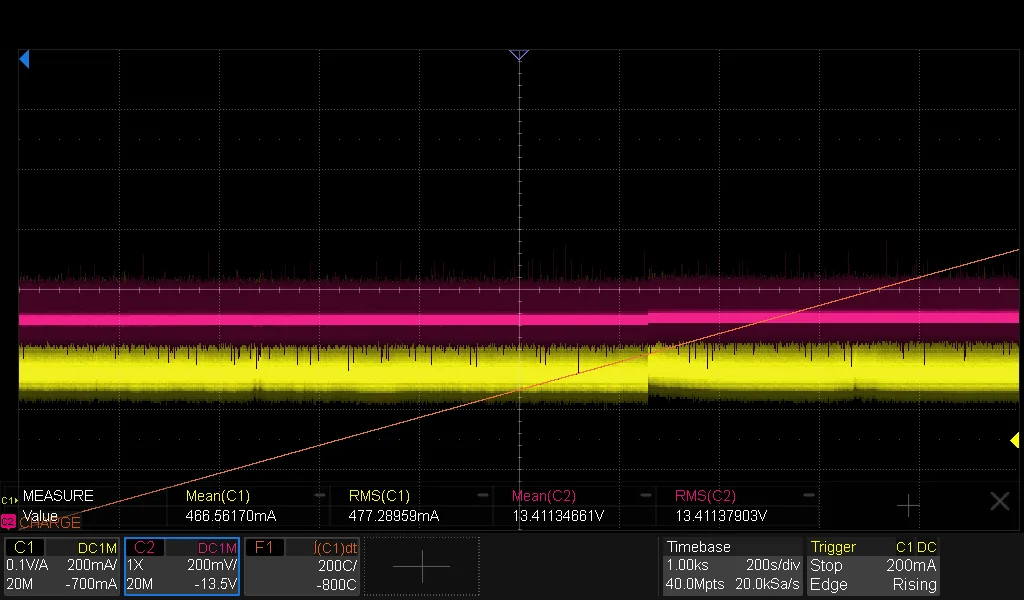
Charging current had fallen below 40mA by the next morning. I gave the Battery Tender another go:
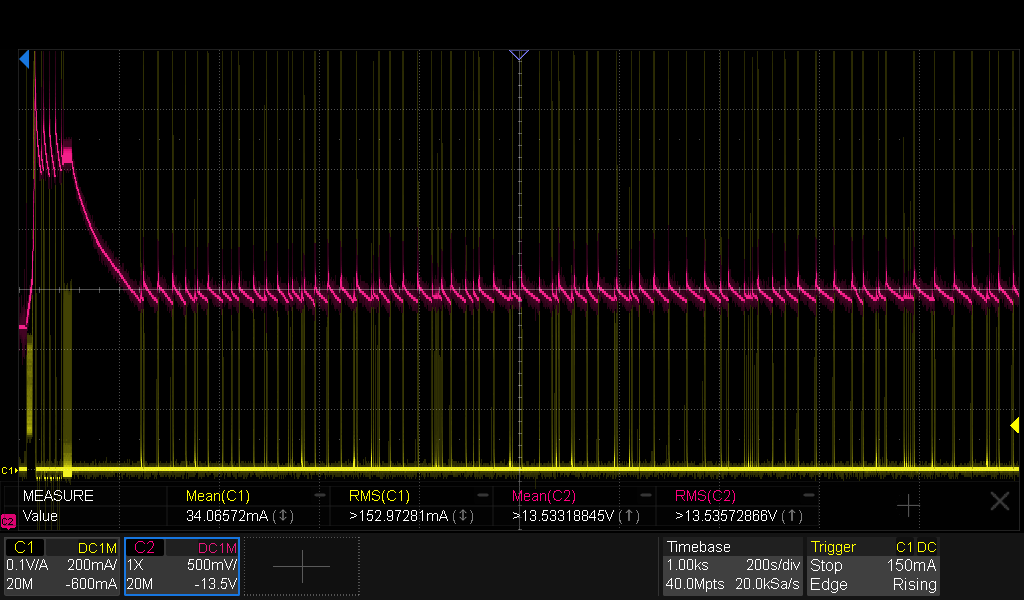
A closer look at the first 100 seconds:
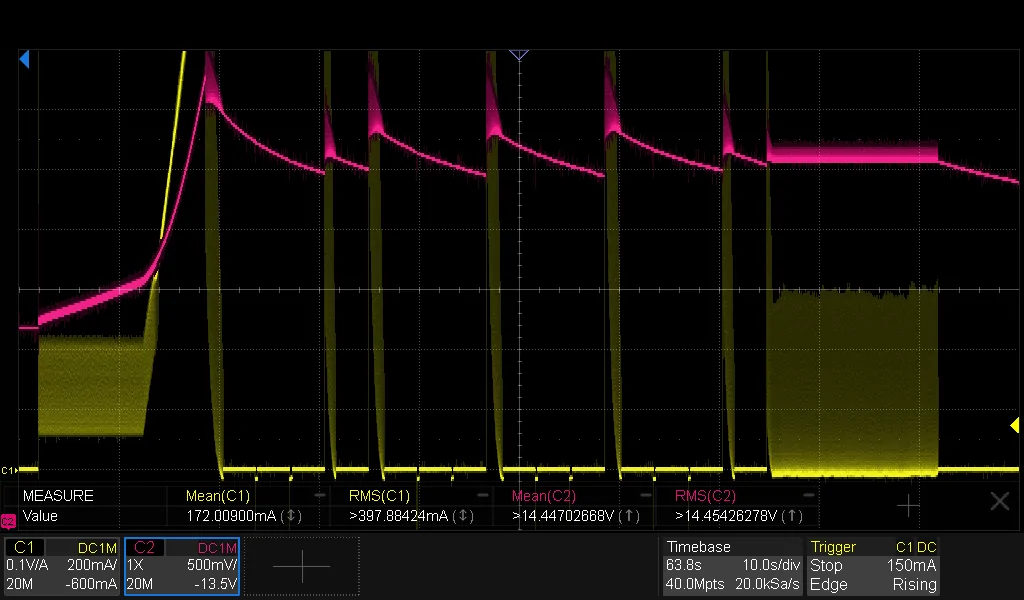
That last flat section of pink is 20 seconds of decent regulation. Why doesn't it do that all the time?
Between pulses, no current flows.
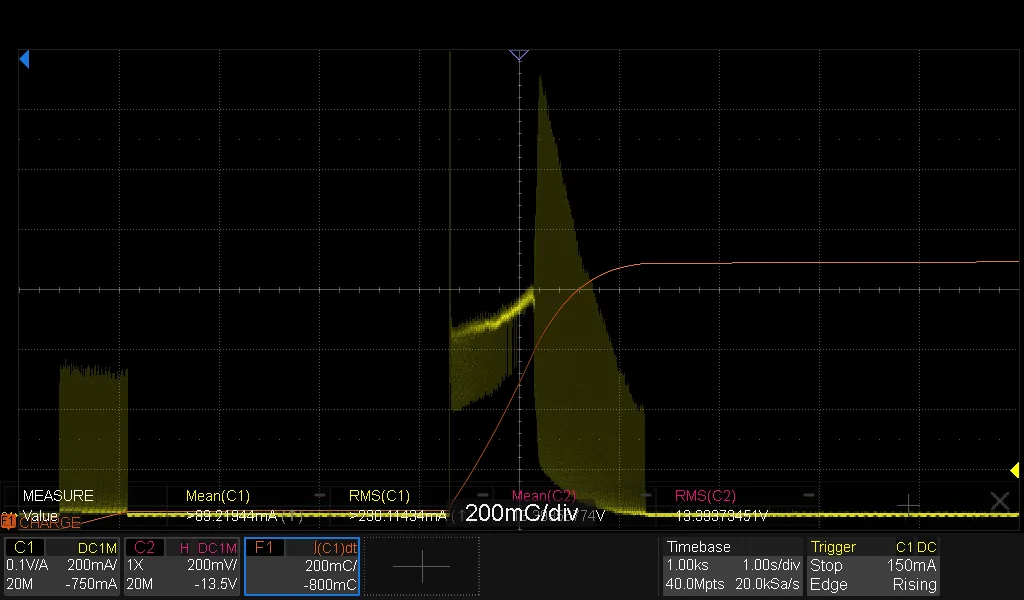
The pulses last less than 2 seconds and oscillate wildly at about 500Hz.
After the first run, I improved my measurement technique to reduce inductance and gave the BT5 another shot, on a flooded lead acid battery discharged lightly by turning on the headlights for 2 minutes.
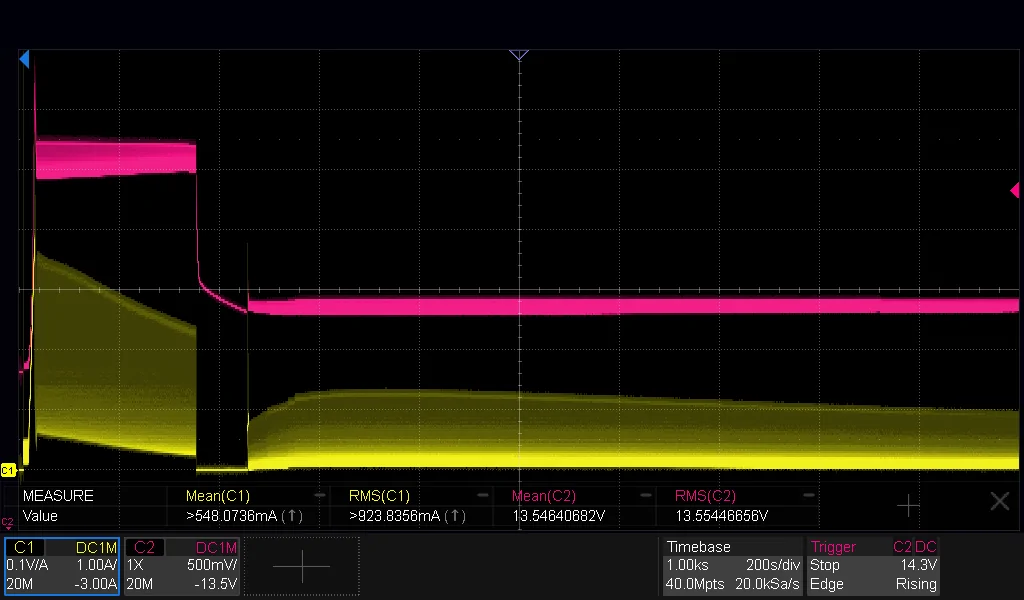
It ended absorption after 6 minutes, about the same as before, this time with 1A flowing. The trace looks cleaner but not much different.
Voltage and current ramp up smoothly during startup with no oscillation until it reaches the constant voltage absorption stage.
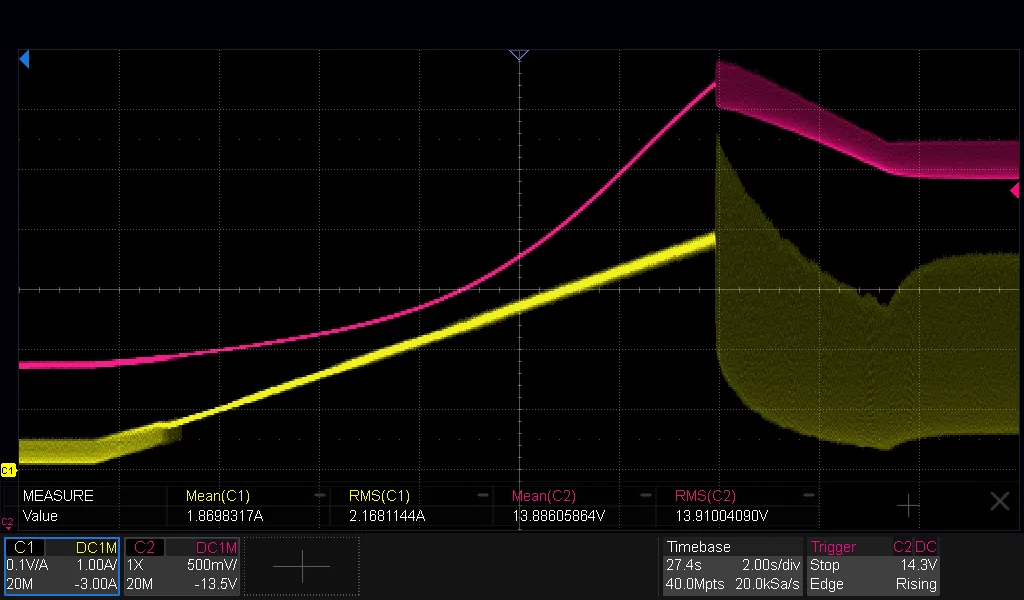
400mV peak-to-peak at the start of absorption.
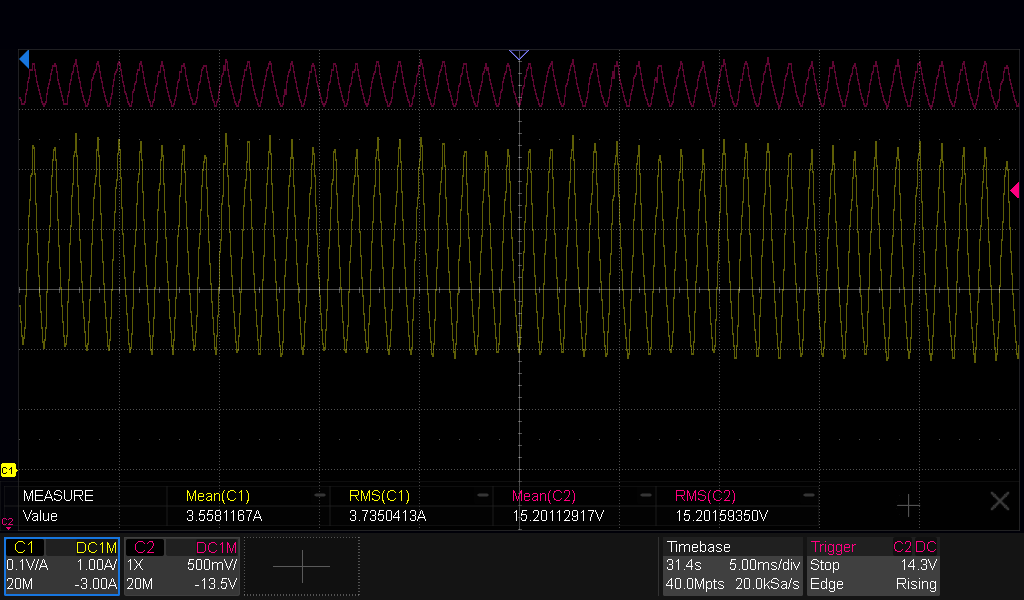
100mV peak-to-peak in maintenance.
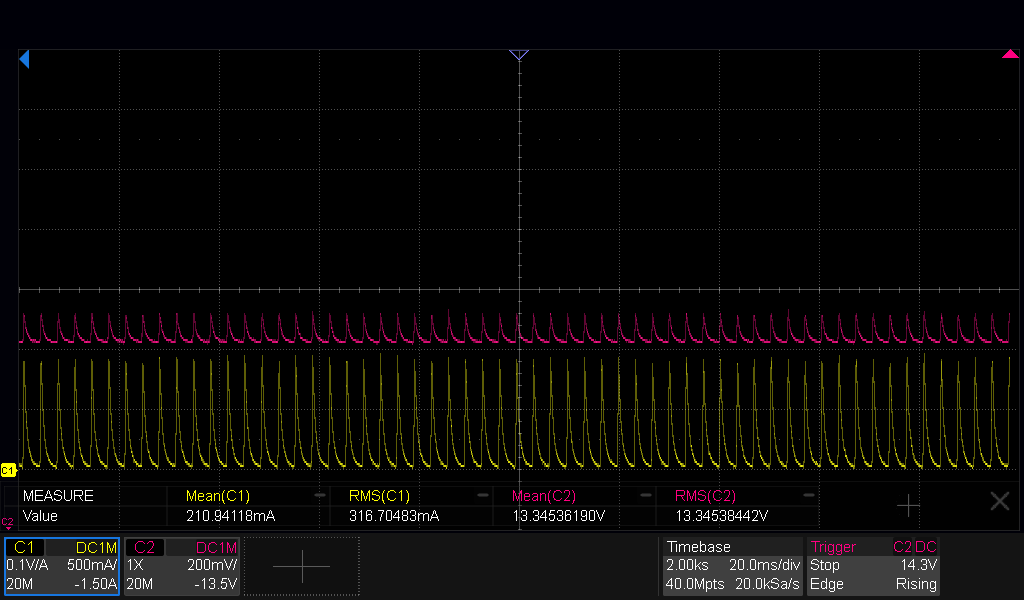
Voltage regulation blows up once charging current drops below about 100mA.
A 10,000-second capture of maintenance. These new scopes are nice.
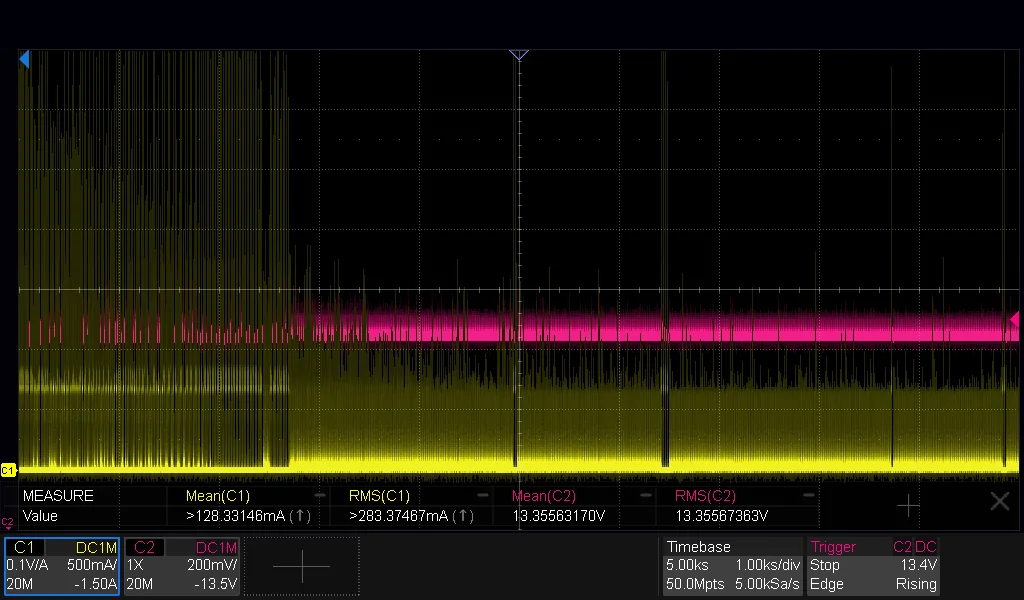
The first 500 seconds looks like before.
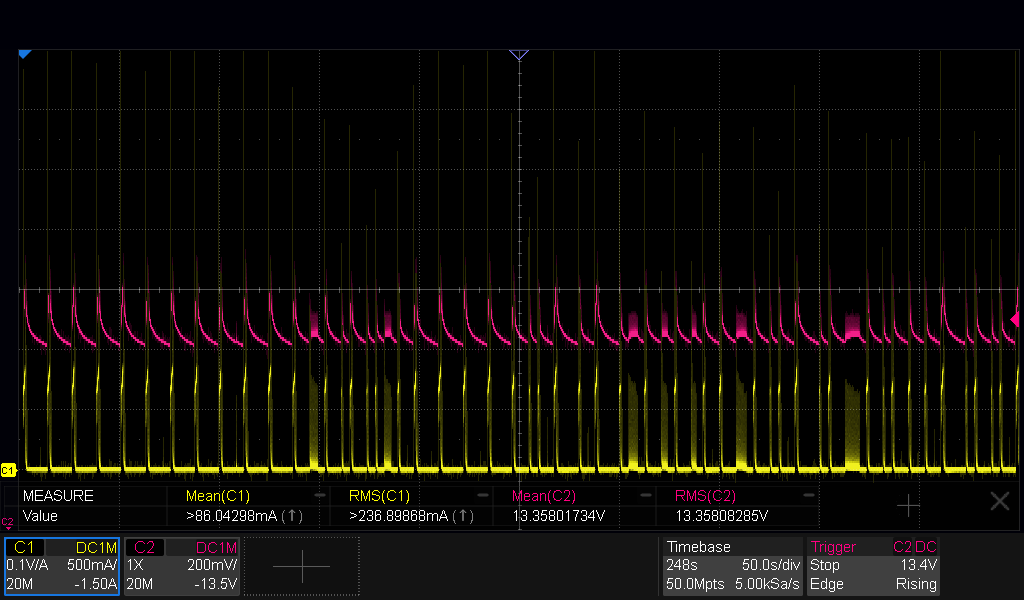
The trace looks cleaner after 2700s. Something different is happening:
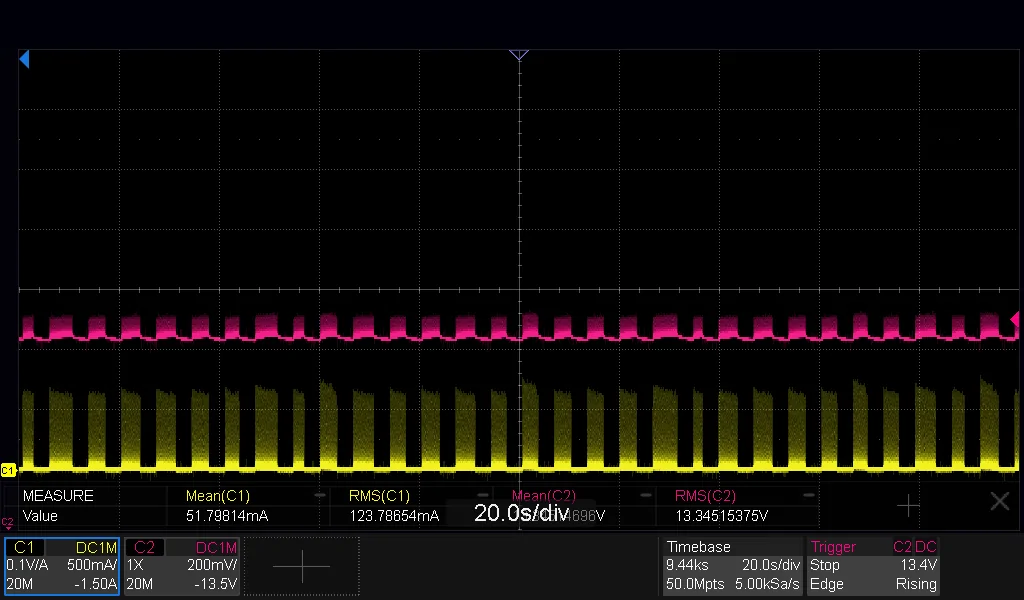
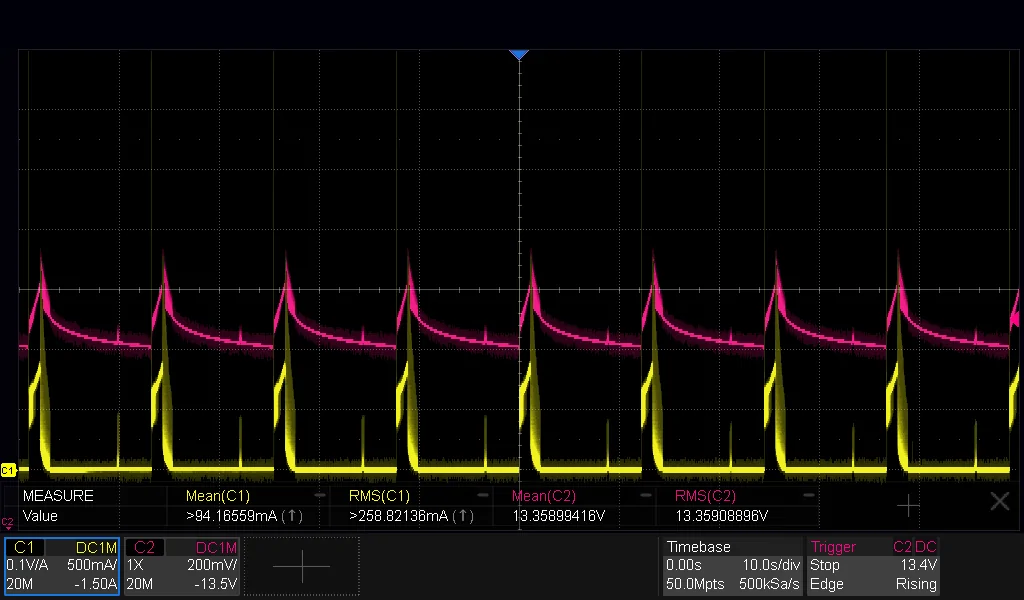
The BT5 can regulate voltage!
It didn't stop doing this:
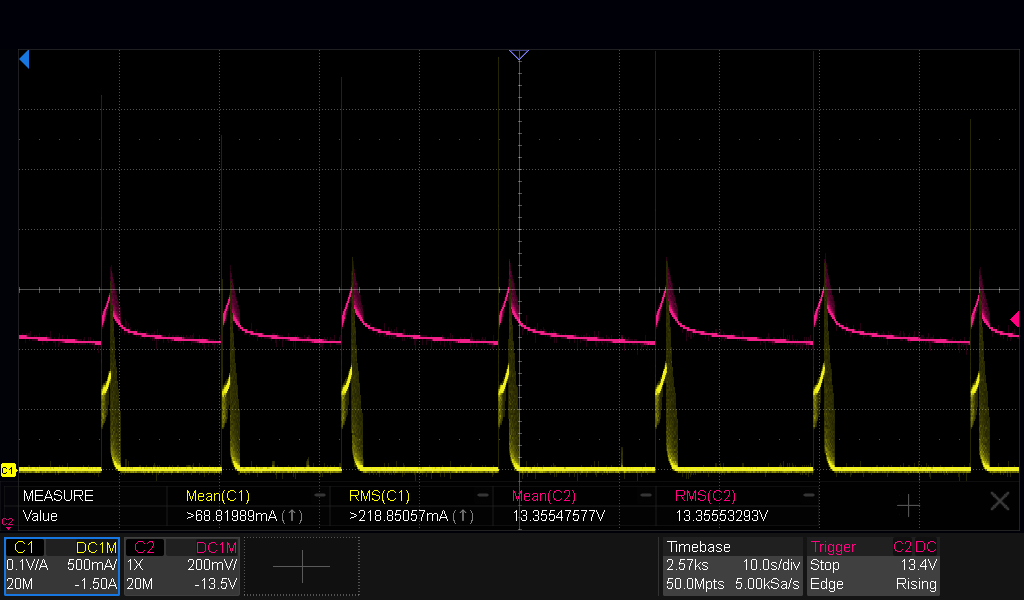
but it did it less.
After that, I turned on the headlights for 30 seconds. The Battery Tender smoothly increased current to its max.
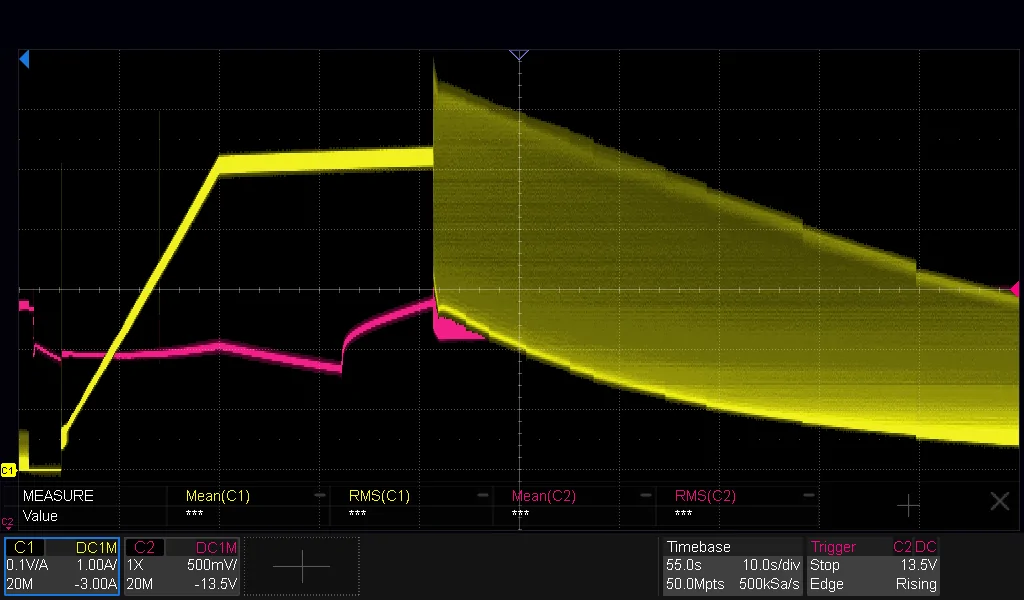
Battery voltage starts to recover when I turned off the headlights. The BT5 did not restart absorption.
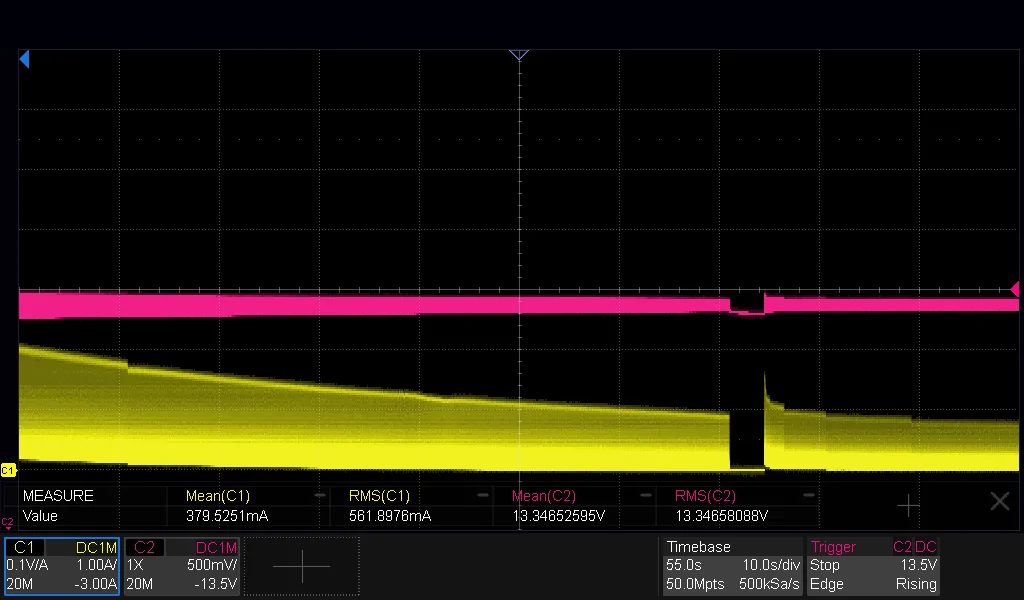
Conclusions:
I like this design in principle: 14.4V absorption and 13.2V maintenance, reasonable temperature compensation. Maintenance mode is constant voltage, which means you can open a door and the charger will pick up the load without restarting the charge cycle or discharging the battery. It's not going to overcharge.
But:
1. I wasn't able to get anything close to a full charge out of this thing before it went into maintenance mode, always about 6 minutes in and with the battery still accepting significant charge. The green light went solid (fully charge) with amp-hours left to go.
It looks like the BT5 is limiting absorption time, possibly depending on the 5A bulk charge time, which in both cases was only few seconds. The problem is this: A lead acid that has been sitting lightly discharged simply won't accept 5A.
The BT5 doesn't have a real float stage. Once it times out of absorption it stays at 13.2V indefinitely.
2. Voltage regulation is generally not great, and alarming at low currents.
Sponsored
Last edited: