
Sponsored

CSF #8344 Transmission Oil Cooler - Looking for feedback

3TDJEEP

Active Member
Joined
Apr 15, 2024
Threads
1
Messages
34
Reaction score
98
Location
California
Vehicle(s)
2023 Gladiator Rubicon Diesel (FarOut)
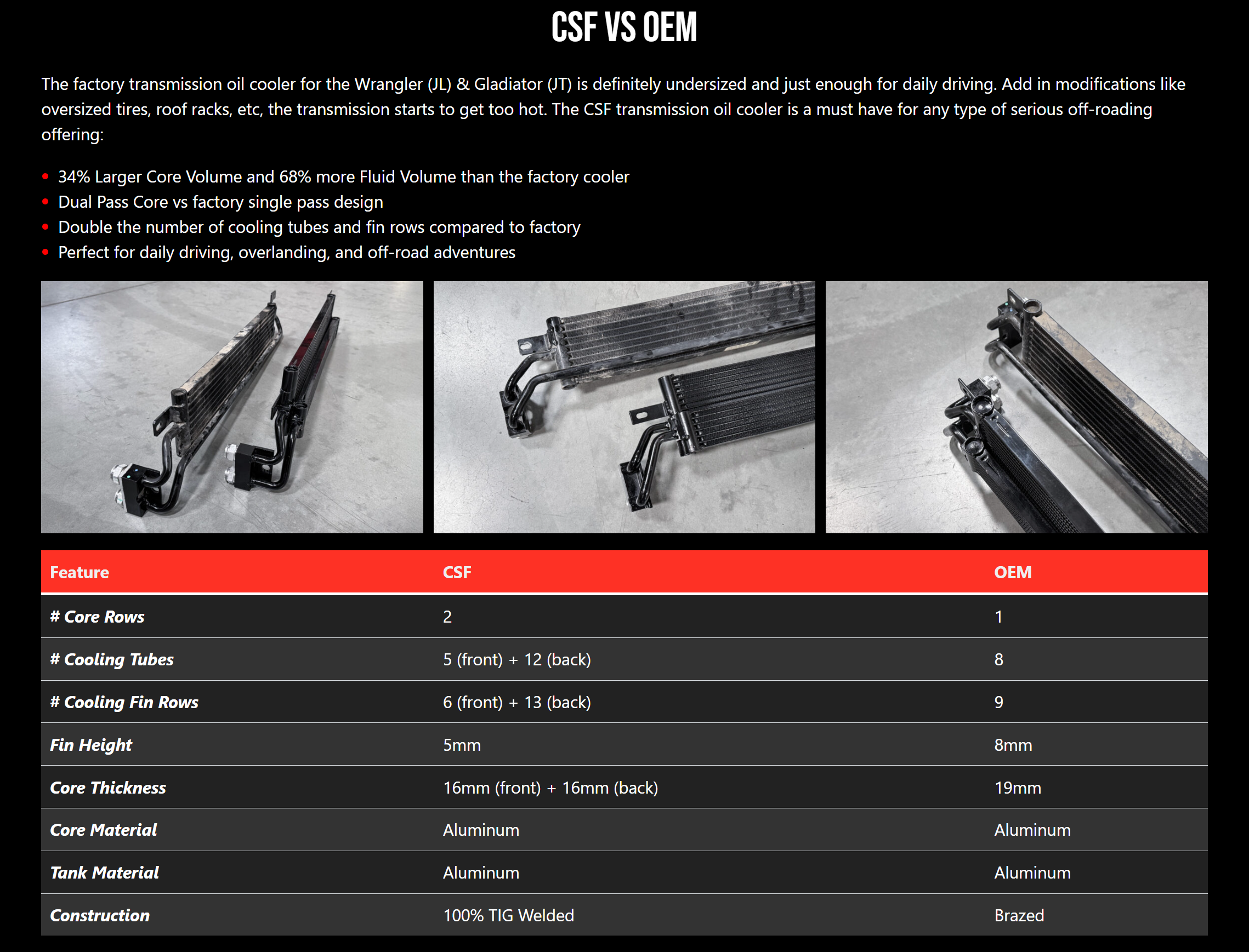
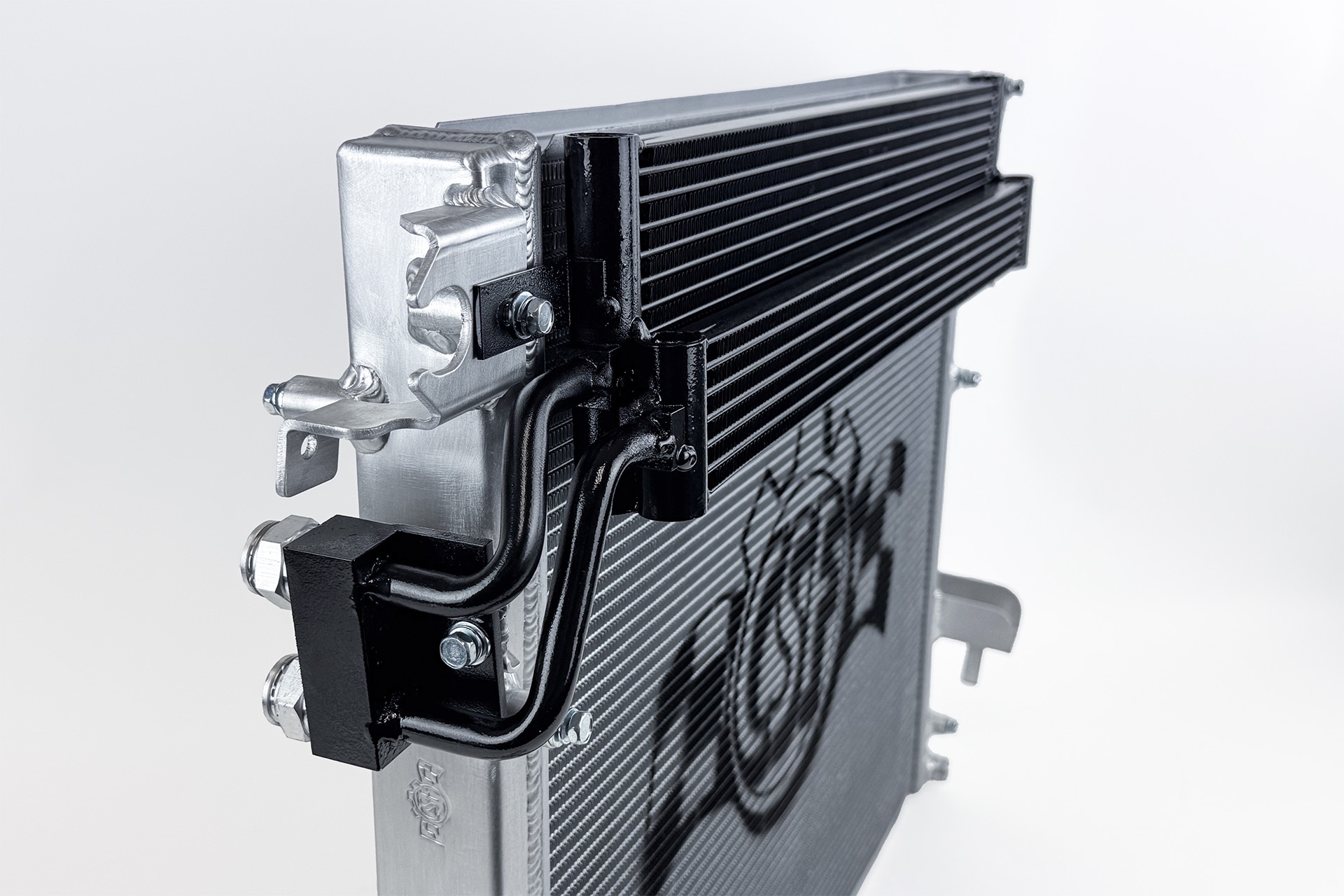
I purchased the CSF #7340 heavy duty radiator for my 23 JTRD and I'm trying to decide if I should pair it with the CSF trans oil cooler. I've read as much info on it as I could find in this forum. There's really not much feedback on it. californiajeeping probably provided the most feedback in the long cooling thread. He has both the radiator and the trans oil cooler and seems to be having very good success getting the temps down. Although his rig is tuned and has a low temp thermostat. I have the stock tune and will be keeping the OEM thermostat so I don't throw a code.

One thing that californiajeeping mentioned in one of his posts is that the OEM trans oil cooler has a
thermostat that bypasses the cooler. Not quite sure I understood his post but he mentioned that the CSF cooler will sometimes spike to 200 degrees in 50mph traffic and then eventually cools down.

Anyone out there that has the CSF rad and cooler combo on a stock EcoDiesel? Would appreciate your feedback.

It would make sense for me to swap it out now since I'm doing the radiator but then again, don't want to spend unnecessary money if its not worth the upgrade. To be honest, I've never tracked my trans temps. But I am buying a toy hauler that's 4800 lbs dry so I am preparing my truck for towing.

One note is that I bought my JTRD brand new in May of 2024 so I still have factory warranty left.

Jeep Gladiator CSF #8344 Transmission Oil Cooler - Looking for feedback zg5sTcN

Jeep Gladiator CSF #8344 Transmission Oil Cooler - Looking for feedback Zix5drR
Sponsored

 
Last edited:

caryt

Well-Known Member
First Name
Cary
Joined
May 29, 2023
Threads
35
Messages
444
Reaction score
303
Location
Wellington NV
Vehicle(s)
'84 stretched CJ7/LS/tons/40's, 2021 Rubicon JT 39
Occupation
Retired/ Build jeeps
Check this out.
Based on the video your jeep has a new thermostat so its not the problem.

I'm planing on ordering the Radiator and trans cooler this week and install all along with a trans oil change.

Ideally trans should never get over 180* but the trans cooler even this CSX one likely won;t be large enough. Time will tell.

If I can drop my max temps 10-15* on both I'll be happy.
 

JTdiRtyD

Well-Known Member
First Name
Wes
Joined
Dec 15, 2024
Threads
34
Messages
1,083
Reaction score
1,987
Location
MN
Vehicle(s)
'22 JTRD
Build Thread
Link
Occupation
Army vet, low-code dev
Check this out.
Based on the video your jeep has a new thermostat so its not the problem.

I'm planing on ordering the Radiator and trans cooler this week and install all along with a trans oil change.

Ideally trans should never get over 180* but the trans cooler even this CSX one likely won;t be large enough. Time will tell.

If I can drop my max temps 10-15* on both I'll be happy.
Never get over 180? Thats barely into transmission fluid operating range of 175-220. Most vehicles have a nominal temp of 190. The 8HP75 in our diesels normal is 175-215, a little higher when running heavy or towing.

People obsess over trans temps and start to freak out when they get to 200deg. It's perfectly normal for trans temps to reach 200. Temps aren't an issue until you start exceeding the fluids normal range AND can't recover from it.
 

caryt

Well-Known Member
First Name
Cary
Joined
May 29, 2023
Threads
35
Messages
444
Reaction score
303
Location
Wellington NV
Vehicle(s)
'84 stretched CJ7/LS/tons/40's, 2021 Rubicon JT 39
Occupation
Retired/ Build jeeps
Good friend of mine builds the strongest Ford trans made to handle way over 1000ftlbs. I've sold doz's of his trans and have ran them for over 100k miles pushing 500+HP and over 1000ftlbs at the tires. My recommendations are based on what he recommends .

Operating temperatures directly correlate to expected fluid lifespan.
  • 175°F: 100,000+ miles
  • 195°F: 50,000 miles
  • 212°F: 25,000 miles
  • 235°F: 12,000 miles
  • 250°F: 6,000 - 9,000 miles
  • 275°F+: Rapid fluid breakdown, seal damage, and catastrophic transmission failure
Temperature Danger Zones
  • 160°F - 200°F: Optimal operating range. Perfect for moisture burn-off and long transmission life.
  • 220°F - 240°F: Caution Zone. Often caused by towing, heavy loads, or steep mountain grades. Fluid is deteriorating quickly.
  • 250°F+: Overheat Zone. Varnish forms, valves stick, and internal seals burn. Most modern vehicles will trigger a dashboard warning
 

Sponsored

JTdiRtyD

Well-Known Member
First Name
Wes
Joined
Dec 15, 2024
Threads
34
Messages
1,083
Reaction score
1,987
Location
MN
Vehicle(s)
'22 JTRD
Build Thread
Link
Occupation
Army vet, low-code dev
Good friend of mine builds the strongest Ford trans made to handle way over 1000ftlbs. I've sold doz's of his trans and have ran them for over 100k miles pushing 500+HP and over 1000ftlbs at the tires. My recommendations are based on what he recommends .

Operating temperatures directly correlate to expected fluid lifespan.
  • 175°F: 100,000+ miles
  • 195°F: 50,000 miles
  • 212°F: 25,000 miles
  • 235°F: 12,000 miles
  • 250°F: 6,000 - 9,000 miles
  • 275°F+: Rapid fluid breakdown, seal damage, and catastrophic transmission failure
Temperature Danger Zones
  • 160°F - 200°F: Optimal operating range. Perfect for moisture burn-off and long transmission life.
  • 220°F - 240°F: Caution Zone. Often caused by towing, heavy loads, or steep mountain grades. Fluid is deteriorating quickly.
  • 250°F+: Overheat Zone. Varnish forms, valves stick, and internal seals burn. Most modern vehicles will trigger a dashboard warning

My point is folks freak out when they see temps temporarily go over 200. It's fine and well within normal operating conditions. Theres no need to run a cooler unless you are consistently seeing temps nearing the higher numbers. And CONSISTENTLY is the key word here. Seeing 220 every now and then for a minute while its 90 degrees out does not mean you need to spend money to keep temps down, but consistently running 220 for long periods of time, or rarely seeing temps below 200 because you tow a heavy trailer every day will impact fluid life.

Monitoring temps is great, especially if towing or running heavy, but I think folks need to better understand what they are monitoring and why, and then perform regular transmission services based on their use case.

Also, my response was more-so a general response because the OP stated the video mentioned spikes over 200, and then you stating trying to stay near 180. That might lead folks to thinking if their temps spike to 200, or if they never cool off down to 180 that they have a problem, and thats not the case. Those temps are well within normal operating conditions.
 
OP
OP
3TDJEEP

3TDJEEP

Active Member
Joined
Apr 15, 2024
Threads
1
Messages
34
Reaction score
98
Location
California
Vehicle(s)
2023 Gladiator Rubicon Diesel (FarOut)
Thanks for the feedback guys. And JTdiRtyD, thanks for the temp operating range. I did make it sound like 200 degrees was an unusually high temp but do know that up to 220 is considered acceptable. I just have no idea how my truck is going to react to towing near the max load which most people advise against. And no idea if these transmissions have been known to spike over 220 or run at that temp for long periods of time when towing.

I'm leaning towards erroring on the side of caution and buying the cooler.

Keep the feedback coming.
 

rubicon4wheeler

Well-Known Member
First Name
Geoff
Joined
Jan 1, 2022
Threads
1
Messages
227
Reaction score
368
Location
Sierra Nevada, California
Vehicle(s)
2022 Gladiator Rubicon Diesel
Occupation
Safety Supervisor
And no idea if these transmissions have been known to spike over 220 or run at that temp for long periods of time when towing.

I'm leaning towards erroring on the side of caution and buying the cooler.

Keep the feedback coming.
I've never had any transmission heat issues while towing or offroading - my problem has always been oil temps as the coolant temps have risen and been unable to pull enough heat out of the oil.

But like you, I want to err on the side of caution by installing CSF's trans cooler since we're already in there installing their radiator.
 

Chance575

Well-Known Member
First Name
C
Joined
May 20, 2021
Threads
15
Messages
553
Reaction score
710
Location
Earth
Vehicle(s)
C
Occupation
D
It’s double the size of the stocker but I can’t say it made a huge difference
 

PropDr

New Member
First Name
Arno
Joined
Apr 19, 2026
Threads
0
Messages
2
Reaction score
2
Location
Eugene, Oregon
Vehicle(s)
JL Rubicon 2D. Raptor, Fat Bob, El Diablo, SLK 55 AMG 030 Compressor
Occupation
Retired (Engineering)
Good friend of mine builds the strongest Ford trans made to handle way over 1000ftlbs. I've sold doz's of his trans and have ran them for over 100k miles pushing 500+HP and over 1000ftlbs at the tires. My recommendations are based on what he recommends .

Operating temperatures directly correlate to expected fluid lifespan.
  • 175°F: 100,000+ miles
  • 195°F: 50,000 miles
  • 212°F: 25,000 miles
  • 235°F: 12,000 miles
  • 250°F: 6,000 - 9,000 miles
  • 275°F+: Rapid fluid breakdown, seal damage, and catastrophic transmission failure
Temperature Danger Zones
  • 160°F - 200°F: Optimal operating range. Perfect for moisture burn-off and long transmission life.
  • 220°F - 240°F: Caution Zone. Often caused by towing, heavy loads, or steep mountain grades. Fluid is deteriorating quickly.
  • 250°F+: Overheat Zone. Varnish forms, valves stick, and internal seals burn. Most modern vehicles will trigger a dashboard warning
Just a side note: The boiling point of water is 212F at sea level.
It is important to keep your lubricants dry.
Unless you are driving a race car and you do not care that your lubricants will absorb moisture over time, temps around 210F are just perfect (automotive lubricants are designed for it) but that is just my personal opinion...
Sponsored


Top