Stan H
Well-Known Member
transmission must be a manual .....what?
Sounds like that has nothing to do with ESS.
This is why these threads become hard to understand.
Sponsored

transmission must be a manual .....what?
Sounds like that has nothing to do with ESS.
This is why these threads become hard to understand.
Thanks, I be sure to keep that in mind. Though nice to not have the ess function. Better keep a small batter backup on me.Your battery life will be shorter.
The more it sits with less than a full charge, the faster the capacity drops. A person who keeps them topped off under the exact same circumstances will see longer battery life.
If the aux battery is dead (it's not an "ESS battery per se"), then it disables ESS shutdowns.
That's about it. nothing is going to happen other than you don't have the help of the aux battery for a cold start and when the main goes, it's going to leave you needing help.

90% of everything is presentationFunny thing - it took 20 pages elsewhere to finally get it accepted - that's what's been said for years........... and shown in voltage tests and FCA documents.

You could start a new thread with your problem rather than talk about an issue that is not being discussed in this thread. You will likely get more troubleshooting suggestions and answers by doing so.Now let me explain that I realize my Gladiator isn’t going to restart itself if I kill it when the ESS is disabled. That was not my issue. My problem is that the vehicle will not start when I push the start button after having killed it when the ESS button has been pushed to disable it. It just goes dead and acts like it doesn’t know to start even though the start button is being pushed.

This exactly.You could start a new thread with your problem rather than talk about an issue that is not being discussed in this thread. You will likely get more troubleshooting suggestions and answers by doing so.

So, the sole purpose of having the auxiliary battery is so that the truck electronic have steady power during an ESS restart? At all other times, the two batteries are functioning as one?We had a long running thread with a lot of contributors trying to settle how the 2 Jeep batteries worked together and what actually happens when the "Start" process is initiated. Below is a synopsis of the discussion. I am also including the link to the thread in the case you are bored and you want all the details. https://www.jeepgladiatorforum.com/...teries-really-isolated-during-ess-stops.87524
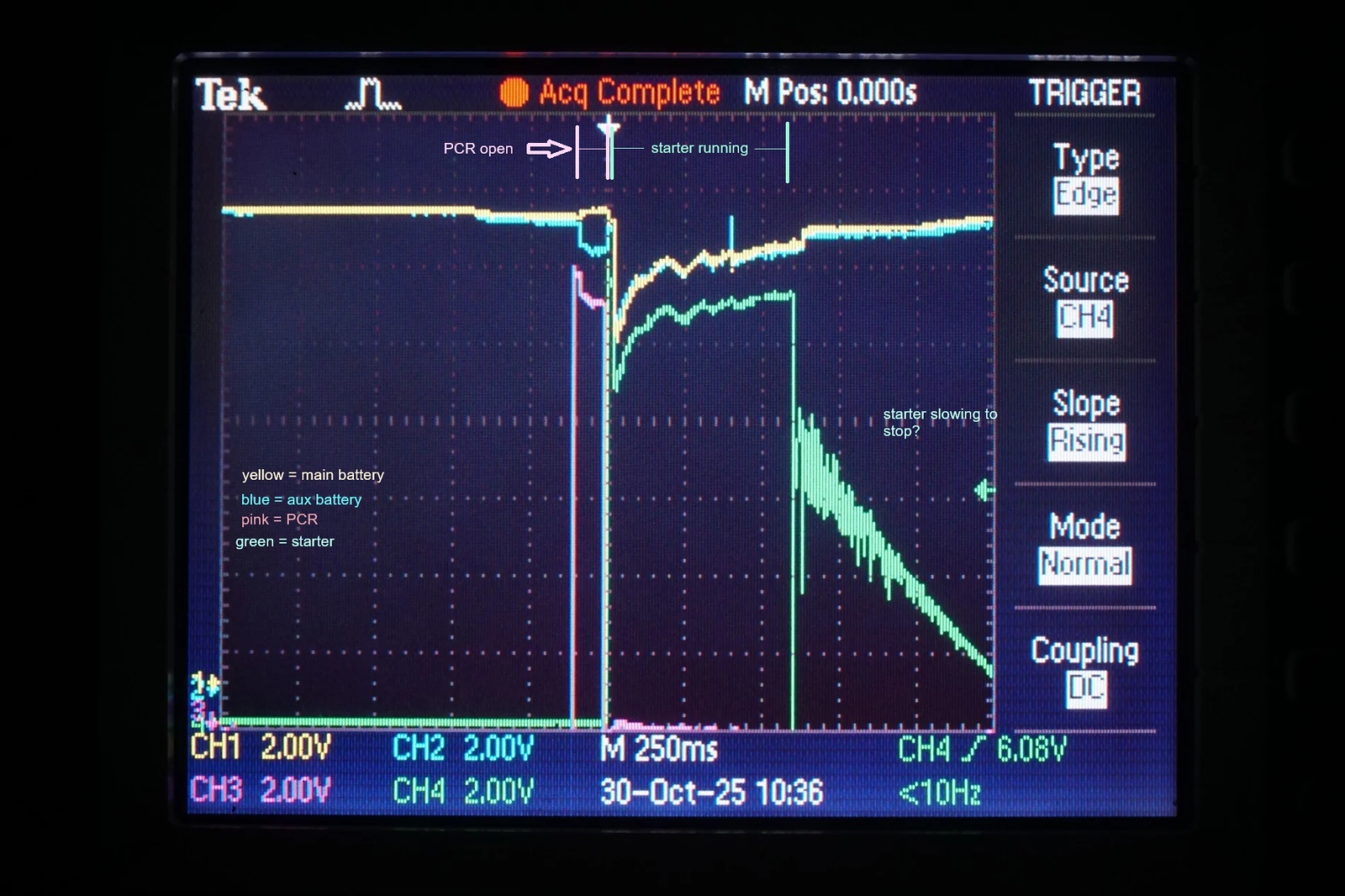
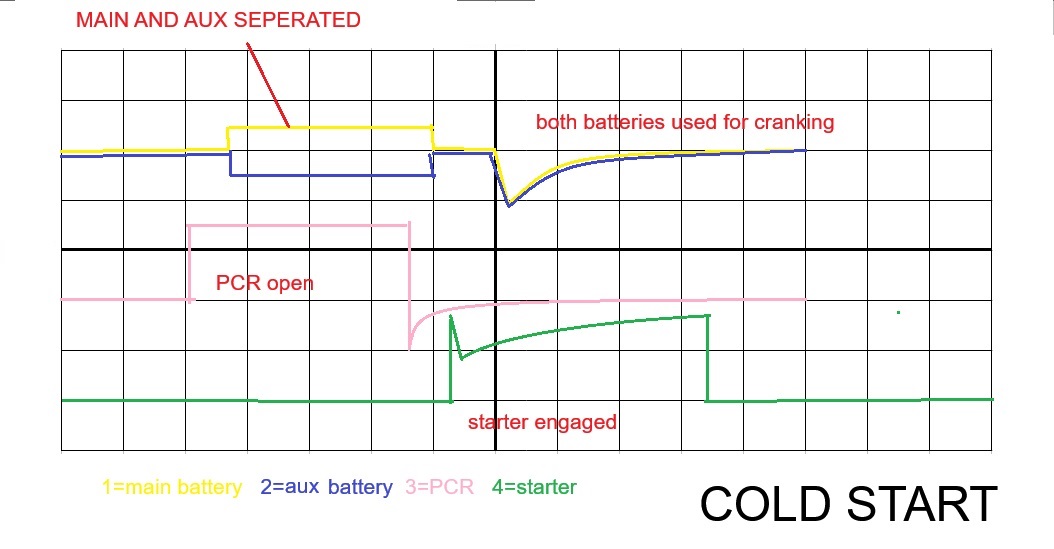
Late model Jeeps with batteries have 2 starting regimes. Let's call the first one "Cold Start." This does not mean that the engine (or weather) is cold.For our purpose, a cold start is one where the vehicle ignition was in the "off" position when you start. When pressing the start button on a cold start, the first thing that happens is that the Power Control Relay separates the 2 batteries. This is for the purposes of testing the auxiliary battery to determine the suitably for a future ESS start. The relay rejoins the 2 batteries in a very short time (~40ms). Once rejoined, both batteries are used to start and run the Jeep.
Actual oscilloscope test for cold start:

Simplified illustration for a cold start:

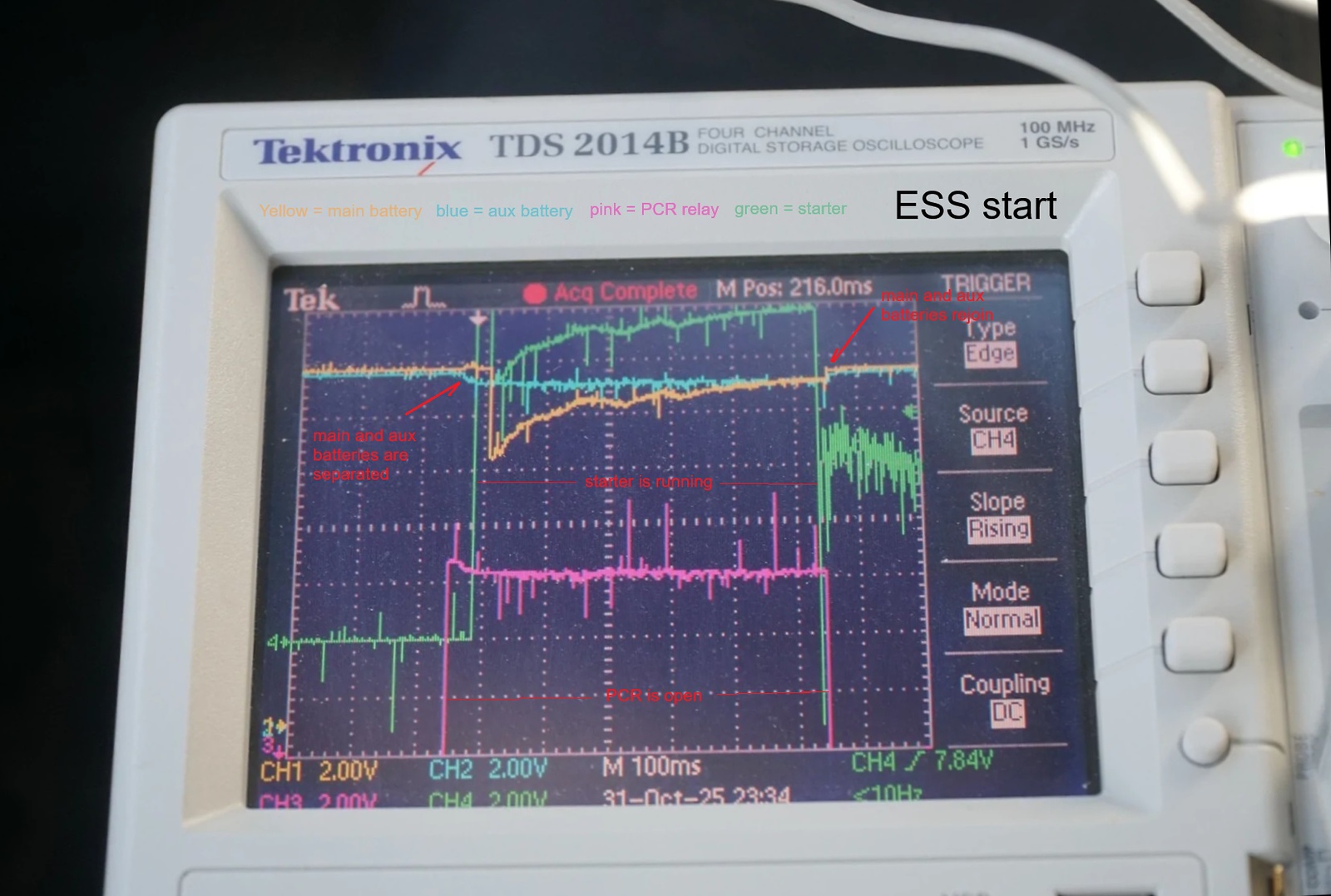
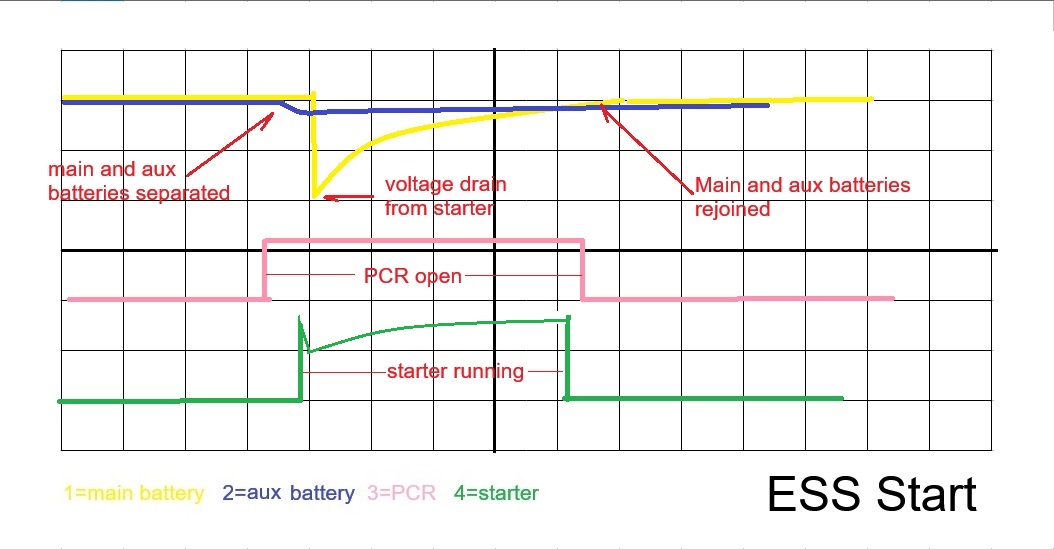
The second starting regime is an ESS start. The is where you are driving, you stop for a light, sign, or traffic, and the Jeep turns off (when you reach a full stop with the brake depressed). When you are ready to resume your drive, you let off the brake and the Jeep automatically restarts. When you make a stop with the ESS system turned on, and the engine shuts down, the 2 batteries remain connected together until you release the brake. Both batteries are keeping the electronics in the cab going. When the brake is released, the Power Control Relay separates the batteries. When the batteries are separated, the auxiliary battery powers the vehicle electronics, keeping things like the radio and AC on while you wait. Next the starter is energized solely on the power of the main battery. The batteries remain separated until the engine is started, and the starter turns off. Once the starter turns off, the Power Control Relay rejoins the batteries.
Actual test for ESS start:

Simplified illustration for ESS Start test:
Revelations?
For the purpose of a cold start, the 2 batteries function as one.
In an ESS Start, the auxiliary battery powers the vehicle electronics while the main battery starts the engine. The time that the batteries are separated on an ESS Start is decided by the time it takes to start the Jeep.
If you are running your Jeep as delivered (with 2 batteries), and you get an ESS Stop/Start message or the infamous Avengers warning light, this might be your first signal that your batteries are nearing end of life.
If you are running your Jeep with the auxiliary battery removed, then you should disable ESS Stop/Start. The reason for this is that when you experience a low battery condition (old or discharged battery drawn down by the power needed to run the starter) you might get a Powertrain Control Module (PCM) reset and error code. You could also damage some of the sensitive vehicle electronics.

So, the sole purpose of having the auxiliary battery is so that the truck electronic have steady power during an ESS restart? At all other times, the two batteries are functioning as one?
Yes, they function as one.So, the sole purpose of having the auxiliary battery is so that the truck electronic have steady power during an ESS restart? At all other times, the two batteries are functioning as one?

Yes to the first part.During times when the two batteries are connected as one (which seems to be the majority of the time), do the batteries self-level? My assumption is that they are wired in parallel, and batteries wired in parallel will self-level their voltage by transferring charge from the higher-voltage battery to the lower-voltage one until they are equalized. Is this why when one dies, they both die?
I really don't mind a dual battery system, as long as both batteries are identical. I'm not sure what made Jeep think it was alright to pair a normal starting battery with a lawn mower battery. I've owned several diesel trucks that had dual batteries, and I've never heard of any issues with them. I even had a diesel truck that had dual batteries and dual alternators.Yes to the first part.
But they don't always both die when one dies. There are multiple ways a battery fails. One some will take down the other.
Several here have bad aux batteries and simply drive along, others have had bad crank batteries, and the same - they replace one or the other and the other lives on.
So really it's "why when one dies, sometimes both go down, but not always or even most of the time". But it can happen, and it does happen.
Series it's a problem, parallel, not so much. There's some videos out there explaining how it works with mis-matched capacities. Don't do it in series.I really don't mind a dual battery system, as long as both batteries are identical. I'm not sure what made Jeep think it was alright to pair a normal starting battery with a lawn mower battery. I've owned several diesel trucks that had dual batteries, and I've never heard of any issues with them. I even had a diesel truck that had dual batteries and dual alternators.