jnett
Well-Known Member
I keep the start stop turned off in mine, just due to the annoyance of it. Is there any validity to keeping it off and that causing the batteries to die sooner?
Sponsored

ESS being off or on has no effect on charging or the life expectancy of the batteries. Keeping the batteries charged provides the longest life span.I keep the start stop turned off in mine, just due to the annoyance of it. Is there any validity to keeping it off and that causing the batteries to die sooner?

Nope, no impact either way.I keep the start stop turned off in mine, just due to the annoyance of it. Is there any validity to keeping it off and that causing the batteries to die sooner?


It's OUR thread. I'm well satisfied with the outcome. I can ignore the peanut gallery. It was fun to collaborate with youse guys.Andy, sorry your thread is getting so trashed with the hate after all of that work and your good summary.
I guess we can't let facts get in the way, eh?



The value of the thread is post #1. All of the rest of it is fluff.huh?
more garbage for this thread?
I've been called worse.The value of the thread is post #1. All of the rest of it is fluff.

Excellent explanation. Makes perfect sense.We had a long running thread with a lot of contributors trying to settle how the 2 Jeep batteries worked together and what actually happens when the "Start" process is initiated. Below is a synopsis of the discussion. I am also including the link to the thread in the case you are bored and you want all the details. https://www.jeepgladiatorforum.com/...teries-really-isolated-during-ess-stops.87524
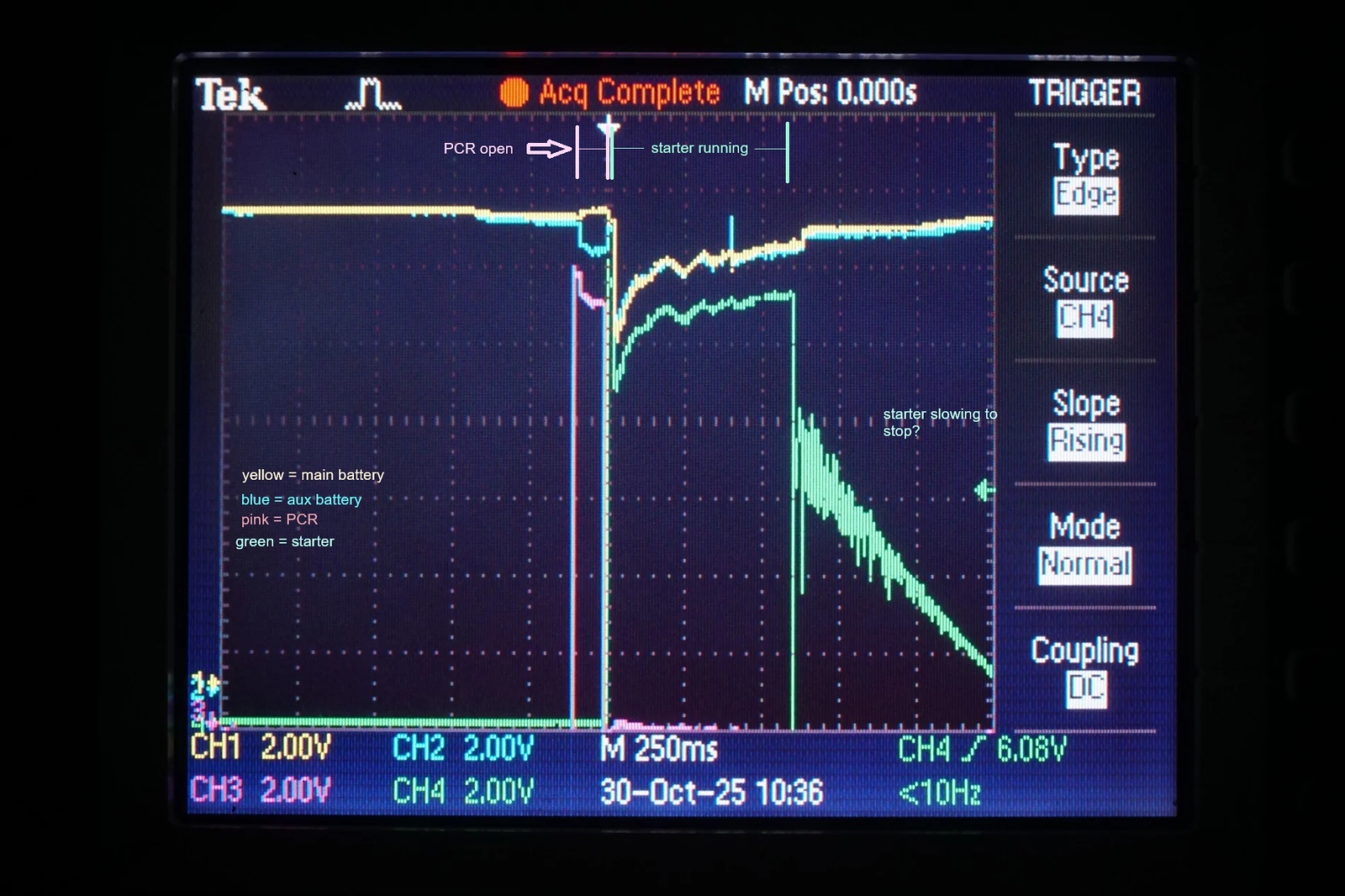
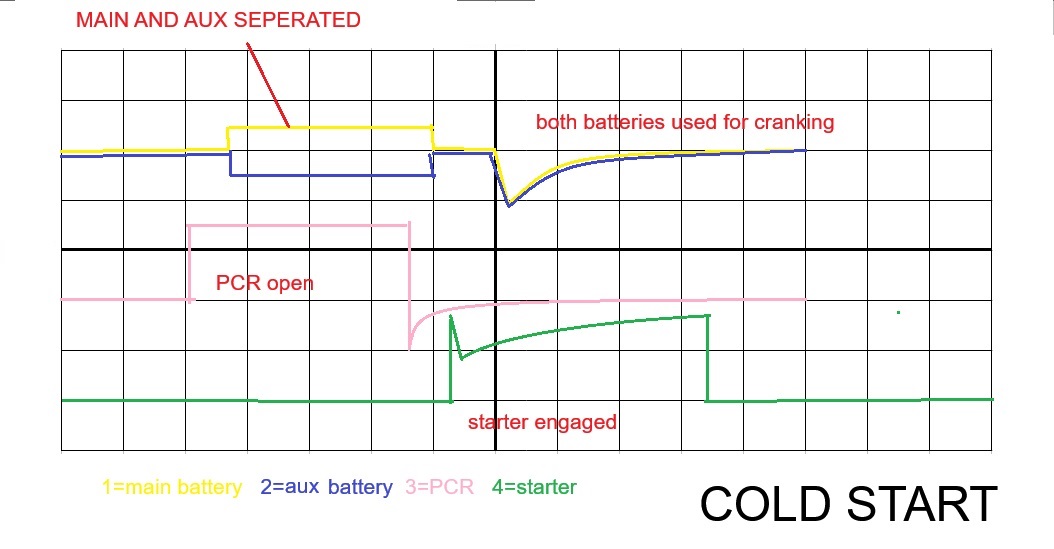
Late model Jeeps with batteries have 2 starting regimes. Let's call the first one "Cold Start." This does not mean that the engine (or weather) is cold.For our purpose, a cold start is one where the vehicle ignition was in the "off" position when you start. When pressing the start button on a cold start, the first thing that happens is that the Power Control Relay separates the 2 batteries. This is for the purposes of testing the auxiliary battery to determine the suitably for a future ESS start. The relay rejoins the 2 batteries in a very short time (~40ms). Once rejoined, both batteries are used to start and run the Jeep.
Actual oscilloscope test for cold start:

Simplified illustration for a cold start:

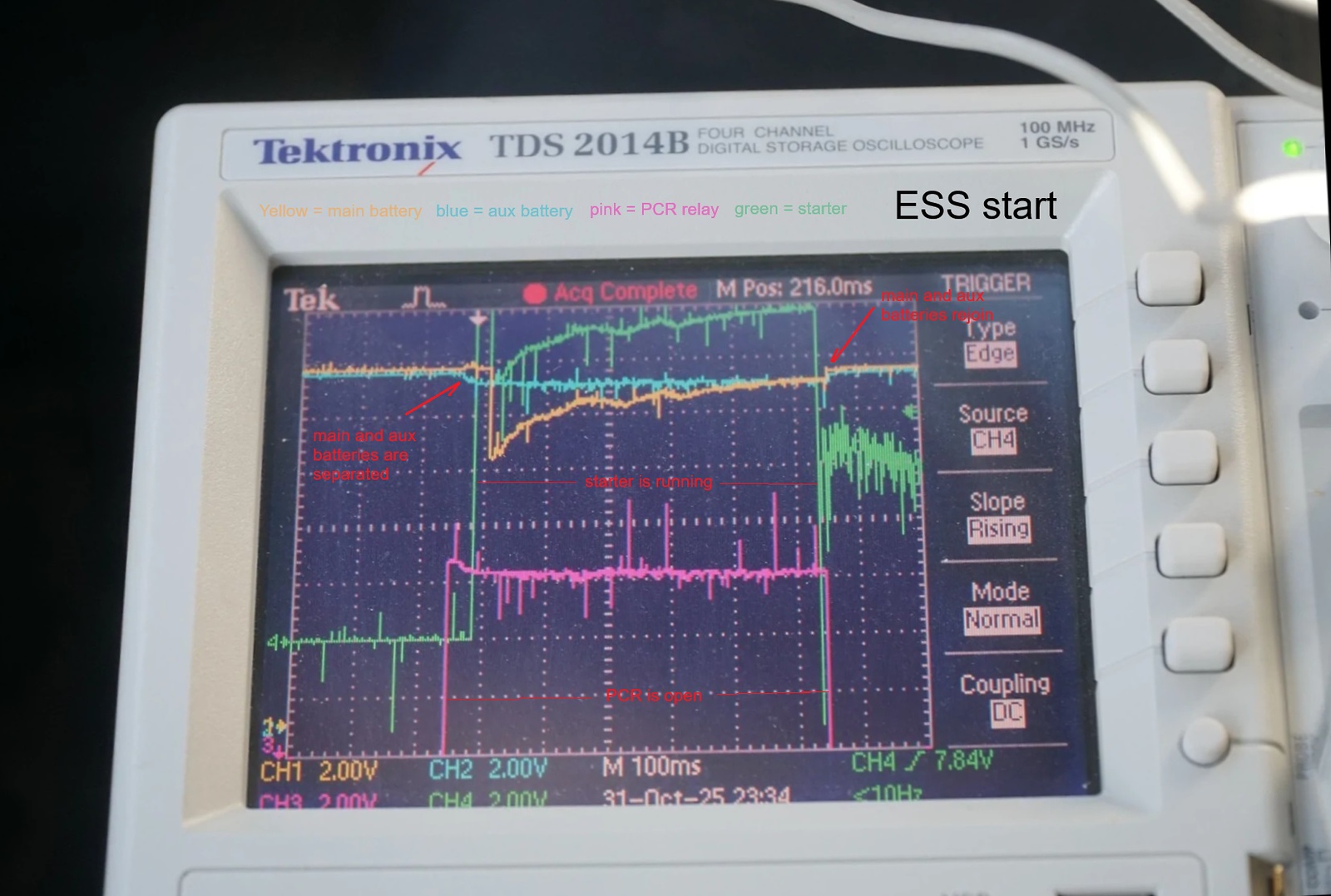
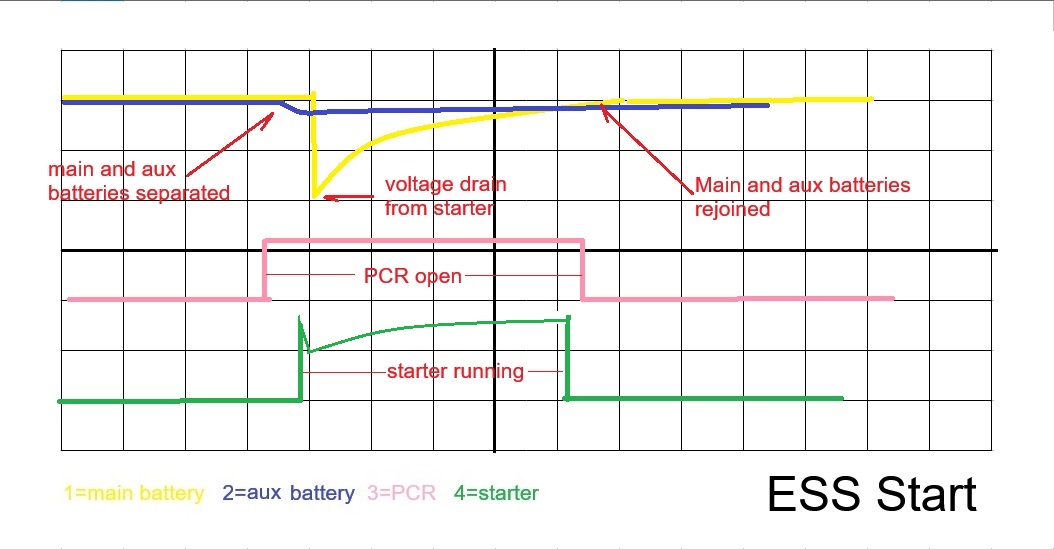
The second starting regime is an ESS start. The is where you are driving, you stop for a light, sign, or traffic, and the Jeep turns off (when you reach a full stop with the brake depressed). When you are ready to resume your drive, you let off the brake and the Jeep automatically restarts. When you make a stop with the ESS system turned on, and the engine shuts down, the 2 batteries remain connected together until you release the brake. Both batteries are keeping the electronics in the cab going. When the brake is released, the Power Control Relay separates the batteries. When the batteries are separated, the auxiliary battery powers the vehicle electronics, keeping things like the radio and AC on while you wait. Next the starter is energized solely on the power of the main battery. The batteries remain separated until the engine is started, and the starter turns off. Once the starter turns off, the Power Control Relay rejoins the batteries.
Actual test for ESS start:

Simplified illustration for ESS Start test:
Revelations?
For the purpose of a cold start, the 2 batteries function as one.
In an ESS Start, the auxiliary battery powers the vehicle electronics while the main battery starts the engine. The time that the batteries are separated on an ESS Start is decided by the time it takes to start the Jeep.
If you are running your Jeep as delivered (with 2 batteries), and you get an ESS Stop/Start message or the infamous Avengers warning light, this might be your first signal that your batteries are nearing end of life.
If you are running your Jeep with the auxiliary battery removed, then you should disable ESS Stop/Start. The reason for this is that when you experience a low battery condition (old or discharged battery drawn down by the power needed to run the starter) you might get a Powertrain Control Module (PCM) reset and error code. You could also damage some of the sensitive vehicle electronics.

 )
)
Depending on the ambient temperature where you are - the higher voltage, 14.7, can mean they are low. If it's cold out, it will run higher voltage to compensate, but see that at 60 degrees and it means they aren't fully charged.Go easy on me…..cuz most of this techy talk is over my head.
Nothing wrong with my batteries, yet….2 years later. 2024 Mojave w/ Tazer (ESS is always off).
So…I took a quick video of the Battery screen at start up. At the bottom, you’ll see arrows and a green dot (right side). That’s only visible a couple seconds and its gone. What is that?? Does that Green dot mean anything?
I’m just trying to understand how to determine the batteries are getting close to needing replaced. And since I’m not using ESS, that functionality won’t be a warning sign for me. Thoughts?
Is that green dot an indicator of battery health? (one could only wish