Sponsored

Is ethanol good for the Gladiator?

bakobobby

Well-Known Member
First Name
Bobby
Joined
Jan 16, 2022
Threads
17
Messages
477
Reaction score
487
Location
Bakersfield
Vehicle(s)
2021 Gladiator California
Build Thread
Link
Occupation
Doer of things
I’d bet the fuel pump is what can’t handle the E85. Something about the lubricity or lack thereof makes the fuel pump fail.

This is a guess and based solely on experience with E85 on wrx’s.
Its just you have to pump a lot more of the fuel. I also have a mkVII tuner car and to break 400ish hp at the wheels OR run E you gotta go to a larger flow rate.
Sponsored


ShadowsPapa

Well-Known Member
First Name
Bill
Joined
Oct 12, 2019
Threads
247
Messages
40,442
Reaction score
53,860
Location
Runnells, Iowa
Vehicle(s)
'25 JTMX, '23 JLU 4xe, '82 SX4, '73 Javelin
Occupation
Retired auto mechanic, frmr gov't ntwrk security admin
Vehicle Showcase
3
Just because you didn't see it, doesn't mean it wasn't happening.

Source?
LOL - semi-poor memory, experience driving in the 70s, and working part time in a shop that had a gas station attached until I graduated college.
Sammy sang "I can't drive fifty five"

Anyway, North Dakota State University has a decent history on when it came into being in modern times.
Source -
Author

Cole Gustafson, North Dakota State University


This is their comment on removing lead - and needing to find other ways to increase octane and reduce dependence on foreign oil, which at the time was a bigger thing:
Today’s ethanol industry began in the 1970s when petroleum-based fuel became expensive and environmental concerns involving leaded gasoline created a need for an octane.........
..................
.......With the phasing out of Methyl Tertiary Butyl Ether (MTBE) as an oxygenate and a desire to decrease dependence on imported oil and increase the use of environmentally friendly fuels, ethanol’s demand increased dramatically.


There are about 75,000 BTU in a gallon of ethanol; it takes about 35,000 BTU to grow the corn and produce the ethanol; you can get about 500 gallons of ethanol from an acre of corn; and thus the net energy gain is about 20 million BTU per acre.
 

CerOf

Well-Known Member
Joined
Jan 1, 2021
Threads
18
Messages
1,375
Reaction score
1,624
Location
Dallas
Vehicle(s)
‘21 JTRD
Its just you have to pump a lot more of the fuel. I also have a mkVII tuner car and to break 400ish hp at the wheels OR run E you gotta go to a larger flow rate.
On my wrx, flow was no problem. Lubricity, if memory serves, was the problem in the subbie world. (Talking about the FA2.0.

STI, I believe, was also flow.
 

JET_83

Banned
Banned
First Name
Eric
Joined
Sep 13, 2020
Threads
3
Messages
1,324
Reaction score
651
Location
US
Vehicle(s)
2022 Jeep Gladiator Overland
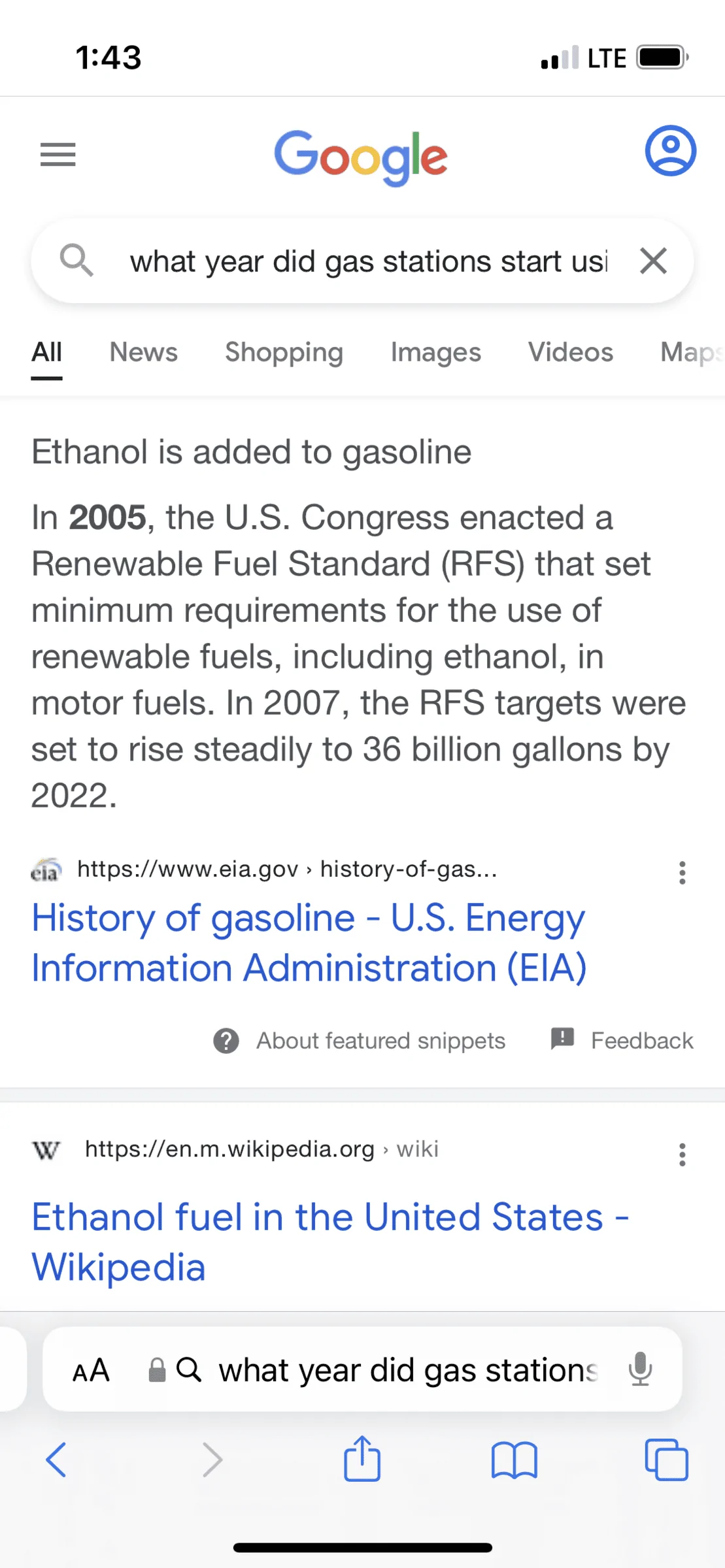
Boom! Not until 2005!!!

Jeep Gladiator Is ethanol good for the Gladiator? 1AF81C62-13F6-4B6C-A183-7C6DD58C9245
 

Gvsukids

Well-Known Member
First Name
Justin
Joined
Mar 7, 2020
Threads
26
Messages
7,267
Reaction score
6,901
Location
Grand Rapids
Website
www.youtube.com
Vehicle(s)
2020 Gladiator Sport S Max Tow
Occupation
Delivery Driver
Boom! Not until 2005!!!

1AF81C62-13F6-4B6C-A183-7C6DD58C9245.png
So close...
https://www.ag.ndsu.edu/energy/biofuels/energy-briefs/history-of-ethanol-production-and-policy

"The Energy Information Agency (2005) describes the history of ethanol. Ethanol’s first use was to power an engine in 1826, and in 1876, Nicolaus Otto, the inventor of the modern four-cycle internal combustion engine, used ethanol to power an early engine. Ethanol also was used as a lighting fuel in the 1850s, but its use curtailed when it was taxed as liquor to help pay for the Civil War. Ethanol use as a fuel continued after the tax was repealed, and fueled Henry Ford’s Model T in 1908. The first ethanol blended with gasoline for use as an octane booster occurred in the 1920s and 1930s, and was in high demand during World War II because of fuel shortages."
 

Sponsored

JET_83

Banned
Banned
First Name
Eric
Joined
Sep 13, 2020
Threads
3
Messages
1,324
Reaction score
651
Location
US
Vehicle(s)
2022 Jeep Gladiator Overland
Clearly says it wasn’t added until 2005 and that’s when I clearly remember seeing it being used at gas stations, “may contain up to 10% ethanol sticker on the pumps” I don’t remember any of that before this
 

sharpsicle

Well-Known Member
Joined
Apr 29, 2021
Threads
22
Messages
2,765
Reaction score
6,255
Location
Tampa, FL / Milwaukee, WI
Vehicle(s)
2020 Gladiator Overland, 2002 VTX1800
Clearly says it wasn’t added until 2005 and that’s when I clearly remember seeing it being used at gas stations, “may contain up to 10% ethanol sticker on the pumps” I don’t remember any of that before this
Dude, your own screenshot says that minimum requirements were not set until then. It says nothing about when it was first used. At all.

Just because it didn't have a sticker on it back in 2000 doesn't mean it didn't already contain some ethanol. It just means they weren't required to disclose it in the same manner back then.

This is the reading comprehension part I mentioned that needs some work.
 

Gvsukids

Well-Known Member
First Name
Justin
Joined
Mar 7, 2020
Threads
26
Messages
7,267
Reaction score
6,901
Location
Grand Rapids
Website
www.youtube.com
Vehicle(s)
2020 Gladiator Sport S Max Tow
Occupation
Delivery Driver
Just because alcohol is used as a fuel doesn’t make it a fuel.

Ethanol is alcohol, genius
From my above quote, "used ethanol to power an early engine. Ethanol also was used as a lighting fuel in the 1850s,"
Fueling stations didn’t show there was ethanol being used until the early 2000s, that’s what I’m saying.
“may contain up to 10% ethanol sticker on the pumps” I don’t remember any of that before this
Yes, should have stopped there.
Clearly says it wasn’t added until 2005 and that’s when I clearly remember seeing it being used at gas stations, “may contain up to 10% ethanol sticker on the pumps” I don’t remember any of that before this
Did you read your article? Or the Wikipedia article?
Ethanol was there before the sticker.
 

JET_83

Banned
Banned
First Name
Eric
Joined
Sep 13, 2020
Threads
3
Messages
1,324
Reaction score
651
Location
US
Vehicle(s)
2022 Jeep Gladiator Overland
Dude, your own screenshot says that minimum requirements were not set until then. It says nothing about when it was first used. At all.

Just because it didn't have a sticker on it back in 2000 doesn't mean it didn't already contain some ethanol. It just means they weren't required to disclose it in the same manner back then.

This is the reading comprehension part I mentioned that needs some work.
That being the case it would’ve had a sticker way back when too not just until 2005, why only require putting a sticker then and not from the beginning, that makes no sense.
 

sharpsicle

Well-Known Member
Joined
Apr 29, 2021
Threads
22
Messages
2,765
Reaction score
6,255
Location
Tampa, FL / Milwaukee, WI
Vehicle(s)
2020 Gladiator Overland, 2002 VTX1800
That being the case it would’ve had a sticker way back when too not just until 2005, why only require putting a sticker then and not from the beginning, that makes no sense.
First time with government rules and regulations?

They always come after something is already happening. Government is reactive, not proactive. Therefore there is always a time when something wasn't there, especially in cases like this with required advertising standards. In this case, the requirement to disclose ethanol content came after the fuel was already containing ethanol.

So no, they wouldn't have had a sticker "from the beginning". It makes perfect sense.
 

Sponsored

JTBurns

Well-Known Member
First Name
Joe
Joined
Jun 28, 2020
Threads
20
Messages
985
Reaction score
1,862
Location
Lancaster, PA
Vehicle(s)
Jeep Gladiator
Okay can we get off the 100% fuel debate? It was entertaining but ran its course.

Anyone want to share some more thoughts on 88 octane that contains up to 15% ethanol?

It's higher octane and cheaper which only makes sense when you factor in the subsidies, blah, blah, blah, I understand that point. It passes the the owners manual test of being 15% or less, but should we anticipate issues if it's all you ran? Or is it more like you wouldnt want it to sit in your tank forever? I'm running a tank of it now and haven't noticed anything different from 87 in terms of performance or mpg, just wondering if used a lot, are there long term problems that would happen that wouldn't with 87?
 

Gvsukids

Well-Known Member
First Name
Justin
Joined
Mar 7, 2020
Threads
26
Messages
7,267
Reaction score
6,901
Location
Grand Rapids
Website
www.youtube.com
Vehicle(s)
2020 Gladiator Sport S Max Tow
Occupation
Delivery Driver

ShadowsPapa

Well-Known Member
First Name
Bill
Joined
Oct 12, 2019
Threads
247
Messages
40,442
Reaction score
53,860
Location
Runnells, Iowa
Vehicle(s)
'25 JTMX, '23 JLU 4xe, '82 SX4, '73 Javelin
Occupation
Retired auto mechanic, frmr gov't ntwrk security admin
Vehicle Showcase
3
Clearly says it wasn’t added until 2005 and that’s when I clearly remember seeing it being used at gas stations, “may contain up to 10% ethanol sticker on the pumps” I don’t remember any of that before this
R U that young, that unlearned to think that until there was a law, something didn't exist?
The only reason they could make such a law and enforce it is because ethanol was already in use, successfully, and the bugs and kinks had been worked out.
Using your logic, there were no seat belts in cars until about 1968! And yet my 1964 had them, and many cars before that had seat belts, and if I recall, WI required them to be in cars well before 1968. But by your logic, seat belts were not in any cars until 1968.
Ethanol was already in gas - the feds just mandated it, and made minimums in the law you reference. Read the code itself - not just signs or links, read the actual law in detail.

Here's more proof it was happening long before the MANDATE in 2005:
President Nixon initiated the “Project Independence” program in 1974 to make the U.S. independent of imported oil. Much of the 1978 Energy Act was a concentration on the viability of domestically produced ethanol to offset imported oil. So the feds were looking at it in the 70s.

You've references OK (the state) by 2007 OK had a huge ethanol plant.

Ethanol Fuel Retailer Tax Credit
Retailers that sell fuel blends of gasoline containing up to 15% ethanol by volume (E15) are eligible for a motor fuel tax credit of $0.016 per gallon of ethanol blended into gasoline and sold in Oklahoma, as long as the retailer provides a price reduction to the purchaser of the ethanol fuel in the same amount. This incentive is effective unless the federal government mandates the use of reformulated fuel in an area within Oklahoma that is in nonattainment with the National Ambient Air Quality Standards. (Reference Oklahoma Statutes 68-500.10-1)

Ethanol Sales Tax Exemption
The portion of ethanol sold and blended with motor fuel is exempt from sales tax. (Reference Oklahoma Statutes 68-500.10-1 and 68-1359)

Anyone want to share some more thoughts on 88 octane that contains up to 15% ethanol?

It's higher octane and cheaper which only makes sense when you factor in the subsidies, blah, blah, blah, I understand that point. It passes the the owners manual test of being 15% or less, but should we anticipate issues if it's all you ran? Or is it more like you wouldnt want it to sit in your tank forever? I'm running a tank of it now and haven't noticed anything different from 87 in terms of performance or mpg, just wondering if used a lot, are there long term problems that would happen that wouldn't with 87?
My truck is one of those that has had ZERO engine issues. It runs and works and starts fine.
I run U88 any chance I get - a couple of reasons but a biggy is the 1 point added octane, another is - it's 10 cents cheaper and my MPG has been on the high side of my truck's history. I can't honestly say it's better, but can really say it's no less as far as MPG. I don't have enough history to prove any positive. I have a hunch based on trends but nothing provable.
University studies have shown no change in mpg and no difference between 10 and 15% as far as fuel system performance or life. ISU has been studying the effects for the last 10-15 years. They have indicated that only above 15% are there potentials for drops in mpg and different tunes and fuel system requirements.

You don't want any fuel to sit in the tank "forever" or for that matter even a few months.
 

ShadowsPapa

Well-Known Member
First Name
Bill
Joined
Oct 12, 2019
Threads
247
Messages
40,442
Reaction score
53,860
Location
Runnells, Iowa
Vehicle(s)
'25 JTMX, '23 JLU 4xe, '82 SX4, '73 Javelin
Occupation
Retired auto mechanic, frmr gov't ntwrk security admin
Vehicle Showcase
3
Boom! Not until 2005!!!

1AF81C62-13F6-4B6C-A183-7C6DD58C9245.png
You need to learn to tweak your searches - you are limiting yourself by the search terms, narrow at that, you are using. I did research for part of my job and you have to know the question to ask and how to ask it to get the answers.


Top