Sponsored

Lug nut torque

ShadowsPapa

Well-Known Member
First Name
Bill
Joined
Oct 12, 2019
Threads
247
Messages
40,445
Reaction score
53,880
Location
Runnells, Iowa
Vehicle(s)
'25 JTMX, '23 JLU 4xe, '82 SX4, '73 Javelin
Occupation
Retired auto mechanic, frmr gov't ntwrk security admin
Vehicle Showcase
3
Personally I have always used a torque wrench on lug nuts unless it was beside the road in which case I took care of it asap. I worked on Caterpillar equipment for years at a dealership and torque was critical on a majority of fasteners. Some of that stuff was 3500ft lb+

I personally don't like using anti seize compound on lugs but I use lots of it elsewhere. Years ago I saw a set of tractor trailer wheels (stud piloted) with cone seats that were antisiezed and properly torqued come loose but on the same axle opposite side was torqued without antisieze and they were fine.

I could only assume that the cone seats need to be dry to aid in holding. We thought at first the studs had stretched due to over torque with the compound on the threads and seat but the micrometer said no.
HA - and I thought 250 ft/lbs for an axle nut was big. Whoa. My best friend in high school - his godfather was a diesel mechanic for the Milwaukee line. He worked at the roundhouse west of town. He gave us a tour one day and when I saw the nuts and bolts in those engines............ whoa.

Yeah, that taper not only centers things unless hub-centric but it's the taper that actually helps hold things in place as opposed to flat nuts against flat steel. The engine torque coming at the nuts sideways they just wouldn't hold without it.
Sponsored

 

whiteglad

Well-Known Member
First Name
Joe
Joined
Feb 12, 2020
Threads
13
Messages
1,306
Reaction score
1,216
Location
Vegas
Vehicle(s)
2022 Gladiator Mojave
I use high pressure chassis grease on the wheel lug tapers and threads, and torque the lug nuts to 80-90 ft lb. Any lube reduces friction on the threads and/or taper, so torque should be reduced. Wear on the factory thread coatings will increase friction, as will rust and corrosion. If you do a search for torque specs, include the ARP fasteners site. They market a super slippery lube for their bolts and you will see that less torque is used with it compared to regular grease, oil, or dry. Never-seez and similar anti-seize lubes are mostly for high heat situations, but can be used elsewhere, of course. They aren't the best choice for low heat situations like lug nuts. Anti-seize is good for exhaust manifold bolts, etc.
 

ShadowsPapa

Well-Known Member
First Name
Bill
Joined
Oct 12, 2019
Threads
247
Messages
40,445
Reaction score
53,880
Location
Runnells, Iowa
Vehicle(s)
'25 JTMX, '23 JLU 4xe, '82 SX4, '73 Javelin
Occupation
Retired auto mechanic, frmr gov't ntwrk security admin
Vehicle Showcase
3
Super critical situations like racing engine rod bolts it's measured in bolt stretch, not torque, due to the things you describe.
There are different specs for the finish on the metal, too - is it zinc, phosphate, etc? Some platings change the friction.
I just clean things up well - make sure I remove any grit, dirt, rust, etc.
I have some charts somewhere that address that - comparing bare to plated and so on, as well as comparing lubed to dry torque specs.
Your 90 sounds about right for a clean and lightly lubed situation, depending on the vehicle, lug size and so on. Sounds about right for my cars.
 

smlobx

Well-Known Member
First Name
Eddie
Joined
Jun 28, 2018
Threads
87
Messages
2,652
Reaction score
4,525
Location
Mid Atlantic
Vehicle(s)
JTR, F-350 diesel, Porsche Spyder, Model Y
Occupation
Semi retired consultant
The highest lug nut torque I’ve ever experienced is on a newer Porsche GT3 with the center lock wheel like in an F1 car.
that torque is a whopping 600#/ft! and the torque wrench that the dealer uses is about 4 feet long!

You better eat your Wheatees for those wheels.
 

ShadowsPapa

Well-Known Member
First Name
Bill
Joined
Oct 12, 2019
Threads
247
Messages
40,445
Reaction score
53,880
Location
Runnells, Iowa
Vehicle(s)
'25 JTMX, '23 JLU 4xe, '82 SX4, '73 Javelin
Occupation
Retired auto mechanic, frmr gov't ntwrk security admin
Vehicle Showcase
3
The highest lug nut torque I’ve ever experienced is on a newer Porsche GT3 with the center lock wheel like in an F1 car.
that torque is a whopping 600#/ft! and the torque wrench that the dealer uses is about 4 feet long!

You better eat your Wheatees for those wheels.
A 200 pound guy could do 800 pound feet with that
 

Sponsored

bill61

Well-Known Member
First Name
Bill
Joined
Feb 3, 2025
Threads
6
Messages
706
Reaction score
1,438
Location
SoCal
Vehicle(s)
2024 Gladiator Rubicon X
YEP, that 150 is based upon anti-seize compound being used. If you don't use that stuff somewhere down the road at tire changing time you can snap those lug nuts off or spin them in the hub. They actually make a lug nut splitter that you put on the lug nut and tighten down a bolt to split it...
I don’t understand how anti seize requires a higher torque than a dry torque?
 

Hootbro

Well-Known Member
First Name
Don
Joined
Apr 13, 2019
Threads
57
Messages
10,184
Reaction score
19,951
Location
Delaware
Vehicle(s)
2025 Gladiator Sport
I don’t understand how anti seize requires a higher torque than a dry torque?
Anti-Sieze reduces the thread friction and the increase in torque is to account for it is needed for the bolt stud clamping force to be retained. The bolt stud has an elasticity that it will retain for the clamping force. Too much torque though will stretch the bolt beyond spec and why anti-sieze is generally not recommended unless called out in service data that has accounted for it.
 

ShadowsPapa

Well-Known Member
First Name
Bill
Joined
Oct 12, 2019
Threads
247
Messages
40,445
Reaction score
53,880
Location
Runnells, Iowa
Vehicle(s)
'25 JTMX, '23 JLU 4xe, '82 SX4, '73 Javelin
Occupation
Retired auto mechanic, frmr gov't ntwrk security admin
Vehicle Showcase
3
Anti-Sieze reduces the thread friction and the increase in torque is to account for it is needed for the bolt stud clamping force to be retained. The bolt stud has an elasticity that it will retain for the clamping force. Too much torque though will stretch the bolt beyond spec and why anti-sieze is generally not recommended unless called out in service data that has accounted for it.
And to get really picky, the bolt's finish matters as well since zinc, for example, lubricates. Tin-zinc even more, vs. plain steel or oxide finishes.
 

bill61

Well-Known Member
First Name
Bill
Joined
Feb 3, 2025
Threads
6
Messages
706
Reaction score
1,438
Location
SoCal
Vehicle(s)
2024 Gladiator Rubicon X
Anti-Sieze reduces the thread friction and the increase in torque is to account for it is needed for the bolt stud clamping force to be retained. The bolt stud has an elasticity that it will retain for the clamping force. Too much torque though will stretch the bolt beyond spec and why anti-sieze is generally not recommended unless called out in service data that has accounted for it.
So wouldn’t that require less torque to apply the same clamping force?
 

Hootbro

Well-Known Member
First Name
Don
Joined
Apr 13, 2019
Threads
57
Messages
10,184
Reaction score
19,951
Location
Delaware
Vehicle(s)
2025 Gladiator Sport
So wouldn’t that require less torque to apply the same clamping force?
No, think of the lubricant acting as a pillow layer. Have to overcome that with more torque to retain the same clamping force as if the threads were dry.

I work in aircraft manufacturing and we have separate standard torque tables for both dry and lubricated threads. In all cases, lubricated threads have higher torque values for a given fastener.
 

Sponsored

Rusty PW

Well-Known Member
First Name
Russ
Joined
Jan 10, 2022
Threads
37
Messages
11,373
Reaction score
30,355
Location
Fayette Nam, Pennsyltucky
Website
www.youtube.com
Vehicle(s)
'22 JTRD, '11 370Z Nismo, '07 Honda VFR
Build Thread
Link
Occupation
Muff Diver
Lock tite acts as a thread lubricant too when installing.

When I installed a OS Giken LSD in my Nismo. The instructions called for lock tite on the threads of the ring gear bolts and grease under the flange of the bolt head. That was a new one on me.
 

Badunit

Well-Known Member
Joined
Jan 31, 2023
Threads
20
Messages
817
Reaction score
1,346
Location
USA
Vehicle(s)
2023 JT Rubicon, 1997 TJ
Have to overcome that with more torque to retain the same clamping force as if the threads were dry.
I'm not understanding that statement. If the threads are lubricated there is less friction resistance to turning versus dry so less torque is needed to obtain the same clamping force. But it works the other direction, too: if the lubricant is oil or antisieze, the friction force keeping the nut from backing off is also reduced and it could back off more easily. Is that what you are getting at, that with lubricant or antisieze you need more clamping force (which is also more normal force on the threads) to create the same resistance to the nut backing off?
 

ShadowsPapa

Well-Known Member
First Name
Bill
Joined
Oct 12, 2019
Threads
247
Messages
40,445
Reaction score
53,880
Location
Runnells, Iowa
Vehicle(s)
'25 JTMX, '23 JLU 4xe, '82 SX4, '73 Javelin
Occupation
Retired auto mechanic, frmr gov't ntwrk security admin
Vehicle Showcase
3
I'm not understanding that statement. If the threads are lubricated there is less friction resistance to turning versus dry so less torque is needed to obtain the same clamping force. But it works the other direction, too: if the lubricant is oil or antisieze, the friction force keeping the nut from backing off is also reduced and it could back off more easily. Is that what you are getting at, that with lubricant or antisieze you need more clamping force (which is also more normal force on the threads) to create the same resistance to the nut backing off?
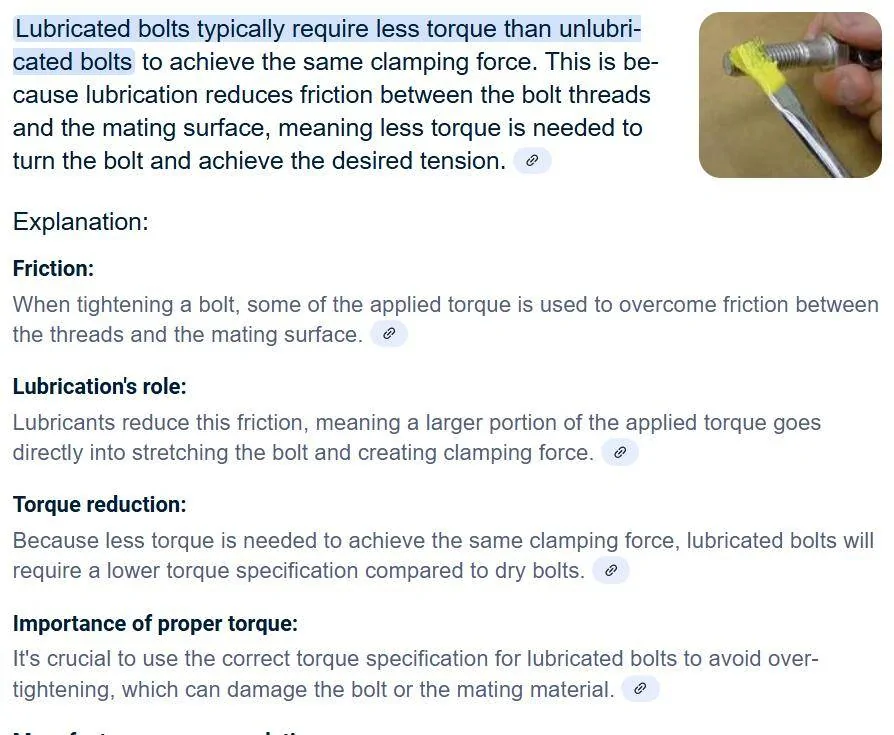
It's easier to turn a fastener that has any lubrication - either on the threads, or shoulder or whatever.
Torque is the force required to turn a fastener.
If its' easier to turn a fastener due to the lube it takes less force to tighten to the point of stretching the bolt or whatever.

With no lube, it takes more force to get it to turn the same amount as it does with lube.

So lubricated fasteners will always take LESS torque - or force - to get the same bolt stretch or clamping force.


Jeep Gladiator Lug nut torque 1750879179776-eh


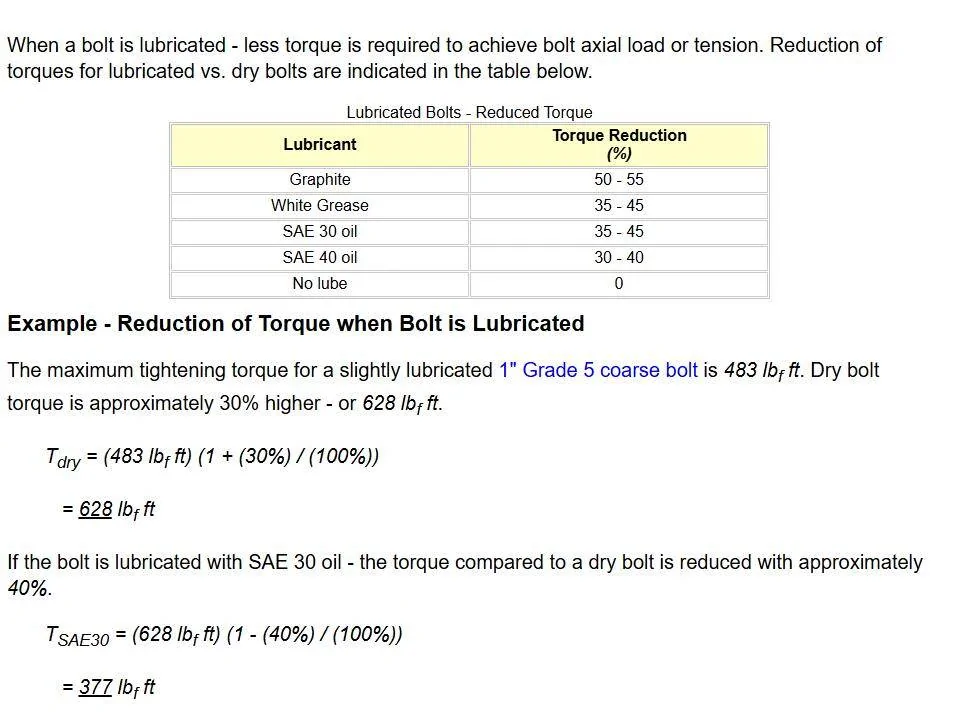
From an engineering site -

Jeep Gladiator Lug nut torque 1750879353802-0c
 

ShadowsPapa

Well-Known Member
First Name
Bill
Joined
Oct 12, 2019
Threads
247
Messages
40,445
Reaction score
53,880
Location
Runnells, Iowa
Vehicle(s)
'25 JTMX, '23 JLU 4xe, '82 SX4, '73 Javelin
Occupation
Retired auto mechanic, frmr gov't ntwrk security admin
Vehicle Showcase
3
I'm not understanding that statement. If the threads are lubricated there is less friction resistance to turning versus dry so less torque is needed to obtain the same clamping force. But it works the other direction, too: if the lubricant is oil or antisieze, the friction force keeping the nut from backing off is also reduced and it could back off more easily. Is that what you are getting at, that with lubricant or antisieze you need more clamping force (which is also more normal force on the threads) to create the same resistance to the nut backing off?
Actually, you are correct. Lower the torque applied to achieve the same clamping force if the fastener is lubricated.

Even the finish on the bolt matters. I had it backwards in my mind, but thinking - you really do lower the torque applied for either certain finishes or lubrication of any type.

I was thinking up-side-down - internet has been out since last night, AC is flooding the filter area, other stuff on the fritz all at once and I've been dealing with Safelite STILL not paying us and not saying why (then find out there was a form involved I never got - but did they ask me about it? No!) Crazy here today!


Jeep Gladiator Lug nut torque logo
Engineering ToolBox
- Resources, Tools and Basic Information for Engineering and Design of Technical Applications!

Bolt Torque Calculator: Loads & Preloads Data and Calculator
Calculate required bolt torque.

The relation between applied torque and axial force - or load - in a bolt can be calculated in this general equation as
T = K F d (1 - l / 100) (1)
where
T = wrench torque (Nm, lbf ft)
K = constant that depends on the bolt material and size
d = nominal bolt diameter (m, ft)
F = axial bolt force (N, lbf)
l = lubrication factor (%)

Typical values for K with mild-steel bolts in range 1/4" to 1":
  • normal dry: K = 0.2
  • nonplated black finish: K = 0.3
  • zinc-plated: K = 0.2
  • slightly lubricated: K = 0.18
  • cadmium-plated: K = 0.16
Sponsored


Top