Sponsored

Mojave Bump Stops

KHam

Well-Known Member
First Name
Kelly
Joined
Jul 6, 2020
Threads
3
Messages
139
Reaction score
304
Location
Oklahoma
Vehicle(s)
2020 Gladiator Rubicon
Occupation
Network Engineer
Vehicle Showcase
1
I have a question for someone. Does the Mojave hydraulic bump stops make a clunk when they connect to the axle bump stop pad?

I've added in hydraulic bump stops to my Gladiator but it's a little annoying when they engage. I have about 3" travel before contact with the hydraulic bump stop, then it provides about 3-4 inches of suppressed travel. The hydraulic stop has a hard nylon pad, and the axle side is just a metal plate. Is the Mojave similar to this or do they have a rubber contact pad on the axle side, or a short progressive pad attached to the bump stop to lessen the clunk?

It's a little annoying for street driving to hear that once in awhile on a moderate bump, but off road you don't hear or pay any attention to the noise and the absorption is fantastic.

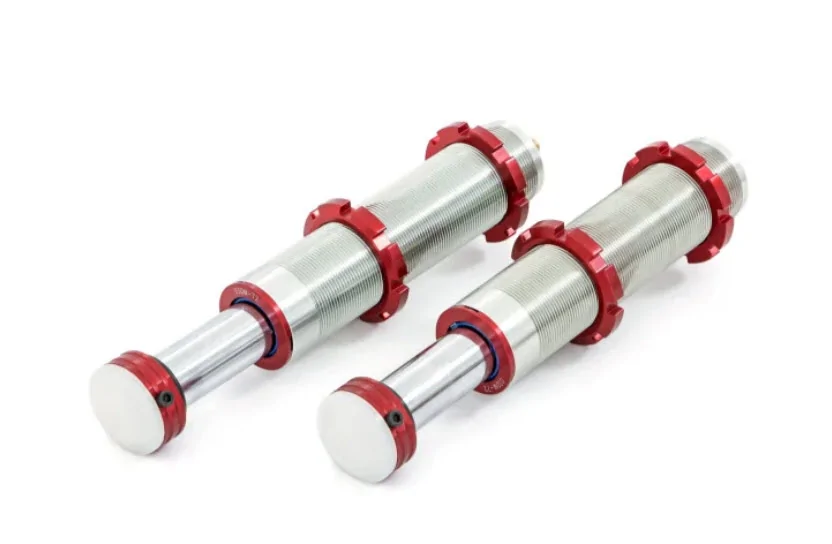
For clarification, this is what I'm asking about, and you can see the white hard nylon ends.

Jeep Gladiator Mojave Bump Stops RoughCountryBumpSto
Sponsored


KurtP

Well-Known Member
First Name
Kurt
Joined
Oct 9, 2020
Threads
68
Messages
2,310
Reaction score
3,019
Location
VA
Vehicle(s)
S/C Mojave
Occupation
Only Fans Content Creator
I have a question for someone. Does the Mojave hydraulic bump stops make a clunk when they connect to the axle bump stop pad?

I've added in hydraulic bump stops to my Gladiator but it's a little annoying when they engage. I have about 3" travel before contact with the hydraulic bump stop, then it provides about 3-4 inches of suppressed travel. The hydraulic stop has a hard nylon pad, and the axle side is just a metal plate. Is the Mojave similar to this or do they have a rubber contact pad on the axle side, or a short progressive pad attached to the bump stop to lessen the clunk?

It's a little annoying for street driving to hear that once in awhile on a moderate bump, but off road you don't hear or pay any attention to the noise and the absorption is fantastic.

For clarification, this is what I'm asking about, and you can see the white hard nylon ends.
RoughCountryBumpStop.jpg
A
oddly enough, i have a Mojave and heard exactly what you were describing on a wheeling trip recently. Coming into large bumps i would hear that kind of sound and didnt know what it was. Did a walk around and steering check before getting back on the highway and everything seemed fine. No issues on the drive and I havent heard it since on the road.

its been raining and i havent had a chance to get up under the truck to check more thoroughly, but im not worried about it. There was no wheel or chassis feedback when i heard the sound, but on thinking of it in light kf your question, i only heard it on bumps that would have engaged the bump stops.

ill be lifting it here in a couple weeks. Ill let you know if i find anything i feel is definitive
 
OP
OP
KHam

KHam

Well-Known Member
First Name
Kelly
Joined
Jul 6, 2020
Threads
3
Messages
139
Reaction score
304
Location
Oklahoma
Vehicle(s)
2020 Gladiator Rubicon
Occupation
Network Engineer
Vehicle Showcase
1
A
oddly enough, i have a Mojave and heard exactly what you were describing on a wheeling trip recently. Coming into large bumps i would hear that kind of sound and didnt know what it was. Did a walk around and steering check before getting back on the highway and everything seemed fine. No issues on the drive and I havent heard it since on the road.

its been raining and i havent had a chance to get up under the truck to check more thoroughly, but im not worried about it. There was no wheel or chassis feedback when i heard the sound, but on thinking of it in light kf your question, i only heard it on bumps that would have engaged the bump stops.

ill be lifting it here in a couple weeks. Ill let you know if i find anything i feel is definitive
I don't really think there's a way around it. I may have mine adjusted to engage too soon. I haven't changed the pressure in them and I do think they're a little too stiff so that may be part of the issue. I need to get a Nitrogen recharge kit with the gauges anyway to change or maintain pressure in the bumps and shocks. I'm probably not going to mess with that until summer rolls back around. I think mine are probably charged at 150 psi from the factory and if so, may need to be around 125 or so. Part of the tuning process I guess.
 

KurtP

Well-Known Member
First Name
Kurt
Joined
Oct 9, 2020
Threads
68
Messages
2,310
Reaction score
3,019
Location
VA
Vehicle(s)
S/C Mojave
Occupation
Only Fans Content Creator
I don't really think there's a way around it. I may have mine adjusted to engage too soon. I haven't changed the pressure in them and I do think they're a little too stiff so that may be part of the issue. I need to get a Nitrogen recharge kit with the gauges anyway to change or maintain pressure in the bumps and shocks. I'm probably not going to mess with that until summer rolls back around. I think mine are probably charged at 150 psi from the factory and if so, may need to be around 125 or so. Part of the tuning process I guess.
Might not be, but if you're feeling them on pavement my guess is, as you stated, set to engage too soon. I do like the return feel of the hydro stop, though. it definitely makes it more controlled.

Good luck, keep us posted on how it goes and what you find. Maybe give the company a call about it as well.
 

LostWoods

Well-Known Member
Joined
Mar 13, 2020
Threads
15
Messages
2,027
Reaction score
2,420
Location
Gilbert, AZ
Vehicle(s)
2024 4Runner / 1995 YJ
Air bumps are designed to be tuned as a complete system and the idea is really just stiffening up the last few inches of travel - mostly because they came about with desert racing on Fox, King, and other progressive valved shocks. These shocks do really well for quick hits and slower oscillations like whoops but not so much big hits - the air bumps are largely there to absorb these big hits.

The problem on a street truck vs a race truck is there isn't a lot of uptravel to start with so you're definitely going to be riding the air bumps from time to time. The middle section of most shocks is pretty soft unless you like a stiff ride.

The pressure in the bumps should be set based on the truck's weight and you basically want them to be able to catch nearly the entire weight of the truck to prevent bottoming. If you feel they're activating too soon you can move them upwards a bit but I would not reduce pressure unless you know what you're doing. Normally you tune height alongside your shock travel zones but you're not exactly running Baja here.
 

Sponsored

OP
OP
KHam

KHam

Well-Known Member
First Name
Kelly
Joined
Jul 6, 2020
Threads
3
Messages
139
Reaction score
304
Location
Oklahoma
Vehicle(s)
2020 Gladiator Rubicon
Occupation
Network Engineer
Vehicle Showcase
1
Air bumps are designed to be tuned as a complete system and the idea is really just stiffening up the last few inches of travel - mostly because they came about with desert racing on Fox, King, and other progressive valved shocks. These shocks do really well for quick hits and slower oscillations like whoops but not so much big hits - the air bumps are largely there to absorb these big hits.

The problem on a street truck vs a race truck is there isn't a lot of uptravel to start with so you're definitely going to be riding the air bumps from time to time. The middle section of most shocks is pretty soft unless you like a stiff ride.

The pressure in the bumps should be set based on the truck's weight and you basically want them to be able to catch nearly the entire weight of the truck to prevent bottoming. If you feel they're activating too soon you can move them upwards a bit but I would not reduce pressure unless you know what you're doing. Normally you tune height alongside your shock travel zones but you're not exactly running Baja here.
Good advice. They work extremely well for heavy hits and I've been a few places where I've maxed these out to 100% compression. I love them. I was hoping someone had an idea to lessen the clunk noise on light impacts when they engage for daily driving. Granted it doesn't happen very often and takes a fairly decent bump to engage. Only way I can see that is if there was a contact pad on the axle side of some kind of rubberized material, or a replacement pad on the bump itself that wasn't a hard nylon material. I'm not sure if that would work as a fast impact to the bumpstop would smash most material.

I guess next time I'm at the car lot I need to look under a Mojave to see if they are using anything like a pad or something like that. Or maybe they all just clunk the same way.
 

LostWoods

Well-Known Member
Joined
Mar 13, 2020
Threads
15
Messages
2,027
Reaction score
2,420
Location
Gilbert, AZ
Vehicle(s)
2024 4Runner / 1995 YJ
Good advice. They work extremely well for heavy hits and I've been a few places where I've maxed these out to 100% compression. I love them. I was hoping someone had an idea to lessen the clunk noise on light impacts when they engage for daily driving. Granted it doesn't happen very often and takes a fairly decent bump to engage. Only way I can see that is if there was a contact pad on the axle side of some kind of rubberized material, or a replacement pad on the bump itself that wasn't a hard nylon material. I'm not sure if that would work as a fast impact to the bumpstop would smash most material.

I guess next time I'm at the car lot I need to look under a Mojave to see if they are using anything like a pad or something like that. Or maybe they all just clunk the same way.
They're going to make noise regardless, you might be able to add some rubber to the plate but it will get destroyed through use unless it's bonded to a steel backer or something.

Ok so a few things... I guess first questions are which ones do you have and where do you have them set?

You might have too much bump travel. A stiff 2" is plenty for a mostly street truck with the 3" being more for light race or street trucks with ride height and long travel and 4" versions being for the race level stuff where you have massive shock travel. If too long, you are just going to have to deal with tapping them because while you can raise them as I mentioned, you can't go too far or you won't have enough time in the hard zone to stop the truck when you need it.

As for setting, our typical setup would be to empty most of the the nitrogen from the bumps, install them with shocks but no springs, and set height so the truck is resting on the bumps (full compress) with about 1/2" to 1" of shock travel remaining depending on total travel and any need to preserve up travel. Then you pressurize them based on the axle weight and take them for a romp. If you've already bottomed them out, you absolutely need more pressure.

Bumps typically have 2-3 zones in increasing harshness... you want to play right up to the final zone which is going to be harsh and fully intended to stop the truck. There should be an o-ring on the bump and that's a great tool to tune your pressures. Just raise it up all the way and go for a hard drive. I'm talking hitting dips, whoops, and drop offs about as hard as you feel comfortable. Then go look where the ring is. Generally speaking, you want it 1/2-2/3 down the shaft. Too low gets more pressure, too high gets less - just make sure you aren't going above the max.
 

MoparToYou

Well-Known Member
Joined
Aug 11, 2020
Threads
5
Messages
325
Reaction score
796
Location
Utah
Vehicle(s)
2023 Jeep Gladiator Mojave
The Mojave hydraulic bump stops also make noise when they bottom out. I would describe the sound as a "THUNK", whereas normal rubber bump stops sound like "THUD".

The Mojave shocks are super smooth over small to mid size bumps. Anything bigger than that and the suspension just blows through its travel instantly, and you hear the loud THUNK from the hydraulic bump stops. I have wondered if the sound is from the hydraulic bump hitting the axle pad, or the sound is from the hydraulic bump bottoming out. Its hard to tell which it is, because everything happens so fast. I think it is the former, and not the latter.
 
Last edited:
OP
OP
KHam

KHam

Well-Known Member
First Name
Kelly
Joined
Jul 6, 2020
Threads
3
Messages
139
Reaction score
304
Location
Oklahoma
Vehicle(s)
2020 Gladiator Rubicon
Occupation
Network Engineer
Vehicle Showcase
1
@LostWoods Thank you for that. That was very concise and informative. Using the rubber rings I was able to get them pushed all the way to the top but it took some very hard whoops with, as you said, hitting them as hard as I felt comfortable with. But never did I actually feel them bottoming out as a sudden jar. It takes a LOT to get them that high. I don't believe the process you described was followed when installed so I do think I may pull this all apart and go back through it once the weather warms up. The bumps are Rough Country BST3000 and provide 3" of travel. I kind of wish now I had gone with the Fox Racing ones for just a couple hundred more. These seem to do well though.

@MoparToYou That's the info I was looking for. Thanks! I figured they had to make noise in the Mojave as well from the nature of how they work. The noise catches me off guard sometimes when they connect. I need to put a GoPro camera or something on it to watch it. But yes, when the axle pad contacts the hard end of bumps there can be a pretty good clunk sound depending on how hard/fast they connect.
 

EXTORTION

Well-Known Member
First Name
Carl
Joined
Sep 11, 2020
Threads
15
Messages
86
Reaction score
49
Location
St Charles MO
Vehicle(s)
2020 Jeep Gladiator Overland
Occupation
Retired Law Enforcement
Was just informed that the left bump stop on my Mojave is bad, needs replacement. Thank god for warranty. The part cost $1400 plus installation without warranty.
 

Sponsored

Tuggernuts

Well-Known Member
First Name
Scott
Joined
Oct 29, 2020
Threads
11
Messages
657
Reaction score
1,153
Location
NorCal
Vehicle(s)
Ram 1500
Occupation
Truck driver
Was just informed that the left bump stop on my Mojave is bad, needs replacement. Thank god for warranty. The part cost $1400 plus installation without warranty.
How did you know it’s bad? My Mojave is making a clunk sound if I take a speed bump over 10mph. It’s coming from the driver side.
 

EXTORTION

Well-Known Member
First Name
Carl
Joined
Sep 11, 2020
Threads
15
Messages
86
Reaction score
49
Location
St Charles MO
Vehicle(s)
2020 Jeep Gladiator Overland
Occupation
Retired Law Enforcement
How did you know it’s bad? My Mojave is making a clunk sound if I take a speed bump over 10mph. It’s coming from the driver side.
I didn't know it was bad until having front leveling kit installed. Mechanic noticed it was frozen/stuck in place.
 

LostWoods

Well-Known Member
Joined
Mar 13, 2020
Threads
15
Messages
2,027
Reaction score
2,420
Location
Gilbert, AZ
Vehicle(s)
2024 4Runner / 1995 YJ
WTF Jeep... how can you possibly justify selling a single unit for twice what Fox charges for a pair of these things?
 

Wantajustride

Member
First Name
Jeff
Joined
Sep 17, 2020
Threads
0
Messages
8
Reaction score
6
Location
Peyton CO
Vehicle(s)
2020 Jeep Gladiator Mojave
Occupation
Retired Electric Lineman
I installed a 2.5" Clayton Overland + with the Falcon 3.3 fast adjust shocks and am experiencing the same "Thunk" (seems driver side only) when hitting dips/rocks/depressions with some speed. I did leave the Fox OEM hydraulic stops in place and added the Clayton bump stop extension to the axle.
I installed the suspension myself and am not a newbie to this stuff.
At any rate you can imagine my frustration as this Bottoming out feeling is super annoying.
How can I be sure the Fox damper is not functioning properly or if the shock/spring is running out of travel before the bump stop engages.
Please help me out with ideas fellas.
 

MoparToYou

Well-Known Member
Joined
Aug 11, 2020
Threads
5
Messages
325
Reaction score
796
Location
Utah
Vehicle(s)
2023 Jeep Gladiator Mojave
This is going to take a little work, but you could cycle the suspension to check clearances. Jack up your Gladiator and put the frame on jack stands. Then remove the front tires and disconnect the shocks and sway bar links, and then remove the springs. Then reconnect the shocks and sway bar link. Then using a jack under the axle compress the suspension all the way without the resistance of the spring preventing it from bottoming out. You should be able to compress the suspension enough to see when the hydraulic bump contacts the axle pad, and then compress it further to see what clearances are left when the hydraulic bump is completely compressed. That won't tell you if the spring is becoming coil bound, but you can check all of the other clearances that way.

I thought about doing this with mine, but then decided, … "nope, not worth it". I was pretty certain the "thunk" sound is just pad slap, and I live with it. I think it is just the nature of hydraulic bump stops.

When running the Transamerica Trail earlier this summer I was traveling at about 65 mph on a dirt road on the plains of Wyoming, and hit a big silt hole, where the silt was a foot deep, with a square edged exit ramp out the far side of the silt hole. My Mojave bottomed the suspension front and rear so hard you would swear you would be peeing blood for the next few days. But the Mojave itself just took it in stride, no damage, no change to front end alignment, no problems at all. I'm pretty sure I cycled the suspension with that move, LOL.
Sponsored


Top