
Sponsored

Never use a tow ball for recovery.

Snake Eyes

Well-Known Member
Joined
Feb 10, 2022
Threads
11
Messages
659
Reaction score
1,094
Location
Las Vegas
Vehicle(s)
2022 Sport S Max Tow, 2011 Toyota FJ Cruiser
I would never use a hitch ball. Period. Dont care what anyone says about angle, strength, etc. That is lazy and risky. Wont do it. Take the damn thing out if you are going to do something with the hitch.

Always use a winch blanket also no matter what. You should have a dampener on any recovery line. Use a proper recovery rope, etc. 5 minutes of proper safe set up can help prevent a permanent death. Too many people treat recovery like a no risk quick hit.
Sponsored
 

OngsterA

Well-Known Member
First Name
August
Joined
Mar 13, 2022
Threads
12
Messages
268
Reaction score
451
Location
So CA
Vehicle(s)
'22 Sarge Rubicon
Occupation
Software Security
The idea of straps and ropes - you want the bend to be gradual, otherwise with a sharp bend or curve, as going around a small pin (and by small, I mean a radius a lot smaller than the devices that go into receivers made to do the job, would have.
A rope going around a small pin is actually only holding on the outer part of the rope. The inner part against the pin is compresses. The outer part of the rope is stretched. So whatever the rope is rated at on a straight pull - take a fraction of that at the point it bends around a pin. The compressed part of the rope in the inside of the circle against the pin isn't doing anything. That leaves the load or stress to be handled by the part of the rope on the outside of the curve around the pin.
Yes, great points. Even the front receivers sold for these have different numbers for towing, tongue weight and straight pulls, etc. Be VERY VERY careful using those for a winch or recovery. They are rated for 9,000 pounds only in that case - and then that's a STRAIGHT pull.
I'd bet similar for the rear receiver - ignore the towing numbers, when using it for recovery - it's likely to be different and then those are rated for straight loads, nothing pulling on them at any angle.
Again, good points to remember.
Excellent points, for straight pulls, i.e dynamic, not solid 'yanks', can use a receiver within its limits, but as last resort if no actual recovery points (attached to frame) exists. I always use a winch rope blanket, floormats, etc as precaution. Amazes me how many people forget this part, see them on trails all the time!
 

NachoRuby

Well-Known Member
First Name
Chad
Joined
Apr 28, 2021
Threads
28
Messages
2,992
Reaction score
4,428
Location
Pennsylvania
Vehicle(s)
'21 JTR , '18 JLU, 73 VW Bug, 97 VW Jetta, all MTs
I'm an absolute and complete novice when it comes to this stuff. But doesn't an f-250 have actual rated recovery points from the factory?
 

Rusty PW

Well-Known Member
First Name
Russ
Joined
Jan 10, 2022
Threads
37
Messages
11,366
Reaction score
30,326
Location
Fayette Nam, Pennsyltucky
Website
www.youtube.com
Vehicle(s)
'22 JTRD, '11 370Z Nismo, '07 Honda VFR
Build Thread
Link
Occupation
Muff Diver
Years ago I showed up late to a stuck F150 on the trail. The guy with the Jeep with a winch had already hooked up and started to winch the F150 out. The F150 wasn't moving. Heard the bang and the winch hook with shackle went through the windshield, drivers headrest, and out the back window. Lucky the guy was standing behind the open driver's door. What failed was a cheap 3,000lb rated strap that was wrapped around the rear axle.

Seen a F250 get it's bull bar yanked off with the bumper. The bumper bolts pulled through the bumper. You should have seen the look on that guy's face.

When I worked for Elliott and at the power plant. We had to rigged equipment to lift with cranes. Some of the equipment was 100 ton. Got lots of training to do that.
 

doc-ketamine

Well-Known Member
First Name
Matt
Joined
Dec 30, 2020
Threads
20
Messages
417
Reaction score
639
Location
Pennsylvania
Vehicle(s)
2021 JT Rubicon
Build Thread
Link
You can use a receiver based recovery device with no concerns IF it is a solid piece of steel.
Or machined aluminum - there are some with a 50,000lb rating or above, and a ⅝ steel pin can have similar tolerance.
 

Sponsored

Rusty PW

Well-Known Member
First Name
Russ
Joined
Jan 10, 2022
Threads
37
Messages
11,366
Reaction score
30,326
Location
Fayette Nam, Pennsyltucky
Website
www.youtube.com
Vehicle(s)
'22 JTRD, '11 370Z Nismo, '07 Honda VFR
Build Thread
Link
Occupation
Muff Diver
Always inspect your rigging equipment before and after each use. Look for cuts, loose ends, cracks, etc. If it looks iffy. Toss it and get new. Don't take a chance.
 

Snake Eyes

Well-Known Member
Joined
Feb 10, 2022
Threads
11
Messages
659
Reaction score
1,094
Location
Las Vegas
Vehicle(s)
2022 Sport S Max Tow, 2011 Toyota FJ Cruiser

Rusty PW

Well-Known Member
First Name
Russ
Joined
Jan 10, 2022
Threads
37
Messages
11,366
Reaction score
30,326
Location
Fayette Nam, Pennsyltucky
Website
www.youtube.com
Vehicle(s)
'22 JTRD, '11 370Z Nismo, '07 Honda VFR
Build Thread
Link
Occupation
Muff Diver

Geoarch

Well-Known Member
First Name
Steve
Joined
Feb 3, 2022
Threads
26
Messages
1,528
Reaction score
1,431
Location
Albuquerque, NM
Website
swxrflab.net
Vehicle(s)
2024 JTR, Bright White AT; 2022 JTR MT (traded)
Occupation
geoarchaeologist (retired)
I think we're both mostly novice. I've done tractors - using chains, but those were straight pulls, never any "jerking" or stored energy in straps - just with a very large and heavy chain can store and release.
The idea of straps and ropes - you want the bend to be gradual, otherwise with a sharp bend or curve, as going around a small pin (and by small, I mean a radius a lot smaller than the devices that go into receivers made to do the job, would have.
A rope going around a small pin is actually only holding on the outer part of the rope. The inner part against the pin is compresses. The outer part of the rope is stretched. So whatever the rope is rated at on a straight pull - take a fraction of that at the point it bends around a pin. The compressed part of the rope in the inside of the circle against the pin isn't doing anything. That leaves the load or stress to be handled by the part of the rope on the outside of the curve around the pin.

I'm not saying it can't be done. I'm sure people here have done it - but there's better ways.
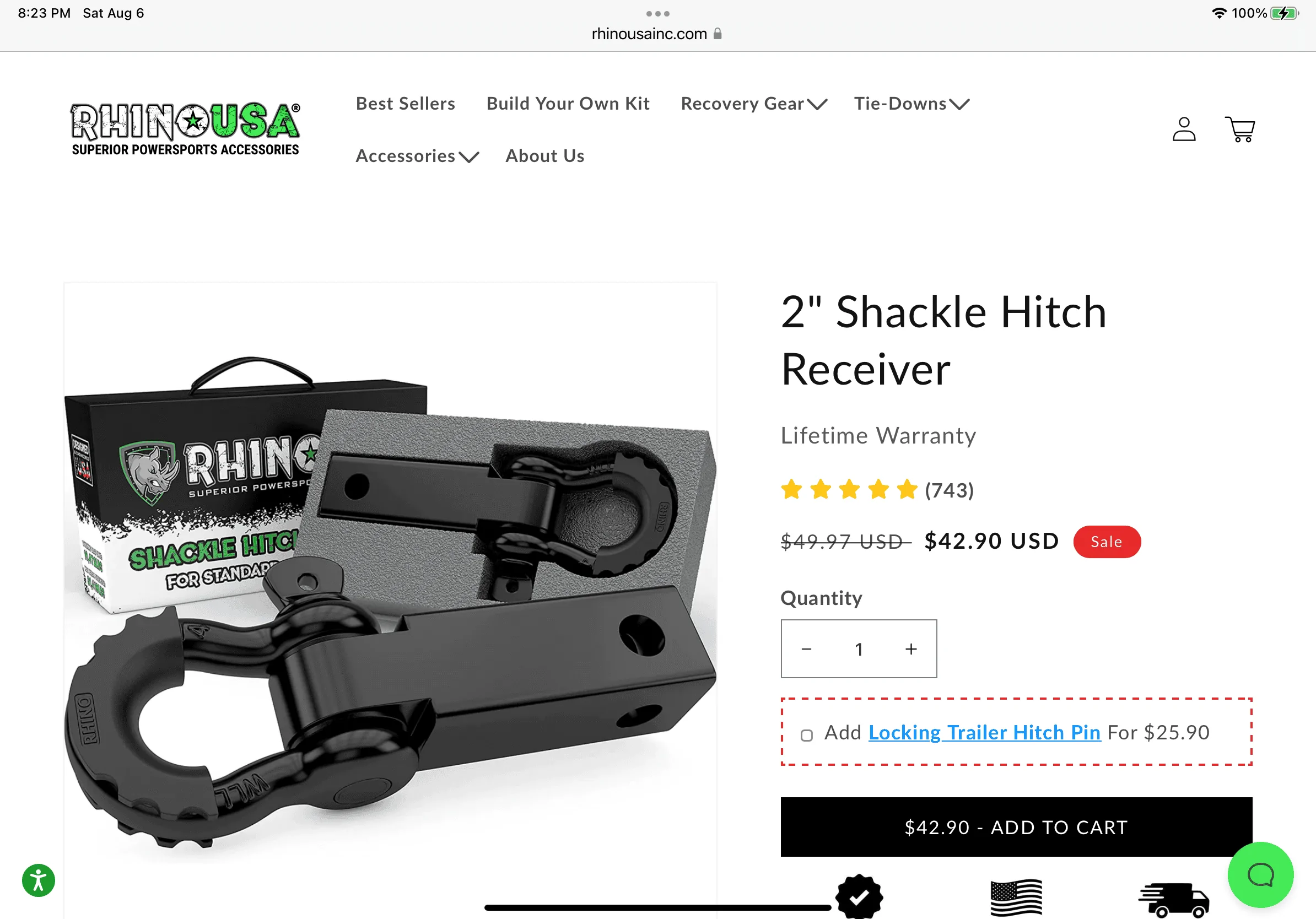
It's got me thinking of buying one of those pieces that slips into the receiver to handle such occasions.
I have one for the receiver and have used it. Got it at 4wheel parts.
 

Geoarch

Well-Known Member
First Name
Steve
Joined
Feb 3, 2022
Threads
26
Messages
1,528
Reaction score
1,431
Location
Albuquerque, NM
Website
swxrflab.net
Vehicle(s)
2024 JTR, Bright White AT; 2022 JTR MT (traded)
Occupation
geoarchaeologist (retired)
I would never use a hitch ball. Period. Dont care what anyone says about angle, strength, etc. That is lazy and risky. Wont do it. Take the damn thing out if you are going to do something with the hitch.

Always use a winch blanket also no matter what. You should have a dampener on any recovery line. Use a proper recovery rope, etc. 5 minutes of proper safe set up can help prevent a permanent death. Too many people treat recovery like a no risk quick hit.
I always use a blanket and have two.
 

Sponsored

Panthers65

Well-Known Member
First Name
Brent
Joined
Aug 23, 2021
Threads
46
Messages
574
Reaction score
593
Location
Atlanta, GA
Vehicle(s)
NA
Occupation
Account Manager
I saw this. Tragic.

But even if you accept that you shouldn't use a ball. This example was an extreme case. The hitch had like a 8 inch drop. So the ball was cantilevered way down which put huge stress on the welds where the drop attached to the drawbar.

One other thing. Lets pretend you don't have dedicated recovery points. You can always remove the drawbar, insert the recovery rope into the receiver and put the pin in.

If it fails all you are dealing with at that point is the rope itself.
That was my initial thought too, an 8" drop (lever bar) against a 7500# truck with a running start. I'd be curious what commonly used points on the market WOULD survive that? Would any of the shackle mounts/ect... survive if you put an 8" pry bar on the recovery point and generated that much torque on the mount?

I don't have the money, but that sounds like one of those cool mythbusters/offroad physics shows. How much torque was likely placed on the drop hitch at that point and would other recovery points have survived where that one failed?

I pulled a wrangler out of a mud pit back in the day with my little 2000# Suzuki Samurai based buggy, using one of the mounts on his front bumper, and after a few running starts he was out and his front bumper was tweeked enough to be touching his grill.
 

ShadowsPapa

Well-Known Member
First Name
Bill
Joined
Oct 12, 2019
Threads
247
Messages
40,442
Reaction score
53,860
Location
Runnells, Iowa
Vehicle(s)
'25 JTMX, '23 JLU 4xe, '82 SX4, '73 Javelin
Occupation
Retired auto mechanic, frmr gov't ntwrk security admin
Vehicle Showcase
3
41K pound rated

44C2DBAB-10F9-4958-AE34-9D57D346B525.png
Good job.
I find it interesting that people figure hey, the vehicle is not even 10,000 pounds, why do I need 20,000 or 30,000 pound strength?
Then they proceed to get a running start - with a solid chain or rope that's not made for that type of use. You can pick any number of things for comparison - the people who bust boards with their hands - they can't push on it and break it and yet a really QUICK hit and it snaps.
I saw a demo of breaking nylon tape. The guy challenged a class to pull and break the tape. No one could do it. He took the tape and SNAP with a quick jerk.
The straps I use to strap the cars onto my car hauler - I've been asked why such heavy rated straps for a car that weighs less than 4,000 pounds. Hit a hard bump, or have to come to a sudden stop and all of a sudden that car is a slide hammer - it's got the energy of motion, many times greater, many thousands of pounds of force against those straps.
This is no different. Kinetic energy -the energy in a mass in motion. Energy was applied to make it start moving so in a sense that energy is stored in it until it stops moving and then all of that energy is released and has to go somewhere.

I know some have asked about the pin - in the case of the tool pictured above - you are relying on the sheer strength of the pin. It can't really bend and get weaker because of the fit of these things, so you'd have to sheer that pin in two places at the same time. Not likely.
But pulling on the pin by itself with just a rope - the force is concentrated in the middle of the pin so I suppose it could bend?? again if the receiver is thick where the pin goes through it would prevent an easy bend.
 

MrKnowitall

Well-Known Member
First Name
Guenther
Joined
Oct 4, 2018
Threads
0
Messages
471
Reaction score
348
Location
Detroit
Vehicle(s)
14 JKU-R
That's horrible. I bought a Factor55 insert for the tow hitch, I have to imagine there are similar risks with that. Makes me think twice about using it with a kinetic rope.
That insert is a totally different animal. The geometry is correct to handle the loads.
 

bwildoutside

Active Member
First Name
Brad
Joined
Mar 11, 2021
Threads
3
Messages
30
Reaction score
33
Location
Washington
Vehicle(s)
2021 eco diesel JT
41K pound rated

44C2DBAB-10F9-4958-AE34-9D57D346B525.png
I’d ditch that shackle and get a soft shackle if I were you. Hopefully they smoothed the edges out like the factor55 does. I won’t use hard shackles anymore unless I’m doing a double haul on my winch back to my front bumper shackles.
 

cafecito

Well-Known Member
First Name
Lucas
Joined
Mar 22, 2021
Threads
53
Messages
679
Reaction score
1,305
Location
Orlando, FL
Vehicle(s)
2021 Gladiator Mojave, Granite Crystal
Occupation
Corporate Tool
FWIW, I have also heard of people that recommend opening your hood when you're doing the recovering in case something becomes a projectile. I don't imagine it would have thoroughly prevented this, but another layer of metal might have slowed it down enough to not be fatal.
Sponsored


Top